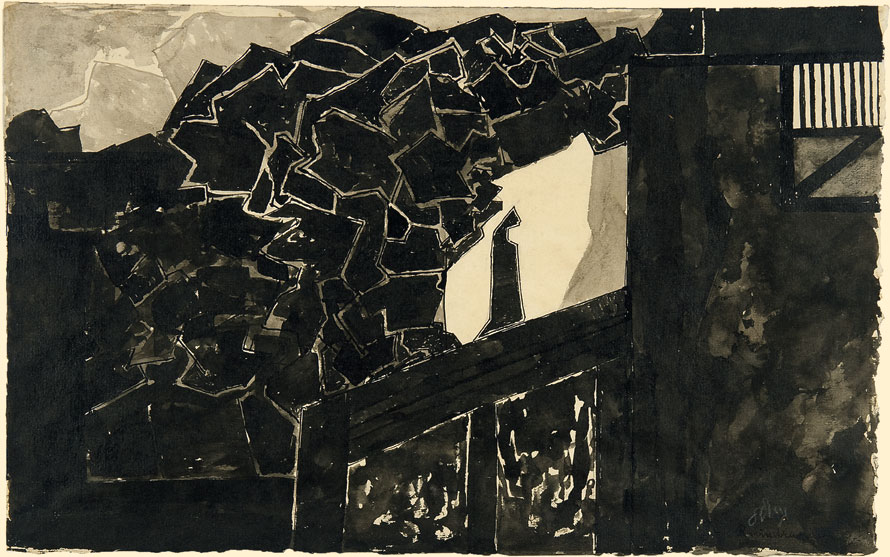
Rabindranath Tagore, “Untitled (Architectural setting with a silhouetted figure),” ink on paper, 1929
Asia Society
725 Park Ave. at 70th St.
Tuesday – Sunday, $10, 11:00 am – 6:00 pm
212-288-6400
www.asiasociety.org
Although Rabindranath Tagore might be most well known for being the first non-European to win the Nobel Prize in Literature, having given Mohandas Gandhi the name Mahatma, composing the national anthems of both Bangladesh and India (among more than two thousand other songs), and being a subject in Philip Glass’s epic opera Satyagraha, he also became a painter in his later years, beginning at the age of sixty. Several dozen of his paintings and drawings are on view at Asia Society through December 31 in the fascinating exhibition “Rabindranath Tagore: The Last Harvest.” Tagore once said, “Love is kindred to art, it is inexplicable. Duty can be measured by the degree of its benefit, utility by the profit and power it may bring, but art by nothing but itself. There are other factors of life which are visitors that come and go. Art is the guest that comes and remains. The others may be important, but art is inevitable.” Tagore’s works are filled with love, focusing on the human body, nature, animals, portraiture, and the environment, together forming a kind of captivating visual poetry. The exhibit, which runs through December 31, is supplemented with biographical information, music, and a documentary on Tagore made by India’s greatest filmmaker, Satyajit Ray. Also on view through the end of the year is “U-Ram Choe: In Focus,” a large kinetic sculpture of a fantastical creature the Korean artist calls “Custos Cavum.” Composed of steel, stainless steel, brass, aluminum, resin, CPUs, and motors, it at times seems to come alive, its myriad antenna-like extremities rising and twisting, its body appearing to breathe in and out. The excellent triumvirate of exhibitions at Asia Society is completed by the lightweight “Sarah Sze: Infinite Line,” but we don’t mean that in a negative way. The Boston-born, New York City-based artist, whose “Corner Plot” was installed at the Scholars’ Gate entrance to Central Park in 2006, uses paper, string, tape, twigs, mirrors, and found objects galore in creating fragile alternate universes built on memory. “I am interested in an object or image that plays with the state of its own existence,” she says. “In both drawing and sculpture I’m interested in the depiction of gravity and weightlessness as both an operative and a disorienting force.” Be careful where you walk when making your way around Sze’s engaging world, which continues at Asia Society through March 25.


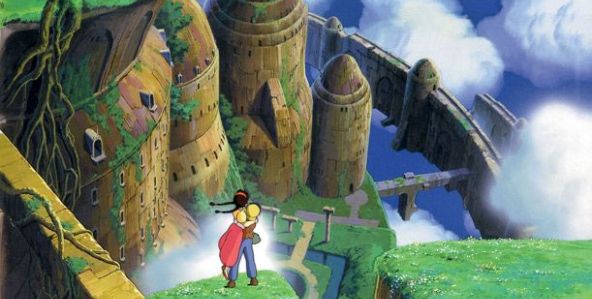
 The hunt is on for the mysterious land known as Laputa, an Atlantis-like civilization in the sky, in Hayao Miyazaki’s award-winning Laputa: Castle in the Sky. Pazu is looking for it to prove that his father wasn’t crazy; Mooska needs its power to rule the world; Dola and her sons want its jewels; and little Sheeta is searching for her past. Miyazaki’s gorgeous landscapes are at once Monet-like, then Constable-esque. The story, inspired by the town of Laputa in Gulliver’s Travels, will delight the child in everyone who lets themselves get spirited away by the magic. The first film released by Japan’s Studio Ghibli, Laputa is screening in a new 35mm print December 28 to January 12 as part of the series “Castles in the Sky: Miyazaki, Takahata & the Masters of Studio Ghibli,” a dual presentation of the IFC Center and GKIDS’ New York International Children’s Film Festival. As an added treat, the film is being shown in its original Japanese with English subtitles instead of dubbed, so you won’t get distracted by the voices of James Van Der Beek, Mark Hamill, Cloris Leachman, Mandy Patinkin, and Anna Paquin. The series also includes such other Miyazaki works as Howl’s Moving Castle, Kiki’s Delivery Service, Ponyo, My Neighbor Totoro, Nausicaa of the Valley of the Wind, Porco Rosso, Princess Mononoke, and his masterpiece, Spirited Away, in addition to such lesser-known Studio Ghibli films as Hiroyuki Morita’s The Cat Returns, Tomomi Mochizuki’s Ocean Waves, Isao Takahata’s Only Yesterday, and Yoshifumi Kondo’s Whisper of the Heart, all being screened in new 35mm prints.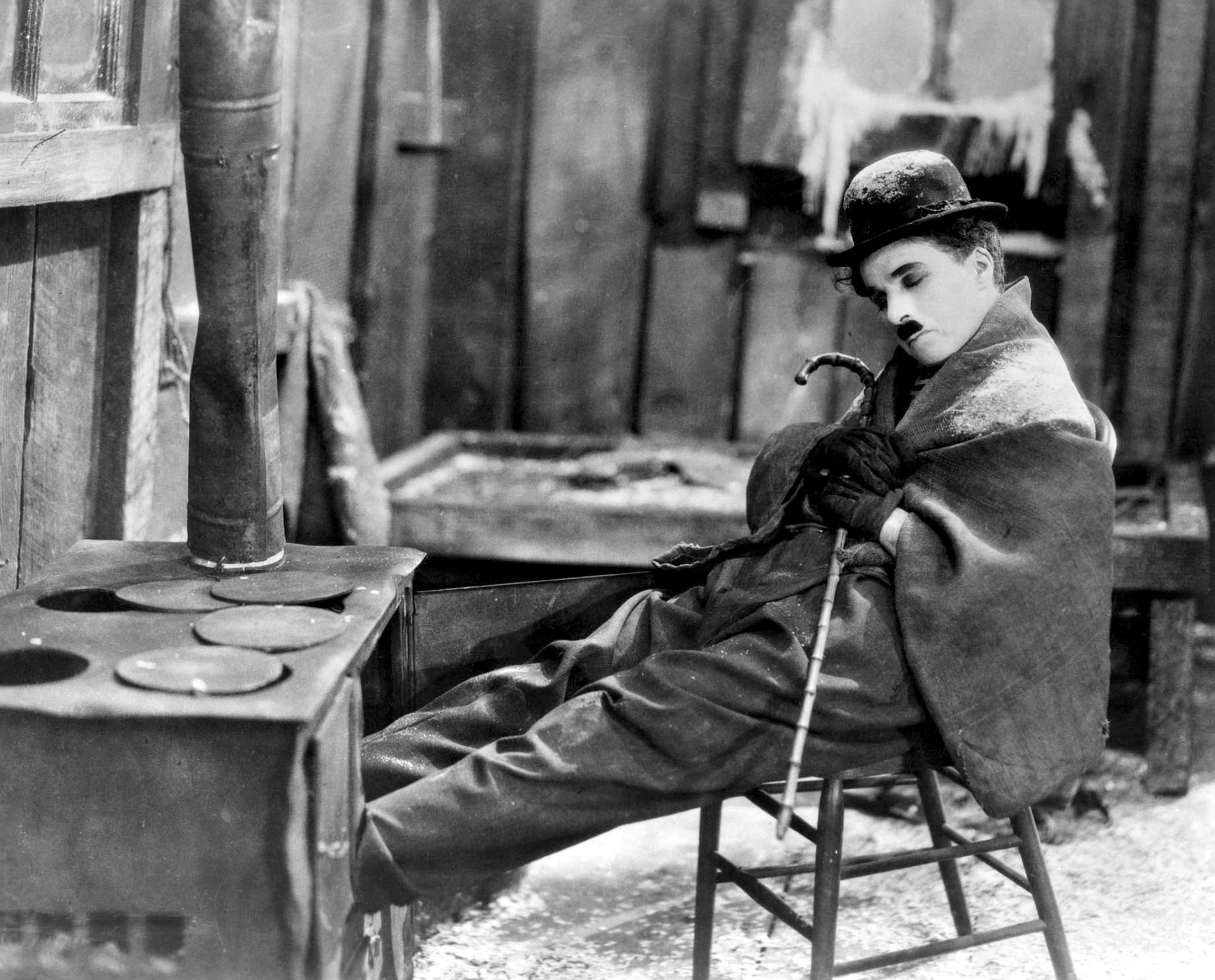
 Charlie Chaplin died thirty-four years ago on Christmas Day, at the ripe old age of eighty-eight, so Film Forum is paying tribute to the anniversary by screening a restored 35mm print of the complete version, with a newly recorded orchestral score, of what Chaplin called “the picture I want to be remembered by.” Made four years prior to the Great Depression, the slapstick comedy is still remarkably socially relevant, tackling unemployment, crime, hunger, and poverty. Chaplin, who wrote, produced, and directed the silent masterpiece, stars as the Lone Prospector, a little tramp who has set out to strike it rich during the Alaskan Gold Rush of 1848 but isn’t really having much luck. He takes shelter during a snowstorm in a small shack, does battle with a pair of much bigger men, turns into a chicken, and, yes, eats his shoe, doing whatever it takes to survive. The prescient film was originally to star Lita Grey as the love interest, but Chaplin impregnated (and later married) the sixteen-year-old, so she was replaced by Georgia Hale. Film Forum is screening The Gold Rush, which also features Mack Swain as Big Jim McKay, Malcolm Waite as ladies’ man Jack Cameron, and Tom Murray as Black Larsen, through December 29, including five times on Christmas Day. (And by the way, if you’ve only seen Charles Chaplin’s reedited 1942 version with his own treacly narration and score, well, you’ve never really experienced this American treasure.)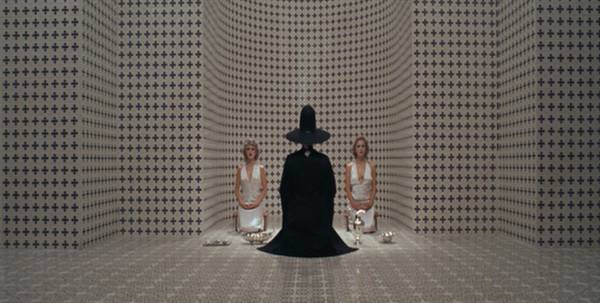
 While churches around the city are filling up for midnight mass on Christmas Eve, you can have a completely different kind of religious experience at the IFC Center, one of New York’s cinematic temples. Inspired by Rene Daumal’s Mount Analogue: A Novel of Symbolically Authentic Non-Euclidean Adventures in Mountain Climbing, Alejandro Jodorowsky’s The Holy Mountain also involves symbolically non-Euclidean adventures in mountain climbing, funneled through Carlos Castaneda, Stanley Kubrick’s 2001: A Space Odyssey, and magic mushrooms and LSD galore. What passes for narrative follows a Jesus look-alike thief (Horacio Salinas) and an alchemist with a thing for female nudity (Jodorowsky) on the path to enlightenment; along the way they encounter the mysterious Tarot, stigmata, stoning, eyeballs, frogs, flies, cold-blooded murder, naked young boys, chakra points, life-size plaster casts, Nazi dancers, sex, violence, blood, gambling, turning human waste into gold, death and rebirth, and the search for the secret of immortality via representatives of the planets, each with their own extremely bizarre story to tell. Jodorowsky, who is credited with having invented the midnight movie with the acid Western El Topo (1970), literally shatters religious iconography in a kaleidoscopic whirlwind of jaw-droppingly gorgeous and often inexplicable imagery composed from a surreal color palette, set to a score by free jazz trumpeter Don Cherry and Archies keyboardist Ron Frangipane. (Frangipane also worked with John Lennon and Yoko Ono, who produced this film with their business manager, Allen Klein.) The Holy Mountain — which brings a whole new insight to Matthew Barney’s Cremaster Cycle — is filled with psychedelic mysticism centered around the human search for transcendence in a wilderness of the sacred and profane. Jodorowsky’s work can move you deeply, but don’t expect it to make much sense. Sit back and let in pour in and over you — you’ll feel it. You may hate it, but you’ll feel it. Although you’ll definitely hate the very end. The film is also screening on Christmas night and New Year’s weekend at the IFC Center, offering one helluva way to welcome in 2012.