twi-ny recommended events

TIMES SQUARE INTERNATIONAL THEATER FESTIVAL

SUPERMAN 2050 soars into New York as part of the first Times Square International Theater Festival

Roy Arias Studios & Theaters
300 West 43rd St., fifth floor
January 16-22, $18-$20 (staged readings $10, festival pass $99)
www.tsitf.com

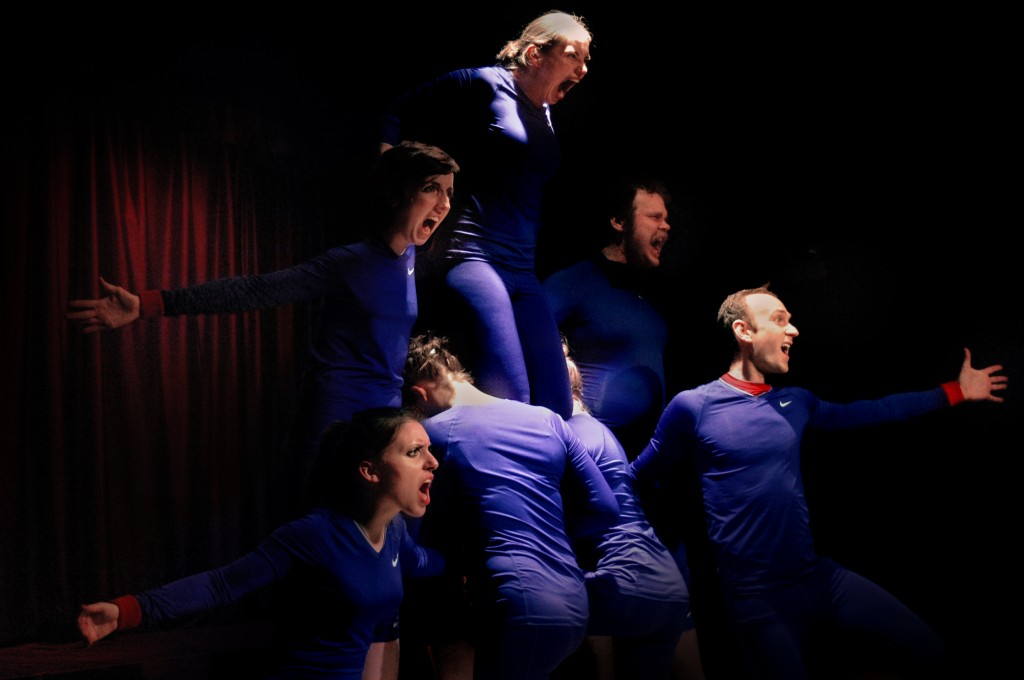
While Under the Radar American Realness, and Coil continue downtown, to be followed shortly by Culturemart and Frigid New York, a new festival has popped up in the Theater District. Produced by Roy Arias and Stalin Urbano and curated by Alfred Preisser and Irma Bello, the inaugural Times Square International Theatre Festival will take place January 16-22 at the Times Square Arts Center, featuring nineteen productions from such countries as the Dominican Republic, Germany, Argentina, Spain, and Cuba in addition to the United States and Puerto Rico. Dedicated to bringing affordable, diverse theater to the Broadway area, the festival will include such works as Jose Triana’s The Night of the Assassins, about hatred, family ties, and murder; Nicolas Dorr’s Breve Temporada de Invierno, centered around an aging actress making amends; Libby Skala’s A Time to Dance, a solo show in which Skala portrays her great-aunt, Austrian dancer Elizabeth “Lisl” Polk; Theater Un-Speak-Able’s Superman 2050, which is set in the Metropolis of the future; and Freia Canals and Denise Kornitz’s family-friendly, bilingual Alita the Show, a fairy tale with handmade puppets. There will also be staged readings of Anton Pagan’s A Times Square Piñero and Joe Gulla’s Garbo and a three-day workshop led by Paola Coletto.

PATRICK KEILLER’S ROBINSON TRILOGY: ROBINSON IN RUINS

Patrick Keiller leads viewers down a poetic path of words and imagery in ROBINSON IN RUINS

ROBINSON IN RUINS (Patrick Keiller, 2010)
Anthology Film Archives
32 Second Ave. at Second St.
January 13-18, $9
212-505-5181
www.anthologyfilmarchives.org

British filmmaker Patrick Keiller’s follow-up to 1994’s London and 1997’s Robinson in Space is another staggering achievement, a gorgeous pairing of word and image resulting in something fresh, challenging, and unlike anything you’ve ever seen before. The conceit behind Robinson in Ruins is that it consists of found footage taken by a man named Robinson, with text from his rather eclectic notebook; in fact, every shot is carefully planned by writer, director, and editor Keiller, with the narrative added later, intoned by Vanessa Redgrave. The camera barely moves throughout the film’s one hundred and one minutes; instead, it remains still as it depicts a construction site, rapeseed fields, nuclear power plants, a mail slot, and a street corner, the only signs of movement the wind blowing through the trees, a passing car, or industrial smoke. People are virtually nonexistent as Redgrave reads Robinson’s complex treatise on agriculture, architecture, the economic crisis, history, politics, and opium, all centered around, as Keiller said at the press preview at the 2010 New York Film Festival, “the problem of dwelling.” Robinson in Ruins is like a tour through a thrilling art exhibition, each piece beautifully composed, coupled with fiercely intellectual poetry that is wonderful to listen to, even if much of it is impossible to understand. The film is screening January 13-18 at Anthology Film Archives as part of “Patrick Keiller’s Robinson Trilogy,” which also includes multiple showings of London and Robinson in Space as well as Keiller’s 2000 work The Dilapidated Dwelling and the 1986 short The End.

SONG OF THE DAY — CRAIG FINN: “NEW FRIEND JESUS”

Craig Finn’s debut solo album is due January 24, followed by a tour that will have him holding steady at Mercury Lounge and Maxwell’s (photo by Mark Seliger)

“People say we suck at sports / but they don’t understand / It’s hard to catch with holes right through your hands,” Craig Finn sings on “New Friend Jesus,” one of the tracks from the Hold Steady leader’s debut solo album, Clear Heart Full Eyes, due from Vagrant Records on January 24. “New Friend Jesus,” which you can check out here, is one of eleven songs on the disc, which also includes such tunes as “Honolulu Blues,” “No Future,” “Terrified Eyes,” and “Balcony.” (The first five hundred preorders come with a bonus bandanna.) Finn will be in New York City for two sold-out shows at Mercury Lounge on February 29, but there are still a few tickets left for his March 1 show at Maxwell’s in Hoboken. And you can catch Finn performing the new album’s “Jackson” in his apartment for the A.V. Club here.

TICKET GIVEAWAY: 20AT20

SILENCE! THE MUSICAL is one of three dozen shows participating in the 20at20 off-Broadway promotion

Multiple venues
January 18 – February 6, $20
www.20at20.com

It’s time for off-Broadway’s annual 20at20 promotion, in which audiences can score $20 tickets to some three dozen productions twenty minutes before curtain by going up the box office and saying, “20at20.” Among this year’s participants are Black Angels Over Tuskegee at the Actors Temple, Dancing at Lughnassa at the Irish Rep, Fuerza Bruta at the Daryl Roth, Million Dollar Quartet and Rent at New World Stages, Russian Transport at the Acorn, Silence! The Musical at P.S. 122, Psycho Therapy at the Cherry Lane, Ionescopade at the York, Love, Loss and What I Wore at the Westside, The Devil’s Music: The Life and Blues of Bessie Smith at St. Luke’s, and Traces at Union Square.

TICKET GIVEAWAY: In case that deal isn’t good enough, we’ve got an even better one for you. We have vouchers for three of the shows participating in 20at20 that will score you a pair of free tickets in advance. To be eligible to win, just send your name, daytime phone number, and which show you’d like to see to contest@twi-ny.com by Friday, January 13, at 5:00 pm. All entrants must be twenty-one years of age or older; winners will be selected at random.

UNDER THE RADAR: HOT PEPPER, AIR CONDITIONER, AND THE FAREWELL SPEECH

HOT PEPPER . . . examines an office temp’s imminent departure in absurdist ways (photo by Toru Okada)

Japan Society
333 East 47th St. at First Ave.
Through January 14, $22
212-715-1258
www.japansociety.org
www.undertheradarfestival.com

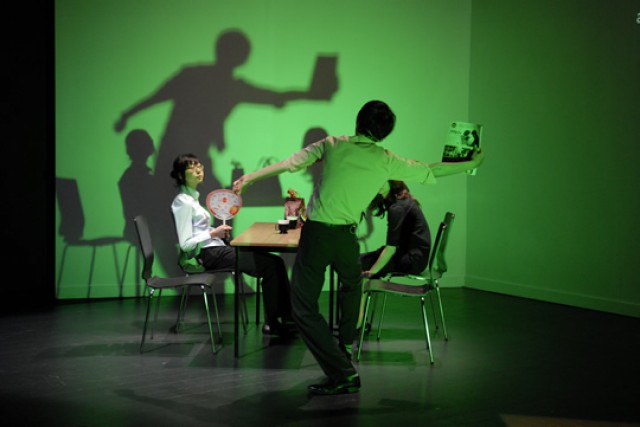
Built around an office temp’s imminent departure, Toshiki Okada’s Hot Pepper, Air Conditioner, and the Farewell Speech is a highly stylized, very funny three-part absurdist comedy that riffs on Japan’s Generation Y culture and office politics. The sixty-five-minute piece is set in Japan Society’s reconfigured gallery space, with a white table and chairs placed in a corner in front of a white backdrop. In the first section, “Hot Pepper,” three temps are on break, discussing where they should hold a farewell party for fellow temp Erika, whose contract at the company has been terminated early despite her fine knowledge of Excel. One at a time, the temps deliver brief monologues, the man insistent on picking a restaurant from the latest issue of Hot Pepper magazine, one of the women obsessed with motsu hot pot, and the other woman confused as to why three temps and not full-timers have been put in charge of the party. As they make their points, they walk around the small set in awkward, carefully choreographed gestural movements, with different-colored lights casting shadows on the walls behind them, their words forming a rhythmic pattern. In the second part, “Air Conditioner,” a pair of full-time workers get into a conversation about the office temperature (a metaphor for the office temps), the woman concerned with how cold it always is. “I mean, 23°C is like, it’s the middle of summer, OK, 23°C is ridiculous, don’t you think?” she says. “I’m seriously totally freezing and like, every day is like this hellish ordeal, the state I’m living in, like, my desk is, where I sit is pretty much right in front of the air conditioner, the air blows right into my face, like on my forehead, like, I’m in the situation all day long where I can’t get any work done at all, I’m miserable, like what am I doing here at work, it’s a really miserable feeling, you know what I’m talking about?” As in the first scene, the employees repeat their assertions over and over, rambling on and on about the same thing, echoing what often happens in a work environment. But whereas they all have very specific points to make, Erika really rambles on in the play’s conclusion, “The Farewell Speech,” in which she gives a wonderfully disjointed good-bye speech to the other workers, words spilling out of her in a stream-of-consciousness eruption of nearly manic proportions. Performed by Okada’s chelfitsch Theater Company (a play on the word “selfish”), which was last at Japan Society in September 2009 with Five Days in March, the show features Taichi Yamagata, Riki Takeda, Mari Ando, Saho Ito, Kei Namba, and Fumie Yokoo as the office workers, an engaging group of very different personalities. Performed in Japanese with English subtitles, the charming Hot Pepper, Air Conditioner, and the Farewell Speech continues at Japan Society through January 14 as part of the Under the Radar festival.

UNDER THE RADAR: THE BEE

Hideki Noda’s THE BEE centers on an intense stand-off between a salaryman and an escaped killer (photo by Masahiko Yakou)

Japan Society
333 East 47th St. at First Ave.
Through January 15, $25
212-715-1258
www.japansociety.org
www.undertheradarfestival.com

On his way home from work, a Tokyo salaryman named Ido is shocked to find that his street has been roped off by the police. Swarmed by the media, Ido soon discovers that his wife and son have been taken hostage by an escaped murderer named Ogoro. Frustrated by the lack of help from the police and the insensitivity of the press, Ido suddenly decides to take matters into his own hands, leading to an intense stand-off in Hideki Noda’s brilliant experimental stage drama The Bee. Based on Yasutaka Tsutsui’s short story “Mushiriai” (“Plucking at Each Other”) and set in the summer of 1974, The Bee is a brutal examination of just how far one man will go to save his family. Kathryn Hunter is outstanding as Ido, her small body stuffed into a business suit, her nasally voice an excellent counter to Clive Mendus’s British Detective Inspector Dodoyama, Glyn Pritchard’s stuttering Ogoro, and Noda’s Japanese stripper, Ogoro’s wife. The latter three actors take on multiple roles, often going back and forth in an instant, with Mendus also playing a reporter and a TV chef, Noda playing a reporter as well, and Pritchard also portraying a reporter and Ogoro’s six-year-old son. The early fast pace eventually slows down as Ido heads over the edge, a simple family man who just wanted to come home and celebrate his son’s birthday but instead is mired in a violent psychological battle with a confused criminal amid a media-driven society. A hostage drama reminiscent of Akira Kurosawa’s High and Low and Archie Mayo’s The Petrified Forest, The Bee features unusually choreographed movement, particularly by Hunter; a translucent mirrored backdrop; and, as the audience take their seats, a Japanese version of the Eagles’ “Hotel California.” Vastly entertaining and, ultimately, extremely disturbing, The Bee is running at Japan Society through January 15 as part of the Under the Radar festival.

AN AUTEURIST HISTORY OF FILM: ALL ABOUT EVE

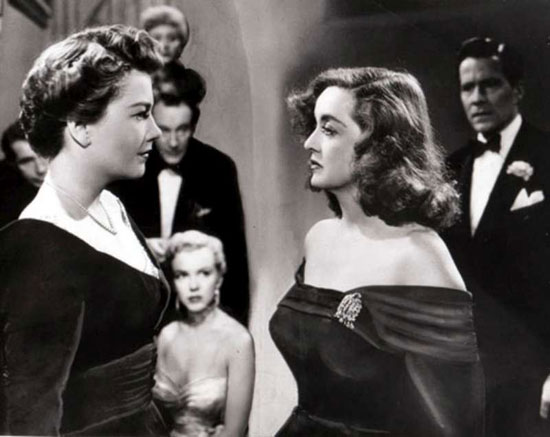
Anne Baxter and Bette Davis put on quite a show in ALL ABOUT EVE (yes, that’s Marilyn Monroe in the center)

ALL ABOUT EVE (Joseph L. Mankiewicz, 1950)
MoMA Film
Museum of Modern Art
11 West 53rd St. between Fifth & Sixth Aves.
January 11-13, 1:00
Tickets: $12, in person only, may be applied to museum admission within thirty days, same-day screenings free with museum admission, available at Film and Media Desk beginning at 9:30 am
212-708-9400
www.moma.org

Nominated for fourteen Academy Awards and winner of six, including Best Picture, Best Director, and Best Screenplay, All About Eve is one of Hollywood’s all-time greatest movies, a searing depiction of naked ambition set on the Great White Way. Based on Mary Orr’s 1946 short story “The Wisdom of Eve,” writer-director Joseph L. Mankiewicz’s flawless drama stars Anne Baxter as Eve Harrington, who is not exactly the mousey wallflower she at first appears to be. She quickly worms her way into an inner circle of Broadway vets populated by superstar Margo Channing (Bette Davis), her younger lover, Bill Sampson (Gary Merrill), playwright and director Lloyd Richards (Hugh Marlowe), and Richards’s wife, Karen (Celeste Holm), who takes Eve under her wing. Joining in on all the fun is powerful theater critic Addison DeWitt (Oscar winner George Sanders), who marvels at all the manipulation and backstage drama, much of which he wickedly orchestrates himself. “There never was, and there never will be, another like you,” DeWitt tells Eve in one of the film’s most poignant moments. All About Eve is filled with classic quotes, including the iconic “Fasten your seatbelts, it’s going to be a bumpy night,” boldly proclaimed by Davis. In a movie about acting and the theater, Mankiewicz never shows anyone onstage; instead, he focuses on the characters and the intrigue with a sly flair that is deliciously entertaining. All About Eve is screening January 11-13 at 1:00 as part of MoMA’s ongoing “An Auteurist History of Film” series, which continues January 18-20 with “Rossellini and God,” featuring Roberto Rossellini’s Francesco, Giullare di Dio (The Little Flowers of St. Francis) and Il Miracolo (The Miracle) and January 25-27 with Luis Buñuel’s Los olvidados (The Young and the Damned).