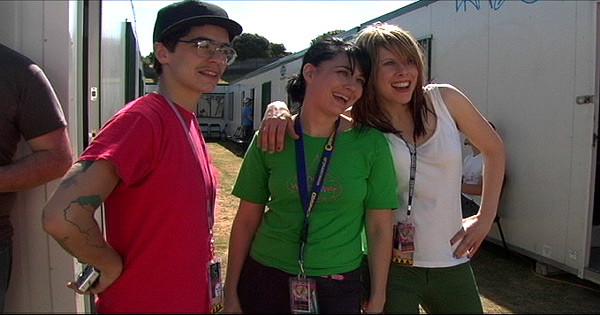
Le Tigre concert documentary will screen January 25 at the Nitehawk Cinema, with members of the band on hand to discuss the film and more
WHO TOOK THE BOMP? LE TIGRE ON TOUR (Kerthy Fix, 2010)
Nitehawk Cinema
136 Metropolitan Ave.
Wednesday, January 25, 9:00
718-384-3980
www.nitehawkcinema.com
www.letigreworld.com
 In 1961, Barry Mann and Gerry Goffin wrote, “I’d like to thank the guy / who wrote the song / that made my baby / fall in love with me.” The title of that be-bop song, “Who Put the Bomp,” inspired one of music’s first fanzines and later the punk record label Bomp! Records. In their 1999 song “Deceptacon,” the riot grrrl group Le Tigre flipped that question around, asking, “Who took the bomp from the bompalompalomp? / Who took the ram from the ramalamadingdong?” In the song they also dare, “Let me hear you depoliticise my rhyme.” Formed in 1998 by former Bikini Kill leader Kathleen Hanna, zine writer Johanna Fateman, and visual artist Sadie Benning, who was replaced in 2000 by DJ and projectionist JD Samson, Le Tigre challenged the male-dominated world of rock and punk, championing individuality and sexual freedom while redefining gender roles. In 2004, Hanna, Fateman, and Samson set out on a world tour in support of their third and final album, This Island, and asked their lighting designer, Carmine Covelli, to capture it all on film. The result is the engaging Who Took the Bomp? Le Tigre on Tour, in which Covelli and director Kerthy Fix go onstage, backstage, and behind the scenes as the influential trio heads across four continents and ten countries, playing exciting live shows, meeting the media, taking pictures with Slipknot, revealing what they pack in their luggage, exercising in the gym, and talking about facial hair. They also discuss more serious issues such as gender identity, lesbianism, and their DIY mentality, which flew in the face of the music industry. The seventy-two-minute film, which features live multimedia performances of such songs as “Hot Topic,” “Keep on Livin’,” “Viz,” and “Deceptacon,” is screening on January 25 at 9:00 at the Nitehawk Cinema in Brooklyn and will be followed by a Q&A with members of the band.



 “Kino-eye has managed to find its way in the struggle with bourgeois cinema,” Russian filmmaker Dziga Vertov wrote in 1925, “and we seriously doubt that the latter (despite its present international dominance) can long withstand our revolutionary onslaught. There is another, greater danger — the distortion of our ideas.” One of the early masters of the new art form, Vertov, along with such contemporaries as Sergei Eisenstein, Lev Kuleshov, and Vsevolod Pudovkin, explored the potential power of the cinema in both fiction and nonfiction storytelling and as a propaganda tool. Vertov, whose most famous film is 1929’s Man with a Movie Camera, a revolutionary work about cinema itself, searched for truth in his films, what he referred to as “kino-pravda,” employing a unique cinema-verité style to capture real life. Not that he also didn’t have a very specific agenda. In the seminal Kino-Eye, what Vertov called a “tapestry of life,” Vertov and one of his brothers, cameraman Mikhail Kaufman, depict Soviet life of the 1920s, exploiting the technology of the medium while following a group of Young Pioneers marching through towns putting up political banners and waving flags. Along the way they stop by a village party filled with drunken revelers, wander through a street market, camp out in the fields, watch a Chinese magician perform, and come upon such health issues as tuberculosis and mental illness. Several scenes are projected in reverse, including the butchering of meat, the baking of bread, and even the sport of diving, as Vertov and Kaufman play with the story while also revealing the methods of production. By focusing on the children, Vertov is forming a blueprint for the future of the nation, just as in the film itself he is laying the groundwork for the future of cinema. Kino-Eye is screening on January 21 at 5:15 as part of Anthology Film Archives’ continuing “Essential Cinema” series, which followed by Vertov’s Forward, Soviet! at 7:00 and A Sixth of the World at 8:45.


 In 1954, the St. Louis Housing Authority completed a massive urban renewal project, Pruitt-Igoe, a thirty-three-building complex for low-income families that was like a city unto itself. Eighteen years later, mired in crime, violence, poverty, and horrifically unsanitary and unsafe conditions, Pruitt-Igoe was torn down, the implosion famously being shown on news channels around the country as an example of the failure of public policy planning. The short, contentious history of Pruitt-Igoe is explored in the revealing documentary The Pruitt-Igoe Myth. Director Chad Freidrichs (Jandek on Corwood, First Impersonator) revisits Pruitt-Igoe through archival footage, new interviews, and a drive past the site where the iconic housing development, designed by architect Minoru Yamasaki, once stood, revealing the fascinating story of what was first a symbol of the post-WWII boom and then a prime example of the nation’s financial and racial problems of the 1970s. “It was like an oasis in the desert,” Ruby Russell remembers. “I never thought I would live in that kind of a surrounding.” But Brian King, who spent his childhood there, sees it a little differently. “It was hell on earth,” he says. Freidrichs speaks with urban historians Robert Fishman and Joseph Heathcott, sociologist Joyce Ladner, and former residents as they chronologically follow the rise and fall of “the poor man’s penthouse.” Narrated by actor Jason Henry, The Pruitt-Igoe Myth tells a shameful chapter in American history, one that should still be used today as a blueprint on what not to do. “It seemed to me that we were being penalized for being poor,” says former resident Jacqueline Williams. “That caused so much anger.” Named Best Documentary at several festivals and winner of the American Historical Association’s John E. O’Connor Film Award, The Pruitt-Igoe Myth opens January 20 at the IFC Center, with Freidrichs on hand to talk about the film at the 8:20 showings on Friday and Saturday night.
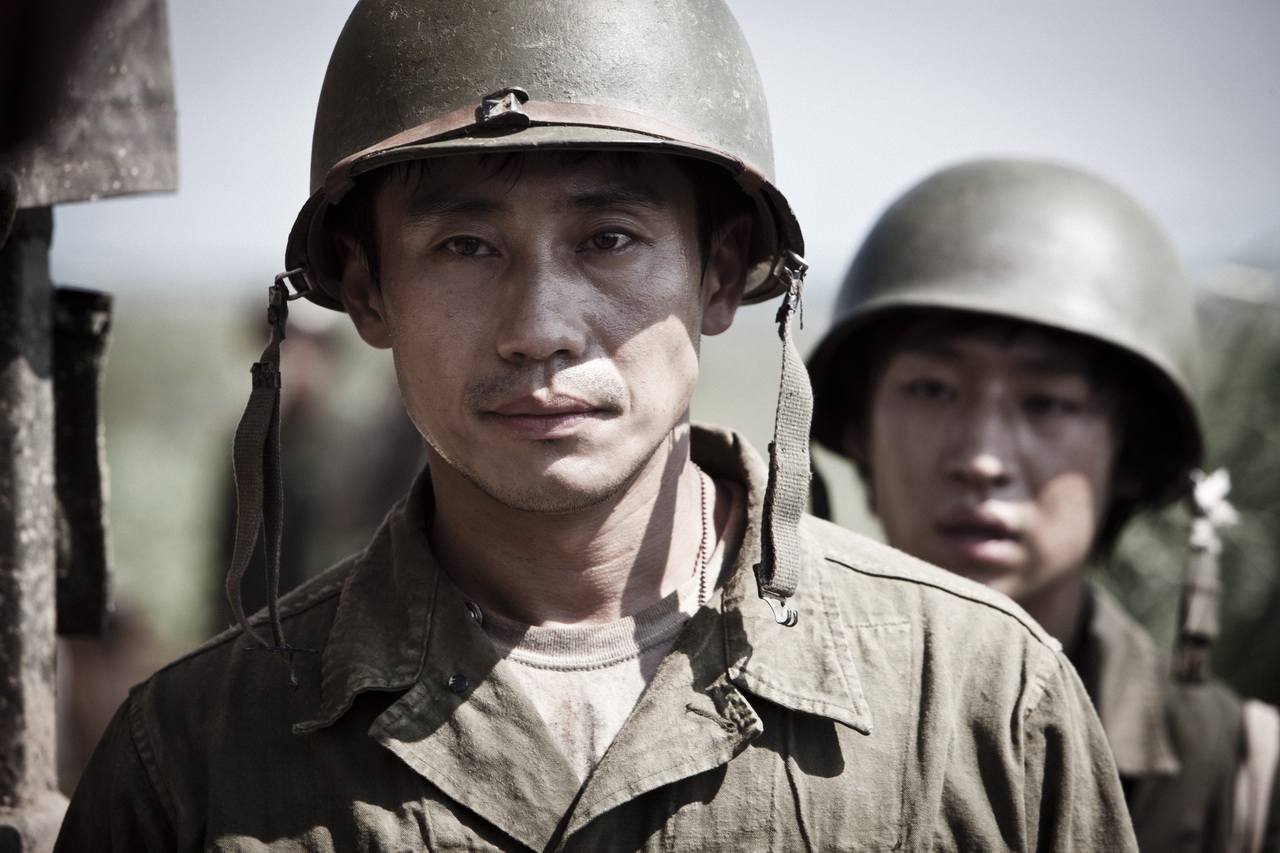
 During the Korean War, the north and south did battle over a series of hills, with the key locations changing hands of over and over, sometimes multiple times the same day. Director Jang Hun tells the fictionalized story of one such hill, Aero.K, in the tense military thriller The Front Line. Shin Ha-Kyun (Thirst, Sympathy for Mr. Vengeance) stars as Lt. Kang Eun-pyo, an investigator who has been sent to the eastern front to uncover a possible spy. Upon joining Alligator Company, Eun-pyo is surprised to find his old college friend, Kim Su-hyeok (Ko Soo), a former scared grunt who had been captured by the North Koreans and has now blossomed into a strong leader — and quickly becomes the leading candidate to be the potential traitor. The hill has changed hands so often that each side has been secretly communicating with the other by leaving such materials as photos, letters, and alcohol in a hidden spot, developing a relationship that reveals their humanity but also could compromise them on the field. And as a possible armistice approaches, the brass ramps up the fighting in a series of last-ditch efforts to take the hill and expand the potential demarcation line in their favor. Park Sang-yeon’s script is filled with clichéd characters and familiar plot lines, leaning toward the melodramatic, but Jang still makes it work, building the violent film around the strong main characters and several powerful, unexpected twists. South Korea’s official entry for the Academy Awards, The Front Line is a gritty epic that reveals man’s inhumanity to man and the ultimate futility of war.