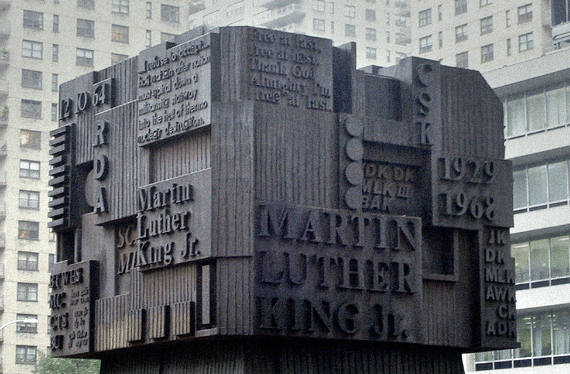
MLK Day features a host of special events and community-based service projects throughout the city (photo by twi-ny/mdr)
Multiple venues
Monday, January 16
www.mlkday.gov
In 1983, the third Monday in January was officially recognized as Martin Luther King, Jr. Day, honoring the birthday of the civil rights leader who was assassinated in Memphis on April 4, 1968. Dr. King would have turned eighty-three today, and you can celebrate his legacy tomorrow by participating in a Martin Luther King, Jr. Day of Service project or attending one of several special events taking place around the city. BAM’s twenty-sixth annual free Tribute to MLK includes a keynote speech by education chancellor Denis M. Walcott, the community art exhibition “Picture the Dream,” a musical performance by Toshi Reagon and BIGLovely and the Institutional Radio Choir C.O.G.I.C. of Brooklyn, and a screening of the stirring documentary The Black Power Mixtape 1967-1975. The JCC in Manhattan will be holding a blood drive and a food-service project during the day, then team up with Symphony Space for “Moving Ideas: A Conversation Between Choreographers Jawole Willa Jo Zollar and Liz Lerman,” including excerpts from Zollar’s Give Your Hands to Struggle and Lerman’s The Matter of Origins, which were both partially inspired by Dr. King and Rabbi Abraham Joshua Heschel; a concert by Daniel Kahn and the Painted Bird; Zalmen Mlotek’s “Soul to Soul: A Celebration of African-American and Jewish Song” with Elmore James, Tony Perry, and Cantor Magda Fishman; and a screening of Nick Parker and Jazmin Jones’s documentary The Apollos. The Museum of the Moving Image will be honoring King with a screening of Michael Roemer’s seminal Nothing But a Man, in which Ivan Dixon and Abbey Lincoln play a young couple battling racism in 1960s Alabama. The Children’s Museum of Manhattan will teach kids about King’s legacy with its “Make a Difference Pledge” and performances by the Harlem Gospel Choir, while the Brooklyn Children’s Museum has “Let’s Join Hands,” a “Historical Snapshot” talk with civil rights activist Yolanda Clarke, and a living legacy collage and hand wreath workshop. And Dizzy’s Club Coca-Cola is hosting Jazz at Lincoln Center’s annual “Dr. Martin Luther King Celebration” with the Warren Wolf Quintet, with Tim Green, Christian Sands, Kriss Funn, and Billy Williams.

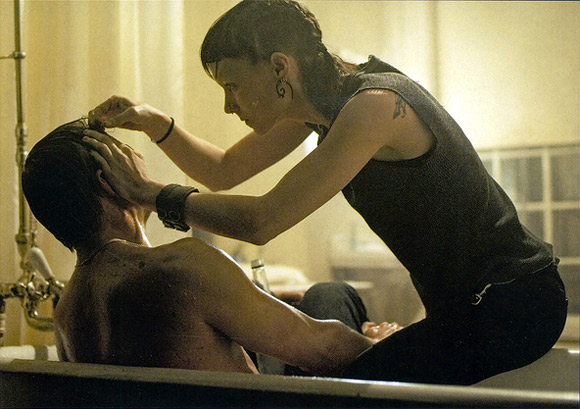
 David Fincher knows how to make movies. The director of such standout films as Fight Club, Zodiac, The Curious Case of Benjamin Button, and The Social Network has scored another critical and popular success with the hotly anticipated English-language remake of Swedish author Stieg Larsson’s 2005 posthumously published runaway bestseller, The Girl with the Dragon Tattoo. And “remake” is the key word, as Fincher’s film, adapted by Steven Zaillian (Schindler’s List, American Gangster), feels like it was based more on Niels Arden Oplev’s 2009 Swedish version than the book itself, but no matter, it’s still a highly entertaining, if overly long, thriller with elements all its own. Daniel Craig stars as Mikael Blomkvist, a journalist who loses a high-profile case, accused of slandering a powerful businessman. Blomkvist is hired by wealthy patriarch Henrik Vanger (Christopher Plummer), who believes Blomkvist was right, to search through the dysfunctional Vanger clan and find out who murdered young Harriet forty years earlier. Blomkvist is soon joined by investigator Lisbeth Salander (Rooney Mara), a ward of the state who is being horrifically abused by her new guardian (Yorick van Wageningen), as they combine cutting-edge technology with old-fashioned detective legwork to get to the bottom of the mystery. Craig plays Blomkvist with a stark vulnerability, letting Mara drive the film with her quiet, unassuming power that’s ready to explode at any moment — and when it does, well, watch out. The soundtrack, by Trent Reznor (look for the Nine Inch Nails T-shirt in the movie) and Atticus Ross, who also composed the score for The Social Network, opens with a cover of Led Zeppelin’s “Immigrant Song,” sung by Karen O, that is played over a bizarre title sequence that looks like it was meant for the next James Bond adventure. The first of Larsson’s Millennium trilogy, The Girl with the Dragon Tattoo is an exciting psychological drama that sets the stage for the follow-ups, The Girl Who Played with Fire and The Girl Who Kicked the Hornet’s Nest, with Craig and Mara reprising their roles.

 British filmmaker Patrick Keiller’s follow-up to 1994’s London and 1997’s Robinson in Space is another staggering achievement, a gorgeous pairing of word and image resulting in something fresh, challenging, and unlike anything you’ve ever seen before. The conceit behind Robinson in Ruins is that it consists of found footage taken by a man named Robinson, with text from his rather eclectic notebook; in fact, every shot is carefully planned by writer, director, and editor Keiller, with the narrative added later, intoned by Vanessa Redgrave. The camera barely moves throughout the film’s one hundred and one minutes; instead, it remains still as it depicts a construction site, rapeseed fields, nuclear power plants, a mail slot, and a street corner, the only signs of movement the wind blowing through the trees, a passing car, or industrial smoke. People are virtually nonexistent as Redgrave reads Robinson’s complex treatise on agriculture, architecture, the economic crisis, history, politics, and opium, all centered around, as Keiller said at the press preview at the 2010 New York Film Festival, “the problem of dwelling.” Robinson in Ruins is like a tour through a thrilling art exhibition, each piece beautifully composed, coupled with fiercely intellectual poetry that is wonderful to listen to, even if much of it is impossible to understand. The film is screening January 13-18 at Anthology Film Archives as part of “Patrick Keiller’s Robinson Trilogy,” which also includes multiple showings of London and Robinson in Space as well as Keiller’s 2000 work The Dilapidated Dwelling and the 1986 short The End.