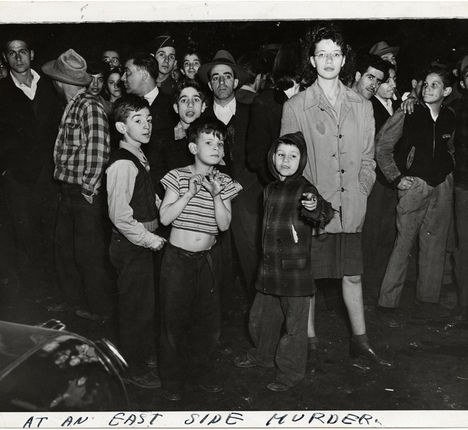
Weegee, “At an East Side Murder,” ca. 1943 (copyright Weegee/International Center of Photography
WEEGEE: MURDER IS MY BUSINESS
International Center of Photography
1133 Sixth Ave. at West 43rd St.
Tuesday – Sunday through September 2, $12 (pay-what-you-wish Fridays 5:00 – 8:00)
212-857-0000
www.icp.org
A true New York City original, Ukraine-born Usher “Arthur” Fellig, better known as Weegee, revolutionized the art of photojournalism during the 1930s and ’40s. A freelance photographer who used a police-band radio to often get to crime scenes before the NYPD, Weegee snapped black-and-white pictures of murder victims, fires, and other tragedies, capturing not only the dead bodies but interested bystanders as well as friends and family of the deceased. His emotion-packed photos, which appeared in daily newspapers and magazines, gave viewers the feeling that they were there at the scene, his use of flash illuminating his subjects in the foreground against a dark, gritty background. ICP chief curator Brian Wallis has gathered together more than one hundred photos for the exciting exhibition “Weegee: Murder Is My Business.” Named after a show Weegee held of his work at the Photo League in 1941 — which is re-created here, along with a room in his studio — “Murder Is My Business” features shots of dead bodies lying lonely on the street, chalk outlines, rubbernecking crowds, firemen going into burning buildings, and a policeman holding a pair of rescued kittens. Weegee also took photos of New York nightlife and street scenes, including a New Year’s Eve party at Sammy’s Bar, two smiling Bowery entertainers, a Santa Claus balloon being inflated for the Thanksgiving Day Parade, and huge crowds at Coney Island. There is also a fun series, “Weegee Procedural,” in which Weegee photographed himself being handcuffed, taken to a station house, posing for a mug shot, and ending up behind bars. ICP debunks the idea that Weegee got his name from a Ouija board because of his ability to magically appear at scenes before anyone else; according to the exhibit text, the name actually came from when he was a squeegee boy at a photo house. Arranged thematically, the photos offer a thrilling look at a New York gone by and will have visitors crowding around not unlike the people seen in much of Weegee’s work. (ICP will be hosting a series of “Weegee’s Night Walks” through Times Square, the Bowery, the Lower East Side, Chinatown, and Lower Manhattan from February 24 through March 30; registration is $75.)
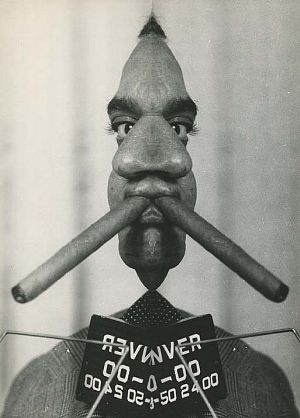
Weegee, “Self Portrait,” vintage gelatin silver mounted to board, ca. 1945
WEEGEE: NAKED CITY
Stephen Kasher Gallery
521 West 23rd St. between Tenth & Eleventh Aves.
Through February 25, free, 11:00 am – 6:00 pm
212-966-3978
www.stevenkasher.com
In conjunction with “Weegee: Murder Is My Business,” Steven Kasher Gallery in Chelsea is presenting “Weegee: Naked City,” comprising more than 125 prints that reveal Weegee’s wide-ranging subject matter. In his 1945 tome, Naked City, Weegee wrote, “For the pictures in this book I was on the scene; sometimes drawn there by some power I can’t explain, and I caught the New Yorkers with their masks off . . . not afraid to Laugh, Cry, or make Love. What I felt I photographed, laughing and crying with them.” The exhibit does include a handful of photos that are also in the ICP show, and it does not have any accompanying text, but there is still lots to see: shots of a woman in tears at a Frank Sinatra concert, famous clown Emmett Kelly sadly waving his hat, children crammed into a tenement penthouse, advertising signs, Stanley Kubrick on the set of Dr. Strangelove, a close-up of a woman’s stockinged leg at the Bowery Savings Bank, a big dog in a Greenwich Village hangout, and several experimental self-portraits using multiple images. Together, they offer a fabulous adventure through the New York of old. “The people in these photographs are real,” Weegee went on to explain in Naked City. “To me a photograph is a page from life, and that being the case, it must be real.”
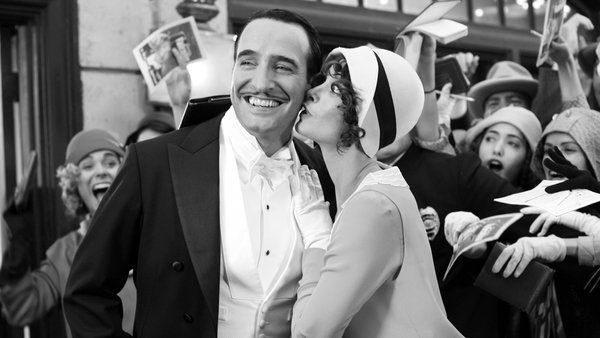
 French director Michel Hazanavicius has followed his two OSS 117 espionage parodies, Cairo, Nest of Spies and Lost in Rio, with another genre exercise, this time taking on silent film in the charming international hit The Artist. Reteaming Jean Dujardin and Bérénice Bejo from Cairo, Nest of Spies, Hazanavicius tells the story of the end of silent cinema through the clever use of the genre’s own familiar conventions. Dujardin stars as George Valentin, a silent-film idol who believes that talking pictures will just be a passing fad. Bejo, who is married to Hazanavicius, plays Peppy Miller, a young, peppy Hollywood hopeful who embraces the arrival of the sound era, rising as fast as Valentin is falling. It’s a different take on the classic A Star Is Born theme, with plenty of inside jokes and cute references about the movies, although purposefully using clichés doesn’t excuse the film from often being too clichéd itself; many of the scenes are far too predictable, offering few genuine surprises as the plot unfolds. However, Hazanavicius and his crew nail the period both aurally and visually, with splendid costumes by Mark Bridges, production design by Laurence Bennett, set decoration by Robert Gould, cinematography by Guillaume Schiffman, and music by Ludovic Bource. Excellent support is supplied by James Cromwell as Valentin’s loyal valet, John Goodman as cigar-chomping producer Al Zimmer, and Uggie as Valentin’s ever-faithful dog, Jack. Nominated for ten Academy Awards, The Artist is a fabulously made though flawed and overrated film that is a charming celebration of the movies — and a great way to get people into theaters to experience the myriad pleasures of black-and-white silent cinema.
 Based on the 2007 novel by Kaui Hart Hemmings, Alexander Payne’s The Descendants is a masterfully made, beautifully told story of love, loss, and family, highlighted by a graceful, wonderfully nuanced performance by George Clooney. Clooney stars as Matt King, a successful Hawaiian lawyer whose wife (Patricia Hastie) has suffered a devastating water-skiing accident that has left her in a coma. King is suddenly forced to be both father and mother to his two daughters, the troubled Alex (Shailene Woodley), who is in college, and ten-year-old Scottie (Amara Miller), something he admits in voice-over narration he is absolutely clueless about. Meanwhile, he is in the midst of deciding what to do with his family inheritance, an enormous plot of pristine beachfront property that his large group of cousins (including Michael Ontkean and Beau Bridges) wants to sell to a major developer. But his life is again turned upside down when he discovers that his marriage was not quite what he thought it had been, learning a secret about his wife that complicates things even further. Nominated for Best Picture, Best Director, Best Actor (Clooney), Best Editing (Kevin Tent), and Best Adapted Screenplay (Payne, Nat Faxon, and Jim Rash), The Descendants never takes the easy way out. In his first film since 2004’s Sideways, Payne (Election, About Schmidt) avoids melodramatic clichés and obvious plot twists, instead creating intelligent scenes filled with complex emotions that continually defy expectations. Clooney gives one of the best performances of his career as King, a carefully measured, subtle portrayal that keeps the film firmly balanced, whether he is being shot from the front, his eyes both intensely thoughtful and painfully confused, or shown from the back, his shoulders barely steady, his head facing out into a whole new world. Payne often allows scenes to take place off-screen and behind closed doors, putting his faith in the audience, who will be well rewarded by putting their trust in him. The Descendants is another great success from Payne, one of Hollywood’s best, and most fascinating, storytellers.