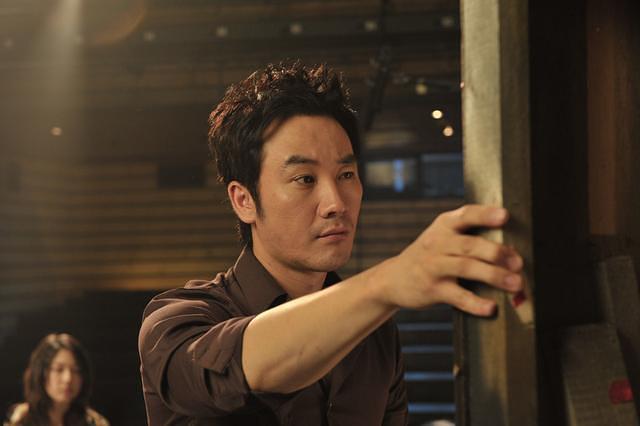
Things get a little too personal for Byung-hun (Uhm Tae-woong) in Korean rom-com CYRANO AGENCY
KOREAN MOVIE NIGHT: CYRANO AGENCY (SHIRANO) (Kim Hyeon-seok, 2010)
Tribeca Cinemas
54 Varick St. at Laight St.
Tuesday, March 13, free, 7:00
Series runs every other Tuesday through February 28
212-759-9550
www.tribecacinemas.com
www.koreanculture.org
 Desperate to raise cash so they can renovate an old theater and put on productions again, a small theater company resorts to matchmaking, writing real-life scripts and acting out parts in order to light a spark between their client and the object of his or her desire. Using the latest technological gadgetry, including a microphone in a pair of glasses, the secret company, known as the Cyrano Agency — named after the 1897 play by Edmond Rostand in which the ugly Cyrano de Bergerac writes love letters to help Christian capture the heart of the beautiful Roxane, the woman they both love — creates elaborately choreographed scenarios that slowly bring the man and woman together, led by director Byung-hun (Uhm Tae-woong) along with his associates, Min-young (Park Shin-hye), Jae Pil (Jun A-min), and Chul-bin (Park Cheol-min). The Cyrano Agency boasts a success rate of one hundred percent, but that record is suddenly in jeopardy when Byung-hun discovers that their latest client, fund manager Sang-yong (Daniel Choi), has fallen hard for Hee-joong (Rhee Min-jung), the director’s former girlfriend. A huge hit in its native Korea, Cyrano Agency is a silly but fun romantic comedy that riffs on Korean soap operas and the familiar Cyrano tale. The multilayered narrative works well through most of the movie, especially as Min-young starts to suspect something is up with Byung-hun, who seems to be sabotaging their current project. Writer-director Kim Hyeon-seok (When Romance Meets Destiny, YMCA Baseball Team) pours on the melodrama for the sappy finale, but Cyrano Agency is still a light and fanciful story of love and heartache. Cyrano Agency is screening for free Tuesday at Tribeca Cinemas, kicking off the next Korean Movie Night series, “It’s a Fine Romance,” which continues March 27 with the New York premiere of My Girlfriend Is an Agent and April 10 with the U.S. premiere of Petty Romance.

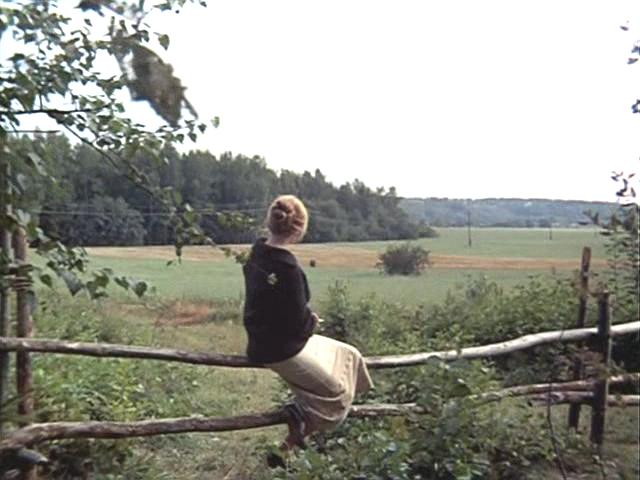
 “Words can’t really express a person’s emotions. They’re too inert.” So says Andrei Tarkovsky’s dream-filled, surreal masterpiece The Mirror, which features long scenes with little or no dialogue. Tarkovsky turns the mirror on himself and his childhood to tell the fragmented and disjointed story of WWII-era Russia through his own personal experiences with his family. Tarkovsky was obsessed with film as art, and this nonlinear film is his poetic masterpiece; he even includes his father’s poems read over shots that are crafted as if paintings. Many of the actors play several roles; have fun trying to figure out who is who and what exactly is going on at any one moment. The Mirror is screening on March 11 at 6:00 at the Museum of the Moving Image as part of the special program “Geoff Dyer on Tarkovsky, Cinema, and Life” and the ongoing “See It Big!” series and will be introduced by award-winning author Dyer, whose latest nonfiction tome is Zona: A Book About a Film About a Journey to a Room (Pantheon, February 21, $24), an obsessively detailed examination of Tarkovsky’s

 Inspired by an actual event that took place during the first Gulf War, Nina Menkes’s The Bloody Child is a visually captivating abstract tale of murder. Shot in the 29 Palms area of the Mojave Desert, the film is essentially told backward in three distinct sections. In one, a group of Marine officers have discovered a dead woman in the back of a car. It’s a crystal-clear beautiful day as they come and go, discussing the situation in dialogue that is often hard to make out. In another, people are having a good time in a dark bar, the men shooting pool, the women being entertained by a male stripper. And in the third, an ash-covered angelic figure lies naked in a forest, carving a prayer in Hebrew on her arm as the witches’ chant from Macbeth is repeated on the soundtrack. Despite its abstract, fractured narrative and ambiguous, unidentified characters, The Bloody Child is an atmospheric, gripping tale. Menkes tells the story in long takes with little or no camera movement, almost as if action is secondary to mood. Casting actual Marines in the film — in addition to her sister, Tinka, who stars in most of her work and plays the Marine captain here — Menkes imbues the film with a reality that lends it a documentary feel, enhanced by gorgeous poetic moments that lift things to a higher plane. The Bloody Child is screening March 9, 11, and 15 as part of Anthology Film Archives’ weeklong Menkes retrospective that also includes such films as Dissolution (2010), The Great Sadness of Zohara (1983), Magdalena Viraga (1986), The Bloody Child (1996), and Phantom Love (2007).