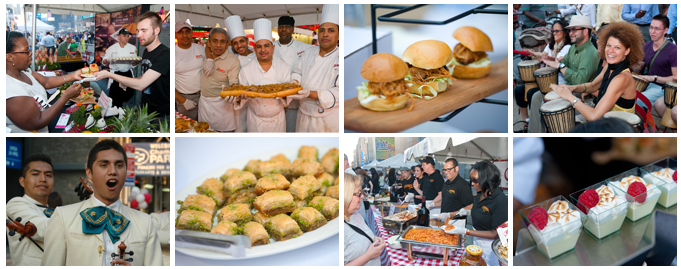
Live music and a wide variety of food are on the menu at annual Taste of Times Square
46th St. between Broadway & Ninth Ave.
Monday, June 11, most dishes $2-$6, 5:00 – 9:00
www.timessquarenyc.org
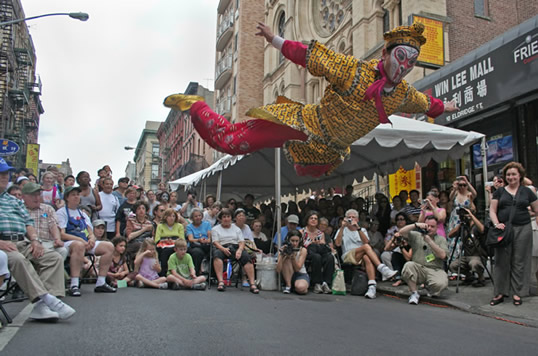
The international culinary flavor of the Times Square area will be on display tonight at the annual Taste of Times Square, where more than fifty local restaurants will be serving their signature dishes on West 46th St. The menu lineup, with most dishes costing between two and six dollars (purchased with dollar tasting tickets), incudes blackened tenderloin tips from Shula’s American Steakhouse, pork and bean sausage with Tori’s buffalo chips from Ca Va Brasserie, beef sliders from the Library at the Paramount Hotel, salmon caviar blini and chicken Kiev from Firebird, traditional spinach and feta cheese spanakopitas from Hourglass Tavern, chicken pot pie from O’Lunney’s, empanadas from Nuchas, sliced steak sandwiches from Gallagher’s, Memphis pork ribs from Virgil’s, lobster rolls from Snackbox, paella from Meson Sevilla, doners from Dervish, pulled pork sandwiches from Joe Allen, steak frites sushi hand rolls from Mr. Robata, penne alla vodka from Carmine’s, crespelle alla Savolarda from Barbetta, and yellowfin tuna, pickled enoki, miso aioli, and ginger soy glaze from Nios. For dessert, there’s the classic Junior’s original cheesecake, Le Rivage’s bread pudding with crème Anglaise, flan from Sangria 46, strawberry sundaes from Blue Fin, gelato from Salume, and shaved ice from Rickshaw Dumpling Bar. Free live entertainment will be provided by Paul Mueller, the Ebony Hillbillies, the Baby Soda Jazz Band, Mariachi Real de Mexico, Moses Josiah, Alais Lucette, Don Witter Jr., the Jazz Collective, and George Gee and the Jump Jive n’ Wail Swing Orchestra.

 As soon as Stefano Savano heard about the people’s rebellion going on in Egypt’s Tahrir Square in January, the Italian filmmaker grabbed his camera and headed over to Cairo, where he had been many times before over the previous twenty years, and just started filming what he saw. As hundreds of thousands of Egyptians flooded the area, singing, protesting, and demanding that President Hosni Mubarak step down, Savano followed around various individuals and groups, including Elsayed, Noha, and Ahmed, getting them to share their thoughts on revolution and change, capturing intimate moments of their fight for freedom. When violence erupts, Savano fearlessly heads to the source, rocks flying through the air, bleeding men being carried past him. The film has no narration and no textual information; instead, Savano places the viewer right in the middle of the action, as if we’re there with him in Tahrir Square. “I’m not a journalist, and I don’t pretend to be one,” Savano pointed out in a Skype press conference following a New York Film Festival preview screening of the film last year. Over the course of two weeks last summer, Savano and Penelope Botroluzzi edited down thirty-five hours of visuals and twenty-five hours of sound into this ninety-minute inside look at democracy in action, although it does get repetitive in the second half. Once again Savona, whose previous films include 2002’s A Border of Mirrors, 2006’s Notes from a Kurdish Rebel, and last year’s Spezzacatene, focuses more on the human element than the political, adding a coda during the credits that places much of what went on before into intriguing perspective. Tahrir: Liberation Square will be screening June 11-17 as part of the Maysles Institute’s Documentary in Bloom series curated by Livia Bloom.
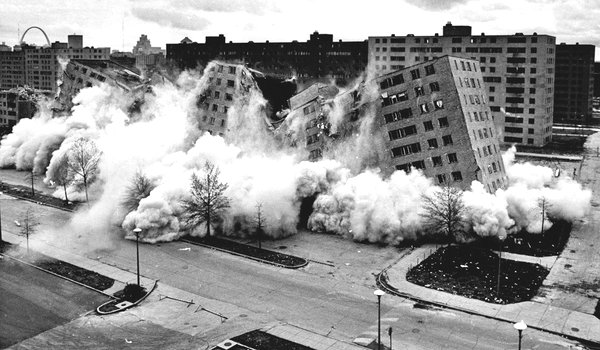
 In 1954, the St. Louis Housing Authority completed a massive urban renewal project, Pruitt-Igoe, a thirty-three-building complex for low-income families that was like a city unto itself. Eighteen years later, mired in crime, violence, poverty, and horrifically unsanitary and unsafe conditions, Pruitt-Igoe was torn down, the implosion famously being shown on news channels around the country as an example of the failure of public policy planning. The short, contentious history of Pruitt-Igoe is explored in the revealing documentary The Pruitt-Igoe Myth. Director Chad Freidrichs (Jandek on Corwood, First Impersonator) revisits Pruitt-Igoe through archival footage, new interviews, and a drive past the site where the iconic housing development, designed by architect Minoru Yamasaki, once stood, revealing the fascinating story of what was first a symbol of the post-WWII boom and then a prime example of the nation’s financial and racial problems of the 1970s. “It was like an oasis in the desert,” Ruby Russell remembers. “I never thought I would live in that kind of a surrounding.” But Brian King, who spent his childhood there, sees it a little differently. “It was hell on earth,” he says. Freidrichs speaks with urban historians Robert Fishman and Joseph Heathcott, sociologist Joyce Ladner, and former residents as they chronologically follow the rise and fall of “the poor man’s penthouse.” Narrated by actor Jason Henry, The Pruitt-Igoe Myth tells a shameful chapter in American history, one that should still be used today as a blueprint on what not to do. “It seemed to me that we were being penalized for being poor,” says former resident Jacqueline Williams. “That caused so much anger.” Named Best Documentary at several festivals and winner of the American Historical Association’s John E. O’Connor Film Award, The Pruitt-Igoe Myth is screening for free at BAMcinématek on June 11 at 6:50, followed by a panel discussion with Freidrichs and urban housing and development experts.