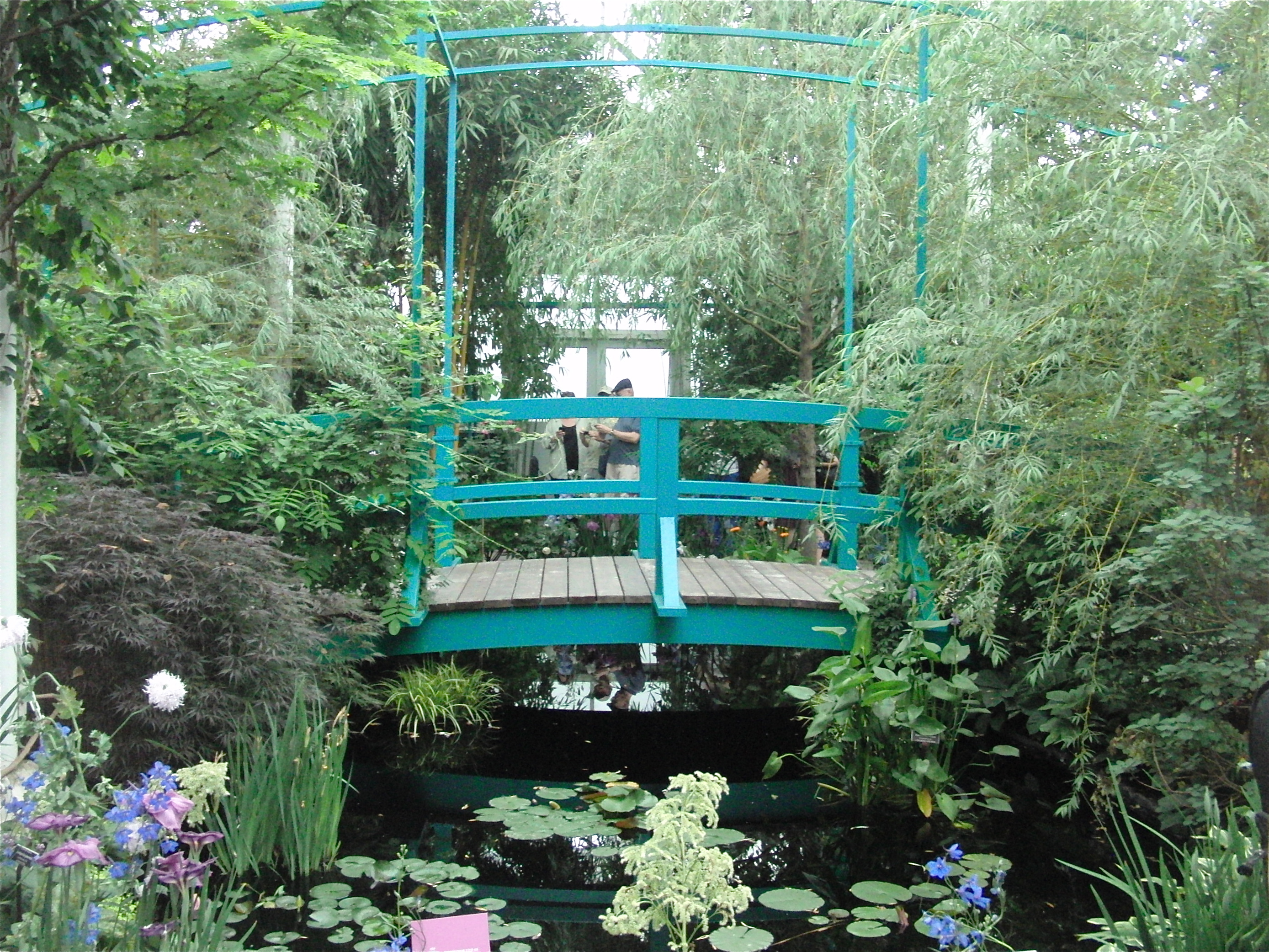
“Monet’s Garden” will change with the seasons at the New York Botanical Garden (photo by twi-ny/mdr)
The New York Botanical Garden
2900 Southern Blvd.
Tuesday – Sunday through October 21, $8-$25
718-817-8700
www.nybg.org
monet’s garden slideshow
“My most beautiful work of art is my garden,” Impressionist master Claude Monet once explained to his stepson. That statement is at the heart of the wide-ranging New York Botanical Garden exhibition “Monet’s Garden,” on view through October 21 in the Bronx oasis. In 1883, the forty-two-year-old Monet moved with his family into a house in Giverny, where he spent the second half of his life developing magnificent gardens and creating some of his most famous masterpieces, paintings based on the natural world he immersed himself in. The New York Botanical Garden has transformed the Enid A. Haupt Conservatory into a tribute to Monet, complete with a facade of his house and a re-creation of the Grand Allée from the Clos Normand and the famed Japanese footbridge. The long, narrow path is lined with many of the plants that bloomed in Giverny and will change seasonally, beginning with such flowers as irises, morning glories, aubretias, roses, delphiniums, foxgloves, peonies, and poppies. Visitors can walk across the green footbridge, then head outside to the Conservatory Courtyard’s Hardy Pool, which is filled with water lilies and other aquatic plants similar to the ones Monet collected after having been introduced to Nymphaeas by Joseph Bory Latour-Marliac at the 1889 Paris World’s Fair. As you make your way over to the library, you can stroll along the Monet to Mallarmé Poetry Walk, featuring French Symbolist poems, inspired by nature, by Monet contemporaries Charles Baudelaire, Arthur Rimbaud, Paul Verlaine, and Stéphane Mallarmé, who were doing with words what Monet was doing with paint.
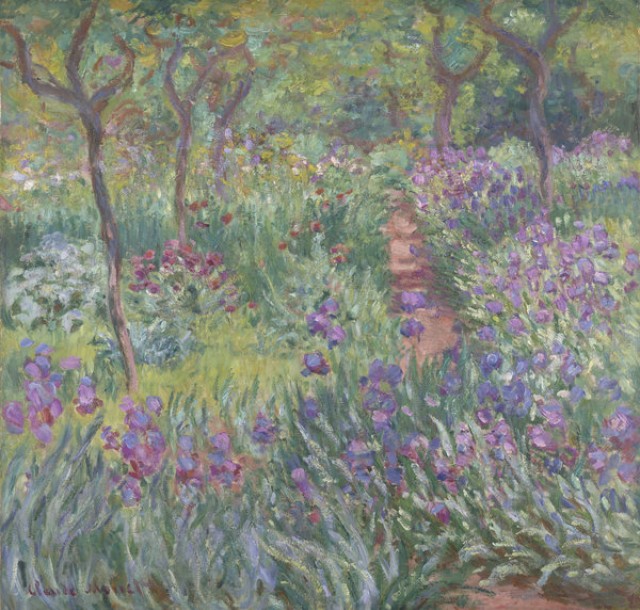
Claude Monet, “The Artist’s Garden in Giverny,” oil on canvas, circa 1900 (courtesy Yale University Art Gallery)
The library’s Rondina Gallery is home to several vitrines of photographs of Monet by himself and with friends in the garden in addition to letters, sales receipts, and a glorious palette he used between 1914 and 1926, a work of art in itself. The gallery is also displaying two of Monet’s paintings, the lush and beautiful “The Artist’s Garden in Giverny” and the darker, more mysterious “Irises,” which has never before been shown in the United States. Upon exiting the library, be sure to stop by the Ross Gallery, where Elizabeth Murray’s “Seasons of Giverny” consists of more than two dozen photographs taken by Murray, who has been documenting the garden for a quarter century. Curated by Monet expert Dr. Paul Hayes Tucker, “Monet’s Garden” is supplemented by a series of special events and technological enhancements, including a free iPhone app, an audio tour, weekend screenings of the films The Impressionists: Monet and Monet’s Palate, monthly poetry salons, “Monet’s Friends” chamber music concerts, “Monet Evenings” water lily concerts, home-gardening demonstrations, adult education classes, and “Observe and Create” workshops for children. “I perhaps owe having become a painter to flowers,” Monet wrote in an 1890 letter to art dealer Paul Durand-Ruel. The New York Botanical Garden celebrates both of these aspects of one of the world’s most beloved artists.

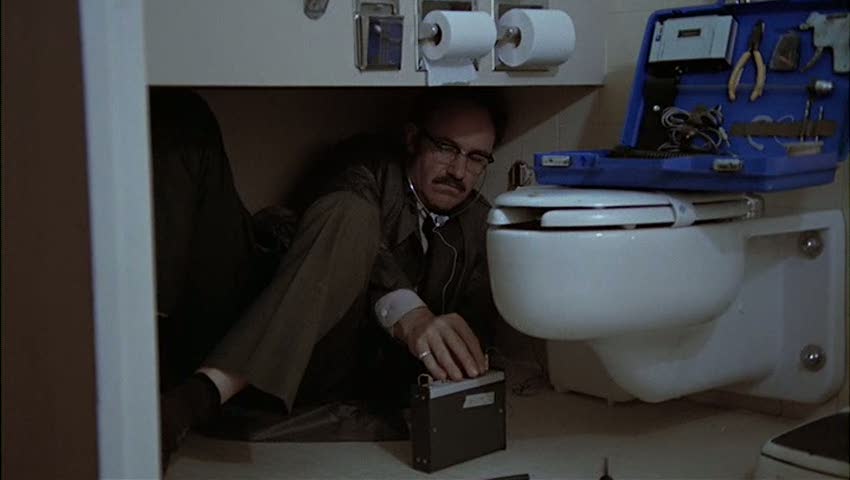
 While changing the face of Hollywood cinema with The Godfather and The Godfather Part II, American auteur Francis Ford Coppola snuck in yet another 1970s masterpiece, the dark psychological thriller The Conversation. Gene Hackman gives a riveting performance as Harry Caul, an audio surveillance expert who has been hired to record a meeting between two people (Cindy Williams and Frederic Forrest) in Union Square in San Francisco. Thinking that he might have stumbled onto a murder plot, Caul soon finds himself in the middle of a dangerous conspiracy that threatens the lives of all those involved. The Conversation is a gripping, taut examination of obsession, paranoia, and loneliness as well as an exploration of language and communication. Caul might spend most of his time listening in on the intimate conversations of others, but he is an intensely private individual who is extremely uncomfortable in his own skin. A deeply religious man who also plays the saxophone, Caul has trouble relating to other people; Hackman is particularly outstanding in a party scene where Caul is forced to talk shop with fellow surveillance expert Bernie Moran (Allen Garfield), who wants to know Caul’s secrets, but the always nervous Caul isn’t about to share everything. The supporting cast, which also features Harrison Ford, Robert Duvall, Teri Garr, and John Cazale, is exceptional, but this is Hackman’s show all the way, leading to one of the great endings in the history of cinema. Winner of the Palme d’Or at Cannes, The Conversation is screening June 23 & 24 as part of the Museum of the Moving Image series “Paramount in the 1970s,” a month of films from the studio that changed the shape of American popular cinema during the decade that began with the Vietnam War and ended with the Reagan revolution. The series, which celebrates Paramount’s centennial, also includes such films as Peter Yates’s The Friends of Eddie Coyle, John Badham’s Saturday Night Fever, Robert Altman’s Nashville, and Terrence Malick’s Days of Heaven.