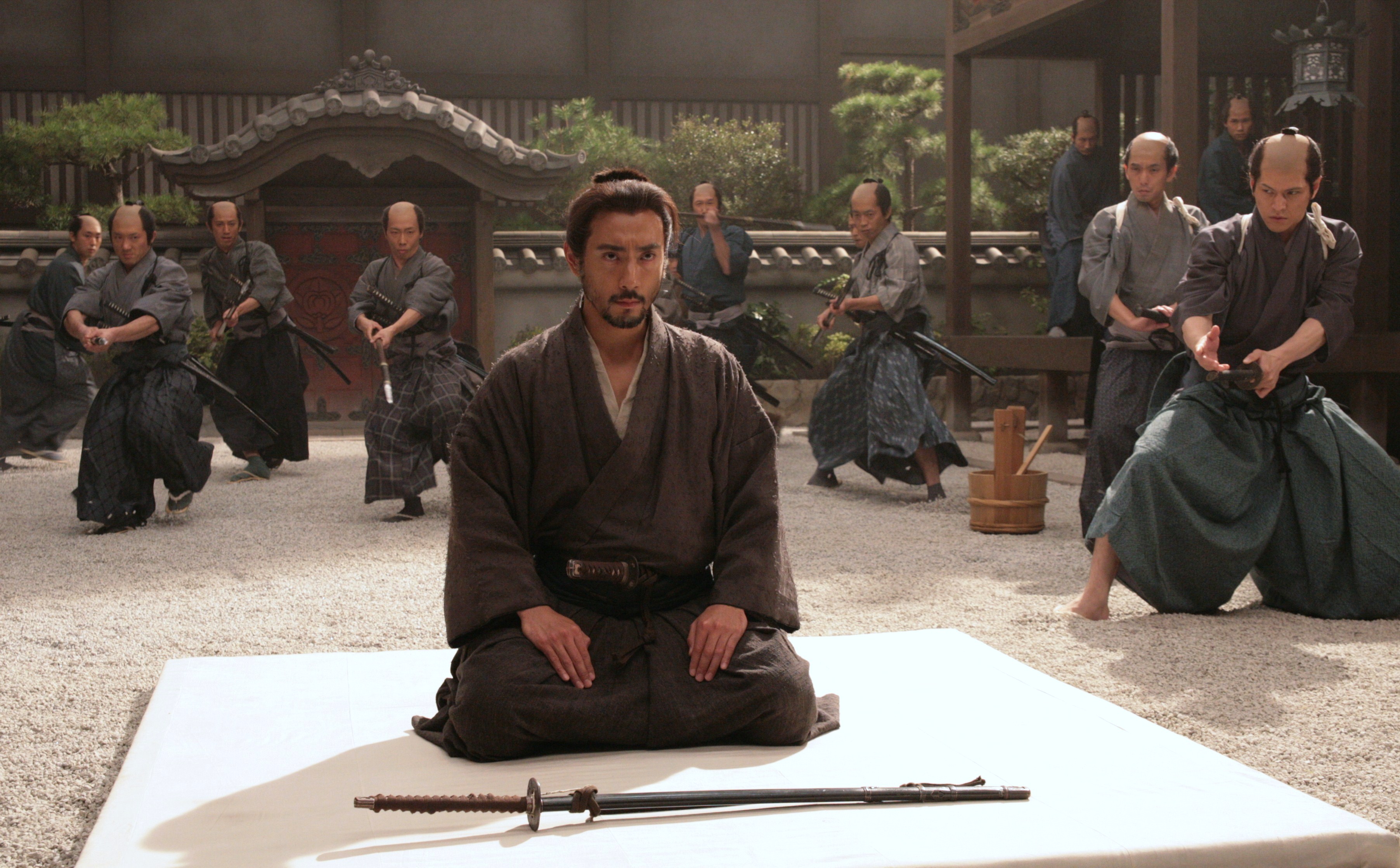
Hanshiro Tsukumo (Ebizo Ichikawa) has quite a story to tell in Takashi Miike’s HARA-KIRI
HARA-KIRI: DEATH OF A SAMURAI (ICHIMEI) (Takashi Miike, 2011)
IFC Center
323 Sixth Ave. at Third St.
Through August 16, $17.50, 1:25 & 9:35
212-924-7771
www.ifccenter.com
www.tribecafilm.com
 Nearly fifty years after Masaki Kobayashi’s Harakiri won the Special Jury Award at the 1963 Cannes Film Festival, Takashi Miike’s magnificent 2011 remake was also entered into competition at the prestigious French event. During peaceful times in 1634 Edo, a masterless samurai named Hanshiro Tsukumo (Kabuki star Ebizo Ichikawa) comes to the Lyi clan, requesting permission to commit seppuku in the estate’s courtyard, seeking an honorable death. But clan retainer Kageyu Saito (Kōji Yakusho) and his right-hand man, Hikokuro Omodaka (Munetaka Aoki), believe he might be yet another penniless samurai using a suicide bluff in order to get either a job or money. Trying to discover if the man is serious about wanting to commit hara-kiri, the retainer tells him the horrific story of a young samurai named Motome Chijiiwa (Eita) who requested the same thing two months before. But soon Hanshiro has his own story to tell, one that turns everything around in surprising ways. Miike, who has directed more than eighty movies across a multitude of genres during his twenty-two-year career, including such masterworks as Audition, Ichi the Killer, and Thirteen Assassins, has made his most emotional, compassionate film yet with Hara-Kiri: Death of a Samurai. Ichikawa, taking on the role played in the original by Tatsuya Nakadai, is brilliant as Hanshiro, a deeply thoughtful samurai with a fierce dedication to honor and loyalty. As he stares into Yakusho’s eyes, the tension can be cut with a steel sword. Miike and cinematographer Nobuyasu Kita shot the film in 3D, but they chose not to get gimmicky with the effects, just making the film they wanted to as if it were in regular 2D. “There was no change to my approach other than I was able to go brag to the director shooting at the studio next door and say, ‘Huh? Yours is flat and level? Ours is bumpy and convexo-concave,’” Miike explains in the press notes. Although he adds, “I definitely anticipate making more 3D movies. Next, if I have the chance, I want to have things that shouldn’t come out of our bodies be hurled at the audience.” The 3D adds a beautiful depth to Akira Sakamoto and Kazuto Kagoo’s gorgeous sets, which are enhanced by Yuji Hayashida’s rich art direction, bathed in deep black, white, gray, and red. The 3D also makes it easier to read the subtitles, which pop off the screen, along with the snow. Hara-Kiri might be a thinking person’s samurai movie, but it is still a Miike film, so it also features one of the most brutal suicides ever depicted on celluloid, and it ends with one helluva fight scene.
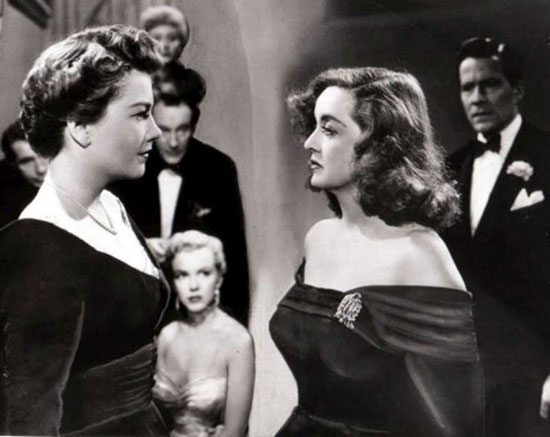
 Nominated for fourteen Academy Awards and winner of six, including Best Picture, Best Director, and Best Screenplay, All About Eve is one of Hollywood’s all-time greatest movies, a searing depiction of naked ambition set on the Great White Way. Based on Mary Orr’s 1946 short story “The Wisdom of Eve,” writer-director Joseph L. Mankiewicz’s flawless drama stars Anne Baxter as Eve Harrington, who is not exactly the mousey wallflower she at first appears to be. She quickly worms her way into an inner circle of Broadway vets populated by superstar Margo Channing (Bette Davis), her younger lover, Bill Sampson (Gary Merrill), playwright and director Lloyd Richards (Hugh Marlowe), and Richards’s wife, Karen (Celeste Holm), who takes Eve under her wing. Joining in on all the fun is powerful theater critic Addison DeWitt (Oscar winner George Sanders), who marvels at all the manipulation and backstage drama, much of which he wickedly orchestrates himself. “There never was, and there never will be, another like you,” DeWitt tells Eve in one of the film’s most poignant moments. All About Eve is filled with classic quotes, including the iconic “Fasten your seatbelts, it’s going to be a bumpy night,” boldly proclaimed by Davis. In a movie about acting and the theater, Mankiewicz never shows anyone onstage; instead, he focuses on the characters and the intrigue with a sly flair that is deliciously entertaining. All About Eve is screening August 13 as part of the Bryant Park Summer Film Festival, which concludes August 20 with Raiders of the Lost Ark.
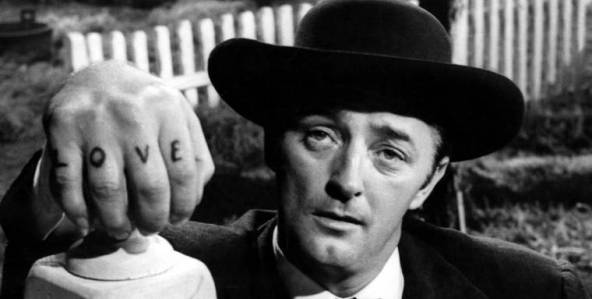
 Robert Mitchum stars in Charles Laughton’s lurid story of traveling preacher/con man/murderer Harry Powell, who has the word “love” tattooed on one set of knuckles and “hate” on the other. While in prison, Powell bunks with Ben Harper (Peter Graves), who got caught stealing $10,000 — but the only person who knows where the money is is Ben’s young son, John (Billy Chapin). When Preacher is released from jail, he shows up on the Harpers’ doorstep, ready to woo the widow Willa (Shelley Winters) — and get his hands on the money any way he can, including torturing John and his sister, Ruby (Gloria Castillo). Laughton’s only directorial effort is seriously flawed — the scenes in the beginning and end with Lillian Gish are wholly unnecessary and detract from the overall mood. Stanley Cortez’s cinematography is outstanding, featuring his unique use of shadows, the battle between light and dark (which plays off of several themes: old versus young, rich versus poor, good versus evil, and men versus women), and some marvelous silhouettes. The Night of the Hunter is screening August 11 at 8:00 as part of the MoMA film series “Unaccompanied Minors: Views of Youth in Films from the Collection,” being held in conjunction with the new exhibit “Century of the Child: Growing by Design, 1900-2000.” Running through August 14, the festival includes such other films about childhood as William A. Wellman’s Frisco Jenny, Darren Aronofsky’s Black Swan, Vittorio De Sica’s Bicycle Thieves, and David D. Williams’s Thirteen.