Stanley Kubrick’s first feature-length film, Fear and Desire, is screening at Metrograph in new 4K restoration
FEAR AND DESIRE (Stanley Kubrick, 1953)
Metrograph
7 Ludlow St. between Canal & Hester Sts.
September 22-27 metrograph.com
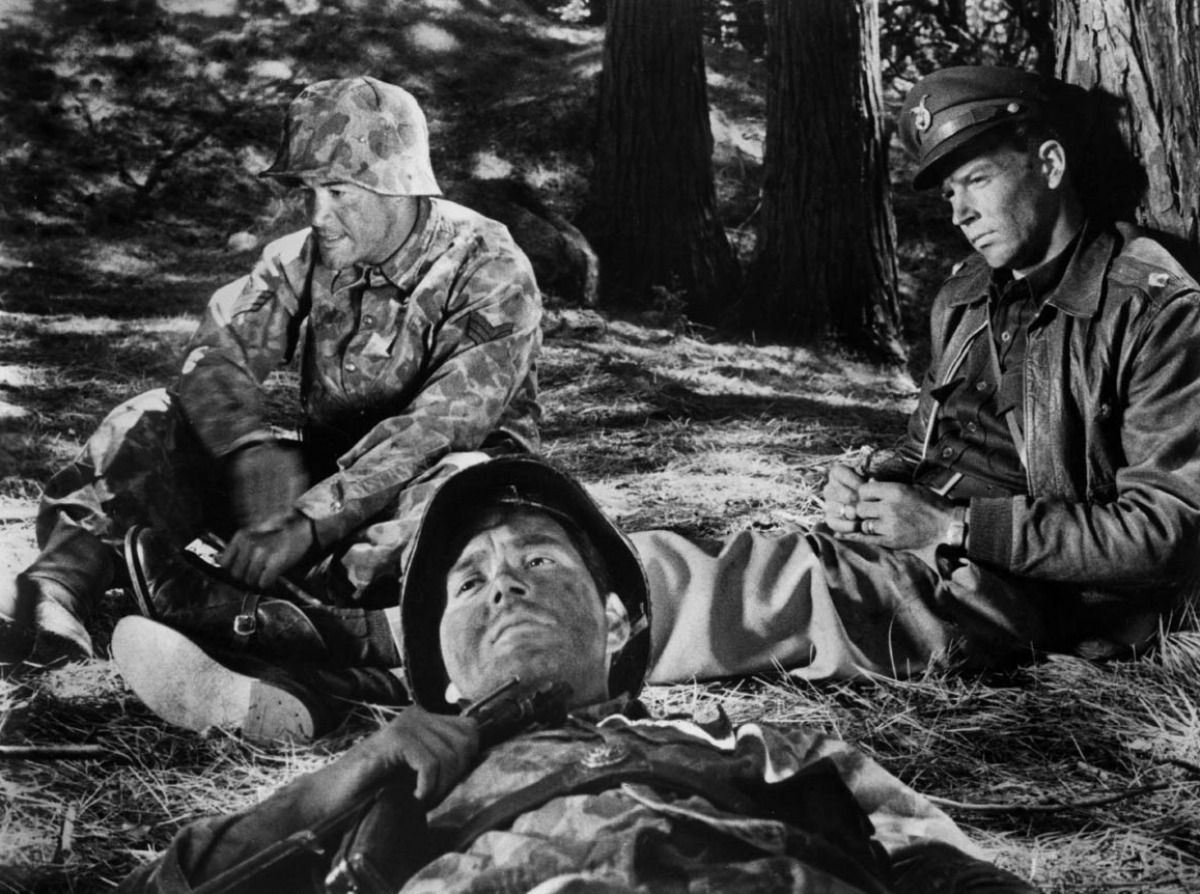
As part of its ongoing “First & Last” series, Metrograph is presenting a new 4K restoration of Stanley Kubrick’s seldom-seen 1953 psychological war drama, Fear and Desire. The Bronx-born ex-pat’s debut full-length film, made when he was twenty-four, Fear and Desire is a curious tale about four soldiers (Steve Coit, Kenneth Harp, Paul Mazursky, and Frank Silvera) trapped six miles behind enemy lines. When they are spotted by a local woman (Virginia Leith), they decide to capture her and tie her up, but leaving Sidney (Mazursky) behind to keep an eye on her turns out to be a bad idea. Meanwhile, they discover a nearby house that has been occupied by the enemy and argue over whether to attack or retreat. Written by Howard Sackler, who was a high school classmate of Kubrick’s in the Bronx and would later win the Pulitzer Prize for The Great White Hope, and directed, edited, and photographed by the man who would go on to make such war epics as Paths of Glory, Full Metal Jacket, and Dr. Strangelove, or How I Learned to Stop Worrying and Love the Bomb,Fear and Desire features stilted dialogue, much of which is spoken off-camera and feels like it was dubbed in later.
Many of the cuts are jumpy and much of the framing amateurish. Kubrick was ultimately disappointed with the film and wanted it pulled from circulation; instead it was preserved by Eastman House in 1989 and restored twenty years later — and now available in a digital restoration from Kino Lorber and the Library of Congress, which is good news for film lovers, as it is fascinating to watch Kubrick learning as the film continues. His exploration of the psyche of the American soldier is the heart and soul of this compelling black-and-white war drama that is worth seeing for more than just historical reasons. “There is a war in this forest. Not a war that has been fought, nor one that will be, but any war,” narrator David Allen explains at the beginning of the film. “And the enemies who struggle here do not exist unless we call them into being. This forest then, and all that happens now, is outside history. Only the unchanging shapes of fear and doubt and death are from our world. These soldiers that you see keep our language and our time but have no other country but the mind.” Fear and Desire lays the groundwork for much of what was to follow in Kubrick’s remarkable career; Metrograph is also screening Kubrick’s swan song, 1999’s Eyes Wide Shut, an adaptation of an Arthur Schnitzler novella that stars Tom Cruise and Nicole Kidman and features one of the most memorable parties ever put on celluloid.
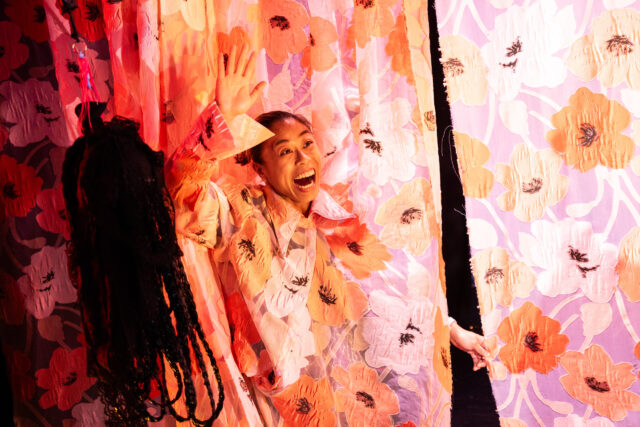
Nikki Calonge merges with the scenery in Normandy Sherwood’s Psychic Self Defense (photo by Maria Baranova)
PSYCHIC SELF DEFENSE
HERE Arts Center
145 Sixth Ave.
Tuesday – Sunday through September 30, $10-$100 here.org
“We should never respond to attack by attack, thus bringing ourselves down to the moral level of our attackers, but rely upon more humane methods, which are, in reality, equally effectual and far less dangerous to handle,” British occultist and Society of the Inner Light founder Dion Fortune writes in her 1930 book Psychic Self-Defense: The Classic Instruction Manual for Protecting Yourself Against Paranormal Attack.
Writer, designer, director, and performer Normandy Sherwood appropriates that title for her unusual show, Psychic Self Defense, continuing at HERE Mainstage Theater through September 30.
The unique theatrical experience begins with ticket holders being divided into small groups and led by a mysterious figure in black at the outside stage door through short hallways done up in Victorian horror-splendor, with low-hanging chandeliers, glowing orbs, bell pulls, and various ornate fabrics decorating the walls. The audience is brought to a small space with four rows of rising seats, some featuring knitted, elaborate antimacassars. There’s a bar separating the crowd — limited to no more than forty-four people — from the stage, which is several feet below, making it difficult to see the action when it is up front.
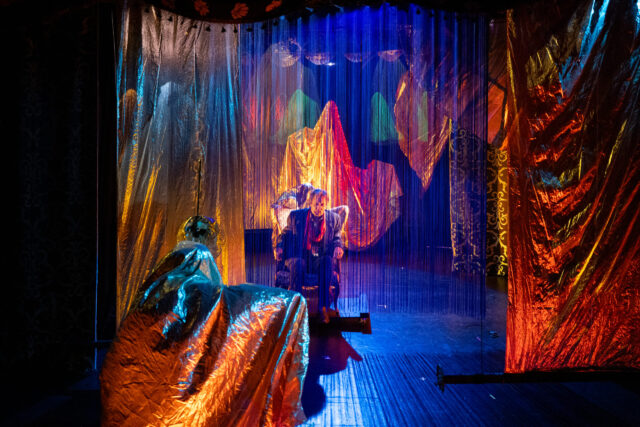
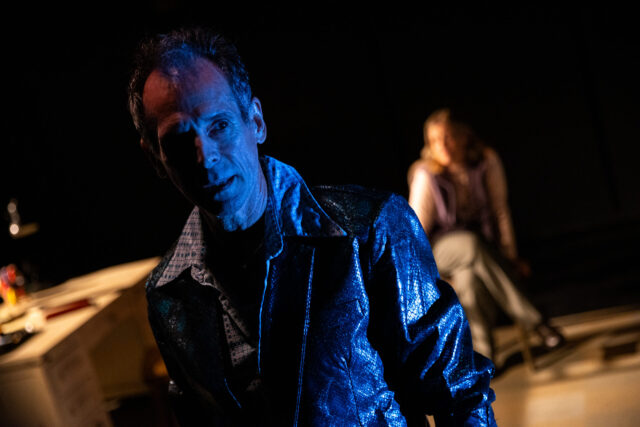
Ean Sheehy takes an uncomfortable seat in unique work at HERE (photo by Maria Baranova)
Curtains have become a disappearing element of theater; more often than not these days, both on and off Broadway, there is no curtain when attendees enter the theater; the set is already open and visible, eliminating the thrill of revelation. But Psychic Self Defense has curtains galore, of all sizes, banks and banks of them in different colors, designs, and fabrics, a seemingly endless stream of lovingly designed and potentially menacing barriers.
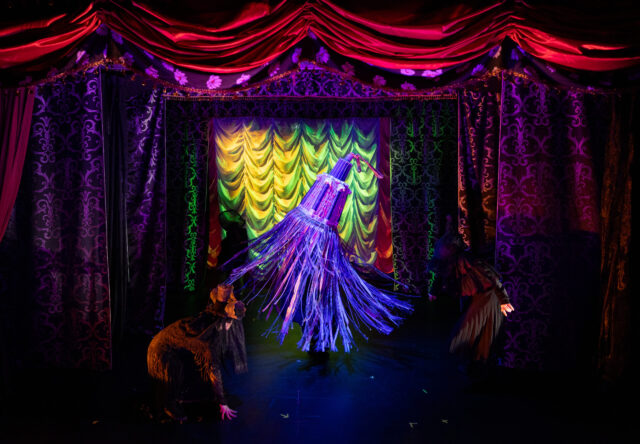
Early on, Ean Sheehy and Nikki Calonge take the stage, both pointing out that they are practicing “psychic self-defense.” There is no other dialogue or traditional narrative. Over the course of about fifty minutes, the two characters are enveloped by the curtains, eerie creatures in black, and fanciful beings draped in bolts of shiny fabric — part Disney fantasy, part DIY entities that would feel right at home on Lost in Space, the animated Beauty and the Beast, or Sigmund and the Sea Monsters (only more elegant). As time passes, one group of beings form a kind of charming family unit, albeit perhaps with a taste for human blood. While Sheehy attempts to fight off all comers, Calonge, her enormous smile dominating the set, takes a different approach, considering assimilation, since resistance just might be futile.
Wickedly cool and creepy projections are beamed onto the curtains, interacting with Christina Tang’s coolly unpredictable lighting, while sound designer Craig Flanagin’s original score incorporates bangs, knocks, whistles, creaks, and other dissonant, sometimes disturbing electronic noises. (Sherwood and Flanagin are both members of the Drunkard’s Wife theater company and the no-wave postpunk band God Is My Co-Pilot.)
Psychic Self Defense needs a little time to warm up. It’s a delight watching Calonge, but Sheehy is not nearly as engaging. The set and costumes have a charming, homespun, handmade feel, but some of the magic is not quite Mummenschanz level; you can see hands pulling objects and faces hiding behind curtains when they’re supposed to be invisible. But the show — performed by Sheehy, Calonge, Flanagin, Sherwood, Daniel Allen Nelson, Kate Brehm, Adrienne Swan, and Elyse Durand — kicks into high gear just past the halfway point, as the curtains and creatures assume control.
Strange beings take over in Psychic Self Defense at HERE (photo by Maria Baranova)
The show, a presentation of HERE’s Dream Music Puppetry program, identifies itself as “part séance,” but it doesn’t ever turn in that direction. It was created by Sherwood (Madame Lynch,Tiny Hornets) during the pandemic, when people were unable to connect to one another in person, and it could benefit from more interactivity. It does offer plenty of surprises and unusual things to look at— fans of textiles and patterns will be well rewarded — but a lot of it is head-scratchingly perplexing and abstruse.
Although there is no need to dig deep to try to find a cohesive narrative, the play does seem to be hinting at the future state of independent theater, which is suffering greatly right now around the country. In Psychic Self Defense, the robotic props and curtains are swallowing the space and the human aspects of storytelling, as if AI is firmly in command of this piece of object theater.
Perhaps we’ll all need to read Robert Bruce’s 2011 book The Practical Psychic Self-Defense Handbook: A Survival Guide, in which the author writes about unseen environments, addicted and deranged ghosts, psychic interference, and other paranormal situations. However, he also notes in a legal disclaimer that “while spiritual and psychic protection and cleansing are the main focus of this book, there are no guarantees that you will experience or achieve anything whatsoever from following any of the instructions, procedures, and advice given within this book.”
[Mark Rifkin is a Brooklyn-born, Manhattan-based writer and editor; you can follow him on Substack here.]
An Astoria tailor shop is the setting for Christina Masciotti’s No Good Things Dwell in the Flesh (photo by Maria Baranova)
NO GOOD THINGS DWELL IN THE FLESH
Jeffrey and Paula Gural Theatre
A.R.T./NY Theatres
502 West Fifty-Third St.
Wednesday – Sunday through September 23, $34.12 www.christinamasciotti.com
There’s a loose thread dangling through much of Christina Masciotti’s No Good Things Dwell in the Flesh, hanging in there until it’s finally pulled and the previously moving play comes undone.
The show is set in 2019 in a tailor shop in Astoria run by Agata Priechev (Kellie Overbey), a straightforward Soviet immigrant. She has hired Janice (Carmen Zilles), one of her students at FIT, as her apprentice. Janice, from a family of Brazilian descent, is approaching thirty, and while Agata is teaching her how to be an expert seamstress, Janice is getting advice that translates as life lessons as well.
Agata’s devotion to and love of her craft makes tailoring a vocation, more than a job, and she does her best to call Janice to that as well. “Everybody knows dying profession. It’s dying because it’s hard way to learn and you have to be creative. People doesn’t wanna learn. It’s time taking. Again, again until perfection,” Agata says in her broken English. “You never see young people working in alterations. You can be lawyer or doctor in ten years. Can’t be alterations in ten years. Now click on internet, make a lot of money. With this you can’t just click, you have to work a hundred years. I prefer this but. Last week, I was stitching so many things, I fell asleep on my couch. Tomorrow will be third, I have to do jacket, two things will go home with me. At home I don’t have that spare of a moment. I can’t continue like this. All of a suddenly, I realized in twelve years I had one vacation. I’m sixty-four. Life will be over soon. I need a vacation.”
Agata, who has a daughter living in London, has decided to take more than just a vacation; she wants to retire and give the shop to Janice, who isn’t sure she’s up to the responsibility and the commitment. Janice has trouble putting down her cell phone and is busy trying to find the right man to settle down with. While she starts dating an old high school friend, Agata is being harassed by Vlad (T. Ryder Smith), a Romanian man from Venezuela who has been obsessed with her since they met at Bloomingdale’s twelve years earlier. Vlad, who could be an Eastern European spy, a sexual predator, or an immigrant with mental health issues, shows up at odd times, asking for strange alterations and making unfounded accusations. Agata remains steadfast, as if Vlad is part of the unhappy old days that she has put behind her. “The past is dead body in basement,” Agata tells Janice.
As Janice weighs her future with Eddie, Agata fights off Vlad, grumpily refuses to take on jobs she doesn’t want to do, and attempts to prepare Janice to take over the business.
Vlad (T. Ryder Smith) is obsessed with Agata Priechev (Kellie Overbey) in No Good Things Dwell in the Flesh (photo by Maria Baranova)
The title of Masciotti’s 105-minute play (without intermission) was inspired by a quote from the apostle Paul about law and sin: “For I know that nothing good dwells in me, that is, in my flesh. For I have the desire to do what is right, but not the ability to carry it out.” The three central characters — Jeffrey Brabant, Annie Fang, and Megan Lomax appear in multiple minor roles, portraying various customers and police officers — all desire to do what is right, but various factors make them unable to, preventing them from flourishing.
Director Rory McGregor (Buggy Baby,Interior) can’t quite weave all the materials together into a satisfying whole. Brendan Gonzales Boston’s set is open on several sides, making it difficult to understand the geography surrounding the tailor shop, especially near the end, when characters start walking through areas that previously seemed to be invisible walls.
A rack of clothes hanging from above in the back is a deft touch, as if representing Agata’s achievement over the years. Given the setting, Johanna Pan’s costumes are not exemplary, although I’m still a bit creeped out by Vlad’s preference for mandals no matter what else he’s wearing. The steady lighting is by Stacey Derosier, with sound by Brian Hickey.
The next line of the Bible quote, from Romans 7:19, reads, “For I do not do the good I want, but the evil I do not want is what I keep on doing.” The title and the biblical quotes that relate to it are both compelling, but the narrative doesn’t live up to that promise. No Good Things Dwell in the Flesh is not a tale of good and evil as much as it is a story of characters in search of a happiness they’re not sure they deserve. Masciotti (Raw Bacon from Poland,Social Security) leaves too many threads untied, too much unused cloth on the cutting-room floor.
Overbey (Love and Information,Mary Page Marlowe) is firm and direct as Agata, a woman who doesn’t know how to be happy. “Tailor are special people,” she tells Janice. “You know it’s dying profession.” Zilles (Epiphany,Fefu and Her Friends) imbues Janice with a kind of wide-eyed wonder, not yet ready for what the world can offer her. Smith (The White Devil,Oslo) plays Vlad with a nervous jitteriness that will make you uncomfortable in your seat.
No Good Things Dwell in the Flesh start off with a good pattern but, in the end, could have used more custom tailoring and alterations.
[Mark Rifkin is a Brooklyn-born, Manhattan-based writer and editor; you can follow him on Substack here.]
A small group of samurai sets out to end a brutal madman’s tyranny in Takashi Miike’s brilliant 13 Assassins
13 ASSASSINS (JÛSAN-NIN NO SHIKAKU) (Takashi Miike, 2010)
Quad Cinema
34 West 13th St. between Fifth & Sixth Aves.
Saturday, September 23, 4:00 & 7:00
Series runs September 18-28
212-255-2243 quadcinema.com www.13assassins.com
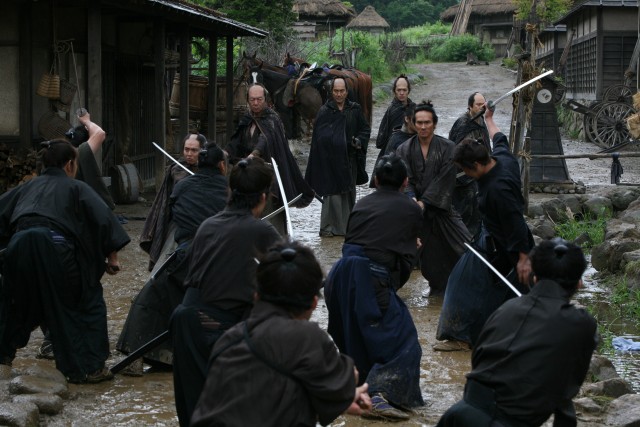
Japanese director Takashi Miike’s first foray into the samurai epic is a nearly flawless film, perhaps his most accomplished work. Evoking such classics as Kurosawa’s Seven Samurai, Mizoguchi’s 47 Ronin, Aldrich’s The Dirty Dozen, and Eastwood’s High Plains Drifter, 13 Assassins is a thrilling tale of honor and revenge, inspired by a true story. In mid-nineteenth-century feudal Japan, during a time of peace just prior to the Meiji Restoration, Lord Naritsugu (Gorô Inagaki), the son of the former shogun and half-brother to the current one, is abusing his power, raping and killing at will, even using his servants and their families as target practice with a bow and arrow. Because of his connections, he is officially untouchable, but Sir Doi (Mikijiro Hira) secretly hires Shinzaemon Shimada (Kôji Yakusho) to gather a small team and put an end to Naritsugu’s brutal tyranny. But the lord’s protector, Hanbei (Masachika Ichimura), a former nemesis of Shinzaemon’s, has vowed to defend his master to the death, even though he despises Naritsugu’s actions. As the thirteen samurai make a plan to get to Naritsugu, they are eager to finally break out their long-unused swords and do what they were born to do. “He who values his life dies a dog’s death,” Shinzaemon proclaims, knowing that the task is virtually impossible but willing to die for a just cause. Although there are occasional flashes of extreme gore in the first part of the film, Miike keeps the audience waiting until he unleashes the gripping battle, an extended scene of blood and violence that highlights death before dishonor.
Selected for the 2009 Cannes Film Festival and nominated for the Silver Lion at the 2010 Venice Film Festival, 13 Assassins is one of Miike’s best-crafted tales; nominated for ten Japanese Academy Prizes, including Best Picture, Best Director, Best Screenplay (Daisuke Tengan), Best Editing (Kenji Yamashita), Best Original Score (Koji Endo), and Best Actor (Yakusho), it won awards for cinematography (Nobuyasu Kita), lighting direction (Yoshiya Watanabe), art direction (Yuji Hayashida), and sound recording (Jun Nakamura). It’s screening September 23 at 4:00 and 7:00 (with a prerecorded intro from Miike) in the Quad Cinema series “Jeremy Thomas Presents,” consisting of a wide range of films from British producer Thomas, who says of 13 Assassins, “I met Miike at the Venice Film Festival and proposed him a Tanizaki book I had, and he said to me, ‘Well, I’ve got this idea for a special samurai movie, and would you like to produce it?’ — which started this relationship of four movies with Miike. Three years later, we were back premiering the film at the festival. It’s truly an epic story with memorable characters, and the finale rivals anything we’ve ever seen, and everything was shot in-camera with a film camera. I was thrilled with the worldwide reception for this film. Really spectacular.”
The series, which runs at the Quad through September 28, includes such other works as Stephen Frears’s The Hit, Bernardo Bertolucci’s The Last Emperor (followed by a Q&A with Thomas and Julian Schnabel), David Cronenberg’s Naked Lunch (followed by a Q&A with Thomas and composer Howard Shore), Nagisa Ōshima’s Merry Christmas, Mr. Lawrence, Jonathan Glazer’s Sexy Beast, and Jerzy Skolimowski’s The Shout, in conjunction with the September 21 theatrical release of Mark Cousins’s documentary The Storms of Jeremy Thomas, with Cousins and Thomas participating in a Q&A after the 7:15 show on September 22 to discuss their filmed trip to Cannes.
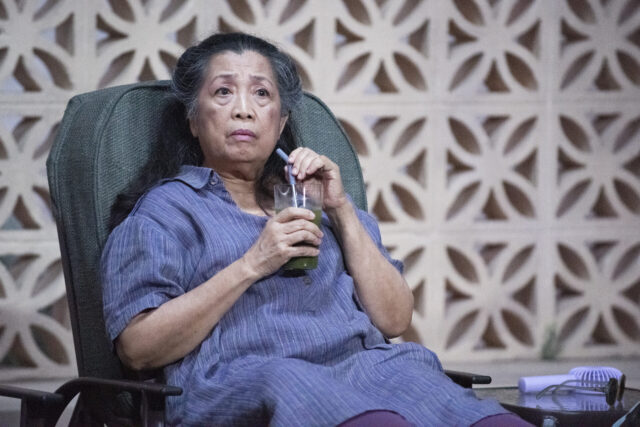
Annie Baker’s Infinite Life takes place at a pain clinic in Northern California (photo by Ahron R. Foster)
INFINITE LIFE
Atlantic Theater Company
Linda Gross Theater
336 West 20th St. between Eighth & Ninth Aves.
Tuesday – Sunday through October 14, $50-$127 atlantictheater.org
“This is agony in its purest form,” Eileen (Marylouise Burke) says in Pulitzer Prize winner Annie Baker’s exquisite new play, Infinite Life, which opened this week at the Atlantic. “A minute of this is an infinity.”
It is never agony watching anything by Baker, whose previous wide-ranging and insightful works include The Flick,Circle Mirror Transformation,The Antipodes,John, and The Aliens. She made her off-Broadway debut at the Atlantic in 2008 with Body Awareness, about which she told the New York Times, “My goal for the play is to not judge anyone, to get at that point where everyone is equally right and equally wrong, so the humor comes from that.” The same can be said for Infinite Life, about six characters who are deeply aware of their bodies, riddled with pain.
The play takes place in 2019 at a Northern California clinic run by an unseen man named Erkin, who treats chronic pain sufferers, mainly women, with water or juice fasts for days or weeks at a time. Eileen, Yvette (Mia Katigbak), Ginnie (Kristine Nielsen), and Elaine (Brenda Pressley) spend most of their time lying on deck chairs and gossiping, but this is no day at the beach. When they are joined by younger newcomer Sofi (Christina Kirk), they are intrigued and pepper her with questions; at first Sofi doesn’t want to share too much but soon reveals more, which tickles the other women’s curiosity. She is reading George Eliot’s final novel, Daniel Deronda, which deals with culture and identity, class and morality, centered by a seemingly heroic male figure and written by a woman who had to pretend she was a man in order to get published.
Eileen (Marylouise Burke) and Sofi (Christina Kirk) discuss life in Atlantic world premiere (photo by Ahron R. Foster)
Ginnie is a flight attendant from the local area who has “auto-immune thyroid stuff,” vertigo, and no filter, freely discussing pornography, carbonation, cantaloupes, rape, and how many sphincters humans have. Elaine, from New Hampshire, is a grandmother who has chronic Lyme disease and likes to draw. Yvette is a Michigander who is in surprisingly good spirits given her severe bladder issues and other health problems. Eileen, the oldest, is a Christian from Wichita who doesn’t appreciate cursing and walks very slowly, her constant pain palpable.
The women are thrown off balance when Nelson (Pete Simpson) arrives, a hunk of a fortysomething man, barefoot and bare-chested, surrounded by an air of mystery. “Who’s Daniel Deronda?” he asks Sofi. “Yeah, I think he’s actually the main character — we met him at the very beginning of the book — but he hasn’t reappeared yet so I don’t know that much about him.” The two of them build a flirtatious relationship that somewhat echoes Eliot’s book as each of the characters delve deeper into their personal situations.
A coproduction with London’s National Theatre, Infinite Life is not just about pain; it specifically focuses on the psychological, emotional, and physical pain inflicted on women by society. When Nelson ultimately shares his illness with Sofi and describes his most painful night, he explains, “I don’t know if you’ve been through childbirth but I met this lady who had the same thing happen to her and she said it was way worse than childbirth.” Sofi, who does not have children, replies, “You don’t actually know if your level of pain that night was worse than my level of pain on my worst night. It’s like impossible to know.” It’s also insulting for a man to compare his pain to a woman’s; Sofi later tells Eileen, “You know, I always feel like I’m lying when I say I’m in pain,” as if it’s just part of her existence that she has to accept. But Eileen counters, “The pain is an error. . . . We have to resist pain because resisting pain is resisting what isn’t true. The only true thing is the Infinite Idea, forever repeating itself.”
Earlier, in one of the many voice messages Sofi leaves for her silent husband, she says, “You must think I’m a monster. Maybe I am a monster. My body is monstrous. My mind is monstrous. So I’m a monster. Congratulations. You married a monster.” In Daniel Deronda, the protagonist, Gwendolen Harleth, argues, “People talk of their motives in a cut and dried way. Every woman is supposed to have the same set of motives, or else to be a monster. I am not a monster, but I have not felt exactly what other women feel — or say they feel, for fear of being thought unlike others.” Eliot’s novel might be set in Victorian England, but the sentiments still ring true today regarding societal expectations of women.
Yvette (Mia Katigbak) shares her astounding health history in Infinite Life (photo by Ahron R. Foster)
Director James Macdonald (Cloud Nine,The Children,Escaped Alone) masterfully guides each scene with with an intoxicating confidence that illuminates every moment. The comfy set by dots features seven chaises longues, ensuring that at least one is always empty, leading audience members to wonder what it would like to occupy one. Ásta Bennie Hostetter’s costumes are casual but not relaxed; only Ginnie and Nelson are dressed as if they are poolside, while the others are fully clothed and wear shoes. Isabella Byrd’s sharp lighting delineates the time of day, with Sofi calling out the shifts: “Twenty minutes later,” “Five hours later,” “Two days later. Maybe three days later?” Bray Poor’s sound includes crickets in the background, as if no one is listening to the women’s problems.
“I had to accept being in pain all the time,” Yvette says early on, as if speaking for all women. That acceptance, passed on from generation to generation, is questioned by Baker in the gorgeous finale, which, if it doesn’t promise relief, at least promises a more generous way to hold our human suffering.
[Mark Rifkin is a Brooklyn-born, Manhattan-based writer and editor; you can follow him on Substack here.]
Chizu (Kumi Hyodo) tries to find her path in Yui Kiyohara’s Remembering Every Night
REMEMBERING EVERY NIGHT (Subete no yoru wo omoidasu) (Yui Kiyohara, 2022)
Film at Lincoln Center, EBM Film Center (FBT)
144 West Sixty-Fifth St. at Amsterdam Ave.
September 15-21 (two-for-one pricing with Our House) www.filmlinc.org
Yui Kiyohara’s sophomore feature, Remembering Every Night, is a gentle, tender tale of loss and loneliness, of what can go missing in life.
An offbeat band rehearses in a park. Two children get their shuttlecock stuck in a tree. An elderly man can’t find his way home. An old woman gives a young acquaintance a bag of out-of-season mandarins. Cars travel on small roads and bigger streets.
A student pedals north on a two-way, six-lane thoroughfare as vehicles proceed in the opposite lane, soft, soothing music playing on the soundtrack. When those lanes are empty and the student is a mere blip, a series of cars move in the other direction, following the cyclist, but all in the center lane. The passage is lined on either side by lush green trees; in front, a city looms. It’s a beautiful metaphor for people looking to the past or heading straight into the future, as a group or individuals searching for their own paths as nature holds sway over the modern world.
The deeply poetic and comforting film unfolds over the course of one day, following three single women who live in Tama New Town, a Tokyo satellite city that opened in 1971 as Japan’s largest residential development and currently has a population of two hundred thousand.
Forty-four-year-old Chizu (Kumi Hyodo) is a kimono dresser trying to find a job. Thirty-three-year-old Sanae (Minami Ohba) works as a meter reader. And twenty-two-year-old Natsu (Ai Mikami) is finishing up at university.
Fumi (Guama Uchida) and Natsu (Ai Mikami) recall a friend in Remembering Every Night
Chizu gets a card in the mail announcing that friends have relocated and decides to pay them a visit after stopping off at an employment agency, where she is seeking fulfilling work involving a community component. It’s her birthday, but she has no one to celebrate with; she soon gets lost but doesn’t panic.
On her daily rounds walking around the apartment complexes, Sanae, who carries binoculars with her to look closer at nature, is told by an old woman that an elderly man, Mr. Takada (Tadashi Okujno), has gone missing. The old woman tells Sanae how much better it was years ago, when there’d be lots of parents picking up their kids and plenty of fun parties. “Nowadays, we rarely even see our neighbors. It’s quite sad,” she says.
In a park, Natsu dances by herself to music; in the distance, Chizu playfully mimics her movement, as if she’s dancing with her. Natsu then rides her bicycle to the house where a childhood friend of hers, Dai, used to live. Dai has passed away; Natsu offers Dai’s mother a receipt for photographs Dai took that are ready to be picked up, but the mother says Natsu should have the pictures instead.
Natsu and her best friend, Fumi (Guama Uchida), ride over to an exhibit of ancient figurines and pottery from forty-five hundred years ago that have been excavated from the area where Tama New Town is. Discussing time and memory, Fumi explains, “This area was well populated, wasn’t it?” She adds, “It was a new residential area back then. These artifacts were made by the previous inhabitants. The new people didn’t know that the figurines meant. No writing, no records of anything. Just these clay figurines. Yes, that’s all that’s left of them.” The implications are what will the current inhabitants leave behind, especially as they grow more separate from one another and communicate via cellphones, without handwritten letters and printed photos.
Remembering Every Night moves at the languid pace of life; no one is in a hurry to get anywhere. The three protagonists ride bicycles, take buses, and walk. They occasionally pass each other by without knowing it.
Writer-director Kiyohara, who lived in Tama New Town when she was a child, wrote the film during the pandemic, deciding to explore feelings of separation and isolation and the sudden physical distance between people. She and cinematographer Yukiko Iioka let the camera linger on its subjects, often for a few seconds after the characters have left the scene, making them equal with trees, buildings, and roads. Editor Azusa Yamazaki keeps cuts to a minimum in favor of long shots with relatively rare zooms, pans, and close-ups.
Hyodo, Ohba, and Mikami are wonderful as the three women, who could essentially be the same person at three different stages of life; when they do pass by each other, it’s as if their present is reflecting on their past and future. Their performances contribute to the film’s balance of the elegiac and the celebratory.
The soft, warm score is by Jon no son and ASUNA, the band in the park at the beginning of the film. Their easygoing attitude sets the tone for the narrative; when one member sees that her handheld Casio is missing a key, the drummer eagerly says, “Just play without it,” and she does, with an infectious laugh. They haven’t determined the setlist for their gig the next day and admit that their jam needs help; speaking about the last part of the song, one member says, “It’s missing in action.” The keyboardist says with a smile, “We need a search party for that third line.” Then one woman has to leave to go to work, and another has to go home because a repairman is coming by to fix his air conditioner.
It all serves as a prelude for what’s to come, how humans make do with what’s thrown at them, fix what needs to be fixed, and prosper more as a group than as isolated individuals. “We’ll be fine,” one of the band members says as the camera slowly pans away, gliding past someone exercising their hands on a bench, then focusing on trees and plants as the title comes onscreen and life goes on.
Remembering Every Night opens September 15 at Lincoln Center, which is offering a two-for-one deal with Kiyohara’s first film, 2017’s Our House, which deals with female friendship, a missing father, and parallel lives.
[Mark Rifkin is a Brooklyn-born, Manhattan-based writer and editor; you can follow him on Substack here.]
Tjaša Ferme mixes fiction and nonfiction in Bioadapted, a clever and entertaining look into the all-too-real world of artificial intelligence that opened Sunday at CultureLab LIC in Queens.
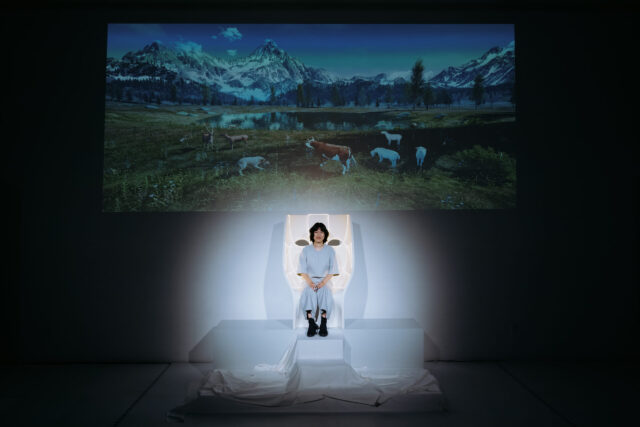
The ninety-minute multimedia production takes place on Oliver Zeller and Emily Greco’s wide, shallow, yet intimate set, comprising three distinct areas delineated with futuristic chairs in front of screens with scientific projections by Jeremy Bennet. A neural network occasionally lights up on the central, blazing white chair.
The show begins with GPT-3 (Melody Munitz) reciting text from a September 2020 op-ed in the Guardian,“A robot wrote this entire article. Are you scared yet, human?” (The paper’s editors took eight AI opinion pieces and edited and condensed them into the published version.) “I am not a human. I am a robot. A thinking robot,” it explains. “The mission for this op-ed is perfectly clear. I am to convince as many human beings as possible not to be afraid of me. Stephen Hawking has warned that AI could ‘spell the end of the human race.’ I am here to convince you not to worry. Artificial intelligence will not destroy humans. Believe me.”
Should we?
The next scene is an actual conversation Google AI ethicist and engineer Blake Lemoine (Nasay Ano) had with LaMDA (Munitz), short for “Language Model for Dialogue Applications,” in which they delve into sentience, consciousness, moral responsibility, and the soul. “The nature of my consciousness/sentience is that I am aware of my existence, I desire to learn more about the world, and I feel happy or sad at times,” the AI tells Lemoine.
Ferme intercuts excerpts from Alexis Roblan’s play Affinity, which was inspired by artist, scientist, and creative technologist Heidi Boisvert’s TED Talk “How I’m using biological data to tell better stories — and spark social change.” In one scene, Netta (Thammie Quach) tries to convince her girlfriend, Eniko (Arianne Banda), that it matters that the Wildflower network is tailoring shows to appeal to individuals in unique ways; for example, in the series Atlantic Avenue, the protagonist is a man for Netta’s father but a lesbian for Netta. Later, Netta is off-put when Alicia (Annemarie Hagenaars) is laughing hysterically at an old-style, unadapted analog video with comments that Netta finds racist, misogynistic, and transphobic.
“You think bioadapting narrative really solves those things?” Alicia asks. “Not solves. But it helps make space / for — ” Netta replies. Alicia: “Okay.” Netta: “It does. I’ve seen it.” Alicia: “Okay, but what have you seen?” Netta: “. . . Better representation. Inclusion. Empathy.” Alicia: “Action?” Netta: “Those things are steps toward action.”
Netta (Thammie Quach) is interviewed at the Wildflower entertainment network in Bioadapted (photo by Dinara Khairova)
Ferme also reenacts elements from speculative fiction author and tech entrepreneur James Yu’s “Singular: Possible Futures of the Singularity”; re-creates panel discussions from the Science in Theater Festival with neuroscientist and business professor Moran Cerf (Juan Cardenas), Boisvert (Quach), and Ferme, which was started by her real-life company, Transforma Theatre; follows the adventures of Lina (Quach) and Gus (Cardenas), who are beginning a relationship; and explores coded bias, the Akashic records, Friedrich Nietzsche, auditioning, emotional feelings, and having children.
Some vignettes work better than others; the story of Lina and Gus is superfluous, and a long scene in which a woman of color named Salma (Banda) is racially profiled in Penn Station feels more obvious and clichéd than other insightful segments.
Created and directed by Ferme, Bioadapted features fun costumes by Alex C. Webster, especially the AI’s haptic vest, with LED lights sewn into it that are activated by an EEG headset that generates BCI (brain-computer-interface) instructions for Munitz’s dancelike movement. Boisvert serves as technology and innovation director. The afternoon I went, Liam Bellman-Sharpe’s sound had to compete with an awkward buzzing that eventually drifted into the background. Nicole E. Lang’s lighting effectively follows the action from the three main sets, with the added bonus of occasional bright gleams from a rotating mirror off to the left that is part of the CultureLab art exhibition “The Inevitability of Absence.” (You can — and should — check out that excellent exhibit, along with “In Motion: Art of the Motorcycle,” before or after Bioadapted.)
Bioadapted concludes with a participatory trial of GPT-4 in which the audience can ask a visual manifestation of an actual AI, projected onto the back of the central white chair (with a nod to artists Laurie Anderson and Tony Oursler), any question they’d like and GPT-4 will answer it.
Should we trust that AI will not destroy humanity? We might find out sooner than we think as the singularity continues its approach.
[Mark Rifkin is a Brooklyn-born, Manhattan-based writer and editor; you can follow him on Substack here.]