twi-ny recommended events

KOREAN MOVIE NIGHT: ROMANCE JOE

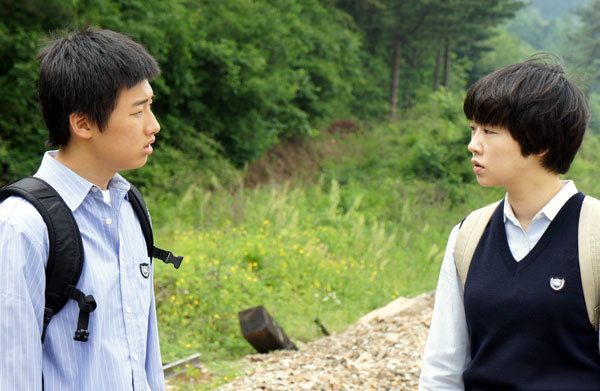
ROMANCE JOE is made up of an interweaving collection of related narratives built around the suicide of a famous actress

GEMS OF KOREAN CINEMA: ROMANCE JOE (RO-MAEN-SEU-JO) (Lee Kwang-kuk, 2011)
Tribeca Cinemas
54 Varick St. at Laight St.
Tuesday, September 11, free, 7:00
212-759-9550
www.koreanculture.org
www.tribecacinemas.com

Following in the footsteps of his mentor, Hong sang-soo, for whom he served as assistant director for five years, Lee Kwang-kuk’s debut film, Romance Joe, is a complex, engaging narrative about the art of storytelling. Made up of interweaving tales that eventually come together in surreal ways, mixing fantasy and reality, Romance Joe begins as an elderly mother and father (Kim Su-ung and Park Hye-jin) arrive in Seoul to surprise their son, a film director, but they are informed by his friend, Seo Dam (Kim Dong-hyeon), that he has disappeared after the suicide of a popular actress and has given up the film business. Soon Dam is telling his friend’s parents his own idea for a screenplay, about a determined young boy (Ryu Ui-hyeon) who runs away from home to find his mother at the only address he has for her, a teahouse brothel, where the owner, Re-ji (Shin Dong-mi), isn’t sure what to do with him. Meanwhile, Lee (Jo Han-cheol), a director with one hit under his belt and now facing writer’s block, has been left at a country inn without his cell phone, forced to finish his next screenplay. He orders coffee that is delivered by the movie-obsessed Re-ji, who tells him the story of Romance Joe (Kim Yeong-pil), a suicidal film director who relates a story of his own from his youth, when he (Lee David) saved a girl he loved, Cho-hee (Lee Chae-eun), after she slit her wrist in a forest. The various narratives — flashbacks, stories within stories, the modern-day framing, and script ideas — slowly merge in fascinating and confusing ways, reminiscent of such Hong films as Oki’s Movie, Like You Know It All, and Tale of Cinema. Although suicide is a major theme running through all of the stories, Romance Joe is not a sad melodrama; instead, it is an entertaining, thoughtful, if overly long exploration of narrative in film. Romance Joe, which was part of this year’s “New Directors, New Films” series at MoMA and Lincoln Center, is screening for free September 11 at Tribeca Cinemas, kicking off the Korean Cultural Service film series “Gems of Korean Cinema,” which focuses on indie works and continues September 25 with Moon Si-hyun’s Home Sweet Home and October 9 with Kim Joong-hyun’s Choked.

THE FRENCH OLD WAVE: GRAND ILLUSION

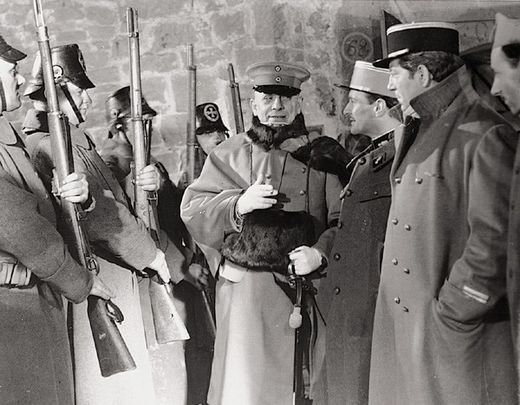
Jean Renoir’s GRAND ILLUSION continues its seventy-fifth anniversary celebration as part of Film Forum’s “The French Old Wave” series

GRAND ILLUSION (Jean Renoir, 1937)
Film Forum
209 West Houston St.
Monday, September 10, 5:10
Series continues through September 13
212-727-8110
www.filmforum.org

If you’ve never seen this remarkable cinematic achievement, prepare to be overwhelmed by Jean Renoir’s antiwar masterpiece. The first foreign film to be nominated for a Best Picture Oscar, Grand Illusion is set in a POW camp during WWI, where everyman pilot Lieutenant Maréchal (Jean Gabin), by-the-book Captain de Boieldieu (Pierre Fresnay), lovable Rosenthal (Marcel Dalio), and others are being held by the aristocratic Captain von Rauffenstein (an unforgettable Erich von Stroheim). Proclaimed “cinematic public enemy no. 1” by Joseph Goebbels, Grand Illusion takes on anti-Semitism, class structure, and religion in addition to war, a humanist film that is as relevant as ever seventy-five years after its initial release. It will be screening on September 10 at Film Forum as part of “The French Old Wave” in a new 35mm restored print (shown earlier this year at Film Forum), made in honor of the film’s seventy-fifth anniversary. The series continues through September 13 with such classics as Jean Cocteau’s Beauty and the Beast and Renoir’s The Rules of the Game in addition to double features of Jean Grémillon’s Lumière d’Eté and Le Ciel Est à Vous, Henri-Georges Clouzot’s L’Assassin Habite au 21 and Quai des Orfèvres, and Grémillon’s Remorques and L’Étrange Monsieur Victor.
HARRISON, TX: THREE PLAYS BY HORTON FOOTE

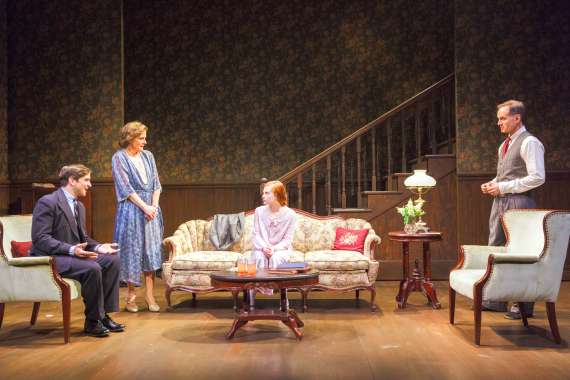
BLIND DATE is the first of three intimate short dramas by Horton Foote set in Harrison, Texas

Primary Stages, 59E59 Theaters
59 East 59th St, between Park & Madison Aves.
Tuesday – Sunday through September 15, $30-$70
212-279-4200
www.59e59.org

Texas-born playwright and screenwriter Horton Foote, who died in 2009 at the age of ninety-two after a long, fruitful career, had an uncanny knack for capturing the inherent beauty and heartbreak of American life, putting realistic characters in believable situations, just going through their daily chores of merely existing. He is best known for such films as Tender Mercies and To Kill a Mockingbird (for which he won an Oscar for Best Adapted Screenplay) and such plays as The Trip to Bountiful, the Pulitzer Prize-winning Young Man from Atlanta, and the three-part “Orphans’ Home Cycle.” His intoxicating slice-of-life Americana is currently on view in Harrison, TX, a compilation of three short works, ably directed by Pam MacKinnon (Clybourne Park), that have been brought together at Primary Stages. Blind Date is set in Harrison in 1928, on the cusp of the Great Depression, as pouty sourpuss Sarah Nancy (Andrea Lynn Green) has been sent to live with her aunt Dolores (Hallie Foote, one of Horton’s daughters) and uncle Robert (Devon Abner). Sarah Nancy is a mopey, bored young woman who’d rather hang out in her room than have to talk to anyone, especially young men, but Dolores is determined to get her a boyfriend and has thus set him up with Felix (Evan Jonigkeit), a local insurance salesman who is due to show up any minute. Dolores tries to coach Sarah Nancy on how to be a better conversationalist while also attempting to take care of her rather hapless husband, but when Felix arrives, things go a bit crazy.

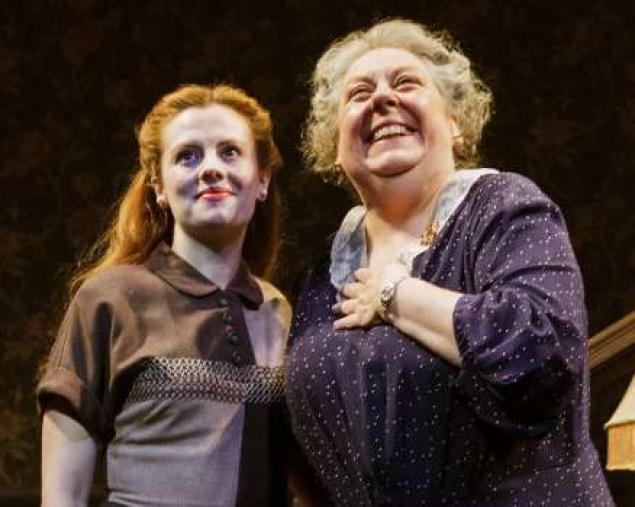
Andrea Lynn Green and Jayne Houdyshell think of the good times in Horton Foote’s THE MIDNIGHT CALLER

In The One-Armed Man, also set in 1928, an angry former employee, McHenry (Alexander Cendese), is demanding to see his old boss, C. W. Rowe (Jeremy Bobb), so he can get back the arm he lost in an accident, but Rowe seems more intent on railing on about his personal success to his accountant, Pinkey (Abner). Rowe offers McHenry five dollars to go away, but it’s going to take a lot more than money to make things straight. The third play, The Midnight Caller, is set nearly a quarter-century later, but it feels like Harrison hasn’t changed a bit as a trio of gossipy women — judgmental chatterbox Alma Jean Jordan (Mary Bacon), “Cutie” Spencer (Green), and older teacher Miss Rowena Douglas (Jayne Houdyshell) — debate the upcoming arrival of Helen Crews (Jenny Dare Paulin), a woman with a reputation who is moving into their boarding house after being thrown out by her mother for her questionable activities. When a stranger, Ralph Johnston (Bobb), also shows up looking for a room, the situation gets a lot more complicated. Unfortunately, the eventual appearance of Helen’s former flame, Harvey Weems (Cendese), severely detracts from the play, which is otherwise sweet and engaging. In the first and third works, Foote’s snappy down-home dialogue is the centerpiece, adding beautiful, funny, poetic language to the relatively simple goings-on, with characters that are easy to warm to, especially Miss Rowena, who looks out the window, remembering what it was like as a child gazing out at the fireflies. The middle piece is far more abrupt and shocking, providing a strong counterpoint that would have felt significantly out of place had it started or finished the trio of plays. Taken together, the three pieces, running approximately one hundred minutes and performed without an intermission, offer a fascinating examination of an old-time America that might not be quite as far away as one might imagine. (Harrison, TX runs through September 15 and will be followed at Primary Stages by Him, a new play by another of Foote’s daughters, Daisy Foote.)

SEE IT BIG! THE LAST PICTURE SHOW

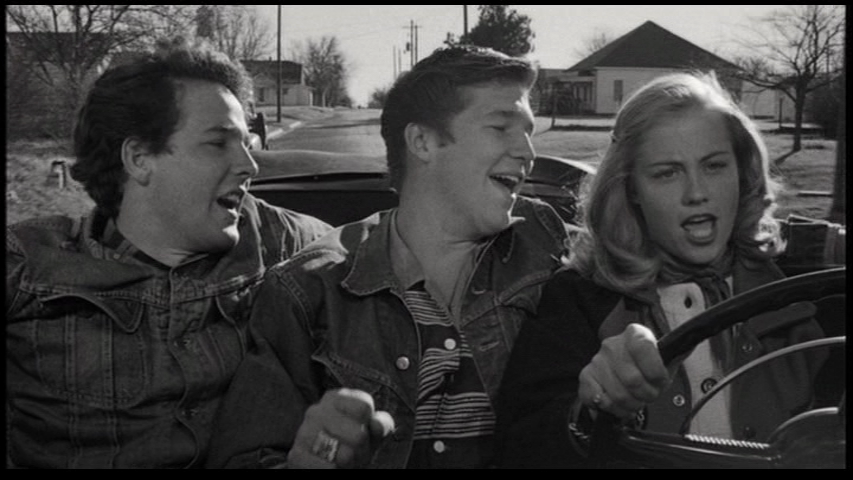
Timothy Bottoms, Jeff Bridges, and Cybill Shepherd prepare for adulthood in THE LAST PICTURE SHOW

THE LAST PICTURE SHOW (Peter Bogdanovich, 1971)
Museum of the Moving Image
35th Ave. at 36th St., Astoria
Sunday, September 9, free with museum admission, 7:00
718-777-6800
www.movingimage.us

The summer season of the Museum of the Moving Image “See It Big!” series concludes this weekend with two very different films, both shot by cinematographer Robert Surtees: William Wyler’s glorious Ben-Hur, for which he won his third Oscar, and Peter Bogdanovich’s much more subtle The Last Picture Show, a tender-hearted, poignant portrait of sexual awakening and coming-of-age in a sleepy Texas town. Adapted from the Larry McMurtry novel by the author and the director, the film is set in the early 1950s, focusing on Sonny Crawford (Timothy Bottoms), a teenager who works at the local pool hall with Billy (Timothy’s brother Sam), a simple-minded boy who needs special caring. Sonny’s best friend, Duane Jackson (Oscar-nominated Jeff Bridges), is dating the prettiest girl in school, Jacy Farrow (Cybill Shepherd, in her film debut), who is getting ready to test out the sexual waters, sneaking away on a date with Lester Marlow (Randy Quaid), who takes her to a naked-swimming party in a wealthier suburb of Wichita Falls. Meanwhile, Sonny breaks up with his girlfriend, Charlene Druggs (Sharon Taggart), and becomes drawn to the sad, unhappy Ruth Popper (an Oscar-winning Cloris Leachman), the wife of his football coach (Bill Thurman). The outstanding all-star cast also features Oscar-nominated Ellen Burstyn as Lois, Jacy’s mother; Eileen Brennan as a waitress in the local diner who makes cheeseburgers for Sonny; Clu Gulager as a working man who has a thing for Lois; Frank Marshall, who went on to become a big-time producer, as high school student Tommy Logan; and Oscar winner Ben Johnson as Sam the Lion, the moral center of the town and owner of the pool hall, diner, and movie theater, which shows such films as Father of the Bride and Red River. Surtees shoots The Last Picture Show in a sentimental black-and-white that gives the film an old-fashioned feel, as if it’s a part of Americana that is fading away. Bogdanovich also chose to have no original score, instead populating the tale with country songs by Hank Williams, Bob Wills and the Texas Playboys, Lefty Frizzell, Tony Bennett, and others singing tales of woe. In many ways the film is the flip side of George Lucas’s 1973 hit American Graffiti, which is set ten years later but looks like it’s from another century; it also has a lot in common with François Truffaut’s 1962 classic Jules and Jim.. Nominated for eight Oscars including Best Picture and Best Director, The Last Picture Show is an unforgettable slice-of-life drama that will break your heart over and over again.

DAILY NEWS BLOCK PARTY

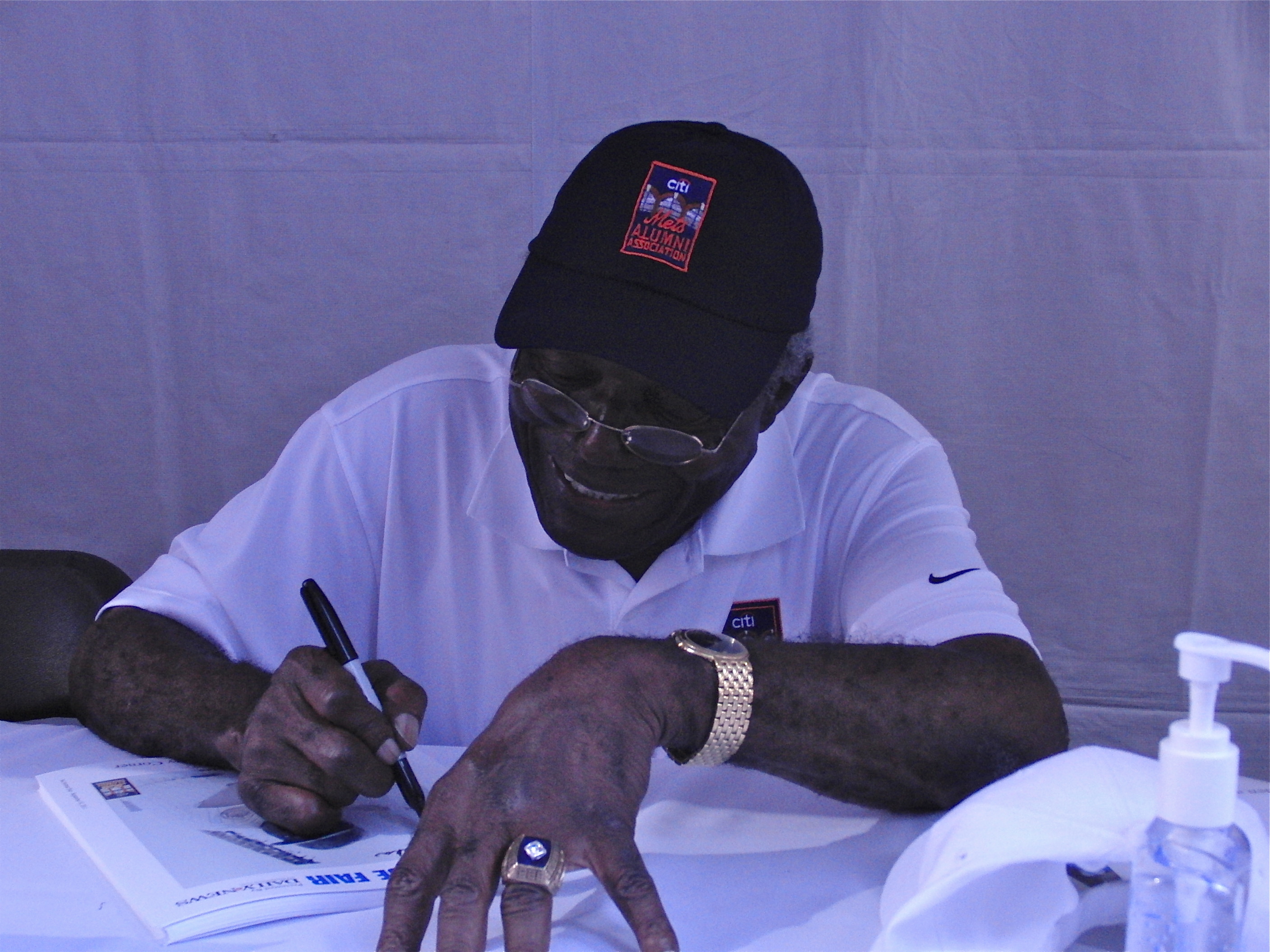
Ed Charles will be back at the Daily News Block Party to sign autographs and show off his championship ring on Sunday (photo by twi-ny/mdr)

The Third Avenue Street Fair takes place on Sunday from 12 noon to 5:00, between 66th & 86th Sts., but what makes this one a little different is that the Daily News hosts a block party from 76th to 77th Sts., featuring an all-star lineup of meet-and-greets, autograph signings, and live music and comedy. Among this year’s media participants are the News’s own Bill Madden and Denis Hamill, channel 4’s Pat Battle, Lauren Scala, and Raphael Miranda, NY1’s Cheryl Wills, FOX 5’s Greg Kelly and Dari Alexander, and MY9’s Brenda Blackmon. Among the current and former athletes on hand will be boxers Bryant Jennings, Riddick Bowe, Steve Cunningham, Danny Jacobs, Marcus Browne, and Mark Breland, Guyanese sprinter Aliann Pompey, and Mets champion third baseman Ed Charles, along with such pseudo-celebrities as JoJo Spatafora of Big Brother, Elizabeth Vashisht of VH1’s Tough Love, Raquel Castro of The Voice, Christina Salgado and Jenna Russo of Oxygen’s Bad Girls Club, and the Naked Cowboy and the Naked Cowgirl. Live performers include the C.A.S.Y.M. Orchestra, Gary Russo, Kool Mike Ski, the Edwin Vazquez Band, and Taina.

BAM FISHER NEXT WAVE: ECLIPSE

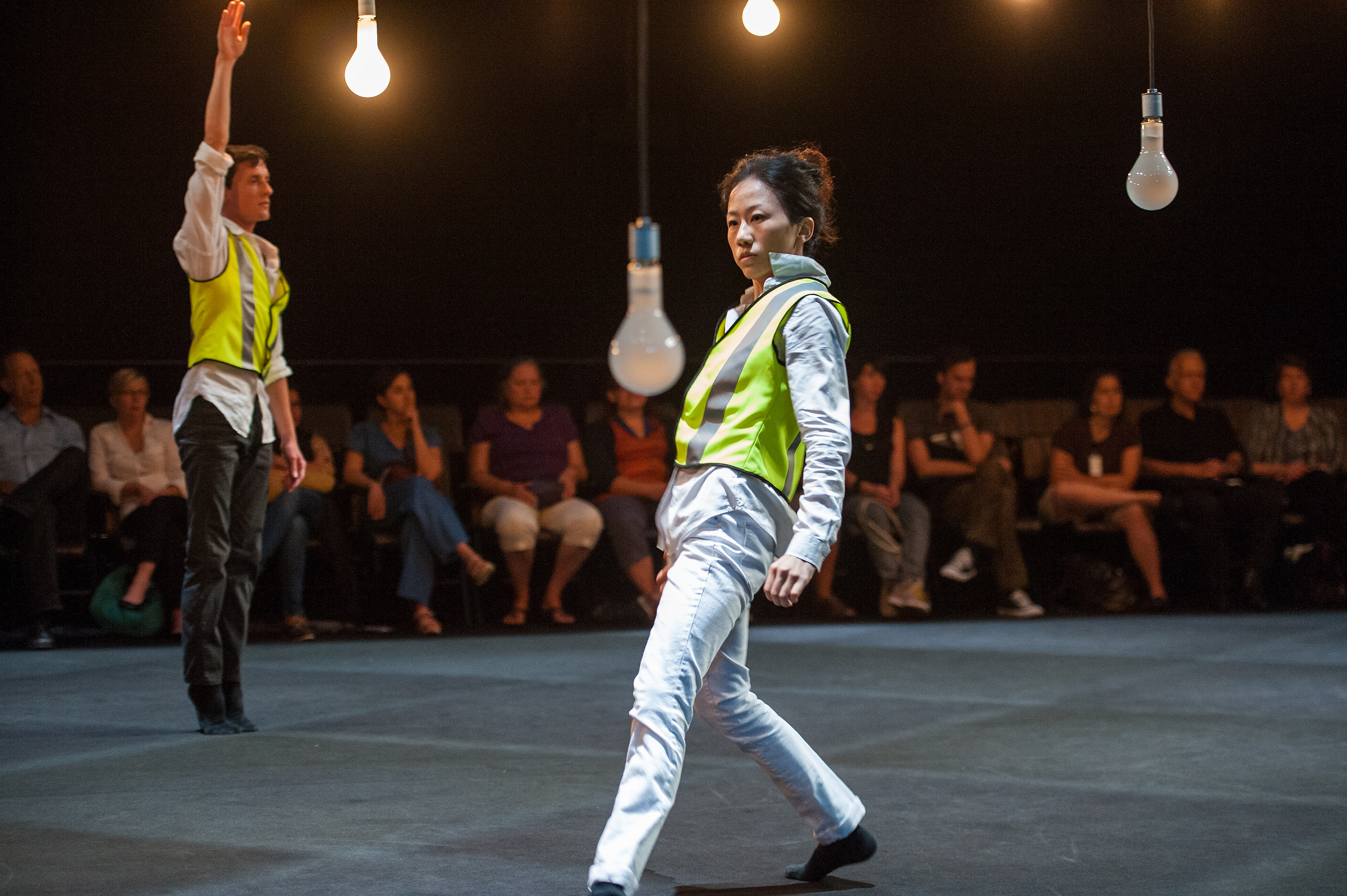
Jonah Bokaer and Anthony McCall present the first production in new BAM black-box space (photo by Stephanie Berger)

BAM Fisher, Fishman Space
321 Ashland Pl.
Through Sunday, September 9, $20
718-636-4100
www.bam.org

BAM has inaugurated its new black-box theater, the 250-seat Fishman Space in the Fisher Building, with the illuminating Eclipse. Part of BAM’s thirtieth Next Wave Festival, the seventy-minute piece is a collaboration between thirty-year-old Ithaca-born choreographer and Chez Bushwick founder Jonah Bokaer and sixty-six-year-old “solid-light” British installation artist Anthony McCall, commissioned by BAM specifically for the Fishman. Performed by Tal Adler-Arieli, Sara Procopio, CC Chang, and Julie Seitel, with Bokaer soloing at the beginning and the end, Eclipse takes place on a soft, dark floor, with the audience sitting two or three rows deep on all four sides, in addition to balcony seats. (All seating is general admission for this show.) Thirty-six lightbulbs hang from the ceiling in diagonal rows and at different heights, going on and off at timed intervals as the dancers move under and around them to the whirr of an old-fashioned movie projector, courtesy of sound designer David Grubbs. Wearing socks, button-down white shirts, and either white or gray cuffed pants — as well as, at times, a vest that is part school crossing guard, part airport ramp agent — the four main dancers walk to the four corners of the stage, stand face-to-face with the audience, and meet at the center, where they perform slow duets and trios. Shadows cast by the lightbulbs and spotlights cast geometric patterns on the floor, particularly triangles at the corners and a square at the center, where much of the more intricate, sculptural choreography occurs. The overall effect is supposed to evoke a live, three-dimensional, four-sided cinematic experience, with close-ups and long shots all in deep focus, but some of those aspects seem to get lost, at least for those audience members seated downstairs. Perhaps the people sitting in the balcony get a better angle of the pathways and changing geography created by the bulbs, supervised by lighting designer Aaron Copp. Still, Eclipse shines a fascinating light on BAM’s new venue, which will feature more experimental productions, with all tickets $20. Also playing the Fishman this month are Nora Chipaumire’s Miriam, Derrick Adams’s The Channel, and Ian and Chad’s Next Wave of Song.

BRUCE HIGH QUALITY FOUNDATION: ART HISTORY WITH LABOR / OPEN HOUSE

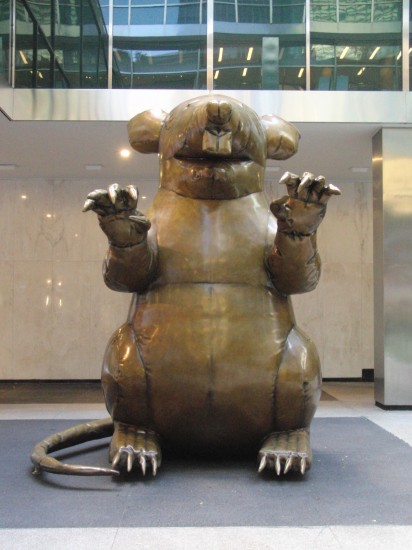
Bronze rat watches over Bruce High Quality Foundation installation in Lever House (photo by twi-ny/mdr)

Lever House
390 Park Ave. at 54th St.
Through October 1
Admission: free
www.leverhouseartcollection.com

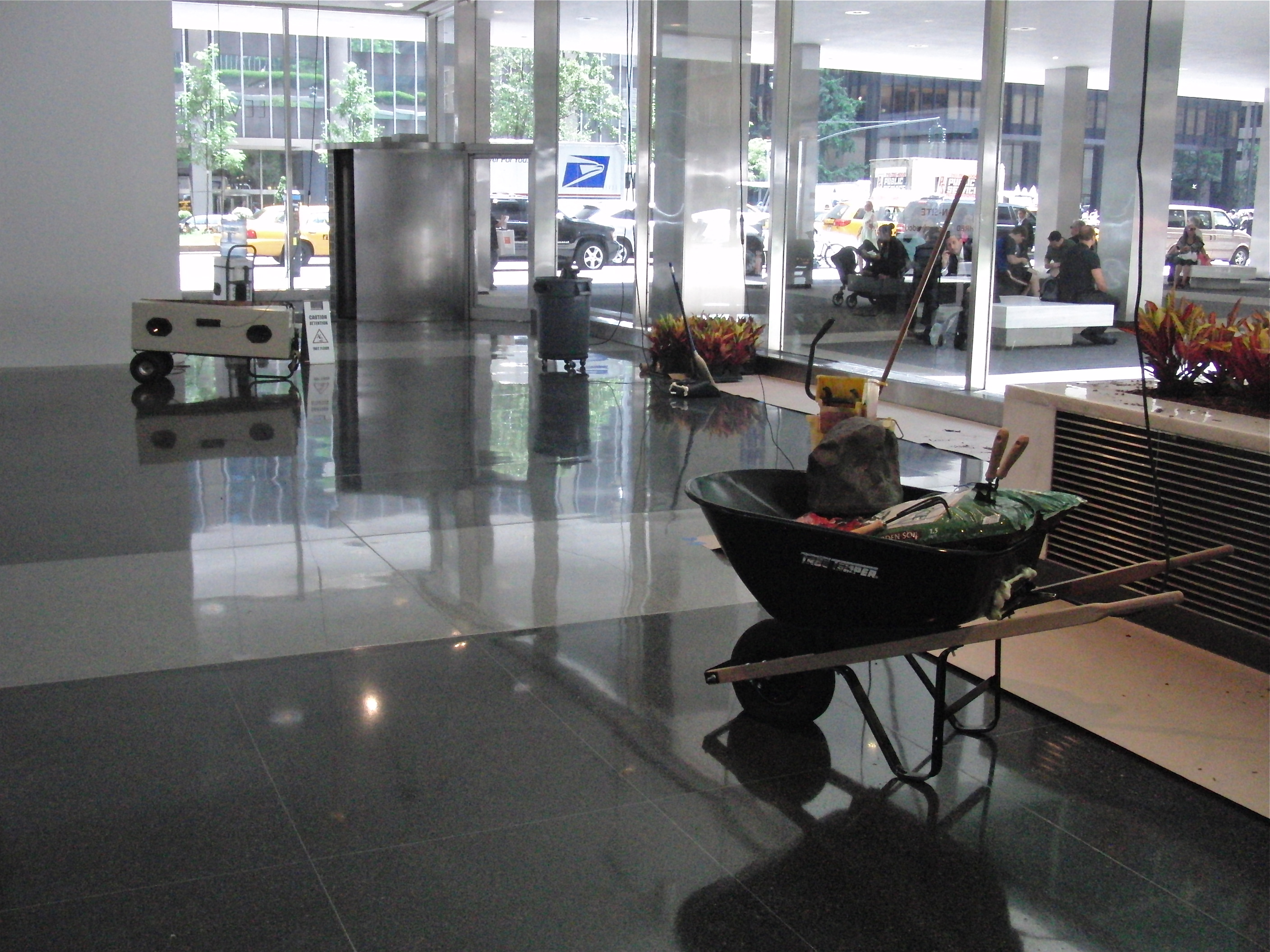
When we were photographing the latest display in the Lever House lobby a few days before the official opening, a young man in a suit, seemingly on his way to lunch, stopped us and asked, “What is this?” When we told him it was an art installation by the Bruce High Quality Foundation, he just looked blankly around and said, “Is it finished?” We said that we thought it was probably pretty close to completion, if not done yet, and he sneered. “What the hell! I gotta walk through this every day?” And he stormed off, shaking his head. An arts collaborative formed eight years ago and named for a fictional character, Bruce High Quality, who supposedly died in the September 11 terrorist attacks, BHQF creates multimedia installations and performances that comment on the state of art, politics, and the world. Indeed, “Art History with Labor” at first appears unfinished, with working materials all around the lobby, including a bucket with a mop, a wheelbarrow with a bag of soil, a floor polisher, a ladder, a trash can, and other elements that make it look like a construction site. Meanwhile, outside in the plaza, a giant rat faces the gallery, growling, but instead of his being another blow-up Scabby the Rat seen at so many city construction sites that employ nonunion workers, this twelve-foot-high bronze casting is called “The New Colossus,” directly evoking the 1883 Emma Lazarus poem that is on a plaque within the Statue of Liberty (“‘Give me your tired, your poor, your huddled masses yearning to breathe free’”).

The Bruce High Quality Foundation reimagines Martin Luther’s 95 Theses for the modern age (photo by twi-ny/mdr)

But everything is part of the exhibition, along with a lone briefcase, an old watercooler, and a knocked-over filing cabinet spilling out printouts of “Art History with Labor: 95 Theses.” Free for the taking, the stapled-together four pages mimic Martin Luther’s 1517 document, a major force in the arrival of the Protestant Reformation, with quotes from Luther as well as Jean-Luc Godard, Roland Barthes, Andy Warhol, Bruce Nauman, Oscar Wilde, Jean-Paul Sartre, Jamie Dimon, Thomas Edison, and Sun Tzu in addition to facts about Ayn Rand, the Art Workers Guild, Auschwitz, Nikola Tesla, Paul Robeson, Iwo Jima, and the Lever Brothers, who built the company town Port Sunlight in 1888 for the men and women working in their soap factory. Each object in the lobby is equipped with a speaker pronouncing the theses, accompanied by a video, examining the nature of art and labor and how they have intertwined through the ages. The exhibit also includes “Double Iwo Jima,” a two-panel painting that raises questions about art, truth, propaganda, and labor by re-creating multiple images of Joe Rosenthal’s Pulitzer Prize-winning photograph. So, is the installation actually finished? One could argue that it’s only a start to further investigation on the part of the visitor. You can find out more about the Bruce High Quality Foundation and their unaccredited art university (a self-described “‘fuck you’ to the hegemony of critical solemnity and market-mediocre despair”) on Sunday, September 9, when they host an open house at their headquarters at 34 Ave. A, and there will be a closing reception for “Art History with Labor” at Lever House on October 1.