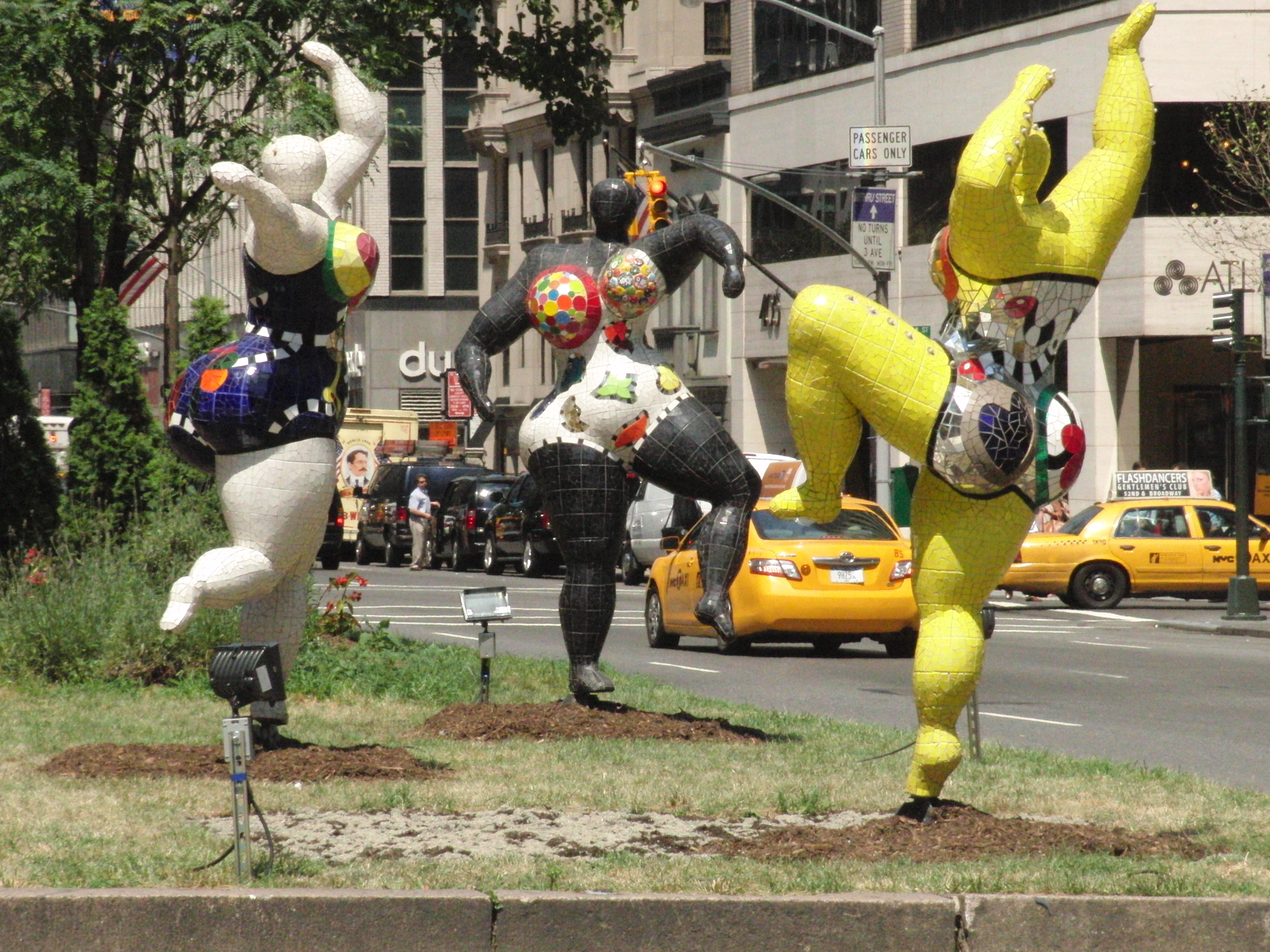
Niki de Saint Phalle’s “Les Trois Graces” dance for joy on Park Ave. (photo by twi-ny/mdr)
Park Avenue Malls
Park Ave. between 52nd & 60th Sts.
Through November 15, free
www.nikidesaintphalle.org
nikki de saint phalle slideshow
You don’t have to go to the Tarot Garden in Tuscany, Noah’s Ark in Jerusalem, or the Queen Califias Magic Circle in Escondido to see a sculpture park designed by French artist Niki de Saint Phalle. In commemoration of the tenth anniversary of her death — she died of emphysema in 2002 — the Niki Charitable Art Foundation has teamed up with the Nohra Haime Gallery to install ten monumental sculptures along the Park Ave. malls, big, bold figures that bring a different kind of life to one of the world’s most famous thoroughfares. An eclectic character who was also a model, a filmmaker, a playwright, and a feminist, Saint Phalle was the daughter of a count and hung around in impressive artistic circles; among her friends, acquaintances, and colleagues were Robert Rauschenberg, Larry Rivers, Jean Tinguely (who became one of her husbands), Ed Kienholz, Kenneth Koch, and Merce Cunningham. In fact, it was the pregnancy of Rivers’s wife, Clarice, that inspired Saint Phalle to begin her bold, empowering Nana sculptures of strong women; several Nanas are on view along Park Ave., including “Nana on a Dolphin,” in which an orange woman holding a ball is balancing on a dolphin that seems to be swimming through the air, and “Les Trois Graces,” which consists of three goddesses — one black, one white, one yellow — proudly strutting their stuff. A colorful combination of Fernand Botero’s oversized characters and Antoni Gaudí´s playful architectural style, the sculptures are made of polyester, resin, ceramics, mirrors, and stained glass. As you continue along the malls, you’ll come upon tributes to basketball legend Michael Jordan, baseball Hall of Famer Tony Gwynn, and jazz giants Miles Davis and Louis Armstrong, from Saint Phalle’s Black Heroes series. There’s also a Native American-inspired “Grand Step Totem” as well as “Les Baigneurs” (“The Bathers”), in which a man and a woman play on the water. At the northern end of the rather unique procession, “Arbre Serpents” references Eve in the Garden of Eden as multiple snake heads lash out in every direction, finding sin wherever they look. After visiting Barcelona in 1955 and falling in love with Gaudí´s Parc Guell, Saint Phalle wrote, “I met both my master and my destiny. I trembled all over. I knew that I was meant to build my own Garden of Joy. A little corner of Paradise. A meeting place between man and nature.” She might have been referring to the Tarot Garden, but it also applies to this happy parade on Park Ave.


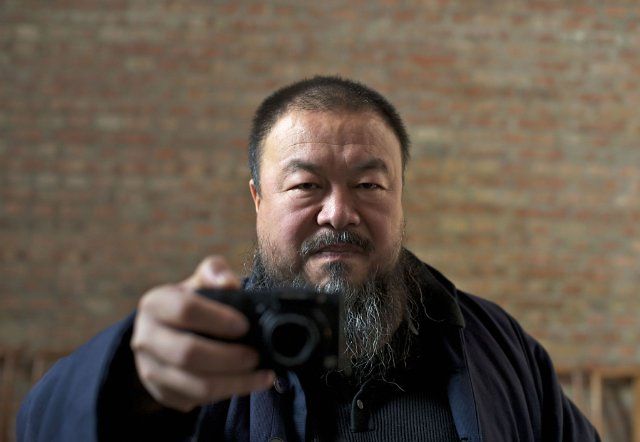
 “I consider myself more of a chess player,” Ai Weiwei says at the beginning of Never Sorry, Alison Klayman’s revealing documentary about the larger-than-life Chinese artist and dissident. “My opponent makes a move, I make a move. Now I’m waiting for my opponent to make the next move.” Over the last several years, Ai has become perhaps the most famous and controversial artist in the world, primarily since he participated in the design of Beijing National Stadium, known as the Bird’s Nest, for the 2008 Summer Olympics, then denounced the Games on political grounds. Ai gives director, producer, and cinematographer Klayman, making her first full-length film, remarkable access to his personal and professional life as he gets physically abused by Chinese police, prepares to open major exhibits in Munich and London, and visits with his young son, Ai Lao, the result of a tryst with Wang Fen, an editor on his underground films. Klayman speaks with Ai Weiwei’s devoted wife, Lu Qing, an artist who publicly fought for his freedom when he disappeared in 2011; his mother, Gao Ying, who spent time in a labor camp with her dissident-poet husband, the late Ai Quing; and such fellow Chinese artists and critics as Chen Danqing, Feng Boyi, Hsieh Tehching, and Gu Changwei, who speak admiringly of Ai’s dedication to his art and his fearless search for the truth. A round man with a long, graying bear, Ai is a fascinating, complicated character, a gentle bull who openly criticizes his country because he loves it so much. He is a social media giant, making documentaries that are available for free on the internet and revolutionizing the way Twitter and the blogosphere are used. Ai risks his own freedom by demanding freedom for all, calling for government transparency before and after he is secretly arrested, not afraid of the potential repercussions. And he is also a proud cat lover — more than forty felines regularly roam around his studio — eagerly showing off one talented kitty that has a unique way of opening a door. Ai Weiwei: Never Sorry shows Ai to be an honorable, supremely principled human being who has deep respect for the history of China and a fierce determination to improve its future, no matter the personal cost. The film completed its extended run at the IFC Center on November 8, but it will have an encore screening there on November 13, with Klayman on hand, as part of the DOC NYC festival, a week of nonfiction screenings that also includes such works as Emad Burnat and Guy Davidi’s 5 Broken Cameras, with Michael Moore in attendance; Rob Fruchtman and Lisa Fruchtman’s Sweet Dreams, with the directors and special guests participating in a discussion; and Mary Kerr’s