Yannick Lebrun and Jacqueline Green perform in Alvin Ailey premiere of Jirí Kylián’s PETITE MORT (photo by Paul Kolnik)
New York City Center
130 West 56th St. between Sixth & Seventh Aves.
Through December 30, $25-$135
212-581-1212
www.alvinailey.org
www.nycitycenter.org
Alvin Ailey American Dance Theater’s all-new program on December 16 was one of the most exciting nights of dance of the year. The evening began with the company premiere of Czech choreographer Jiří Kylián’s Petite Mort, commissioned for the 1991 Salzburg Festival honoring the two hundredth anniversary of the death of Wolfgang Amadeus Mozart. Set to Mozart’s Piano Concerto in A Major – Adagio and Piano Concerto in C Major – Andante, the eighteen-minute piece starts off with six male dancers standing over fencing foils, which they soon pick up and slice through the air. Meanwhile, a half dozen women linger in the background, hovering behind black Baroque dresses that they soon push across the floor. It’s a wildly imaginative work that balances humor with seriousness as it conjures up thoughts of war and mutilation. (Petite Mort will also be performed December 23, 26, and 30 as part of Ailey’s annual month-long season at City Center.) After a pause, Renaldo Gardner and Michael Francis McBride took the stage for the company premiere of Ailey artistic director Robert Battle’s Strange Humors, a short, energetic duet, originally choreographed for Parsons Dance Company in 1998, in which the bare-chested dancers, in bright orange Missoni pants redesigned by Jon Taylor, deliriously shake, move, and groove to a score by John Mackey that mixes African percussion with Middle Eastern melodies. The title comes from a quote by Maya Angelou: “When I think of death, and of late the idea has come with alarming frequency, I seem at peace with the idea that a day will dawn when I will no longer be among those living in this valley of strange humors.” (Strange Humors is also scheduled for December 19, 22, 26, 27, 28, and 30.)
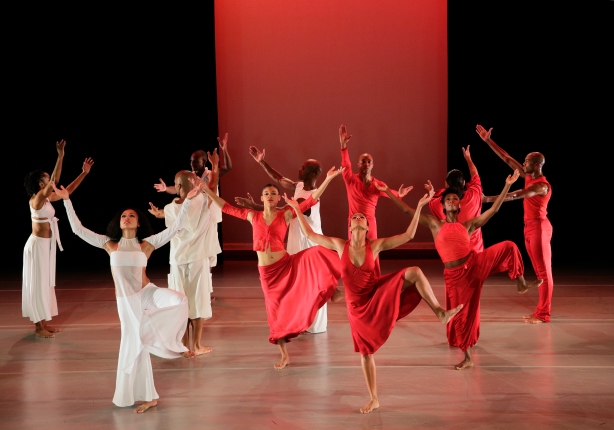
Ronald K. Brown’s rapturous GRACE is more dazzling than ever in new Ailey production (photo by Paul Kolnik)
After the first of two intermissions, AAADT presented the world premiere of hot choreographer Kyle Abraham’s Another Night, a sort-of sequel to the Ailey classic “Night Creature.” Set to Art Blakey and the Jazz Messengers’ version of Dizzy Gillespie’s “A Night in Tunisia,” the sixteen-minute piece is led by Rachael McLaren, shimmering in a blue dress and gliding across the stage, joined by nine other dancers in bright clothing who are enjoying a night on the town, checking out one another’s moves, pairing off into duets (possible pick-ups?), and just generally having a great time. (The fun will be repeated December 19, 22, 27, and 30.) The evening concluded with a stunning new production of Ronald K. Brown’s Grace, which was commissioned for AAADT in 1999. The remarkable Linda Celeste Sims emerges from behind a scrim in the back, under white light, in a white dress, elegantly dancing to Jimmy McPhail singing Duke Ellington’s “Come Sunday.” As the music shifts to Roy Davis Jr., Paul Johnson, and Fela Kuti, Sims is joined by four other women and six men (including guest artist and former Ailey star Matthew Rushing) in red or white costumes by Omatayo Wunmi Olaiya. Incorporating Brown’s trademark West African–influenced movement, the dancers reach for the sky, seeking enlightenment as sinners (in red) become angels (in white) and look toward heaven. Grace is an exhilarating, rapturous work, filled with an innate, infectious spirituality that resonates throughout the audience. (Grace continues December 19, 23, 26, and 30.)
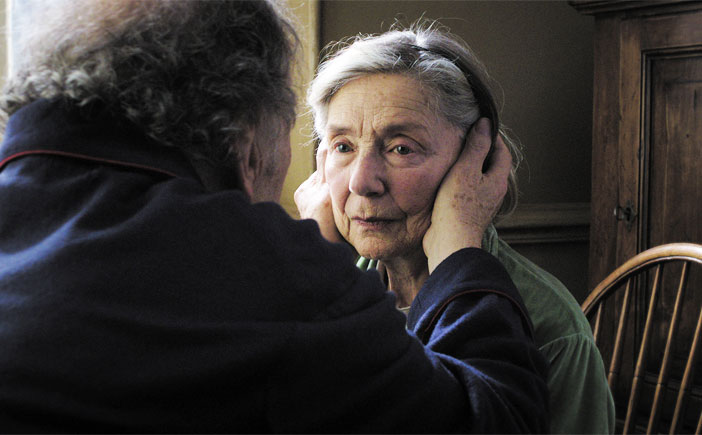
 Legendary French actor Jean-Louis Trintignant puts an exclamation point on his long, distinguished career with Amour, one of the most beautiful love stories ever told. In his first film in nearly a decade, Trintignant, the star of such classics as Z, My Night at Maud’s, A Man and a Woman, and The Conformist, plays Georges, an octogenarian who is immediately concerned when his wife, Anne (Emmanuelle Riva), suddenly freezes for a few moments, unable to speak, hear, move, or recognize anything. So begins a downward spiral in which Georges takes care of his ailing wife by himself, refusing help from his daughter, Eva (Isabelle Huppert), as he faces the grim situation with grace and dignity. A genuine romance for the ages, Amour is brilliantly written and directed by Michael Haneke, earning the German filmmaker his second Palme d’Or, following 2009’s The White Ribbon. Haneke (Cache, The Piano Teacher) and cinematographer Darius Khondji allow the heartbreaking tale to unfold in long interior shots with very little camera movement, spread across more than two hours. Despite its length, the film is far from torturous; instead, it is filled with quietly beautiful moments. Trintignant, who just turned eighty-two, is magnificent as Georges, his every physical movement and eye glance rendered with powerful yet gentle emotions, whether he’s preparing food for Anne or trying to catch a bird that has flown into the apartment. It’s an unforgettable performance in an unforgettable film.
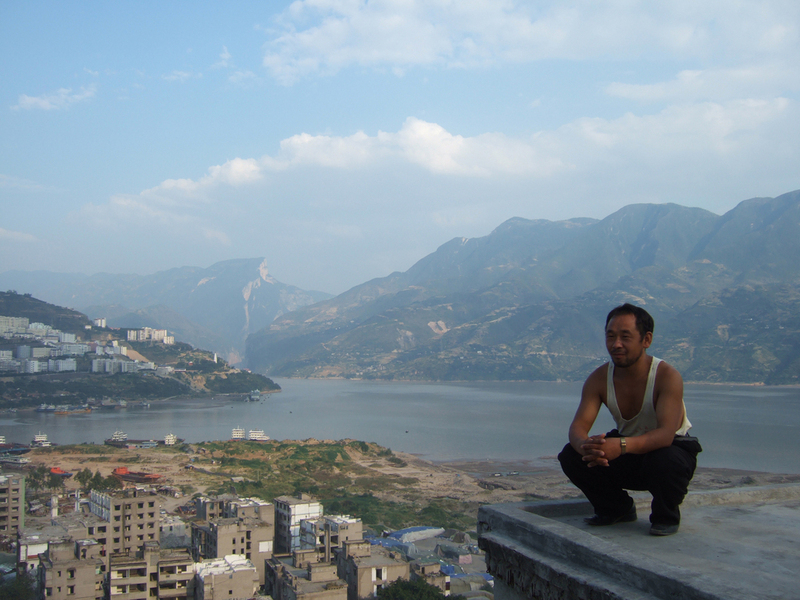
 Sixth Generation Chinese film director Jia Zhangke won the Golden Lion for Best Film at the Venice Film Festival for Still Life, his beautiful, elegiac, documentary-like examination of displaced family. Jia sets his film around the ongoing, controversial Three Gorges Dam project, which has forced millions of residents from their homes. Han Sanming, a miner from Shanxi, arrives in the former town of Fengjie, looking for the daughter he hasn’t seen in sixteen years, since she was a baby. Meanwhile, a young nurse, Shen Hong, is seeking out her husband, a construction executive whom she hasn’t heard from in two years. Using nonprofessional actors, Jia (Platform, The World) tells their heartbreaking stories virtually in slow motion, with many scenes driven by Han’s tired eyes, featuring little or no dialogue. He gets a job helping tear down buildings, in direct contrast to his desire to rebuild his relationship with his long-lost family. Jia’s gentle camera reveals how China, in its quest for modernization and financial power, has left behind so many of its people, the heart and soul of the land that has literally been torn out from under them. A small gem, Still Life is screening December 20 at 9:00 in a new 35mm print as part of the IFC Center series “Road Movies: Directed and Selected by Walter Salles,” in conjunction with the December 21 theatrical release of Salles’s adaptation of Jack Kerouac’s On the Road.