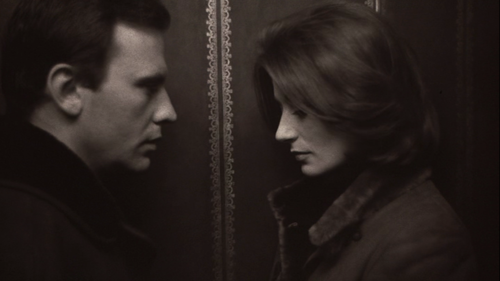
Anouk Aimée and Jean-Louis Trintignant play characters trying to escape their pasts in Claude Lelouch’s A MAN AND A WOMAN
A MAN AND A WOMAN (UN HOMME ET UNE FEMME) (Claude Lelouch, 1966)
Film Forum
209 West Houston St.
Sunday, December 16, and Monday, December 17
Series runs through December 20
212-727-8110
www.filmforum.org
 Winner of both the Oscar for Best Foreign Language Film and the Palme d’Or at Cannes, Claude Lelouch’s A Man and a Woman is one of the most popular, and most unusual, romantic love stories ever put on film. Oscar-nominated Anouk Aimée stars as Anne Gauthier and Jean-Louis Trintignant as Jean-Louis Duroc, two people who each has a child in a boarding school in Deauville. Anne, a former actress, and Jean-Louis, a successful racecar driver, seem to hit it off immediately, but they both have pasts that haunt them and threaten any kind of relationship. Shot in three weeks with a handheld camera by Lelouch, who earned nods for Best Director and Best Screenplay (with Pierre Uytterhoeven), A Man and a Woman is a tour-de-force of filmmaking, going from the modern day to the past via a series of flashbacks that at first alternate between color and black-and-white, then shift hues in curious, indeterminate ways. Much of the film takes place in cars, either as Jean-Louis races around a track or the protagonists sit in his red Mustang convertible and talk about their lives, their hopes, their fears. The heat they generate is palpable, making their reluctance to just fall madly, deeply in love that much more heart-wrenching, all set to a memorable soundtrack by Francis Lai. Lelouch, Trintignant, and Aimée revisited the story in 1986 with A Man and a Woman: 20 Years Later, without the same impact and success. A new print of the original will be shown December 16-17 in a grand double feature with Eric Rohmer’s My Night at Maud’s as part of Film Forum’s two-week tribute to Trintignant, leading up to the theatrical release of the French star’s latest, Michael Haneke’s remarkable Palme d’Or winner Amour, which once again displays the actor’s unique range and sensitivity in an unforgettable performance that is likely to finally make him much better known in the United States, at the tender age of eighty-two.
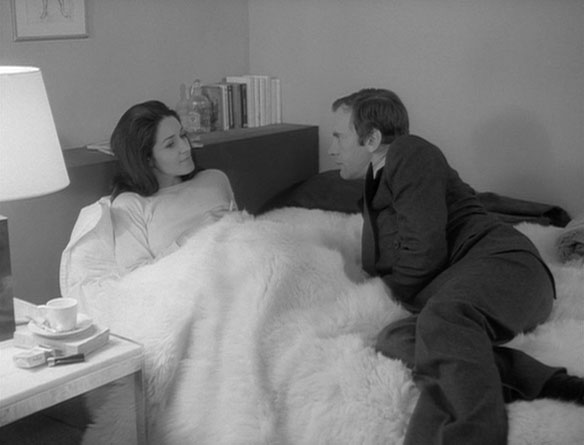
Jean-Louis (Jean-Louis Trintignant) is more than a little intrigued by Maud (Françoise Fabian) in the fourth of Eric Rohmer’s Six Moral Tales
MY NIGHT AT MAUD’S (MA NUIT CHEZ MAUD) (Eric Rohmer, 1969)
Film Forum
209 West Houston St.
Sunday, December 16, and Monday, December 17
Series runs through December 20
212-727-8110
www.filmforum.org
 Nominated for the Palme d’Or and a Best Foreign Language Film Oscar, My Night at Maud’s, Éric Rohmer’s fourth entry in his Six Moral Tales series (Clarie’s Knee, Love in the Afternoon), continues the French director’s fascinating exploration of love, marriage, and tangled relationships. Three years removed from playing the romantic racecar driver Jean-Louis in Claude Lelouch’s A Man and a Woman, Jean-Louis Trintignant again stars as a man named Jean-Louis, this time a single thirty-four-year-old Michelin engineer living a relatively solitary life in the French suburb of Clermont. A devout Catholic, he is developing an obsession with a fellow churchgoer, the blonde, beautiful Françoise (Marie-Christine Barrault), about whom he knows practically nothing. After bumping into an old school friend, Vidal (Antoine Vitez), the two men delve into deep discussions of religion, Marxism, Pascal, mathematics, Jansenism, and women. Vidal then invites Jean-Louis to the home of his girlfriend, Maud (Françoise Fabian), a divorced single mother with open thoughts about sexuality, responsibility, and morality that intrigue Jean-Louis, for whom respectability and appearance are so important. The conversation turns to such topics as hypocrisy, grace, infidelity, and principles, but Maud eventually tires of such talk. “Dialectic does nothing for me,” she says shortly after explaining that she always sleeps in the nude. Later, when Jean-Louis and Maud are alone, she tells him, “You’re both a shamefaced Christian and a shamefaced Don Juan.” Soon a clearly conflicted Jean-Louis is involved in several love triangles that are far beyond his understanding, so he again seeks solace in church. My Night at Maud’s is a classic French tale, with characters spouting off philosophically while smoking cigarettes, drinking wine and other cocktails, and getting naked. Shot in black-and-white by Nestor Almendros, the film roams from midnight mass to a single woman’s bed and back to church, as Jean-Louis, played with expert concern by Trintignant, is forced to examine his own deep desires and how they relate to his spirituality. Fabian (Belle de Jour, The Letter) is outstanding as Maud, whose freedom titillates and confuses Jean-Louis. One of Rohmer’s best, most accomplished works despite its haughty intellectualism, My Night at Maud’s is screening December 16-17 at Film Forum in a terrific double feature with A Man and a Woman as part of its “Trintignant” series.
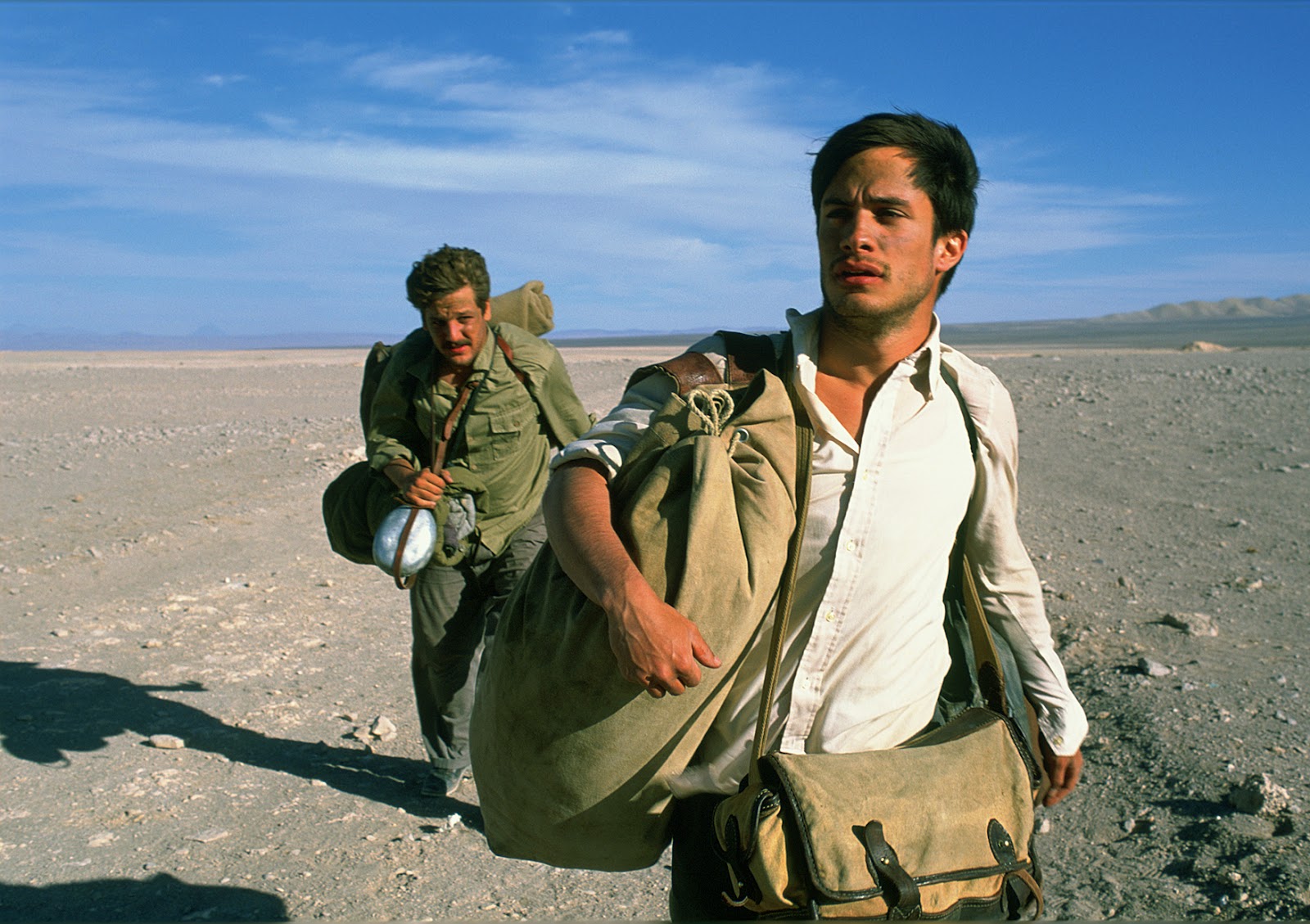
 In Walter Salles’s road movie The Motorcycle Diaries, Gael Garcia Bernal and Rodrigo De la Serna star as buddies Ernesto Guevara de la Serna and Alberto Granado, who hop aboard the Mighty One, an old, dilapidated Norton motorcycle, on a grand adventure across South America, on their way to work at a leper colony. While fun-loving Alberto is out for action, the more serious Ernesto wants to remain true to his love, Chichina (Mia Maestro). As they scam people for food, drink, mechanical help, and a place to sleep, they learn a lot more about life than they expected, especially Ernesto, who gets caught up in the plight of the poor, the sick, and the homeless, laying the groundwork for his revolutionary leadership in Cuba (where he is more well known as Che Guevara). The film, based on the writings of Ernesto and Alberto, is beautifully shot on location by Eric Gautier and excellently directed by Brazilian Salles, who previously gave us the wonderful Central Station and the heartbreaking Behind the Sun. Stick around for the credits, which begin with photos of Ernesto and Alberto from the actual trip. The Motorcycle Diaries is screening December 16 at 6:30 in a new 35mm print as part of the IFC Center series “Road Movies: Directed and Selected by Walter Salles,” in conjunction with the December 21 theatrical release of Salles’s adaptation of Jack Kerouac’s On the Road. The series also includes such films as Central Station, Edgar G. Ulmer’s Detour, and John Ford’s The Searchers.