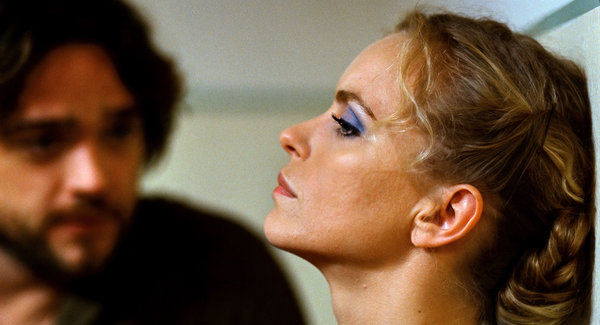
Andre (Ronald Zehrfeld) and Barbara (Nina Hoss) try to retain their humanity under difficult conditions in 1980 East Germany
BARBARA (Christian Petzold, 2012)
Angelika Film Center, 18 West Houston St. at Mercer St., 212-995-2570
Lincoln Plaza Cinema, 1886 Broadway between 62nd & 63rd Sts., 212-757-2280
www.adoptfilms.net
 Christian Petzold’s Barbara is a gripping, eerily slow-paced psychological thriller that explores fear, paranoia, and responsibility. Nina Hoss, in her fifth film with writer-director Petzold, gives a subtly powerful performance as Barbara Wolff, an East German doctor who has been shipped off by the government to a country hospital run by Andre (Ronald Zehrfeld). It is 1980, and Barbara has done something to get on the GDR watch list, causing her to be under near-constant surveillance. She carefully looks around everywhere she goes, wondering if the woman on the bus, the man out for a smoke, or the person on the pay phone is working for the Stasi. She is most suspicious of Andre as he attempts to get close to her, asking her personal questions and trying to spend more and more time with her. Meanwhile, Barbara has secret meetings with various people, including her West German lover, Jörg (Mark Waschke), who wants to get her out of the east. But as much as Barbara wants to live a free and open life, she is also a dedicated doctor who has become attached to two patients: Stella (Jasna Fritzi Bauer), a pregnant woman who does not want to be sent back to a labor camp, and Mario (Jannik Schümann), who has suffered a potentially fatal head injury following a suicide attempt. Petzold (Something to Remind Me, Wolfsburg, Yella), inspired by the likes of Claude Chabrol, To Have and Have Not, and The French Connection, drapes Barbara in a compulsive feeling of paranoia and dread, creating a blanketing atmosphere of mystery and imminent danger in which one wrong move can result in capture, imprisonment, or worse. Wrapped in a cloak of suspicion, Barbara evokes for the viewer what living in 1980 East Germany might have been like. The complex relationship between Barbara and Andre is handled with great skill by Petzold, balancing their individual needs with their responsibilities to their profession and the state. Germany’s official submission for the 2012 Best Foreign Language Film, Barbara is a tense tale that examines the cold war in unique and fascinating ways.

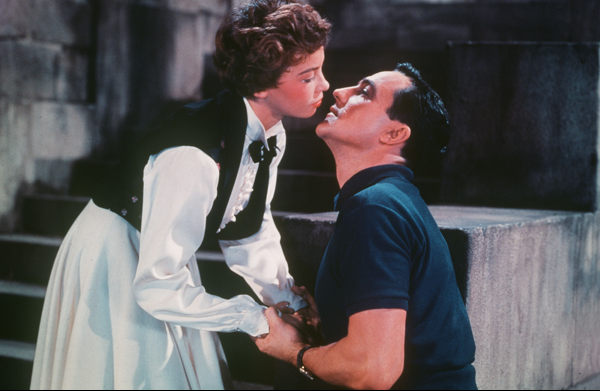
 To borrow a phrase from the Gershwins, Vincente Minnelli’s An American in Paris “’s wonderful, ’s marvelous.” In the 1951 MGM musical, which won six Academy Awards — including Best Picture, Best Color Cinematography, and Best Musical Score — it’s love at first sight for ex-pat artist Jerry Mulligan (a delightful Gene Kelly) upon seeing squirrely parfumerie girl Lise Bouvier (ballerina Leslie Caron, making her film debut after having been discovered by Kelly dancing with Les Ballets de Paris de Roland Petit). While Mulligan pursues Lise, he is pursued by wealthy socialite Milo Roberts (Nina Foch), who lures him in by buying one of his paintings and promising him a show. Complicating matters is French singer Henri Baurel (Georges Guétary), who has taken Lise under his wing. An American in Paris is a charmer from start to finish, with Kelly leading the way singing in the streets, tapping atop a piano, and romancing Caron on cheesy Hollywood sets doubling for the City of Lights.

 In such unique films as Rushmore, The Royal Tenenbaums, and The Darjeeling Limited, black-comedy master Wes Anderson has created a bizarre collection of characters who seem to live in their own alternate realities. In his latest, Moonrise Kingdom, Anderson has once again assembled an oddball assortment of men, women, and children in a terrifically clever and entertaining fairy tale all its own. Tired of being abused by his fellow Khaki Scouts and dismissed by his foster parents, twelve-year-old orphan Sam Shakusky (Jared Gilman) runs away from Camp Ivanhoe on the island of New Penzance, much to the chagrin of dedicated scout master Randy Ward (Edward Norton). Meanwhile, twelve-year-old loner Suzy Bishop (Kara Hayward) is fed up with her life as well, which she mostly spends listening to Benjamin Britten, reading fairy tales (fictitious stories made up by Anderson), watching the world through a pair of ever-present binoculars, and despising her parents (Bill Murray and Frances McDormand). Afraid of what might have happened to the children, the local police officer, Captain Sharp (Bruce Willis), gets involved, as does a stern woman from social services (Tilda Swinton) and, eventually, a very different kind of scout, Cousin Ben (Jason Schwartzman). The proceedings are overseen by a narrator (Bob Balaban) who ends up being more than just an omniscient presence. Moonrise Kingdom is an absolute gem of a film, an exciting, original tale about growing up told in a fabulously funny deadpan manner that combines slapstick humor with wildly ironic elements, filled with the endless wonders of childhood, although it is most definitely not for children. Newcomers Gilman and Hayward appear wise beyond their years in the lead roles, with outstanding support from an all-star cast, most prominently Norton as the by-the-book scout master on a mission. Written by Anderson with Roman Coppola and featuring a lovely score by Alexandre Desplat, Moonrise Kingdom is one of the best films of the year, by a director whose imagination never ceases to amaze. Moonrise Kingdom is screening December 22 at 8:00 as part of MoMA’s annual series “The Contenders,” consisting of exemplary films they believe will stand the test of time; upcoming entries include Tom Hooper’s Les Misérables, Sally Potter’s Ginger and Rosa, and Raoul Ruiz’s Night Across the Street.