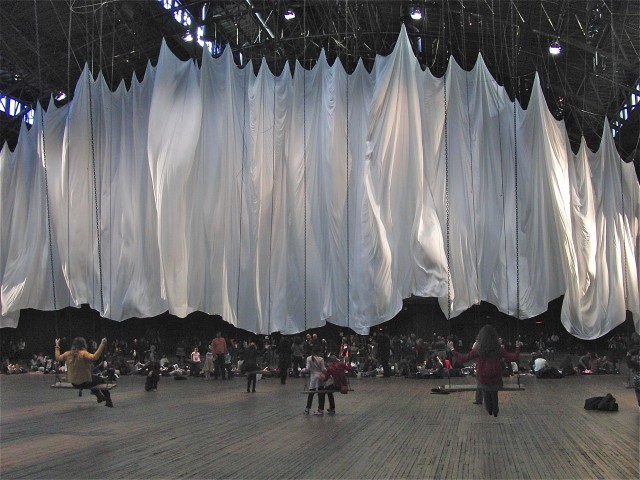
Ann Hamilton’s interactive “the event of a thread” spreads across the Wade Thompson Drill Hall at Park Avenue Armory (photo by twi-ny/mdr)
Park Avenue Armory, Wade Thompson Drill Hall
643 Park Ave. at 67th St.
Tuesday – Sunday through January 6, $12
212-933-5812
www.armoryonpark.org
the event of a thread slideshow
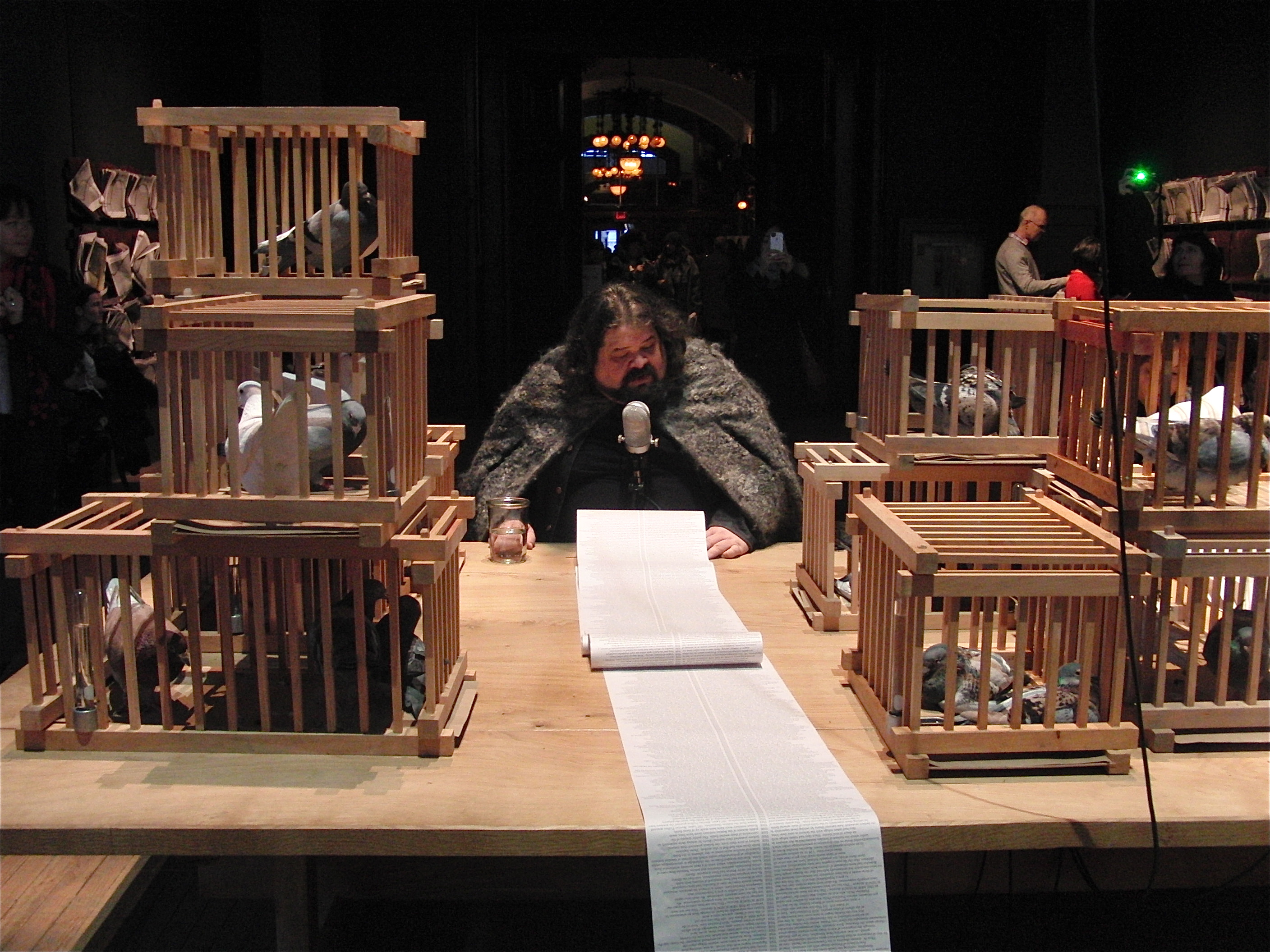
First and foremost, Ohio-born visual artist Ann Hamilton’s “the event of a thread” at Park Avenue Armory is fun, fun, fun. Visitors get to push each other on wooden swings that hang seventy feet from the ceiling of the vast Wade Thompson Drill Hall, the movements manipulating an enormous white cloth that dances with the manufactured wind, rising and falling like ocean waves and drifting like clouds, especially when viewed from below, lying on the floor underneath it. But there’s much more to this interactive site-specific commission, curator Kristy Edmunds’s final contribution as the institution’s artistic director. (Edmunds has played a major role in transforming the armory into one of the city’s most exciting spaces for experimental public art.) Hamilton’s multisensory shared experience is about warp and weft, speaking and listening, reading and writing, voice and gesture, music and memory; it’s about interdependence and multiple meanings; it’s about community, connection, crossing, concordance, and communication; and it’s about flying home. Hamilton weaves a different kind of social media web with “the event of a thread,” bringing people physically together to work as a unit to effect change. At the entrance to the hall, two members of Anne Bogart’s SITI Company, wearing bulky animal-hair coats, are seated at a table, reading carefully organized texts by Charles Darwin, Ralph Waldo Emerson, Aristotle, Susan Stewart, Ann Lauterbach, and others; their voices are broadcast via paper-bag radios scattered throughout the room (which visitors are encouraged to pick up and listen to). Also on the table are dozens of pigeons in small cages, waiting to be released at the end of the day so they can fly home to their roost as a performer sings. At the far end of the hall, a lone woman sits at a second table, writing letters with a pencil while watching the activities going on behind her via a mirror.
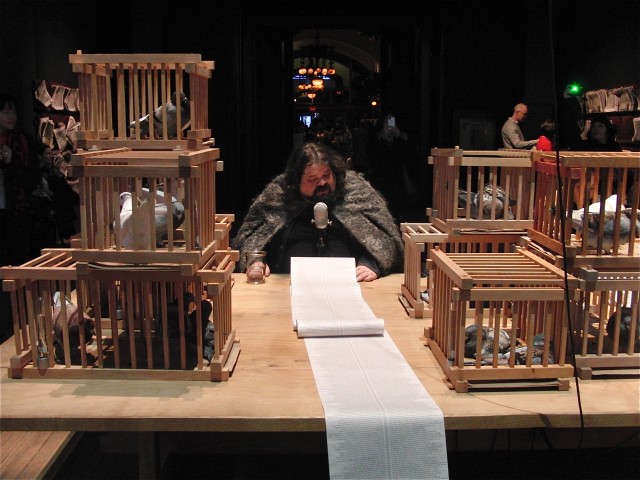
One of two readers recites from a concordance scroll as part of Ann Hamilton’s multisensory “the event of a thread” at Park Avenue Armory (photo by twi-ny/mdr)
Taking her title from the Encyclopaedia Brittanica article “Weaving, Hand” written by textile artist Anni Albers (wife of Josef Albers), Hamilton explores the nature of crossings, beginning with cross stitching. In an essay in the must-read newspaper that accompanies the project, Hamilton writes that “‘the event of a thread’ is made of many crossings of the near at hand and the far away: it is a body crossing space, is a writer’s hand crossing a sheet of paper, is a voice crossing a room in a paper bag, is a reader crossing with a page and with another reader, is listening crossing with speaking, is an inscription crossing a transmission, is a stylus crossing a groove, is a song crossing species, is the weightlessness of suspension crossing the calling of bell or bellows, is touch being touched in return. It is a flock of birds and a field of swings in motion. It is a particular point in space at an instant of time.” The work takes on yet another crossing when viewed from above; the armory usually does not allow visitors on the upper balcony level, but for “the event of a thread” people can walk up the stairs and stand parallel to the huge sheet, watching the intense pulley system lift and lower it in a thrilling marionette-like dance, comparing the men, women, and children on the swings, who are actually making the cloth move, to the unseen hand of a supreme being. With “the event of a thread,” Hamilton has created an awesome spectacle, a complex combination of elements that can be enjoyed in multiple ways.

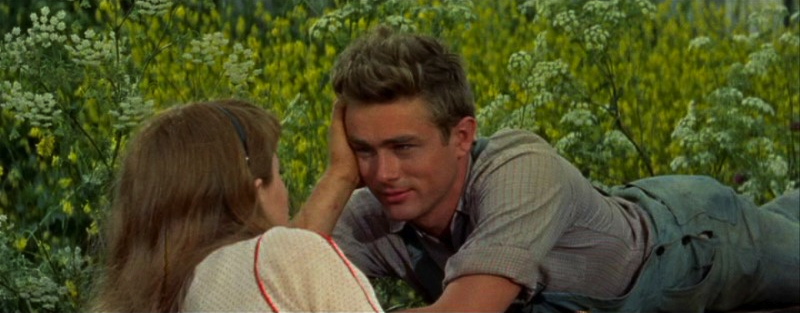
 “I guess there’s just a certain amount of good and bad you get from your parents and I just got the bad,” Cal (James Dean) says in Elia Kazan’s cinematic adaptation of part of John Steinbeck’s 1952 novel, East of Eden, a modern retelling of the biblical Cain and Abel story. In his first starring role, Dean received a posthumous Oscar nomination for his moody, angst-ridden performance as Cal Trask, a troubled young man who discovers that the mother (Best Supporting Actress winner Jo Van Fleet) he thought was dead is actually alive and well and running a successful house of prostitution nearby. Cal tries to win his father’s (Raymond Massey as Adam Trask) love and acceptance any way he can, including helping him develop his grand plan to transport lettuce from their farm via refrigerated railway cars, but his father seems to always favor his other son, Aron (Richard Davalos). Aron, meanwhile, is in love with Abra (Julie Harris), a sweet young woman who takes a serious interest in Cal and desperately wants him to succeed. But the well-meaning though misunderstood Cal does things his own way, which gets him in trouble with his father and brother, the mother who wants nothing to do with him, the sheriff (Burl Ives), and just about everyone else he comes in contact with. Set in Monterey and Salinas, East of Eden begins with a grand overture by Leonard Rosenman, announcing the film is going to be a major undertaking, and it lives up to its billing. Dean is masterful as Cal, peppering Paul Osborn’s script with powerful improvisational moments as he expresses his frustration with his family and life in general. His inner turmoil threatens to explode in both word and gesture as he just seeks to be loved. Dean would follow up East of Eden with seminal roles in Rebel Without a Cause and Giant before his death in a car crash in 1955 at the age of twenty-four, leaving behind a remarkable legacy that has influenced generations of actors ever since. East of Eden is screening January 2-4 at 1:30 as part of MoMA’s ongoing series “An Auteurist History of Film,” which continues January 9-11 with Phil Karlson’s The Brothers Rico and January 16-18 with Ingmar Bergman’s Wild Strawberries.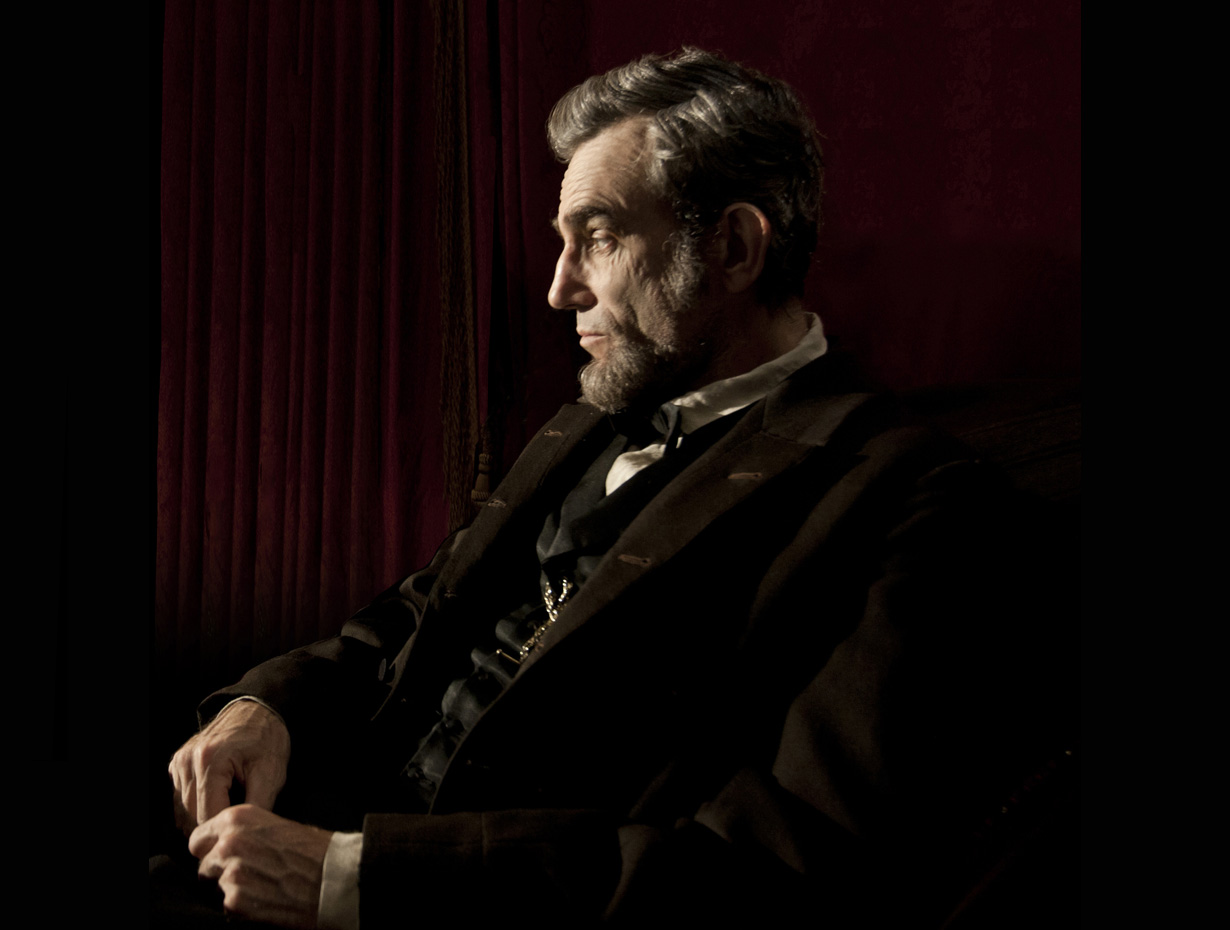
 Over the years, a handful of fine actors have portrayed Abraham Lincoln, including Walter Huston in D. W. Griffiths’s 1930 Abraham Lincoln, Henry Fonda in John Ford’s 1939 Young Mr. Lincoln, Raymond Massey in John Cromwell’s 1940 Abe Lincoln in Illinois, and Emmy winner Hal Holbrook in the 1974 miniseries Sandburg’s Lincoln, as well as George A. Billings in Phil Rosen’s 1924 The Dramatic Life of Abraham Lincoln and Benjamin Walker in Timur Bekmambetov’s 2012 Abraham Lincoln: Vampire Hunter. But no one has ever quite captured the essence of the sixteenth president of the United States of America as Daniel Day-Lewis does in Steven Spielberg’s Lincoln. Day-Lewis is mesmerizing as Lincoln, a tall, goodhearted soul trying to end slavery and the Civil War. Based on Doris Kearns Goodwin’s 2005 book, Team of Rivals: The Political Genius of Abraham Lincoln, the film begins in January 1865, as newly reelected Honest Abe is caught in a tenuous situation: He can work to pass the Thirteenth Amendment, which would abolish slavery, or meet with a contingent from the South (which includes Jackie Earle Haley as Confederate vice president Alexander H. Stephens) to reach a peaceful settlement, but it is unlikely he can do both. Secretary of State William H. Seward (David Strathairn) wants him to forget about the amendment, believing passage in the House of Representatives would be impossible, but Lincoln is determined to do what is right, even if it takes a trio of shady lobbyists (James Spader, John Hawkes, and Tim Blake Nelson) to help get it done. Spielberg and screenwriter Tony Kushner (Angels in America) depict Lincoln as a careful, caring man who loves going off on tangents, telling stories, parables, and even dirty jokes. He lies on the floor with his young son, Tad (Gulliver McGrath), tries to calm his wife, Mary (Sally Field), whom he calls Molly and is still haunted by the death of their son Willy, and attempts to convince their older son, Robert (Joseph Gordon-Levitt), not to join the Union Army. Day-Lewis plays Lincoln as a strong yet fragile man torn apart on the inside much like the country is torn apart over the issue of slavery — as shown particularly in the House, where radical Republican leader Thaddeus Stevens (Tommy Lee Jones) is enjoying a vicious battle of words with Democratic standard-bearer Fernando Wood (Lee Pace) that is every bit as contentious as the current Congress. The uniformly fine cast, filled with stage veterans, also includes Holbrook as Francis Preston Blair, Jared Harris as Ulysses S. Grant, Michael Stuhlbarg as George Yeaman, Colman Domingo as Harold Green, Stephen McKinley Henderson as William Slade, Walton Goggins as Wells A. Hutchins, Gregory Itzin as John Archibald Campbell, and Stephen Spinella as Asa Vintner Litton. Unfortunately, Spielberg can’t leave well enough alone, pulling at the heartstrings with an unnecessary opening sequence and a tragically overwrought finale; without those scenes, Lincoln had a chance to become a classic; with them, it is merely a solid film that sheds fascinating new light on a critical moment in U.S. history, portrayed by a master craftsman with immense skill, the first actor to completely disappear into the part of this genuine American hero.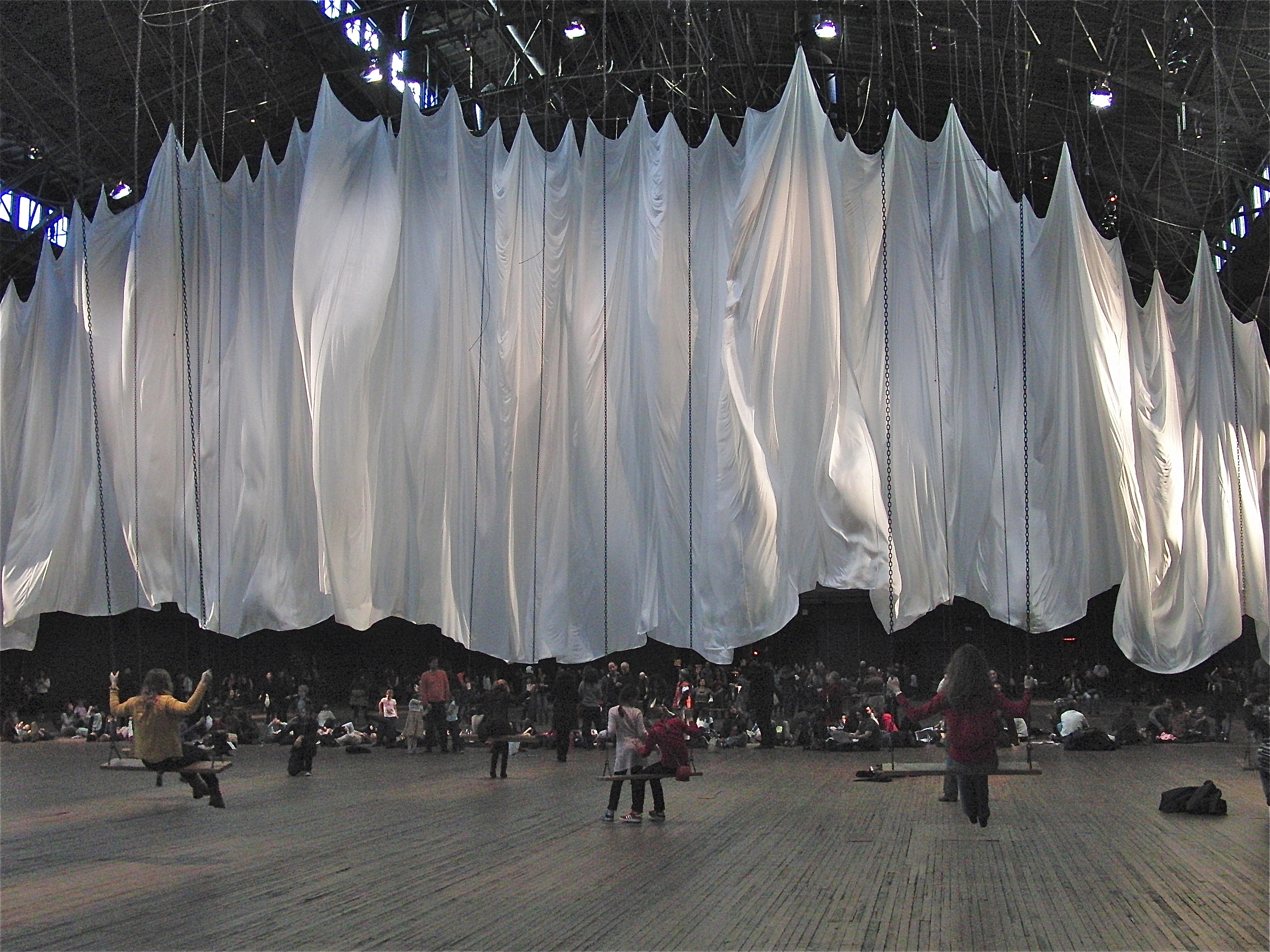
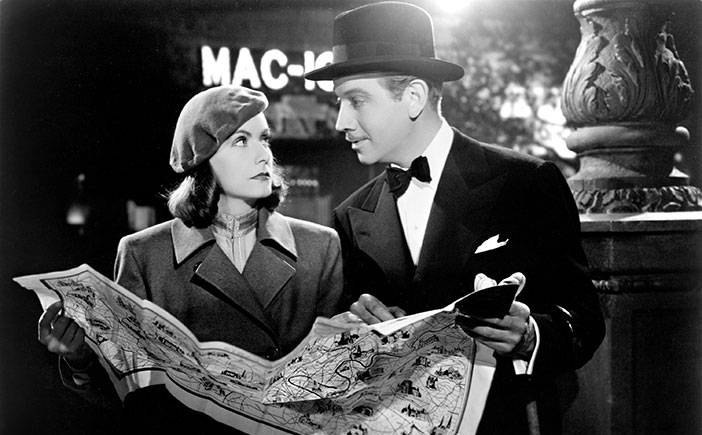
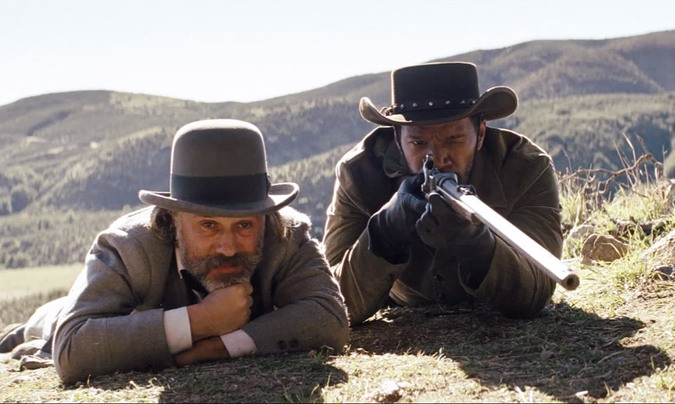
 Multigenre master Quentin Tarantino, who as writer-director has taken on the gangster film (Reservoir Dogs), pulp movies (Pulp Fiction), Blaxploitation (Jackie Brown), the martial arts (Kill Bill, Vols. I & II), grindhouse (Death Proof), and WWII (Inglourious Basterds) with nearly universally acclaimed results, has now turned his attention to the spaghetti Western, resulting in yet another awesome achievement. A Southern Western that in many ways is the black version of Inglourious Basterds, Django Unchained is set immediately before the Civil War, as bounty hunter and former dentist King Schultz (Oscar winner Christoph Waltz) obtains a slave named Django (Oscar and Grammy winner Jamie Foxx) in order to track down the wanted Brittle brothers (Cooper Huckabee, Doc Duhame, and M. C. Gainey) and collect a substantial reward. Schultz has promised Django his freedom and some cash in return for his assistance, but the two stick together as they go off in search of Django’s wife, Broomhilda Von Shaft (Kerry Washington), who was brutally taken away from him and now works on the Candyland plantation owned by the slick, smooth Calvin J. Candie (Leonardo DiCaprio) and run by an Uncle Tom slave known as Stephen (Samuel L. Jackson). As with most Tarantino films, things get a little violent by the end, an operatic barrage of blood and guts that would make Sam Peckinpah proud. Tarantino, who appeared in Takashi Miike’s 2007 Sukiyaki Western Django and plays a small part here as well, continues his reign as the King of the Revenge Film with Django Unchained, another movie that is, at its heart, another celebration of movies themselves. Tarantino masterfully toys with cinematic conventions, tongue often firmly in cheek, evoking a stream of Western classics, including The Wild Bunch, The Searchers, Blazing Saddles, and, of course, Sergio Corbucci’s 1966 Django — he even gives a small part to Franco Nero, who played the title role in the Corbucci flick. Tarantino also adds beautifully absurd humor, primarily in the form of a riotous scene with masked marauders, a perhaps overly liberal use of the N-word, a vast array of familiar faces rounding out the cast (Don Johnson, Dennis Christopher, Bruce Dern, Tom Wopat, James Russo, Jonah Hill, Robert Carradine, and James Remar inexplicably in two roles), and, as usual, a killer soundtrack, ranging from new music by Ennio Morricone, John Legend, and Anthony Hamilton to a spectacularly out-of-place song by the late Jim Croce. He even references German literature in the form of the famous myth of Siegfried and Brunhilde. Yes, the film is too long, too violent, and too filled with stereotypes, and the story comes together a little too easily, but heck, it’s still about as much fun as you’re gonna have at the movies this year.