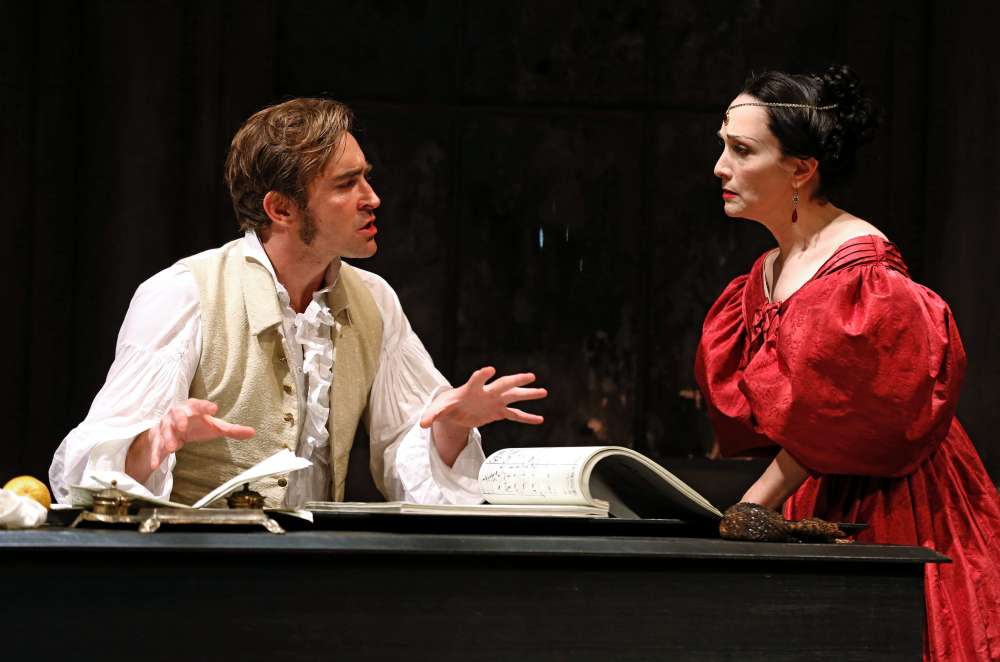
Sicilian composer Vincenzo Bellini (Lee Pace) and diva Maria Malibran (Bebe Neuwirth) discuss art and love in Terrence McNally’s GOLDEN AGE (photo by Joan Marcus)
Manhattan Theatre Club
New York City Center Stage 1
Through January 13, $85
www.goldenageplay.com
In It’s Only a Play, Terrence McNally took audiences behind the scenes of a Broadway production’s opening night. In The Lisbon Traviata and Master Class, McNally focused on opera star Maria Callas. He brings those two themes together in the light but charming Golden Age. Sicilian composer Vincenzo Bellini (Lee Pace) is presenting the world premiere of I puritani on January 24, 1835, at the Théâtre-Italien in Paris, the first of his operas to open outside Italy. The composer of such previous triumphs as I Capuleti e i Montecchi, La sonnambula, and Norma is joined by a quartet of popular singers who just might be as famous as he is: baritone Antonio Tamburini (Lorenzo Pisoni), who continually stuffs vegetables down his pants to enhance his manhood; soprano Giulia Grisi (Dierdre Friel), who cannot decide how much jewelry to wear when she takes the stage; bass Luigi Lablache (Ethan Phillips), who laments the always minor roles given to those of his vocal range; and tenor Giovanni Battista Rubini (Eddie Kaye Thomas), who is preparing to hit a high F-natural above high C that has never before been achieved. At Bellini’s side is his biographer and lover, Francesco Florimo (Will Rogers).
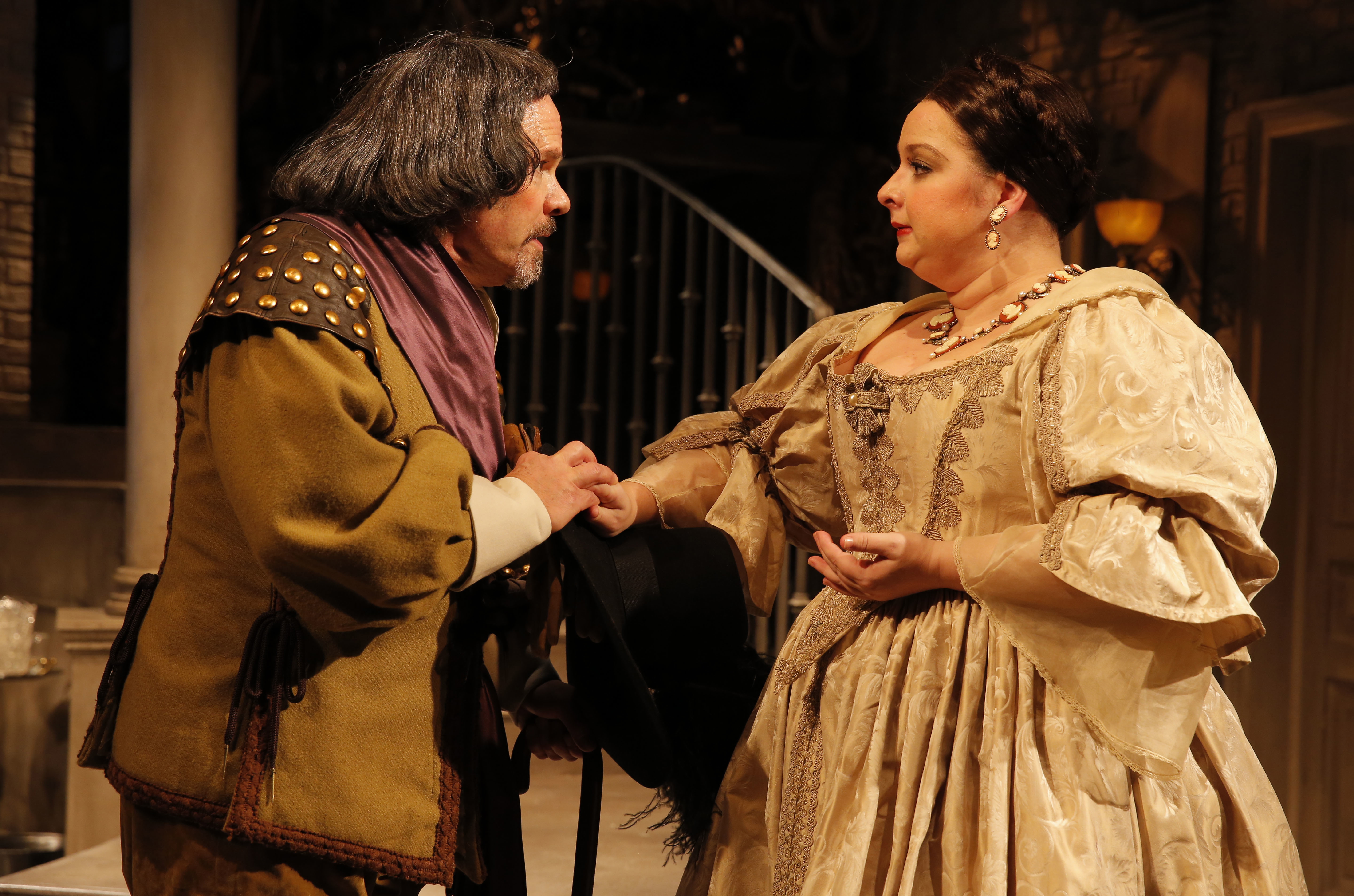
Luigi Lablache (Ethan Phillips) and Giulia Grisi (Dierdre Friel) get serious during premiere of Bellini’s I PURITANI (photo by Joan Marcus)
Tony-winning director Walter Bobbie (Venus in Fur, Chicago) has the four Puritans move from individual dressing rooms to backstage area (where Bellini makes use of a piano) and then up steps to the opera hall on Santo Loquasto’s dramatic set, their singing “voices” heard in the background as those still downstairs discuss the French versus the Italians (and the English), egotistically praise their own talents, debate whether the composer or singer is more important, and wonder about who is in the audience, from rival composers such as Donizetti and Rossini (George Morfogen) to such other opera stars as Giovanni Matteo Mario and Maria Malibran (Bebe Neuwirth). When the Malibran does indeed show up, the talk turns to love, romance, and heartbreak as well. Combining factual events with his vivid imagination, four-time Tony winner McNally (Frankie and Johnny in the Clair de Lune, Love! Valour! Compassion!) investigates the nature of art and its very creation in Golden Age, exploring inspiration, influence, and truth. What is occurring backstage often mimics what is happening in the opera itself, especially as Grisi gets ready for her mad scene and various characters declare their love for others. The acting is exemplary throughout, ranging from appropriately bombastic to somewhat more subdued, with Neuwirth a standout as she poetically recites a song by Bellini. And McNally and Bobbie have crafted Golden Age in such a way that the audience doesn’t need to know anything about opera, or be an opera fan at all, in order to enjoy this inside look at a magical moment in time.

 Douglas Sirk would surely be proud of Otto Preminger’s wickedly obsessive 1958 melodrama, Bonjour Tristesse. Based on the 1954 novel by eighteen-year-old author Françoise Sagan, the film, whose titles translates as “Hello, Sadness,” stars Jean Seberg as Cécile, a seventeen-year-old girl on the cusp of womanhood, a child-adult living the good life while beginning to enjoy the pleasures of drinking, smoking, and sexual desire. She and her wealthy father, Raymond (a dapper David Niven), have moved into a posh villa on the French Riviera for the summer, where the widowed Raymond attempts to balance his time with serious fashion queen Anne Larsen (Deborah Kerr) and flighty young blonde Elsa (Mylène Demongeot). A selfish cad who considers only himself, Raymond is soon in deep water when the two women find out about each other. Meanwhile, Cécile tosses aside her studies in order to flirt with twenty-five-year-old neighbor Philippe (Geoffrey Horne) and other older men who quickly fall in love with her relatively carefree lifestyle, one that seemingly can only end in trouble. Written by Arthur Laurents (Anastasia, The Way We Were), beautifully photographed in color (in Saint-Tropez) and black-and-white (in Paris) by Georges Périnal (Rembrandt, The Fallen Idol), and featuring costumes by Givenchy and jewelry by Cartier, Bonjour Tristesse examines love, lust, power, style, and jealousy, directed with an iron fist by Preminger, who often yelled at and embarrassed Seberg on-set in order to influence her performance. But at the heart of the film is the risqué relationship between Raymond and Cécile, one that more than hints at incest. Bonjour Tristesse is screening December 28-30 in DCP as part of the continuing Museum of the Moving Image series “See It Big!”
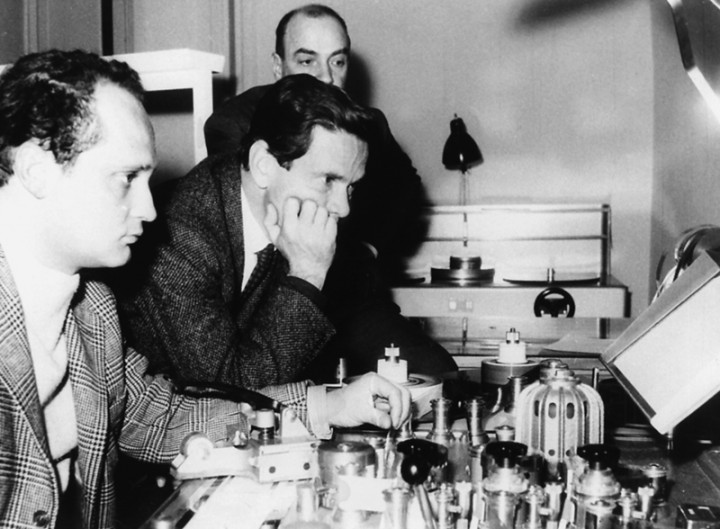
 In 1963, producer Gastone Ferranti asked Italian director Pier Paolo Pasolini to make a leftist political documentary about the postwar situation utilizing the producer’s large collection of Mondo Libero newsreel footage, answering the question “Why is our life dominated by discontent, by anguish, by the fear of war, by war?” Not thrilled with the result, he chopped Pasolini’s film in half and hired right-wing demagogue Giovanni Guareschi to create a conservative documentary providing an opposing viewpoint. La rabbia, or The Anger, opened in theaters in Italy and was quickly pulled from release, essentially disappearing until 2005, when a complete color negative was discovered and the two parts were restored and brought back together in a deluxe DVD package. La rabbia di Pasolini (The Anger of Pasolini), which is screening with the amazing La ricotta on December 26 at 4:30 as part of MoMA’s Pasolini career retrospective, is a curious examination of the state of the world. “My idea was to offer a Marxist denunciation of the society and events of the time,” Pasolini explained. Over the course of fifty-four minutes, he and editor Nino Baragli (with Giuseppe Bertolucci handling the recent reconstruction) create a cinematic collage of religion, communism, fascism, socialism, poverty, hunger, colonialism, race, and war through footage of the Hungary revolts of 1956, protests in Rome and Madrid, the war in Algeria, the coronation of Queen Elizabeth II, the rise of Patrice Lumumba in the Belgian Congo, and clips of such other international figures as Lenin, Stalin, Pope John XXIII, Sukarno, Nasser, de Gaulle, Eisenhower, Khrushchev, Yuri Gagarin, and even Marilyn Monroe as he poetically laments about life in the twentieth century. “People of color, it is in hope that man has no color,” one of his narrators says in the film. (The text is recited by actor Giorgio Bassani and painter Renato Guttuso; works by the latter are included in the documentary, along with pieces by Ben Shahn, Jean Fautrier, and George Grosz.) “Long live freedom,” the film repeats, but there’s not much promise for the future.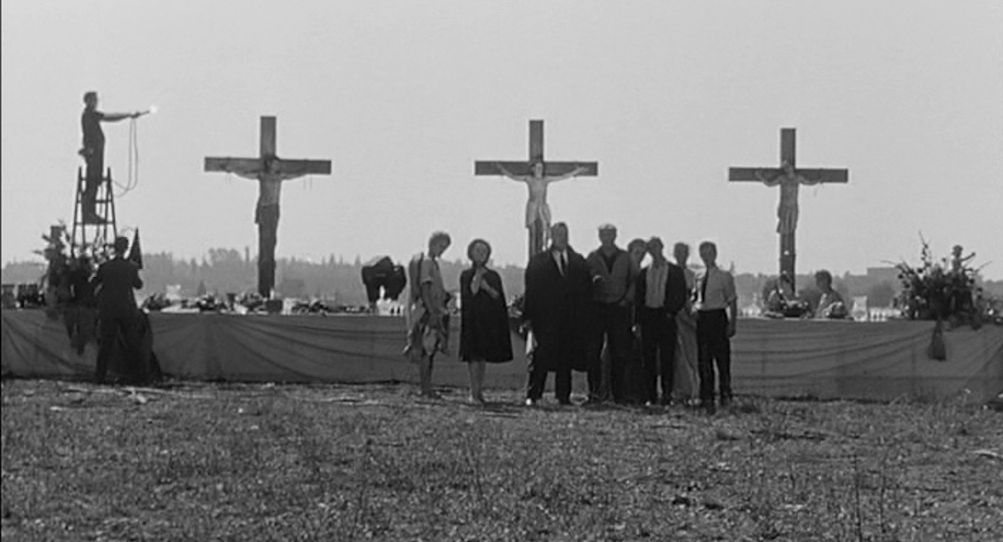
 In 1962, producer Alfredo Bini invited Pier Paolo Pasolini to participate in an omnibus film featuring four shorts, which came to be known as Ro.Go.Pa.G. for the four directors involved, Roberto Rossellini (llibatezza), Jean-Luc Godard (Il Nuovo Mondo), Pasolini, and Ugo Gregoretti (Il Pollo Ruspante). Pasolini contributed the mini-masterpiece La ricotta, a marvelously entertaining satire set around the making of a film about the Passion of the Christ. Mario Cipriani stars as Givoanni Stracci (“Joe Rags”), a goofy, very hungry man who is playing the role of the good thief in the film within a film. As the put-upon Stracci desperately tries to feed his family and get a bite to eat for himself, the director, played by Orson Welles (dubbed by La rabbia narrator Gregorio Bassani), has to deal with a pampered lead actress (Laura Betti), a crew that keeps playing hip 1960s cha-cha music instead of the intended classical score by Scarlatti (Carlo Rustichelli’s soundtrack is mind-blowingly magnificent), and a nosy reporter (Vittorio La Paglia) who wants an interview — which turns into a riotous segment with Welles quoting from Pasolini’s Mamma Roma book. “What do you think of Italian society?” the reporter asks. “The most illiterate masses and the most ignorant bourgeoisie in Europe,” the director replies. Pasolini fills La ricotta with inside jokes, social commentary, and wry humor while he and cinematographer Tonino Delli Colli go from Technicolor biblical epic to black-and-white neo-Realist melodrama to speeded-up Hollywood slapstick comedy. In the film’s introduction, Pasolini says, “I want to state here and now that however La ricotta is taken, the story of the passion, which La ricotta indirectly recalls, is for me the greatest event that has ever happened.” That didn’t stop the government from arresting Pasolini upon the film’s release, charging him with “insulting the religion of the state,” and sentencing him to four months in prison, a verdict that was later overturned on appeal. A small classic that has to be seen to be believed, La ricotta is screening on December 26 as part of a double feature with La rabbia di Pasolini as MoMA’s tribute to the Italian genius continues.