live performance

AIN’T NO MO’

Jordan E. Cooper has a lot to say about Ain’t No Mo’ at the Belasco (photo © Joan Marcus)

AIN’T NO MO’
Belasco Theatre
111 West 44th St. between Sixth & Seventh Aves.
Tuesday – Saturday through December 18, $58 – $318
aintnomobway.com

At the end of the uproarious curtain call at the December 11 matinee of Ain’t No Mo’ at the Belasco, playwright and actor Jordan E. Cooper grabbed a microphone and gave a short speech about “turning the tide” and “changing Broadway,” announcing to the crowd, in case they hadn’t already heard, that the show was closing early, on December 18, after a mere twenty-two previews and twenty-one performances. The news was so sudden and unexpected, following very positive opening reviews, that as of Monday morning, December 13, Telecharge was still selling seats through February 26.

Cooper plays African American Airlines flight attendant Peaches, a boisterously dressed character trying to make sure that every Black person makes it onto the last plane out of the United States, which has offered free one-way reparation flights back to Africa (from gate 1619) to get rid of all the Black people in the country. Peaches tells someone over the phone, “Well, bitch, I don’t know what to tell you ’cause if you stay here, you only got two choices for guaranteed housing and that’s either a cell or a coffin. After this flight, there will be no more Black folk left in this country, and I know ya’ll don’t wanna be the only ones left behind because them muthafuckas will try to put you in a museum or make you do watermelon shows at SeaWorld and shit. Hurry up or I will give your seat to some of the Latinos on stand-by.”

At the curtain call, the twenty-seven-year-old Cooper, the youngest Black American playwright to have a show on Broadway (a designation previously held by Lorraine Hansberry, who was twenty-nine when A Raisin in the Sun opened at the Ethel Barrymore in March 1959 before traveling to the very same Belasco that October), called for the audience to spread the word about Ain’t No Mo’, by mouth and social media. “We won’t go down without a fight,” he declared, also referencing the early closing notice of the Korean musical KPOP, which was playing its final performance that afternoon.

Pastor Freeman and his flock look toward a supposedly bright future in Ain’t No Mo’ (photo © Joan Marcus)

The response to the Ain’t No Mo’ closing notice has been swift (notably, Will Smith and Jada Pinkett Smith bought out a performance, and the line to get in wrapped around Forty-Fifth St. at the matinee I attended), echoing the movement this past May to keep for colored girls who have considered suicide / when the rainbow is enuf running at the Booth after it announced it was closing three months early. The effort earned the show an additional two weeks but no more. While I had raved about the off-Broadway versions of KPOP and for colored girls, I was not a fan of either Broadway iteration, each of which had been changed dramatically, in my opinion not for the better.

Still, these voices need to be heard and these bodies seen, on and off Broadway. In an open letter on Instagram, Cooper wrote, “Ain’t No Mo’ needs your help! Now they’ve posted an eviction notice, we ‘must close’ December 18. But thank God Black people are immune to eviction notices. The Wiz got one on opening night in 1974, but audiences turned that around and it ended up running for four years. . . . We need all hands on deck with urgency. In the name of art, in the name of resistance, in the name of we belong here too, in the name of every storytelling ancestor who ever graced a Broadway stage or was told they never could, please support this production and buy a ticket and come have church with us. Radical Black work belongs on Broadway too.”

https://twitter.com/JordanECooper_/status/1602144592081879040?s=20

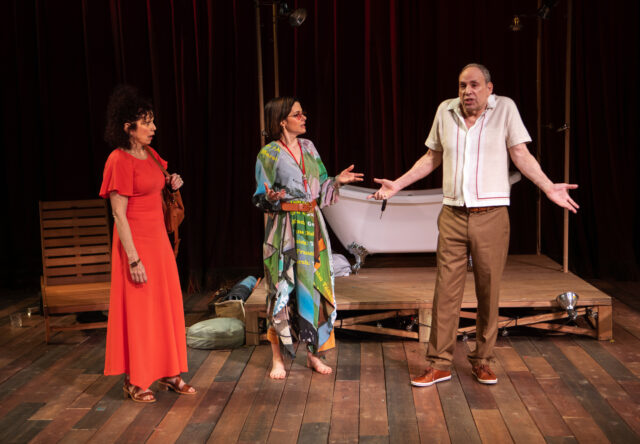
Ain’t No Mo’ has been tweaked since its 2019 debut at the Public, with the same wonderful cast and only minor changes to its zany yet poignant narrative, which is divided into interrelated sketches taking place at the aforementioned gate 1619; a funeral service for the dear departed Brother Righttocomplain’ in 2008 upon the election of the first American Black president, Barack Obama; an abortion clinic where millions of Black women are terrified of bringing a son into this dangerous racist world; a television gossip show in which a white woman is transitioning to Black; and a mansion where a wealthy Black family discovers their late patriarch has been keeping a secret in the basement.

Munching on Scott Pask’s imaginatively playful sets are Cooper, Fedna Jacquet, Marchánt Davis (I saw understudy Michael Rishawn in his Broadway debut), Shannon Matesky, Ebony Marshall-Oliver, and Crystal Lucas-Perry, in hysterical and, in one case, terrifying costumes by Emilio Sosa and fab wigs by Mia M. Neal. I wrote about the Public original, and it applies to the Broadway iteration as well (both of which were directed by Stevie Walker-Webb, now making his Broadway debut): “Cooper gets right to the point when a woman at the clinic tells a reporter, ‘The problem is we’re racing against a people who have never had to compete, and people who have never had to compete are fearful of competition and they will annihilate any being that challenges their birth-given promise of a victory.’ As wildly funny, if occasionally over the top and too scattershot, Ain’t No Mo’ can be, it’s also a bitter pill to swallow.”

Since coming out of the pandemic lockdown, there has been an encouraging increase in the number of Broadway shows by BIPOC creators about the Black experience, including Ruben Santiago-Hudson’s Lackawanna Blues, Death of a Salesman, The Piano Lesson, Chicken & Biscuits, Thoughts of a Colored Man, Trouble in Mind, Pass Over, Clyde’s, and Caroline, Or Change, all of which had limited runs. That progress needs to continue apace, with plays running longer.

The hootin’ and hollerin’ on- and offstage is coming to an end at the Belasco (photo © Joan Marcus)

At one point in Cooper’s show, Pastor Freeman proclaims, “Aint no mo’ blueish red light in the rearview mirror when you taking your family to the church picnic and all you got in yo’ trunk is three Dollar Store aluminum pans of sister Threadgill’s chitlins, cornbread, and collard greens. Ain’t no mo’ waiting for FEMA while the Louisiana sun is stabbing at yo’ back on the interstate and your grandmama is backstroking in a river of expired bodies. Ain’t no mo’ massa’ tiptoein’ in yo’ mama’s room to rock the shack into the midnight hour. Aint no mo’ shotdown dreams with its blood soaking the concrete outside room 306. Ain’t no mo’ Riots. Ain’t no mo’ Rosewood. Ain’t no mo’ Jasper, ain’t no mo’ Jiggin’, ain’t no mo’ Shufflin’, ain’t no mo’ Shuckin’, ain’t no mo’ Amos, ain’t no mo’ Andy, ain’t no mo’ Emmett Till, ain’t no mo’ Rodney King, ain’t no mo’ Jena 6, ain’t no mo’ Stop, ain’t no mo’ Frisk. Ain’t no mo’ getting followed around by the tall white lady in the Kmart on Jones Street. There ain’t no mo double locking they car when you walk by, they thinking you gonna hot wire they car and drive it out the parking lot, when they know they just saw you pulling up in a car they can’t even afford. That’s all over . . . that’s all done.”

Sadly, you can add to that list “ain’t no mo’ Ain’t No Mo’,” which isn’t good news for anyone.

TOPDOG/UNDERDOG

Siblings Lincoln (Corey Hawkins) and Booth (Abdul-Mateen II) face hard times in Topdog/Underdog (photo by Marc J. Franklin)

TOPDOG/UNDERDOG
Golden Theatre
336 West 20th St. between Eighth & Ninth Aves.
Tuesday – Sunday through January 15, $84-$248
topdogunderdog.com

“Theater will save the universe!” the writer, portrayed by Suzan-Lori Parks, declares in Parks’s theatrical concert Plays for the Plague Year, a sensational three-hour show that recently concluded a Covid-shortened run at Joe’s Pub. Later, she adds, “Yeah, maybe when I started I had this belief that theater would save us. But it won’t. Not in the way I thought it would. But it does preserve us, somehow.”

In honor of its twentieth anniversary, Parks’s Pulitzer Prize–winning Topdog/Underdog is being revived on Broadway at the Golden, just in time to preserve us.

Topdog/Underdog takes place in the here and now, as two brothers contemplate their fate in their cramped, tiny apartment in a rooming house. Older sibling Lincoln (Corey Hawkins), the topdog, was dumped by his wife, Cookie, and works at an arcade, where he dresses up as President Abraham Lincoln at Ford’s Theatre, slouching over and over again as patrons pay to shoot him with a fake pistol.

Booth (Abdul-Mateen II), the underdog, is a petty thief who is attempting to get back together with his ex-girlfriend, Grace, and learn how to master three-card monte, a con game in which people are duped into thinking they can pick a specific card as the dealer, aided by carefully placed accomplices, magically shuffles three cards. Lincoln was a three-card monte master, but he gave it up after one of his partners was shot and killed. Booth wants his brother to teach him, but Lincoln refuses, even though his job is in jeopardy. “They all get so into it. I do my best for them,” he says about the arcade patrons. “And now they talking bout replacing me with uh wax dummy. Itll cut costs.”

The brothers were abandoned first by their mother, who gave them each a small “inheritance,” then by their father, leaving them on their own when Lincoln was sixteen and Booth thirteen. Booth looks up to Lincoln’s three-card monte prowess and begs him to teach him to become a dealer; he doesn’t understand why Lincoln won’t help him out with the game.

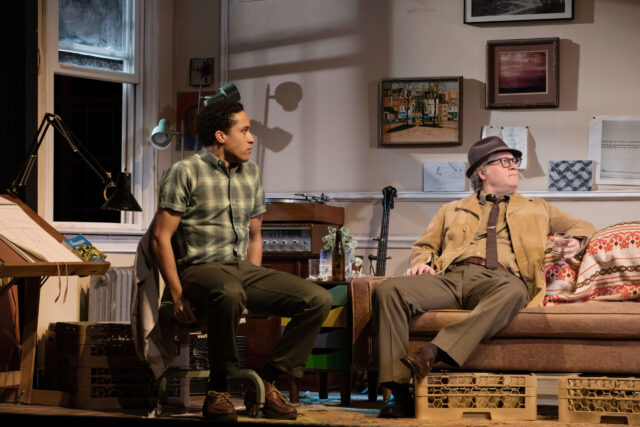
They might live in squalor, but they both dream of a better life. There’s only one bed, so Lincoln sleeps in a recliner; the bathroom is down the hall, and their sink, which has no running water, is instead a storage space for Lincoln’s guitar; their phone has been turned off; and they have no table, so they use a large piece of cardboard atop milk crates to eat on. That arrangement doubles as Booth’s three-card monte table, except he angles the cardboard down for the game, as if everything is on the precipice of slipping away. (The claustrophobic set is by Arnulfo Maldonado, with costumes by Dede Ayite, lighting by Allen Lee Hughes, and sound by Justin Ellington.)

Lincoln (Corey Hawkins) and Booth (Abdul-Mateen II) consider teaming up for three-card monte in Pulitzer Prize–winning play by Suzan-Lori Parks (photo by Marc J. Franklin)

At one point Lincoln picks up his guitar and plays an improvised blues song. “My dear mother left me, my fathers gone away / My dear mother left me and my fathers gone away / I dont got no money, I dont got no place to stay. / My best girl, she threw me out into the street / My favorite horse, they ground him into meat / Im feeling cold from my head down to my feet,” he sings. “My luck was bad but now it turned to worse / My luck was bad but now it turned to worse / Dont call me up a doctor, just call me up a hearse.” The luck of the draw is an underlying theme of the show; Lincoln is adamant that three-card monte has nothing to do with luck but only skill, and when he celebrates a little victory, he goes to a bar named Lucky’s.

It all leads to a shocking ending that will echo in your head long after the show is over.

Topdog/Underdog pulsates with an electrifying energy as a cloud of doom hovers over the proceedings. Parks’s (Fucking A, The Death of the Last Black Man in the Whole Entire World AKA the Negro Book of the Dead) dialogue is pure poetry as she explores the Black experience in America from slavery to the present day, every sentence loaded with significance as it challenges stereotypes and selective history. The play reestablishes itself as part of the pantheon of outstanding works about two siblings at odds, along with such plays as Sam Shepard’s True West, Lyle Kessler’s Orphans, and August Wilson’s The Piano Lesson.

Tony winner Kenny Leon (A Raisin in the Sun, A Soldier’s Play) directs the play like a modern-dance choreographer, with nary a stray movement and gesture. Tony nominee Hawkins (In the Heights, Six Degrees of Separation) and Emmy winner Abdul-Mateen II (Watchmen, Candyman) are a formidable duo in roles originated by Jeffrey Wright and Don Cheadle at the Public in July 2001 (and on Broadway in April 2002). In his Broadway debut, Abdul-Mateen II portrays Booth with an edginess and a false bravado, his relationship with the world off kilter, while Hawkins offers up a Lincoln who is exhausted but unwilling to give up as he tries desperately to go straight.

In Plays for the Plague Year, the writer points out that she celebrates January 6 as Topdog Day, when she began writing Topdog/Underdog, but now it will go down in history as the date that MAGA rioters stormed the Capitol. Shows like Topdog/Underdog might not save us from such horrific events, but they do extend life preservers that help us survive them. “‘Does thuh show stop when no ones watching or does thuh show go on?’” Lincoln recalls one of his customers asking. The show must always go on.

NEW YORK FESTIVAL OF SONG: A GOYISHE CHRISTMAS TO YOU!

Christmas songs by Jews take center stage at NYFOS concert (photo by Cherylynn Tsushima)

Who: Lauren Worsham, Donna Breitzer, Rebecca Jo Loeb, Alex Mansoori, William Socolof, Cantor Joshua Breitzer, Steven Blier, Alan R. Kay
What: Holiday concert
Where: Merkin Concert Hall, Kaufman Music Center, 129 West 67th St.
When: Wednesday, December 14, $45, 7:00
Why: Everyone knows that the Jewish Irving Berlin wrote “White Christmas,” but there are lots of other seasonal favorites and lesser-known holiday gems that were also penned by Jewish composers. On December 14 at 7:00 in Merkin Hall’s Upper Lobby at the Kaufman Music Center, New York Festival of Song will present its thirteenth iteration of “A Goyishe Christmas to You!,” featuring Christmas songs — with a twist — written by Jews. Soprano Lauren Worsham, mezzo-sopranos Donna Breitzer and Rebecca Jo Loeb, tenor Alex Mansoori, bass-baritone William Socolof, and Cantor Joshua Breitzer, with clarinetist Alan R. Kay and pianist and host Steven Blier, will perform such holiday tunes as Roy Zimmerman’s “Don’t Let Gramma Cook Christmas Dinner,” Johnny Marks’s “Rockin’ Around the Christmas Tree” and “Rudolph the Red-Nosed Reindeer” (in Yiddish arrangements), David Friedman’s “My Simple Christmas Wish,” Mel Tormé’s “The Christmas Song” (with new lyrics by Adam Gopnik), Frank Loesser’s “Baby, It’s Cold Outside” and “What Are You Doing New Year’s Eve?” and David Javerbaum and Adam Schlesinger’s “Can I Interest You in Hanukkah?” It might be worth it just for Joan Javits and Phil and Tony Springer’s “Santa Zaydee.” The concert will be followed by a wine reception with the artists.

A MAN OF NO IMPORTANCE

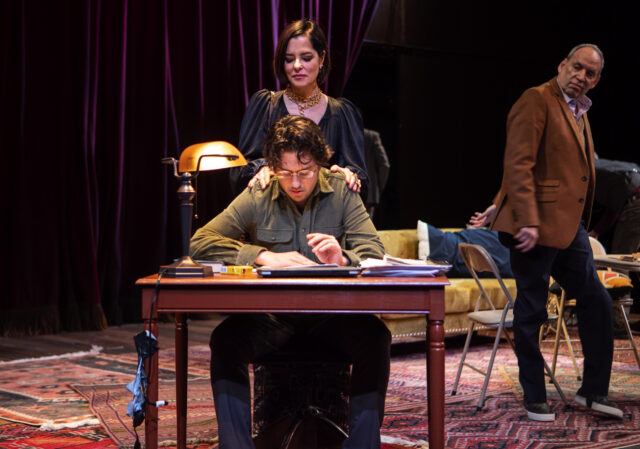
Jim Parsons stars as a parishioner directing his church’s next play in A Man of No Importance (photo by Julieta Cervantes)

A MAN OF NO IMPORTANCE
Classic Stage Company, Lynn F. Angelson Theater
136 East 13th St. between Third & Fourth Aves.
Tuesday – Sunday through December 18
www.classicstage.org

Tony winner John Doyle says farewell to Classic Stage after six years as artistic director with the humbly titled A Man of No Importance. At a talkback following the performance I saw, six of the actors couldn’t stop gushing about Doyle’s unique style and, of course, his importance.

At St. Imelda’s, a small parish church in Dublin in 1964, fortysomething Alfie Byrne (Jim Parsons) has decided that instead of staging Oscar Wilde’s The Importance of Being Earnest again, he and the amateur church theater company will put on Wilde’s controversial 1891 play, Salome, which troubles Father Kenny (Nathaniel Stampley, but I saw Benjamin Howes).

Talking about the choice of play, Father Kenny tells Alfie: “I went to the archbishop myself.” “‘Don’t put him out,’ I said. ‘That little theater is a holy place to Alfie Byrne. He loves Saint Imelda’s the same way some men love women.” Alfie, who is a bus conductor, replies, “I’m sure he had a fine smirk on him when he heard that one.” Father Kenny answers, “The truth be told: You brought this on yourself, Alfie, no one else did. You should have told me this Salome was a dirty play.” Alfie retorts, “It’s not. It’s art, Father, art!”

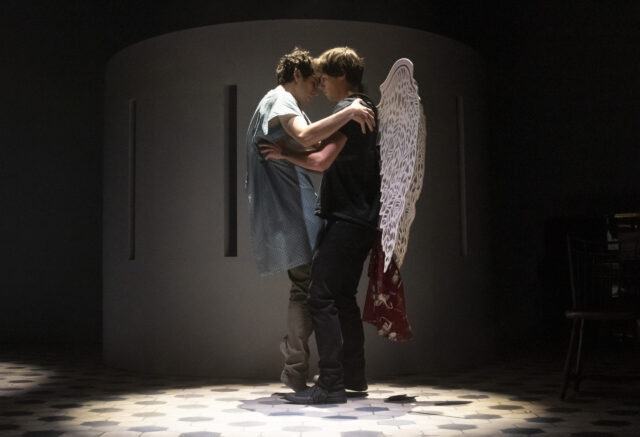
Father Kenny’s analogy will resonate later when Alfie brings up “the love that dare not speak its name” with an apparition of Oscar Wilde himself.

Characters hang out in the back as the action happens out in front at Classic Stage (photo by Julieta Cervantes)

In a rousing first musical number, we meet the rest of the cast on the bus driven by Robbie Fay (A. J. Shively), including Mr. Carney the butcher (Thom Sesma), mother-of-nine Mrs. Curtain (Kara Mikula) former all-Ireland gymnast Ernie Lally (Joel Waggoner), Peter Pan portrayer Miss Oona Crowe (Alma Cuervo), onetime Saint Joan star Mrs. Grace (usually played by Mary Beth Peil but I saw Beth Kirkpatrick), acting newbie and temporary church janitor Peter Linehan (Da’Von T. Moody), Sodality stalwart Mrs. Patrick (Jessica Tyler Wright), and stage manager Baldy O’Shea (William Youmans).

Everything stops when a fresh face boards the bus, the young, shy, and beautiful Adele Rice (Shereen Ahmed), a country lass arriving from Roscommon; she especially captures the attention of Alfie, who instantly decides she must play Salome, a casting choice that takes a lot of convincing, as Adele has never acted before and appears to be escaping a past she prefers not to discuss.

Alfie lives with his sister, the matronly Lily (Mare Winningham), who is being courted by Mr. Carney. But she refuses to settle down with a man until Alfie weds. When Alfie tells her about Adele, Lily erupts with happiness, singing, “The girls at Sodality / Call me a martyr / But that’ll be all in the past / Now heaven has lifted / The burden of life: / And has brought you a sweetie at last! / Oh . . . / You had better propose to her fast!” Little does Lily know but Alfie has his heart set on someone very different.

As opening night approaches, the revelation of deep-held secrets threatens the production and various characters’ personal lives.

Several actors also play instruments in A Man of No Importance (photo by Julieta Cervantes)

A Man of No Importance features a terrific book by Terrence McNally, who wrote several plays about theater making, including It’s Only a Play, And Away We Go, and Golden Age. McNally captures just the right impression of amateur theatrics, focusing on people for whom theater might not be central to their lives but absolutely necessary.

Composer Stephen Flaherty and lyricist Lynn Ahrens, who have previously collaborated on such musicals as Once on This Island, Anastasia, and Ragtime, contribute lovely songs that celebrate theater (“Going Up” “First Rehearsal”), examine everyday Irish life (“The Streets of Dublin,” “Princess”), and delve into the power, and intolerance, of religion (“Books,” “Our Father,” “Confession”). The unerlying theme is professed by Alfie in “Love Who You Love.”

The score, orchestrated by Bruce Coughlin, is performed by conductor Caleb Hoyer on keyboards, Michael Blanco on bass, Justin Rothberg on guitars and mandolins, and Tereasa Payne on flutes, Irish flutes, recorders, and pennywhistles, playing at the back of the stage balcony; they are joined by many of the actors on acoustic guitar, accordion, violin, drum head (which also double as plates of invisible food), and other instruments on Doyle’s thrust set, where the cast constantly rearranges chairs and other furniture as the story moves from the church and the bus to a bar and a kitchen. At times it is like Doyle is navigating everyone in an adult version of musical chairs.

Parsons is an exceptionally warm and amiable actor, whether he is playing a man throwing a snarky gay party in The Boys in the Band, a gentle soul living in his own alternate reality in Harvey, or the Supreme Being himself in An Act of God. His natural demeanor is so appealing in A Man of No Importance — which debuted at Lincoln Center in 2002 with Roger Rees as Alfie, based on the 1994 film starring Albert Finney — that you want to be his friend, even giving him a break when he occasionally loses his Irish accent. Throughout the show, several actors go into the audience, taking a seat, walking up the aisle, or hanging out in a landing; I was actually disappointed when Alfie did not come up to my row, but I did get a close-up look at Moody and his guitar.

Although all casts attempt to achieve this, this one feels like an inclusive family, with Oscar/Tony nominee and Emmy winner Winningham and Tony nominee Shively standing out; at the talkback, a half dozen of the other actors spoke about how well they were getting along and that Parsons might be the star but he insists on being treated just like everyone else. Saying goodbye to CSC, Doyle makes the audience feel that they’re all part of something important as well.

KPOP

The flashy KPOP is closing early on Broadway (photo by Matthew Murphy & Evan Zimmerman)

KPOP
Circle in the Square Theatre
1633 Broadway at 50th St.
Through December 11
kpopbroadway.com

On Saturday night, December 3, I was at Circle in the Square, watching KPOP. I had loved Ars Nova’s 2017 immersive production at A.R.T./New York and was looking forward to the Broadway incarnation. Alas, lightning did not strike twice.

I was supremely disappointed in the revised book, which eschewed most of the behind-the-scenes drama and the progression of the plot — in the original, small groups of audience members were led through a series of rooms in which the action played out, exploring how K-pop stars are made through vocal and dance lessons, press training, makeup, and costumes, following along as a South Korean record company prepares for its major introduction to the US market. Instead, the new version concentrates on big, glittering production numbers centered around a white filmmaker documenting the rehearsals. The central creative team has not changed — the book is by Jason Kim, with music and lyrics by Helen Park and Max Vernon, music production and arrangements by Park, choreography by Jennifer Weber, and direction by Teddy Bergman. But the feeling has.

While I sat in my seat, missing all the nuance of the original story, the soul of which has been sucked dry, I looked around at the Saturday night crowd, nearly all of whom were having a great time. At Circle in the Square, the audience sits on three sides of the thrust stage, and the lighting is so bright that you can see everyone in the theater. Aside from a few pockets of empty seats in the upper corners, the house was packed, and nearly everyone was eating up every minute of the show; a colleague of mine had a huge smile on his face throughout the two hours and ten minutes (with intermission); he emailed me afterward to say that he “fucking loved” it. (Another colleague of mine said that the night he went, there was an embarrassing amount of empty seats.) People were dancing in their seats, clapping along, eyes sparkling wide at Clint Ramos and Sophia Choi’s dazzling costumes, Jiyoun Chang’s flashy, colorful lighting, Peter Fitzgerald and Andrew Keister’s propulsive sound design, and Peter Nigrini’s constant barrage of cool projections on Gabriel Hainer Evansohn’s set, which includes a mobile platform, video monitors with live footage from multiple angles, and a stage lift with a trap door where a character’s past is explored.

So the last thing I expected was, a few days later, to find out that the show was closing extremely early, on December 11, a mere three weeks after opening, having played forty-four previews and only seventeen performances.

KPOP found itself mired in controversy when Jesse Green used some highly questionable language in his negative New York Times review, leading to the producers of the show and several cast members to take to social media, demanding an apology.

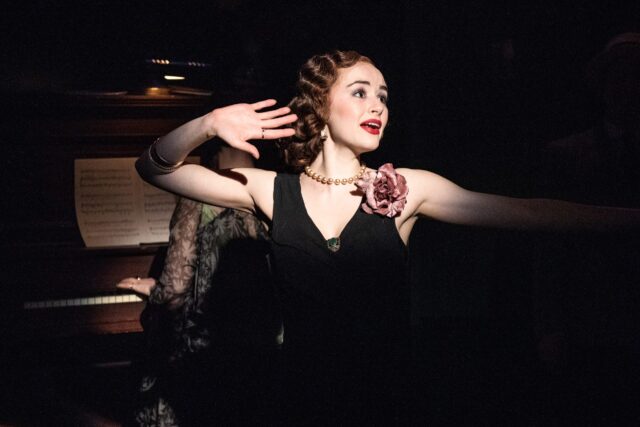
Real-life K-pop star Luna takes center stage at Circle in the Square (photo by Matthew Murphy & Evan Zimmerman)

But was that enough to lead to the surprising closing notice? Plenty of Broadway musicals survive bad reviews and thrive, sometimes for years. Was there not enough interest in K-pop, the music phenomenon that has given rise to such groups as BTS, Blackpink, and Monsta X, who play well-attended concerts around the country? KPOP tries to capitalize on that success, following the fictional girl group RTMIS (pronounced like “Artemis,” featuring its young female stars often posing as if shooting a bow and arrow) and the boy band F8 (“Fate”), a mixed bunch of young men dealing with a new member hogging the spotlight and accused of not being Korean enough. The fictional label’s star, MwE, wants to move away from her highly stylized image and be more real — maybe even become a singer-songwriter (gasp!) — and is portrayed by Luna, an actual Korean pop star who was in the hugely popular troupe f(x).

Even though it’s my job to critique theater, I don’t take pleasure when poorly reviewed shows close, even one that has spurred such nicknames as OKpop, KPOOP, and KFLOP. It might not be to my taste, but a whole lotta people were having a great time the night I was at Circle in the Square, and the audience was far more varied than the usual Broadway crowd, which is a good thing.

I just hope this experience doesn’t sour producers from taking chances on shows that bring a more wide-ranging diversity onstage and in the seats.

I called the original “an awesome journey into music making, promotion, assimilation, the desire for fame, and more,” pointing out, “Early on, Jerry [a marketing expert not in the Broadway production] explains that the mission of his agency ‘is to launch rockets into American markets.’”

Unfortunately, this rocket barely lifted off the ground.

STEPHEN PETRONIO COMPANY: BLOODLINES/BLOODLINES(FUTURE)

Stephen Petronio’s New Prayer for Now is part of special program at Danspace (film still courtesy of the Joyce Theater)

Who: Stephen Petronio Company
What: Bloodlines/Bloodlines(future)
Where: Danspace Project, St. Mark’s Church in-the-Bowery, 131 East Tenth St. at Second Ave.
When: December 8-10, $20, 7:30
Why: The indefatigable Stephen Petronio doesn’t know how to stop, which is a boon for dance lovers. The Newark-born choreographer presented innovative virtual work during the pandemic lockdown, followed by the exciting “Petronio’s Punk Picks and Other Delights” at La MaMa last November and a season at the Joyce this past May. Petronio, who celebrates postmodern dance history in his “Bloodlines” project, restaging classic works by Merce Cunningham, Trisha Brown, Lucinda Childs, Anna Halprin, Yvonne Rainer, and others, while collaborating with the next generation of creators, including Johnnie Cruise Mercer, Davalois Fearon, and UFlyMothership (dancer, singer, and songwriter Tendayi Kuumba and sound designer, director, and music producer Greg Purnell), is now returning to Danspace Project, where he presented his first evening-length work forty years ago.

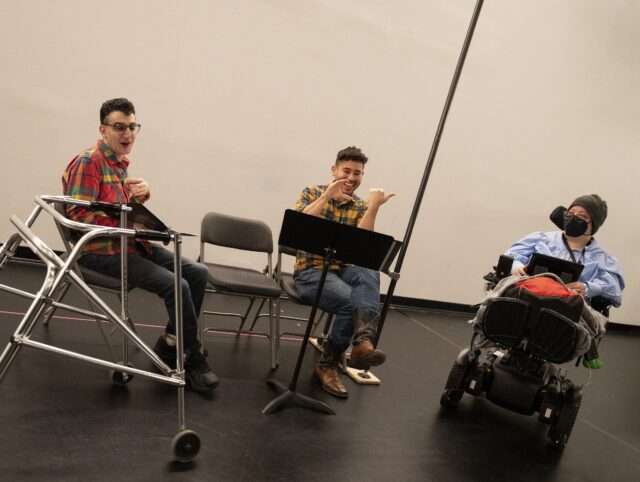
Bloodlines/Bloodlines(future) consists of that 1982 piece, Steve Paxton’s improvisational Jag Vill Gärna Telefonera (I Would Like to Make a Phone Call), which Paxton, interpreting sports photographs, originally performed with Robert Rauschenberg in 1964 (see 2018 SPC MoMA rehearsal clip above); Petronio’s initially virtual New New Prayer for Now, set to original music by Monstah Black and renditions of “Balm in Gilead” and “Bridge Over Troubled Water” recorded with the Young People’s Chorus of New York City (YPC); UFlyMothership’s The Adventures of Mr. Left Brain and Ms. Right, which pits technology against nature; Fearon’s Finding Herstory, a solo set to a compilation of Kumina, Doundounba, Congolese, Ska, Reggae, and Dancehall and music composed by Fearon and clarinetist and sax player Michael McGinnis; and the conclusion of Mercer’s six-year Process memoir 7 (Vol 8): ‘back to love.’

“It’s a thrill to come back to Danspace, the first venue to ever produce my work,” Petronio said in a statement. “And to do so in conversation with a work from history that empowers me, alongside these voices of the future that inspire me, makes this evening a profound one for me.” It should be a profound, and extremely entertaining, evening for the audience as well.

LUIZA PRADO DE O. MARTINS: THE SERMON OF THE WEEDS

Luiza Prado de O. Martins will perform The Sermon of the Weeds at the 8th Floor on December 8 (photo by MeetFactory)

Who: Luiza Prado de O. Martins
What: Live performance installation activation
Where: The 8th Floor, Shelley & Donald Rubin Foundation, 17 West 17th St.
When: Thursday, December 8, free with RSVP, 6:00
Why: Continuing at the 8th Floor at the Shelley & Donald Rubin Foundation through January 21, the powerful exhibition “El Corazón Aúlla (Heart Howls): Latin American Feminist Performance in Revolt” features photography, painting, video, sculpture, and installation focusing on gender-based violence, with works by more than a dozen female and nonbinary artists from Peru, Costa Rica, Guatemala, Mexico, El Salvador, Chile, Brazil, and Argentina. Jazmín Ra’s Falo X Falo — El Estado de Chile nos viola y nos mata (“The State of Chile rapes and kills us”), Flavia Marcus Bien’s From Night to Earth, and Elina Chauvet’s My Hair for Your Name explore misogyny, racism, and LGBTQ hate through documentation and performance, revealing serious issues and attempting to take the power back. Curators Alexis Heller and Tatiana Muñoz-Brenes explain, “These performances, their aesthetic decisions, and their particular social contexts answer questions that other artistic media cannot answer, or that could not establish an alliance with the viewer in the search for social justice. . . . Gender violence, reaching its highest peaks in feminicide and state violence, is a topic that should be howled when shouting is not enough, and that should go through political corporality and affections when common sense fails to bring about change.”

On December 8 at 6:00, Brazil-born, Berlin-based artist and activist Luiza Prado de O. Martins will activate The Sermon of the Weeds, a ritualistic circle of dirt on a white plinth, with a Jesus infinity sign on top of the small mound; the materials consist of paper, soil, Caesalpinia pulcherrima (peacock flower), Ruta graveolens (rue), Artemisia vulgaris (mugwort), Mentha pulegium (pennyroyal), and Cimifuga racemose (Black cohosh). The performance is a response to the current attacks on women’s reproductive rights in America and Brazil; Prado de O. Martins will dress as a priest, deliver a liturgical mass, and offer communion to the audience, specially made wafers (with natural ingredients used in traditional forms of birth control) and libations that equate humans and plants. (The menu includes parsley pesto; crisps; carrot, mint, and pistachio salad; seeded crackers; aged sheep’s cheese with grapes and pomegranate; fresh soft sheep’s cheese with balsamic and juniper; guava and cinnamon compote squares; pennyroyal liqueur; and artemisia iced tea.) The performance will be followed by a discussion with Prado de O. Martins and Heller. On December 10, Heller will give a curatorial tour of the exhibition, which also features works by Nayla Altamirano, Denise E. Reyes Amaya, Elina Chauvet, Cristina Flores, Regina José Galindo, Fernanda Laguna and Cecilia Palmeiro, Rossella Matamoros-Jiménez, Bárbara Milano, Wynnie Mynerva, and Berna Reale.