live performance

CAMP SIEGFRIED

A seventeen-year-old boy (Johnny Berchtold) chops wood as a sixteen-year-old girl (Lily McInerny) watches (photo by Emilio Madrid)

CAMP SIEGFRIED
Tony Kiser Theater
305 West 43rd St. between Eighth & Ninth Aves.
Tuesday – Sunday through December 4, $56-$107
2st.com/shows

Tony-nominated playwright Bess Wohl has a penchant for setting her plays in singular, fictional locations where the characters are cocooned from the rest of the world, oddly constructed outdoor microcosms that also comment on society at large. Her 2015 hit Small Mouth Sounds takes place at a silent retreat in the woods, while Continuity unfurls on an isolated movie set in the New Mexico desert re-created to look like a doomed Arctic glacier.

Her latest play, Camp Siegfried, making its US premiere at Second Stage’s Tony Kiser Theater, transpires at a 1930s summer camp on Long Island run by the German American Bund. Incredibly, it’s based on reality. During the pandemic lockdown, Wohl and her family escaped their Brooklyn home and stayed near Yaphank. Surfing the web to find things to do with her three children, Wohl learned about Camp Siegfried, which from 1936 to 1941 served as a gathering place in Yaphank for German Americans to support the Third Reich, holding Nazi indoctrination programs and encouraging young men and women to hook up and create the next generation of Aryans.

It’s 1938, and a shy, mousy sixteen-year-old girl (Lily McInerny) is standing by herself, holding a large mug of beer. She is approached by a bold seventeen-year-old boy (Johnny Berchtold) who instantly chats her up. (The two are never given names.) She is from Baltimore, attending the camp for the first time, while he is a regular, his father a bigwig in the Bund. Brett J. Banakis’s marvelous set is a large grassy hill with a deep valley, tree branches overhead, and a narrow dirt path running from bottom to top across the stage.

He (Johnny Berchtold) and she (Lily McInerny) grow close in new Bess Wohl play (photo by Emilio Madrid)

“My aunt / She thinks I need to get more physical exercise / Move around more,” she explains. “Things fester in dark spaces is what she says / And I think by dark spaces she just means Baltimore.” Wohl is referring to a lot more than just a city in Maryland.

She says she doesn’t dance, can’t swim, and doesn’t like crowds, ghost stories, or the ocean; she’s scared of just about everything. He is intent on displaying his strength and superiority, feeling he has something to prove because he’s the runt of his family. He calls her “dummy,” since she has so much to learn. When she doesn’t express pride in her heritage, he gets mad at her, decrying, “Being German / You look all hangdog about it / ‘My mom is . . .’ / What are you ashamed of / We’ve got Oktoberfest / Beer / Hamburgers / Hot dogs.” He claims that Christmas, Santa Claus, and kindergarten are all German inventions, but since WWI, Germans have been mistreated, stigmatized as “Barbarians” and “Huns.”

While he splits logs and shows off his muscles, determined to demonstrate to his father that he has “Kampfgeist” — “Kampf is struggle / Geist is spirit / The spirit of the fight / We’re supposed to have it” — she accumulates cuts and bruises on her legs, gossips about the boys and girls who disappear in pairs into the woods at night, and expresses her admiration for the romantic story of Siegfried and Brunhilde in Valhalla that ends with a funeral pyre. Wohl does not have to remind us that the tale was made famous in the epic opera Der Ring des Nibelungen by renowned German anti-Semite Richard Wagner.

They start growing closer as they work together to build a wooden platform where specially selected youths will give speeches on German Day, in front of tens of thousands of people. He thinks she would be a great choice to represent the girls as they all await what her aunt Linda calls “the Day of Freedom . . . When we storm the government / And fight back.” The two teens share stories with each other that indicate there is more to them than what is on the surface while also revealing vulnerabilities that make them ripe to fall under the lure of Hitler-style extremism. But each of them undergoes a transformation that alters the dynamics of their relationship and just what they are building together.

An unnamed pair of teenagers (Johnny Berchtold and Lily McInerny) work together at Camp Siegfried (photo by Emilio Madrid)

In their professional New York stage debuts, McInerny and Berchtold are thoroughly engaging, superbly capturing the many changes their characters undergo in a short period of time, as weakness becomes strength and vice versa. Christopher Darbassie’s sound design includes offstage chattering of the other camp attendees as well as the chirping of birds and other nature elements, in addition to the blasts of guns during target practice; Tyler Micoleau’s lighting creates long shadows that hover over the teens, who wear summery costumes by Brenda Abbandandolo.

Camp Siegfried is a modest play by Tony nominee Wohl, who is a mix of Jewish, Mormon, and Irish Catholic; her husband is Jewish, and they are raising their children Jewish. The eighty-five-minute narrative unfolds quietly under the almost elegiac direction of Tony winner David Cromer (Our Town, The Band’s Visit), a mostly secular Jew from Skokie, Illinois, where a Nazi group famously marched in 1977; Cromer confronted his own feelings about anti-Semitism when he directed Joshua Harmon’s Prayer for the French Republic earlier this year, as he told the Forward.

Prayer travels back and forth between 1944–46 and 2016–17, as a family deals with the Nazi occupation of Paris seventy years before as well as the growing anti-Semitism in the twenty-first century. Camp Siegfried tackles similar themes; the play ends a few months before Kristallnacht, which is unleashed in November 1938, leading the way to the Holocaust.

An extraordinarily talented writer, Wohl (Grand Horizons, Make Believe) makes subtle hints that bring the story into modern times, as much of the camp rhetoric evokes QAnon-type conspiracy theories involving racism, anti-Semitism, militia training, and plans to overthrow the government by force. As the girl is told in the play, “Anybody can fall into anything really / Anyone can be seduced. . . . Never underestimate your / Infinite capacity for delusion.” As we’ve seen from the January 6 insurrection at the Capitol to heavily armed Brownshirt-like figures hanging around ballot boxes this month, such seduction and delusion can happen anywhere, at any time.

BAM NEXT WAVE: TROJAN WOMEN

Ong Keng Sen and the National Changgeuk Company of Korea make their BAM debut with Trojan Women (photo courtesy NTOK)

TROJAN WOMEN
Brooklyn Academy of Music, BAM Howard Gilman Opera House
30 Lafayette Ave. between Ashland Pl. & St. Felix St.
Friday, November 18, and Saturday, November 19, $44-$125 (use code COURAGE to save 20%), 7:30
www.bam.org
www.ntok.go.kr/en

In 2011, as part of the thirtieth Next Wave Festival, BAM presented SITI Company’s Trojan Women (After Euripides), Jocelyn Clarke’s adaptation of Euripides’s 415 BCE play, the conclusion of a Trojan War trilogy that began with Alexandros and Palamedes.

In 1991, Singaporean director Ong Keng Sen staged Jean-Paul Sartre’s 1965 adaptation of Trojan Women in a granite quarry. In 2016, Ong revisited the tale, this time with the National Changgeuk Company of Korea, combining classical Greek tragedy with contemporary K-pop and the Korean storytelling form known as pansori, which dates back to the seventeenth century and features each solo singer accompanied by one instrument.

Now Ong brings Hecuba (Kim Kum-mi), Cassandra (Yi So-yeon), Andromache (Kim Mi-jin), Helen (Kim Jun-soo), and the rest of the Trojan men and women (Lee Kwang-bok as Talthybios, Choi Ho-sung as Menelaus, Yu Tae-pyung-yang as Soul of Souls, an eight-woman chorus, and a nine-piece orchestra) to BAM’s Howard Gilman Opera House November 18 and 19 as part of the fortieth Next Wave Festival. The production, which has traveled around the world, melds text by playwright Bae Sam-sik, traditional pansori music by South Korean Living National Treasure master singer Ahn Sook-sun, K-pop music by Parasite and Squid Game composer Jung Jae-il, a surreal set by Cho Myung-hee, bold lighting by Scott Zielinski, exciting video design by Austin Switser, and white costumes by Kim Moo-hong.

“My style of distilled yet rich storytelling is often expressed through a strong concept, integrated gesamtkunstwerk, and bold visuality,” Ong explains in a program note. “When I was invited by the National Changgeuk Company of Korea to direct Trojan Women, I yearned to return to the minimalism of pansori, where a solo storyteller sings all the parts with only one drummer. Thus began the task of removing the layers which had been overlaid in time over changgeuk (a musical theater genre formed in the early twentieth century from pansori), like stripping off layers of paints and renovations to get to the base architecture of an old house. . . . From the beginning I felt that Helen, who stands between the Greeks and the Trojans, is a character between binary opposites. In our production, the voice of Helen exists in the space between masculine and feminine — she is an outsider who launched the war between Greece and Troy. With the chorus, I drew inspiration from the music of enslaved peoples transported from Africa to the Americas. Similarly to how African music became the music of spirituals, blues, jazz, rap, it would be wonderful if the chorus of Trojan Women could express the vibrant potential future of pansori. Hence the invitation to Jang Jae-Il to write the music for the chorus in the genre of K-pop, where the emotionalism of pansori infuses contemporary pop elements. ”

This show marks the BAM debut of the National Changgeuk Company of Korea, which is celebrating its sixtieth anniversary. The 110-minute multimedia drama incorporates music, dance, and theater, with a cast of more than dozen singers, actors, and musicians exploring the effects of battle on women, particularly the Korean War. “Trojan Women deals with human dignity and self-respect,” Ong said in an October 2016 interview with the Financial Times. “Most of all, it is focused on women’s strong will to live. I also hope that this work would remind the audience of the pain and sorrow Korean women had suffered after the war.”

MONTAG

Novella (Nadine Malouf) and Faith (Ariana Venturi) face an uncertain future in Montag (photo by Julieta Cervantes)

MONTAG
Soho Rep
46 Walker St. between Broadway & Church St.
Tuesday – Sunday through November 20, $55
sohorep.org

In German, Montag, the name of Kate Tarker’s new play, making its world premiere at Soho Rep through November 20, means “Monday,” a day that is critical to the plot of the eighty-minute show. But it also made me think of Guy Montag, the protagonist of Ray Bradbury’s sci-fi classic Fahrenheit 451. Named after a paper company, Montag is a firefighter in charge of finding books in people’s homes and burning them, at 451 degrees Fahrenheit.

In the first chapter, Bradbury writes, “The last few nights he had had the most uncertain feelings about the sidewalk just around the corner here, moving in the starlight toward his house. He had felt that a moment before his making the turn, someone had been there. The air seemed charged with a special calm as if someone had waited there, quietly, and only a moment before he came, simply turned to a shadow and let him through. Perhaps his nose detected a faint perfume, perhaps the skin on the backs of his hands, on his face, felt the temperature rise at this one spot where a person’s standing might raise the immediate atmosphere ten degrees for an instant. There was no understanding it. Each time he made the turn, he saw only the white, unused, buckling sidewalk, with perhaps, on one night, something vanishing swiftly across a lawn before he could focus his eyes or speak. But now tonight, he slowed almost to a stop. His inner mind, reaching out to turn the corner for him, had heard the faintest whisper. Breathing? Or was the atmosphere compressed merely by someone standing very quietly there, waiting? He turned the corner.”

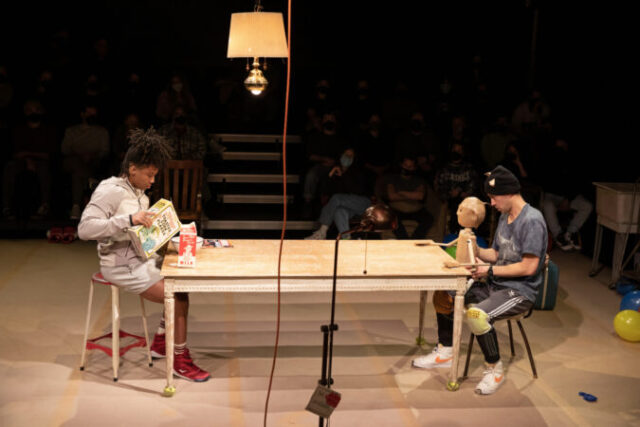
That same feeling pervades Montag, which takes place in set designer Lisa Laratta’s dark box in the middle of the stage. A lone light dangles from the ceiling. (The appropriately dingy lighting is by Masha Tsimring.) Faith (Ariana Venturi) and Novella (Nadine Malouf) sit opposite each other at a small table, the former smoking a cigarette, the latter crunching loudly on chips and crinkling the plastic snack bag. It’s live, in-person ASMR for the audience, experienced in a mysterious claustrophobic space instead of an online video. In the back is a wall filled with random, mostly unidentifiable objects, like remnants from a life shuttered away. Next to that is a doorway through which light can be seen, reminiscent of that corner Montag eventually turns onto.

It’s April 2014, and Faith and Novella live together in a basement apartment on a US army base in Germany; the former is a lead systems analyst from America, while the latter is a comfort woman for the soldiers, a Turkish immigrant who is now a German citizen. They are contemporary versions of the Gastarbeiter, or guest workers, who moved to Germany between 1955 and 1973; each one is married and has a child, none of whom the audience ever sees.

Two friends (Ariana Venturi and Nadine Malouf) search for meaning in Soho Rep world premiere (photo by Julieta Cervantes)

On this evening, Novella is ready to party. “We go all night?” Novella asks. “That’s the deal,” Faith says. “The deal we made with the devil.” They are in day seven of some kind of weeklong deprivation. During that time, a colleague of Faith’s named Clifford Andrews has gone missing. Faith interviews Clifford, channeled by Novella, who, when asked why he stopped coming to work, replies, in a nod to the Boomtown Rats, “Maybe I just don’t like Mondays.” He eventually gets extremely angry, which adds to the sense of danger that surrounds the somewhat existential situation. “Are you planning anything, Cliff?” Faith asks. (The Boomtown Rats’ 1979 hit “I Don’t Like Mondays” was based on a school shooting that year in San Diego.)

But even as they worry about what might happen next, they occasionally break out into song and dance, putting on glittering costumes (by Montana Levi Blanco) and moving and grooving to Beyoncé as well as Rupert Holmes’s “Piña Colada Song,” the real name of which is actually “Escape.” Several characters who enter late, played by Dane Suarez and Jacob Orr, add further confusion to an abstruse plot that is never fully revealed while also providing a sense of finality.

Director Dustin Wills (Wolf Play, Plano) has trouble finding a narrative flow to the proceedings, which too often feel jumpy and random, although he does capture the overall sense of impending doom. Venturi (Mary Page Marlowe, These Paper Bullets!) and Malouf (A Bright Room Called Day, Intractable Woman: A Theatrical Memo on Anna Politkovskaya) form an engaging bond as the friends trapped in a dystopian near-future.

Tarker (Thunderbodies, Laura and the Sea), who grew up on the outskirts of an army base in Germany, has cited such wide-ranging influences on the play as Carrie Mae Weems’s “Kitchen Table Series,” Rainer Werner Fassbinder’s Ali: Fear Eats the Soul, Martha Rosler’s Semiotics of the Kitchen, and Ridley Scott and Callie Khouri’s Thelma & Louise, which accounts for the show’s unpredictable course and what it is inherently about, although it’s no coincidence that in August 2014, four months after Montag is set, authoritarian Recep Erdoğan will be elected president of Turkey.

Faith sums it all up when she says, “Most people — they have no idea. How scary the world is.”

Ray Bradbury’s Montag would no doubt agree.

STEVE MARTIN, HARRY BLISS, AND NATHAN LANE: NUMBER ONE IS WALKING

Who: Steve Martin, Harry Bliss, Nathan Lane
What: Book launch
Where: The Town Hall, 123 West Forty-Third St. between Sixth & Seventh Aves.
When: Tuesday, November 15, $68, 8:00
Why: Multihyphenate Steve Martin has made films and records and written plays, movie scripts, novels, children’s books, and tongue-in-cheek self-help tomes. He has now entered the graphic novel field with Number One Is Walking: My Life in the Movies and Other Diversions (Celadon, November 15, $30), with the help of black-and-white illustrations by cartoonist Harry Bliss. A follow-up to their 2020 cartoon collection A Wealth of Pigeons, the new book features scenes in which Martin looks back at his career for the first time in print. The title comes from a Hollywood trope; in one panel, Martin explains, “On a movie call sheet, the actors are listed numerically. The lead is number one, the second lead is number two, etc. I was slightly embarrassed on my first film, The Jerk, when I would head toward the set and the assistant director would trail me, transmitting into his walkie talkie . . . ‘Number one is walking.’” Martin points out that he was also “number one” on Bowfinger, Cheaper by the Dozen, and Bringing Down the House, but when he did Nancy Meyers’s It’s Complicated with Meryl Streep and Alec Baldwin, each time he came on set he was horrified to hear: “Number three is walking.”

Longtime New Yorker cartoonist Bliss has illustrated such books as Joanna Cotler’s Sorry (Really Sorry), Doreen Cronin’s Diary of a Worm, and Alison McGhee’s Countdown to Kindergarten as well as writing and illustrating Bailey and Luke on the Loose. On November 15 at 8:00, Martin and Bliss will be at the Town Hall to discuss their collaboration; serving as moderator will be the one and only Nathan Lane, who appears with Martin in Only Murders in the Building. All audience members will receive a signed copy of Number One Is Walking: My Life in the Movies and Other Diversions, courtesy of the Strand.

ALBERT CAMUS’ THE FALL

Ronald Guttman brings his one-man show, Albert Camus’ The Fall, to the Huron Club at SoHo Playhouse (photo © Zack DeZon)

ALBERT CAMUS’ THE FALL
The Huron Club at SoHo Playhouse
15 Vandam St. between Varick St. & Sixth Ave.
Wednesday – Saturday through November 19, $51, 7:30
www.sohoplayhouse.com/the-fall
www.highbrow.net

Theater is all about the connection between audience and performer. During the pandemic lockdown, I watched hundreds of livestreamed or prerecorded shows, but being at home in front of your computer by yourself is not the same as sitting in a dark venue with other people as a story unfolds in front of you, told by live actors.

Among the memorable virtual plays I watched was Albert Camus’ The Fall, Alexis Lloyd’s adaptation of Camus’ final novel, known in French as La Chute. The book was published in 1956; Nobel Prize winner Camus, who also wrote A Happy Death, The Stranger, and The Plague, would die four years later in a car accident at the age of forty-six. The one-man show starred Belgian-born actor Ronald Guttman onstage in FIAF’s Tinker Auditorium on October 1, 2020, with an audience of twenty-five.

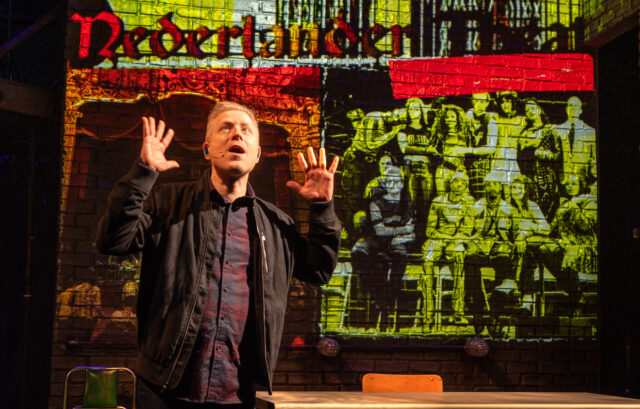
Guttman has been presenting various iterations of The Fall, which he first read when he was seventeen, for more than two decades; the latest version, directed by Didier Flamand, takes place in the Huron Club at SoHo Playhouse, a downstairs bar with a small stage. The audience is seated at round tables, several of which are only a few feet from the stage; there is also a row of barstools. The walls are plastered with images of women, in framed pictures and pages from magazines, along with a few travel posters; the stage features a backdrop of an Amsterdam canal. Guttman, wearing an old brown suit, his long white hair nearly reaching his shoulders, enters from the rear of the room, instantly making eye contact with just about everyone. It’s an exciting moment that can’t be experienced virtually. He walks onstage and then scans the crowd again, deciding which member of the audience will serve as a stand-in for the man his character addresses directly in the book, which is essentially a public confession by Parisian ex-pat former lawyer Jean-Baptiste Clamence, delivered to an unidentified person in a seedy dive bar in Amsterdam’s red light district.

The night I went, he selected me.

“Pleased to make your acquaintance. You’re probably . . . a businessman? Kind of a businessman? We all tend to be kind of, in almost everything,” he says to me at the start, carefully looking me over. “Let me guess, if you don’t mind. You’re in your fifties, you’ve been around, kind of . . . Your hands are clean, and you’re well dressed, kind of. You’re upper-middle class, but . . . sophisticated upper-middle class. And you find me amusing, which means you’re open minded. Kind of.” He didn’t do too bad, although I was wearing a jeans jacket and a black mask. (Masks are optional.) I would nod, shake my head, or laugh in response, confident the best thing was to say nothing.

He then turns to the rest of the audience and explains, “As for me, well, I’ll let you be the judge of that. In spite of my good manners, and my way with words, I am a regular of these sailors dives, here in Amsterdam. There’s only one thing simple about me: I don’t own anything. I used to, I used to be wealthy, back in Paris.”

Looking at me once again, he adds, “Which makes us compatriots, I imagine?”

Ronald Guttman is mesmerizing as Parisian ex-pat former lawyer Jean-Baptiste Clamence in The Fall (photo © Zack DeZon)

It’s a fabulous opening to this immersive experience, in which Clamence shares aspects of his private and professional life as he walks around the space, gets drinks from the bartender — who spends the sixty-minute show reading a copy of Playboy — and stops by each table to make sure everyone is involved in his tale. He moves and speaks with an eloquent, elegant poetry as he explores the nature of truth and humanity’s innocence, and its guilt. “I look trustworthy, don’t you think?” he asks. “If thieves were always condemned, honest people would always feel innocent, and that would be a disaster.”

He talks about his success with women, about his insufficiencies, about shame. “Think for a moment about your own life, search your own memories, maybe you’ll find something of that kind,” he says. “Something you’ll tell me later, one day.”

The centerpiece is a rainy November night when Clamence — a play on the word clemence, which means “forgiveness” — passes a woman on a bridge, then hears a loud splash in the river below, along with several screams, followed by silence. “I wanted to run to her, but I didn’t move,” he admits. He walks away, convincing himself there was nothing he could do. It’s a poignant parable for the choices we all have to make every day. Camus is forcing us to put ourselves under the microscope, facing what we’ve done, what we haven’t done, and whether there’s still time to confess and change, how to avoid being judged but still be punished.

“You can never really prove anybody’s innocence, but you can be sure we’re all guilty,” he says. “Every man bears witness to the crimes of all the others, such is my faith, such is my only hope.”

Guttman (Bauer, Patriots) is mesmerizing as Clamence; he embodies the character from the moment he enters the Huron Club. We are not so much watching a one-man show as listening to a stranger telling us about his life and how we can learn from his story as we, perhaps, become friends.

“I don’t have any friends anyway, not anymore. I only have accomplices. But I have a lot of them; they are the whole of mankind,” he tells everyone. He then looked right at me and said, “And within mankind, you. You’re the first of my accomplices. The one who is there is always the first accomplice.”

Consider me guilty as charged.

ACTION SONGS / PROTEST DANCES

Who: Edisa Weeks, Taína Asili, Spirit McIntyre, Martha Redbone, Noni Byrd-Gibbs, Steven Jeltsch, Johnnie Cruise Mercer, Devin Oshiro, Brittany Stewart, Marýa Wethers
What: Action Songs/Protest Dances
Where: Kupferberg Center for the Arts, 153-49 Reeves Ave., Flushing
When: Saturday, November 12, 8:00, and Sunday, November 13, 3:00, $20
Why: Given the state of the nation, particularly following the midterm elections, it is a time for action and protest. On November 12 and 13, Queens College will be hosting the timely program “Action Songs/Protest Dances,” featuring an impressive lineup of musicians and dancers. The event was conceived by director and choreographer Edisa Weeks in honor of civil rights activist James Forman (1928-2005), who wrote such books as The Making of Black Revolutionaries, Self Determination: An Examination of the Question and Its Application to the African American People, and High Tide of Black Resistance and Other Political & Literary Writings.

“I started teaching at Queens College in 2010, which is also when the QC Rosenthal Library Civil Rights Archives acquired James Forman’s personal papers,” Weeks said in a statement. “I was incredibly excited as Forman was the first person I heard criticize capitalism as an exploitive economic system. I was a kid at the time, and remember feeling shocked, as I grew up playing Monopoly and believing that capitalism was good and the ‘American Way.’ Since 2010 I’ve been wondering how I can lift up James Forman’s voice, work, advocacy, and sacrifices during the civil rights movement in the 1960s. Then in 2020 the pandemic happened, followed by the murder of George Floyd and Brianna Taylor. I began wondering how as a choreographer I can engage with the protests that were happening across the nation and help address injustices in America. The Kupferberg Center for the Arts Incubator Project provided the opportunity to create ‘Action Songs/Protest Dances,’ which celebrates the life and words of James Forman, and through music and dance advocates for America to be a truly great nation.”

The event features original songs by Taina Asili, Spirit McIntyre, and Martha Redbone, with dancers Noni Byrd-Gibbs, Steven Jeltsch, Johnnie Cruise Mercer, Devin Oshiro, Brittany Stewart, and Marýa Wethers. Each show will be followed by a discussion with the composers and performers, moderated by Miles Grier on November 12 and Natanya Duncan on November 13.

NEIL GREENBERG: BETSY

Neil Greenberg will present the world premiere of Betsy this week at La MaMa (photo by Frank Mullaney)

Who: Neil Greenberg, Paul Hamilton, Opal Ingle, Owen Prum
What: World premiere dance
Where: La MaMa’s Downstairs Theater, 66 East Fourth St. between Second & Third Aves.
When: November 12-14, 17-20, $10-$30
Why:Betsy makes use of projected written text that situates the dance within a two-pandemic landscape of COVID and AIDS, and within the also-ongoing crisis of racism and white supremacy,” dancer and choreographer Neil Greenberg explains on the Kickstarter page for his latest piece, premiering November 12-14 and 17-20 at LaMaMa. “I’m working to expose the cultural rootedness of any performance material in the conditions of its production. The use of text simultaneously gestures toward the kind of meaning-making encouraged by language while also intervening to allow for other perceptual possibilities.” The work features Greenberg, Paul Hamilton, Opal Ingle, and Owen Prum, with an original score by James Lo and Zeena Parkins and lighting by Michael Stiller. A former member of Merce Cunningham Dance Company and dance curator at the Kitchen and currently on the dance faculty at the New School, Greenberg made his La MaMa debut in 1987 with MacGuffin, or How Meanings Get Lost.

Betsy will engage with the phenomenon of performance itself, in a play with the multiple relational possibilities between performers and spectators, and between a work and its spectators,” Greenberg (Partial View, This) continues. “Betsy will be presented with audience surrounding the performance arena, each viewer necessarily experiencing the performance materials differently due to their distinct vantage point, enabling spectators to watch the dance, themselves, and each other as they watch the dance together.”