live performance

KPOP

The flashy KPOP is closing early on Broadway (photo by Matthew Murphy & Evan Zimmerman)

KPOP
Circle in the Square Theatre
1633 Broadway at 50th St.
Through December 11
kpopbroadway.com

On Saturday night, December 3, I was at Circle in the Square, watching KPOP. I had loved Ars Nova’s 2017 immersive production at A.R.T./New York and was looking forward to the Broadway incarnation. Alas, lightning did not strike twice.

I was supremely disappointed in the revised book, which eschewed most of the behind-the-scenes drama and the progression of the plot — in the original, small groups of audience members were led through a series of rooms in which the action played out, exploring how K-pop stars are made through vocal and dance lessons, press training, makeup, and costumes, following along as a South Korean record company prepares for its major introduction to the US market. Instead, the new version concentrates on big, glittering production numbers centered around a white filmmaker documenting the rehearsals. The central creative team has not changed — the book is by Jason Kim, with music and lyrics by Helen Park and Max Vernon, music production and arrangements by Park, choreography by Jennifer Weber, and direction by Teddy Bergman. But the feeling has.

While I sat in my seat, missing all the nuance of the original story, the soul of which has been sucked dry, I looked around at the Saturday night crowd, nearly all of whom were having a great time. At Circle in the Square, the audience sits on three sides of the thrust stage, and the lighting is so bright that you can see everyone in the theater. Aside from a few pockets of empty seats in the upper corners, the house was packed, and nearly everyone was eating up every minute of the show; a colleague of mine had a huge smile on his face throughout the two hours and ten minutes (with intermission); he emailed me afterward to say that he “fucking loved” it. (Another colleague of mine said that the night he went, there was an embarrassing amount of empty seats.) People were dancing in their seats, clapping along, eyes sparkling wide at Clint Ramos and Sophia Choi’s dazzling costumes, Jiyoun Chang’s flashy, colorful lighting, Peter Fitzgerald and Andrew Keister’s propulsive sound design, and Peter Nigrini’s constant barrage of cool projections on Gabriel Hainer Evansohn’s set, which includes a mobile platform, video monitors with live footage from multiple angles, and a stage lift with a trap door where a character’s past is explored.

So the last thing I expected was, a few days later, to find out that the show was closing extremely early, on December 11, a mere three weeks after opening, having played forty-four previews and only seventeen performances.

KPOP found itself mired in controversy when Jesse Green used some highly questionable language in his negative New York Times review, leading to the producers of the show and several cast members to take to social media, demanding an apology.

Real-life K-pop star Luna takes center stage at Circle in the Square (photo by Matthew Murphy & Evan Zimmerman)

But was that enough to lead to the surprising closing notice? Plenty of Broadway musicals survive bad reviews and thrive, sometimes for years. Was there not enough interest in K-pop, the music phenomenon that has given rise to such groups as BTS, Blackpink, and Monsta X, who play well-attended concerts around the country? KPOP tries to capitalize on that success, following the fictional girl group RTMIS (pronounced like “Artemis,” featuring its young female stars often posing as if shooting a bow and arrow) and the boy band F8 (“Fate”), a mixed bunch of young men dealing with a new member hogging the spotlight and accused of not being Korean enough. The fictional label’s star, MwE, wants to move away from her highly stylized image and be more real — maybe even become a singer-songwriter (gasp!) — and is portrayed by Luna, an actual Korean pop star who was in the hugely popular troupe f(x).

Even though it’s my job to critique theater, I don’t take pleasure when poorly reviewed shows close, even one that has spurred such nicknames as OKpop, KPOOP, and KFLOP. It might not be to my taste, but a whole lotta people were having a great time the night I was at Circle in the Square, and the audience was far more varied than the usual Broadway crowd, which is a good thing.

I just hope this experience doesn’t sour producers from taking chances on shows that bring a more wide-ranging diversity onstage and in the seats.

I called the original “an awesome journey into music making, promotion, assimilation, the desire for fame, and more,” pointing out, “Early on, Jerry [a marketing expert not in the Broadway production] explains that the mission of his agency ‘is to launch rockets into American markets.’”

Unfortunately, this rocket barely lifted off the ground.

STEPHEN PETRONIO COMPANY: BLOODLINES/BLOODLINES(FUTURE)

Stephen Petronio’s New Prayer for Now is part of special program at Danspace (film still courtesy of the Joyce Theater)

Who: Stephen Petronio Company
What: Bloodlines/Bloodlines(future)
Where: Danspace Project, St. Mark’s Church in-the-Bowery, 131 East Tenth St. at Second Ave.
When: December 8-10, $20, 7:30
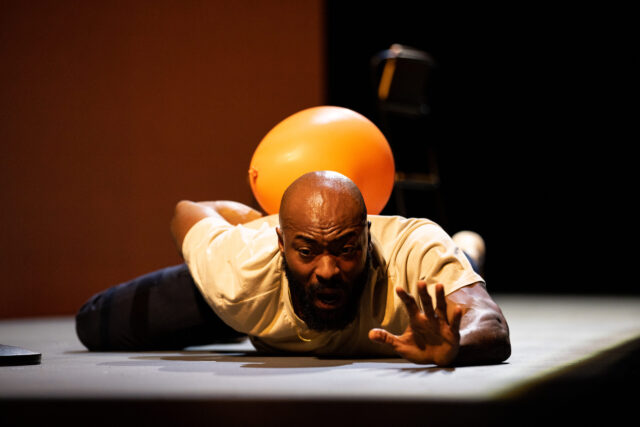
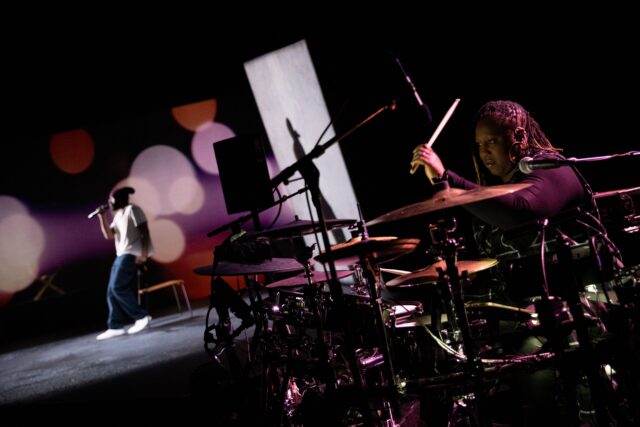
Why: The indefatigable Stephen Petronio doesn’t know how to stop, which is a boon for dance lovers. The Newark-born choreographer presented innovative virtual work during the pandemic lockdown, followed by the exciting “Petronio’s Punk Picks and Other Delights” at La MaMa last November and a season at the Joyce this past May. Petronio, who celebrates postmodern dance history in his “Bloodlines” project, restaging classic works by Merce Cunningham, Trisha Brown, Lucinda Childs, Anna Halprin, Yvonne Rainer, and others, while collaborating with the next generation of creators, including Johnnie Cruise Mercer, Davalois Fearon, and UFlyMothership (dancer, singer, and songwriter Tendayi Kuumba and sound designer, director, and music producer Greg Purnell), is now returning to Danspace Project, where he presented his first evening-length work forty years ago.

Bloodlines/Bloodlines(future) consists of that 1982 piece, Steve Paxton’s improvisational Jag Vill Gärna Telefonera (I Would Like to Make a Phone Call), which Paxton, interpreting sports photographs, originally performed with Robert Rauschenberg in 1964 (see 2018 SPC MoMA rehearsal clip above); Petronio’s initially virtual New New Prayer for Now, set to original music by Monstah Black and renditions of “Balm in Gilead” and “Bridge Over Troubled Water” recorded with the Young People’s Chorus of New York City (YPC); UFlyMothership’s The Adventures of Mr. Left Brain and Ms. Right, which pits technology against nature; Fearon’s Finding Herstory, a solo set to a compilation of Kumina, Doundounba, Congolese, Ska, Reggae, and Dancehall and music composed by Fearon and clarinetist and sax player Michael McGinnis; and the conclusion of Mercer’s six-year Process memoir 7 (Vol 8): ‘back to love.’

“It’s a thrill to come back to Danspace, the first venue to ever produce my work,” Petronio said in a statement. “And to do so in conversation with a work from history that empowers me, alongside these voices of the future that inspire me, makes this evening a profound one for me.” It should be a profound, and extremely entertaining, evening for the audience as well.

LUIZA PRADO DE O. MARTINS: THE SERMON OF THE WEEDS

Luiza Prado de O. Martins will perform The Sermon of the Weeds at the 8th Floor on December 8 (photo by MeetFactory)

Who: Luiza Prado de O. Martins
What: Live performance installation activation
Where: The 8th Floor, Shelley & Donald Rubin Foundation, 17 West 17th St.
When: Thursday, December 8, free with RSVP, 6:00
Why: Continuing at the 8th Floor at the Shelley & Donald Rubin Foundation through January 21, the powerful exhibition “El Corazón Aúlla (Heart Howls): Latin American Feminist Performance in Revolt” features photography, painting, video, sculpture, and installation focusing on gender-based violence, with works by more than a dozen female and nonbinary artists from Peru, Costa Rica, Guatemala, Mexico, El Salvador, Chile, Brazil, and Argentina. Jazmín Ra’s Falo X Falo — El Estado de Chile nos viola y nos mata (“The State of Chile rapes and kills us”), Flavia Marcus Bien’s From Night to Earth, and Elina Chauvet’s My Hair for Your Name explore misogyny, racism, and LGBTQ hate through documentation and performance, revealing serious issues and attempting to take the power back. Curators Alexis Heller and Tatiana Muñoz-Brenes explain, “These performances, their aesthetic decisions, and their particular social contexts answer questions that other artistic media cannot answer, or that could not establish an alliance with the viewer in the search for social justice. . . . Gender violence, reaching its highest peaks in feminicide and state violence, is a topic that should be howled when shouting is not enough, and that should go through political corporality and affections when common sense fails to bring about change.”

On December 8 at 6:00, Brazil-born, Berlin-based artist and activist Luiza Prado de O. Martins will activate The Sermon of the Weeds, a ritualistic circle of dirt on a white plinth, with a Jesus infinity sign on top of the small mound; the materials consist of paper, soil, Caesalpinia pulcherrima (peacock flower), Ruta graveolens (rue), Artemisia vulgaris (mugwort), Mentha pulegium (pennyroyal), and Cimifuga racemose (Black cohosh). The performance is a response to the current attacks on women’s reproductive rights in America and Brazil; Prado de O. Martins will dress as a priest, deliver a liturgical mass, and offer communion to the audience, specially made wafers (with natural ingredients used in traditional forms of birth control) and libations that equate humans and plants. (The menu includes parsley pesto; crisps; carrot, mint, and pistachio salad; seeded crackers; aged sheep’s cheese with grapes and pomegranate; fresh soft sheep’s cheese with balsamic and juniper; guava and cinnamon compote squares; pennyroyal liqueur; and artemisia iced tea.) The performance will be followed by a discussion with Prado de O. Martins and Heller. On December 10, Heller will give a curatorial tour of the exhibition, which also features works by Nayla Altamirano, Denise E. Reyes Amaya, Elina Chauvet, Cristina Flores, Regina José Galindo, Fernanda Laguna and Cecilia Palmeiro, Rossella Matamoros-Jiménez, Bárbara Milano, Wynnie Mynerva, and Berna Reale.

THE RAT TRAP

Sheila Brandreth (Sarin Monae West) and Keld Maxwell (James Evans) toast to their upcoming marriage in Mint production of Noël Coward’s The Rat Trap (photo © Todd Cerveris)

THE RAT TRAP
New York City Center Stage II
131 West 55th St. between Sixth & Seventh Aves.
Tuesday – Sunday through December 10, $45-$90
minttheater.org
nycitycenter.org

There’s a reason why Noël Coward’s first “serious play,” The Rat Trap, has never before been performed in the United States: It’s not all that good. In fact, not even the Mint, the finest purveyors of lost and forgotten theater, can save the drawing-room comedy of manners in its sharp production running at City Center’s Stage II through December 10.

“For years I have mourned the fact that The Rat Trap never saw the light of day,” Coward wrote in 1924’s Three Plays, consisting of The Rat Trap and the more successful Fallen Angels and The Vortex. “But now the time for it is past, the sterling merits I saw in it when it was first written in 1920 have faded.” Coward wrote the play when he was eighteen, reportedly for Meggie Albanesi, who died in December 1923 from the aftereffects of a botched abortion.

Coward didn’t attend the play’s 1926 debut in London; he wrote in his 1937 autobiography, Present Indicative, “In spite of the effulgence of the cast, the play fizzled out at the end of its regulation two weeks. I was not particularly depressed about this; The Rat Trap was a dead love.” He particularly called out the big scene in the last act, which “made me shudder, nostalgically, but with definite embarrassment. It was neither good enough nor bad enough to merit a West-End run, and it was perhaps a mistake to have allowed it to be produced at all; however no harm was done, and I am sure that it was admirable exercise for the actors.”

It is indeed admirable exercise for the splendid Mint actors and director Alexander Lass, but the story grows quickly tedious. It begins in Olive Lloyd-Kennedy’s (Elisabeth Gray) apartment in West Kensington, where she lives with young writer Sheila Brandreth (Sarin Monae West), who is about to marry burgeoning playwright Keld Maxwell (James Evans). Olive is not a fan of the wedding ritual; she tells Sheila and Keld, “Marriage nowadays is nothing but a temporary refuge for those who are uncomfortable at home.”

Olive has invited over another couple, the decadent author Naomi Frith-Bassington (Heloise Lowenthal) and the would-be poet Edmund Crowe (Ramzi Khalaf), Bohemian lovers who refuse to get married because that would be too conventional. “Miss Brandreth, how courageous it is of you to marry! I should never dare,” Naomi says. “Edmund and I realise the value of love, perhaps better than anyone; it seems sacrilege to fetter it down with chains of matrimony.”

Naomi (Heloise Lowenthal) and Ruby (Claire Saunders) share a moment as Edmund (Ramzi Khalaf) looks on in The Rat Trap (photo © Todd Cerveris)

Six months after their marriage, Sheila and Keld are living in their house in Belgravia, she working on her next book in her bedroom, he on his play in the far more comfortable study. There are already signs of strain as they argue over a pencil and the value of their ornery maid, Burrage (Cynthia Mace). Sheila tells Keld, “I mean to discover what the trouble is; it’s getting on my nerves terribly, so it is on yours. We’re not being happy together, Keld, we’re not being happy together. Don’t you realise it — isn’t it awful?” He unconvincingly tries to push it aside and declare it’s all “trivialities,” but when his play is an instant hit and he is spending more time with one of the stars, the ambitious ingénue Ruby Raymond (Claire Saunders), trouble is not far off.

The Rat Trap is impeccably rendered by director Alexander Lass (in his New York debut) on Vicki Davis’s ever-changing set, as stagehands move around furniture between scenes and a yellow semicircular curtain occasionally opens in the back to introduce a larger space. Hunter Kaczorowski’s period costumes capture the era, and the lighting, by Christian DeAngelis, and the sound, by Bill Toles, are meticulous and precise, as always with the Mint. And the cast is excellent, particularly West (The Skin of Our Teeth, Merry Wives) as Sheila, her initially dreamy eyes turning sour over time; Khalaf as Edmund, who makes what he believes to be profound statements that get no reaction from the others; and Mace as Burrage, whose displeasure with her life is apparent in her every word and move.

The problem is that The Rat Trap is very much an early play by a writer still sowing his oats; Coward would go on to pen Private Lives, Cavalcade, Design for Living, Present Laughter, and Blithe Spirit, all within a spectacular twelve-year span from 1929 to 1941. While impressive for a teenager, The Rat Trap ultimately falls apart as Coward drifts into melodrama with soap-opera twists and turns. A late revelation actually made my jaw drop and my face wince.

Sharing yet another rave review of his aptly titled play Stress, Coward’s protagonist Keld, a kind of stand-in for the author himself, reads: “‘There was none of that forced appreciation one generally sees at first nights nowadays; the debonair author made a witty speech in response to the ecstatic calls for him. He should indeed be proud of a really great achievement. . . .” In this case, Coward’s own really great achievements lay in the future, with at least one clunker to help pave the way.

THE GETT

Ball (Ben Edelman) and Ida’s (Liba Vaynberg) relationship kicks off in an elevator in The Gett (photo by Bronwen Sharp)

THE GETT
Rattlestick Playwrights Theater
224 Waverly Pl.
Wednesday – Monday through December 11, $45
www.rattlestick.org

When was the last time you saw a new show that was accompanied by a sixty-three-page dramaturgy packet? You’ll find one for The Gett, an offbeat, extremely clever — almost too much so for its own good — and ultimately satisfying play in which a young woman imagines her relationship with men through the lens of the creation of the world.

The ninety-minute work, written by and starring the charming Liba Vaynberg and continuing at the Rattlestick through December 11, is divided into seven sections that essentially follow the biblical seven-day creation story. Vaynberg, in a modest wedding dress, takes the stage, holding up a sheet of parchment, explaining what a gett is. “The gett is technically just an old religious document of divorce,” she says. “An old text on a piece of paper / That needs a rewrite — / Revision / Re-creation.”

Vaynberg is Ida — pronounced EE-dah, not eye-dah like my own grandmother, who had unique, freethinking views about a woman’s sexuality. Ida tells us, “Six thousand years ago I fell in love with a man. / I mean, sometimes it feels like a week ago. / Depends on when you ask me. And how.” She also sets up one of the play’s key themes when she says, “None of this is real. Or true. / It’s just what I believe.” The Gett is about faith — in G-d and religion, in family, in love, and, perhaps most important, in oneself.

On her way to a Christmas party at her friend Lilah’s apartment on the twenty-third floor, Ida, a poet who works in a library, gets stuck in an elevator with Baal (Ben Edelman), a tall, lanky man who is also going to the fête, bringing Chinese food. Vaynberg has painstakingly made nearly every single detail of the play relevant, every name, every prop, every number, nearly all of which are pointed out in the dramaturgy packet.

Ida means “witness” in Hebrew and has a numerological value of two; a gett would make a couple into a pair of ones. Baal means “husband,” “owner,” “false, violent god,” or “slavemaster” in Hebrew, is the name of the Canaanite god of fertility, and evokes the Baal Shem Tov, the eighteenth-century Ukrainian rabbi, mystic, and healer who founded Hasidic Judaism and whose name means “Master of the Good Name”; just as human beings cannot know or pronounce the full name of G-d, Baal, who is a magician and inventor, says to Ida, “I have a weird name no one can pronounce.” The floor number conjures Psalm 23, which includes the lines “The Lord is my shepherd; I shall not want. . . . He leads me in paths of righteousness for his name’s sake.” Lilah, derived from Delilah, the Philistine beauty who betrayed Samson, has been interpreted to be the angel of conception and the opposite of Lilith, Adam’s first wife (and Baal’s second wife in the play). And Baal and Ida meet on Christmas Day, celebrated as the day Jesus Christ was born.

Ida’s mother (Jennifer Westfeldt) chats away on the phone throughout new play (photo by Bronwen Sharp)

As Ida meets with a divorce attorney and starts dating other men (all unnamed, all played by Luis Vega with different accents), Baal occasionally watches from the corners, an all-seeing figure hovering over her life. During one of her dates, Baal appears in her mind, magically pulling a condom for her out of thin air, then making it disappear. (Alexander Boyce serves as magic consultant.) Baal later shows up for real, asking Ida to give him a gett.

Meanwhile, Ida’s mother (Jennifer Westfeldt) incessantly calls her daughter, leaving long, gossipy messages when Ida doesn’t pick up, going on and on about Ida’s future, how friends’ kids are doing, and how her father has taken up kabbalah, the esoteric discipline involving mysticism. In a script note, Vaynberg explains about Mama, “No Jewish woman is complete without her.” We never see the father, as Judaism is a matriarchal religion, passed through the mother. “It’s never too early to procreate. No one thinks produce is going bad in the fridge,” Mama says. “I can say these things; I’m your mother.” Ida is petrified when her mother tells her to go to a sex store and find out where her G-spot is, then discusses some of the sexual role-playing she and Ida’s father engage in, things no child should know about their parents. But Jewish mothers have no boundaries.

Vaynberg (Scheiss Book, The Oxford Comma) has no boundaries as well, and that’s one of the elements that makes The Gett so successful. She is immediately likable as Ida; it’s impossible not to root for her even when she goes off track. Director Daniella Topol (Novenas for a Lost Hospital, Ironbound) smooths out some of the rough edges, but the narrative is still too choppy. The set, anchored by a screen of what looks like vertical filmstrips that open up to reveal other spaces (an elevator, a living room, a lawyer’s office), is by Misha Kachman, with costumes by Johanna Pan, lighting by Paul Whitaker, and extensive sound effects by Megumi Katayama.

Edelman (The Chosen, Admissions) is a fine foil as Baal, Vega (The Underlying Chris, Change Agent) effectively portrays a series of non-Jews, and Tony nominee Westfeldt (Wonderful Town, Kissing Jessica Stein) has a field day as Ida’s mother, who I can practically still hear chatting away on the phone.

Like Ida’s mother’s phone messages, Vaynberg can get caught up in trivialities, but the majority of the story is delightfully appealing and relatable whether you’re Jewish or not, exploring universal truths about family, faith, and love. You might not believe in religion, and rituals might not be your thing, but you will leave the theater believing in Vaynberg.

THE PATIENT GLORIA

Gina Moxley makes a phallic point in The Patient Gloria (photo by Teddy Wolff)

THE PATIENT GLORIA
St. Ann’s Warehouse
45 Water St.
Through December 4, $49-$59
718-254-8779
stannswarehouse.org
www.panpantheatre.com

I never want to end up on Gina Moxley’s shitlist.

In 1964, a thirty-one-year-old chain-smoking divorced mother of a young girl sat down with three distinguished psychotherapists to discuss various aspects of her personal life. The sessions were filmed; the woman, Gloria Szymanski, was told that the recordings were to be used for educational purposes — astonishly, they ended up being shown in theaters. Three Approaches to Psychotherapy, which became more familiarly known as The Gloria Films, documented Gloria speaking with Dr. Carl Rogers, whose specialty was client-centered therapy; Dr. Frederick Perls, founder of Gestalt therapy; and Dr. Albert Ellis, whose discipline was rational-emotive therapy.

Dublin-based actor and playwright Moxley shares Gloria’s story in The Patient Gloria, a stirring seventy-five-minute work making its US premiere at St. Ann’s Warehouse. Focusing on the misogyny inherent in the field of psychology and society at large, it may have taken place more than half a century ago, but the attitudes remain all too contemporary.

As the audience enters the theater, Moxley is sitting at a small table at the front of the stage to the right. Behind her, Gloria (Liv O’Donoghue), in a pouffy hairdo and an elegant white dress that shows off her long legs, tries to relax on a couch. She might look like the wife straight out of an early 1960s sitcom, except she is about to talk about sexual desire in a way that Donna Reed (The Donna Reed Show) and June Cleaver (Leave It to Beaver) never dreamed of.

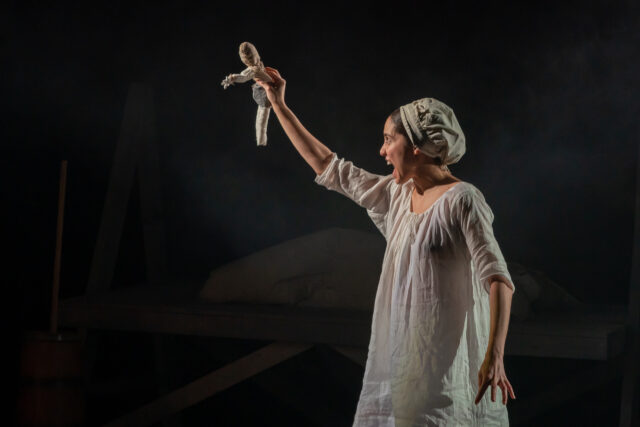
As the play begins, Moxley, in tight-fitting men’s pants, a white button-down shirt, and awesome gold shoes (the costumes are by Sarah Bacon), asks the audience if they can hear her. She then gets up and says, “Can you see me? That any better? Can you see me now? You can? Wow. Yes. Miraculous. You should not be able to see me at all. Seriously, I’ve been fading for years and am technically invisible by now.” She reveals the item that she was sewing to be a fabric phallus, which she gleefully swings around. “I’m about to play three men — yeah, because I want to — so I felt I needed to get a true feeling for the apparent sense of authority and entitlement that comes with this lump of meat, of manhood,” she says, offering an alternate interpretation of Sigmund Freud’s theory of penis envy. “Since I’ve always been good with my hands I thought I’d make myself a nice, muscular dick to help me get into character.” The male member is a humorous motif that continues throughout the play.

Gloria (Liv O’Donoghue) and one of her psychotherapists (Gina Moxley) are exasperated in US premiere at St. Ann’s (photo by Teddy Wolff)

Moxley proceeds to portray each of the three doctors, with slight adjustments to her costume, accent, and demeanor, as Gloria explains that her major concern is how to tell her nine-year-old daughter, Pammy, that since the divorce she has been having sex with men other than Pammy’s father. She tells Dr. Rogers, “The other day she asked, ‘Mommy, did you ever go to bed with anyone besides Daddy?’ And I lied to her. I looked straight into her eyes and lied, ‘No, honey.’ I mean, what was I meant to say? ‘Sure, honey, everyone does.’ Oh shit. It keeps coming into my mind. I feel so guilty having lied to her. I never lie, I hate liars. I want — I can’t help wanting . . . I remember when I was a little girl and found out my parents made love, oh, it was dirty, terrible. I was particularly disgusted by my mom.”

The idea of a woman, no less a mother, admitting to having and enjoying sex for pleasure has always been frowned upon by much of America, yesterday and today, and the psychotherapists aren’t hesitant to demean Gloria by displaying their own sexual desires for her, thinking with their dicks. Just as Moxley announced at the beginning that she assumed she couldn’t be heard or seen, Gloria is not truly being listened to by the doctors.

To assert themselves and celebrate their quest for individuality and freedom, Gloria and Moxley occasionally break out into joyous dancing (O’Donoghue is also the choreographer), sometimes joined by experimental Irish bassist Jane Deasy, who participates in several dialogues. Feeling like a devil, Gloria says, “I want to get rid of my guilt. But I don’t want to put it on Pammy. Guilt kills.” “Guilt kills,” Moxley agrees. “Guilt kills. Ain’t that the truth,” Deasy adds. A few minutes earlier, Deasy had come to the front of the stage, stood at a microphone, and performed a version of the all-female rock band L7’s “Shitlist,” declaring, “For all the ones / Who bum me out / Shitlist / For all the ones / Who fill my head with doubt / Shitlist / For all the squares who get me pissed / Shitlist / You’ve made my shitlist.”

Presented by Beckett experts Pan Pan (Cascando, Embers), The Patient Gloria is directed by John McIlduff (The Scorched Earth Trilogy, Fatal System Error) with a mix of chaos, absurdity, and exhilaration. Andrew Clancy’s open set counters the claustrophobic design of The Gloria Films, where the subject was mostly seen in the shadow of the supposedly brilliant, much more powerful men. Adam Welsh’s sound and Sinéad Wallace’s lighting maintain the overarching welcoming atmosphere, which often has more of a feel of a party than conversations with a shrink. Projections of photos from the original sessions, words, drawings of phalluses, and other imagery appear on the folded red curtain in the back, not always clear, contributing to the at-times disorienting atmosphere.

O’Donoghue (Good Sex, Lippy) portrays Gloria with a subtle fierceness; the character might be nervous and off balance speaking with the psychotherapists, but she also is not ashamed of the choices she has made. Moxley (Danti-Dan, Endgame), here a dynamic sprite who, dressed as a man, resembles a cross between Mike Pence, Jeff Sessions, and Lindsey Graham, is bursting with an infectious, confident energy that fills St. Ann’s. And the tall, thin Deasy adds just the right flourishes, including a rousing finale. Together they don’t just take the power back but revel in it. It’s the kind of play that needs to be performed for the US Congress and at psychiatric conferences around the world.

The real Gloria Szymanski got married and divorced again before dying from leukemia in 1979 at the age of forty-six. In 2008, her daughter, Pamela J. Burry, wrote the book Living with ‘The Gloria Films,’ sharing the effects Three Approaches to Psychotherapy had on her and her mother, who essentially starred in one of the first reality shows. Nearly sixty years after the events of The Patient Gloria, the rights of women to control their bodies are under siege, an undercurrent of the play, which, in its extremely entertaining way, demands that things must change, yet again, as more people make Moxley’s shitlist.

TRANSFORMER TURNS 50!

Who: Joe Hurley & the Gents, Eugene Hutz, Edward Rogers, Mary Lee Kortes, Ellen Foley, Don Fleming, Tish & Snooky, Richard Barone, Eamon Rush, Roger Clark, Screaming Orphans, Michael Tee, Jesse Bates, more
What: Tribute to Lou Reed’s 1972 Transformer album
Where: City Winery New York, 25 Eleventh Ave. at Fifteenth St., 646-751-6033
When: Saturday, December 3, $30-$55, 8:00
Why: In November 1972, Lou Reed released his second solo album following the dissolution of the seminal experimental Velvet Underground. His eponymous debut earlier that year was met with barely a whimper, but Transformer was a transformative record, for Reed and for rock music itself. Produced by David Bowie and Mick Ronson, the LP boldly mixed glam with S&M from its opening words. “Vicious / You hit me with a flower / You do it every hour / Oh, baby, you’re so vicious / Vicious / You want me to hit you with a stick / But all I’ve got’s a guitar pick / Huh, baby, you’re so vicious,” Reed declared over a squealing guitar and happily thudding bass. Reed changed the face of top-forty radio with his biggest hit, “Walk on the Wild Side,” which detailed the adventures of Andy Warhol Factory denizens Holly Woodlawn, Candy Darling, Joe Dallesandro, Jackie Curtis, and Joe Campbell and included controversial lyrics that are still shocking today. “Andy’s Chest” is about Warhol, inspired by his 1968 shooting. The album was way ahead of its time, exploring gay and trans subculture and androgyny years before the AIDS crisis.

In celebration of the album’s golden anniversary, City Winery is hosting “Transformer Turns 50!,” in which Joe Hurley & the Gents and special guests will perform the record and other Reed/VU tracks; joining in will be Eugene Hutz, Mary Lee Kortes, Ellen Foley, Don Fleming, Richard Barone, Roger Clark, Screaming Orphans, and members of Ian Hunter’s Rant Band, Roxy Music, Twisted Sister, the Bob Dylan Band, Sonic Youth, and Mink DeVille. Transformer also features the gorgeous “Perfect Day” and “Satellite of Love,” the playful “New York Telephone Conversation,” and the Tin Pan Alley–like closer, “Goodnight Ladies,” which is now a kind of epitaph for Reed, who died in 2013 at the age of seventy-one; “Goodnight ladies, ladies goodnight / It’s time to say goodbye,” he sings. “Oh, nobody calls me on the telephone / I put another record on my stereo / But I’m still singing a song of you / It’s a lonely Saturday night.”

Reed fans must also check out “Lou Reed: Caught Between the Twisted Stars,” the outstanding, wide-ranging exhibition at the New York Public Library for the Performing Arts, consisting of hundreds of Reed items, from early, never-before-heard recordings to interviews, photographs, memorabilia, and live footage, highlighted by songs from the Transformer tour, when Reed dyed his hair blonde and did a bit of disco dancing, in a black T-shirt and dark sunglasses.