live performance

JewCE!: THE JEWISH COMIC EXPERIENCE

THE FIRST ANNUAL JEWISH COMIC BOOK CONVENTION
Center for Jewish History
15 West Sixteenth St. between Fifth & Sixth Aves.
Sunday, November 12, $40 (children eight and under free)
jewce.org
www.cjh.org

Jews played key roles in the development of the comic book industry in the United States, as artists, illustrators, editors, and publishers. In 2006-7, the Jewish Museum presented with the Newark Museum the outstanding exhibit “Masters of American Comics,” which explored the work of fourteen artists, several of whom were Jewish.

This weekend the Center for Jewish History is hosting “JewCE!: The Jewish Comic Experience,” being held in conjunction with the exhibit “The Museum and Laboratory of the Jewish Comics Experience,” consisting of original art, historical memorabilia, and interactive installations focusing on Jewish history, culture, and identity as depicted in comic books, on view through December 29.

Awards will be handed out Saturday night, in such categories as Career Contributions to Jewish Comics, Diverse Jewish Representation, Historical Narratives, Autobiographical Content, Contemporary Topics, and Combating Prejudice. The big day is Sunday, with a full slate of lectures, panel discussions, workshops, artist booths, and more. The guest of honor is Trina Robbins, the Brooklyn-born cartoonist and activist who is in the Will Eisner Hall of Fame and is one of the three characters in the Joni Mitchell song “Ladies of the Canyon” (“Trina takes her paints and her threads / And she weaves a pattern all her own”).

Among the events are “Jewish Roots of the Comic Industry,” “Queering Jewish Comics,” “Kids Comics for Mini Mensches,” “Jewish Female Narratives in the Graphic Arts,” and “Holy Graphic Novels!”; the lineup of participants includes Frank Miller, Stephanie Phillips, Neil Kleid, Koren Shadmi, Fabrice Sapolsky, Yehudi Mercado, Dean Haspiel, Chari Pere, Ken Krimstein, Danny Fingeroth, Barry Deutsch, Roy Schwartz, Amy Kurzweil, E. Lockhart, Ben Kahn, Emily Bowen Cohen, Jenny Caplan, Karen Green, Leela Corman, Paul Levitz, Tahneer Oksman, Terri Libenson, Simcha Weinstein, JT Waldman, Jessica Tamar Deutsch, and Stan Mack, as well as Source Point Press, Big Apple Comics, Jews in Doodles, Israeli Defense Comics, Jewish Arts Salon, Stand Up! Comics/Stand Up! Records, and Torah Comics. Below is the full schedule.

Exhibition continues at the Center for Jewish History through December 29

Jewish Roots of the Comic Industry, with Arie Kaplan, Roy Schwartz, and Simcha Weinstein, moderated by Danny Fingeroth, auditorium, 10:00

Jewish Folklore in Comics, with Dani Colman, Trian Robbins, Chanan Beizer, and Yehudi Mercado, moderated by Eddy Portnoy, Kovno Room, 10:00

Jump into Drawing Comics!, with Joshu Edelglass, for kids ages 8-12, Discovery Room, 10:00

From Strength to Strength: Jewish Superheroes through the Ages!, with Brian Michael Bendis, E. Lockhart, Dean Haspiel, and Frank Miller, moderated by Roy Schwartz, auditorium, 11:30

Queering Jewish Comics, with Ben Kahn, Shira Spector, Barry Deutsch, and Miriam Libicki, moderated by Tahneer Oksman, Kovno Room, 11:30

Jewish Comics Trivia Game: JewCE Edition, with Sholly Fisch and Jeremy Arcus-Goldberg, Discovery Room, 11:30

Breaking the Mainstream: Getting Past Ashkenormativity and Secularism in Comics, with Daniel Lobell, Emily Bowen Cohen, Joshua Sky, and Carol Isaacs, moderated by Arnon Shorr, auditorium, 1:00

Kids Comics for Mini Mensches, with Yehudi Mercado, Terri Libenson, Chari Pere, and Barry Deutsch, moderated by Jeremy Dauber, Kovno Room, 1:00

Torah Comic Workshop, with Andrew Galitzer, for kids ages 6-12, Discovery Room, 1:00

Canons Are Made to Blow Up! Retconning, Rebooting, Jossing, and Other Paradigm Shifts, with Brian Michael Bendis, Brian Azzarello, Joshua Sky, and Barbara Slate, moderated by Jenny Caplan, auditorium, 2:30

Jewish Comics and Remembrance Culture, with Rafael Medoff, Ken Krimstein, Stan Mack, and Trina Robbins, moderated by Samantha Baskind, Kovno Room, 2:30

From Perek to Panel: Using Pictures to Explore Interpretation, with Ben Schachter, for teens and adults, Discovery Room, 2:30

Will Eisner: The First Poet Laureate of the Jewish Graphic Novel, with Paul Levitz and Jules Feiffer (via Zoom), auditorium, 4:00

Telling Other People’s Stories, with Tracy White, Stephanie Phillips, Koren Shadmi, and Neil Kleid, moderated by Julian Voloj, Kovno Room, 4:00

Jewish Comics Trivia Game: JewCE Edition, with Sholly Fisch and Jeremy Arcus-Goldberg, Discovery Room, 4:00

Jewish Female Narratives in the Graphic Arts, with Leela Corman, Amy Kurzweil, Alisa Whitney, and Miriam Libicki, moderated by Karen Green, auditorium, 5:30

Holy Graphic Novels!, with JT Waldman, moderated by Jordan B. Gorfinkel, Kovno Room, 5:30

[Mark Rifkin is a Brooklyn-born, Manhattan-based writer and editor; you can follow him on Substack here.]
ARMS AND THE MAN

Raina (Shanel Bailey) asks her mother (Karen Ziemba) to be quiet about an uninvited guest (Kesha Moodliar) in Arms and the Man (photo by Carol Rosegg)

ARMS AND THE MAN
Theatre Row
410 West 42nd St. between Ninth & Tenth Aves.
Tuesday – Sunday through November 18, $71.50
gingoldgroup.org
www.theatrerow.org

It’s seldom a good sign when the actors onstage are having more fun than the audience. Such is the case with Gingold Theatrical Group’s (GTG) latest George Bernard Shaw adaptation, Arms and the Man. Continuing at Theatre Row through November 18, the production features several scene introductions with the cast at the front of the stage, delivering their lines right to the seats, preparing the audience for what comes next. Director David Staller notes in the script that Shaw was going to use this convention of actors speaking directly to the audience in a filmed version of the play but they made Major Barbara instead. Staller explains, “Thanks to [Shaw biographer] Sir Michael Holroyd, notes and letters from [veteran Shaw actor] Maurice Evans, and documents at the British Library, we have attempted to honor Shaw’s bold notion of employing the actors’ direct address and to view this world through a world of a Victorian toy theater.”

The evening begins with the cast of seven welcoming the audience to the show and introducing their roles. “Don’t worry; it’s Shaw but it’s short,” one says. “We’re determined to create a world of magic for you,” another promises. It’s a charming beginning that can’t maintain its appeal.

Lindsay Genevieve Fuori’s set is adorable, an elegantly outlined space, evoking a toy theater, that serves alternately as a bedroom, drawing room, and garden patio of a fancy abode in Bulgaria where the Petkoffs live in splendor: Major Paul Petkoff (Thomas Jay Ryan), his wife, Catherine (Karen Ziemba), and their daughter, Raina (Shanel Bailey). They are taken care of by their maid, Louka (Delphi Borich), who sees it all, and the ever-efficient major domo, Nicola (Evan Zes).

The 1885 Serbo-Bulgarian War is well underway, where Reina’s fiance, the brave blowhard Major Sergius Saranoff (Ben Davis), is leading the charge. Amid a barrage of gunfire below, a ragged enemy soldier, Captain Bluntschli (Kesha Moodliar), sneaks into Raina’s bedchamber, just looking for a reprieve from the battle. After hiding him from a Russian officer (Zes), Raina reevaluates her relationship with Sergius as everyone takes stock of what they want out of life.

Major Paul Petkoff (Thomas Jay Ryan) and Major Sergius Saranoff (Ben Davis) share a laugh as Catherine (Karen Ziemba) and Raina (Shanel Bailey) look on sternly in Shaw adaptation (photo by Carol Rosegg)

The fourth of Shaw’s sixty-five plays, Arms and the Man debuted in 1894 on the West End and has been produced on Broadway seven times, most recently in 1985 at Circle in the Square with Kevin Kline, Glenne Headley, and Raul Julia, directed by John Malkovich. George Orwell famously raved, “It is probably the wittiest play [Shaw] ever wrote, the most flawless technically, and in spite of being a very light comedy, the most telling.” Alas, little of that is evident in Staller’s adaptation. The costumes (by Tracy Christensen) and the pacing were off; while we were told early on that there were to be three acts with two intermissions, that second interval never arrived, making me uncomfortable as I wriggled in my seat.

Shaw takes on class and war in this comedy of manners; we get plenty of class and war but unfortunately not much comedy in this rendition, which attempts to add contemporary relevancy. Scenes feel tenuously stitched together; characters are underplayed or overplayed, creating a mishmash of the narrative. The title comes from the opening words of Virgil’s Aeneid: “Arms and the man I sing, who, forced by fate / And haughty Juno’s unrelenting hate, / Expelled and exiled, left the Trojan shore,” an epic poem about war and power; that reference falls flat at Theatre Row.

GTG kicked off its Project Shaw in 2009, presenting just about everything Shaw ever wrote, from full-length and one-act plays to sketches. Their recent shows have been hit-or-miss, from the exquisite Mrs. Warren’s Profession to the less-charming Caesar & Cleopatra and Heartbreak House

At one point in Arms, Reina declares, “The world is really a glorious world for women who can see its glory and men who can act its romance! What happiness! What unspeakable fulfillment!”

If only more of that were evident in this wartime farce that lacks ammunition.

[Mark Rifkin is a Brooklyn-born, Manhattan-based writer and editor; you can follow him on Substack here.]

ALL THE DEVILS ARE HERE: HOW SHAKESPEARE INVENTED THE VILLAIN

Patrick Page explores the history of villainy in Shakespeare’s plays in captivating one-man show at DR2 (photo by Julieta Cervantes)

ALL THE DEVILS ARE HERE: HOW SHAKESPEARE INVENTED THE VILLAIN
Daryl Roth Theatre
103 East 15th St. between Irving Pl. & Park Ave.
Tuesday – Sunday through March 31, $110-$160
allthedevilsplay.com

In May 2021, Tony nominee Patrick Page presented a streaming version of his one-man show All the Devils Are Here: How Shakespeare Invented the Villain, recorded in Shakespeare Theatre Company’s empty Sidney Harman Hall in DC. At the time, I wrote, “Page knows what of he speaks; in addition to having portrayed his fair share of Shakespeare baddies, he has played Scar in The Lion King, Scrooge in A Christmas Carol, the Green Goblin in Spider-Man: Turn Off the Dark, Hades in Hadestown, and the Grinch in Dr. Seuss’s How the Grinch Stole Christmas, villains all in one form or another. His command of Shakespeare and the concept of evil is bold and impressive, but he is down-to-earth enough to throw in plenty of surprising modern-day pop-culture references to keep it fresh and relevant to those who might not know much about the Bard or Elizabethan theater.” His bravura performance provided a vital dose of theater to the drama-starved during the lockdowns, and I named it Best Solo Shakespeare Play in twi-ny’s third Pandemic Awards.

He has now brought the show to the Daryl Roth Theatre in Union Square, adapting it for a live audience in the intimate space that seats a mere ninety-nine people. Arnulfo Maldonado’s set features a desk and a chair in front of a red curtain, with various props stored on lighting scaffolds on either side of the stage. Primarily dressed in a red velvet outfit with a vest (the costumes are by Emily Rebholz, with chilling lighting by Stacey Derosier and sinister sound by Darron L West), Page makes only minor garment changes and uses minimal props, including a skull, a dagger, a book, and other items, as he portrays Lady Macbeth (Macbeth), Richard of Gloucester (Richard III), Shylock (The Merchant of Venice), Malvolio (Twelfth Night), Claudius (Hamlet), Angelo (Measure for Measure), Iago (Othello), and other villainous Shakespeare creations. He connects the development of these evildoers to Shakespeare’s own maturation as a playwright, comparing Barabas from Christopher Marlowe’s The Jew of Malta to Aaron the Moor from Titus Andronicus. Exploring the mindset of psychopaths, Page draws a through line among the characters.

“Think of it: It’s a superpower!” he proclaims. “You might become a wizard on Wall Street or an Academy Award–winning producer. You might even become president of the United States. That is a psychopath.”

Page regularly drops in contemporary references, from Facebook and House of Cards to Succession and Uma Thurman as well as a bit of juicy gossip about the Bard.

With his deep, resonant voice and buff body, Page is a mesmerizing performer; it’s easy to be carried away by his imposing stage presence, and the audience’s trust in him is well placed. Simon Godwin, the artistic director of Shakespeare Theatre Company, previously directed Page as King Lear and expertly lets him strut his stuff in All the Devils Are Here as Page delivers a master class in villainy.

Patrick Page beckons the audience to join him on a unique Shakespeare ride in All the Devils Are Here (photo by Julieta Cervantes)

At a talkback after the show I saw, I asked Page about how he adapted the streaming film into the current live play. He responded, “A one-man show is already such a strange thing for an actor because acting is by its very nature a reciprocal process. You really are a reactor. You don’t generate a lot of stuff when you’re in a play with people. You’re simply reacting, listening, reacting, listening, reacting, listening, reacting. So in a one-man show, it’s different. With no audience, of course, you have to make up a lot in your imagination of what might be going on. Now I still have to make up some, but at least you’re there.

“So I feel the vibrations, I feel the energy, I feel the listening, I hear the laughs (as much as I can hear), and that you become my acting partner in the show. And my overall objective, of course, is to communicate this story to you as clearly as I can. And it’s very, very helpful to have someone there listening and thinking, you know, how you would tell a story differently to different people. And so I’m aware that there are people in the audience who have, let us say, a depth of experience with Shakespeare. I’m aware that there are people who’ve had very little experience with Shakespeare. I’m aware that there are people who have had only bad experiences, which many of us have had. It’s likely that you have had bad experiences. And someone tried to get you to read King Lear when you were in high school and, of course, it was completely indecipherable, never meant to be read in that way. So I’m aware of that as I’m telling the story. And that’s part of what animates it.”

With humor and gravitas, Page (Coriolanus, Cymbeline, Casa Valentina, Spring Awakening) deepens our experience of Shakespeare, offering a gift that will stay with you as you continue on your personal adventures with the Bard.

[Mark Rifkin is a Brooklyn-born, Manhattan-based writer and editor; you can follow him on Substack here.]

LAURA ORTMAN & RAVEN CHACON LIVE IN BROOKLYN BRIDGE PARK

Raven Chacon and Laura Ortman will perform a free show in Brooklyn Bridge Park on November 5

Who: Laura Ortman & Raven Chacon
What: Live concert presented by Public Art Fund
Where: Empire Fulton Ferry Lawn, Brooklyn Bridge Park
When: Sunday, November 5, free (advance RSVP recommended), 4:00
Why: Following an earlier rainout, Laura Ortman (White Mountain Apache) and Raven Chacon (Navajo) will activate Nicholas Galanin’s Brooklyn Bridge Park sculpture, In every language there is Land / En cada lengua hay una Tierra, with a free concert on November 5 at 5:00. Chacon is a Pulitzer Prize–winning composer, performer, and installation artist based in Red Hook and Albuquerque, while Ortman is a multi-instrumentalist and composer who has collaborated with Tony Conrad, Jock Soto, Nanobah Becker, Okkyung Lee, Martin Bisi, Jeffrey Gibson, Caroline Monnet, New Red Order, and many others.

Discussing the large-scale immersive piece, Galanin, who is based in Sitka, Alaska, said in a promotional video, “Creative sovereignty and creating work is a form of reclamation of our ideas, our knowledge, our language, our place, while including other perspectives and other ideas and other people’s experiences to be accessed through that work too.”

Ortman and Chacon have worked together previously, including at Ende Tymes X in Brooklyn, the American Academy in Berlin, the Center for Contemporary Arts in Santa Fe, and other locations. In Brooklyn Bridge Park, they will present an improvisational site-specific performance incorporating local field recordings and a mix of instruments. Admission is free, though advance registration is recommended, and attendees are encouraged to bring a blanket to sit on.

[Mark Rifkin is a Brooklyn-born, Manhattan-based writer and editor; you can follow him on Substack here.]
WATCH NIGHT

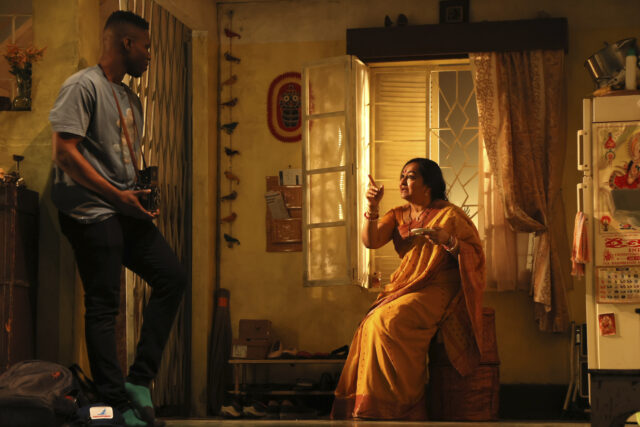
Bill T. Jones leads rehearsal for upcoming Watch Night at PAC NYC (photo by Stephanie Berger)

WATCH NIGHT
Perelman Performing Arts Center (PAC NYC)
251 Fulton St.
November 3-18, $52-$138
pacnyc.org

Bill T. Jones’s home base might be New York Live Arts, where he’s the artistic director, but he stages works all over New York (and the world). In August, Bill T. Jones/Arnie Zane Company presented the free, site-specific Dance for Sunset in Brookhaven, Long Island. In April, his Deep Blue Sea dazzled audiences at Park Avenue Armory, where he debuted the immersive Afterwardsness the previous year. And last month he was back at NYLA with Curriculum II, kicking off his troupe’s forty-first season.

So it’s no surprise that he is presenting the first dance work at the brand-new Perelman Performing Arts Center (PAC NYC) in Lower Manhattan, by Ground Zero. Running November 3-18, Watch Night will explore tragedy, justice, and forgiveness in these ever-more-difficult times. The multimedia work was conceived by director and choreographer Jones and librettist/poet Marc Bamuthi Joseph; the score is by Brooklyn musician and composer Tamar-kali.

The cast features approximately two dozen dancers portraying such characters as the Wolf, Super/Natural, and members of an Echo Chamber, with an eight-person ensemble including violin, viola, cello, bass, flute, oboe, and clarinet. The set is by Tony-nominated designer Adam Rigg, with costumes by Kara Harmon, lightning by Robert Wierzel, sound by Mikaal Sulaiman, and projections by Lucy Mackinnon.

In a program note, Jones lists dos and don’ts; for example:

DO NOT:
Create an event too easily digested in its desire to succeed by standards not of my making.
Be cowed by the city and this theater site’s precarious history in our fractious era.
Be oppressed by personal fear and anger.
Try to heal the world in this event.
Ignore each character’s worldview, individual psychological motivations that give them dimension and substance.
Attempt to be understood by all viewers and stake holders.

DO:
Acknowledge the privilege of this opportunity and the platform provided by the Perelman Performing Arts Center in its Inaugural Season.
Acknowledge this event is informed by real tragedies, real people, and real consequences.
Explore the potential of this new historic theater, built on contested land and a site of trauma.
Challenge my own taste and notions of abstraction and movement.
Attempt to “see this event” through the eyes of many people — different from myself and very much like me.
Stay alert, grateful, and hungry for joy!

Jones will be on hand for two postshow talkbacks, on November 9 with Joseph, Tamar-kali, and dramaturg Lauren Whitehead, moderated by rabbinical consultant Kendell Pinkney, delving into the creative inspiration behind the show, and on November 12, when Jones and guests from the Interfaith Center of New York will discuss faith and forgiveness. In addition, on December 4, Jones will speak with Joseph at NYLA as part of the ongoing “Bill Chats” series.

In her program note, Whitehead explains, “Every massacre has its moment. In the aftermath of every staggering act of violence we are inundated, for a time, with outrage and rallying cries, marches and memorials, public lament and lengthy speeches and great groanings of grief. And then, as is our way, we metabolize the grotesque. We will ourselves into movie theaters, send our children into schools again. We weep, we wail, and then we walk on. What our show is attempting to do is to ask ‘what if?’ What if we were unsatisfied by platitudes of forgiveness and forgetting? What if instead of moving on, we pointed our rage and discontent in a different direction?”

Don’t expect any easy answers to those challenging questions in what promises to be a memorable experience.

[Mark Rifkin is a Brooklyn-born, Manhattan-based writer and editor; you can follow him on Substack here.]
HOW TO BE A DANCER IN 72,000 EASY LESSONS

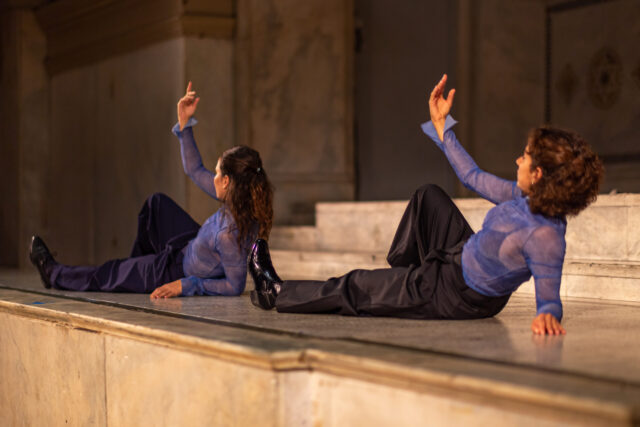
The Dancer (Rachel Poirier) whips the Dance Man (Michael Keegan-Dolan) into shape in semiautobiographical show (photo by Teddy Wolff)

HOW TO BE A DANCER IN 72,000 EASY LESSONS
St. Ann’s Warehouse
45 Water St.
Through November 5, $39-$69
718-254-8779
stannswarehouse.org

“Don’t look back,” Michael Keegan-Dolan says near the beginning of the exceptional How to Be a Dancer in 72,000 Easy Lessons. “But I want to look back.”

The Irish choreographer and director takes a unique look back in his triumphant return to the stage after two decades, joined by his longtime collaborator and life partner, French dancer Rachel Poirier. The semiautobiographical ninety-minute show — the first dance-theater work to be presented by St. Ann’s Warehouse — starts and ends with a story about an egg, signaling birth and rebirth. Keegan-Dolan is the Dance Man and Poirier the Dancer as he relates episodes from his past. Driven by his deep desire to be a dancer, he walked a long road to success with his pigeon-toed feet that included being bullied by other boys for dancing like a “queer” and a bruising stint in musical theater, among other adventures.

Michael Keegan-Dolan returns to the stage in How to Be a Dancer in 72,000 Easy Lessons at St. Ann’s (photo by Teddy Wolff)

The Dance Man prefers Gene Kelly to rugby, ballet to musical theater. Across forty-one brief scenes, the character introduces us to his mother and father, his best friend, his choir priest, his ballet teacher, his first girlfriend, Belgian choreographer Anne Teresa de Keersmaeker, his brother Paul, and a famous Australian conductor. He includes the high and low points, the moments that forged his future as he sought the freedom to be who he wanted to be, anchored by his meeting the Dancer, who moves about the stage and interacts with him in often outrageously funny and deliciously wicked ways as he shares his tales.

Each vignette features playful props that Keegan-Dolan and Poirier remove from a large wooden box and scatter about, from a child’s bicycle and a red balloon to a mirror and a helium tank, from cinderblocks and shoes to a dartboard and a ladder. A long white rope hangs down from the ceiling, offering danger and escape. White tape forms a large rectangle on the floor and back wall, but Keegan-Dolan, in a black suit and white shirt, and Poirier, in a black dress, ignore it, refusing to be contained.

The set and costumes are by Hyemi Shin, with lighting and direction by Adam Silverman and sound by Sandra Ní Mhathúna, creating an anything-goes atmosphere. Keegan-Dolan often carries a boombox with him, playing such songs as Jacques Brel’s “J’arrive,” Men Without Hats’ “The Safety Dance,” Depeche Mode’s “Just Can’t Get Enough,” Queen’s “Bohemian Rhapsody,” and Charles Penrose’s “The Laughing Policeman,” in addition to pieces by Stravinsky, Strauss, Handel, and Verdi.

“Psycho Killer,” with its touch of French, plays a pivotal role, as the Dance Man points out, “If there is a place in the world for the Talking Heads’ lead singer and front man David Byrne, then there must be a place in the world for me.” Poirier brings down the house with an exhilarating and exhausting fifteen-minute solo to Maurice Ravel’s “Bolero in C Major” that is breathlessly exquisite.

Nearly every minute provides something singular and unexpected, running the gamut of emotions, as exemplified when the Dance Man runs around the stage. “I have a voice!” he declares early on. “And it’s not, the endless monologue in my head, in my head voice. This is my voice.”

Keegan-Dolan found his voice through dance; his latest show, subtitled “A Performance Ritual in Four Parts for Two Performers,” is a clarion call for everyone to seek out and find theirs.

[Mark Rifkin is a Brooklyn-born, Manhattan-based writer and editor; you can follow him on Substack here.]
MEET MISS BAKER: PARTNERSHIP

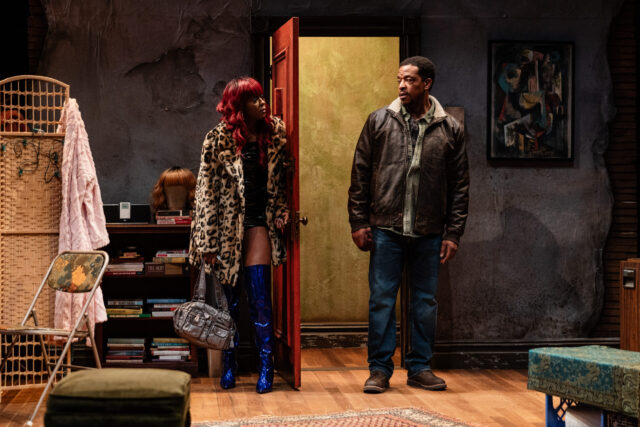
Sara Haider (center) is mesmerizing in Mint production of Elizabeth Baker’s Partnership (Todd Cerveris Photography)

PARTNERSHIP
The Mint Theater at Theatre Row
410 West 42nd St. between Ninth & Tenth Aves.
Tuesday – Sunday through November 12, $39-$79
minttheater.org
www.theatrerow.org

The Mint completes its wonderful “Meet Miss Baker” trilogy with Partnership, another exquisite production of a work by early-twentieth-century playwright and office typist Elizabeth Baker, following 2019’s The Price of Thomas Scott and last year’s Chains. Born in 1876, Baker was a teetotaler raised in a strict, religious lower-middle-class family that was in the drapery business; she didn’t go to the theater until she was nearly thirty and didn’t marry until nearly forty. Her debut, Chains, is a 1909 working-class drama about capitalism and social convention, while Scott, from 1913, also deals with those issues, through a lens involving religion and a family’s clothing store.

A fancy women’s clothing store in Brighton is at the center of Partnership, which explores two types of alliances: business and personal. Kate Rolling (Sara Haider) is a young, single woman who owns a fashionable shop that is poised to make it big. Kate has impressed the fussy and ultrafashionable Lady Smith-Carr-Smith (Christiane Noll), who promises Kate she’ll recommend her shop to “the Duchess,” ensuring a steady, if demanding, stream of wealthy customers.

Kate’s staff gets excited by the possibility, including vivacious salesperson Maisie Glow (Olivia Gilliatt), cynical seamstress Miss Blagg (Gina Daniels), and mousey shop assistant Miss Gladys Tracey (Madeline Seidman), who is engaged to the hapless Jack Webber (Tom Patterson), who is jealous of another of Gladys’s suitors. Jack works for successful haberdasher George Pillatt (Gene Gillette), who has made a surprise appointment with Kate.

“I wonder what Pillatt wants. There’s one thing, I suppose, and that is, he won’t propose,” Kate says to Maisie, who replies, “And he’d be a catch if you like. It’d be better than fighting him, wouldn’t it?”

The space next to Kate’s store has become available, and Pillatt is interested in taking it over — joining forces with Kate, who has been considering leasing the space as well. Pillatt is a dry, grim, darkly serious man with no sense of humor; speaking to Kate privately, he offers, “I have a plan to put before you Miss Rolling, but I will say at the outset that if you don’t care about it, we can drop it and go on as before, without prejudice. It need make no difference, I hope, to our present friendly business relations. If it commends itself to you I shall be very much gratified. Has the idea of a partnership ever entered your head? . . . Your business and mine.”

Kate is flattered by his kind words about her store, but then Pillatt ups the ante in one of the least romantic proposals imaginable: “I want to suggest, to propose a partnership — in another sense, and that is — marriage. Being a plain businessman, I wish to be quite frank in the matter, and so I have not hesitated to put the business part of the plan foremost. I am sure you, as a business woman, thoroughly understand this. . . . I am not a sentimentalist, but then you, a woman of business, do not wish for any expression of sentiment.”

When Kate admits that marriage was not on her radar, Pillatt assures her, in his cold, dispassionate manner, “That part of it will make no more difference than the other.” He then presents her with a formal contract, relating to both the business and the marriage. He is not exactly bursting with love and affection when he tells her, “I have thought it out very carefully. If you can see your way to accept it, I am sure it would work out satisfactorily.”

It’s a phenomenal scene that beautifully develops the characters and sets the stage for what comes next, twisting societal gender conventions and the male-dominated power structure. It takes place in the back private room of Kate’s shop, which features fashion drawings, various materials, shelves of boxes and files, stairs to the upper apartment, and a sharply dressed, realistic-looking mannequin known as Sally that essentially represents how women should be seen and not heard, treated as objects and not free-thinking human beings.

Discussing with Kate and Maisie how all men are fools, Miss Blagg contends, “Dress anything up in a smart blouse and a coiffure and men will make love to it. I’d like to put Sally here just inside the door and see how many of the idiots would come in to have a look at her.”

Lawrence Fawcett (Joshua Echebiri), Elliman (Tom Patterson), Maisie Glow (Olivia Gilliatt), and Kate Rolling (Sara Haider) take a break in the South Downs in Partnership (Todd Cerveris Photography)

When Pillatt’s friend and former classmate, the shy and awkward Lawrence Fawcett (Joshua Echebiri), enters, he is startled by Sally. “Christopher! — I thought she was real,” he calls out. “She’s just ‘it’! I’ve met dozens like her in flesh and blood.” Pillatt, wearing a persnickety, upper-crust striped suit and wielding a cane, and Fawcett, in a plain, unimpressive brown suit and hat, are the same age, but Fawcett looks much younger and has more interest in the outside world. (The stylish costumes are by Kindall Almond, with lighting by M. L. Geiger and sound by Daniel Baker.)

Fawcett has given up his lucrative family corset business to get into dyes, specifically orange. Pillatt has no respect for his decision, telling him, “What fool’s talk is this? You mean, I hope — though I can’t say I follow you quite — that you’re investing money in a dyeing business?”

Kate, in a resplendent cutting-edge fashionable suit and vest with a lacy cravat, purple bowtie, and black buttons and trimmings, is intrigued by Fawcett. When Fawcett, who is on a monthlong vacation, mentions that he is on his way to the South Downs — a national park with diverse landscapes, rich wildlife, spectacular views, unspoiled areas, and small communities — Kate decides that she, Fawcett, Pillatt, and Maisie should have tea on the Downs, and Maisie promises to bring her friend Elliman (Tom Patterson), who has a motorcar.

Up on the Downs — Alexander Woodward’s simplified set for the second act consists of a few rocks in front of a re-creation of James Hart Dyke’s colorful, tranquil 2021 painting, Winter Evening Light on Windmill — Fawcett is in his element, while Pillatt is uncomfortable and perturbed. Kate is intrigued by the freedom Fawcett is experiencing; it’s like he’s a different man in these natural surroundings.

“You are one of the lucky ones who can do as they like,” Kate says, to which Fawcett responds, “Can’t you? I thought you were your own mistress?” The planting of that seed leads to Kate taking another look at her life in the third act.

Miss Gladys Tracey (Madeline Seidman) and Miss Blagg (Gina Daniels) gossip in Elizabeth Baker rediscovery (Todd Cerveris Photography)

Director Jackson Grace Gay (A Little Journey, Transfers) nimbly dances around a gaping plot hole surrounding the question of whether a woman can have it all, success in love and business. Daniels (Becomes a Woman, Network) and Gilliatt (Chains, Mother of the Maid) provide playful humor, Echebiri (Merry Wives) builds charm, Gillette (Pushkin, Orpheus Descending) could not be any more dour, and Tony nominee Noll (Ragtime, God of Carnage) has a ball chewing up the scenery.

But the show belongs to Pakistani singer-songwriter and actress Haider, who is mesmerizing in her off-Broadway debut; you can’t take your eyes off her as Kate, a strong, independent woman, weighs the different parts of her life and must choose which path to follow. We might not always like the choices she makes, but she has every right to follow her heart and mind, wherever they may lead her. Anyone who partners with Kate, or Haider, her has made a wise decision indeed.

[Mark Rifkin is a Brooklyn-born, Manhattan-based writer and editor; you can follow him on Substack here.]