live performance

LAURA ORTMAN & RAVEN CHACON LIVE IN BROOKLYN BRIDGE PARK

Raven Chacon and Laura Ortman will perform a free show in Brooklyn Bridge Park on November 5

Who: Laura Ortman & Raven Chacon
What: Live concert presented by Public Art Fund
Where: Empire Fulton Ferry Lawn, Brooklyn Bridge Park
When: Sunday, November 5, free (advance RSVP recommended), 4:00
Why: Following an earlier rainout, Laura Ortman (White Mountain Apache) and Raven Chacon (Navajo) will activate Nicholas Galanin’s Brooklyn Bridge Park sculpture, In every language there is Land / En cada lengua hay una Tierra, with a free concert on November 5 at 5:00. Chacon is a Pulitzer Prize–winning composer, performer, and installation artist based in Red Hook and Albuquerque, while Ortman is a multi-instrumentalist and composer who has collaborated with Tony Conrad, Jock Soto, Nanobah Becker, Okkyung Lee, Martin Bisi, Jeffrey Gibson, Caroline Monnet, New Red Order, and many others.

Discussing the large-scale immersive piece, Galanin, who is based in Sitka, Alaska, said in a promotional video, “Creative sovereignty and creating work is a form of reclamation of our ideas, our knowledge, our language, our place, while including other perspectives and other ideas and other people’s experiences to be accessed through that work too.”

Ortman and Chacon have worked together previously, including at Ende Tymes X in Brooklyn, the American Academy in Berlin, the Center for Contemporary Arts in Santa Fe, and other locations. In Brooklyn Bridge Park, they will present an improvisational site-specific performance incorporating local field recordings and a mix of instruments. Admission is free, though advance registration is recommended, and attendees are encouraged to bring a blanket to sit on.

[Mark Rifkin is a Brooklyn-born, Manhattan-based writer and editor; you can follow him on Substack here.]
WATCH NIGHT

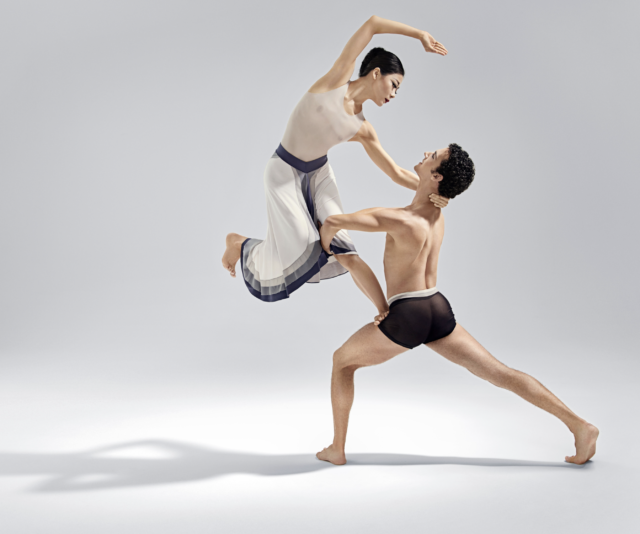
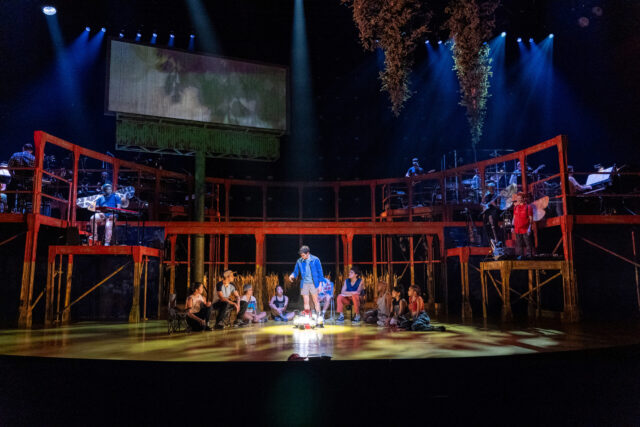
Bill T. Jones leads rehearsal for upcoming Watch Night at PAC NYC (photo by Stephanie Berger)

WATCH NIGHT
Perelman Performing Arts Center (PAC NYC)
251 Fulton St.
November 3-18, $52-$138
pacnyc.org

Bill T. Jones’s home base might be New York Live Arts, where he’s the artistic director, but he stages works all over New York (and the world). In August, Bill T. Jones/Arnie Zane Company presented the free, site-specific Dance for Sunset in Brookhaven, Long Island. In April, his Deep Blue Sea dazzled audiences at Park Avenue Armory, where he debuted the immersive Afterwardsness the previous year. And last month he was back at NYLA with Curriculum II, kicking off his troupe’s forty-first season.

So it’s no surprise that he is presenting the first dance work at the brand-new Perelman Performing Arts Center (PAC NYC) in Lower Manhattan, by Ground Zero. Running November 3-18, Watch Night will explore tragedy, justice, and forgiveness in these ever-more-difficult times. The multimedia work was conceived by director and choreographer Jones and librettist/poet Marc Bamuthi Joseph; the score is by Brooklyn musician and composer Tamar-kali.

The cast features approximately two dozen dancers portraying such characters as the Wolf, Super/Natural, and members of an Echo Chamber, with an eight-person ensemble including violin, viola, cello, bass, flute, oboe, and clarinet. The set is by Tony-nominated designer Adam Rigg, with costumes by Kara Harmon, lightning by Robert Wierzel, sound by Mikaal Sulaiman, and projections by Lucy Mackinnon.

In a program note, Jones lists dos and don’ts; for example:

DO NOT:
Create an event too easily digested in its desire to succeed by standards not of my making.
Be cowed by the city and this theater site’s precarious history in our fractious era.
Be oppressed by personal fear and anger.
Try to heal the world in this event.
Ignore each character’s worldview, individual psychological motivations that give them dimension and substance.
Attempt to be understood by all viewers and stake holders.

DO:
Acknowledge the privilege of this opportunity and the platform provided by the Perelman Performing Arts Center in its Inaugural Season.
Acknowledge this event is informed by real tragedies, real people, and real consequences.
Explore the potential of this new historic theater, built on contested land and a site of trauma.
Challenge my own taste and notions of abstraction and movement.
Attempt to “see this event” through the eyes of many people — different from myself and very much like me.
Stay alert, grateful, and hungry for joy!

Jones will be on hand for two postshow talkbacks, on November 9 with Joseph, Tamar-kali, and dramaturg Lauren Whitehead, moderated by rabbinical consultant Kendell Pinkney, delving into the creative inspiration behind the show, and on November 12, when Jones and guests from the Interfaith Center of New York will discuss faith and forgiveness. In addition, on December 4, Jones will speak with Joseph at NYLA as part of the ongoing “Bill Chats” series.

In her program note, Whitehead explains, “Every massacre has its moment. In the aftermath of every staggering act of violence we are inundated, for a time, with outrage and rallying cries, marches and memorials, public lament and lengthy speeches and great groanings of grief. And then, as is our way, we metabolize the grotesque. We will ourselves into movie theaters, send our children into schools again. We weep, we wail, and then we walk on. What our show is attempting to do is to ask ‘what if?’ What if we were unsatisfied by platitudes of forgiveness and forgetting? What if instead of moving on, we pointed our rage and discontent in a different direction?”

Don’t expect any easy answers to those challenging questions in what promises to be a memorable experience.

[Mark Rifkin is a Brooklyn-born, Manhattan-based writer and editor; you can follow him on Substack here.]
HOW TO BE A DANCER IN 72,000 EASY LESSONS

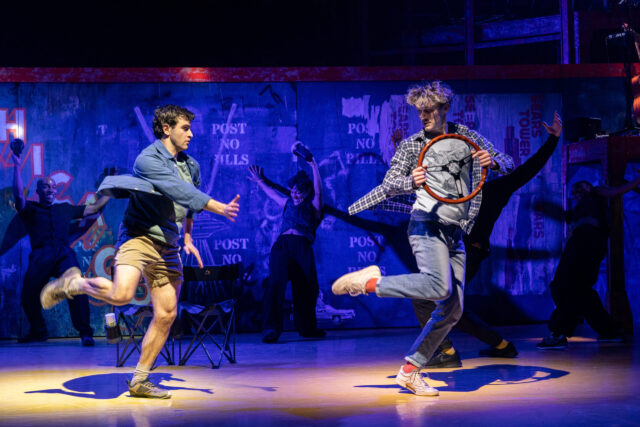
The Dancer (Rachel Poirier) whips the Dance Man (Michael Keegan-Dolan) into shape in semiautobiographical show (photo by Teddy Wolff)

HOW TO BE A DANCER IN 72,000 EASY LESSONS
St. Ann’s Warehouse
45 Water St.
Through November 5, $39-$69
718-254-8779
stannswarehouse.org

“Don’t look back,” Michael Keegan-Dolan says near the beginning of the exceptional How to Be a Dancer in 72,000 Easy Lessons. “But I want to look back.”

The Irish choreographer and director takes a unique look back in his triumphant return to the stage after two decades, joined by his longtime collaborator and life partner, French dancer Rachel Poirier. The semiautobiographical ninety-minute show — the first dance-theater work to be presented by St. Ann’s Warehouse — starts and ends with a story about an egg, signaling birth and rebirth. Keegan-Dolan is the Dance Man and Poirier the Dancer as he relates episodes from his past. Driven by his deep desire to be a dancer, he walked a long road to success with his pigeon-toed feet that included being bullied by other boys for dancing like a “queer” and a bruising stint in musical theater, among other adventures.

Michael Keegan-Dolan returns to the stage in How to Be a Dancer in 72,000 Easy Lessons at St. Ann’s (photo by Teddy Wolff)

The Dance Man prefers Gene Kelly to rugby, ballet to musical theater. Across forty-one brief scenes, the character introduces us to his mother and father, his best friend, his choir priest, his ballet teacher, his first girlfriend, Belgian choreographer Anne Teresa de Keersmaeker, his brother Paul, and a famous Australian conductor. He includes the high and low points, the moments that forged his future as he sought the freedom to be who he wanted to be, anchored by his meeting the Dancer, who moves about the stage and interacts with him in often outrageously funny and deliciously wicked ways as he shares his tales.

Each vignette features playful props that Keegan-Dolan and Poirier remove from a large wooden box and scatter about, from a child’s bicycle and a red balloon to a mirror and a helium tank, from cinderblocks and shoes to a dartboard and a ladder. A long white rope hangs down from the ceiling, offering danger and escape. White tape forms a large rectangle on the floor and back wall, but Keegan-Dolan, in a black suit and white shirt, and Poirier, in a black dress, ignore it, refusing to be contained.

The set and costumes are by Hyemi Shin, with lighting and direction by Adam Silverman and sound by Sandra Ní Mhathúna, creating an anything-goes atmosphere. Keegan-Dolan often carries a boombox with him, playing such songs as Jacques Brel’s “J’arrive,” Men Without Hats’ “The Safety Dance,” Depeche Mode’s “Just Can’t Get Enough,” Queen’s “Bohemian Rhapsody,” and Charles Penrose’s “The Laughing Policeman,” in addition to pieces by Stravinsky, Strauss, Handel, and Verdi.

“Psycho Killer,” with its touch of French, plays a pivotal role, as the Dance Man points out, “If there is a place in the world for the Talking Heads’ lead singer and front man David Byrne, then there must be a place in the world for me.” Poirier brings down the house with an exhilarating and exhausting fifteen-minute solo to Maurice Ravel’s “Bolero in C Major” that is breathlessly exquisite.

Nearly every minute provides something singular and unexpected, running the gamut of emotions, as exemplified when the Dance Man runs around the stage. “I have a voice!” he declares early on. “And it’s not, the endless monologue in my head, in my head voice. This is my voice.”

Keegan-Dolan found his voice through dance; his latest show, subtitled “A Performance Ritual in Four Parts for Two Performers,” is a clarion call for everyone to seek out and find theirs.

[Mark Rifkin is a Brooklyn-born, Manhattan-based writer and editor; you can follow him on Substack here.]
MEET MISS BAKER: PARTNERSHIP

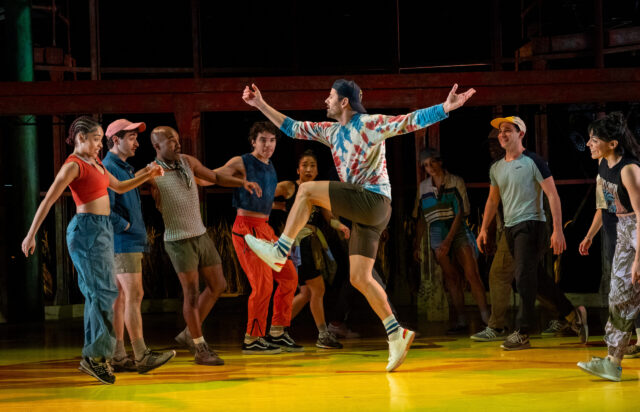
Sara Haider (center) is mesmerizing in Mint production of Elizabeth Baker’s Partnership (Todd Cerveris Photography)

PARTNERSHIP
The Mint Theater at Theatre Row
410 West 42nd St. between Ninth & Tenth Aves.
Tuesday – Sunday through November 12, $39-$79
minttheater.org
www.theatrerow.org

The Mint completes its wonderful “Meet Miss Baker” trilogy with Partnership, another exquisite production of a work by early-twentieth-century playwright and office typist Elizabeth Baker, following 2019’s The Price of Thomas Scott and last year’s Chains. Born in 1876, Baker was a teetotaler raised in a strict, religious lower-middle-class family that was in the drapery business; she didn’t go to the theater until she was nearly thirty and didn’t marry until nearly forty. Her debut, Chains, is a 1909 working-class drama about capitalism and social convention, while Scott, from 1913, also deals with those issues, through a lens involving religion and a family’s clothing store.

A fancy women’s clothing store in Brighton is at the center of Partnership, which explores two types of alliances: business and personal. Kate Rolling (Sara Haider) is a young, single woman who owns a fashionable shop that is poised to make it big. Kate has impressed the fussy and ultrafashionable Lady Smith-Carr-Smith (Christiane Noll), who promises Kate she’ll recommend her shop to “the Duchess,” ensuring a steady, if demanding, stream of wealthy customers.

Kate’s staff gets excited by the possibility, including vivacious salesperson Maisie Glow (Olivia Gilliatt), cynical seamstress Miss Blagg (Gina Daniels), and mousey shop assistant Miss Gladys Tracey (Madeline Seidman), who is engaged to the hapless Jack Webber (Tom Patterson), who is jealous of another of Gladys’s suitors. Jack works for successful haberdasher George Pillatt (Gene Gillette), who has made a surprise appointment with Kate.

“I wonder what Pillatt wants. There’s one thing, I suppose, and that is, he won’t propose,” Kate says to Maisie, who replies, “And he’d be a catch if you like. It’d be better than fighting him, wouldn’t it?”

The space next to Kate’s store has become available, and Pillatt is interested in taking it over — joining forces with Kate, who has been considering leasing the space as well. Pillatt is a dry, grim, darkly serious man with no sense of humor; speaking to Kate privately, he offers, “I have a plan to put before you Miss Rolling, but I will say at the outset that if you don’t care about it, we can drop it and go on as before, without prejudice. It need make no difference, I hope, to our present friendly business relations. If it commends itself to you I shall be very much gratified. Has the idea of a partnership ever entered your head? . . . Your business and mine.”

Kate is flattered by his kind words about her store, but then Pillatt ups the ante in one of the least romantic proposals imaginable: “I want to suggest, to propose a partnership — in another sense, and that is — marriage. Being a plain businessman, I wish to be quite frank in the matter, and so I have not hesitated to put the business part of the plan foremost. I am sure you, as a business woman, thoroughly understand this. . . . I am not a sentimentalist, but then you, a woman of business, do not wish for any expression of sentiment.”

When Kate admits that marriage was not on her radar, Pillatt assures her, in his cold, dispassionate manner, “That part of it will make no more difference than the other.” He then presents her with a formal contract, relating to both the business and the marriage. He is not exactly bursting with love and affection when he tells her, “I have thought it out very carefully. If you can see your way to accept it, I am sure it would work out satisfactorily.”

It’s a phenomenal scene that beautifully develops the characters and sets the stage for what comes next, twisting societal gender conventions and the male-dominated power structure. It takes place in the back private room of Kate’s shop, which features fashion drawings, various materials, shelves of boxes and files, stairs to the upper apartment, and a sharply dressed, realistic-looking mannequin known as Sally that essentially represents how women should be seen and not heard, treated as objects and not free-thinking human beings.

Discussing with Kate and Maisie how all men are fools, Miss Blagg contends, “Dress anything up in a smart blouse and a coiffure and men will make love to it. I’d like to put Sally here just inside the door and see how many of the idiots would come in to have a look at her.”

Lawrence Fawcett (Joshua Echebiri), Elliman (Tom Patterson), Maisie Glow (Olivia Gilliatt), and Kate Rolling (Sara Haider) take a break in the South Downs in Partnership (Todd Cerveris Photography)

When Pillatt’s friend and former classmate, the shy and awkward Lawrence Fawcett (Joshua Echebiri), enters, he is startled by Sally. “Christopher! — I thought she was real,” he calls out. “She’s just ‘it’! I’ve met dozens like her in flesh and blood.” Pillatt, wearing a persnickety, upper-crust striped suit and wielding a cane, and Fawcett, in a plain, unimpressive brown suit and hat, are the same age, but Fawcett looks much younger and has more interest in the outside world. (The stylish costumes are by Kindall Almond, with lighting by M. L. Geiger and sound by Daniel Baker.)

Fawcett has given up his lucrative family corset business to get into dyes, specifically orange. Pillatt has no respect for his decision, telling him, “What fool’s talk is this? You mean, I hope — though I can’t say I follow you quite — that you’re investing money in a dyeing business?”

Kate, in a resplendent cutting-edge fashionable suit and vest with a lacy cravat, purple bowtie, and black buttons and trimmings, is intrigued by Fawcett. When Fawcett, who is on a monthlong vacation, mentions that he is on his way to the South Downs — a national park with diverse landscapes, rich wildlife, spectacular views, unspoiled areas, and small communities — Kate decides that she, Fawcett, Pillatt, and Maisie should have tea on the Downs, and Maisie promises to bring her friend Elliman (Tom Patterson), who has a motorcar.

Up on the Downs — Alexander Woodward’s simplified set for the second act consists of a few rocks in front of a re-creation of James Hart Dyke’s colorful, tranquil 2021 painting, Winter Evening Light on Windmill — Fawcett is in his element, while Pillatt is uncomfortable and perturbed. Kate is intrigued by the freedom Fawcett is experiencing; it’s like he’s a different man in these natural surroundings.

“You are one of the lucky ones who can do as they like,” Kate says, to which Fawcett responds, “Can’t you? I thought you were your own mistress?” The planting of that seed leads to Kate taking another look at her life in the third act.

Miss Gladys Tracey (Madeline Seidman) and Miss Blagg (Gina Daniels) gossip in Elizabeth Baker rediscovery (Todd Cerveris Photography)

Director Jackson Grace Gay (A Little Journey, Transfers) nimbly dances around a gaping plot hole surrounding the question of whether a woman can have it all, success in love and business. Daniels (Becomes a Woman, Network) and Gilliatt (Chains, Mother of the Maid) provide playful humor, Echebiri (Merry Wives) builds charm, Gillette (Pushkin, Orpheus Descending) could not be any more dour, and Tony nominee Noll (Ragtime, God of Carnage) has a ball chewing up the scenery.

But the show belongs to Pakistani singer-songwriter and actress Haider, who is mesmerizing in her off-Broadway debut; you can’t take your eyes off her as Kate, a strong, independent woman, weighs the different parts of her life and must choose which path to follow. We might not always like the choices she makes, but she has every right to follow her heart and mind, wherever they may lead her. Anyone who partners with Kate, or Haider, her has made a wise decision indeed.

[Mark Rifkin is a Brooklyn-born, Manhattan-based writer and editor; you can follow him on Substack here.]
NOSFERATU, A 3D SYMPHONY OF HORROR

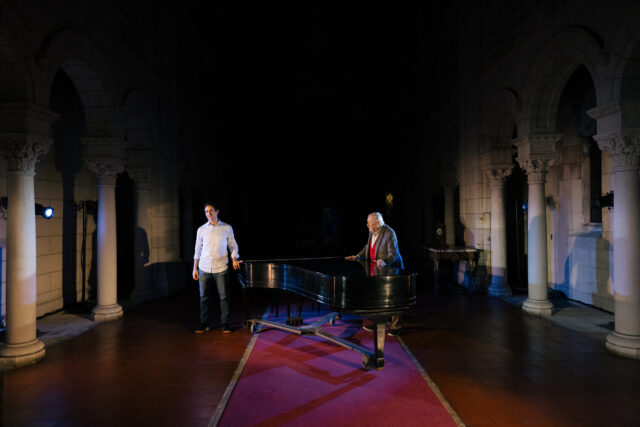
Theater in Quarantine’s Nosferatu is livestreamed right to your phone in 3D

NOSFERATU, A 3D SYMPHONY OF HORROR
NYU Skirball online
October 27-31, 7:00 & 9:00, $20
nyuskirball.org
www.youtube.com

My 3D glasses didn’t arrive in time but I still got chills from Joshua William Gelb’s livestreamed Nosferatu, a 3D Symphony of Horror, which is being presented by NYU Skirball through Halloween night.

During the pandemic, Gelb converted a 2′ x 4′ x 8′ closet in his East Village apartment into Theater in Quarantine, where he staged virtual dance and drama in the claustrophobic white space. He has now returned with a thirty-five-minute Halloween special inspired by Bram Stoker’s 1897 novel, Dracula, and F. W. Murnau’s 1922 silent masterpiece, Nosferatu.

The show is meant to be viewed on your cellphone, your own private, portable miniature closet, and listened to on headphones that make it seem like the characters are moving inside your head. An early title card, in a creepy, old-fashioned font, explains, “Nosferatu: Does this word not sound like the deathbird calling your name at midnight? Beware you never say it — for then the pictures of life will fade to shadows, haunting dreams will climb forth from your heart and feed on your blood.”

Gelb portrays the eerie Count Orlock, Nick Lehane is the real estate agent who has no idea what he’s in for, and Rosa Wolff is the agent’s true love, who knows something dastardly is afoot. The scenography is by Normandy Sherwood, with scary sound by Alex Hawthorn and video by Gelb. The closet turns from bright white to deep black as such props as a cross-laden door, bed, window, and miniature ship spur the action. Be sure to stick around for the time-lapse behind-the-scenes montage after the story concludes.

[Mark Rifkin is a Brooklyn-born, Manhattan-based writer and editor; you can follow him on Substack here.]
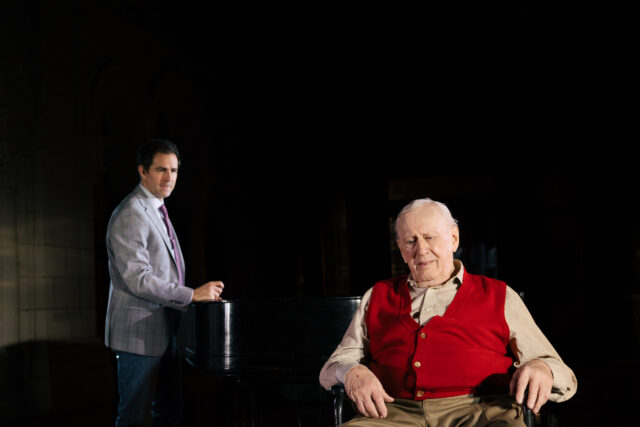
DIG

Roger (Jeffrey Bean) sees his easygoing life uprooted in Dig (photo by Justin Swader)

DIG
Primary Stages, 59E59 Theaters
59 East 59th St, between Park & Madison Aves.
Wednesday – Sunday through November 5, $65.50-$85.50
212-279-4200
www.59e59.org

Theresa Rebeck fertilizes the soil with a nearly endless stream of plant-based metaphors in her emotional, hard-hitting Dig, which is blossoming at 59E59 through November 5. Rebeck fills the dialogue with continual references to growth and growing, water, soil, roots, and pots, as characters dig deep to take stock of their lives. It’s not a question of nature vs. nurture so much as an exploration of the nurturing of nature, both foliage and family.

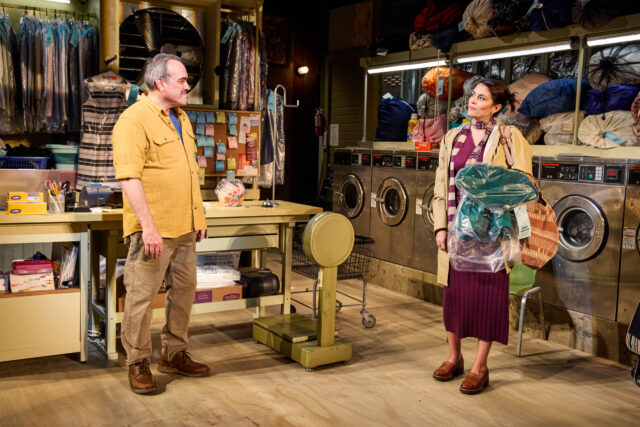
Inspired by a plant business co-owned by her husband, Rebeck’s play is set in a local plant store run by Roger (Jeffrey Bean), a persnickety man in his mid-fifties who is not in the habit of being agreeable with anyone, including customers and personal acquaintances. Roger lives alone in an apartment upstairs, caring more about plants than people. At the start, he is furious that his close friend Lou (Triney Sandoval) has nearly killed a plant he gave him. Roger had given him clear instructions on what to do with it, but Lou didn’t follow them.

“Okay, there was a period where watering was not my central focus,” Lou admits. “‘Focus,’” Roger repeats with scorn. “Focus is the wrong word,” Lou answers. “Focus is no word, it doesn’t apply at all; there is no indication that focus had anything to do with the care of this plant,” Roger argues.

In the corner by the front door, a woman listens to the two men quarreling. “I brought it to you for help. I understand this is not ideal. I did not neglect this plant,” Lou asserts. “I don’t want, I don’t — never mind. It’s fine. I will save this plant,” Roger declares.

We soon learn that the woman in the corner is Megan (Andrea Syglowski), Lou’s thirty-four-year-old daughter who has returned to town after an attempted suicide, a nationally publicized crime, and ensuing imprisonment. Lou and Roger are not so much squabbling over a plant as they are about Megan; Lou is unable to accept the idea that his child-raising could have anything to do with her situation.

Everett (Greg Keller) shares his thoughts on certain types of plants with Roger (Jeffrey Bean) and Megan (Andrea Syglowski) in Dig (photo by James Leynse)

Megan asks for a job from Roger, who is hesitant at first — he prefers things exactly as he has them, viewing change as some kind of enemy — but when Megan insists she doesn’t need to get paid, that she’s just looking for something to do to get her out of her rut, Roger essentially has no choice. The first lesson Roger teaches Megan is repotting, moving a plant to a bigger pot because it has outgrown its space. “It’s too healthy; it just kept growing. It’s something that happens to plants. The roots eat up everything around them. They take in the light and the soil and the air and the leaves, through photosynthesis,” Roger explains, calling photosynthesis “the most important chemical reaction on the face of the planet earth.” Once again, Roger opts for science over relationships with humans.

Meanwhile, Roger’s current assistant, Everett (Greg Keller), is a pot-smoking, video-game-playing dude who drives the delivery truck. Everett wants more responsibilities, but Lou, who does Roger’s books, thinks Everett should be fired.

“I love plants. And I love the truck, I love driving that truck,” Everett pleads with Roger. “You’re driving that truck stoned!” Roger proclaims. “Oh, now listen. The truck — that truck is a holy thing to me,” Everett argues, adding, “I’m good at selling plants, at talking to people about plants.” Roger responds, “You’re good at smoking plants,” to which Everett shoots back, “I don’t apologize for that. The organic world makes sense to me.”

Holiness also comes to the fore through Molly (Mary Bacon), a churchgoing woman looking for bulbs who gets into a tiff with Megan when she recognizes her. Molly returns later to offer forgiveness to Megan and invite her to join their prayer group. Although not religious, Megan checks out the group and finds some comfort there, which doesn’t make her father happy. Each character — including a late-arriving surprise figure (David Mason) — faces their own battle of being “pot bound,” in need of their own form of photosynthesis as they seek happiness in a world in need of cultivation.

Lou (Triney Sandoval) and Megan (Andrea Syglowski) have a tense father-daughter relationship in Dig (photo by James Leynse)

Over her thirty-year career as a playwright, the Ohio-born Rebeck has tended quite a garden; in the past dozen years alone, she has had five plays on Broadway (Dead Accounts with Katie Holmes, Bernhardt/Hamlet with Janet McTeer, Seminar with Alan Rickman, Mauritius with F. Murray Abraham and Bobby Cannavale, and the new I Need That with Danny DeVito) along with several gems off Broadway (Seared with Raúl Esparza, Downstairs with Tim and Tyne Daly). Dig, the New York City debut of which was delayed by the pandemic, is a splendid addition to her hothouse, a tense exploration of rebirth that Rebeck has admirably directed herself.

Christopher and Justin Swader’s cramped set teems with life, primarily green plants with occasional bursts of color. Fabian Fidel Aguilar’s costumes, Mary Ellen Stebbins’s sharp lighting, and Fitz Patton’s incidental music and sound design contribute to the overall realistic feel of the drama. The cast is exceptional, led by a revelatory performance by Syglowski (Halfway Bitches Go Straight to Heaven, queens), who is a whirling dervish of rollercoaster emotions. Sandoval (The Thin Place, 72 Miles to Go . . .), Bacon (Harrison, TX; Women without Men), Bean (About Alice, The Thanksgiving Play), Keller (Shhhh, The Thanksgiving Play), and Mason (Seared, Trick or Treat) provide expert supportive landscaping as the roots of the shop start spreading at a potentially uncontrollable rate.

They all combine to avoid neglect, focusing on properly watering this germinating story of tragedy, responsibility, hope, and redemption.

[Mark Rifkin is a Brooklyn-born, Manhattan-based writer and editor; you can follow him on Substack here.]

NEXT WAVE 2023: CORPS EXTRÊMES

Rachid Ouramdane makes his BAM debut with the high-flying Corps extrêmes (photo © Pascale Cholette)

CORPS EXTRÊMES
Brooklyn Academy of Music
BAM Howard Gilman Opera House
30 Lafayette Ave. between Ashland Pl. & St. Felix St.
October 27-29, $44.50-$84.50
718-636-4100
www.bam.org

Choreographer Rachid Ouramdane and Chaillot — Théâtre national de la Danse make their high-flying BAM debut with the soaring Corps extrêmes, having its US premiere October 27-29 at the Howard Gilman Opera House. The sixty-minute multimedia piece is centered around a large climbing wall where eight acrobats from Compagnie XY (Joël Azou, Airelle Caen, Tamila de Naeyer, Löric Fouchereau, Peter Freeman, Maxime Seghers, Seppe Van Looveren, and Owen Winship) are joined on film and/or onstage by French tightrope walker Nathan Paulin, French rock climber Camille Doumas, and Swiss rock climber Nina Caprez. The work explores the relationship of the human body to the natural world, filled with possibility, danger, and fun. The original score is by Jean-Baptiste Julien, with costumes by Camille Panin, lighting by Stéphane Graillot, and video by Jean-Camille Goimard.

Corps extrêmes is part of BAM’s 2023-24 Next Wave Festival, which includes Geoff Sobelle’s Food, Lynette Wallworth’s How to Live (after you die), and composer Huang Ruo, director Matthew Ozawa, and filmmaker Bill Morrison’s Angel Island, as well as the citywide Dance Reflections Festival, which continues through December 14 with Boris Charmatz’s Somnole and Dimitri Chamblas and Kim Gordon’s takemehome at NYU Skirball, Ola Maciejewska’s Bombyx Mori at FIAF, and Dancing with Glass — The Piano Etudes at the Joyce.