live performance

ARTIST FOR ACTION PRESENTS SHERYL CROW, PETER FRAMPTON, KEVIN BACON + SPECIAL GUESTS: A FATHER’S PROMISE FILM LAUNCH CONCERT

Who: Jimmy Vivino, Mark Barden, Sheryl Crow, Peter Frampton, Kevin Bacon, Bernie Williams, Rozzi, the Dumes, the Alternate Routes, Jen Chapin, Aztec Two-Step 2.0, more
What: Benefit concert for Sandy Hook Promise celebrating film launch
Where: NYU Skirball Center for the Performing Arts, 566 La Guardia Pl. between Third & Fourth Sts.
When: Thursday, December 7, $81-$256, 7:30
Why: “Music succeeds when politics and religion fail,” Darryl “DMC” McDaniels says in A Father’s Promise: The Story of a Father’s Promise to End Gun Violence, a documentary opening December 8 at LOOK Dine-In Cinema W57. Directed by Rick Korn and executive produced by Sheryl Crow, the film follows musician Mark Barden as he takes action after his seven-year-old son Daniel was one of twenty-six people murdered at Sandy Hook Elementary in Newtown, Connecticut, on December 14, 2012.

Barden, cofounder of Sandy Hook Promise, and filmmaker Korn teamed up with Matthew Reich and Neal Saini to form Artist for Action to Prevent Gun Violence. On December 7 at NYU Skirball, Barden and the Promise Band will join musical director Jimmy Vivino and a group of all-stars to celebrate the launch of the film; among the special guests performing live will be Crow, Peter Frampton, Kevin Bacon, Bernie Williams, Rozzi, the Dumes, the Alternate Routes, Jen Chapin, and Aztec Two-Step 2.0. The evening will be filmed for a future documentary, continuing to raise funds and awareness about the horrors of gun violence, the leading cause of death for children and teens in America.

[Mark Rifkin is a Brooklyn-born, Manhattan-based writer and editor; you can follow him on Substack here.]
SCENE PARTNERS

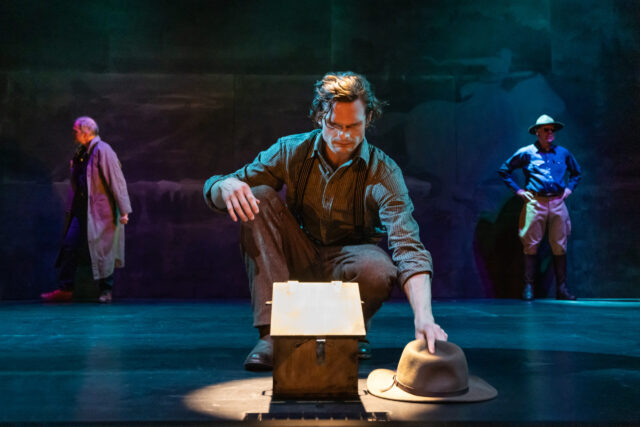
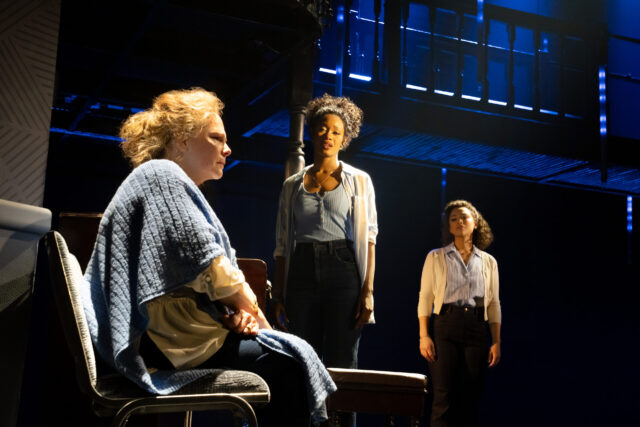
Meryl Kowalski (Dianne Wiest) is haunted by her father (Josh Hamilton) in Scene Partners (photo © Carol Rosegg)

SCENE PARTNERS
Vineyard Theatre
Gertrude and Irving Dimson Theatre
108 East 15th St. between Union Square East & Irving Pl.
Tuesday – Sunday through December 17, $37.80-$160.92
www.vineyardtheatre.org

The confusion begins with Scene Partners at the Vineyard even before the show starts. The program says it’s set in 1985, and the script explains, “And make sure it really feels that way,” but one of the songs playing over the speakers as the audience enters is the theme to Charlie’s Angels, a TV series that ran from 1976 to 1981. A confounding puzzlement continues through the entire play, where plot, dialogue, projections, screens, sound, lighting, and acting are all over the place, never coming together as a solid whole.

And that’s a shame, because it wastes a terrific performance by the wonderful Dianne Wiest, who has won two Oscars and two Emmys and has been nominated for three Drama Desk Awards. Wiest’s lilting, ethereal voice is as intoxicating as ever, but the narrative is like a poorly chopped salad put through an unbalanced spinner, a little Beckett and Pinter here, too much van Hove there, with more than a sprinkling of silly sitcom / soap opera and a dose of Joseph Beuys. It’s nearly impossible to tell what is happening in real time — what are memories, what are fantasies, what are dreams or nightmares, and what are clips from rehearsals or films.

Wiest plays Meryl Kowalski, a seventy-five-year-old woman whose husband just passed away three days ago. The first time she appears in person, not onscreen, only part of her is visible; she’s sitting in a chair, stuck in a kind of elevator shaft / dumbwaiter in the center of the back wall, and we can only see her from the neck down. She starts speaking, and there’s an uncomfortable moment when the audience tries to figure out whether they should applaud Wiest’s entrance. Not being a fan of entrance applause, I was rather content with it; plus, I loved the visual of the character trapped in the middle of nowhere.

Meryl has just come from a grief meeting and has stumbled upon a group that deals with “a bevy of emotional, physical, and mental traumas, trials, and tribulations.” The counselor (Eric Berryman) encourages her to get out of the shaft before the cables supporting her break. He says, “I encourage you to receive those snapping cables as a natural sign!” She asks, “A natural sign of what?!” He replies, “That your mass exceeds the safety-load of your pulley system!” She says, “In other words I’m fat and I don’t stand a chance.” He offers, “Not without sure footing and solid ground, which we offer in spades. Come! Join us once and for all. It only requires a minor injurious leap.”

Meryl (Dianne Wiest) seeks safe shelter with her sister (Johanna Day) in Vineyard world premiere (photo © Carol Rosegg)

Thrilled that she has a new lease on life, Meryl tells her daughter, Flora (Kristen Sieh), that her father “was a monster who ruined our lives. But now with that motherfucker dead and gone, I’m free, I’m finally free!” She explains that she is going to Hollywood to become a movie star, a goal that her husband failed at. A grown woman without a job and on drugs, Flora doesn’t want her mother to go, mostly because she needs her to take care of her. “You’ll play nothing but diaper-shitters, you hear me? Retirement-home background work!” Flora cries out. Meryl boldly replies, “I will play queens and matriarchs. Lawyers and judges, powerful women with pockets full of benzedrine pills and deep dark secrets to boot.”

On her Hollywood journey seeking fame and fortune, Meryl meets a Marxist train conductor (Berryman) who might be the ghost of her dead husband; pulls a gun on high-powered agent Herman Wassermann (Josh Hamilton); joins an acting class taught by Australian director Hugo Lockerby (Hamilton), with snarky wannabe actors Cassie (Carmen M. Herlihy), Pauline (Sieh), Maxine (Sieh), and Chuck (Berryman), who tell Meryl that she must change her name, which she doesn’t want to do because she is finally establishing her own identity, even if it will be by portraying other people; visits Dr. Noah Drake (Berryman), who may or may not be the doctor from General Hospital; is haunted by her father, who appears as a floating hat and trench coat; and reconnects with her sister, Charlize (Johanna Day), whom she hasn’t seen in ten years and who was unable to make it as an actress herself. “I’m happy with life now. I volunteer, I sing at this little dive,” Charlize says. “I don’t miss the rejection. The constant judgment. There’s no harm in being ordinary.”

But Meryl is not about to give up on this second chance at life.

Eric Berryman, Kristen Sieh, and Carmen M. Herlihy play multiple characters in Dianne Wiest–led Scene Partners (photo © Carol Rosegg)

Wiest (Rasheeda Speaking, Happy Days) is marvelous as Meryl, a dreamer with an infectious smile and a tenuous grasp of reality. You can’t help but root for her, no matter how high the barriers are to her potential success. Two-time Tony nominee and Obie winner Day (Sweat, Des Moines) is in her usual excellent form as Charlize, who has come to grips with who she is and now wants to help her sister. Berryman (Primary Trust, Toni Stone), Hamilton (The Antipodes, Dead Accounts), Herlihy (Mrs. Murray’s Menagerie, A Delicate Balance), and Sieh (Dr. Ride’s American Beach House, The Band’s Visit) are all fine in multiple roles, although the merry-go-round of characters can get bewildering, even with set designer Riccardo Hernández’s costumes, which end up battling against David Bengali’s video and projections.

Tony-winning director Rachel Chavkin, who has successfully steered such shows as Hadestown, Small Mouth Sounds, and Natasha, Pierre & the Great Comet of 1812, can’t seem to find her way into John J. Caswell Jr.’s (Wet Brain) meandering narrative, throwing too much at the wall, with not enough sticking. Every time I found myself just about ready to accept what was happening onstage, the presentation veered off track yet again.

I did, however, appreciate the music in the play, which includes Steve Perry’s “Oh Sherrie,” Corey Hart’s “Never Surrender,” and Talking Heads’ “Road to Nowhere,” the last of which ends up being a metaphor for the play.

[Mark Rifkin is a Brooklyn-born, Manhattan-based writer and editor; you can follow him on Substack here.]
ALVIN AILEY AMERICAN DANCE THEATER: 65th ANNIVERSARY SEASON

Alvin Ailey American Dance Theater’s Y. Lebrun, P. Coker, X. Mack, and R. Maurice in Alvin Ailey’s For “Bird” — with Love (photo by Dario Calmese)

ALVIN AILEY AMERICAN DANCE THEATER
New York City Center
131 West 55th St. between Sixth & Seventh Aves.
November 29 – December 31, $42-$172
www.alvinailey.org
www.nycitycenter.org

No matter what’s going on in the world — and in case you haven’t noticed, right now there’s a whole lot — when the end of November rolls around, you can count on Alvin Ailey American Dance Theater to provide a much-needed respite with its always exciting and entertaining end-of-year season at New York City Center. This time around the company is celebrating its sixty-fifth anniversary by presenting more than two dozen works, including world premieres by first-time AAADT choreographers Amy Hall Garner (CENTURY) and former Ailey dancer Elizabeth Roxas-Dobrish (Me, Myself and You) and new productions of Hans van Manen’s Solo, Alonzo King’s Following the Subtle Current Upstream, Ronald K. Brown’s Dancing Spirit, and Jamar Roberts’s Ode.

Kyle Abraham’s Are You in Your Feelings? is part of Ailey season at City Center (photo by Paul Kolnik)

The programs are divided into “Premiere Night,” “Ailey Classics,” “All Ailey,” “Live Music,” “All New,” and “Pioneering Women of Ailey”; the opening-night gala, honoring former Ailey dancer, choreographer, and artistic director Judith Jamison, pairs a performance of Revelations with a live choir and a world premiere with Tony, Grammy, and Emmy winner and Oscar nominee Cynthia Erivo.

The personal CENTURY was inspired by Garner’s grandfather and is set to music by Ray Charles, Count Basie, the Dirty Dozen Brass Band, and others; Me, Myself and You explores reminiscence, love, and loss. “Pioneering Women of Ailey” pays tribute to Jamison, Carmen de Lavallade, Denise Jefferson, and Sylvia Waters, while rising jazz stars will perform live December 15-17. Among the other highlights the company of thirty-three dancers will perform are Paul Taylor’s DUET, Alvin Ailey and Mary Barnett’s Survivors, Roberts’s In a Sentimental Mood, and Kyle Abraham’s Are You in Your Feelings? After twelve years as artistic director, Robert Battle announced that he is stepping down immediately because of health concerns; longtime Ailey dancer and associate artistic director Matthew Rushing will take over temporarily until the board chooses a full-time successor; among Battle’s works for the company are Ella, For Four, In/Side, Love Stories, Mass, and Unfold.

SABBATH’S THEATER

Drenka Balich (Elizabeth Marvel) and Mickey Sabbath (John Turturro) are sexually linked in Sabbath’s Theater (photo by Monique Carboni)

SABBATH’S THEATER
The New Group at the Pershing Square Signature Center
The Romulus Linney Courtyard Theatre
480 West 42nd St. between Tenth & Eleventh Aves.
Tuesday – Sunday through December 17, $32-$112
212-244-7529
thenewgroup.org
www.signaturetheatre.org

John Turturro must have been Jewish in a previous life.

Born in Brooklyn to a mother whose parents were from Italy and a father who emigrated from Italy to America when he was six, Turturro has spent a significant part of his five-decade career portraying Jewish characters, from Bernie “the Shamata Kid” Bernbaum in Miller’s Crossing and Herb Stempel in Quiz Show to Primo Levi in The Truce, Moe Flatbush in Mo’ Better Blues, and writer Barton Fink. He’s also portrayed Egyptian pharaoh Seti I in Exodus: Gods and Kings and Palestinian militant Fatoush “The Phantom” Hakbarah in You Don’t Mess with the Zohan in addition to too many Italians to mention.

So it’s no surprise that Turturro is absolutely exhilarating as Mickey Sabbath in the New Group world premiere of Sabbath’s Theater, which has been extended at the Pershing Square Signature Center through December 17, making it an excellent Hanukkah present.

Turturro and New Yorker writer Ariel Levy adapted the script from Philip Roth’s 1994 novel, which won the National Book Award. Turturro was a good friend of Roth’s; they collaborated on a never-completed one-man show of Roth’s controversial 1969 novel, Portnoy’s Complaint — which lends itself to solo performance — and Turturro portrayed Lionel Bengelsdorf, the misguided, overly trusting rabbi, in the 2020 HBO miniseries The Plot Against America, an alternate history of the rise of antisemitism in America in the early 1940s, based on the 2004 book by Roth.

Mickey is a failed puppeteer — he ran the Indecent Theater — who has had two unsuccessful marriages and has a missing daughter. He’s haunted by the death of his beloved brother, Morty, during WWII and by the ghost of his mother, who seems to hover around him, occasionally whistling, “Don’t Fence Me In.” Mickey is also a sex fiend; the show opens with him making love to the married Drenka Balich (Elizabeth Marvel), the two speaking openly and vividly about copulation. “Coming is an industry with you — you’re a factory,” Mickey says when they’re done. She wants him to be loyal to her, demanding, “I don’t want anyone else. Either forswear fucking others or the affair is over.” He replies sarcastically, “You like monogamy so much with your husband you want it with me, too?”

A moment later they are discussing a potential threesome when, still basking in the glow of sex, Mickey admits to the audience, “I was pierced by the sharpest of longings for my late little mother! I wondered if she had somehow popped out of Drenka’s pussy the moment before I entered it…”

Women are always on Mickey’s mind; his last name, Sabbath, is the Jewish day of rest, which is embodied by a Shabbos Queen, fitting Mickey’s approach to life.

Norman (Jason Kravits) and Michelle (Elizabeth Marvel) try to help their friend Mickey (John Turturro) in world premiere production (photo by Monique Carboni)

Mickey often turns directly to the audience, sharing personal tidbits, deep, dark desires, and explanations for why he is the way he is. He is a man of few morals; he has no respect for Drenka’s husband, Matija (Jason Kravits); his best friends, Norman (Kravits) and Michelle Cowan (Marvel), and their teenage daughter; or his second wife, Roseanna (Marvel), who can’t stand him. “I hated his increasing girth, his drooping scrotum,” Roseanna says about Mickey, adding, “his apish hairy shoulders, his white, stupid, biblical beard.” She then relates how she considered going all Lorena Bobbitt on him. Mickey responds by citing scripture: “She couldn’t have stuck something unpleasant up his ass? A frying pan! A rectum for a rectum. Exodus 21:24.”

When an old acquaintance, Lincoln Gelman, dies by suicide, Mickey starts having thoughts of killing himself too, but he might just love — or at least think he needs — sex too much. Then a visit with his father’s hundred-year-old cousin, Fish (Kravits), sends him careening again back into the past. “Was it good, life? Was it good to live, Fish?” Mickey asks. Fish replies, “Sure, better than being dead.”

Arnulfo Maldonado’s spare set features small pieces of furniture and a handful of props at the far left and right sides that are occasionally brought center stage by the actors or stage crew; Maldonado also designed the costumes, primarily modern-day dress save for a fab white sweater worn by Drenka and an American flag that Mickey wraps himself in. Alex Basco Koch’s projections, Mikaal Sulaiman’s sound, Jeff Croiter’s lighting, and Erik Sanko’s shadow puppet design help define the past from the present.

The story grows bumpier and bumpier in the second half as Mickey, an unreliable narrator, becomes more and more unlikable. But director Jo Bonney (Cost of Living, Fucking A) steers it back just in time before the character completely loses his way.

Turturro (Endgame, The Master Builder) is a powder keg as Mickey, a frenetic, mesmerizing whirlwind you cannot keep your eyes off of; onstage for nearly the full one hundred minutes, Turturro is relentless, relishing his acting job much how Mickey relishes sex. When, during an argument with Roseanna, she yells at him, “You cannot think straight if you’re shouting!” and he fires back, “Wrong! It’s only when I’m shouting that I begin to think straight! Shouting is how a Jew thinks things through!” it’s nearly impossible to believe that Turturro is not Jewish.

Marvel (Julius Caesar, Long Day’s Journey into Night) inhabits her characters so thoroughly that she is nearly unrecognizable as Drenka, Roseanna, Michelle, and cemetery superintendent A. B. Crawford, willing to go toe to toe with Turturro through thick and thin. And Kravits (The Drowsy Chaperone, A Play Is a Poem) sparkles as a series of schleppy men, culminating in his loving portrayal of Fish.

Developed earlier this year by New Jersey Performing Arts Center for “Philip Roth Unbound: Illuminating a Literary Legacy” in honor of what would have been Roth’s ninetieth birthday weekend — the Newark-born writer died in 2018 in Manhattan at the age of eighty-five — Sabbath’s Theater is an uneven but intriguing exploration of sex, love, and death with a heavy dose of filthy Jewish schmaltz.

Mickey might be a wholly indecent man, but underneath it all is a scared little boy. Reflecting on the many losses he’s experienced, he explains, “What’s the point of trying to find reason or meaning? By the time I was twenty-five I already knew there wasn’t any.” But just as Mickey is dishonest with others, he’s also dishonest with himself.

[Mark Rifkin is a Brooklyn-born, Manhattan-based writer and editor; you can follow him on Substack here.]
POOR YELLA REDNECKS

The cast of Poor Yella Rednecks occasionally breaks out into hip-hop songs (photo by Jeremy Daniel)

POOR YELLA REDNECKS
MTC at New York City Center – Stage I
131 West Fifty-Fifth St. between Sixth & Seventh Aves.
Tuesday – Sunday through December 3, $89-$109
212-581-1212
www.manhattantheatreclub.com
www.nycitycenter.org

Arizona-born Vietnamese American playwright and screenwriter Qui Nguyen follows up his semiautobiographical Vietgone with Poor Yella Rednecks, making its New York premiere at MTC at New York City Center — Stage I through December 3.

In praising Vietgone, I wrote, “Passionately directed by [May] Adrales with a frenetic warmth, the hip-hop immigrant tale — with a sweet nod to Hamilton — is colorful and energetic.” I am happy to say the same thing about Poor Yella Rednecks, except it’s even better than its predecessor.

Once again, the play begins with Nguyen (Jon Norman Schneider), called the playwright, explaining that not everything we are about to see actually happened. “This story is based on true events. All heavily researched. All one hundred percent historically accurate. Well, at least according to my mom.”

It’s August 7, 2015, and Nguyen is sitting at a table, interviewing his mother, Tong (Maureen Sebastian), for a play about how she left Vietnam and began a new life in America. But she thinks it’s a terrible idea and the reason why he is poor. “No one want to hear story about old woman who speak bad English with bald son,” she says. She ultimately agrees to talk with him but with a few important rules: “I don’t want you to only tell happy thing. I see your other play. You like to write romantic and funny. But no life is all romance. And it is not all fun. Sometimes it is hard. We Vietnamese. We good at being hard. I want it to be true and hard.” Another rule relates to speech: “If this going to be my play, I want all the white people to sound like the way I hear them. Let them hear all the stupid stuff they say. . . . And finally, I want to talk good.”

Thus, when Vietnamese characters speak with each other, it is in perfect English, substituting for Vietnamese so the audience can understand what they’re saying. But when a Vietnamese character is actually speaking English, it is in broken English. For example, when the older Tong talks to her son in broken English, that is how she is pronouncing the language; however, when she speaks in perfect English, she is actually talking to him in Vietnamese. It’s handled beautifully by Adrales and the cast, a constant reminder of the immigrant experience.

Tong takes him back to Arkansas in 1975, when she met her future husband, Nguyen’s father, Quang, at a relocation camp named Fort Chaffee, then moved to El Dorado. When the playwright says that it must have been love at first sight, Tong replies, “Mm-hmm. And Santa Claus is real, as is the Easter Bunny, and capitalism works for everybody.”

The playwright (Jon Norman Schneider) interviews his mother (Samantha Quan) in Poor Yella Rednecks (photo by Jeremy Daniel)

The action then shifts to the past as Tong and Quang (Ben Levin) fall in love even though she is still dating Bobby (Paco Tolson) and he is still married to Thu (Samantha Quan), who is raising their two children in Vietnam. Five years later, Quang and Tong are living in a trailer with her mother, Huong (Quan), a foul-mouthed, cynical smoker who takes care of Quang and Tong’s son, Little Man, while Tong works at a local diner and Quang hangs out with his hapless friends, including his bestie, Nhan (Jon Hoche). In an ingenious move, Little Man is a puppet, designed by David Valentine, that is voiced and operated by Schneider as the playwright, essentially the adult son playing himself as a child. It works wonderfully, especially when Huong teaches Little Man how to defend himself.

When Nhan announces that he’s moving to Houston to find better opportunities and it turns out that Quang hasn’t quite settled things with Thu yet, Tong starts to reevaluate who she is and what she wants out of life.

Tim Mackabee’s set is structured around five large neon letters — Y, E, L, L, A — that occasionally light up in different colors and are moved around to expose smaller sets attached to them, from a living room and a bar to the diner and a fast-food joint. They were designed to evoke the letters in the fabled Hollywood sign; just as that sign beckons wannabe stars to California from all over the world, the Y-E-L-L-A letters represent the American dream that Asians have when they emigrate from their countries to the United States — and encounter hatred, bigotry, language barriers, and other elements that do not make their transition easy. Several scenes also occur in and around a pickup truck, revealing that the vehicle is a favorite not only for a certain stereotyped group of white men who like country music and beer.

The big letters, along with comic-book-like projections by Jared Mezzocchi, are also a nod to Nguyen’s success as a writer for Marvel Studios and founder of the New York–based Vampire Cowboys troupe; Nguyen even has Marvel legend Stan Lee (Tolson, who portrayed the playwright in Vietgone) show up once in a while and deliver statements about heroes. Valérie Thérèse Bart’s costumes hit their target, and Lap Chi Chu’s lighting ranges from bold to intimate.

As in Vietgone, the cast, nearly all of whom appeared in that show at South Coast Rep and/or MTC, displays their vast talents by often breaking out into exciting raps; the original music is by sound designer Shane Rettig, arranged by Kenny Seymour, choreographed by William Carlos Angulo, and with music direction by Cynthia Meng. “I know you think I’m joking — what the hell am I smoking? / But being next to you is what got my heart thumping / Our kiddies will be cuties, bring over that fine bootie / Nothing’s gonna stop us with our combined beauty,” Quang declares. “Let me reintroduce myself / I’m better known as that shorty that you up and left / I must be crazy, baby — thought you were dead / We threw a funeral to commemorate your death,” Thu announces. “Cuz I’m more than just pretty, my brain is damn witty / Gimme one hot second — Imma run this city / Yo, say that I shouldn’t — I’m my own woman / Stronger than any man and twice as good looking,” Tong proclaims. “Even if they mad at you, you gotta be true to you / Every scar you wear, you show the shit that you went through / Ya gotta stand strong, be strong, head strong, ya ain’t wrong / So come on listen close, this here’s our fight song,” Huong tells Little Man.

Jon Norman Schneider (left) portrays the playwright and his younger puppet self in New York premiere from MTC (photo by Jeremy Daniel)

Nguyen (She Kills Monsters, Living Dead in Denmark) and Adrales (The Strangest, Golden Shield) are in total sync; nearly every minute rings true, and the pace never lags. Schneider (The Coast Starlight, Once Upon a (korean) Time) is warm and charming as the playwright, Hoche (King Kong, Life of Pi) is a hoot as Nhan and various rednecks, Levin is hunky as Quang, Quan is cute and lovable as Huong, Tolson (The Knight of the Burning Pestle, Children of Vonderly) gives Bobby an unexpected edge, but Sebastian (The Best We Could: A Family Tragedy, Soul Samurai) steals the show as Tong, who stares adversity right in the face but refuses to give up, in many ways representing the Asian diaspora in America.

Early on, right before the official interview begins, Tong tells her son, “Let me tell you what kind of story white people want to hear.” He asks, “Wait, why only ‘white people?’” She replies, “Because only white people like to watch a play.” He argues, “All sorts of people watch plays, Mom.” To which she counters, “Yes, all sorts of white people. It look like a Fleetwood Mac concert. It so white. . . . Maybe I don’t want to dig up old history just so you can make a few dollar on play white people won’t like.”

At the matinee I saw, the audience appeared to be at least half Vietnamese or Vietnamese American, both young and old, and they and the white people reacted in unison to the unconventional, important story taking place onstage. Eliciting a wide range of emotions, the show accomplishes what theater does best, bringing people of different backgrounds together to focus on the human condition, reaching into the past while giving us hope for the future.

[Mark Rifkin is a Brooklyn-born, Manhattan-based writer and editor; you can follow him on Substack here.]
MERRY ME

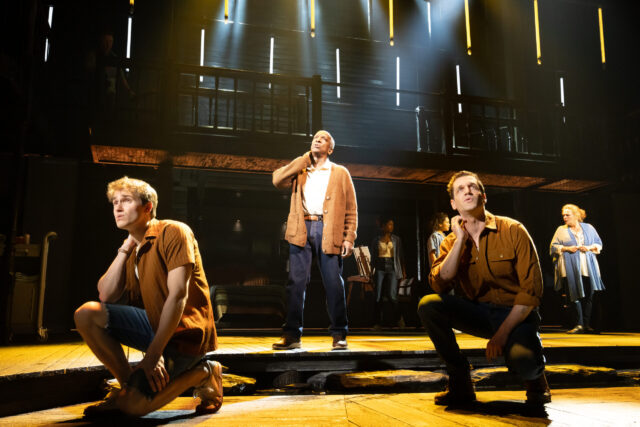
An Angel (Shaunette Renée Wilson), Lt. Shane Horne (Esco Jouléy), and Dr. Jess O’Nope (Marinda Anderson) seek out latest merryment from Hansol Jung (photo by Joan Marcus)

MERRY ME
New York Theatre Workshop
79 East Fourth St. between Second & Third Aves.
Tuesday – Sunday through November 19, $65-$75
www.nytw.org

Rising star Hansol Jung finishes a busy 2023 with her third production, Merry Me, continuing at New York Theatre Workshop through November 19. The year began with the exhilarating and unpredictable Wolf Play at MCC, followed by the confusing and overly self-referential Romeo and Juliet. Merry Me falls somewhere in between, but it is certainly worth catching before it closes.

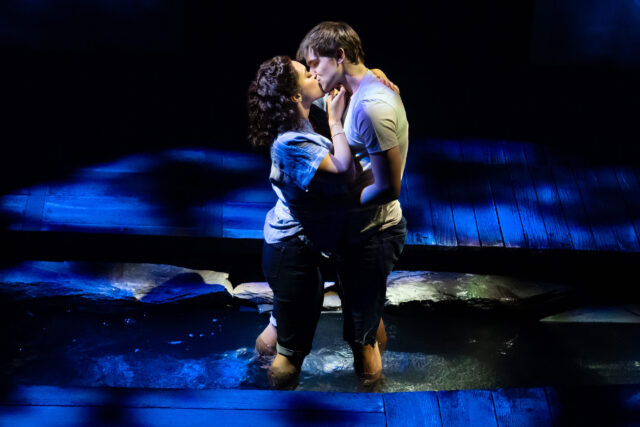
As the audience enters the theater, songs are blasting through the speakers, by Melissa Etheridge, Peaches, and Tegan & Sara, all longtime lesbian faves. “Do you like my playlist? You’re welcome,” says our host and narrator, the Angel (Shaunette Renée Wilson) from Angels in America, to open the show.

Merry Me mixes Tony Kushner, Greek tragedy (Aeschylus’s Oresteia, Homer’s Odyssey), William Wycherly’s seventeenth-century Restoration comedy The Country Wife, and Shakespeare into a frenetic tale about sex as power. It takes place on a naval base camp on a “Naval basecamp of A Nation’s most prestigious navy on an Island not far from Another Nation’s most vulnerable coast cities,” wonderfully depicted by set designer Rachel Hauck as a wall of tents as if seen from high above. A small door sits at stage right, a military foot locker stage left. Above are two white clouds amid a blue sky.

There’s a bit of a furor at the encampment, where an electric blackout is hampering the navy’s ability to defend itself. Curiously, the only devices that work are vibrators. Lt. Shane Horne (Esco Jouléy), known as “God’s gift to lady parts of all shapes, colors, and vintages,” is just out of the brig, having served time for bedding Gen. Aga Memnon’s (David Ryan Smith) wife, Clytemnestra (Cindy Cheung). The androgynous Horne, inspired by The Country Wife womanizer Harry Horner, looks fabulous in a camouflage tank top that reveals bulging muscles and tattoos. Horne and their therapist, Dr. Jess O’Nope (Marinda Anderson), who has trouble making decisions — her name is a riff on “yes or no” — concoct a plan in which the doctor will falsely report that “Lieutenant Shane Horne has been zapped, nuked, and lobotomized and returned to the world as Straight as a Road through Nevada!” Thus “converted,” Horne will be able to pursue, unabated, their “merries,” referring to orgasms.

Meanwhile, the general’s son, Pvt. Willy Iphigenia Memnon (Ryan Spahn), is trying to assert his military acumen with his father and his sexual prowess with his wife, Mrs. Sapph Memnon (Nicole Villamil). “I’m a woke white man,” he tells Dr. O’Nope. “I can come to pretend to understand extremities I do not fully comprehend by mansplaining and then apologizing. . . . What if I have been conditioned all my life to believe I am excellent above all other types of humans while not really being trained to work as hard? What if I am actually quite medium in talent, tenacity, and general interestingness and I know I have not developed a mental capacity to bridge the discrepancy between the genius I self-identify to be and the mediocre lump of ego that I actually am?”

As the apt-named Willy struggles with his conscience, Horne keeps up their search for pleasure, demanding, “I want my orgasm.”

Mrs. Sapph Memnon (Nicole Villamil) and Pvt. Willy Memnon (Ryan Spahn) are joined by a surprise guest (Shaunette Renée Wilson) in Merry Me (photo by Joan Marcus)

“The principal concern for women is not having an orgasm. But a woman has to take responsibility for her own orgasms,” Dr. Ruth said in 2010. Merry Me is, well, like an orgasm. Sometimes it explodes, sometimes it disappointingly falls flat, and other times it teases, tickles, and titillates.

The ninety-minute show can’t quite find its center, although it does occasionally locate its G-spot; Jung and director Leigh Silverman (Grand Horizons, On the Exhale), her regular collaborator, along with the cast, are having an absolute blast, which is infectious up to a point. Aficionados of Greek drama may enjoy the Homeric references sprinkled liberally throughout, but the narrative can get overwhelmed by repeated jokes, too many pop-culture references, and a nearly endless stream of double entendres — “It’s my fault, General. I have distracted your dear wife. I asked her to come,” Horne explains — while also having a lot to say about gender, sexuality, war, and the theater itself. Sometimes less is more, as with the navy’s small insignia, a slingshot, comparing sexual freedom to David’s battle with Goliath.

Lt. Shane Horne (Esco Jouléy) makes her case in wild and woolly Merry Me (photo by Joan Marcus)

Alejo Vietti’s costumes counter military fatigues with the blue-and-white outfit worn by Clytemnestra and the red dress adorning Sapph, a sly tip of the cap to America, along with the Angel’s fab getup, which is dazzling. Barbara Samuels’s lighting and Caroline Eng and Kate Marvin’s sound are bold and brash.

The excellent cast is led by Shaunette Renée Wilson (La Race, The Resident), who makes a spectacular appearance as the Angel, and Jouléy (Wolf Play), who is likely to turn you on as Horne no matter your orientation. Anderson (You Will Get Sick, Sandblasted), Cheung (Catch as Catch Can, Golden Child), Smith (Arden of Faversham, The Death of the Last Black Man in the Whole Entire World AKA the Negro Book of the Dead), Spahn (Moscow Moscow Moscow Moscow Moscow Moscow; Jane Anger, or . . .), and Villamil (Wolf Play, Lessons in Survival) provide solid support, at the ready for whatever is to come.

Merry Me makes for some fine merriment, even if the ending is a bit, er, anticlimactic.

[Mark Rifkin is a Brooklyn-born, Manhattan-based writer and editor; you can follow him on Substack here.]
JAJA’S AFRICAN HAIR BRAIDING

Marie (Dominique Thorne, right) receives an unexpected visitor in Jaja’s African Hair Braiding (photo © Matthew Murphy, 2023)

JAJA’S AFRICAN HAIR BRAIDING
Samuel J. Friedman Theatre
261 West Forty-Seventh St. between Broadway & Eighth Ave.
Tuesday – Sunday through November 19, $74-$205.50
www.manhattantheatreclub.com

“I feel like I moved in for the day,” Jennifer (Rachel Christopher) says in Jocelyn Bioh’s Broadway debut, Jaja’s African Hair Braiding. An aspiring journalist, Jennifer is a kind of doppelganger for the audience; she arrived just as Jaja’s hair salon on the corner of 125th St. and St. Nicholas Ave. in Harlem opened, asked for long micro braids, and has spent the entire morning and afternoon with Miriam (Brittany Adebumola), an optimistic stylist from Sierra Leone. It’s Jennifer’s first time in the shop, and she carefully watches from her chair to the side as people come and go and the stylists laugh, argue, gossip, and wonder what’s next for them. Just as Jennifer starts to feel part of this tight-knit community, so does the audience.

It’s an auspicious, and very hot, July day in 2019, and Senegalese owner Jaja (Somi Kakoma) is getting married that night. Her eighteen-year-old daughter, wannabe writer Marie (Dominique Thorne), is managing the shop and the stylists, who can be a handful: the Ghanaian Sista Bea (Zenzi Williams), a busybody who thinks she’s better than the others and is hoping to open her own salon; the Senegalese Aminata (Nana Mensah), who loves hanging around the shop, especially while she’s having issues with her husband; Miriam, a patient and agreeable young woman with a surprise secret; and the Nigerian Ndidi (Maechi Aharanwa), a fast, talented, fun-loving braider who the older Bea is jealous of.

Over the course of the day, a variety of customers come and go. The nasty and rude Vanessa (Lakisha May) complains about nearly everything, from the way the others look at her to the chair. Chrissy (Kalyne Coleman) is a cheerful young woman who wants to look like Beyoncé. Sheila (May) is a businesswoman who can’t stop talking on her phone. Laniece (Coleman) is a local DJ. And Michelle (Coleman) is a nervous mother who has made an appointment with Ndidi instead of her usual stylist, Bea, who is furious and feels betrayed.

Also stopping by are a series of men, including Franklin the Sock Man, Olu the Jewelry Man, and Eric the DVD Man, selling their wares, in addition to Aminata’s husband, James (all portrayed by Michael Oloyede).

Shortly after Jaja (Somi Kakoma) arrives, the narrative takes a sharp, unexpected turn, forcing everyone to face a hard dose of contemporary reality.

Jocelyn Bioh’s Jaja’s African Hair Braiding takes place in a Harlem salon (photo © Matthew Murphy, 2023)

In School Girls; Or, The African Mean Girls Play, Bioh, who has appeared in such plays as Suzan-Lori Parks’s In the Blood, Branden Jacobs-Jenkins’s Everybody and An Octoroon, and Jaclyn Backhaus’s Men on Boats, follows a group of young Ghanaian students seeking to be selected as a contestant for Miss Ghana, raising issues of jealousy, fairness, and colorism.

She expands on the concept of Black style in Jaja’s African Hair Braiding, celebrating individuality and woman entrepreneurship while also exploring immigration and the African diaspora in America. In a program note, Bioh explains, “To many people, they are just ‘hair braiding ladies,’ random women people pass by on the street, but to me, they are heroes, craftswomen and artists with beautiful, gifted and skilled hands.” Each character has her hopes and dreams, her fears and desires, that feel real, not cartoonish or pedagogic.

At the center is Marie, who, despite being the youngest, is both friend and mother to the other stylists while figuring out how she can afford to go to college and start up her own life. “You know, I really don’t wanna talk about ANY of this anymore, okay?! I don’t want to talk about school or my mother or her ‘connections’ or whatever you saw on the news!” she blurts out, succumbing to the pressure. “Trust me — this is already all I think about every single day. Every single second! For once, can I just have a day where I come here, do my work — in peace — and go home? Is that okay?!”

The show is lovingly directed by Obie winner Whitney White (soft, On Sugarland), balancing uproarious comedy and wit with sincerity and grace. The ensemble cast is outstanding, led by Thorne as Marie, who imbues her with an inner strength that is wise beyond her years yet existing on a knife’s edge. Adebumola is engaging as the warm and caring Miriam, Mensah is hilarious as Aminata, and Oloyede pulls off quite a feat in portraying all four male characters.

Dede Ayite nails the costumes, giving identity, dignity, and humor to each of the women. The effective lighting is by Jiyoun Chang, with lively sound and original music by Justin Ellington. David Zinn’s phenomenal set, a remarkably detailed salon that essentially puts the audience right in Jaja’s shop (and receives its own well-deserved applause), and Nikiya Mathis, who is responsible for the spectacular hair and wigs, are stars in themselves.

You won’t mind spending a lot more time in Jaja’s, moving in for a day or more.

[Mark Rifkin is a Brooklyn-born, Manhattan-based writer and editor; you can follow him on Substack here.]