live performance

ALVIN AILEY: ALL NEW 2023

Caroline T. Dartey and James Gilmer team up in world premiere of Elizabeth Roxas-Dobrish’s Me, Myself and You (photo by Paul Kolnik)

ALVIN AILEY AMERICAN DANCE THEATER
New York City Center
131 West 55th St. between Sixth & Seventh Aves.
Through December 31, $42-$172
www.alvinailey.org
www.nycitycenter.org

Alvin Ailey American Dance Theater’s annual all-new programs at City Center are among my favorite events of the year, and the 2023 edition, the troupe’s sixty-fifth anniversary, is no exception. The evening began with a new production of Alonzo King’s Following the Subtle Current Upstream, which the choreographer calls “a piece about how to return to joy”; the original debuted at City Center in 2000. The twenty-two-minute work unfolds in a series of vignettes featuring, on December 23, Patrick Coker, Isaiah Day, Caroline T. Dartey, Coral Dolphin, Samantha Figgins, Jacquelin Harris, Yannick Lebrun, Corrin Rachelle Mitchell, and Christopher Taylor, who perform to silence, a storm, chiming bells, and other sounds by Indian percussionist Zakir Hussain, American electronics composer Miguel Frasconi, and the late South African singer and activist Miriam Makeba (a gorgeous duet to “Unhome”). At one point a dancer is alone onstage, like a music box ballerina, two horizontal beams of smoky light overhead; the lighting is by Al Crawford based on Axel Morgenthaler’s original design, with tight-fitting, short costumes by Robert Rosenwasser, the men in all black, the women in black and/or yellow.

Former Ailey dancer Elizabeth Roxas-Dobrish’s world premiere, Me, Myself and You, is a seven-minute duet that recalls Jamar Roberts’s 2022 In a Sentimental Mood, about a young couple exploring love and desire. Here Roxas-Dobrish uses Damien Sneed and Brandie Sutton’s version of the Duke Ellington classic, “In a Sentimental Mood,” as Dartey, in a sexy, partially shear black gown, sets up a three-paneled mirror in the corner and shares tender moments with James Gilmer, bare-chested with black pants, combine for some awe-inspiring moves. The costumes are by Dante Baylor, with lighting by Yi-Chung Chen that makes the most of the couple’s reflections in the mirror while calling into question whether it is actually happening or a memory or fantasy.

A new production of Hans van Manen’s Solo, originally performed by the company in 2005 and staged here by Clifton Brown and Rachel Beaujean, is seven minutes of playful one-upmanship as Renaldo Maurice, Christopher Taylor, and Kanji Segawa strut their stuff in a kind of dance-off, their costumes (by Keso Dekker) differentiated by yellow, orange, and red; as each finishes a solo, they make gestures and eye movements inviting the next dancer to top what they have just done. But this is no mere rap battle; instead, it’s set to Sigiswald Kuijken’s versions of Johann Sebastian Bach’s “Partita for Solo Violin No. 1 in B minor, BWV 1002 — Double: Presto” and “Partita for Solo Violin No. 1 in B minor, BWV 1002 — Double: Corrente.”

A new production of Ronald K. Brown’s Dancing Spirit honors Judith Jamison’s eightieth birthday (photo by Paul Kolnik)

In 2009, AAADT presented the world premiere of by Ronald K. Brown’s Dancing Spirit, which Brown choreographed as a tribute to former Ailey dancer Judith Jamison’s twentieth anniversary as artistic director of the company. Now, in honor of Jamison’s eightieth birthday, Brown revisits the work in a lovely new production. The half-hour piece, danced by Hannah Alissa Richardson, Deidre Rogan, Yazzmeen Laidler, Harris, Solomon Dumas, Taylor, Christopher R. Wilson, Jau’mair Garland, and Coker, builds at a simmering pace as the cast, in blue and white costumes designed by Omatayo Wunmi Olaiya that evoke Jamison’s performance of the “Wade in the Water” section of Revelations, move in unison and break out into solos, duets, and other groups to Stefon Harris’s and Joe Temperley’s versions of Ellington’s “The Single Petal of a Rose,” Wynton Marsalis’s “What Have You Done?” and “Tsotsobi — The Morning Star (Children),” the Vitamin String Quartet’s cover of Radiohead’s “Everything in Its Right Place,” and War’s “Flying Machine (The Chase).” Brown incorporates Afro-Cuban and Brazilian movement into his rhythmic language; the work is highlighted by Dumas and Richardson celebrating Ailey and Jamison, respectively, with stunning solos as the moon arrives for a glowing conclusion.

Also debuting at City Center in 2023 is a new production of Roberts’s Ode and the world premiere of Amy Hall Garner’s CENTURY.

In her 1993 autobiography, Dancing Spirit, Jamison writes, “Dance is bigger than your physical body. When you extend your arm, it does not stop at the end of your fingers, because you’re dancing bigger than that; you’re dancing spirit.” AAADT has been maintaining that spirit for sixty-five years, with more to come.

[Mark Rifkin is a Brooklyn-born, Manhattan-based writer and editor; you can follow him on Substack here.]

LIFE & TIMES OF MICHAEL K

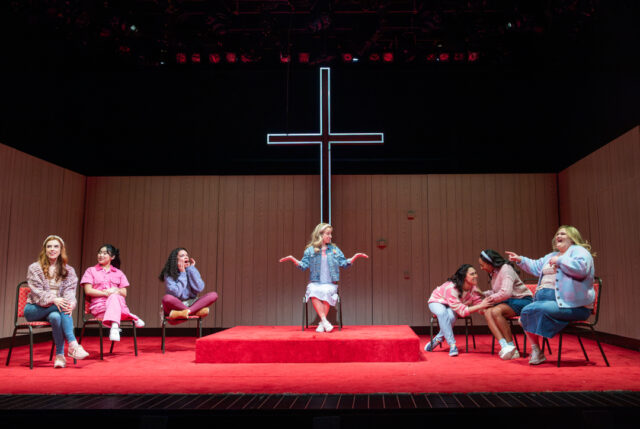
Life & Times of Michael K tells a heart-wrenching story set in war-torn South Africa (photo by Richard Termine)

LIFE & TIMES OF MICHAEL K
St. Ann’s Warehouse
45 Water St.
Through December 23
718-254-8779
stannswarehouse.org

Lara Foot’s extraordinary adaptation of J. M. Coetzee’s 1983 Booker Prize–winning novel, Life & Times of Michael K, begins with a group of people huddling around a figure wrapped in a blanket on the ground of a dark, bombed-out area, like an infant left on its own to face a harsh struggle. The figure is lifted up to reveal a wooden puppet of a young man with a harelip, seemingly born from the earth. For the next two hours, he goes on an adventure that takes him across poor and desolate sections of South Africa during a fictional civil war in the time of apartheid.

He is part Josef K from Kafka’s The Trial, part Chauncey Gardiner from Jerzy Kosiński’s 1970 novel, Being There, and subsequent Hal Ashby film, with a bit of Jack Crabb from Thomas Berger’s 1964 novel, Little Big Man, made into a 1970 film by Arthur Penn. On his journey, he faces bureaucratic red tape, tragic loss, severe hunger, and violence as he survives scene after scene in which it is hard to tell the good people from the bad, all the while just wanting to tend to a garden, bringing new life to a dangerous world. “It is because I am a gardener, he thought, because that is my nature,” one of several narrators says. “The impulse to plant had been reawakened / now, in a matter of weeks, he found his waking life bound tightly to the patch of earth / he had begun to cultivate / and the seeds he had planted there.”

It’s a haunting tale told through puppetry — Michael K is a life-size wooden puppet operated by Markus Schabbing, Craig Leo, and Carlo Daniels, who voices the character, while Michael K’s mother, Anna K, is animated by Faniswa Yisa, Roshina Ratnam, and Nolufefe Ntshuntshe. Designed by Adrian Kohler, who cofounded Handspring Puppet Company with puppetry director Basil Jones, the puppets are magically imbued with emotion by the handlers, who are out in the open, not hidden from the audience; when Michael K is given a pie, the handlers actually eat it. However, the handlers also represent how Michael K and his mother are controlled, never free; when left to himself, Michael K crumples on the floor, unable to move. As he says, “I do not know what is going to happen. The story of my life has not been an interesting one; there has usually been someone to tell me what to do next; but now there is no one, and the best thing seems to be to wait.”

The journey starts with Michael K determined to bring his ailing mother back to their home in Prince Albert, a trip for which he constructs a special rickshaw cart for her. Along the way he encounters bullies, armed soldiers, a goat, work camps, thieves, children playing, and extreme poverty and hunger, which is made palpable when Michael K removes his shirt, revealing bones with nothing inside. Although race is never mentioned specifically, Michael K is treated differently, and often negatively, because of his harelip, a physical manifestation that makes him feel less than, a metaphor for his color.

The other, nonpuppet characters are portrayed by Sandra Prinsloo, Andrew Buckland, Wessel Pretorius, Billy Langa, Ntshuntshe, Yisa, and Ratnam, including cyclists, soldiers, bus passengers, guards, police officers, bullies, nurses, clerks, and others; Ntshuntshe excels making baby noises. They also serve as narrators, relating important plot developments with Coetzee’s poetic language: “Michael did not miss his mother. No, he did not miss her, he found, except insofar as he had missed her all his life.” “Because of his face Michael did not have women friends. He was easiest when he was by himself.” “The problem that had exercised him all those years ago behind the bicycle shed at Huis Norenius, namely, why had he been brought into the world, had finally received its answer: He had been brought into the world to look after his mother.”

The effective, naturalistic costumes are by Phyllis Midlane, with sound by Simon Kohler and lighting by Joshua Cutts that puts you right in the middle of the action on Patrick Curtis’s war-torn set, enhanced by Kyle Shepherd’s original music. Video projections feature extreme close-ups of Michael K in which his face and body dominate the back wall; the photography and film are by Fiona McPherson and Barrett de Kock, with videography and editing by Yoav Dagan and projection design by Kirsti Cumming.

In such recent shows as The Jungle, Into the Woods, Life of Pi, and Wolf Play, puppets have been used ingeniously; Michael K continues that welcome trend.

Michael K encounters a goat in unique adaptation of novel by J. M. Coetzee (photo by Richard Termine)

One characters sums it up when he tells Michael K, “Why should we run away if we have nowhere to run?”

A collaboration between Foot’s Baxter Theatre Centre (Mies Julie, The Inconvenience of Wings), Handspring Puppet Company (Little Amal, War Horse), and the Dusseldorfer Schauspielhaus, Life & Times of Michael K is about trying to find one’s place in a world that is overwhelmed by sociopolitical ills, where one individual can get trapped in a system that refuses to acknowledge who he is and what his needs are. It might be set in South Africa, but it is a timeless, universal story, told here in a moving and poignant way.

[Mark Rifkin is a Brooklyn-born, Manhattan-based writer and editor; you can follow him on Substack here.]
MADWOMEN OF THE WEST

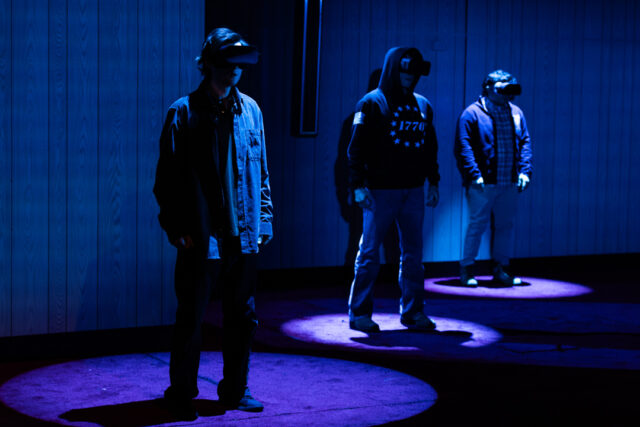
Melanie Mayron, Marilu Henner, Brooke Adams, and Caroline Aaron enjoy a hilarious brunch from hell in Madwomen of the West (photo by Carol Rosegg)

MADWOMEN OF THE WEST
Actors Temple Theatre
339 West 47th St. between Eighth & Ninth Aves.
Through December 31, $48.50 – $110
sandratloh.ag-sites.net
actorstempletheatre.com

The tag line for Sandra Tsing Loh’s Madwomen of the West might be “Brunch Is Hell,” but that doesn’t mean it can’t be a whole lotta fun, especially with four heavenly actresses having a blast together. The play itself, if you can even call it that, is a mess, with plot holes galore, inexplicable tangents, confusing breaks of the fourth wall, and unimaginative direction. But spending one hundred minutes with this quartet of lovely seventysomethings is wonderful.

Madwomen of the West features four delightful talents; for the uninitiated, who should know better, they are: Caroline Aaron, a regular on The Marvelous Mrs. Maisel who has appeared onstage in The Iceman Cometh, The Sisters Rosensweig, and Come Back to the Five and Dime, Jimmy Dean, Jimmy Dean and in a bevy of films by Woody Allen, Robert Altman, Nora Ephron, Paul Mazursky, and Mike Nichols; Brooke Adams, the star of such films as Invasion of the Body Snatchers and Days of Heaven and such plays as Happy Days, Key Exchange, and Lend Me a Tenor; Marilu Henner, most famous for her role as Elaine Nardo on Taxi but who has also appeared on Broadway in Gettin’ the Band Back Together, The Tale of the Allergist’s Wife, and Chicago and in such films as Bloodbrothers, Perfect, and L.A. Story; and Melanie Mayron, who won an Emmy for thirtysomething, appeared in such plays as Godspell, Crossing Delancey, and The Goodbye People and such indies as Girlfriends and Sticky Fingers, and has directed nearly one hundred episodes of television series and movies. I’m not embarrassed to admit that I’ve had long crushes on three of them.

It’s Claudia’s (Mayron) birthday, and Jules (Adams) has invited her to her ritzy Brentwood mansion for a special brunch, along with Marilyn (Aaron). “Birthdays can be fraught — especially our dear friend Claudia’s,” Marilyn tells the audience. “She’s been feeling a little down — she needed a lift!” The three college friends are soon unexpectedly joined by another member of their old gang, the fabulously famous Zoe (Henner).

“Oh, for Pete’s sakes, Zoey! I’m happy for your mega-success but I haven’t read any of your books!” Marilyn declares. “I’m on this fucking sugar cleanse and I don’t know why you’ve suddenly turned up in our lives to make them look shitty when we’re just trying to mark Claudia’s sad ‘run out of condiments’ birthday and I’m just so hungry!”

College friends Jules (Brooke Adams) and Claudia (Melanie Mayron) share a happy moment at the Actors Temple Theatre (photo by Carol Rosegg)

Many of the characters’ attributes are based on the actors’ real lives. Marilyn is a growly voiced kvetcher who founded a private girls school for underrepresented minorities and has been married to Barry for thirty-five years (in actuality, Aaron teaches at HB Studio; the show begins with her telling a story about her and Shelley Winters at the Actors Temple Theatre); Zoey is a world-renowned actress and self-help guru with a perfect memory (Henner is renowned for her own memory skills and has written numerous wellness books); Claudia is a single mother and photographer who is “vaguely Jewish, vaguely lesbian” (Mayron played a Jewish photographer on thirtysomething and in Girlfriends and has twins with her ex, screenwriter Cynthia Mort); and Jules was a law partner who gave it up to start a family (the role was originally going to be played by JoBeth Williams, who was replaced by Adams in October).

Christian Fleming’s set looks like a special edition of an afternoon women’s TV chat show on location, featuring two comfy chairs, a matching couch, a large backdrop of a photo of palm trees, a piñata just waiting to be broken open, and a round, gold-plated circular table that is oddly misused. Sharon Feldstein and Erin Hirsh’s costumes do a good job helping define the four friends, with Zoe in a sexy, tight-fitting black bodysuit with a gold chain belt, Marilyn in black shirt and pants and a blue blazer, Jules in a long, elegant black Issey Miyake gown and boots, and Claudia in pajamas and sneakers. When Jules says, “No costume budget. I brought this from home,” it’s easy to believe her.

Loh, whose previous books and plays include The Madwoman in the Volvo: My Year of Raging Hormones, Mother on Fire, Aliens in America, and Bad Sex with Bud Kemp, doesn’t give much of a chance for Caruso (Emojiland, Southern Comfort) to make sense of things, so the story is all over the place as the actors go in and out of character and the plot meanders. Meanwhile, the quartet’s first-wave feminism doesn’t do the show any favors as they discuss the women’s movement, Hillary Clinton, Mary Tyler Moore, motherhood, smoking, female bodies, sexual liberation, getting canceled, and what Marilyn calls the “trans wave.”

Spoiler alert: They never bust open that piñata, which is a shame.

“You really can’t have it all,” Jules says.

Maybe not, but these actors do deliver a lot of it.

[Mark Rifkin is a Brooklyn-born, Manhattan-based writer and editor; you can follow him on Substack here.]
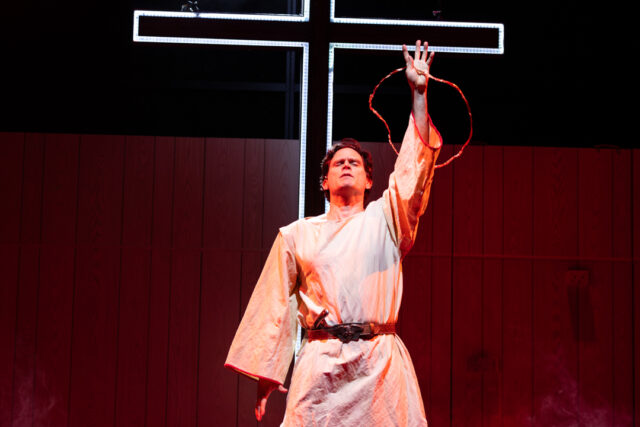
JOHN ADAMS’ EL NIÑO: NATIVITY RECONSIDERED

John Adams’ El Niño: Nativity Reconsidered returns to St. John the Divine on December 21 (photo by Nina Westervelt)

Who: American Modern Opera Company (AMOC)
What: John Adams’ El Niño: Nativity Reconsidered
Where: The Cathedral Church of St. John the Divine, 1047 Amsterdam Ave. at 112th St.
When: Thursday, December 21, choose-what-you-pay; suggested admission $35, 7:30
Why: Originally presented by American Modern Opera Company (AMOC) in 2018 at the San Martín at Fuentidueña chapel in the Cloisters, John Adams’ El Niño: Nativity Reconsidered was performed last December at the Cathedral Church of St. John the Divine, in a slightly revised iteration, and it is now back for an encore presentation. A retelling of the traditional Christmas story, El Niño premiered in Paris in 2000, with a libretto by Peter Sellars. At St. John the Divine, the nativity oratorio, conceived and curated by Julia Bullock, includes soprano Bullock, countertenor Anthony Roth Costanzo, bass-baritone Davóne Tines, violinists Miranda Cuckson and Keir GoGwilt, cellist Coleman Itzkoff, bassist Doug Balliett, flutist Emi Ferguson, percussionist Jonny Allen, pianist Conor Hanick, guest soloist contralto Jasmin White, and the Choir of Trinity Wall Street; the conductor is Christian Reif, who is responsible for the new chamber opera arrangement.

In a program note for the Met Museum digital premiere, Bullock wrote, “El Niño is one of my favorite pieces of music and I feel one of John and Peter’s greatest collaborations. . . . It is rarely programmed, either because of the resources needed or possibly because our North American holiday tradition insists upon multiple performances of Handel’s Messiah. The Messiah is, of course, a beloved work, but it doesn’t meditate solely on the nativity story; it also encompasses the life, death, and resurrection of Christ. El Niño, on the other hand, explores the central themes of the nativity — the immaculate conception, the unique relationship between mother and child, and gift giving — and also ruminates on the notion that with the promise of new life, there is the equal threat of inexplicable violence and sacrifice. In creating El Niño, John and Peter consciously decided that alongside European interpretations from the male-centric biblical canon, they would feature the contributions of women and Latin American poets.” Tickets for this special event are choose-what-you-pay with a suggested donation of $35.

[Mark Rifkin is a Brooklyn-born, Manhattan-based writer and editor; you can follow him on Substack here.]
STEREOPHONIC

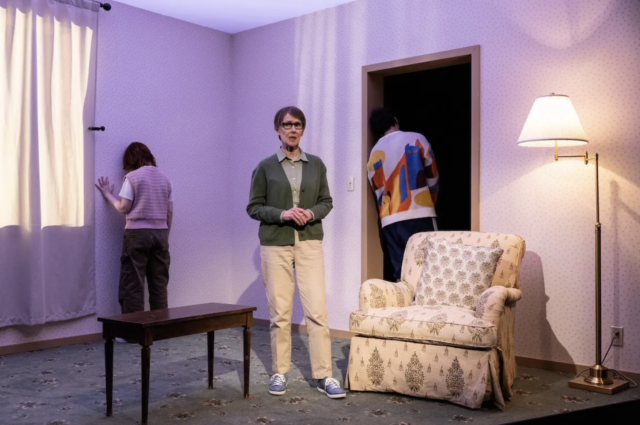
Engineers Grover (Eli Gelb) and Charlie (Andrew R. Butler) chew the fat as the band readies to record in David Adjmi’s Stereophonic (photo by Chelcie Parry)

STEREOPHONIC
Playwrights Horizons, Mainstage Theater
416 West 42nd St. between Ninth & Tenth Aves.
Through December 17, sold out
www.playwrightshorizons.org

In many ways, the creation of David Adjmi’s Stereophonic mimics the record that the fictional band is making in the play. Following such well-received works as Elective Affinities, Stunning, The Evildoers, and Marie Antoinette, Adjmi announced to friends and colleagues in 2013 that he was leaving the theater, but he immediately started receiving offers of grants and residencies. A three-year residency at Soho Rep resulted in what would become the widely hailed Stereophonic, which went from a seventy-minute play to a two-act, then three-act, and ultimately four-act, three-hour epic whose premiere was delayed because of the pandemic.

In the play, a successful, unnamed rock band suddenly has an eighteen-month-old song called “Dark Night” rising on the charts and are working on a new one, titled “Bright,” echoing the up-and-down nature of personal and professional partnerships. The band is in a Sausalito recording studio in the summer of 1976 for what was expected to be quick, low-budget sessions that start turning into much more.

The band consists of British bass player Reg (Will Brill), British keyboard player and singer Holly (Juliana Canfield), British drummer Simon (Chris Stack), American guitarist and lead singer Peter (Tom Pecinka), and American singer and tambourine player Diana (Sarah Pidgeon). Reg is getting lost in a haze of booze and coke; Simon, who also serves as manager, is having trouble keeping the beat; Holly, who is married to Reg, is reevaluating her living situation; and the controlling Peter is jealous of his girlfriend, Diana, as she brings another potential hit to the group.

Grover (Eli Gelb), who lied on his resume to get the gig, is the recording engineer, assisted by Charlie (Andrew R. Butler); while Grover, a stoner, is nervous and fidgety, worried that he is in over his head, especially when the discord within the band grows, Charlie is gentle and quiet, preferring to remain in the background, their relationship somewhat recalling that between Jay and Silent Bob in Kevin Smith’s films.

Band and crew members take a much-needed break in three-hour Stereophonic (photo by Chelcie Parry)

The show unfolds like a cool double, or even triple, LP. Not every play scene / LP song works, but the cast/band are uniformly excellent, as are the engineers/crew (with studio set by David Zinn, costumes by Enver Chakartash, lighting by Jiyoun Chang, sound by Ryan Rumery, and music direction by Justin Craig). The songs, by former Arcade Fire multi-instrumentalist and Grammy winner Will Butler, capture the essence of 1970s California rock as the angst increases among the members of the band and they attempt to balance professional and personal success. Director Daniel Aukin helms the play like a star album producer.

Sure, it’s too long at three hours in four parts, the equivalent of a quadruple album. At one point, concerned about the length of the record they’re making and one song in particular, Peter says, “We can’t fit everything. I know no one wants to cut anything and we’ve talked a whole lot about continuity. But I’m sorry. We need to have this conversation. We need to decide what we’re gonna do; we’re four minutes over and it’s not enough for a double album. . . . We need to cut stuff.” Reg asks, “Why can’t we do a double album?”

Younger audience members might not know that on cassettes and LPs, artists were limited to 22.5 minutes per side, and sometimes the songs on the cassette were in a different order than on the record, resulting in a loss of continuity. In addition, listeners had to flip the cassette or album to hear the other side; musicians couldn’t just make an album of any length that could stream online endlessly, complete with the ability to easily skip over songs they might not like.

You can’t do that in the theater. Thus, Stereophonic contains some fluff, repetition, and scenes that don’t seem to fit with the others, but for the most part it’s a fun and poignant behind-the-scenes look at artistic creation, collaboration, ego, and jealousy. We’re all the better with Adjmi deciding not to quit the band/theater; I’m looking forward to the several plays he has coming up, including an exploration, with Lila Neugebauer, of the making of Brian Wilson’s Smile album.

[Mark Rifkin is a Brooklyn-born, Manhattan-based writer and editor; you can follow him on Substack here.]
ATMOSPHERES: ARTISTS ON FEMINISM AND THE ENVIRONMENT

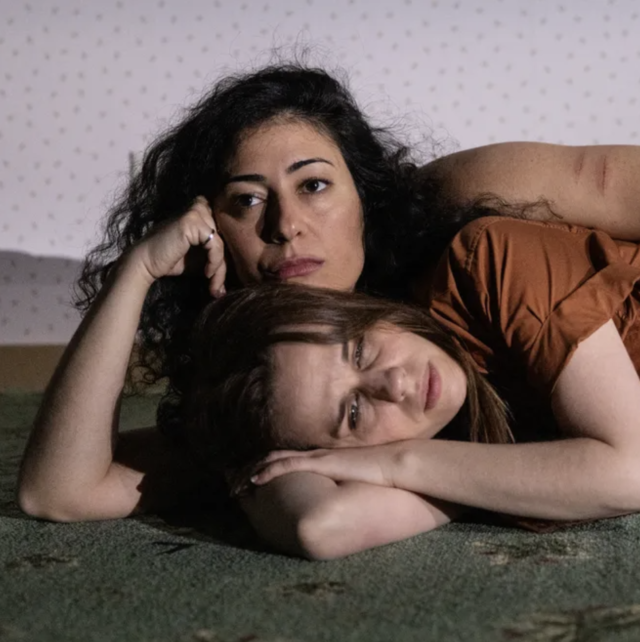
Torkwase Dyson (photo by Suzie Howell), Candice Hopkins (photo by Thatcher Keats), and Joan Jonas (photo by Toby Coulson) will be at New Museum December 14 for special conversation

Who: Candice Hopkins, Torkwase Dyson, Joan Jonas
What: Artist talk inspired by Judy Chicago’s ecofeminist performances from the 1970s
Where: New Museum Theater, 235 Bowery at Rivington St.
When: Thursday December 14, $10, 6:30
Why: Between 1968 and 1974, Chicago-born multidisciplinary artist Judy Chicago staged a series of events, called “Atmospheres,” that used fireworks to bring feminist impulses to site-specific environments, sometimes involving butterflies; she revisited the works in 2012, 2015, 2020, and 2021. In conjunction with the New Museum career survey “Judy Chicago: Herstory,” the Bowery institution is hosting what should be a compelling discussion on December 14. “Atmospheres: Artists on Feminism and the Environment” brings together curator Candice Hopkins, abstract artist Torkwase Dyson, and multimedia installation pioneer Joan Jonas to discuss the incorporation of the natural world into works that explore ecofeminism, from the 1970s to today. Hopkins is the executive director of Forge Project, which “fosters relationships between the land and the built environment, creating spaces of kinship for the people who use them.” The exhibition, which covers four floors of the New Museum, continues through March 3; there will be a live virtual tour on January 9 at 2:00 and the conversation “Herstory: Responses to ‘The City of Ladies’” on January 11 at 6:30 with scholar Sophie Lewis, poet Simone White, novelist Kate Zambreno, and moderator and exhibition cocurator Madeline Weisburg.

[Mark Rifkin is a Brooklyn-born, Manhattan-based writer and editor; you can follow him on Substack here.]
SPAIN

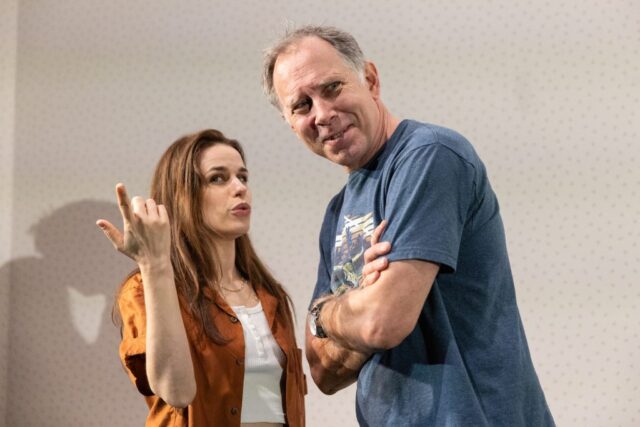
Helen (Marin Ireland) and Joris (Andrew Burnap) share their ideas about Spain in world premiere at Tony Kiser Theater (photo by Matthew Murphy)

SPAIN
Second Stage Theater — Tony Kiser Theater
305 West 43rd St. between Eighth & Ninth Aves.
Tuesday – Sunday through December 17, $46-$106
2st.com/shows

“Spain! What’s not to love about Spain?” Dutch documentary filmmaker Joris Ivens (Andrew Burnap) says in the opening monologue of Jen Silverman’s new play, Spain. While there’s lots to love about the Iberian country, there’s not enough to love about the show, running at Second Stage’s Tony Kiser Theater through December 17.

Spain is a fictionalized behind-the-scenes account of the development of Ivens’s 1937 film The Spanish Earth. Ivens, who had previously made such films as The Street, The Bridge, Rain, and Borinage, is hired by KGB agents — “They weren’t calling themselves that, obviously, it was the Office of the Branch of International Cultural Socialist Whatever Whatever but — the KGB,” he explains — to make a propaganda film about the Spanish Civil War to elicit the sympathy of the American public, and financial donations, in support of the common Russian. Reciting what his handler, Karl (Zachary James), has told him, Joris relates, “The War in Spain Is a War / Between the Rich and the Poor / The Noble Peasant Crushed by the Rich Fascist / See? / A Single-Sentence War / And Single-Sentence War Is a Perfect Opportunity for . . . / — and then he said: ART / but we both knew that wasn’t the word he meant.” Joris is also told to never reveal that the Russians are behind the movie.

Joris enlists the aid of his personal and professional partner, Helen (Marin Ireland), based on real-life editor Helen van Dongen. They decide to hire Chicago-born novelist John Dos Passos (Erik Lochtefeld), whose best friend is Spanish author and activist José Robles, to write the script, primarily to lure in Ernest Hemingway (Danny Wolohan), Dos’s competitive colleague. It also helps that both Dos and Hemingway have been to Spain, which is not true of Joris and Helen, who write words on a blackboard to show what they know about the country, including “tapas,” “bulls,” and “cerveza.”

Although Joris has been sworn to secrecy about the Russian involvement, Helen seems more casual about the relationship, mentioning by name a man named Ivor, who was more than just a handler, arousing jealousy in Joris. “So you don’t love him. You do love him? You did love him but you don’t anymore? You did and you still do but you love me more?” Joris burbles. They also argue about their careers and what constitutes art, understanding they are at the beck and call of the Russians, who want Joris to make a film about Italy next. “Are you sure this is worth it?” Helen asks Joris.

Soon the testosterone-charged, philandering Hemingway and the more straightlaced Dos are tossing about ideas for the screenplay and needling each other. “You like to make things complicated. I like to keep them simple,” Hemingway tells Dos, who responds, “You want people to feel like they don’t need to be any smarter or better. You just want them to love you.” To which Hemingway replies, “Maybe they’re smart enough. There’s a reason nobody wants to read your books.” At the time, Dos had just completed the third book in his U.S.A. trilogy, while Hemingway had already published such books as The Sun Also Rises and A Farewell to Arms.

As the prep work continues, relationships unravel and storylines tangle. “What’s started to scare me lately is this feeling that I can’t remember what was the cover story and what was the real story / what’s the art and what’s the plan / and what’s the back-up plan,” Helen says. She warns Joris of potential danger from the back-room dealings.

Helen (Marin Ireland) gets caught between propaganda and art in Spain (photo by Matthew Murphy)

Early on, Karl tells Joris to make the film about Spain as metaphor; the word metaphor appears six more times in the play, but Silverman (Collective Rage: A Play in 5 Betties, The Moors) and director Tyne Rafaeli (The Coast Starlight, Selling Kabul) can’t seem to decide if it’s a true story, a noir thriller, or a metaphor about politics and the creation of art.

Dane Laffrey’s dark set features such compelling touches as shadowy doorways where the Russians appear, threateningly, and a red phone lodged in a wall space, as well as an odd recording room where Hemingway expounds on life and art. The stage is dimly lit by Jen Schriever, with menacing music and sound by Daniel Kluger and costumes by Alejo Vietti, highlighted by Helen’s dramatic red blouse. Burnap (The Inheritance,Camelot) is bland and boring as Joris, Wolohan (Camelot, Assassins) is overly bombastic as Hemingway, James (The Addams Family,South Pacific) is mysterious as the hulking Karl, Lochtefeld (Stupid F***ing Bird, Small Mouth Sounds) is superb as Dos, and Ireland (Reasons to Be Pretty, Uncle Vanya) manages to overcome the inconsistencies written into her character.

Narrated in separate versions by Hemingway, Orson Welles, and Jean Renoir (in French), the fifty-two-minute The Spanish Earth was released in July 1937, a year after the war started and nearly two years before it would end with the Nationalist victory and Francisco Franco’s seizure of power. The war inspired classic works by Pablo Picasso, Salvador Dalí, Joan Miró, Alexander Calder, George Orwell, Jean-Paul Sartre, Guillermo del Toro, and others; sadly, the obtuse Spain does not make the cut.

[Mark Rifkin is a Brooklyn-born, Manhattan-based writer and editor; you can follow him on Substack here.]