live performance

HOW TO DANCE IN OHIO

Seven autistic actors portray seven autistic characters in Broadway premiere (photo © Curtis Brown)

HOW TO DANCE IN OHIO
Belasco Theatre
111 West 44th St. between Sixth & Seventh Aves.
Tuesday – Sunday through February 11, $74 – $518
howtodanceinohiomusical.com

“Will I be totally humiliated if I mess it up?” Remy (Desmond Luis Edwards) asks in the Broadway premiere of Rebekah Greer Melocik and Jacob Yandura’s How to Dance in Ohio, which opened last night at the Belasco. It’s a question that we’ve all asked ourselves, and it’s a central theme of the musical, which focuses on seven autistic young adults trying to make connections while preparing for a spring formal, dealing with the same types of emotions as neurotypical people but facing a world that was not built with them in mind.

The two-and-a-half-hour show (with intermission), which was developed and first presented at Syracuse Stage, was inspired by Alexandra Shiva’s Peabody Award–winning documentary about Amigo Family Counseling in Columbus, Ohio, which provides “Respons· ability Social Therapy” for individuals with Autism Spectrum Disorder. The film featured more than two dozen child and adult clients — they avoid such words as “patients,” “sufferers,” and “victims” — but the musical has trimmed it down to seven young adults, each with one particular disorder. Although some of the characters are based on specific clients, they are all amalgams; none is an exact representation, with various changes made for dramatic purposes.

The clinic was founded by Dr. Emilio Amigo (Caesar Samayoa), who, in the show, runs it with the help of his daughter, Ashley (Cristina Sastre), a ballerina at Juilliard who is recovering from a fractured leg and reconsidering her future as a dancer. (The actual clinic has a handful of therapists, specialists, and aides covering several different groups.) AFC has seven clients: Remy (Desmond Luis Edwards), who wants to be a stylish viral superstar; Caroline (Amelia Fei), who is starting college and has her first boyfriend; Jessica (Ashley Wool), a dragon lover who wants to move out of her mother’s house; Drew (Liam Pearce), an electrical engineering wiz choosing which university to attend; Mel (Imani Russell), who is seeking a promotion at the pet store where she works; Tommy (Conor Tague), who hates collared shirts and is getting ready to take his driving test, excited to get behind the wheel of his brother’s new truck; and the newest member of the group, Maredith (Madison Kopec), who is obsessed with facts.

“I am going places / There are places I need to be,” the group sings. “But, most of the spaces / that I want to get to / were not designed for me.” They explain, “That’s what we do in Ohio: / Doing the same thing over and over.” Jessica says self-referentially, “Like lines of a play, or a song’s refrain.”

Terry (Haven Burton) and Johanna (Darlesia Cearcy) go dress shopping with their daughters in How to Dance in Ohio (photo © Curtis Brown)

At Maredith’s first session, Dr. Amigo tells everyone to “circle up!,” passing around a long white rope as each client shares something personal, slowly connecting them all, even if they’re not necessarily comfortable with it. The fears and anxieties they face range from tying shoelaces and answering telephones to speaking with strangers and being touched. Some have trouble showing emotions and setting boundaries, and most have repetitive habits. “Repetition creates reality,” Mel notes.

Dr. Amigo decides to hold a spring formal at the Encore nightclub, a dance where the group can face their social awkwardness while practicing communication skills and experiencing a rite of passage. It sounds like a terrible idea — especially when he encourages them to bring dates, whether from within the group or outside it — but Dr. Amigo wants his clients to take that next step.

“Disaster is always a possibility / Real life is loud, confusing, fast / We shelter our children because we care / But how long can childhood last?” he tells Columbus Gazette reporter Shauna Parks (Melina Kalomas), adding, “Because victory is also a possibility / Your odds improve each time you try / Your skin gets thicker, failure stings a bit less / and maybe that’s worth all the worry and stress.” The doctor is also meeting with blogger Rick Jenkins (Carlos L Encinias), who wants to do a big piece on the dance.

As the event nears, Drew’s parents, Amy (Melina Kalomas) and Kurt (Encinias), are concerned about Dr. Amigo’s influence over their son; Jessica’s mother, Terry (Haven Burton), and Caroline’s mom, Johanna (Darlesia Cearcy), take their daughters dress shopping at Macy’s while Maredith’s widowed father, Michael (Nick Gaswirth), can only afford discounted clothing at Dress Barn; and the clients consider how they will pair up for the formal.

How to Dance in Ohio is dedicated to Hal Prince, who was originally going to direct the production before he died in 2019 at the age of ninety-one. His granddaughter Lucy Chaplin is autistic and served as inspiration to Shiva. Melocik, who wrote the book and lyrics, has Tourette’s syndrome, and Yandura, who composed the music, has an autistic sister.

Directed by Sammi Cannold in her Broadway debut, the show moves like clockwork, at a swift, even pace, with evocative, if unspectacular, songs (“Today Is,” “Under Control,” “Drift,” “Terminally Human,” “Building Momentum,” “Two Steps Backward”) and choreography by Mayte Natalio, lighting by Bradley King, and sound by Connor Wang that all take into consideration how movement, noise, and flashing lights can affect not only the seven autistic actors but audience members as well. There are cool-down spaces in the mezzanine and lower lounge for anyone who might need to take a break, in addition to sensory bags with fidget toys and glasses that are available for borrowing at the merch stand. Robert Brill’s set consists of LED letters arranged in grids in the back and on columns on either side, along with rectangles of numbered dance steps; location changes either descend calmly from above or from the wings as the narrative shifts from a room in the clinic to stores, a nightclub, a bus stop, and several characters’ homes.

Dr. Emilio Amigo (Caesar Samayoa) prepares his clients for a spring formal in How to Dance in Ohio (photo © Curtis Brown)

Unfortunately, the book is laden with problems, primarily when Melocik strays from the documentary and invents subplots involving the reporters, class difference, and Dr. Amigo’s battles with parents over his possible interference in their children’s lives. The additions seek to give voice to the seven young adults and educate theatergoers about the right words and approach when talking about or to people with autism, but it displays a lack of confidence in the audience to figure that out by the action that unfolds in front of them; instead, we’re hit over the head with teaching moments that don’t ring true.

None of that detracts from the production itself; the seven autistic actors, all Broadway newcomers, are terrific, and they seem to be having the time of their lives onstage. When Edwards, as Remy, looks into his ring light and says, “This is the ‘Many Faces of Me,’ with me, Remy: live! I see you, Tommy! — Our first topic is: Nothing about us without us,” he is speaking for the neurodivergent community as a whole, celebrating their multifaceted existence. When Drew offers to lend a book about Pangea to Marideth, it’s a subtle metaphor for the seven clients: Pangea was the single land formation that eventually broke into the seven continents, evoking how the clients are unique individuals who should not merely be seen as a group unto themselves.

Samayoa (Come from Away, Sister Act) is the glue that holds it all together, with solid support from Sastre, Burton, Cearcy, Encinias, Gaswirth, and Kalomas, although some minor characters are underwritten, there just to push through a small, forced story point.

In a 1980s public service announcement for United Cerebral Palsy that has stuck with me for decades, actor Tony Danza asks, “How do you treat a person with a disability?” After receiving a variety of comments from several random people in the street, Danza shares the answer: “Like a person.” That essentially is what How to Dance in Ohio is attempting to convey in regard to autism, and it does so with an abundance of charm, even though it occasionally goes astray. But it gets to the heart of so much of what makes us all human, as we progress from children to teenagers to young adults: learning to drive a car, going out on a first date, selecting a college, choosing a social media presence, and building momentum to be able to eventually live on one’s own.

[Mark Rifkin is a Brooklyn-born, Manhattan-based writer and editor; you can follow him on Substack here.]

PSYCHIC CINEMA: EXPERIMENTAL FILMS — NICK DIDKOVSKY AND ROBERT KENNEDY

Who: Nick Didkovsky and Robert Kennedy
What: Experimental short films with live musical accompaniment
Where: The LetLove Inn, 21-27 Twenty-Third Ave., Astoria
When: Monday, December 11, free (donations accepted), 9:00
Why: On December 11 at the LetLove Inn in Astoria, Nick Didkovsky of Doctor Nerve and Robert Kennedy of the Flushing Remonstrance will team up for the next iteration of “Psychic Cinema,” an evening of classic experimental short films by Bill Morrison, Joel Schlemowitz, Stan Brakhage, Peter Tscherkassky, Barbara Hammer, Lawrence Jordan, and others, set to all-new experimental live scores. Kennedy will be on keyboards, electronics, and voice, Didkovsky on guitar. In May, the duo performed to a collection of surrealist and Dada works by Fernand Léger, Hans Richter, Man Ray, Władysław Starewicz, Slavko Vorkapich, Mary Ellen Bute, Joseph Cornell, Marie Menken, Wallace Berman, Tscherkassky, and Guy Maddin, which should provide insight into what awaits on December 11. Admission is free; donations are accepted.

[Mark Rifkin is a Brooklyn-born, Manhattan-based writer and editor; you can follow him on Substack here.]
MY HARRY

Photographer unknown, Harry Smith at Naropa Institute, gelatin silver print, 1990 (Harry Smith Papers, Getty Research Institute, Los Angeles; gift of the Harry Smith Archives)

MY HARRY
Whitney Museum of American Art, Education Center and Hess Family Theater
99 Gansevoort St.
December 8-10, $18-$25
212-570-3600
whitney.org

The Whitney celebrates the legacy of American polymath Harry Smith in the three-day festival “My Harry.” Held in conjunction with the multimedia exhibition “Fragments of a Faith Forgotten: The Art of Harry Smith,” which continues at the museum through January 28, the revelry features listening sessions, illustrated lectures, film screenings, conversations, live music, art workshops, and more, with appearances by friends and colleagues of Smith, who was born in Portland, Oregon, in 1923 and died in New York City in 1991 at the age of sixty-eight, leaving behind a treasure trove of music, art, and film that he both made and collected, as well as a lifelong interest in the occult. Among those participating in the weekend are Carol Bove, Ali Dineen, Bradley Eros, Raymond Foye, Andrew Lampert, April and Lance Ledbetter, James Inoli Murphy, Rani Singh, Peter Stampfel, Charles Stein, and Anne Waldman. Below is the full schedule.

My Harry: Magick and Mysticism
Friday, December 8, $8-$10, 5:30–9 pm

Listening Session: Harry Smith’s Field Recordings, 5:30

Fragments of a Faith Forgotten: A Presentation by Carol Bove, with Carol Bove and Andrew Lampert, 6:30

Screening of Harry Smith’s “Film No. 14: Late Superimpositions,” 7:30

Harry Smith and the Future of Magick: A Presentation by Charles Stein, with Charles Stein and Raymond Foye, 8:00

Harry Smith, Untitled [Zodiacal hexagram sctratchboard], ink on cardstock, ca 1952 (Lionel Ziprin Archive, New York)

My Harry: Stories, Songs, and Strings
Saturday, December 9, free with museum admission, 11:00 am – 6:00 pm

Stop Motion Animation Studio and Paper Airplane Workshop, hosted by Bradley Eros, 11:00 am – 3:00 pm

Singing Circle with Ali Dineen, 11:00 am

Peter Stampfel and the Atomic Meta-Pagan Posse, with Peter Stampfel, Eli Smith, Zoe Stampfel, Eli Hetko, Steve Espinola, Paul Nowinski, Sam Werbalowsky, Heather Wagner, and Dok Gregory, 12:00

String Figure Workshop with James Inoli Murphy, 12:00

Paper Airplane Contest with Bradley Eros, 2:00

On Mahagonny: A Presentation by Rani Singh, 5:00

My Harry: Affinities
Sunday, December 10, free with museum admission, 11:00 am – 5:00 pm

Listening Session: Harry Smith’s Field Recordings, 11:00 am

On Harry’s Trail: A Presentation by Dust-to-Digital, with Lance and April Ledbetter, 12:00

Screening: A selection of films and videos featuring Harry Smith by a variety of the artist’s friends and associates, 1:00

Friendly Rivals: The Art of Jordan Belson, a Presentation by Raymond Foye, 3:00

Anne Waldman, 4:00

[Mark Rifkin is a Brooklyn-born, Manhattan-based writer and editor; you can follow him on Substack here.]
EITHER/OR: TIME | AGAIN

TIME | AGAIN
Speyer Hall at University Settlement
184 Eldridge St. between Rivington & Delancey Sts.
Friday, December 8, $12.71-$23.41, 8:00
www.eitherormusic.org
www.universitysettlement.org

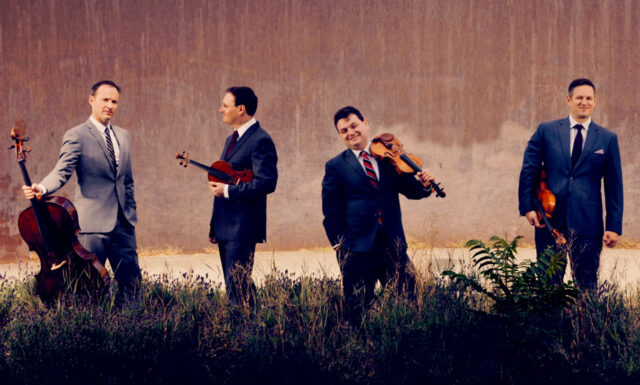
New York City–based flexible chamber ensemble Either/Or (EO) looks to the past and the future with its next performance, December 8 at 8:00 at Speyer Hall at University Settlement. The evening begins with the world premiere of the EO commission It only has shelves by Bronx-based multidisciplinary composer Victoria Cheah. Written for violin, cello, trombone, and electronics, the piece explores layering, depth, ritual, and preparation. “To know you have a place to put something, where something can belong, where the fact of its emptiness suggests its readiness to receive instead of impose, to me suggests the possibility of belonging,” Cheah said in a statement. The work will be performed by Pala Garcia on violin and John Popham on cello — the cofounders of progressive trio Longleash — Cheah on electronics, and event curator Chris McIntyre on trombone. Cheah, a Hunter and Brandeis graduate who is assistant professor at Berklee College of Music and Boston Conservatory and director of production of Talea Ensemble, has previously scored commissions or had pieces featured by Non-Event, Switch Ensemble, andPlay, Yarn/Wire, Wavefield Ensemble, Guerilla Opera, Ensemble Dal Niente, PRISM Quartet, and others, with such enigmatic titles as “Ocean into wire,” “We drank wine from the bottle on a rooftop next to god,” and “I watched her smile her hand.”

Either/Or presents Time | Again on December 8 at Speyer Hall at University Settlement

It only has shelves will be followed by the late Danish composer and visual artist Henning Christiansen’s 1973 Requiem of Art (NYC) (fluxorum organum II), a Fluxus “tape piece” realized for live ensemble by British-Lithuanian cellist, composer, and visual artist Anton Lukoszevieze for Ultima Festival New York in 2014. The work will be performed by the full ensemble, consisting of the aforementioned Garcia, Popham, and McIntyre joined by EO director Richard Carrick and Anthony Coleman on keyboards, Margaret Lancaster on voice and percussion, Dennis K. Sullivan on percussion, and sound technician Alex Lough on electronics as each minute provides unique experimental shifts in what we’re hearing.

Henning Christiansen (rear, left) collaborates with Joseph Beuys (in hat) at 1970 “Strategy: Gets Art” festival (photo courtesy Demarco Digital Archive)

In 2015, Ursula Reuter Christiansen, Henning’s widow — the Danish composer died in 2008 at the age of seventy-six — wrote of the work, “In the summer of 1969 we made a collective film, The Search, on the heath in Jutland, Denmark. Henning Christiansen made on site field recordings for the individual scenes with Peter Sakse as sound master. The music was first used during the performance at the festival ‘Strategy: Gets Art’ exhibition organised by Richard Demarco at Edinburgh College of Art, on August 21, 1970, with Joseph Beuys and Henning Christiansen. Henning Christiansen sampled the field recording into the organ music from [Beuys’s 1968 performance film] Eurasienstab. He gave this composition subsequently the title Requiem of Art fluxorum organum II Opus 50. That means a requiem over the role of art in the 1960s.” McIntyre adds that the original Requiem was “a sort of portrait of the sound world Christiansen conjured for Beuys’s real-space rituals.” Tickets to the event are $12.71 to $23.41 and available here.

[Mark Rifkin is a Brooklyn-born, Manhattan-based writer and editor; you can follow him on Substack here.]
ARTIST FOR ACTION PRESENTS SHERYL CROW, PETER FRAMPTON, KEVIN BACON + SPECIAL GUESTS: A FATHER’S PROMISE FILM LAUNCH CONCERT

Who: Jimmy Vivino, Mark Barden, Sheryl Crow, Peter Frampton, Kevin Bacon, Bernie Williams, Rozzi, the Dumes, the Alternate Routes, Jen Chapin, Aztec Two-Step 2.0, more
What: Benefit concert for Sandy Hook Promise celebrating film launch
Where: NYU Skirball Center for the Performing Arts, 566 La Guardia Pl. between Third & Fourth Sts.
When: Thursday, December 7, $81-$256, 7:30
Why: “Music succeeds when politics and religion fail,” Darryl “DMC” McDaniels says in A Father’s Promise: The Story of a Father’s Promise to End Gun Violence, a documentary opening December 8 at LOOK Dine-In Cinema W57. Directed by Rick Korn and executive produced by Sheryl Crow, the film follows musician Mark Barden as he takes action after his seven-year-old son Daniel was one of twenty-six people murdered at Sandy Hook Elementary in Newtown, Connecticut, on December 14, 2012.

Barden, cofounder of Sandy Hook Promise, and filmmaker Korn teamed up with Matthew Reich and Neal Saini to form Artist for Action to Prevent Gun Violence. On December 7 at NYU Skirball, Barden and the Promise Band will join musical director Jimmy Vivino and a group of all-stars to celebrate the launch of the film; among the special guests performing live will be Crow, Peter Frampton, Kevin Bacon, Bernie Williams, Rozzi, the Dumes, the Alternate Routes, Jen Chapin, and Aztec Two-Step 2.0. The evening will be filmed for a future documentary, continuing to raise funds and awareness about the horrors of gun violence, the leading cause of death for children and teens in America.

[Mark Rifkin is a Brooklyn-born, Manhattan-based writer and editor; you can follow him on Substack here.]
SCENE PARTNERS

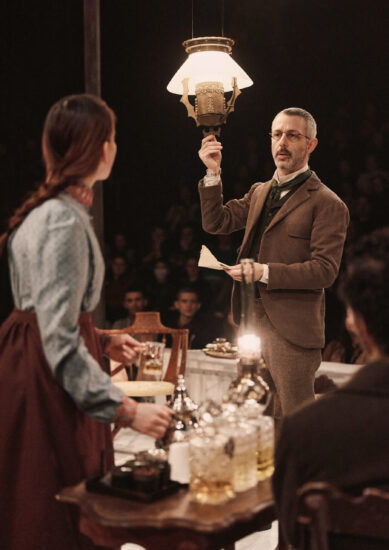
Meryl Kowalski (Dianne Wiest) is haunted by her father (Josh Hamilton) in Scene Partners (photo © Carol Rosegg)

SCENE PARTNERS
Vineyard Theatre
Gertrude and Irving Dimson Theatre
108 East 15th St. between Union Square East & Irving Pl.
Tuesday – Sunday through December 17, $37.80-$160.92
www.vineyardtheatre.org

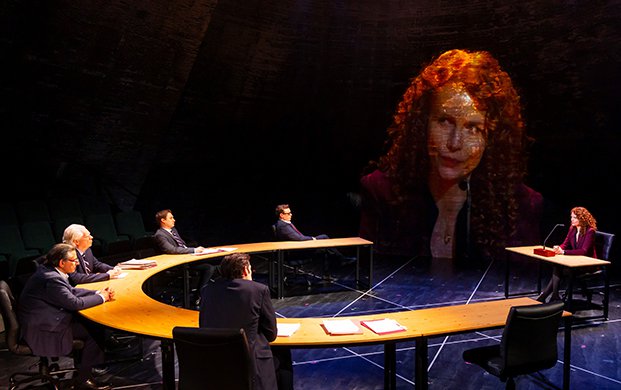
The confusion begins with Scene Partners at the Vineyard even before the show starts. The program says it’s set in 1985, and the script explains, “And make sure it really feels that way,” but one of the songs playing over the speakers as the audience enters is the theme to Charlie’s Angels, a TV series that ran from 1976 to 1981. A confounding puzzlement continues through the entire play, where plot, dialogue, projections, screens, sound, lighting, and acting are all over the place, never coming together as a solid whole.

And that’s a shame, because it wastes a terrific performance by the wonderful Dianne Wiest, who has won two Oscars and two Emmys and has been nominated for three Drama Desk Awards. Wiest’s lilting, ethereal voice is as intoxicating as ever, but the narrative is like a poorly chopped salad put through an unbalanced spinner, a little Beckett and Pinter here, too much van Hove there, with more than a sprinkling of silly sitcom / soap opera and a dose of Joseph Beuys. It’s nearly impossible to tell what is happening in real time — what are memories, what are fantasies, what are dreams or nightmares, and what are clips from rehearsals or films.

Wiest plays Meryl Kowalski, a seventy-five-year-old woman whose husband just passed away three days ago. The first time she appears in person, not onscreen, only part of her is visible; she’s sitting in a chair, stuck in a kind of elevator shaft / dumbwaiter in the center of the back wall, and we can only see her from the neck down. She starts speaking, and there’s an uncomfortable moment when the audience tries to figure out whether they should applaud Wiest’s entrance. Not being a fan of entrance applause, I was rather content with it; plus, I loved the visual of the character trapped in the middle of nowhere.

Meryl has just come from a grief meeting and has stumbled upon a group that deals with “a bevy of emotional, physical, and mental traumas, trials, and tribulations.” The counselor (Eric Berryman) encourages her to get out of the shaft before the cables supporting her break. He says, “I encourage you to receive those snapping cables as a natural sign!” She asks, “A natural sign of what?!” He replies, “That your mass exceeds the safety-load of your pulley system!” She says, “In other words I’m fat and I don’t stand a chance.” He offers, “Not without sure footing and solid ground, which we offer in spades. Come! Join us once and for all. It only requires a minor injurious leap.”

Meryl (Dianne Wiest) seeks safe shelter with her sister (Johanna Day) in Vineyard world premiere (photo © Carol Rosegg)

Thrilled that she has a new lease on life, Meryl tells her daughter, Flora (Kristen Sieh), that her father “was a monster who ruined our lives. But now with that motherfucker dead and gone, I’m free, I’m finally free!” She explains that she is going to Hollywood to become a movie star, a goal that her husband failed at. A grown woman without a job and on drugs, Flora doesn’t want her mother to go, mostly because she needs her to take care of her. “You’ll play nothing but diaper-shitters, you hear me? Retirement-home background work!” Flora cries out. Meryl boldly replies, “I will play queens and matriarchs. Lawyers and judges, powerful women with pockets full of benzedrine pills and deep dark secrets to boot.”

On her Hollywood journey seeking fame and fortune, Meryl meets a Marxist train conductor (Berryman) who might be the ghost of her dead husband; pulls a gun on high-powered agent Herman Wassermann (Josh Hamilton); joins an acting class taught by Australian director Hugo Lockerby (Hamilton), with snarky wannabe actors Cassie (Carmen M. Herlihy), Pauline (Sieh), Maxine (Sieh), and Chuck (Berryman), who tell Meryl that she must change her name, which she doesn’t want to do because she is finally establishing her own identity, even if it will be by portraying other people; visits Dr. Noah Drake (Berryman), who may or may not be the doctor from General Hospital; is haunted by her father, who appears as a floating hat and trench coat; and reconnects with her sister, Charlize (Johanna Day), whom she hasn’t seen in ten years and who was unable to make it as an actress herself. “I’m happy with life now. I volunteer, I sing at this little dive,” Charlize says. “I don’t miss the rejection. The constant judgment. There’s no harm in being ordinary.”

But Meryl is not about to give up on this second chance at life.

Eric Berryman, Kristen Sieh, and Carmen M. Herlihy play multiple characters in Dianne Wiest–led Scene Partners (photo © Carol Rosegg)

Wiest (Rasheeda Speaking, Happy Days) is marvelous as Meryl, a dreamer with an infectious smile and a tenuous grasp of reality. You can’t help but root for her, no matter how high the barriers are to her potential success. Two-time Tony nominee and Obie winner Day (Sweat, Des Moines) is in her usual excellent form as Charlize, who has come to grips with who she is and now wants to help her sister. Berryman (Primary Trust, Toni Stone), Hamilton (The Antipodes, Dead Accounts), Herlihy (Mrs. Murray’s Menagerie, A Delicate Balance), and Sieh (Dr. Ride’s American Beach House, The Band’s Visit) are all fine in multiple roles, although the merry-go-round of characters can get bewildering, even with set designer Riccardo Hernández’s costumes, which end up battling against David Bengali’s video and projections.

Tony-winning director Rachel Chavkin, who has successfully steered such shows as Hadestown, Small Mouth Sounds, and Natasha, Pierre & the Great Comet of 1812, can’t seem to find her way into John J. Caswell Jr.’s (Wet Brain) meandering narrative, throwing too much at the wall, with not enough sticking. Every time I found myself just about ready to accept what was happening onstage, the presentation veered off track yet again.

I did, however, appreciate the music in the play, which includes Steve Perry’s “Oh Sherrie,” Corey Hart’s “Never Surrender,” and Talking Heads’ “Road to Nowhere,” the last of which ends up being a metaphor for the play.

[Mark Rifkin is a Brooklyn-born, Manhattan-based writer and editor; you can follow him on Substack here.]
ALVIN AILEY AMERICAN DANCE THEATER: 65th ANNIVERSARY SEASON

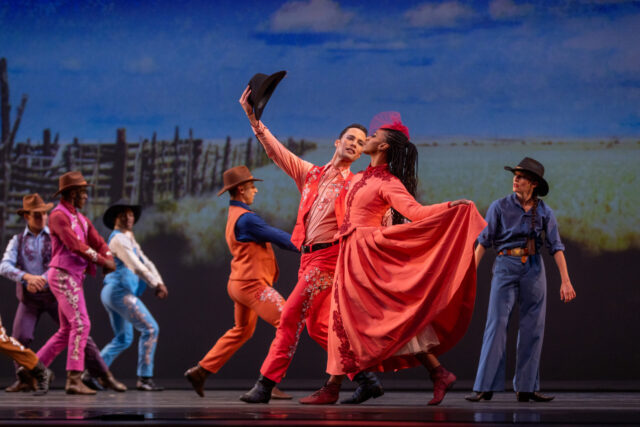
Alvin Ailey American Dance Theater’s Y. Lebrun, P. Coker, X. Mack, and R. Maurice in Alvin Ailey’s For “Bird” — with Love (photo by Dario Calmese)

ALVIN AILEY AMERICAN DANCE THEATER
New York City Center
131 West 55th St. between Sixth & Seventh Aves.
November 29 – December 31, $42-$172
www.alvinailey.org
www.nycitycenter.org

No matter what’s going on in the world — and in case you haven’t noticed, right now there’s a whole lot — when the end of November rolls around, you can count on Alvin Ailey American Dance Theater to provide a much-needed respite with its always exciting and entertaining end-of-year season at New York City Center. This time around the company is celebrating its sixty-fifth anniversary by presenting more than two dozen works, including world premieres by first-time AAADT choreographers Amy Hall Garner (CENTURY) and former Ailey dancer Elizabeth Roxas-Dobrish (Me, Myself and You) and new productions of Hans van Manen’s Solo, Alonzo King’s Following the Subtle Current Upstream, Ronald K. Brown’s Dancing Spirit, and Jamar Roberts’s Ode.

Kyle Abraham’s Are You in Your Feelings? is part of Ailey season at City Center (photo by Paul Kolnik)

The programs are divided into “Premiere Night,” “Ailey Classics,” “All Ailey,” “Live Music,” “All New,” and “Pioneering Women of Ailey”; the opening-night gala, honoring former Ailey dancer, choreographer, and artistic director Judith Jamison, pairs a performance of Revelations with a live choir and a world premiere with Tony, Grammy, and Emmy winner and Oscar nominee Cynthia Erivo.

The personal CENTURY was inspired by Garner’s grandfather and is set to music by Ray Charles, Count Basie, the Dirty Dozen Brass Band, and others; Me, Myself and You explores reminiscence, love, and loss. “Pioneering Women of Ailey” pays tribute to Jamison, Carmen de Lavallade, Denise Jefferson, and Sylvia Waters, while rising jazz stars will perform live December 15-17. Among the other highlights the company of thirty-three dancers will perform are Paul Taylor’s DUET, Alvin Ailey and Mary Barnett’s Survivors, Roberts’s In a Sentimental Mood, and Kyle Abraham’s Are You in Your Feelings? After twelve years as artistic director, Robert Battle announced that he is stepping down immediately because of health concerns; longtime Ailey dancer and associate artistic director Matthew Rushing will take over temporarily until the board chooses a full-time successor; among Battle’s works for the company are Ella, For Four, In/Side, Love Stories, Mass, and Unfold.