live performance

WE PERSIST! I CAN’T REMEMBER ANYTHING

Who: Penny Fuller, Bob Dishy, James Naughton, Susan Charlotte
What: In-person and livestreamed play reading
Where: Theatre 80 St. Marks and Zoom
When: Monday, April 19, live and on Zoom, 2:00 (available on demand April 24-25, 646-366-9340 / info@foodforthoughtproductions.com)
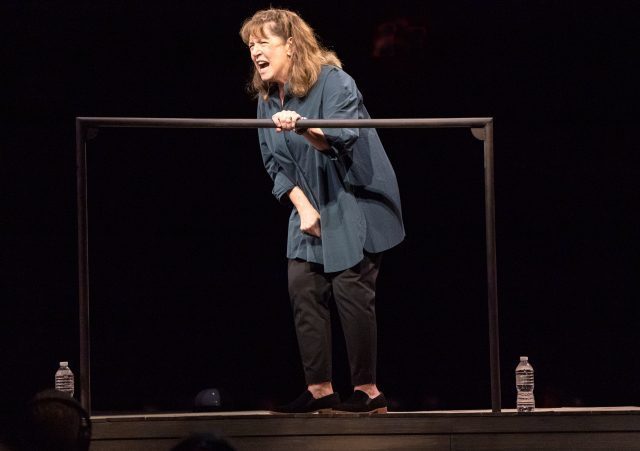
Why: Food for Thought Productions is now in its twenty-first season of presenting all-star readings of little-known and classic one-act plays by major writers. Its current series, “We Persist!,” kicked off with Christopher Durang’s For Whom the Southern Belle Tolls and Tennessee Williams’s Life Boat Drill, presented live at Theatre 80 St. Marks to a limited, masked audience. The award-winning company is now back for Arthur Miller’s I Can’t Remember Anything, directed by Antony Marsellis and starring Penny Fuller and Bob Dishy as an elderly widow and her late husband’s best friend, respectively; FFTP previously presented the play two decades ago with Elaine Stritch and Dishy, with Miller in attendance. (Miller would later go on to direct shows for the troupe.) The play will be followed by a Q&A with the cast, moderated by FFTP founder Susan Charlotte, with a special appearance by James Naughton, who directed Dishy in Miller’s The Price at the 1999 Williamstown Theatre Festival. In addition, FFTP regular Tony Roberts will read from his 2015 memoir, Do You Know Me? Free tickets to see the show in person are first come, first served, for those who agree to be part of a documentary being made about the company; the recording will be available for a small fee April 24-25. Next up for FFTP is Charlotte’s The Hairdresser on May 24.

PARTY IN THE BARDO

Park Ave. Armory, Wade Thompson Drill Hall
643 Park Ave. at 67th St.
May 5-9, $45
212-933-5812
www.armoryonpark.org

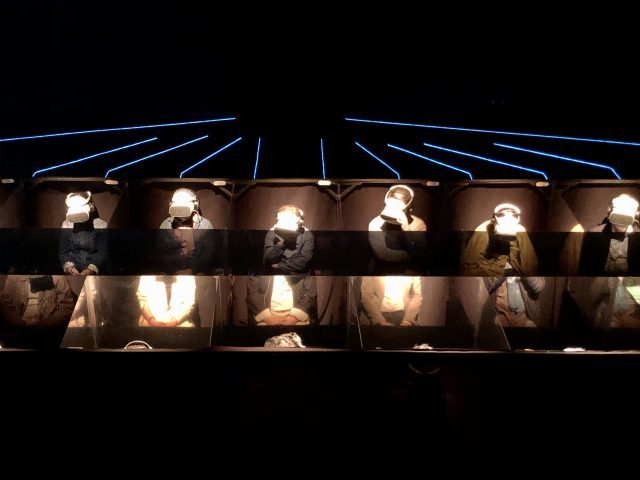
The Park Ave. Armory’s Social Distance Hall series has been selling out almost immediately, so act right now if you want to get the chance to experience Party in the Bardo, a collaboration between Laurie Anderson and Jason Moran, consisting of only four sixty-minute shows in which they will play live music over the epic soundscape that is Lou Reed: Drones, joined by special guests. The season began with Steven Hoggett, Christine Jones, and David Byrne’s SOCIAL! the social distance dance club, in which audience members get to dance in their own spotlights in the drill hall (through April 22), and continues May 9-26 with Bill T. Jones’s previously Covid-delayed Afterwardsness. Curator of the armory’s Artists Studio Series, Moran is a musician, composer, visual artist, MacArthur Fellow, and more, as depicted in his revelatory 2019-20 Whitney exhibition. In October 2015, Anderson presented Habeas Corpus at the armory with Mohammed el Gharani, a dazzling multimedia, sociopolitical installation. And Lou Reed’s former guitar tech and collaborator Stewart Hurwood has been guiding Drones through a variety of locations, from outdoors at Lincoln Center to the Cathedral Church of St. John the Divine, keeping Lou’s guitars humming. It should all come together for a compelling evening of improvisation and meditation at New York City’s best venue to see just about anything.

JEWELS: A BALLET IN THREE PARTS

San Francisco Ballet presents a dazzling virtual production of Balanchine’s Emeralds (photo by Erik Tomasson)

JEWELS
SF Ballet online
Available on demand through April 21, $29
www.sfballet.org

You’re likely to let out a gasp when the curtain rises on San Francisco Ballet’s newly filmed production of George Balanchine’s Emeralds, the first section of the legendary choreographer’s three-part masterpiece, Jewels. I know I did. Onstage are a dozen dancers, the most I’ve seen at any one time together since the pandemic lockdown started. Then Gabriel Fauré’s score kicks in — consisting of extracts from Pelléas et Mélisande Suite, Op. 29 and incidental music to Shylock, Op. 57, conducted by Martin West — and principals Misa Kuranaga and Angelo Greco touch hands, leading to another gasp. I’ve watched a lot of dance pieces made during the current health crisis, but it’s mostly been solos or works outdoors, with no contact between performers. To see a full ensemble dance without restrictions for thirty glorious minutes is exhilarating, especially every lift, throw, and turn involving physical human connection. (Of course, SFB followed all Covid-19 protocols.)

The floor of the War Memorial Opera House reflects the dancers, who are wearing dark tops with necklaces, the women in green calf-length tulle skirts. A chandelier laden with faux emeralds hangs above, while stars dot the back wall, melding inside and outside. Balanchine considered Emeralds to be “an evocation of France — the France of elegance, comfort, dress, and perfume,” and that’s precisely what comes across in this glittering production, staged by the late Elyse Borne and Sandra Jennings, with additional decor by Susan Touhy and costumes by Karinska (re-created by Haydee Morales).

The camera slowly zooms in and out and pans right and left but always stays at orchestra level while concentrating on two couples, a trio, and a corps de ballet of ten women. The many stunning moments include a line of four women in attitude position, with three men on their knees, their right leg flat behind them, all holding hands; a gorgeous solo by Kuranaga; duets first with Kuranaga and Greco, then with Sasha Mukhamedov and Aaron Robison; and a concluding trio with Greco, Robison, and Esteban Hernandez, the three men left all alone at the end, their arms reaching out dramatically.

As the curtain descends, something strange and unexpected happens; applause can be heard, getting louder as the dancers take their bows. The work was filmed on January 28 without an audience, and there was no piped-in applause at intermediary points of beauty. It’s a bit unnerving, since we know that the seats are empty, though the show is well worthy of high praise.

Emeralds debuted at the New York City Ballet on April 13, 1967, followed by Rubies and Diamonds, a sparkling trilogy inspired by Claude Arpels’s designs for jeweler Van Cleef & Arpels. For both of the latter pieces, applause is heard as the curtain rises and throughout; the former was recorded February 2, 2016, the latter March 12, 2017, both at the War Memorial as well, giving the full program an added visual continuity, making it feel as if it is all occurring over the course of one evening. It also might explain why SFB decided not to add more camera angles to the 2021 performance; it would have been exciting to see closeups as well as views from the mezzanine, but it would not have matched the next two works.

The featured trio for Rubies are Mathilde Froustey, Pascal Moulat, and Wanting Zhao; the cast is dressed in tight red bejeweled tops with frills at the waist, the women with red hair accessories. Set to Stravinsky’s Capriccio for Piano and Orchestra, Rubies is passionate and exuberant; in one pas de deux, Froustey, wearing a flowery red tiara, and Moulat run, bounce, and spin around the floor. The focus is on the movement itself; there is no chandelier, and the stars on the backdrop are muted.

An homage to Marius Petipa, Diamonds is an opulent, luxurious climax, taking place in an icy blue world with two chandeliers and Tchaikovsky’s lovely Symphony No. 3 in D major, Op. 29, movements 2, 3, 4 & 5, conducted by Ming Luke. It begins with a glorious seven-minute scene with first twelve, then fourteen women, in glistening white tutus, followed by a pas de deux between De Sola and Tiit Helimets. In the finale, more than thirty dancers come together for a grand ball, intersecting and weaving among themselves with an infectious romanticism as the music builds to a thrilling crescendo.

And then, one last surprise; as the dancers take their bows, audience members rise to give a standing ovation, their heads partially blocking our view. It is an apt reminder that ballet — and theater, music, opera, et al. — is meant to be seen live and in person, in a crowd of people all there for one purpose, to share an experience that is happening right then and there, in real time. May it soon be so again.

(For more on SFB’s Jewels, you can stream a virtual discussion about “three composers, three styles, three moods” with De Sola, Helimets, Mukhamedov, and Molat here; there is also extensive background information available here.)

JOHN CULLUM: AN ACCIDENTAL STAR

John Cullum shares a life in the theater in one-man show (photo by Carol Rosegg)

JOHN CULLUM: AN ACCIDENTAL STAR
Available on demand through May 6, $28.75 – $81 (pay-what-you-can)
Live watch party: Saturday, April 17, 2:00
irishrep.org
www.vineyardtheatre.org

“Most of the shows I’ve done – and the parts I’ve played – have come to me through the back door, by accidents, you might say, or coincidence, or just plain luck. And tonight, I’d like to share with you some of my lucky accidents,” two-time Tony winner John Cullum says at the start of his wonderful one-man show, An Accidental Star, streaming on demand through April 21. Copresented by three theaters that have played an important role in Cullum’s long, distinguished career, the Vineyard, the Irish Rep, and Goodspeed Musicals, the eighty-minute production takes viewers behind the curtain as Cullum relates funny and poignant anecdotes and sings songs from throughout his more than sixty years in the business.

Cullum, who turned ninety-one last month, was born in Tennessee and had dreams of making it as an actor. When he arrived in New York City in 1956, he was ready to do whatever it took to land an audition and get an acting job. Through a series of lucky accidents, he soon found himself cast in three summer plays for Joe Papp’s Shakespeare in the Park, even though he had zero experience with the Bard. That led directly to auditioning for Moss Hart for Camelot on Broadway, where Cullum would meet Richard Burton, who became a lifelong friend.

Julie McBride plays piano as John Cullum reflects on his long career in An Accidental Star (photo by Carol Rosegg)

Cullum, who won Tonys for Shenandoah and On the Twentieth Century, was nominated for On a Clear Day You Can See Forever, Urinetown, and 110 in the Shade, and scored an Emmy nomination for his role as Holling Vincoeur in Northern Exposure, also chronicles experiences involving Maximilian Schell, Louis Jourdan, Lerner & Lowe, Hal Prince, Robert Preston, Robert Goulet, Madeline Kahn, The Scottsboro Boys, and his wife of more than sixty-one years, choreographer and writer Emily Frankel. Filmed by Carlos Cardona in January onstage at the Irish Rep, An Accidental Star was conceived by Cullum and Jeff Berger, written by David Thompson (The Scottsboro Boys; Priscilla, Queen of the Desert), and directed by Lonny Price and Matt Cowart (110 in the Shade, Lady Day at Emerson’s Bar & Grill), with music supervision by Georgia Stitt and music direction by Julie McBride, who accompanies Cullum on piano. The cameras shoot Cullum, dressed in an unbuttoned vest, purple shirt, and brown pants, from all sides as he sits on a stool, gets up and spreads his arms for a big finale, and walks over to the piano to join McBride. He’s an engaging raconteur who is deservedly proud of what he’s accomplished yet humble enough to understand how fortunate he’s been on this amazing journey, which includes a live watch party on April 17 at 2:00.

RUDE MECHS: DIONYSUS IN 69

Rude Mechs will faithfully restage Performance Group environmental theater classic DIONYSUS in 69 at New York Live Arts

New York Live Arts
219 West 19th St. between Seventh & Eighth Aves.
November 6-10, $30
212-924-0077
www.newyorklivearts.org
www.rudemechs.com

In 1968, the Performance Group, an experimental SoHo theater company founded by artistic director Richard Schechner the year before, staged Dionysus in 69, an avant-garde version of Euripides’ Greek tragedy The Bacchae, which involves the beautiful young partying god Dionysus; Pentheus, the king of Thebes, who took over for his grandfather Cadmus; the blind prophet Teiresias; and Pentheus’s mother, Agauë. The production was filmed by Brian De Palma, who had been impressed by the participatory environmental show that melds audience and performer. Now the Austin-based Rude Mechs, who specialize in organic theatrical performances, are faithfully restaging Dionysus in 69 at New York Live Arts, using the original production and film as sources for the evening-length piece, which features, among other things, full-frontal male and female nudity. Once again the audience gets in on the action, as all seats are general admission on wooden platforms on the floor or accessed via ladders. The show runs November 6-10; on November 8, there will be a preperformance conversation, “The (Re)performance of Discussing Dionysus in 69,” with Schechner and Rude Mechs co-artistic producing directors Madge Darlington and Shawn Sides, while on November 9 there will be a special talk following the 7:30 performance, “Discussing Dionysus in 69, NOW,” with Schechner, Darlington, and Sides speaking with writer and dance critic Elizabeth Zimmer.

CHAPLIN

Rob McClure embodies the Little Tramp in new Broadway musical about Charlie Chaplin (photo by Joan Marcus)

Ethel Barrymore Theatre
243 West 47th St. between Broadway & Eighth Ave.
Through February 3, $49.50 – $135.50
www.chaplinbroadway.com

From his Dickensian upbringing to Hollywood stardom to his penchant for underage women and his long exile overseas, followed by a final redemption, Charles Spencer Chaplin lived quite a life, something book writers Christopher Curtis and Thomas Meehan are only partially successful in bringing to the big stage with Chaplin. The new musical, directed and choreographed by Warren Carlyle, glories, perhaps a bit too much, in Rob McClure’s dazzling performance as Chaplin, embodying the multitalented actor, writer, director, musician, composer, political rebel, and womanizer whose socially relevant silent comedies brightened up hard times in America during the 1920s and 1930s. The show starts in London, as young Charlie (a charming Zachary Unger) grows up in the seedy alleys and burlesque clubs with his mother, Hannah (an outstanding Christiane Noll), a bawdy performer whose husband has essentially abandoned the family. An older Charlie soon catches a break and is working for Mack Sennett (a strong Michael McCormick) in Hollywood; the scene in which Charlie is ordered to be funny and transforms into the Little Tramp is splendidly done, adding a deft touch of magic to the invention of this seminal character. Hiring his brother, Sydney (Wayne Alan Wilcox), as his business manager, Charlie finds massive success with such films as The Kid, The Gold Rush, and The Circus, but the musical oddly chooses which to focus on; while Carlyle does a good job equating The Kid with Chaplin’s real-life experiences as a child (clever casting has Unger also playing Jackie Coogan), shorter (or stranger) shrift is given to such critical works as City Lights and Modern Times, and later films such as Monsieur Verdoux and Limelight warrant nary a mention, despite their many inside references to his personal situations.

The musical does, however, devote a major sequence to The Great Dictator that reveals the development of his public political persona. But in the second act, Chaplin spends way too much time concentrating on Hedda Hopper’s (Jenn Colella) mission to destroy Chaplin by labeling him a communist in order to get even for his refusal to be interviewed by her. And the musical deals with Chaplin’s ultimately disastrous marriages to Mildred Harris (Hayley Podschun), Lita Grey, and Paulette Goddard in a baffling boxing scene that sideswipes the show, while his relationship with Oona O’Neill (Erin Mackey) swoops in from nowhere and then essentially disappears. Beowulf Boritt’s sets, Amy Clark and Martin Pakledinaz’s costumes, and Ken Billington’s lighting, along with Jon Driscoll’s inventive video projections, give Chaplin the look and feel of a black-and-white movie, but few of the songs stand out, aside from Noll’s “Look at All the People” and the ensemble piece “Just Another Day in Hollywood.” Much like Chaplin’s career, Chaplin kicks off with quite a bang but eventually dissipates into the disappointment of what could have been.

SLEEP NO MORE

Sleep No More, starring Luke Murphy, is finally coming to the end of its long run at the McKittrick Hotel (photo by Thom Kaine)

SLEEP NO MORE
McKittrick Hotel
530 West 27th St. between Tenth & Eleventh Aves.
Monday – Saturday through January 2, 2025, $80
866-811-4111
www.sleepnomorenyc.com

The less you know about Punchdrunk’s dazzling production, Sleep No More, the better, but one thing you do need to know about this runaway success is that tickets continue to sell fast. Sleep No More takes place at the long-abandoned McKittrick Hotel in Chelsea, where guests are given masks and then left to wander on their own through the myriad rooms of the mysterious warehouse space, a different story going on behind every door and down each hallway. Don’t look for a linear narrative, although there are elements of Shakespeare’s Macbeth scattered about. Many of the rooms contain notebooks, diaries, postcards, letters, medical texts, and other paraphernalia that point toward the McKittrick, which was built in 1939 but shut down shortly thereafter, having been the site for some very questionable scientific experimentation, but don’t get too lost in that either. There are several ways to proceed through this spectacularly immersive theatrical experience; while some visitors prefer to go from room to room and floor to floor more or less in order, others select a character and follow him or her as they meet up with other characters, pause in a room to offer more personal hints at what’s going on, or coax a guest behind closed doors.

Although we strongly suggest you get the early tickets and stay the entire three hours, you still won’t see everything, but don’t worry about that. Just catch what you can and let yourself get swept up in all the action, which includes contemporary dance, fighting, a bloody bath, detective work, interrogation, poisoning, nightclub performances, a fab dinner party, and virtually no dialogue. Punchdrunk artistic director Felix Barrett and choreographer Maxine Doyle’s lighting, Barrett, Livi Vaughan, and Beatrice Minns’s sets, and Stephen Dobbie’s sound design combine to create a dark, spooky mood that is exhilarating and intoxicating. And the more you put into it, the more you get out of it; be adventurous, wear comfortable shoes, and try not to bring a bag, backpack, or coat, because everything needs to be checked. Advance reservations are a must and are scheduled every fifteen minutes between 7:30 and 8:30 Monday through Thursday and 7:00 to 8:00 and 11:00 to midnight on Friday and Saturday. A collaboration between Punchrunk and Emursive, Sleep No More was a hit in London and Boston before becoming New York City’s must-see theatrical event.