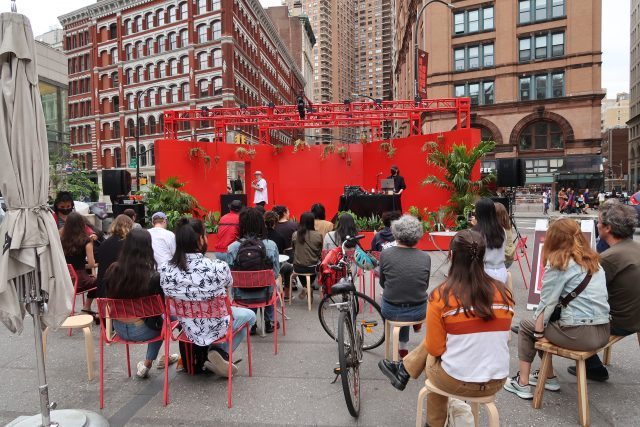
Creative Time’s Red Stage continues through July 4 at Astor Plaza (photo by twi-ny/mdr)
CREATIVE TIME: THE PEOPLE’S PLATFORM
Astor Plaza
Through July 4, free (some events require advance RSVP and in-person sign-in)
creativetime.org
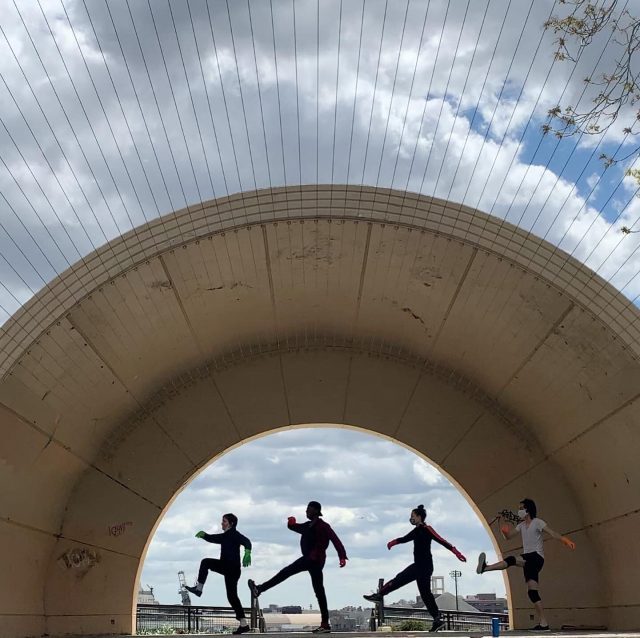
Since June 5, the nonprofit arts organization Creative Time as been hosting live events in Astor Plaza in celebration of the reopening of New York City and the return of live performance in front of audiences. “Amidst an ongoing global pandemic and multiple human rights crises that have kept the world in isolation and grief, Rashid Johnson’s Red Stage is an emergency call to artists and creatives to experiment, collaborate, and gather in an act of resurgence,” Creative Time associate curator Diya Vij said in a statement. “The minimalist sculpture — akin to a bandshell stage — is rendered in steel and powder-coated in a color Johnson describes as ‘alarm red.’ Its simplicity is imbued with life: The entirety of the surface is marked by Johnson’s hand and the structure holds a vibrancy of thriving living plants. Stewarding this work requires a commitment to engender and nurture life-affirming futures.”
Chicago-born artist Johnson filled the first two weeks of Red Stage with a wide array of events, including Ethan Philbrick’s 15 cellists, Emily Johnson’s The Rising Stomp, Papi Juice’s The Portal, Jason Moran and Total Freedom, poetry, a dance party, karaoke, and community discussion. Coming up are an audio installation, a painting demonstration and workshop, a farmer’s market, a participatory marathon reading, a commencement ceremony honoring the end of the school year, a special Black trans Pride empowerment, and other presentations.
“As the world unevenly experiences the impact of Covid-19, and New York City begins to economically and socially reawaken, Red Stage affords us the opportunity to come together in this complexity to question the idea for a new normal and to envision the potential of truly engaging in public space,” Vij continued. “Red Stage establishes a temporary public-led public space for artists, organizers, and agitators. It is a proposition to the public to occupy space through movement — activation of the body in dance, the breath in song, the fist in protest, and the collective in revolutionary potential.” Everything is free, although some programs require advance RSVP to attend and/or take part in. Below is the full schedule as of June 19.
Monday, June 21
Graphic reading: The People’s Platform, 10:00 am–2:00 pm
Brooklyn Music School, with vocalist and faculty member Emily Tepe performing original works, 3:00- 5:00
An Exploration in Still Life Movement with Black Painters Academy, led by artist and academy founder Azikiwe Mohammed, painting supplies available for first ten people, 5:30 – 6:30
Meditation Journey for Renewal & Emergence with Lana Homeri, 6:00 – 8:00
The first sky is inside you: A sound experience by sunlove, 7:00 -7:45
Tuesday, June 22
GrowNYC Farmer’s Market, 8:00 am – 5:00 pm
Wednesday, June 23
Graphic reading: The People’s Platform, 10:00 am
Thursday, June 24
Echo Location by Charlotte Brathwaite, intimate public marathon reading of Alexis Pauline Gumb’s Undrowned: Black Feminist Lessons from Marine Mammals, embraced by song, initiated by Brathwaite in collaboration with Sunder Ganglani and y.o.u., 10:00 am – 10:00 pm
Friday, June 25
Graphic reading: The People’s Platform, 10:00 am–2:00 pm
Commencement: A Procession & Ceremony of Gratitude, Reunion, Celebration and the Closing of School Year led by Tiffany Lenoi Jones, 3:00 – 4:30
Graphic reading: The People’s Platform, 5:00
Saturday, June 26
Arts on Site, with the Bang Group, ARKAI Music, Jamal Jackson Dance Company, BOiNK! Dance & Film, and Dual Rivet, 2:30 – 3:30
Live Arts Pride 2021: The House Party, with DJ THELIMITDOESNOTEXIST, Switch n’ Play (Divina GranSparkle, K.James, Nyx Nocturne, the Illustrious Pearl, and Zoe Ziegfeld, hosted by Miss Malice), Bubble_T (Sammy Kim, Keekai, Sina, Kiko Soiree, Snix), Oops! (Chiquitita & West Dakota), Ragga NYC (Shawn Neon, Viva Ruiz, Batalá New York), and Linda La & the Perfect Poison (Linda La, the Perfect Poison, Rozay LaBeija, and guests), introduced by Bill T. Jones, free with RSVP, 4:00 – 8:00
Sunday, June 27
Stonewall Protests Takeover: Black Trans Liberation, with special guests, 10:00 am –