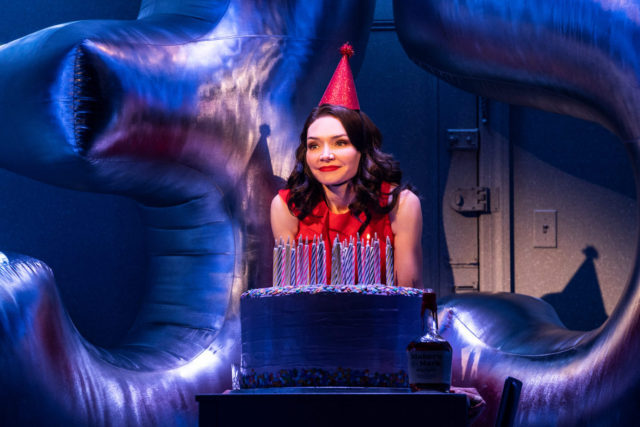
live performance

THIS IS ME EATING___

Et Alia Theater’s This Is Me Eating___ has been turned into an immersive, in-person experience (photo courtesy Et Alia Theater)

THIS IS ME EATING___
The Alchemical Studios
104 West 14th St. between Sixth & Seventh Aves.
Saturday, October 30, free with advance RSVP, 4:00 – 9:00
www.etaliatheater.com

“I like my body,” Maria Müller says at the beginning of her video This Is Me Eating Those Stupid Comments. “Or at least I’ve grown to like it.” The short is one of five made by members of the two-year-old New York City–based Et Alia Theater as part of This Is Me Eating___, in which women share their personal thoughts about food and body image.

In This Is Me Eating My Taste Buddies, Ana Moioli explains, “Life can get pretty shitty. You can’t trust anyone. People betray you. But you can trust food. Even in the darkest times, food will always be there for you. Now, what if, suddenly, you weren’t there for food anymore?” The online project, which was an official selection of the NYC Indie Theatre Film Festival, also features Giorgia Valenti’s This Is Me Eating My Eating Disorder, Luísa Galatti’s This Is Me Eating My Weight, and Deniz Bulat’s This Is Me Eating Alone Thinking About Eating Together in addition to public submissions from around the world, which you can watch here.

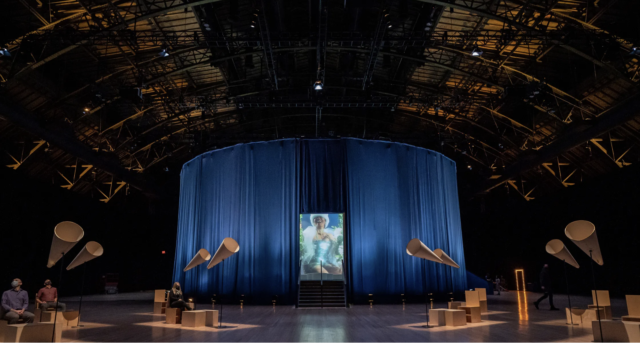
Et Alia, which “strives to foster an accepting community that provides a safe space where people can take risks, push themselves outside of their comfort zones, and collide with an array of international voices which may be culturally unfamiliar,” is now presenting a live version of This Is Me Eating___, taking place October 30 at the Alchemical Studios on West Fourteenth St. There will be four forty-five-minute cycles, starting at 4:00, followed by an open discussion at 8:00. The immersive sessions, directed by Debora Balardini, designed by Dave Morrissey, and conceived by Valenti after Moioli received a City Artist Corps Grant, combine projection, sound, and movement that expand off the videos but are wholly new. Admission is limited to twenty to twenty-five audience members per cycle as people are encouraged to consider how they would fill in the blank in the title; among the virtual submissions were Thais Fernandes’s This Is Me Eating My Anxiety, Ana Carolina’s This Is Me Eating the Time We (Don’t) Have, Bianca Waechter’s This Is Me Eating My Anger, Kendall DuPre’s This Is Me Eating My Words, and Bruna da Matta’s This Is Me Eating and Being Eaten.

“Come ready to be part of these women’s inner and outer explorations of their eating habits, traditions, and mental reflections,” co-artistic director Valenti said in a statement. “Come ready to feel part of a creative process and absorb this global process. You might just discover you are not so alone.”

Et Alia has previously staged Hasnain Shaikh’s Running in Place at Dixon Place, Müller’s On How to Be a Monster at Casa Italiana Zerilli Marimò and the Tank, and None of the Above at Rattlestick’s Global Forms Theater Festival. “Do you eat for pleasure or survival?” Galatti asks in This Is Me Eating My Weight. The same can be asked about live theater, especially as we come out of a pandemic lockdown.

SIX

Six queens battle it out to see who has it worst in Six (photo by Joan Marcus)

SIX
Brooks Atkinson Theatre
256 West Forty-Seventh St. Between Broadway & Eighth Ave.
Thursday – Tuesday through September 4, $99-$279
sixonbroadway.com

The premise of the new Broadway musical Six is as simple as its title: The six wives of Henry VIII battle it out in an American Idol–like competition to determine which of them had it worst, a riotous twist on the old game show Queen for a Day, in which women shared their personal problems on television, with the most heart-wrenching tale earning its forlorn teller a crown and various sponsored prizes.

Fighting it out in Six, which premiered at the 2017 Edinburgh Fringe Festival and made its way across the UK and to Australia, Canada, Chicago, and Massachusetts before landing at the Brooks Atkinson Theatre, are the divorced Catherine of Aragon (Adrianna Hicks); the beheaded Anne Boleyn (Andrea Macasaet); Jane Seymour (Abby Mueller), who died shortly after giving birth; the divorced Anna of Cleves (Brittney Mack); the beheaded Katherine Howard (Samantha Pauly); and Catherine Parr (Anna Uzele), who survived Henry. Each woman makes her case in a spotlighted solo, set to music that ranges from pop to hip-hop to R&B and techno, performed onstage by the Ladies in Waiting: conductor and keyboardist Julia Schade, bassist Michelle Osbourne, guitarist Kimi Hayes, and drummer Elena Bonomo. The playful orchestrations are by Tom Curran, with flashy choreography by Carrie-Anne Ingrouille, the music and movement referencing Adele, Britney Spears, Beyoncé, the Spice Girls, and other pop faves.

Each former wife of Henry VIII takes center stage in Six (photo by Joan Marcus)

Wearing dark, glittering spikey costumes bordering on futuristic S&M, designed by Gabriella Slade, the women take center stage one by one as Tim Deiling’s frenetic lighting evokes a medieval discotheque. Each woman details her unique relationship with Henry in such songs as “Don’t Lose Ur Head,” “Heart of Stone,” and “I Don’t Need Your Love”; don’t be surprised if people near you are singing along, because the 2018 cast album has been streamed more than a hundred million times prior to the show’s Broadway opening. A woman sitting in front of me even knew specific gestures made by the performers, moving and grooving to every tune and nearly jumping out of her chair for the grand finale.

In between songs, each of the queens explains why she should be ruled the ultimate champion. Catherine of Aragon declares, “Who lasted longest was the strongest.” Boleyn claims, “The biggest sinner is obvs the winner.” Seymour opines, “Who had the son takes number one.” Cleves states, “Who was most chaste shall be first-placed.” Howard demands, “The most inglorious is victorious.” And Parr concludes, “The winning contestant was the most ProTESTant . . . Protestant.”

The divas also throw plenty of shade at one another in their quest to prove that they had it worst. When Seymour admits, “You know, people say Henry was stone-hearted. Uncaring. And I’m not sure he was?” Boleyn replies, “Yeah, actually, come to think of it, there was this one really cute time where I had a daughter and he chopped my head off.” When Catherine of Aragon says, “How about this: When my one and only child had a raging fever, Henry wouldn’t even let me, her mother, see her,” Seymour responds, “Oh, boo hoo, baby Mary had the chicken pox and you weren’t there to hold her hand; you know, it’s funny, because when I wanted to hold my newborn son, I died!!!!!!”

Cleverly cowritten with sheer glee by Toby Marlow and Lucy Moss, who previously collaborated on Hot Tub Time Machine, and codirected by Moss (Ratatouille: The TikTok Musical, Fisk) and Jamie Armitage (And Tell Sad Stories of the Death of Queens, Love Me Now), Six knows exactly what it is, not trying to be anything else; it’s an immensely crowd-pleasing show that doesn’t overwhelm you with history but does make mention of Hans Holbein, the C of E (Church of England), the Tudors, the Bubonic Plague, Thomas Cromwell, Henry Mannox, and the Holy Roman Empire. “Let’s get in Reformation,” Cleves orders in one song. (If you’re afraid you’ve missed something, you can most likely find it at this Wiki fan page.) Marlow and Moss also inject a powerful dose of female empowerment, although it leads to a too-easy, politically correct finish. As Parr says, “Every Tudor rose has its thorns.”

The cast is passionate and exuberant, making tons of eye contact with audience members in order to gain their vote. I saw understudy Courtney Mack as Boleyn, replacing Macasaet, and she more than held her own with Hicks, Mueller, Brittney Mack, Pauly, and Uzele, who form a strong team that often repeats the familiar refrain, “Divorced, beheaded, died, divorced, beheaded, survived,” but want to be known for something more in this exhilarating “histo-remix.”

AUTUMN ROYAL

Life is not exactly looking up for Timmy (John Keating) and May (Maeve Higgins) in Autumn Royal (photo by Carol Rosegg)

AUTUMN ROYAL
Irish Repertory Theatre, Francis J. Greenburger Mainstage
132 West 22nd St. between Sixth & Seventh Aves.
Tuesday – Sunday through November 21, $50-$70
212-727-2737
irishrep.org

It was with a bittersweet wistfulness that I entered the Irish Rep for the first time in more than a year and a half. During the pandemic lockdown, the company was at the global forefront of digital theater, presenting more than a dozen outstanding livestreamed and recorded shows online, using cutting-edge technology that went far beyond Zoom boxes and clumsy green-screening. (Among the best were The Weir, Bill Irwin’s On Beckett / In Screen, and The Cordelia Dream; twelve of the shows are still available on demand.) Of course, I was excited to be back at the Francis J. Greenburger Mainstage on West Twenty-Second St. for a matinee, greeted by masked founding directors Charlotte Moore and Ciarán O’Reilly as I made my way in to sit with an audience of real people rather than virtual avatars Zooming in from home.

The Irish Rep has brilliantly reopened with the North American premiere of Kevin Barry’s Autumn Royal, a charming two-character, seventy-minute dark comedy that takes place on a claustrophobic set, an oddly appropriate reminder of the lockdown. The walls seem to be closing in on May (Maeve Higgins) and Timothy (John Keating), a pair of thirtysomething siblings who are caregivers for their ailing father, who lives upstairs in the attic. Charlie Corcoran’s set consists of a small table, two chairs, a doorway leading out of the house, and stairs to the attic, which appear ridiculously small and narrow, practically untenable. It’s as if May and Timmy are trapped, not only in their quaint Cork City home, but in the past, still reeling from their mother’s sudden departure when they were young. (“Went out for a packet o’ Birds custard and never came back,” Timmy recalls.)

Timmy dreams of moving to Australia to become a surfer, while May is much more realistic in their lack of options. She counters his talk of riding a wave with a detailed description of a local woman whose mother fell into a fireplace and “half the face melted off her.” It’s as if they’re fire and water, opposites who need each other.

Their father is never seen — it’s like he’s quarantining — but is occasionally heard, and every once in a while he bangs on the floor, sending dust and crumbling parts of the ceiling down on his grown children, who are not particularly fond of a poem he is writing about a duck walking across a puddle. However, the three of them bond over the 1982 song “Zoom” by Fat Larry’s Band, which Timmy blasts from an old boombox, on cassette. (Yes, even the name of the song evokes virtual theater, even though the play was first performed in Cork in 2017.)

May and Timmy share memories with little thought of their future. “I remember fucking everything,” May proclaims. A moment later, she adds, “We’re never going to get past ourselves here, Tim.” Timmy replies, “I’m definitely going to Australia, May. All I need is to have, like, two grand, I think is it?, in the, am . . .” She shoots back, “Timmy? You’re not going to make it as far as the Esso station.”

A haunting darkness hovers over a sister and brother in Irish drama (photo by Carol Rosegg)

They start to believe that their lives might be different if they put their father in a nursing home, but whenever they start thinking about how things can improve, their discussions turn sour. “All we’re doin’ now is talkin’ ourselves into a very dark read o’ things, yunno?” Timmy says. “Ah, the world sometimes is just complete . . . fucken . . . bollocks, like,” May opines. No matter which way they turn, regardless of their desires, they just seem to end up stuck back at home, their parents practically ghosts haunting their lives.

Directed by O’Reilly (The Weir, The Emperor Jones) with a deft touch, Autumn Royal features projections by Dan Scully, sometimes of blood covering a wall, while others evoke the siblings as kids in the back of a car on a Sunday drive to Tipperary, a beach scene, the silhouette of a mysterious woman, white picture frames, and, repeatedly, a loud washing machine, the spin cycle representing the inner chaos and repetition of their existence, just going around in circles. Keating (The O’Casey Cycle, Pericles) — a true New York theater treasure — and Higgins (Extra Ordinary, Naked Camera) deliver a terrific one-two punch as the arguing siblings, he tall, gangly, and comical, she short, tough, and harder-edged. They each get long monologues, but they really shine when they are both onstage, playing off each other like a classic comedy team, one goofy and wide-eyed, the other harshly direct and to the point. In his first stage work, novelist and short story writer Barry (Beatlebone, City of Bohane) adds a healthy dose of Irish doom and gloom to a common situation, one that hits a little closer to home in the time of Covid.

CROSSING THE LINE FESTIVAL 2021

CROSSING THE LINE FESTIVAL
FIAF and other locations
55 East 59th St. between Madison & Park Aves.
October 20 – November 6, free – $25
212-355-6100
fiaf.org

Igbo-Nigerian American multidisciplinary artist Okwui Okpokwasili has not let the pandemic lockdown slow her down. After appearing in the Public’s outstanding revival of Ntozake Shange’s for colored girls who have considered suicide / when the rainbow is enuf in the late fall of 2019, Okpokwasili has taken part in Danspace Project’s Platform series, the New Museum exhibition “Grief and Grievance: Art and Mourning in America,” and numerous online discussions and special presentations. Her 2017 film, Bronx Gothic, was screened virtually by BAM. In June, she led a procession through Battery Park City for the River to River Festival. And in May, I caught her captivating project On the way, undone, in which she and a group of performers walked across the High Line wearing futuristic head gear made of light and mirrors, vocalizing as they headed toward Simone Leigh’s Brick House sculpture.

Okpokwasili is now the centerpiece of FIAF’s 2021 Crossing the Line Festival, taking place at multiple locations from October 20 to November 6. Throughout the festival, her video installation Before the whisper becomes the word, made with her regular collaborator, director, and husband, Peter Born, will be on view in the FIAF Gallery, exploring remembrance, community mourning, and history. On October 20 at 7:00, she will speak with festival curator Claude Grunitzky in the FIAF Skyroom about the show. “This installation is a crossroads, a midpoint, a caesura. A place caught between worlds,” she said in a statement. “Can we remember what came before while imagining the shape of a future landscape? We enter mid-song, a song that marks a singular moment in time while also expressing an entire lineage. The song is a container for an unreliable memory. From whose mouth is history born? Whose words are trusted when it comes to the telling of what happened? If the history we learn is that which is spoken aloud, what is learned by listening to the whispers that have not been written?”

Christopher Myers’s Fire in the Head will make its world premiere at FIAF’s Crossing the Line Festival

Okpokwasili will also be presenting On the way, undone at the Weeksville Heritage Center in Brooklyn October 21-23 ($25). In a High Line video, she says about the work, “I hope it’s a kind of medicine . . . an architecture of sound, light, that is in some way trying to imagine a portal, an opening through space and time, and it’s imagining a woman’s future self, a young girl’s future self singing back to her.”

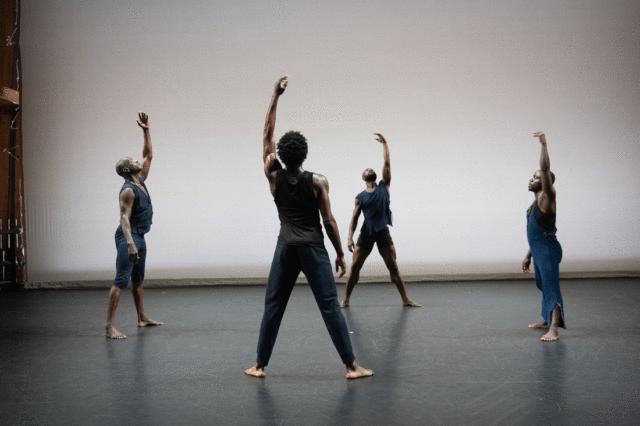
In addition, the festival includes nora chipaumire’s Nehanda, an opera that was excerpted for River to River at the Clemente Soto Vélez Cultural & Educational Center and for FIAF will be broadcast in two cycles both online ($15) and in person ($25) at FIAF’s Tinker Auditorium, divided into eight “days”: natives, whites, pungwe, thinkers, komuredhi judhas nemajekenisheni, white verdict, killings, and manifesting, with an artist talk on October 30 at 5:00; a concert by Grammy nominee Somi in Florence Gould Hall on October 28 ($25); Christopher Myers’s Fire in the Head, a tribute to Vaslav Nijinsky with shadow puppets taking place October 29 and 30 ($25, 7:30) at the Chinese Consolidated Benevolent Association; and Kaneza Schaal’s work-in-progress KLII, November 4-6 in Florence Gould Hall ($25), an exorcism of colonialism and the ghost of King Leopold II, incorporating archival footage and texts by Mark Twain and Patrice Lumumba.

THE FEVER

Wallace Shawn’s The Fever continues at the Minetta Lane through October 24 (photo © Daniel Rader 2021)

THE FEVER
Minetta Lane Theatre
18 Minetta Lane between Sixth Ave. and MacDougal St.
Tuesday – Sunday through October 24, $56
www.audible.com

About two-thirds of the way through The Fever, Wallace Shawn’s one-person play being revived at the Minetta Lane, two audience members siting at the front right got up to walk out. Star Lili Taylor paused her monologue but stayed in character as she told the audience she would wait for the two women to leave. They exited slowly, apparently unaware the show had stopped, hoping to sneak out unnoticed. Wryly smiling, Taylor announced that this would be a good time for anyone else thinking of leaving to head for the exits. Wisely, no one took her up on her offer.

The Fever premiered at the Public in 1991, winning an Obie for Best New American Play. The New Group brought it back in 2007 at Theatre Row; Shawn played the unnamed lead both times. Vanessa Redgrave starred in Carlo Gabriel Nero’s 2004 film version. Now the New Group, in conjunction with Audible, is presenting a limited run, with the innately appealing and engaging Taylor as the traveler, a woman sharing tales of vacationing in banana republics. Although you can imagine how Shawn would have delivered the lines, in a much more wild and snarky way, Taylor is exquisite, like a dear friend sitting down with you and talking over tea and finger sandwiches. The writing and performance are so vivid, you’ll feel like you’re on these trips with her, seeing and experiencing exactly what she is seeing and experiencing.

The show is again directed by New Group founding artistic director Scott Elliott, with a light, amiable hand. A masked Taylor arrives in the theater huffing and puffing, running down the aisle and wriggling onto Arnulfo Maldonado’s set. She puts down flowers and coffee, just as so many of us do regularly when we come home, and begins to wheel out furniture on the otherwise barren stage — a lamp, a comfy chair, an end table with two doors. (The cozy lighting is by Cha See.)

“Okay, so it’s great to see all of you. I mostly see your eyes, obviously, but that’s a very beautiful part of any human being — or animal,” she says, welcoming us into her world. “I don’t know how many of you have dogs, but I love the eyes of dogs in particular. Anyway, as you can see, I’m sort of setting up a very small room here. It’s really just suggestive of a room; I’m not trying to convince you that it’s a real room, but it’s useful to represent a room just to help tell the story I’m going to tell you, and also, I don’t know, I think a completely bare stage can sometimes create a sort of almost threatening atmosphere, as if someone were saying, you know, ‘Don’t get too comfortable, there won’t be anything charming or attractive in the course of our evening at all,’ whereas I find these little bits of furniture quite pleasant and nice.’”

She immediately takes us into her confidence, and we’re on her side, identifying with her thoughts about travel, politics, and art. She seems to care about people in need, and we at first forgive her for certain views that sneak into her story. She notes that she goes to “poor countries” where they don’t speak her language, words that begin to make us uncomfortable as they’re repeated, almost like a mantra. Soon she is emphasizing dichotomies of income inequality: She looks at the helpless people across the street in a shelter as she eats in a fancy restaurant. Recalling how an office worker detailed cases of political murder, torture, and rape sponsored by the government, she remembers her parents teaching her how to properly go to the bathroom, wash her hands, and brush her teeth. She describes a wealthy old man spending a ton of money to keep himself alive as he’s dying, paying for all kinds of special treatments, a direct comparison to an execution by injection she recounted earlier. She prances about on a nude beach while so many in the world can’t afford proper clothing and shelter.

Lili Taylor stars as a well-off traveler sharing vacation stories in The Fever (photo © Daniel Rader 2021)

She admits that she has lived in towns “whose streets ran with the blood of good-hearted victims,” but she still loves the violin and Beethoven. “I like to go out at night in a cosmopolitan city and sit in a dark auditorium watching dancers fly into each other’s arms,” she says, turning a mirror on just about everyone in the theater. She sees The Cherry Orchard with friends but doesn’t understand why she was supposed to be weeping by the end.

Where we were previously nodding in agreement with the traveler, we become taken aback as she starts criticizing poor people for depriving her of the fun she used to have. “I’d always said, ‘I’m a happy person. I love life,’ but now there was a sort of awful indifference or blankness that was coming from somewhere inside me and filling me up, bit by bit,” she complains. “Things that would once have pleased me or even delighted me seemed to go dead on me, to spoil. But my problem was that somehow, suddenly, I was not myself. I was disconcerted.” She turns so sad that she can’t even give her family presents anymore, and it isn’t long before she is blaming the poor.

Our comfort level continues to decrease when she proclaims, “Yes, I’m an aesthete. I like beauty. Yes — poor countries are beautiful. Poor people are beautiful. It’s a wonderful feeling to have money in a country where most people are poor, to ride in a taxi through horrible slums.” She rationalizes why she is not going to give all the money in her purse to a beggar, arguing that she worked hard for that money. “I’m entitled to be served, I’m entitled to expect that certain things will be done. Which means that the holders of money determine what happens in the world,” she says.

Ah, there it is; the truth comes out, and it’s not easy for a liberal New York City audience to hear. Years before the subprime mortgage crisis, before President George W. Bush called his base “the haves and the have-mores,” before the immigration crisis reached epic proportions, before corporations as people were awarded First Amendment rights, Shawn spotlighted the privileged, the growing income gap, and the personal justifications necessary to maintain some agreeable level of inequality by people on both sides of the aisle.

Taylor (Six Feet Under, Household Saints), who played Lemon in the New Group’s 2004 revival of Shawn’s 1985 examination of civilization, Aunt Dan and Lemon — and was mesmerizing reprising the role with the rest of the original cast in a streaming Zoom version during the pandemic — is a warm, affectionate actor, and she excels as the traveler, setting us up for a reevaluation of our personal belief systems, of what we deem important and unavoidable on a beautiful planet where ugliness awaits just around the corner. We can’t help but like her, and in liking her — at least in part because we identify so closely with her — we give her character the benefit of the doubt.

As Pogo said in a 1971 Earth Day comic, “We have met the enemy and he is us.” Perhaps that’s why those two women got up and left before the play was over.

RECLAMATION

Breton Tyner-Bryan will premiere Reclamation in Jefferson Market Library Garden on October 16 (photo by James Jude Johnson)

Who: Breton Tyner-Bryan, Hugh Ryan, Dajuan Harris, James Jude Johnson, Tatiana Stewart
What: World premiere of site-specific work honoring the Women’s House of Detention
Where: Jefferson Market Library Garden, 10 Greenwich Ave. at Tenth St.
When: Saturday, October 16, free with advance RSVP, 5:00
Why: From March 1932 to June 1972, the Women’s House of Detention held female prisoners, including Ethel Rosenberg, Afeni Shakur, Grace Paley, Angela Davis, Valerie Solanas, and Andrea Dworkin; it was an art deco building in which inmates facing the street could speak with passersby. The structure was demolished in 1973 and replaced with a lovely garden behind the Jefferson Market Library, designed by Pamela Berdan with a wide range of colorful plants and flowers.

On October 16 at 5:00, dancer, choreographer, filmmaker, and teacher Breton Tyner-Bryan will activate the space with the world premiere of Reclamation, a piece directed, choreographed, and performed by Tyner-Bryan, joined by three members of the Breton Follies, Dajuan Harris, James Jude Johnson, and Tatiana Stewart, and featuring an original score by Brooklyn-based composer and pianist Ai Isshiki. The work explores the metaphysical energy and spiritual freedom of the garden and the location’s history, particularly as they relate to the local LGBTQIA+ community. In addition, writer, historian, and curator Hugh Ryan (When Brooklyn Was Queer) will read from his upcoming book, The Women’s House of Detention. The library itself is currently closed; when it reopens, Tyner-Bryan will present her latest films, Invicta and West of Frank, as part of the celebration.

CHICKEN & BISCUITS

A family gathers to say farewell to its patriarch in madcap Chicken & Biscuits (photo © Emilio Madrid)

Circle in the Square Theatre
1633 Broadway at 50th St.
Through January 2, $69.50
chickenandbiscuitsbway.com

I was in serious need of some unabashed laughter when I entered Circle in the Square last week, and that’s precisely what writer Douglas Lyons, director Zhailon Levingston, and a fab cast of eight delivered with the madcap comedy Chicken & Biscuits. It’s a divine stew of familiar plot points stirred together in an appealing way, set in a vibrant Black church community, a throwback to the popular crowd pleasers of the 1930s to 1960s that have been popularized more recently by Tyler Perry onstage and onscreen.

Much of the cast and crew are making their Broadway debuts, so the play gets a bit ragged and repetitive at times and is too long at more than two hours, but it’s a ton of fun nonetheless. Set designer Lawrence E. Moten III has transformed the intimate space into St. Luke’s Church in New Haven, with four mobile pews, stained-glass windows, and a pair of kitschy religious portraits. The patriarch of the Jenkins family, Father Bernard, has passed on, and his relatives are gathering to send him off to his beloved late wife in style. Well, kind of.

New pastor Reginald Mabry (Norm Lewis), the husband of Bernard’s oldest daughter, the God-fearing Baneatta (Cleo King), is worried about the eulogy he is preparing, while Baneatta is not looking forward to seeing her sister, the hard-partying, loud, and demonstrative Beverly (Ebony Marshall-Oliver), who arrives with her soon-to-be-sixteen-year-old, glued-to-her-smartphone daughter, the sarcastic La’Trice Franklin (Aigner Mizzelle).

Baneatta is none-too-happy that her son, Kenny (Devere Isaac Rogers), has brought his boyfriend, the white, Jewish nerd Logan (Michael Urie), who has no idea what he’s gotten himself into. Kenny’s older sister, Simone (Alana Raquel Bowers), shows up solo.

“Lord . . . please give me your strength on today,” Baneatta says at the beginning. “Bless me with your patience to deal with my family, for they know not what they do. Lord, help me keep my eyeballs rolled forward, as they have a tendency to roll backwards around foolishness. And Lord, keep me from strangling my baby sister, no matter how much she tests me. For you and I both know . . . she’ll try it. Keep all things unlike you at bay.”

Circle in the Square is transformed into a church in Chicken & Biscuits (photo © Emilio Madrid)

A hilarious farce ensues, as the funeral attendees cut one another down and their private aspirations pop out all over. Wearing a glittering, tight outfit more appropriate for a sleazy nightclub, Beverly tells La’Trice, “They say the best place to find a husband is inside God’s house, and that’s exactly what Beverly will be doing. ’Cause your triflin’ daddy ain’t good for nothing but his child support check, so every new day is an opportunitay.” La’Trice asks, “Even at Grandpa’s funeral?” Beverly responds, “It ain’t a funeral, it’s a celebration! That’s the problem with Black folk, our mindset, always stuck in tradition. Why we gotta wear black, huh? We already Black! We should be honoring my daddy in style, color! Hell, canary yellow was his favorite, and he wore it like a pimp. Shit, he taught me good fashion!”

Logan, a kind of onstage representative of the white theatergoing audience that suddenly finds themselves inside a Black church, says to Kenny, “I’m penetrating a private cultural tradition.” Kenny asks, “Why penetrating?” Logan answers, “It’s like a reverse Get Out, and we all know how that ended.”

The plot thickens when a mysterious woman (NaTasha Yvette Williams) steps up to the pulpit to share her thoughts about Bernard, and all hell breaks loose.

Dede Ayite’s ebullient costumes and Nikiya Mathis’s spectacular wig, hair, and makeup design are key ingredients in Chicken & Biscuits, adding plenty of sweetness and spice. The cast, led by Lewis (Porgy and Bess, The Phantom of the Opera) in his first Broadway nonmusical and King (Jelly’s Last Jam, Beau) in her Great White Way bow, is clearly having a ball, keeping the audience howling with laughter and breaking into spontaneous applause — as well as shouts as if we were all at Sunday service. “Why is everyone screaming at him?” Logan asks Kenny during a call-and-response part of Reginald’s sermon. Sure, it can get too sitcomy, but so what? Not all of the courses are delicious, but there are more than enough savory moments to make the show worthy of a very favorable Yelp review.

The last time I was at Circle in the Square was for Daniel Fish’s controversial Oklahoma!, which included free chili for everyone at intermission. Alas, there are no chicken and biscuits for the audience in Chicken & Biscuits, but there are plenty of tasty treats to satisfy the soul.