live performance

THE FEVER

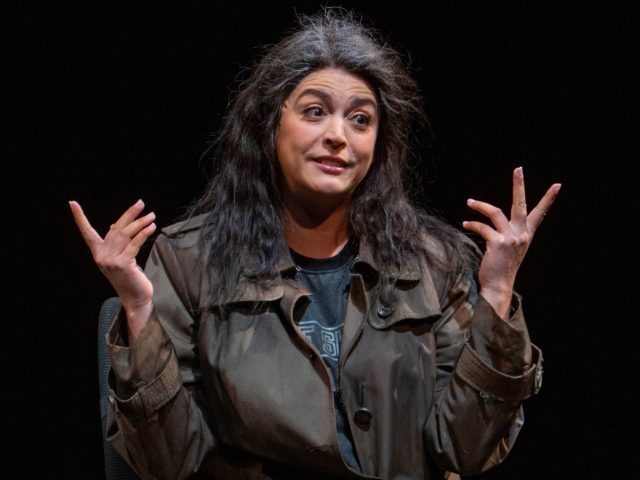
Wallace Shawn’s The Fever continues at the Minetta Lane through October 24 (photo © Daniel Rader 2021)

THE FEVER
Minetta Lane Theatre
18 Minetta Lane between Sixth Ave. and MacDougal St.
Tuesday – Sunday through October 24, $56
www.audible.com

About two-thirds of the way through The Fever, Wallace Shawn’s one-person play being revived at the Minetta Lane, two audience members siting at the front right got up to walk out. Star Lili Taylor paused her monologue but stayed in character as she told the audience she would wait for the two women to leave. They exited slowly, apparently unaware the show had stopped, hoping to sneak out unnoticed. Wryly smiling, Taylor announced that this would be a good time for anyone else thinking of leaving to head for the exits. Wisely, no one took her up on her offer.

The Fever premiered at the Public in 1991, winning an Obie for Best New American Play. The New Group brought it back in 2007 at Theatre Row; Shawn played the unnamed lead both times. Vanessa Redgrave starred in Carlo Gabriel Nero’s 2004 film version. Now the New Group, in conjunction with Audible, is presenting a limited run, with the innately appealing and engaging Taylor as the traveler, a woman sharing tales of vacationing in banana republics. Although you can imagine how Shawn would have delivered the lines, in a much more wild and snarky way, Taylor is exquisite, like a dear friend sitting down with you and talking over tea and finger sandwiches. The writing and performance are so vivid, you’ll feel like you’re on these trips with her, seeing and experiencing exactly what she is seeing and experiencing.

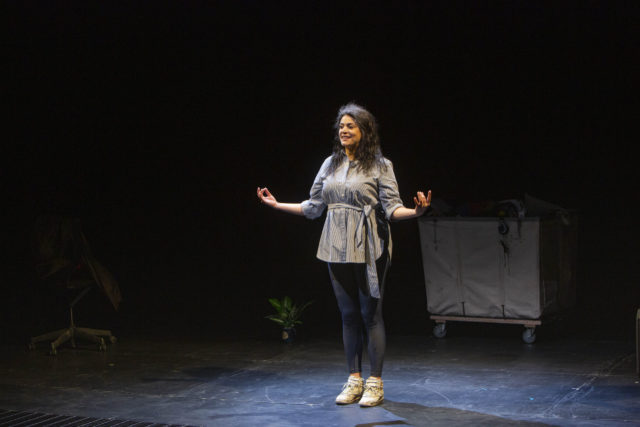
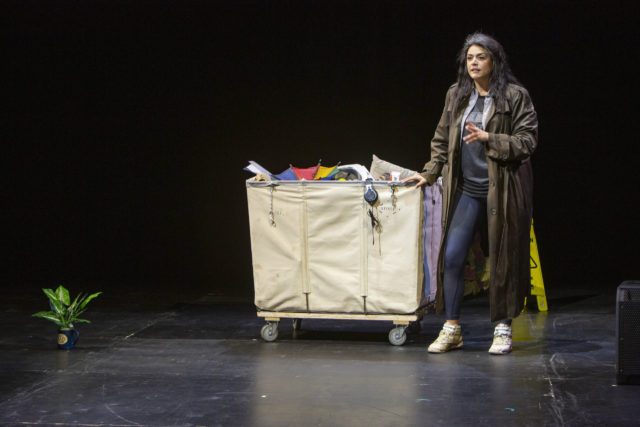
The show is again directed by New Group founding artistic director Scott Elliott, with a light, amiable hand. A masked Taylor arrives in the theater huffing and puffing, running down the aisle and wriggling onto Arnulfo Maldonado’s set. She puts down flowers and coffee, just as so many of us do regularly when we come home, and begins to wheel out furniture on the otherwise barren stage — a lamp, a comfy chair, an end table with two doors. (The cozy lighting is by Cha See.)

“Okay, so it’s great to see all of you. I mostly see your eyes, obviously, but that’s a very beautiful part of any human being — or animal,” she says, welcoming us into her world. “I don’t know how many of you have dogs, but I love the eyes of dogs in particular. Anyway, as you can see, I’m sort of setting up a very small room here. It’s really just suggestive of a room; I’m not trying to convince you that it’s a real room, but it’s useful to represent a room just to help tell the story I’m going to tell you, and also, I don’t know, I think a completely bare stage can sometimes create a sort of almost threatening atmosphere, as if someone were saying, you know, ‘Don’t get too comfortable, there won’t be anything charming or attractive in the course of our evening at all,’ whereas I find these little bits of furniture quite pleasant and nice.’”

She immediately takes us into her confidence, and we’re on her side, identifying with her thoughts about travel, politics, and art. She seems to care about people in need, and we at first forgive her for certain views that sneak into her story. She notes that she goes to “poor countries” where they don’t speak her language, words that begin to make us uncomfortable as they’re repeated, almost like a mantra. Soon she is emphasizing dichotomies of income inequality: She looks at the helpless people across the street in a shelter as she eats in a fancy restaurant. Recalling how an office worker detailed cases of political murder, torture, and rape sponsored by the government, she remembers her parents teaching her how to properly go to the bathroom, wash her hands, and brush her teeth. She describes a wealthy old man spending a ton of money to keep himself alive as he’s dying, paying for all kinds of special treatments, a direct comparison to an execution by injection she recounted earlier. She prances about on a nude beach while so many in the world can’t afford proper clothing and shelter.

Lili Taylor stars as a well-off traveler sharing vacation stories in The Fever (photo © Daniel Rader 2021)

She admits that she has lived in towns “whose streets ran with the blood of good-hearted victims,” but she still loves the violin and Beethoven. “I like to go out at night in a cosmopolitan city and sit in a dark auditorium watching dancers fly into each other’s arms,” she says, turning a mirror on just about everyone in the theater. She sees The Cherry Orchard with friends but doesn’t understand why she was supposed to be weeping by the end.

Where we were previously nodding in agreement with the traveler, we become taken aback as she starts criticizing poor people for depriving her of the fun she used to have. “I’d always said, ‘I’m a happy person. I love life,’ but now there was a sort of awful indifference or blankness that was coming from somewhere inside me and filling me up, bit by bit,” she complains. “Things that would once have pleased me or even delighted me seemed to go dead on me, to spoil. But my problem was that somehow, suddenly, I was not myself. I was disconcerted.” She turns so sad that she can’t even give her family presents anymore, and it isn’t long before she is blaming the poor.

Our comfort level continues to decrease when she proclaims, “Yes, I’m an aesthete. I like beauty. Yes — poor countries are beautiful. Poor people are beautiful. It’s a wonderful feeling to have money in a country where most people are poor, to ride in a taxi through horrible slums.” She rationalizes why she is not going to give all the money in her purse to a beggar, arguing that she worked hard for that money. “I’m entitled to be served, I’m entitled to expect that certain things will be done. Which means that the holders of money determine what happens in the world,” she says.

Ah, there it is; the truth comes out, and it’s not easy for a liberal New York City audience to hear. Years before the subprime mortgage crisis, before President George W. Bush called his base “the haves and the have-mores,” before the immigration crisis reached epic proportions, before corporations as people were awarded First Amendment rights, Shawn spotlighted the privileged, the growing income gap, and the personal justifications necessary to maintain some agreeable level of inequality by people on both sides of the aisle.

Taylor (Six Feet Under, Household Saints), who played Lemon in the New Group’s 2004 revival of Shawn’s 1985 examination of civilization, Aunt Dan and Lemon — and was mesmerizing reprising the role with the rest of the original cast in a streaming Zoom version during the pandemic — is a warm, affectionate actor, and she excels as the traveler, setting us up for a reevaluation of our personal belief systems, of what we deem important and unavoidable on a beautiful planet where ugliness awaits just around the corner. We can’t help but like her, and in liking her — at least in part because we identify so closely with her — we give her character the benefit of the doubt.

As Pogo said in a 1971 Earth Day comic, “We have met the enemy and he is us.” Perhaps that’s why those two women got up and left before the play was over.

RECLAMATION

Breton Tyner-Bryan will premiere Reclamation in Jefferson Market Library Garden on October 16 (photo by James Jude Johnson)

Who: Breton Tyner-Bryan, Hugh Ryan, Dajuan Harris, James Jude Johnson, Tatiana Stewart
What: World premiere of site-specific work honoring the Women’s House of Detention
Where: Jefferson Market Library Garden, 10 Greenwich Ave. at Tenth St.
When: Saturday, October 16, free with advance RSVP, 5:00
Why: From March 1932 to June 1972, the Women’s House of Detention held female prisoners, including Ethel Rosenberg, Afeni Shakur, Grace Paley, Angela Davis, Valerie Solanas, and Andrea Dworkin; it was an art deco building in which inmates facing the street could speak with passersby. The structure was demolished in 1973 and replaced with a lovely garden behind the Jefferson Market Library, designed by Pamela Berdan with a wide range of colorful plants and flowers.

On October 16 at 5:00, dancer, choreographer, filmmaker, and teacher Breton Tyner-Bryan will activate the space with the world premiere of Reclamation, a piece directed, choreographed, and performed by Tyner-Bryan, joined by three members of the Breton Follies, Dajuan Harris, James Jude Johnson, and Tatiana Stewart, and featuring an original score by Brooklyn-based composer and pianist Ai Isshiki. The work explores the metaphysical energy and spiritual freedom of the garden and the location’s history, particularly as they relate to the local LGBTQIA+ community. In addition, writer, historian, and curator Hugh Ryan (When Brooklyn Was Queer) will read from his upcoming book, The Women’s House of Detention. The library itself is currently closed; when it reopens, Tyner-Bryan will present her latest films, Invicta and West of Frank, as part of the celebration.

CHICKEN & BISCUITS

A family gathers to say farewell to its patriarch in madcap Chicken & Biscuits (photo © Emilio Madrid)

Circle in the Square Theatre
1633 Broadway at 50th St.
Through January 2, $69.50
chickenandbiscuitsbway.com

I was in serious need of some unabashed laughter when I entered Circle in the Square last week, and that’s precisely what writer Douglas Lyons, director Zhailon Levingston, and a fab cast of eight delivered with the madcap comedy Chicken & Biscuits. It’s a divine stew of familiar plot points stirred together in an appealing way, set in a vibrant Black church community, a throwback to the popular crowd pleasers of the 1930s to 1960s that have been popularized more recently by Tyler Perry onstage and onscreen.

Much of the cast and crew are making their Broadway debuts, so the play gets a bit ragged and repetitive at times and is too long at more than two hours, but it’s a ton of fun nonetheless. Set designer Lawrence E. Moten III has transformed the intimate space into St. Luke’s Church in New Haven, with four mobile pews, stained-glass windows, and a pair of kitschy religious portraits. The patriarch of the Jenkins family, Father Bernard, has passed on, and his relatives are gathering to send him off to his beloved late wife in style. Well, kind of.

New pastor Reginald Mabry (Norm Lewis), the husband of Bernard’s oldest daughter, the God-fearing Baneatta (Cleo King), is worried about the eulogy he is preparing, while Baneatta is not looking forward to seeing her sister, the hard-partying, loud, and demonstrative Beverly (Ebony Marshall-Oliver), who arrives with her soon-to-be-sixteen-year-old, glued-to-her-smartphone daughter, the sarcastic La’Trice Franklin (Aigner Mizzelle).

Baneatta is none-too-happy that her son, Kenny (Devere Isaac Rogers), has brought his boyfriend, the white, Jewish nerd Logan (Michael Urie), who has no idea what he’s gotten himself into. Kenny’s older sister, Simone (Alana Raquel Bowers), shows up solo.

“Lord . . . please give me your strength on today,” Baneatta says at the beginning. “Bless me with your patience to deal with my family, for they know not what they do. Lord, help me keep my eyeballs rolled forward, as they have a tendency to roll backwards around foolishness. And Lord, keep me from strangling my baby sister, no matter how much she tests me. For you and I both know . . . she’ll try it. Keep all things unlike you at bay.”

Circle in the Square is transformed into a church in Chicken & Biscuits (photo © Emilio Madrid)

A hilarious farce ensues, as the funeral attendees cut one another down and their private aspirations pop out all over. Wearing a glittering, tight outfit more appropriate for a sleazy nightclub, Beverly tells La’Trice, “They say the best place to find a husband is inside God’s house, and that’s exactly what Beverly will be doing. ’Cause your triflin’ daddy ain’t good for nothing but his child support check, so every new day is an opportunitay.” La’Trice asks, “Even at Grandpa’s funeral?” Beverly responds, “It ain’t a funeral, it’s a celebration! That’s the problem with Black folk, our mindset, always stuck in tradition. Why we gotta wear black, huh? We already Black! We should be honoring my daddy in style, color! Hell, canary yellow was his favorite, and he wore it like a pimp. Shit, he taught me good fashion!”

Logan, a kind of onstage representative of the white theatergoing audience that suddenly finds themselves inside a Black church, says to Kenny, “I’m penetrating a private cultural tradition.” Kenny asks, “Why penetrating?” Logan answers, “It’s like a reverse Get Out, and we all know how that ended.”

The plot thickens when a mysterious woman (NaTasha Yvette Williams) steps up to the pulpit to share her thoughts about Bernard, and all hell breaks loose.

Dede Ayite’s ebullient costumes and Nikiya Mathis’s spectacular wig, hair, and makeup design are key ingredients in Chicken & Biscuits, adding plenty of sweetness and spice. The cast, led by Lewis (Porgy and Bess, The Phantom of the Opera) in his first Broadway nonmusical and King (Jelly’s Last Jam, Beau) in her Great White Way bow, is clearly having a ball, keeping the audience howling with laughter and breaking into spontaneous applause — as well as shouts as if we were all at Sunday service. “Why is everyone screaming at him?” Logan asks Kenny during a call-and-response part of Reginald’s sermon. Sure, it can get too sitcomy, but so what? Not all of the courses are delicious, but there are more than enough savory moments to make the show worthy of a very favorable Yelp review.

The last time I was at Circle in the Square was for Daniel Fish’s controversial Oklahoma!, which included free chili for everyone at intermission. Alas, there are no chicken and biscuits for the audience in Chicken & Biscuits, but there are plenty of tasty treats to satisfy the soul.

POLYLOGUES

Xandra Nur Clark wrote and stars in one-person show about ethical nonmonogamy (photo by Ashley Garrett)

HERE Arts Center
145 Sixth Ave.
In person through October 9, $40
On-demand streaming through October 13, $20-$25
here.org/shows
www.polyloguesplay.com

A few years ago, a friend of mine told me that his girlfriend had just explained to him that she was polyamorous. I had not heard that term before, and he wasn’t quite sure what it meant either, but it wasn’t merely that his partner wanted an open relationship so she could see other people. It went well beyond that.

Writer and performer Xandra Nur Clark explores the reality of polyamory in the insightful one-person show, Polylogues. The seventy-five-minute piece of documentary theater has just finished its run at HERE Arts Center and is available on demand through October 13. Clark, a queer Indian American community builder who studied with Anna Deavere Smith, interviewed more than fifty people over three years about ethical nonmonogamy, ranging in age from five to seventy-five, from eleven different countries and numerous races, religions, socioeconomic backgrounds, and political perspectives. Clark wears earphones during the Colt Coeur production, listening to the actual words spoken by the subjects and enacting them for the audience, which sits on three sides of Clark, who doesn’t do a deep dive into each character but embodies them with small differences in tonality and gestures. The characters are either the one who initiated the idea of nonmonogamy in the relationship, the one who was asked to consider it, or had nonmonogamous parents. In some cases they are happy with their decision to participate, but in others it either goes awry or they appear to be trying too hard to defend and rationalize their choices.

Ryan points out, “I’m not behaving like a quote unquote normal person would behave in this situation.” Shamma offers, “When you spend your whole life as a cheater, right? You’re doing it to fulfill a certain insecurity that you have in the, you know, a gap that you have in the relationship?
So you go to the next person to fill that gap. . . . Why can’t this be a new form of family?!” Trudy refers to the additional person as a “love friend.”

Casius says, “Most people think polyamory is just like about having orgies! . . . It’s like being willing to do anything for another person no matter what!” Jackson declares, “You know, I’m not a fucking toy! You know, like, I’m a person. And it’s not that we couldn’t have made a very casual arrangement, but, like, I need to have some autonomy in that decision!

K, a Muslim from Malaysia, where men can have multiple wives, asserts, “Nonmonogamy interacting with male privilege, or interacting with capitalism, can, like, produce some really, like, frightening dynamics. . . . And finding ways to self-limit that in my nonmonogamy practice is . . .
important to me. To ensure I’m not trying to . . . I don’t know, like, build a . . . mmm, I don’t know . . . build a harem or something.”

Xandra Nur Clark embodies multiple characters involved in polyamorous relationships (photo by Ashley Garrett)

The issue of jealousy comes up numerous times. Alex admits, “I’m not okay with him with another girl other than his wife, but I’m okay with him with his w-wife. I want it — this one, this one guy love me with his full heart, everything. But meanwhile, I still got freedom to choose someone else!” And CJ concedes, “I’m fine with being with one person. But I always want to make sure that the other person doesn’t feel an obligation to me. I don’t want you to feel like you’re stuck with me.” She later adds, “It’s just like,
well, I’ll just — if this is just a little piece of it, I can get through nonmonogamy, I’ll take this little piece. Or like, if we’re ‘n a . . . nonmonogamous relationship, you can’t break my heart. But, maybe I just equate breaking my heart with cheating on me.”

Directed by Molly Clifford (Karaoke, Soldier), who introduces the piece in a clever way that prepares everyone for what is to follow, Polylogues begins with a stream of questions and statements on the wall behind Clark, including the key one: “How do you experience love in your life?” Clark (Everything You’re Told, Separated) is charming as she embodies the diverse characters, displaying a relaxing demeanor that brings ease and comfort to an audience that most likely doesn’t understand the complexities of modern-day ethical nonmonogamy, a term I had not encountered until seeing this show. You’re likely to be enticed by the play, if not polyamory itself, although I’m not sure my friend is ready to hear more about it just yet.

TWI-NY TALK: ANTHONY BARILE / 1-2-3 MANHUNT

Anthony Barile with Ilene Kristen in Tony DiMurro’s 1-2-3 Manhunt, opening October 10 at Theater for the New City

1-2-3 MANHUNT
Theater for the New City
155 First Ave. between Ninth & Tenth Sts.
Thursday – Sunday through October 24, $15-$18
theaterforthenewcity.net
www.123manhunt.com

“I really thought I had a place in telling stories in film or theater,” actor, restaurateur, Realtor, and kung fu instructor Anthony Barile says to me over Zoom. “People like me are needed. I feel I have a story to tell; I can portray a person like me who has a story to tell.”

I’ve known Barile since high school on Long Island, where he lettered in football and basketball; I never expected that all these years later, I’d be interviewing him about his performance in a play, Tony DiMurro’s 1-2-3 Manhunt, which opens October 10 at Theater for the New City. The show is set on a Lower East Side tenement roof and deals with Alex (Santo Fazio), an old school Italian American man returning to the neighborhood, and Alec (Chris Paul Morales), a Chinese American teenager dreaming of a career as a professional baseball player. Barile portrays Alex’s best friend, Frankie, which came relatively easy; in real life he’s best friends with Fazio, who he met in 1985. They last appeared onstage together in a 1994 revival of Michael Gazzo’s Hatful of Rain at the Actors Studio, helmed by original director Frank Corsaro, that attracted such luminaries as Norman Mailer and Shelley Winters.

Barile’s path to becoming an actor was a circuitous one.

“It was completely by accident,” the Brooklyn-born Barile explains. “I was going through a lot of changes at this particular point of my life. It was around 1990. I was in a long-term relationship that had ended, and, with that kind of life jolt, I decided to take the time for myself to explore things.”

He quit college the day Led Zeppelin drummer John Bonham died, drove a bread truck, then moved to Manhattan in the mid-’80s and started snapping a lot of pictures around the city. He took a photography class at SVA, a martial arts class — “I thought, I kinda like to fight, so this would be good” — and studied film production at NYU, a connection that led him to acting.

“A lot of friends I met, through my roommate at the time, were actors,” he remembers. “I was invited to a barbecue on the Fourth of July, and one of his friends was studying with Sandra Seacat. She was at this barbecue and got to speaking with me and invited me to her acting class. It was unrelated to acting — she wasn’t that kind of person. She’s a wonderful human being, a phenomenal acting coach; she was just interested by me. I don’t know, she embraced me. She was thinking, ‘This guy’s been through some stuff, he’s leaving his twenties — he should come to my class.’

“Because that’s what her classes were about, finding out who you are, in a healing way. I’m like, I don’t think so; it’s not really my thing. But then I’m thinking that if I want to work with actors in film, maybe it’s a good idea I understand how they think, how they operate, what the process is. So I go.

Former Three of Cups co-owners Anthony Barile and Santo Fazio reunite onstage for the first time in twenty-five years

“I still have my notes, my journal from that day — it was mandatory that you take notes. I read it every once in a while, and I was writing, ‘These people are nuts. They’re super self-indulgent and just out of their minds. This is an insane way to spend a day.’ But I continued in her class because I was fascinated. I’d go to her special workshops, where there would be people who would come from all over the country, some big names. I was never really starstruck; being a New Yorker and living in New York City, especially in the ’80s and then the ’90s, you see famous people all the time. But now I’m watching their process. It was amazing. And now she wants me involved, she wants me acting; she snuck it in on me.”

Barile, wearing a Mets hat and Pretenders T-shirt, shakes his head and laughs as he recalls what happened next.

“We’re doing all kinds of Chekhov pieces. Now, I’m going to be honest with you; I’d never read Chekhov. I don’t know who Chekhov is. This is not my world. Okay, I’ll read it. So I read it and I’m like, ‘Well, this is pretty crazy stuff. Do I understand this even? And then she gives me a scene partner, a name actor, and another friend of mine. We’re doing a scene from Kafka’s The Trial. Again, this is so foreign to me.

“The name actor is getting ready to audition for a major motion picture, so he’s there to get his chops together. So I go up to Sandra and I say, ‘Sandra, you think I should tell him that I’ve never acted before?’”

He laughs again. “And she’s like, ‘Oh, no. Oh, no no no no no. What’s acting? You’ll only make him nervous. There’s no reason for that. Just go, go live, go do the work I’m telling you to do, and go live this scene.’ So I did, and it was kind of phenomenal. So that was the beginning of the bug.”

Barile learned a lot more than acting from the workshops.

“As a human being, it was like an exorcism of my soul. We did dreamwork and numerology and method sensory work, we studied Indian philosophers and poets, Jungian psychology. It made me look at my life and go, ‘What has been going on?’”

Anthony Barile and Santo Fazio share a moment while appearing together in Hatful of Rain at the Actors Studio

His next teacher literally threw the book at him.

“I went on to study with Susan Batson — that was another insane experience where I wasn’t fully prepared for what I was walking into at all. The first time she saw me, she said to the other students, ‘Who’s the Anthony Quinn–looking motherfucker?’ It was an audition class; I didn’t know that. She would have us dance in a circle, speak our thoughts, and then she would write a monologue every day and have you perform it in front of a director and casting agent. Your job was to get the job.

“But she was so brutally tough. She threw things at me at times. She would sit in her apartment with her back against a bookcase. This one time, I remember, my character was supposed to cry in this emotional moment. And my crying was so phony that she just reached back, grabbed a book off the shelf, and flung it at me. I didn’t see it coming, so I got hit in the head by it. She’s like, ‘What the fuck is that? Don’t ever fucking do that in my fucking class again. Get the fuck out of here. If you really gotta cry, pull a hair out of your nose, but don’t do that shit.’

“I didn’t go back for weeks after that, but then I went back, and she tells me, ‘You’re either very brave or very stupid.” Barile also studied with such other prestigious teachers as Marcia Haufrecht and Sheila Gray.

In December 1992, Barile, Fazio, and a third partner had opened the Three of Cups, a Southern Italian restaurant on First Ave. Three of Cups cook Anthony Alessandro was an Actors Studio member, and when one of the supporting actors in Hatful of Rain wasn’t working out, Alessandro asked Barile to take over the role of Chuch, a junkie who was played by Harry Guardino in the 1956 original Broadway production.

“I was scared shitless. What an amazing experience. But I was terrified,” Barile readily admits. “I had gone knee deep into studying; I was entrenched. But all of that work went out the window because I was so fucking scared. Fortunately, the actors in this play were so good that all I really had to do was listen — listen backstage, listen onstage, and I was in it. I just opened my heart and listened, learning to just really be free.”

His next show changed his life. His friend Mark Nassar, a Three of Cups regular, had originated the role of Tony in the hit immersive play Tony n’ Tina’s Wedding. Nassar suggested that Barile join the cast in 1995, portraying the groom’s best friend. At the end of his one-year run, Barile started dating Justine Rossi, who played Tina. The two later married; they now live in Bayside and have two kids in college.

“What a great gift it’s been,” Barile says of Tony n’ Tina. Before the pandemic, he was asked to come back as the priest, Father Mark, and has performed the role in New York as well as in Oklahoma, North Dakota, South Dakota, Ohio, Pennsylvania, Florida, and New Orleans. He’ll be playing Tony’s father in Chicago in November, and recently his daughter appeared in the show, which includes a heavy amount of improv.

“Owning Three of Cups was very helpful in that. What they call it in Tony n’ Tina’s Wedding is table work, because it’s a wedding, you’re dealing with dinner guests. So my interaction with my customer base at Three of Cups got me ready for that. By nature, I’m a ballbreaker. I like comedy; I’m not afraid to break horns or just tell you what I think. So all of those things helped each other. And that training makes me a stronger actor for sure.” He would later appear in plays by David Mamet and John Patrick Shanley in black box theaters, including inhabiting a half dozen characters in Mamet’s Edmond. Three of Cups, where Justine had also worked before they were married and which hosted live music and comedy in its downstairs space, closed in April 2018.

Anthony Barile stands outside his beloved Lower East Side restaurant, Three of Cups

In 1998, Barile played the brutally violent Sally Hipps in DiMurro’s fabulously titled Moe Green Gets It in the Eye at La Tea Theater at the Clemente Soto Velez Arts Center on the Lower East Side.

“I connect to Tony’s writing,” Barile says. “He’s very New York, writing about the Italian American experience. I’m very familiar with that because a lot of the characters he writes about I know very well, whether they be family members, acquaintances, friends, people I’ve worked with. I like his language, and he’s a super guy as well.”

In 1-2-3 Manhunt, which is directed by William Roudebush with set design by Julie DiMurro, Tony’s wife, Barile plays another tough guy, Frankie. They were supposed to begin rehearsals in March 2020, but the pandemic canceled that. Since then, DiMurro has made small changes to incorporate the coronavirus crisis and other current events. They chose not to rehearse or do any readings over Zoom, getting together instead for the first time about a month ago.

“My favorite thing about my character is his enjoyment of a good laugh,” Barile explains. “He loves a good laugh, and he’s a ballbreaker. Listen, the writer knows me. Tony put things in the piece that are straight references right out of Three of Cups, because he used to visit me there all the time.”

Barile is also thrilled to be working with Fazio again.

“It’s like, wow. He’s my best friend in the show,” he tells me. “I’ve known Santo since 1985. It’s fun telling him stories onstage in character, because he’s my best audience. He can recognize when I’m in truth.”

A huge Mets fan — he was at Shea Stadium and Citi Field for the deciding World Series games in 1986, 2000, and 2015 — he is not thrilled with where the club is after a disastrous year.

“It will be a blow-up off-season, from top to bottom, starting with the front office,” he says. “They suck. It’s a curse. I was miserable. I can’t even believe my investment emotionally.”

I ask him what it’s like wearing a Yankees hat in the show.

“Frankie is definitely a baseball fan, and I figured that him being from Staten Island, he’s a Yankees fan. It also was a way for me to know I was playing someone else, not myself, because I’m most comfortable and successful in characters that aren’t too far removed from who I am.
In my approach to a character I like to have at least one part of my costume/wardrobe anchor me to him. In this case it’s the Yankees hat, for sure. As the great Lee Marvin once said, ‘Show up on time, know your lines, and let the clothes do the acting.’”

Barile and his wife also starred together as a couple preparing to go out for the first time since the pandemic took hold in Kevin Alexander Leonidas’s short film You Can’t Fix Stupid, and Barile, aka Mummy, appeared in David Shapiro’s seven-part documentary series Untitled Pizza Movie, about famed pie man Andrew Bellucci.

“I enjoy a good story,” Barile says. “You just want to be natural about it. Just tell the story.”

PASS OVER / SANCTUARY CITY

Moses (Jon Michael Hill) and Kitch (Namir Smallwood) are startled by the arrival of a white man (Gabriel Ebert) in Pass Over (photo by Joan Marcus)

PASS OVER
August Wilson Theatre
245 West Fifty-Second St. between Broadway & Eighth Ave.
Tuesday – Sunday through October 10, $39-$199
www.passoverbroadway.com

A pair of three-actor plays dealing with contemporary social issues, with spare sets and unique staging but curious endings, were among the first to open following the pandemic lockdown. Following earlier versions at Steppenwolf in Chicago in 2017 (which was filmed by Spike Lee) and at Lincoln Center’s Claire Tow Theater in the summer of 2018, Antoinette Chinonye Nwandu’s Pass Over, which deals with police brutality and the dreams of young Black men, made its Broadway debut at the August Wilson Theatre in August. Meanwhile, Martyna Majok’s Sanctuary City, a New York Theatre Workshop production at the Lucille Lortel, looks into the lives of DREAMers trying to stay in America.

Pass Over is a reimagination of Samuel Beckett’s Waiting for Godot filtered through the biblical story of the exodus of Jewish slaves from Egypt along with the fairy tale “Little Red Riding Hood.” Kitch (Namir Smallwood) and Moses (Jon Michael Hill) are like brothers, two men hanging out on a ghetto street, rambling on about life. Wilson Chin’s set is a slightly raised sidewalk with a few pieces of detritus and a central lamppost evoking Beckett’s tree. The script explains that the time is “the (future) present / but also 2021 CE / but also 1855 CE / but also 1440 BCE,” identifying Moses as “a tramp / a n*gga on the block / but also a slave driver / but also the prophesied leader of God’s chosen” and Kitch as “a tramp / a n*gga on the block / but also a slave / but also one of God’s chosen.” Moses, the wiser of the two, tells his best friend, “yo ass gon rise up to yo full potential too / gon git up off dis block / matter fact / man / i’m gon lead you.” Kitch replies, “Amen!”

Moses (Jon Michael Hill) searches for the promised land in Pass Over (photo by Joan Marcus)

They are surprised when a white man (Gabriel Ebert), dressed in a white suit like a plantation owner, suddenly arrives out of nowhere, holding a picnic basket and telling them his name is Master. “What da fuck,” Kitch says upon hearing that. Master, who uses such trite language as “gosh golly gee” and “salutations,” offers them food from the basket he was going to bring to his mother before getting lost, but while Kitch wants to dig in, Moses is suspicious of this unexpected largesse.

Shortly after Master departs, Kitch and Moses are visited by Ossifer (Ebert), a uniformed police officer who says he will protect them but soon pulls out his gun and commands that they put their hands behind their heads. When the cop leaves, Moses is furious, but Kitch philosophizes, “damn man / we still here / sun comin up yeah / iss a new day / and we still on dis block / but damn n*gga / it cud be worse / we cud be dead / we still here / mean we still livin / so tomorrow / tomorrow.”

Fluently directed by Danya Taymor and featuring three all-star performances, Pass Over is riding smoothly until the final scenes. Nwandu significantly changed the ending for Broadway, and not necessarily for the better. It now attempts to make a grander statement about the times we live in and a possible future, with an added dash of stagecraft that is beautiful but feels out of place. It might be more hopeful, but it’s head-scratchingly confusing and strays too far from the tight, succinct narrative that led up to it. In the script, Nwandu writes, “This play should NOT have an intermission. If Moses and Kitch cannot leave, neither can you. (And if, by the end, the magic has worked, you shouldn’t want to.)” The same should have gone for the finale.

Childhood friends B (Jasai Chase-Owens) and G (Sharlene Cruz) encounter immigration issues in Sanctuary City (photo by Joan Marcus)

SANCTUARY CITY
New York Theatre Workshop at the Lucille Lortel Theatre
121 Christopher St.
Tuesday – Sunday through October 17, $30 (20% off with code FRIEND)
www.nytw.org/show

Sanctuary City takes a head-scratching turn as well as the ending approaches, detracting from everything that came before it, which was powerful and moving, as is the case with Pass Over. The play takes place in Newark between 2001 and 2006, as childhood friends B (Jasai Chase-Owens) and G (Sharlene Cruz) contemplate their immigration status, wondering whether they should stay in the United States or move back to their native countries. They walk across Tom Scutt’s spare stage, a cantilevered platform that more than hints at unease. Isabella Byrd has filled the Lucille Lortel with standard and unusual varieties of lighting, on the floor, on the walls, on the ceiling, and in unexpected places. Various lights flash on and off after short scenes that sometimes repeat themselves and travel through time, reminiscent of Nick Payne’s Constellations on Broadway, which also had a set by Scutt (and lighting by Lee Curran).

“She’s goin back,” B says about his mother. “She’s afraid of stayin in the country. There’s some shit at work, she said. Boss keeps takin money from her tips cuz, y’know, he can, what’s she gonna do? report it? to who? And she’s afraid what happened to Jorge’s gonna happen to her and so she’s goin back. And cuz of September. Cuz of the towers.”

G spends a lot of time at B’s apartment, often sleeping over in order to avoid repeated beatings by her stepfather. She skips school, pretending to be sick, but she is running out of excuses. “She’s scared they’ll send us back if they find out what’s goin on at home. She’s scared they’d separate us,” she says about her mother. “Who would send you back?” B asks. G: “America. If they wanted to investigate. If they like — checked. She worked with a fake social security for years. He’s threatened to report her before. Everyone’s more, y’know—” B: “Yeah.” G: “—cuz of September. Cuz of the towers. Or maybe they’d put me in some kind of — some place for kids — separate us. I don’t know if she even knows specifically what to be afraid of but she is. She’s scared.”

Sharlene Cruz and Jasai Chase-Owens star in new play by Martyna Majok (photo by Joan Marcus)

Without the DREAM Act, they are always in danger of being deported, so they can’t apply for student aid or other benefits. Since she sleeps over so much, G offers to pay rent to help B out, but he refuses to accept it. They grow closer and closer and soon are asking each other personal questions about their lives, preparing to get married strictly so B can get a green card. While G looks like she might be interested in something more, B stands back, keeping things platonic. A few years later, Henry (Austin Smith) enters the picture, creating an entirely new dynamic.

Pulitzer Prize winner Majok (Cost of Living, Ironbound), who was born in Poland and contributed short works to A Dozen Dreams and the Homebound Project during the pandemic, and director Rebecca Frecknall (Summer and Smoke, Three Sisters) have our full attention for two-thirds of the play, maintaining a compelling mystery about B and G as well as numerous plot intricacies, and Chase-Owens (The Tempest, A Midsummer Night’s Dream) and Cruz (Mac Beth, The Climb) are appealing as the two leads.

It all comes to a screeching halt when Henry arrives, through no fault of Smith (An Octoroon, Socrates). “Did I just fuck everything up?” Henry asks. Till then, the play had avoided theatrical clichés, challenging the audience to keep pace. But from this point on, it all becomes standard, losing the edge that had made it so compelling. The flash lighting is gone, and instead of quick, staccato scenes with cut-off, incomplete dialogue, the scenes become longer and more drawn out, crossing every T and dotting every I. As with Pass Over, Sanctuary City pulls us into its claustrophobic, carefully built world but then, when opening up, leaves us behind, no longer trusting its own dialectic.

HERSTORY OF THE UNIVERSE@GOVERNORS ISLAND

PeiJu Chien-Pott performs Amaterasu, part of site-specific dance presentation on Governors Island (photo by Slobodan Randjelović)

Who: Richard Move and MoveOpolis!
What: Site-specific dance performances
Where: Governors Island
When: Saturday, October 9 & 16, free with advance RSVP, 1:00 – 4:00
Why: Governors Island is an oasis in New York City, a historic area initially settled by the Lenape before being stolen by the Dutch and later taken over by the British and the United States. It was home to a fort and a castle that held Confederate prisoners during the Civil War and served as headquarters for the army and the coast guard prior to opening to the public in 2003 as a park. On October 9 and 16, the island will host its first-ever performance commission, the site-specific Herstory of the Universe@Governors Island by Richard Move and MoveOpolis! The three-hour show will move across the island, making six fifteen-minute stops, at Nolan Park, Hammock Grove, Outlook Hill, and Rachel Whiteread’s Cabin sculpture, among other locations. Robyn Cascio, Megumi Eda, Lisa Giobbi, Celeste Hastings, PeiJu Chien-Pott, Natasha M. Diamond-Walker, and Gabrielle Willis will perform such pieces as Demolition Angels, Ascent, and Amaterasu, making use of the trees, the buildings, the grass, the rocks, and other natural and manufactured elements of the beautiful island, celebrating its unique ecosystem, storied past, and outstanding views.

Gabrielle Wills and Natasha Diamond Walker rehearse Demolition Angels on Governors Island (photo by Slobodan Randjelović)

Commissioned by the Trust for Governors Island, Herstory invites the audience to follow along with a special keepsake map designed by Connie Fleming, which can be picked up at the Climate Museum in Nolan Park Building 18. A dancer, teacher, choreographer, and filmmaker, Move has previously created site-specific works for the European Capitol of Culture in France, the Guggenheim in New York, the Parrish Art Museum on Long Island, the Cannes Film Festival, the Asian Civilizations Museum in Singapore, and the LMCC Sitelines Festival as well as at a bus station in Sao Paulo. If you haven’t been to Governors Island in a while, Herstory provides an excellent opportunity to refamiliarize yourself with its majesty, which currently also includes installations by Duke Riley, Mark Handforth, Beam Camp City, NYC Audubon, Pratt Gaud, West Harlem Art Fund, the Endangered Language Alliance, American Indian Community House, Harvestworks, Flux Factory, the Swale Floating Food Forest, and others, all free.