FRIGID NEW YORK: GOTHAM STORYTELLING FESTIVAL
The Kraine Theater
85 East Fourth St. between Second & Third Aves.
November 2-14, $15-$20 www.frigid.nyc
Native New Yorker Michele Carlo titles her new solo show What a Difference a Year Makes, and what a year it has been. What a Difference a Year Makes will be performed live November 3 and 13 at the tenth annual Gotham Storytelling Festival, which takes place November 2-14 at the Kraine Theater in the East Village as well as online. Tickets for each of the eleven programs are sliding scales beginning at $20 in person (full price gets you a drink ticket) and $15 at home. The festival kicks off with a double bill of Jackson Sturkey’s work-in-progress, The Devil, about his private Christian high school and Lucifer, and Gastor Almonte’s The Sugar, in which the stand-up comedian discovers he has diabetes. On November 3 and 8, comedian Alexander Payne (not the film director) presents his autobiographical monologue Home Stories, about growing up in South Central. On November 4, Una Aya Osato and some of her friends share personal tales of contracting the coronavirus in Still Sick: Stories of Long Covid, while on November 4 and 10, Reilly Arena retells George Orwell’s Animal Farm using a pair of sticks.
On November 5, David Lawson hosts ACES: Storytelling Sets from Some of NYC’s Best, consisting of ten-minute monologues by David Perez, Annie Tan, Aditya Surendran, Courtney Antonioli, and others. On November 6, 7, 10, and 28, Kylie Vincent delves into childhood sexual abuse in Bird, while several participants contribute to Awkward Teenage Years on November 6. Keith Alessi’s Tomatoes Tried to Kill Me but Banjos Saved My Life, which was named Most Inspirational Show at the 2019 Frigid Fringe Festival, is back at the Kraine on November 7. Four-time Moth StorySLAM winner Jamie Brickhouse channels Joan Crawford, Joan Collins, Monica Lewinsky, Peggy Lee, Helen Gurley Brown, Elizabeth Warren, and others on November 7 and 12 in Stories in Heels: Tall Tales of the Glamorous Women Who Changed My Life. And on November 11 and 13, Mayflower descendant Trav SD celebrates the four hundredth anniversary of the first Thanksgiving in The Pilgrim’s Progress. In her piece, author, podcaster, and story coach Carlo searches for the silver lining in life during the pandemic, which is just what the Gotham Storytelling Festival is offering all of us for two weeks.
Karl Kenzler, Elena Hurst, Wesley T. Jones, Tiffany Rachelle Stewart, and Francis Jue star in reimagining of Anna Deavere Smith’s Twilight (photo by Joan Marcus)
TWILIGHT: LOS ANGELES, 1992
The Pershing Square Signature Center
The Irene Diamond Stage
480 West 42nd St. between Tenth & Eleventh Aves.
Tuesday-Sunday through November 21, $35-$70
212-244-7529 www.signaturetheatre.org
Anna Deavere Smith has brilliantly reimagined her 1993 one-woman show, Twilight: Los Angeles, 1992, for this moment in time, for a cast of five portraying more than two dozen characters, all involved in some way in the LA riots that followed the Rodney King verdict nearly thirty years ago. Originally scheduled to premiere in the spring of 2020 as part of Smith’s residency at the Signature Theatre, which began in October 2019 with a superb remount of her 1992 solo show, Fires in the Mirror, about the Crown Heights riots, Twilight has been updated and expanded to include references to the murders of Eric Garner and George Floyd and the Black Lives Matter movement.
In the nearly three decades since Deveare Smith created the work, a number of different productions have tackled it. In 2001, the play was turned into a film with Deavere Smith as part of PBS’s Great Performances series. During the pandemic, a virtual edition of the play was performed by twenty-one students at the Roxbury Latin School in Massachusetts, and a one-woman version starring Jazzma Pryor ran at Evanston’s Fleetwood-Jourdain Theatre in September. The Signature released a short Zoom preview in July with a slightly different cast that failed to capture the scope and majesty of the final product, which opened at last on the Irene Diamond Stage at the Pershing Square Signature Center on November 1.
The play is exceptionally performed by Elena Hurst, Francis Jue, Wesley T. Jones, Karl Kenzler, and Tiffany Rachelle Stewart, using verbatim dialogue accumulated by Smith from 320 interviews with subjects ranging from King’s aunt Angela, former LA police commissioner Stanley K. Sheinbaum, store owner and gunshot victim Walter Park, gang truce organizer Twilight Bey, and author and professor Elaine Kim to attorney Charles Lloyd, community activist Gina Rae aka Queen Malkah, semitruck driver and beating victim Reginald Denny, liquor store owner Jay Woong Yahng, and Congresswoman Maxine Waters. Taibi Magar directs with a captivating ferocity.
Elvira Evers (Tiffany Rachelle Stewart) is one of dozens of characters who share their thoughts about the Rodney King riots in Smith play (photo by Joan Marcus)
LAPD officer Ted Briseno, one of four cops accused of beating Rodney King, laments that his children might not look up to him as a hero anymore. An anonymous juror in the King trial says that members of the jury have received letters from the KKK asking them to join after they acquitted the officers. Real estate agent Elaine Young talks about how she was safe and sound in Beverly Hills and explains how she “was such a victim” because of all her cosmetic facial surgeries.
Sgt. Charles Duke of the LAPD’s special weapons and tactics unit, testifying for the defense, supports the use of control holds, or chokeholds, despite evidence that it kills suspects, primarily Black men. Discussing his own run-in with bigoted policemen, sculptor and painter Rudy Salas Sr. says, “I grew up with the idea that whites, are . . . Physically . . . I still got that, see that’s a prejudice that whites are physically . . . inferior, physically afraid of minorities. People of color, Blacks, and Mexicans. It’s a physical thing,
It’s a mental, mental thing that they’re physically afraid. But you see I still have that prejudice against whites. (But.) I’m not a racist!”
Reginald Denny co-assailant Keith Watson declares, “You got to realize the not guilty verdicts was heavy on everybody’s mind. I followed the trial cause I wanted to see if justice works and on that particular day justice didn’t work.” Free the LA Four Plus defense committee chairperson Paul Parker exclaims, “Basically, it’s that you as Black people ain’t takin’ this shit no more. Even back in slavery. ’Cause I saw Roots when I was young. My dad made sure. He sat us down in front of that TV when Roots came on, so it’s embedded in me since then. And just to see that, eh, eh! This is for Kunta! This is for Kizzy! This is for Chicken George! Now we got some weapons, we got our pride, we holdin’ our heads up and our chest out. We like, yeah, brother, we did this!” Former LA Times journalist Hector Tobar returns for a 2021 interview that places the events of 1992 in a contemporary context.
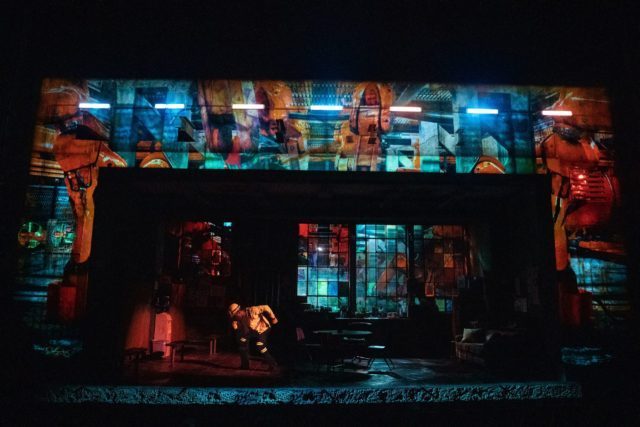
The actors perform on a central platform, occasionally using a chair or table. They change clothing quickly, either in the wings or right onstage. At one point, dozens of costumes are dumped on the floor, evoking the disarray during the riots. Often, as one monologue is finishing, the actor for the next segment walks up to the platform in silhouette. (The effective set is by Riccardo Hernández, with costumes by Linda Cho, lighting by Alan C. Edwards, sound by Darron L West, and projections by David Bengali.)
Each character is identified by accompanying text, along with the title of that segment; for example, “The words of Elaine Brown, former chairwoman of the Black Panther Party, ‘Bad’” and “The words of Daryl Gates, former chief of Los Angeles Police Department, ‘It’s awful hard to break away.’” Archival video footage of the riots, including the beatings of King and Denny, are shown on a pair of video monitors at the right and left as well as the back screen, immersing the audience in the horrific events of 1992–93, which look all too familiar in 2021.
Francis Jue is one of five actors portraying multiple characters in Twilight: Los Angeles, 1992 at the Signature (photo by Joan Marcus)
I was deeply moved by Deavere Smith’s solo Broadway version, which ran at the Cort Theatre in 1994, but this new Signature iteration blew me away. Running more than two hours with an intermission, Twilight flies by at a relentless, furious pace, a nonstop parade of individuals directly and indirectly discussing systemic racism, police brutality, anti-Asian hate, classism, journalistic biases, government indifference, and looting. “Oh yes, I am angry! It is all right to be angry!” Congresswoman Maxine Waters proclaims. “The fact of the matter is, whether we like it or not, riot is the voice of the unheard,” echoing what Waters and others have said about the rash of Black men killed by white police officers this century.
In a program note, Deavere Smith explains that the play is very much about gathering, about diverse people coming to the table despite their differences, ready to talk — and to listen. In the play’s most theatrical and involving scene, “A Dinner Party That Never Happened,” Brown, Parker, Rev. Tom Choi of the Westwood Presbyterian Church, Asian American man Jin Ho Lee, Chez Panisse chef Alice Waters, and former New Jersey senator Bill Bradley sit down at a table, eating and drinking while appearing to speak to one another. (At the performance I attended, one of the actors accidentally knocked over a glass of wine, and as several other cast members wiped it up, staying in character, it made me think of a ritual spilling of wine, an apt metaphor for what was happening onstage.)
Two-time Tony nominee and Pulitzer finalist Deavere Smith (House Arrest,Let Me Down Easy) and Obie winner Magar (Blue Ridge,Is God Is) have woven together a pseudo-conversation from the individual transcripts, in which the participants discuss responsibility, roots, justice, Saddam Hussein, commitment, and community. “I’m saying that these are the long haul,” Brown explains. “We just be thrown back and we will be twenty more years trying to figure out what happened to Martin, Malcolm, and the Black Panther Party.” It’s now nearly thirty years later and, sadly, as Twilight reveals, we are still trying to figure that out.
LACKAWANNA BLUES
Samuel J. Friedman Theatre
261 West Forty-Seventh St. between Broadway & Eighth Ave.
Tuesday – Sunday through November 12, $59 www.manhattantheatreclub.com
In 2006, the HBO film of Lackawanna Blues earned John Papsidera an Emmy for Outstanding Casting for a Miniseries, Movie, or Special and S. Epatha Merkerson won an Emmy and a Golden Globe for her portrayal of Rachel “Nanny” Crosby. But in the Broadway debut of Ruben Santiago-Hudson’s one-man show, which premiered at the Public in 2001 and continues at Manhattan Theatre Club’s Samuel J. Friedman Theatre through November 12, Santiago-Hudson proves once again that he can do it all by himself.
In the ninety-minute play, Santiago-Hudson, serving as actor, writer, and director, portrays more than two dozen characters that were part of his childhood growing up in the steel town of Lackawanna in upstate New York, focusing on his five-year-old self and the woman left in charge of his care, the beloved Miss Rachel, also known to the tight-knit community as Nanny. Ruben’s mother had financial problems stemming from drug abuse, and his father did not live with them. Through the age of eleven, he often lived with Miss Rachel, who ran a pair of boardinghouses, one at 32 Wasson Ave., where young Ruben met such fanciful figures as Numb Finger Pete, Sweet Tooth Sam, Ol’ Po’ Carl, Small Paul, Mr. Lucious, Freddie Cobbs, and Mr. Lemuel Taylor; Santiago-Hudson embodies each of them with shifts in his voice and physical movement as he relates funny and poignant anecdotes about fishing, baseball, and domestic violence.
He wanders across Michael Carnahan’s intimate set, consisting of a few chairs, a small table, the front door of 32 Wasson Ave., a hanging window, and a back wall that evokes the boardinghouse, beautifully lit by Jen Schriever (with several cool surprises). Sitting in one corner is New York Blues Hall of Fame guitarist and Grammy nominee Junior Mack, playing music composed and originally performed onstage by Bill Sims Jr.; Mack previously performed in Sims’s band, so it is a natural hand-off. He interacts well with Santiago-Hudson, sometimes coming to the forefront, other times whispering under Santiago-Hudson’s dialogue. Occasionally, Santiago-Hudson whips out a harmonica and blasts away with verve. (The warm sound design is by Darron L West.)
Lackawanna Blues is a celebration of a town that was enjoying the fruits of prosperity, not a dirge about marginalized people suffering hard times. The play begins with Santiago-Hudson declaring, “Nineteen fifty-six. Lackawanna, New York, like all Great Lakes cities, was thriving! Jobs everywhere, money everywhere. Steel plants, grain mills, railroads, the docks. Everybody had a new car and a conk. Restaurants, bars, stores, everybody made money. The smell of fried fish, chicken, and pork chops floating in the air every weekend. In every bar the aroma of a newly tapped keg of Black Label, Iroquois, or Genesee beer, to complement that hot roast beef-on-weck with just a touch of horseradish. . . . You could get to town on a Monday and by Wednesday have more jobs than one man can take. These were fertile times.” There were problems, but the people knew how to take care of one another, with Miss Rachel at the center. “Nanny was like the government if it really worked,” Santiago-Hudson says.
Santiago-Hudson is no stranger to one-man shows; in 2013 at the Signature, he portrayed his mentor and friend, the late August Wilson, in How I Learned What I Learned. He has directed and/or starred in numerous Wilson works, winning a Tony for his role as Cantwell in Seven Guitars and earning a Drama Desk Award for directing Jitney and an Obie for helming The Piano Lesson. He won an Obie Special Citation for the original production of Lackawanna Blues, while Sims earned an Obie for his music.
On Broadway, Santiago-Hudson makes you think you see every character, smell every smell, witness minute details of every scene even though he never changes his costume or introduces props. It’s a compelling, deeply personal performance that feels right at home in the 622-capacity theater as he marvelously succeeds in inviting the audience into his past. When asked at a talkback about what happened to his mother, he said that would be a show unto itself while sharing some of the specifics of her tragic yet hope-filled life. Sounds like a heckuva sequel.
Et Alia Theater’s This Is Me Eating___ has been turned into an immersive, in-person experience (photo courtesy Et Alia Theater)
THIS IS ME EATING___
The Alchemical Studios
104 West 14th St. between Sixth & Seventh Aves.
Saturday, October 30, free with advance RSVP, 4:00 – 9:00 www.etaliatheater.com
“I like my body,” Maria Müller says at the beginning of her video This Is Me Eating Those Stupid Comments. “Or at least I’ve grown to like it.” The short is one of five made by members of the two-year-old New York City–based Et Alia Theater as part of This Is Me Eating___, in which women share their personal thoughts about food and body image.
In This Is Me Eating My Taste Buddies, Ana Moioli explains, “Life can get pretty shitty. You can’t trust anyone. People betray you. But you can trust food. Even in the darkest times, food will always be there for you. Now, what if, suddenly, you weren’t there for food anymore?” The online project, which was an official selection of the NYC Indie Theatre Film Festival, also features Giorgia Valenti’s This Is Me Eating My Eating Disorder, Luísa Galatti’s This Is Me Eating My Weight, and Deniz Bulat’s This Is Me Eating Alone Thinking About Eating Together in addition to public submissions from around the world, which you can watch here.
Et Alia, which “strives to foster an accepting community that provides a safe space where people can take risks, push themselves outside of their comfort zones, and collide with an array of international voices which may be culturally unfamiliar,” is now presenting a live version of This Is Me Eating___, taking place October 30 at the Alchemical Studios on West Fourteenth St. There will be four forty-five-minute cycles, starting at 4:00, followed by an open discussion at 8:00. The immersive sessions, directed by Debora Balardini, designed by Dave Morrissey, and conceived by Valenti after Moioli received a City Artist Corps Grant, combine projection, sound, and movement that expand off the videos but are wholly new. Admission is limited to twenty to twenty-five audience members per cycle as people are encouraged to consider how they would fill in the blank in the title; among the virtual submissions were Thais Fernandes’s This Is Me Eating My Anxiety, Ana Carolina’s This Is Me Eating the Time We (Don’t) Have, Bianca Waechter’s This Is Me Eating My Anger, Kendall DuPre’s This Is Me Eating My Words, and Bruna da Matta’s This Is Me Eating and Being Eaten.
“Come ready to be part of these women’s inner and outer explorations of their eating habits, traditions, and mental reflections,” co-artistic director Valenti said in a statement. “Come ready to feel part of a creative process and absorb this global process. You might just discover you are not so alone.”
Et Alia has previously staged Hasnain Shaikh’s Running in Place at Dixon Place, Müller’s On How to Be a Monster at Casa Italiana Zerilli Marimò and the Tank, and None of the Above at Rattlestick’s Global Forms Theater Festival. “Do you eat for pleasure or survival?” Galatti asks in This Is Me Eating My Weight. The same can be asked about live theater, especially as we come out of a pandemic lockdown.
Six queens battle it out to see who has it worst in Six (photo by Joan Marcus)
SIX
Brooks Atkinson Theatre
256 West Forty-Seventh St. Between Broadway & Eighth Ave.
Thursday – Tuesday through September 4, $99-$279 sixonbroadway.com
The premise of the new Broadway musical Six is as simple as its title: The six wives of Henry VIII battle it out in an American Idol–like competition to determine which of them had it worst, a riotous twist on the old game show Queen for a Day, in which women shared their personal problems on television, with the most heart-wrenching tale earning its forlorn teller a crown and various sponsored prizes.
Fighting it out in Six, which premiered at the 2017 Edinburgh Fringe Festival and made its way across the UK and to Australia, Canada, Chicago, and Massachusetts before landing at the Brooks Atkinson Theatre, are the divorced Catherine of Aragon (Adrianna Hicks); the beheaded Anne Boleyn (Andrea Macasaet); Jane Seymour (Abby Mueller), who died shortly after giving birth; the divorced Anna of Cleves (Brittney Mack); the beheaded Katherine Howard (Samantha Pauly); and Catherine Parr (Anna Uzele), who survived Henry. Each woman makes her case in a spotlighted solo, set to music that ranges from pop to hip-hop to R&B and techno, performed onstage by the Ladies in Waiting: conductor and keyboardist Julia Schade, bassist Michelle Osbourne, guitarist Kimi Hayes, and drummer Elena Bonomo. The playful orchestrations are by Tom Curran, with flashy choreography by Carrie-Anne Ingrouille, the music and movement referencing Adele, Britney Spears, Beyoncé, the Spice Girls, and other pop faves.
Each former wife of Henry VIII takes center stage in Six (photo by Joan Marcus)
Wearing dark, glittering spikey costumes bordering on futuristic S&M, designed by Gabriella Slade, the women take center stage one by one as Tim Deiling’s frenetic lighting evokes a medieval discotheque. Each woman details her unique relationship with Henry in such songs as “Don’t Lose Ur Head,” “Heart of Stone,” and “I Don’t Need Your Love”; don’t be surprised if people near you are singing along, because the 2018 cast album has been streamed more than a hundred million times prior to the show’s Broadway opening. A woman sitting in front of me even knew specific gestures made by the performers, moving and grooving to every tune and nearly jumping out of her chair for the grand finale.
In between songs, each of the queens explains why she should be ruled the ultimate champion. Catherine of Aragon declares, “Who lasted longest was the strongest.” Boleyn claims, “The biggest sinner is obvs the winner.” Seymour opines, “Who had the son takes number one.” Cleves states, “Who was most chaste shall be first-placed.” Howard demands, “The most inglorious is victorious.” And Parr concludes, “The winning contestant was the most ProTESTant . . . Protestant.”
The divas also throw plenty of shade at one another in their quest to prove that they had it worst. When Seymour admits, “You know, people say Henry was stone-hearted. Uncaring. And I’m not sure he was?” Boleyn replies, “Yeah, actually, come to think of it, there was this one really cute time where I had a daughter and he chopped my head off.” When Catherine of Aragon says, “How about this: When my one and only child had a raging fever, Henry wouldn’t even let me, her mother, see her,” Seymour responds, “Oh, boo hoo, baby Mary had the chicken pox and you weren’t there to hold her hand; you know, it’s funny, because when I wanted to hold my newborn son, I died!!!!!!”
Cleverly cowritten with sheer glee by Toby Marlow and Lucy Moss, who previously collaborated on Hot Tub Time Machine, and codirected by Moss (Ratatouille: The TikTok Musical,Fisk) and Jamie Armitage (And Tell Sad Stories of the Death of Queens,Love Me Now), Six knows exactly what it is, not trying to be anything else; it’s an immensely crowd-pleasing show that doesn’t overwhelm you with history but does make mention of Hans Holbein, the C of E (Church of England), the Tudors, the Bubonic Plague, Thomas Cromwell, Henry Mannox, and the Holy Roman Empire. “Let’s get in Reformation,” Cleves orders in one song. (If you’re afraid you’ve missed something, you can most likely find it at this Wiki fan page.) Marlow and Moss also inject a powerful dose of female empowerment, although it leads to a too-easy, politically correct finish. As Parr says, “Every Tudor rose has its thorns.”
The cast is passionate and exuberant, making tons of eye contact with audience members in order to gain their vote. I saw understudy Courtney Mack as Boleyn, replacing Macasaet, and she more than held her own with Hicks, Mueller, Brittney Mack, Pauly, and Uzele, who form a strong team that often repeats the familiar refrain, “Divorced, beheaded, died, divorced, beheaded, survived,” but want to be known for something more in this exhilarating “histo-remix.”
Life is not exactly looking up for Timmy (John Keating) and May (Maeve Higgins) in Autumn Royal (photo by Carol Rosegg)
AUTUMN ROYAL
Irish Repertory Theatre, Francis J. Greenburger Mainstage
132 West 22nd St. between Sixth & Seventh Aves.
Tuesday – Sunday through November 21, $50-$70
212-727-2737 irishrep.org
It was with a bittersweet wistfulness that I entered the Irish Rep for the first time in more than a year and a half. During the pandemic lockdown, the company was at the global forefront of digital theater, presenting more than a dozen outstanding livestreamed and recorded shows online, using cutting-edge technology that went far beyond Zoom boxes and clumsy green-screening. (Among the best were The Weir, Bill Irwin’s On Beckett / In Screen, and The Cordelia Dream; twelve of the shows are still available on demand.) Of course, I was excited to be back at the Francis J. Greenburger Mainstage on West Twenty-Second St. for a matinee, greeted by masked founding directors Charlotte Moore and Ciarán O’Reilly as I made my way in to sit with an audience of real people rather than virtual avatars Zooming in from home.
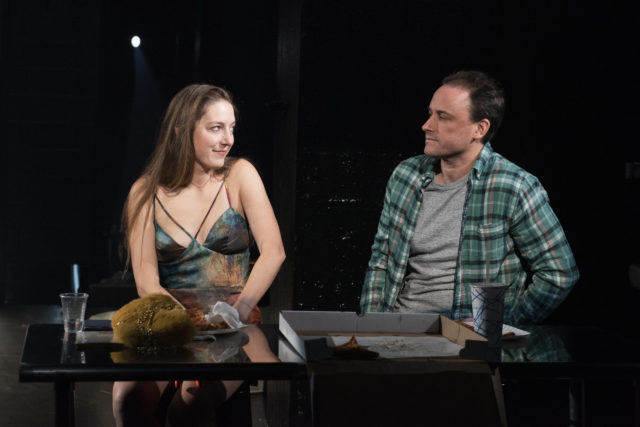
The Irish Rep has brilliantly reopened with the North American premiere of Kevin Barry’s Autumn Royal, a charming two-character, seventy-minute dark comedy that takes place on a claustrophobic set, an oddly appropriate reminder of the lockdown. The walls seem to be closing in on May (Maeve Higgins) and Timothy (John Keating), a pair of thirtysomething siblings who are caregivers for their ailing father, who lives upstairs in the attic. Charlie Corcoran’s set consists of a small table, two chairs, a doorway leading out of the house, and stairs to the attic, which appear ridiculously small and narrow, practically untenable. It’s as if May and Timmy are trapped, not only in their quaint Cork City home, but in the past, still reeling from their mother’s sudden departure when they were young. (“Went out for a packet o’ Birds custard and never came back,” Timmy recalls.)
Timmy dreams of moving to Australia to become a surfer, while May is much more realistic in their lack of options. She counters his talk of riding a wave with a detailed description of a local woman whose mother fell into a fireplace and “half the face melted off her.” It’s as if they’re fire and water, opposites who need each other.
Their father is never seen — it’s like he’s quarantining — but is occasionally heard, and every once in a while he bangs on the floor, sending dust and crumbling parts of the ceiling down on his grown children, who are not particularly fond of a poem he is writing about a duck walking across a puddle. However, the three of them bond over the 1982 song “Zoom” by Fat Larry’s Band, which Timmy blasts from an old boombox, on cassette. (Yes, even the name of the song evokes virtual theater, even though the play was first performed in Cork in 2017.)
May and Timmy share memories with little thought of their future. “I remember fucking everything,” May proclaims. A moment later, she adds, “We’re never going to get past ourselves here, Tim.” Timmy replies, “I’m definitely going to Australia, May. All I need is to have, like, two grand, I think is it?, in the, am . . .” She shoots back, “Timmy? You’re not going to make it as far as the Esso station.”
A haunting darkness hovers over a sister and brother in Irish drama (photo by Carol Rosegg)
They start to believe that their lives might be different if they put their father in a nursing home, but whenever they start thinking about how things can improve, their discussions turn sour. “All we’re doin’ now is talkin’ ourselves into a very dark read o’ things, yunno?” Timmy says. “Ah, the world sometimes is just complete . . . fucken . . . bollocks, like,” May opines. No matter which way they turn, regardless of their desires, they just seem to end up stuck back at home, their parents practically ghosts haunting their lives.
Directed by O’Reilly (The Weir,The Emperor Jones) with a deft touch, Autumn Royal features projections by Dan Scully, sometimes of blood covering a wall, while others evoke the siblings as kids in the back of a car on a Sunday drive to Tipperary, a beach scene, the silhouette of a mysterious woman, white picture frames, and, repeatedly, a loud washing machine, the spin cycle representing the inner chaos and repetition of their existence, just going around in circles. Keating (The O’Casey Cycle,Pericles) — a true New York theater treasure — and Higgins (Extra Ordinary,Naked Camera) deliver a terrific one-two punch as the arguing siblings, he tall, gangly, and comical, she short, tough, and harder-edged. They each get long monologues, but they really shine when they are both onstage, playing off each other like a classic comedy team, one goofy and wide-eyed, the other harshly direct and to the point. In his first stage work, novelist and short story writer Barry (Beatlebone,City of Bohane) adds a healthy dose of Irish doom and gloom to a common situation, one that hits a little closer to home in the time of Covid.
CROSSING THE LINE FESTIVAL
FIAF and other locations
55 East 59th St. between Madison & Park Aves.
October 20 – November 6, free – $25
212-355-6100 fiaf.org
Igbo-Nigerian American multidisciplinary artist Okwui Okpokwasili has not let the pandemic lockdown slow her down. After appearing in the Public’s outstanding revival of Ntozake Shange’s for colored girls who have considered suicide / when the rainbow is enuf in the late fall of 2019, Okpokwasili has taken part in Danspace Project’s Platform series, the New Museum exhibition “Grief and Grievance: Art and Mourning in America,” and numerous online discussions and special presentations. Her 2017 film, Bronx Gothic, was screened virtually by BAM. In June, she led a procession through Battery Park City for the River to River Festival. And in May, I caught her captivating project On the way, undone, in which she and a group of performers walked across the High Line wearing futuristic head gear made of light and mirrors, vocalizing as they headed toward Simone Leigh’s Brick House sculpture.
Okpokwasili is now the centerpiece of FIAF’s 2021 Crossing the Line Festival, taking place at multiple locations from October 20 to November 6. Throughout the festival, her video installation Before the whisper becomes the word, made with her regular collaborator, director, and husband, Peter Born, will be on view in the FIAF Gallery, exploring remembrance, community mourning, and history. On October 20 at 7:00, she will speak with festival curator Claude Grunitzky in the FIAF Skyroom about the show. “This installation is a crossroads, a midpoint, a caesura. A place caught between worlds,” she said in a statement. “Can we remember what came before while imagining the shape of a future landscape? We enter mid-song, a song that marks a singular moment in time while also expressing an entire lineage. The song is a container for an unreliable memory. From whose mouth is history born? Whose words are trusted when it comes to the telling of what happened? If the history we learn is that which is spoken aloud, what is learned by listening to the whispers that have not been written?”
Christopher Myers’s Fire in the Head will make its world premiere at FIAF’s Crossing the Line Festival
Okpokwasili will also be presenting On the way, undone at the Weeksville Heritage Center in Brooklyn October 21-23 ($25). In a High Line video, she says about the work, “I hope it’s a kind of medicine . . . an architecture of sound, light, that is in some way trying to imagine a portal, an opening through space and time, and it’s imagining a woman’s future self, a young girl’s future self singing back to her.”
In addition, the festival includes nora chipaumire’s Nehanda, an opera that was excerpted for River to River at the Clemente Soto Vélez Cultural & Educational Center and for FIAF will be broadcast in two cycles both online ($15) and in person ($25) at FIAF’s Tinker Auditorium, divided into eight “days”: natives, whites, pungwe, thinkers, komuredhi judhas nemajekenisheni, white verdict, killings, and manifesting, with an artist talk on October 30 at 5:00; a concert by Grammy nominee Somi in Florence Gould Hall on October 28 ($25); Christopher Myers’s Fire in the Head, a tribute to Vaslav Nijinsky with shadow puppets taking place October 29 and 30 ($25, 7:30) at the Chinese Consolidated Benevolent Association; and Kaneza Schaal’s work-in-progress KLII, November 4-6 in Florence Gould Hall ($25), an exorcism of colonialism and the ghost of King Leopold II, incorporating archival footage and texts by Mark Twain and Patrice Lumumba.