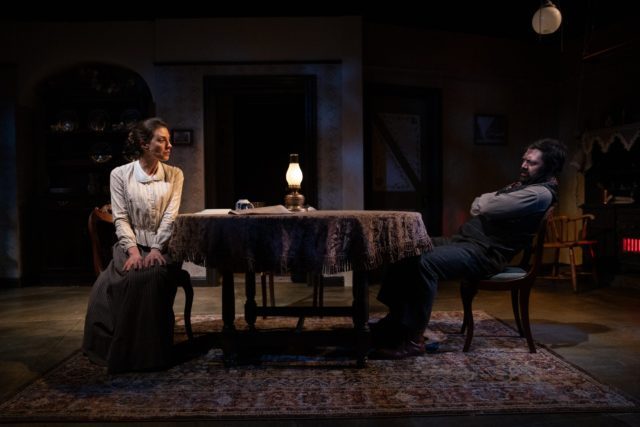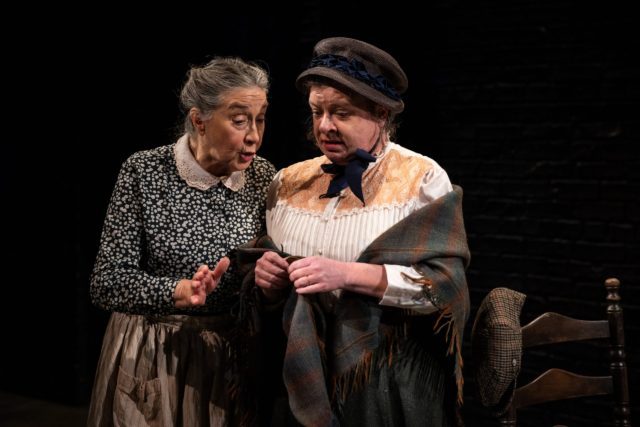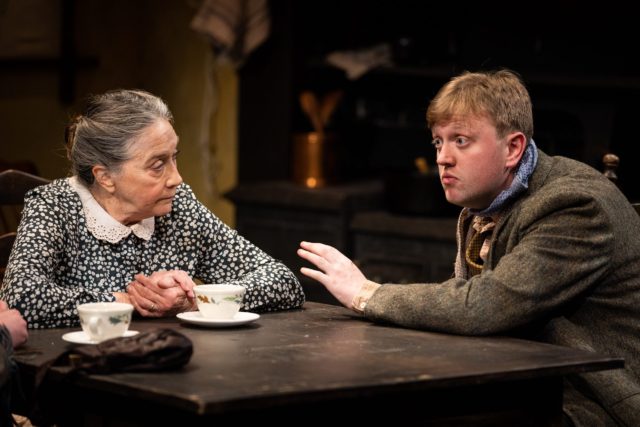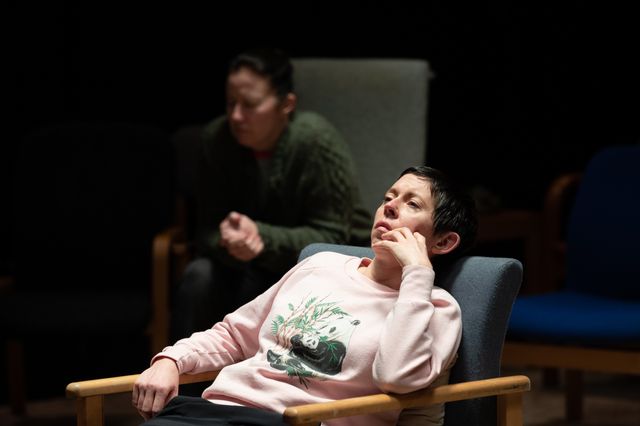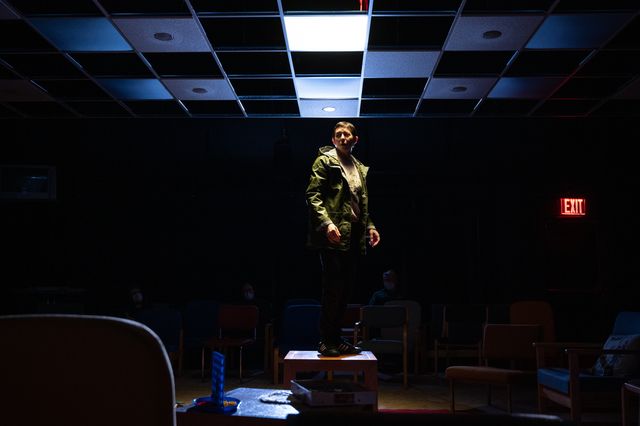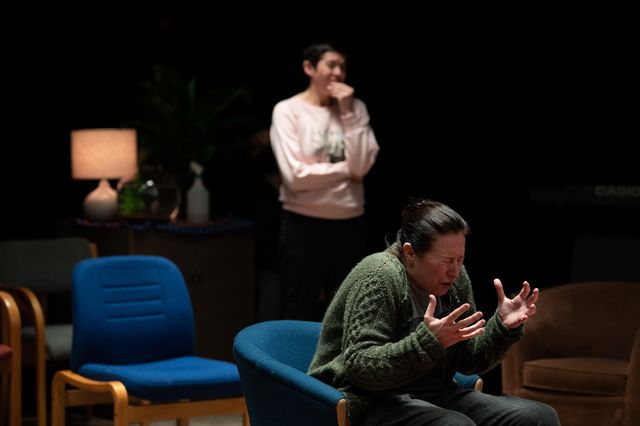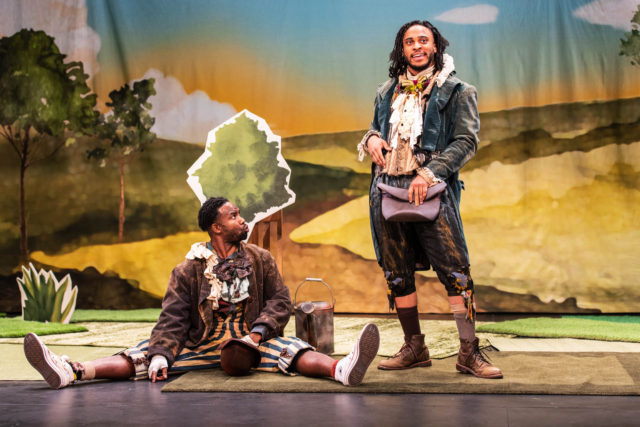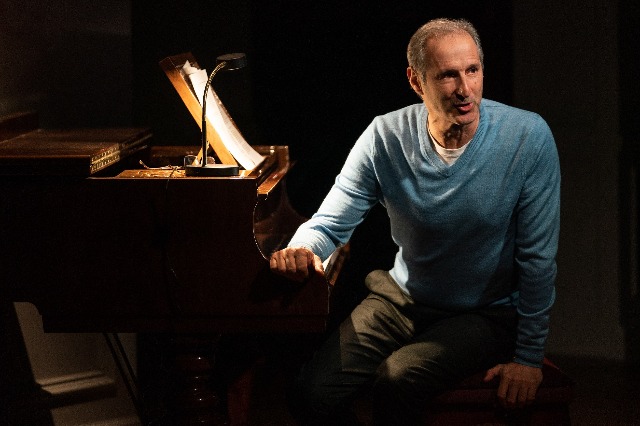
Rich Topol plays nonreligious narrator Patrick Salomon in Manhattan Theatre Club world premiere (photo by Matthew Murphy)
PRAYER FOR THE FRENCH REPUBLIC
Manhattan Theatre Club
MTC at New York City Center – Stage I
131 West 55th St. between Sixth & Seventh Aves.
Tuesday – Sunday through March 27, $99
212-581-1212
www.manhattantheatreclub.com
About seven years ago, I was sitting in the audience at a play when I recognized the man in front of me, actor Richard Topol. I tapped him on the shoulder during intermission and told him that I had just seen him at the Signature in A. R. Gurney’s The Wayside Motor Inn and had enjoyed his performance. He thanked me, saying that he was actually the understudy and that was the only time he had gone on. He was even more thankful when I told him that I had included him in my review.
Since then we’ve bumped into each other a few other times at the theater and discussed various shows we’d seen. He’s an extremely amiable mensch who clearly loves his chosen profession. Even if you don’t recognize his name, you’re likely to know his face; he has approximately fifty television and film credits, including portraying lawyer and politician James Speed in Steven Spielberg’s Lincoln, a recurring role on The Practice, and multiple parts on several Law & Order iterations.
But his true love is theater, which he also teaches. He has appeared extensively on and off Broadway, in such plays as The Merchant of Venice with Al Pacino, Julius Caesar with Denzel Washington, Alice Birch’s Anatomy of a Suicide with Carla Gugino, and Paula Vogel’s Tony-nominated Indecent with Katrina Lenk as well as Tony-winning revivals of Clifford Odets’s Awake & Sing! and Larry Kramer’s The Normal Heart. He is currently starring in Joshua Harmon’s Prayer for the French Republic, a scintillating three-hour exploration of anti-Semitism that travels between 1944 and 2016; Topol plays Patrick Salomon, a nonreligious Jew who has decided not to go into the family piano business.
Topol was raised in Mamaroneck and lost his father when he was twelve. He is married to actress Eliza Foss; they have one daughter, and Richard was close with his father-in-law, the late German-American composer, pianist, and conductor Lukas Foss.
During our wide-ranging Zoom conversation, Topol is thoughtful and generous, laughing and smiling a lot. Behind him in his living room is a landscape by his mother-in-law, the painter and teacher Cornelia (Brendel) Foss.
He admits that the most nervous he’s been in his life was when he hung out with Paul McCartney following a performance of Larry David’s Fish in the Dark, in which Topol played Dr. Stiles; after that, the Cute Beatle went from being his third favorite mop top — behind John and George — to his second.
A few days after Prayer for the French Republic opened at Manhattan Theater Club’s Stage I at City Center, we talked about one-person shows, getting Covid, baseball, and what it’s like being an actor in lockdown, including a detailed description of mounting a play as a pandemic continues.
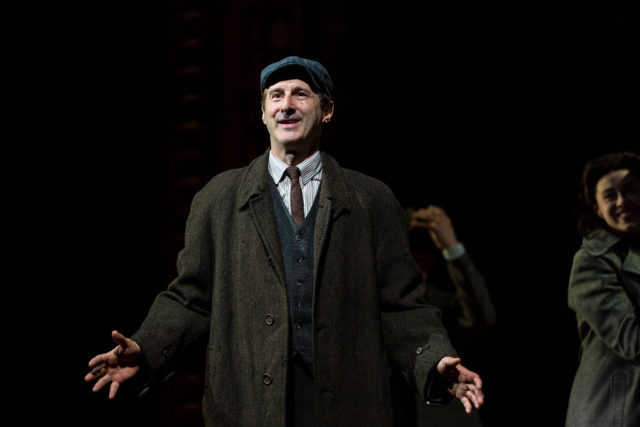
Rich Topol starred as stage manager Lemml in Indecent (photo by Carol Rosegg)
twi-ny: During the pandemic, you appeared in several virtual and audio productions: You were in Melisa Annis’s Beginnings, Anne Washburn’s Shipwreck, Craig Lucas’s More Beautiful — and you played a chicken in Jimonn Cole’s Chickens.
richard topol: Oh my God! That was so much fun.
twi-ny: That was crazy.
rt: I loved Michael Potts in that.
twi-ny: You guys were great. Did you enjoy working on Zoom?
rt: No, no, no. I mean, I enjoyed working as opposed to not working. Shipwreck was the closest we got to working on a play because we rehearsed for a couple of weeks and it felt like, Okay, I’m going to rehearsal today. We did the kind of work that you do in a play before you get up on your feet. [Director] Saheem Ali was great and it was a great cast, obviously in a really interesting play. And we spent enough time with it to dig in the way you do in a play.
I mean, I also shot some TV shows over the course of the pandemic, so all of the Zoom stuff felt more like the way an actor like me connects to short-term work. You don’t develop a through-line, you don’t understand the arc of things. You’re not invested in a team, the whole idea of a team creating a thing and living together and becoming a version of a theater family, or whatever it is. Shipwreck was the closest to that.
twi-ny: As a listener, I felt it Shipwreck was one of the audio plays that worked the best during the lockdown. I got the feeling that this was a group of actors working in tandem.
rt: Right. I think because they had intended originally to produce it live, they had invested in it as fully and fulsomely as you do for a whole theater piece. There had been a lot of preparation. There was a sense of having more in the heads of the director and the producers, what we could imagine this great thing being, that infused the development and the rehearsal and experience of doing it. The Public took a lot of care in making it.
twi-ny: You finally returned to the stage in November in Portland with Searching for Mr. Moon, which is about fathers and sons, particularly about how you lost your father when you were very young and eventually found a father figure in Lukas Foss. This is your first one-man show, which you wrote with Willy Holtzman, a two-time Pulitzer nominee. What was the experience like sharing your life, in person, in front of people, back onstage? It’s a short question, right?
rt: The short answer is it was great. It was so satisfying. I remember at the time talking with people and saying, Oh my God, this is the longest period of time between . . . I was doing Anatomy of a Suicide at the Atlantic Theater Company.
twi-ny: Which was excellent. Loved it.
rt: Thank you. Yeah, I love that play. Intense. So that was the very last performance you could do in New York. And we were shut down. And so from March 12 of 2020 to November 3, 2021, was the longest period of time I hadn’t been onstage in my adult life. And I’ve been an actor for over three decades.
So it was thrilling to be back in a theater on a stage with a live audience, even though they were masked. So on the one hand, it was incredibly thrilling. And on the other hand, it was incredibly scary because it was the first play that I’d ever cowritten with anybody, and it was about my life. I felt more exposed than I’d ever felt before in my life. Willy and I had been talking about this play for a number of years. And then because the pandemic happened, we both had the time to really work on it. And that’s how it came to pass, and Anita Stewart, the artistic director of Portland Stage, was just a real cheerleader for the piece.
We did a developmental workshop in June up in Maine. That theater had stayed open through the pandemic because Maine had so few cases, because of the regulations, and because of their skill at keeping people safe. They produced a lot of one-person shows. They produced Lanford Wilson’s Talley’s Folly — they cast a married couple who played the two parts.
But even though they’re being Covid careful, they have diminished audiences because there are a lot of people who feel, I’m not going to see a play. I’m not going to risk that.
twi-ny: A lot of people still feel that way.
rt: But Willy and I had a lot of time over the pandemic because there wasn’t much else to do to finish the play. And then Anita gave us a shot. We did the workshop, we did a live reading in front of people. It went really well and they’re, like, We want to produce this and we have a slot.
But because it’s about one of the hardest things and most personal struggles that I’ve experienced for the last forty-six years of my life, since my father died, it was scary to share, but it felt worth sharing. Willy was like, I want to write a one-man show for you. I’m like, Okay, sure. First of all, I don’t like one-person shows, I don’t like seeing one-person shows; they’re not interesting to me. I love acting with other people, and it can’t be about me because I’m not interesting. So what could it be about.
twi-ny: Three strikes and you’re out.
rt: Right. It was a total strikeout. And then Willy’s like, Come on, come on. And so initially we decided it would be about Lukas Foss, who was my father-in-law, a really interesting man who had a really interesting life. He escaped the Nazis. Like in Josh’s play, he was one of those people, a German Jew in Berlin who got out. Even though he wasn’t Jewish; he didn’t think of himself as a Jew. He had a really interesting life and a really challenging death.
He had Parkinson’s disease. He had a mind that was brilliant and fingers that could play — I don’t know if you’ve ever heard him play or listened to something. It’s unbelievable. If you can listen to him playing on Lenny Bernstein’s “Age of Anxiety,” listen to the piano on that. It is unbelievable. And so the guy lost his physical abilities and his mental abilities. We thought, Okay, that’s an interesting idea for a play.
I’ve always had this obsession with searching for a father and he was my father-in-law, so let’s do that. And the play started to be about that. And the first two drafts of it were about that. It was this biodrama about Lukas and it was missing something.

Rich Topol debuted his intimate one-person show at Portland Stage in November (photo by No Umbrella Media LLC)
twi-ny: It needed more of you, probably.
rt: Yes, well, that’s what Willy said. And so, kicking and screaming, it became more and more about my relationship to Lukas and then my relationship to fatherhood. Then when my wife told the story to Willy about when she gave birth — the opening scene of the play is her giving birth to our daughter — and Eliza’s parents, in black tie, come in from a gala, bursting into the delivery room because they thought she was about to have a baby — she was about to have a baby — we’re like, What are you doing here? Get the fuck out of here. That seemed like a good starting-off point, discussing my becoming a father and my seeing the best potential father to me to help me learn how to be a father.
It was really satisfying to do. I was really glad to do it at Portland Stage, where most of the people who were watching knew nothing about me and I didn’t have to feel so exposed. I’m hoping to bring the show to New York, but I think doing it here, that’ll be scary.
Although my mother came and saw the show. My wife came and saw the show. People who know me and my life saw it. And I survived.
twi-ny: And they all want you to keep doing it. Since these are your lines and they’re about you, if a joke didn’t quite take or something emotional didn’t register with the audience, is it more or less upsetting than when you’re reciting somebody else’s words and something might not go as expected?
rt: Oh, less upsetting because I know I’m not a professional. I’m no Josh Harmon. Josh is a writer. I’m just some guy —
twi-ny: The third guy from the left.
rt: Exactly, the third guy from the left. At least in that experience I can cut myself some slack. It was the first production of the first play that I’ve ever cowritten. Willy did most of the writing. So that’s the sort of glib answer.
The truth is, most of the play, I play other people. I play my father-in-law. I play my mother, I play my wife, I play my mother-in-law. And in the scenes where I play myself, most of that writing is me, having written down my versions of stories that I’ve experienced. And so the ones that I was willing to share were the ones that couldn’t be avoided and, I guess, were the most important. Maybe I’m fooling myself. The play was well received, so I didn’t have the experience of Oh, that sucked. Right. Why am I doing this play?
twi-ny: Who talked you into this?!
rt: Who let me do this thing?
Let’s take that idea of writing and switch over to Prayer for the French Republic, which is exquisitely written. The language is so beautiful. What was the rehearsal process like?
rt: Well, it started actually in August of 2019, when Josh had been commissioned by Manhattan Theater Club to write a play. He came in with his finished draft and we did a reading of it, prepandemic and in-person. They hand delivered the scripts to everybody’s homes. They bicycled around Manhattan delivering the scripts because they didn’t want to email them. Josh was holding it close. I read it to myself and I thought, this is the best play I’ve read in ten years. And I mean, I haven’t read every play in the last ten years, but I’ve read a lot of plays and I’ve seen a lot of plays, and I thought, this is astoundingly amazing.
And so I was so excited to be part of the beginning of it. We did that reading and I think it confirmed for Manhattan Theatre Club and for Josh that he had latched on to something incredible. Then we did a couple of workshops that fall and then at the end of February of 2020. At that time I was reading Charles, actually.
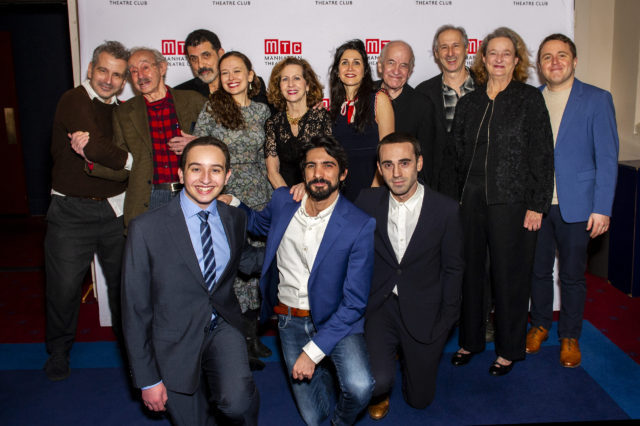
Rich Topol is third guy from the right in cast and crew photo from Prayer for the French Republic opening night (photo © 2022 by Daniel Rader)
twi-ny: That’s really interesting to me, because you fit so well as Patrick.
rt: Yeah, I know. I was like, No, no, no. When they said, Will you read Patrick? I was like, No, no, no, no, no. I love Charles. No, no, please don’t. They’re like, To be honest, Charles should be, if not actually North African, at least more Sephardic, more Middle Eastern. And so I was like, Okay, fine.
Now, of course, I’m totally madly in love with Patrick and I wouldn’t have it any other way. We did a workshop right before the pandemic hit in-person. And Josh had done some incredible things. And that’s when [director David] Cromer came on board. We’re already verklempt about it. So then the pandemic hit and immediately I got the virus.
The show closed on March 12. I had symptoms on the ides of March, on the 15th of March, and I was in bed for nineteen days with Covid-19.
twi-ny: So it was bad.
rt: It was miserable. I didn’t have it like Danny Burstein; I didn’t have to go to the hospital. Or Mark Blum, a lovely man who lost his life to it. And so it was the worst it could be without being bad. And then the symptoms were gone. We have a place upstate that we escaped too, and I got a call two days later from my agents. I’m like, Why is my agent calling me? The business is entirely shut down.
And she said, You just got an offer from Manhattan Theatre Club for Prayer for the French Republic. They want to do a workshop in July and then we’ll go into rehearsal in September and run till Christmas. And I thought, Oh, that’s perfect. This is the kind of play that should be running during the election. It felt to me that it was really important that this play be put up during the election. And then, of course, a month later, they’re, like, Yeah, we’re not going to do the workshop in July. But we’re still on track for the fall. And then a month later, it’s, Yeah, we’re not going to do the play in September. It’ll be sometime in 2021. We don’t know when but we’re still committed to doing the play.
And then we did a couple of Zoom workshops. We would do a weeklong workshop with the first act of the play, then the second act. And then another few months later we did the third. So we had a lot of time processing it with Josh and helping him wrangle this epic piece into what you saw. Then we got into the rehearsal space in December. And for those of us who’d been with it for two years, we’re like, Oh my God, we’re finally getting to do it. But still there was that sense of, Who’s producing a new eleven-person play, with nobody famous? It doesn’t have any songs —
twi-ny: And it’s about the Holocaust.
rt: Exactly. So kudos to them for sticking with it. And putting it up and investing in it, saying, I’m sorry, this is too important. We’re going to put this play up. We started first day of rehearsal learning about the Covid protocols, getting tested regularly.
twi-ny: Masked?
rt: We were wearing masks around the table. And then when we started up on our feet, we were unmasked, for those who were comfortable with that. And then one of our stage managers tested positive, and luckily she didn’t give it to anybody else. But at that point we’re like, Okay, we’re just wearing masks the whole time. We do not want to be shut down.
So this was the middle of December now, right before Christmas, and shows were going down left and right. We’re like, You know what, it’s not worth it. We do not want to shut this play down. Here we have been waiting for so long to do it. Let’s do what we can. And there were conversations among the cast about, Well, what do we do at home? Some of us have children and partners, but there was a real commitment to being safe so that we could get it up on our feet. And then Josh tested positive right before tech. And so actually the last few days of rehearsal and through tech, he watched the play like this.
twi-ny: On Zoom?
rt: There was a computer open and his computerized voice would come through. And again, he didn’t give it to anybody else. And then the testing protocols, we’re getting tested every day, and you can’t come into the room until you’ve tested negative, and, knock wood, that’s been it.
For the last six and a half weeks, we have been safe and we’ve been able to do it. And audiences have come. I am pleasantly surprised at how many hundreds of people are coming to see the show every day. I had seen a number of shows when I came back from Maine, and some had nobody in the audience and some were jam packed.
twi-ny: It’s been very strange. I went to a concert where everybody had to be masked and there were some empty seats, but it was pretty much sold out. But then I went to a hockey game and sixteen thousand people are screaming, no masks, lots of eating and drinking.
rt: Yeah. And I’m not going to any of that stuff. I did go see Hot Tuna and David Bromberg.
twi-ny: I love Bromberg.
rt: I looooove Bromberg.
twi-ny: How was he?
rt: He was great, for a seventy-year-old man. He was beautiful. He was really amazing. It was a really great time.
I’ve been to some plays where I’m sitting right next to total strangers and everybody has their mask on, and this was the same. Everybody did keep their masks on, but there were some drinking and eating. So we’ve been careful and thoughtful and fortunate, and I hope we continue to be so. Because it’s a great joy to do this play. It is a really challenging piece of theater and really satisfying to act in.
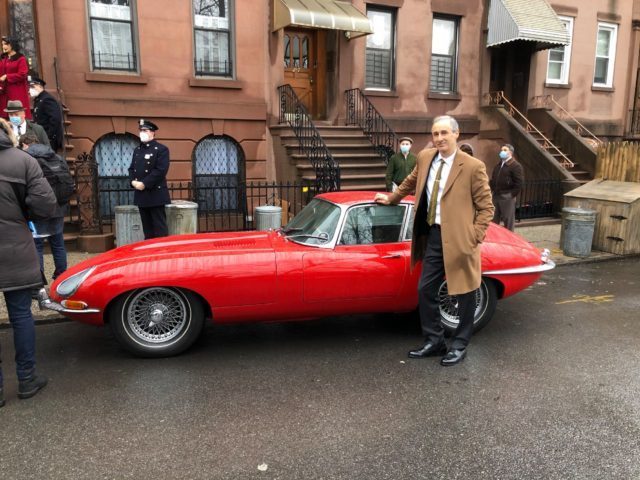
Rich Topol poses with a hot car on set of EPIX series Godfather of Harlem
twi-ny: Throughout your career, and especially more recently, you’ve played a lot of Jews: Sam Feinschreiber in Awake & Sing, Fritz Haber in Genius: Einstein, Lemml in Indecent, and now Patrick, who is a nonreligious Jew. Are you Jewish, or is it just a coincidence that you play a lot of Jews?
rt: I was born a Jew. I got bar mitzvahed. I think of myself as Jew-ish. I was in The Chosen a couple of times [There’s a knock at the door and Topol gets up to answer it, then returns.] That’s the exterminator, not exterminating Jews but exterminating bugs that Nazis would think are like Jews.
I’ve also actually played a lot of Jewish narrators who step into the play. I don’t think I’m as extreme as Patrick; Patrick is a Jew who doesn’t know anything about his Judaism and is happy to not know anything about his Judaism and is somebody who thinks of organized religion as what he says in the play, which is “bullshit.”
twi-ny: Which the character Molly agrees with.
rt: Right. I don’t subscribe there. But I’m also not religious. I think of myself as spiritual and, not to be too woo-woo, I believe in the earth. I’m a tree worshiper. I’m a tree hugger. Where I feel most soulful and spiritual is when I’ve climbed a mountain and I feel small in relation to a large, amazing thing. That’s the way I connect to religion. I think that most of the major religions are about feeling good to be small under the umbrella of something that’s bigger than our oneness, that connects us all.
twi-ny: I felt that that Josh really attacked the numerous angles of how to look at anti-Semitism and Israel and American Jewry. He covered everything. And without, I think, insulting anyone and without becoming didactic and preachy.
rt: He does a great job of giving everybody a valid argument. He’s really, really, really kind to all his characters. And thoughtful in allowing them to be really articulate people who have really strong opinions, and those opinions are different. And I think that’s one of the greatest things about the play, because it leaves the audience getting to consider those ideas that you’ve mentioned from a lot of perspectives. No, not from all perspectives, but certainly from a lot of perspectives within the Jewish community.
I’m always curious about what my non-Jewish friends who come and see the show think of it. I feel like the Jews, the Jews get it, the New York Jews get it, or they have really strong opinions about it.
twi-ny: Jon Stewart would ask, is it too Jewy?
rt: I have asked that of my non-Jewish friends. I’ve actually asked that of some of my Jewish friends too. Is this too Jewy? Is it just Jewy enough? Or is it not? The ones who are not Jews often say how the Jews in the play are just a specific example of the larger issue of otherness.
Look, we live in a world where the hate for other has been unleashed. And so what to do about that? If you’re a WASP from white privilege, maybe you look at this play and think, like Patrick, What’s the big deal, you know? Even those people understand, given what we’ve lived with, at least certainly for the last few years. But the larger questions that Josh asks in the play relate to almost everyone.
twi-ny: If Lukas were still around to see you in the show, would he be happy with your piano playing?
rt: I think he would be disappointed. And I’m slightly disappointed myself too, because I knew I was going to do this part for a long time and I knew that these songs were in the piece. But I feel like he shouldn’t be a better piano player than I am in this play. He doesn’t take over the family business. He shouldn’t be a lounge singer. I sing well, and maybe I’m justifying, but I feel like I play and sing just well enough but not too well for who he is. I love the progression of the piano in the play. It goes from Molly just clinking one note to me playing something schematic to Peyton [Lusk] playing that lovely Chopin piece to the end; the piano has a journey too. It’s a symbol, a metaphor for the journey of our family.
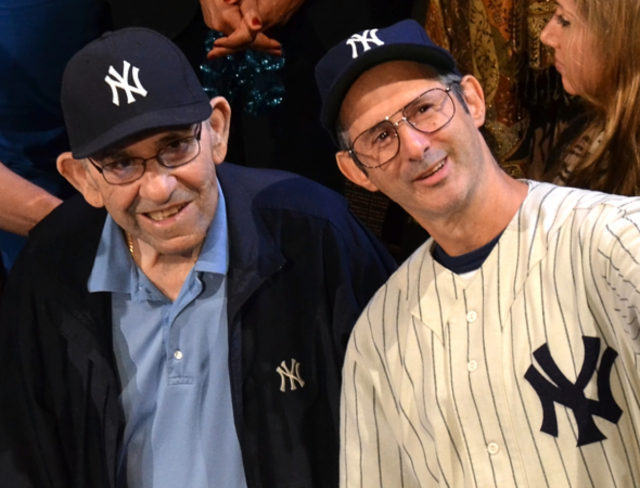
Rich Topol meets Yogi Berra on opening night of Bronx Bombers (photo © David Gordon)
twi-ny: Okay, for my last question, I have a sort of bone to pick with you. You were a Mets fan, then you switched over to the Yankees. I mean, come on.
rt: Did I say that out loud somewhere?
twi-ny: I have my sources.
rt: Actually, it sort of timed out pretty well, you know? Because when I became a Yankees fan, the Yankee sucked. It’s interesting because it connects to the father thing.
My father died in 1975; I don’t remember whether I jumped ship in ’74 or ’75. I know I was a Mets fan in ’73, and then we moved, and my next-door neighbor was a Yankees fan. And I wanted to be his friend.
twi-ny: Right before Reggie.
rt: Exactly. So you can’t pick a bone with me if it was because my father had just died and my next-door neighbor was a Yankees fan. The Mets had been to the World Series, right?
twi-ny: Yes they had, with Yogi Berra as manager. You played Yogi in Bronx Bombers. I think a lot of people forget that. I met him once at a Mickey Mantle Foundation dinner at Gracie Mansion. He was by himself and I went over to him and said, I’m going to ask you something that no one probably ever asks you about. And I asked him about managing the ’73 Mets. He looked up, put on a big smile, and said in that Yogi way, “No one’s asked me about that in years. So I’ll tell you.” And he told me about how much fun it was doing that.
rt: That’s when I was a Mets fan. That was Buddy Harrelson, Wayne Garrett, Tommie Agee, Jerry Grote. I’m a lefty, so Tug McGraw was my hero.
twi-ny: So you played Yogi, and then you met him on opening night of the show. What was that like?
rt: He was really sweet and really happy to be there and to be seeing this play with his wife, Carmen, having this stuff brought to life.