Armitage Gone! Dance will be at New York Live Arts this week with a program of world premieres that mix live performance with film, fashion, visual art, science, and more that promises to be a grand finale before the company is reimagined for the future. As a special treat, Karole Armitage, who founded AG!D in 1981, will take the stage for the first time since 1989.
“A Pandemic Notebook” begins with the diptych Beautiful Monster and Louis. The first part was inspired by Le streghe bruciata viva (The Witch Burned Alive), Luchino Visconti’s contribution to the 1967 omnibus Le streghe, with Silvana Mangano and Annie Girardot, and Roberto Rossellini’s 1966 television film La prise de pouvoir par Louix XIV (The Taking of Power by Louis XIV), along with references to former president Donald Trump and celebrity culture; the music is by Michael Gordon, Jean-Baptiste Lully, Thomas Adès, and David T. Little.
The second part combines two short films from Armitage’s “Under the Dancer” series, Head to Heel and Andy, made during the pandemic, with live performance, followed by Time/Times, an homage to slow cinema in which Armitage, currently an MIT Media Lab Directors Fellow, will dance with former New York City Ballet principal Jock Soto in front of footage taken in White Sand Dunes National Park, Valley of Fires lava fields, and Plaza Blanca in New Mexico and in the snow of Crested Butte, Colorado, set to Bach’s Chaconne.
The next piece, 6 Ft. Apart, debuted online last May in “WOMEN / CREATE! A Virtual Festival of Dance” and will now be performed in person; the work involves Alonso Guzman tracking dancers Sierra French and Cristian Laverde-Koenig using an iPhone attached to his baseball cap that triggers engineer Agnes Fury Cameron’s abstract percussive sounds.
The seventy-five-minute show concludes with Marc Jacobs, adapted from the fall 2021 runway show Armitage choreographed for the designer, who supplies the daring costumes for this performance, set to the Jim Pepper Remembrance Band and Gunther Schuller’s “Goin’ Down to Muskogee.”
The full company consists of Armitage, Guzman, Laverde-Koenig, French, Isaac Kerr, and Kali Marie Oliver, with lighting by Tsubasa Kamei and Clifton Taylor. It should be quite a farewell for the popular, cutting-edge company; it will be fascinating to see what Armitage does next.
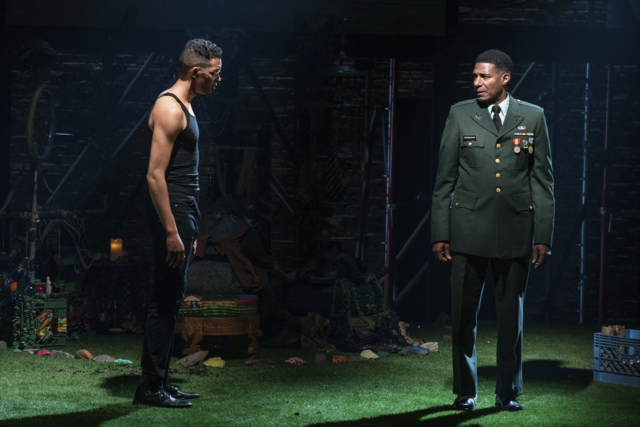
Aleshea Harris’s On Sugarland takes place in a southern cul-de-sac amid wartime (photo by Joan Marcus)
ON SUGARLAND
New York Theatre Workshop
79 East Fourth St. between Second & Third Aves.
Tuesday – Sunday through March 20, $55-$75 www.nytw.org
“We got to holler,” Staff Sergeant Saul Greenwood (Billy Eugene Jones) declares in Aleshea Harris’s electrifying On Sugarland, continuing at New York Theatre Workshop through March 20. He and the Sugarland cul-de-sac of mobile homes, a poor neighborhood trapped inside circular train tracks that promise to take them nowhere, holler in unison to mourn lost members of their community and to honor their ancestors, but the screams resound against generations of socioeconomic injustice and systemic racism emanating from the military industrial complex and its reliance on a fervent nationalism above all else.
Brilliantly filtering Sophocles’s Philoctetes through a bit of Tennessee Williams, Harris tells the vivid, haunting story of the four-hundred-year war fought by Blacks in America for their humanity. The play opens as the people of Sugarland gather to holler for Sergeant Iola Marie Eagle Eye, who the army has finally declared Presumed Killed in Action after her body had gone missing for years. Her fourteen-year-old daughter, Sadie (Kiki Layne), hasn’t spoken in all that time, her voice as well as her mother taken from her, but the narrative is punctuated with her long, poignant monologues to the audience about the matriarchs of her family, generation by generation, back to her great-great-great-grandmother, a freed slave who carried messages to Union soldiers during the Civil War. Each of her stories ends with bloodshed.
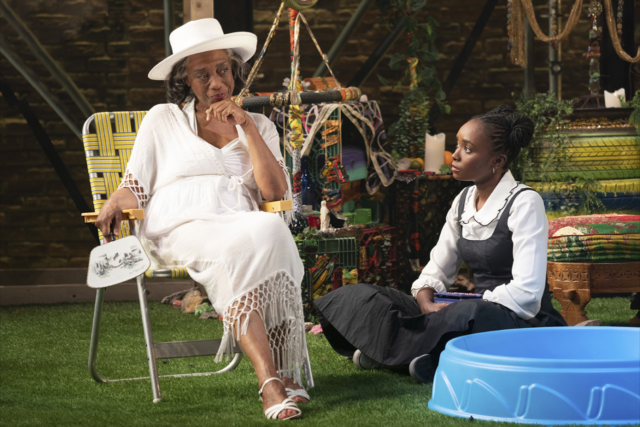
Evelyn (Stephanie Berry) and Tisha (Lizan Mitchell) are elderly sisters who can’t stop squawking at each other. Evelyn is like Blanche DuBois, living in a fantasy world; she takes her time overdressing for Iola Marie’s funeral, hoping to attract a suitor. Tisha tends to an outdoor shrine where she collects items from the men, women, and children who have died, paying special attention to her late son’s belongings, which she talks to as if he were there. “It’s time. You’re gonna make us late,” Tisha complains. “The only ‘late’ a lady ever needs to worry about is when her monthly hasn’t shown itself. And since your basement is sealed shut, you good,” Evelyn responds. “When they send you to hell, Ima be in Heaven waiting,” Tisha says.
Saul leads the service in honor of Iola Marie, proclaiming, “We got to holler / They ain’t sent her body home / ’Cause there ain’t nothin left to send / The War has taken the flesh of our dear sister / but the soul is intact / And we are gathered here to reach into / the next world / the world that now holds Iola / We are gathered here to knock on that world’s door / with a singing and a praise / We are gathered here to holler so she can hear us from where she’s at and know that she was loved.” It’s a powerful memorial for all fallen Black people, not just one lost soldier.
Addis (Caleb Eberhardt) and his father, Saul (Billy Eugene Jones), face different kinds of battles in searing new play (photo by Joan Marcus)
But Evelyn is having none of it. “That War can kiss the black off my ass. Fuck that War. Fuck burying boxes. Fuck hollering,” she tells her sister. “I am not cursing the doing of things. I am cursing their necessity. I am cursing the conditions which have led to what have become our customs. Little girls burying boxes for their dead mothers. Our front yard looking like some kind of horrifying carnival graveyard. Calling it Sugarland don’t make it sweet.”
Saul’s seventeen-year-old son, Addis (Caleb Eberhardt), wants to be a warrior like his father; too young and addled for the military, he guards Sugarland as if he were a soldier. He’s in love with Iola Marie’s sister, Odella (Adeola Role), a woman his father’s age. He tells Sadie, “Uh huh Busy being a soldier if you must know I’m already in Junior Cadets Almost Cadet First Sergeant If The War come to this cul-de-sac Ima show out Gon be the last one standing Ima carry the flag and plant that mug on a hilltop They gon make a statue of ya boy Ima be a hero They gon call my name.” Addis regularly shaves his father with a straight razor and helps tend to Saul’s damaged, foul-smelling foot, which oozes blood. Addis wants to join the army, while Saul wants to return to duty, despite his mental and physical injuries.
Meanwhile, the Rowdy (Thomas Walter Booker, Xavier Scott Evans, Mister Fitzgerald, Josh Fulton, Charisma Glasper, Kai Heath, Shemar Yanick Jonas, and Mariyea), a group of eight male, female, and nonbinary teenagers, serve as the Greek chorus, wandering around on the periphery, parading through the space, blasting music, harassing Addis, and commenting on what they’re seeing and occasionally interacting with the others as the biggest holler of all is to come.
On Sugarland is a brilliant, Pulitzer-worthy play deserving of a Broadway transfer and a wide audience. Harris (Is God Is,What to Send Up When It Goes Down), a former spoken-word performer whose mother is a Trinidadian immigrant who spent twenty years in the army, captures the heart and soul of a community too long unheard and unseen. Sadie talks often in her monologues of how her female ancestors were invisible. “White men ain’t in the business of seeing little black girls / you know / we invisible,” she says. Saul says a similar thing about Iola Marie. Their hollers echo through the theater until you can feel it in your bones. Harris makes it clear that a reckoning is coming, so everyone better start opening their eyes and ears. “It was a goddamn beautiful massacre,” Sadie says of an ancestor’s act of vengeance.
Obie-winning director Whitney White (Our Dear Dead Drug Lord,Semblance), who previously collaborated with Harris on the ritualistic healing production What to Send Up When It Goes Down, maintains a furious pace, a relentless assault on the senses that is superbly choreographed by Raja Feather Kelly (Hurricane Diane,The House That Will Not Stand); there is nary a wasted word or movement during the play’s intense and passionate 160 minutes (with intermission).
Evelyn (Stephanie Berry) remembers the past as Sadie (Kiki Layne) listens intently (photo by Joan Marcus)
The play is set in what the German-born, Kentucky-raised Harris describes as “a time of war. yesterday, today, and, unfortunately, tomorrow.” Adam Rigg’s confining set tempts the characters with a potential freedom that seems to always be just out of reach. Qween Jean’s costumes run from elegant to street-savvy, while Mikaal Sulaiman’s sound design and his and Starr Busby’s original music pound and pulsate.
At several points, the recording of a bugle can be heard. The onstage characters stop what they’re doing and salute a nonexistent flag. Despite how this country has treated them and their ancestors over the last four centuries, they still believe in what it has to offer. “Iss all kinda massacres, ain’t it?” Sadie says after a bugle plays the anthem. “All kinds. They got all kinds.”
Arthur Schnitzler’s controversial La Ronde gets a new adaptation at the IRT Theater (photo by Adrian Viruet)
ROUND DANCE
IRT Theater
154 Christopher St. between Washington & Greenwich Sts.
Thursday – Sunday through March 27, $30 irttheater.org
Arthur Schnitzler’s controversial 1897 play, Reigen, better known as La Ronde, took more than two decades to reach the stage in a professional production, then was banned. The Vienna-born writer was brought up on immorality charges, laced with anti-Semitism, in Berlin and, though cleared, refused to allow the play to be performed in German-speaking countries; it wasn’t until 1982 that his son gave permission for productions in Germany and Austria.
La Ronde is a circular tale of five men and five women rotating in scenes of sex and love in 1890s Vienna; in each episode, one of the characters moves on to another person in the next scene, then that second person continues to a third person, and so on until the story revolves back to the first. The play has been adapted into a glorious 1950 film by Max Ophüls, narrated by Anton Walbrook and featuring a lively merry-go-round; Roger Vadim made a raunchier version in 1964 set in 1914 Paris, the script adapted by Jean Anouilh.
Oldest Boys Productions and Accidental Repertory Theater are now presenting the play, with the English title Round Dance, at the IRT Theater on Christopher St., directed by H. Clark Kee from his own translation. Part of the 3B Development Series, the show takes place in a small, intimate space. All ten actors — who portray men and women from different classes, from a hooker, a count, a poet, and a young wife to a soldier, a sweet girl, a gentleman, and a chambermaid — are always onstage. The eight actors who aren’t in the scene are lined up on the right and left, sitting in folding chairs, and they leap up to rearrange the set (tables, chairs, beds) in between each encounter. The success of the play depends on the subtle chemistry among the cast and the smooth transition between scenes, but Kee can’t quite reach those goals.
The acting is uneven, and the pace is unsteady, particularly over the course of two hours without an intermission. It has its moments but cannot sustain enough intensity, and the attempts to make the tale more relevant in the #metoo era amid the much-needed reevaluation of sexual consent, power dynamics, and conventional gender roles don’t ring true, nor does the incidental and interstitial music, which includes Haddaway’s “What Is Love (Baby Don’t Hurt Me).”
In the twenty-first century, Round Dance, which is set in an unidentified recent past, should look more forward; for example, in 2019, Cutting Ball Theater staged a version of La Ronde performed by two women, one Black, one white, that challenged old-fashioned perceptions and stereotypes from multiple perspectives, and Canada’s Soulpepper Theatre Company went all-out in a bold, sexy adaptation by Jason Sherman in 2013.
At the end of the play the night I went, the cast beckoned to Kee (Yellow Sound,Leonce and Lena) to join them onstage and accept a bouquet of roses; he declined, perhaps out of shyness, or maybe because he knew that the play still could use some further development.
A DAYLONG CELEBRATION
Metropolitan Museum of Art
1000 Fifth Ave. at 82nd St.
Sunday, March 13, free with museum admission, 11:00 am – 4:00 pm
212-535-7710 www.metmuseum.org
In November, the Metropolitan Museum of Art opened a new period room, the spectacular Afrofuturist Before Yesterday We Could Fly, an homage to the nineteenth-century Seneca Village, a thriving African American community, including Black landowners, that was taken away by the city in order to build Central Park. Named after Virginia Hamilton’s 1985 children’s book, The People Could Fly: American Black Folktales, the installation features more than six dozen objects, including bowls, vases, cups, plates, chairs, jars, boxes, paintings, sculpture, and more by such artists as Robert Lugo, Zizipho Poswa, Atang Tshikare, Elizabeth Catlett, William Henry Johnson, Magdalene Odundo, and Njideka Akunyili Crosby. The room is instilled with a spiritual energy that is intoxicating, melding past and present with the future.
“I think for a lot of us, when we were kids, our ability to envision a future that was different than some of the things that we didn’t like that we were seeing around us was to escape into a fantasy and envision a future that’s more akin to a superhero comic book than it is to actual reality — and I think that comes through in my work and a lot of the people that express visions in an Afrofuture,” Swiss industrial designer and artist Ini Archibong says in a Met video; Archibong contributed two Atlas Chairs, an Orion Table, and the Vernus 3 chandelier to the room.
“The Black imagination and manifestation of freedom is really what I was aiming at. And my feeling that roots, magic is really at the center of our strength and identity, and is something that has always helped direct us into the future and given us strength in the present,” Haitian-born, Brooklyn-based conceptual artist Fabiola Jean-Louis says in another Met video; her ornately designed Justice of Ezili corset dress, a tribute to Vodou loa (spirit) Ezili Dantor, is a highlight of the room.
Also be on the lookout for Henry Taylor’s Andrea Motley Crabtree, the first, a portrait of the first woman and Black woman army deep-sea diver; Willie Cole’s Shine, a mask made of high-heeled leather shoes equating soles and souls; Tourmaline’s photographic self-portraits Summer Azure and Morning Cloak; Njideka Akunyili Crosby’s Thriving and Potential, Displaced (Again and Again and…), wallpaper that merges a Seneca Village map with images from the African diaspora; Andile Dyalvane’s Umwonyo, a pot that collapsed when he danced in his studio; Roberto Lugo’s Digable Underground, a porcelain sculpture with images of Harriet Tubman and Erykah Badu, in a place of honor on a glass plinth within an open brick tower; and Jenn Nkiru’s Out/Side of Time, a mysterious photo made specifically for the period room.
On March 13, the Met will host an all-day celebration of the installation, running from 11:00 am to 4:00 pm, consisting of art workshops in which participants can make tech-y accessories and social justice pottery; gallery chats with curators and researchers Sarah Lawrence, Ian Alteveer, and Ana Matisse Donefer-Hickie; the panel discussion “In the Parlor” with Rena Anakwe, Dyalvane, Jean-Louis, and Tourmaline; storytelling; and more. All events are free with museum admission; some require advance registration.
Social Alchemix (Live!) is back for monthly Monday night festivities (photo by Karen May)
Who:Social Alchemix (Live!) What: Cocktail party social experiment Where:the Studio @ Threes Franklin, Threes Brewing Greenpoint, 113 Franklin St., Brooklyn, and Caveat NYC, 21 A Clinton St., Manhattan When: Monthly Monday nights: March 14 and April 18, the Studio @ Threes Franklin, $18-$49, 6:30; May 16, Caveat NYC, $18, 7:00 Why: After being locked inside for much of the last two years, we are all ready to break out and party with friends, relatives, colleagues, and strangers (in safe spaces). During the pandemic, Social Alchemix held events over Zoom, an interactive game night featuring storytelling, an original card deck, and specialty drinks conceived, designed, and hosted by cocktail guru Wil Petre. The participatory event, held monthly on Monday nights, encourages everyone to come together in the spirit of fun and camaraderie. The cards features such prompts as “What rules are meant to be broken?” and “How would you like to be remembered?”
Social Alchemix (Live!) is now back in person; the March 14 and April 18 gatherings take place at the Studio @ Threes Franklin in Brooklyn, while the May 16 edition moves to Caveat NYC in Manhattan. “This game and show certainly had weight prepandemic,” Petre said in a statement. “Feelings of isolation due to this hyperconnected hustle-culture — the past two years only seemed to underline these issues. As a country we’re as divided as ever, and after months of lockdown, we’re incredibly rusty when meeting new people. If ever there was a need for an evening of permission, not only to share our stories but to deeply listen, listen longer than we are used to, that time is now.” General admission is $18; for $49, you get to take home your own copy of the game. And be prepared to hang out for the afterparty.
Who:Et Alia Theater What: One-night-only performance of White Rabbit Red Rabbit Where:Theater for the New City, Johnson Theater, 155 First Ave. between Ninth & Tenth Sts. When: Sunday, March 13, $10-$18, 8:00 Why: On Friday, March 13, 2020, theaters across New York City were shuttered because of Covid-19. On March 13, 2022, at 8:00, to mark the two-year anniversary and to celebrate the reopening of venues around the globe, international companies will be performing Berlin-based Iranian playwright Nassim Soleimanpour’s 2011 autobiographical hit White Rabbit Red Rabbit as part of Let There Be Theatre — A Call to Action. The event is organized by Berlin-based Aurora Nova founder Wolfgang Hoffmann, who explains: “Ten years ago, almost to the day, I performed in a show at the Fadjr Festival in Tehran. At the festival hotel I was introduced to a young unpublished playwright who did not have a passport because he had refused to do military service. In order to get his work in front of an audience, he had devised a play that had to be performed as a cold read, without the need of a director, set, or rehearsals. All it needed was for a brave performer to agree to read a text in front of a live audience, without first knowing what the play was about. I liked this young man and loved his idea and spontaneously agreed to help produce his show at the Edinburgh Fringe later that year. When I finally saw the show performed live, I realised what this playwright had achieved. Through the power of his words alone he had written himself to freedom.”
Here in New York, Et Alia Theater, a company founded and led by international women, will be staging White Rabbit Red Rabbit at Theater for the New City, performed by co-artistic director Maria Müller (On How to Be a Monster,Where Are You from Again?). During the pandemic, Et Alia made the indie film This Is Me Eating___, then performed it live at the Alchemical Studios for one day last October. Tickets are only $10–$18 to see the sixty-to-ninety-minute show, which is always just as surprising for the actor as it is for the audience. I saw Obie winner Linda Emond in Soleimanpour’s autobiographical Nassim in 2018, which also involved no rehearsals and no prior access to the script, and it was a joy from start to finish. Among those who have previously performed White Rabbit Red Rabbit are John Hurt, Whoopi Goldberg, Nathan Lane, Stephen Rea, Sinead Cusack, Dominic West, Wayne Brady, Darren Criss, Kathy Najimy, Cynthia Nixon, Bobby Cannavale, Michael Urie, and Ken Loach.
Et Alia Theater will perform White Rabbit Red Rabbit on March 13 at Theater for the New City
“It is a one-time experience because the performer will have its opening and closing night of this play at the same time,” Hoffmann continues. “At 8 pm in every time zone there will be a multitude of shows starting at the same time for twenty-four hours, thus creating a massive theatrical community. On March 13 hundreds of courageous performers will face the same daring task to read a text they have not seen before to a live audience and everybody will be present at the same moment. The thought of all of us together, making theater once again — gives me boundless hope and energy.” Yes indeed, it’s great to be back.
Pianist Nargiz Aliyarova and cellist Sergey Antonov will perform an all-Chopin concert at Carnegie Hall on March 15
Who:Nargiz Aliyarova,Sergey Antonov What: Benefit concert of Chopin music Where:Carnegie Hall, Weill Recital Hall, 881 Seventh Ave. at West 57th St. When: Tuesday, March 15, $30-$60, 8:00 Why: “I am so excited,” New York–based Azerbaijani pianist Nargiz Aliyarova told me recently about making her Carnegie Hall debut. “Any musician in the world would be happy to be on this stage!” Aliyarova, who is also a professor with a doctorate in art, will be joined by US-based cellist Sergey Antonov in a special all-Chopin program at Weill Recital Hall on March 15. The concert is being presented by the National Music & Global Culture Society, a nonprofit organization founded by Aliyarova “to unite our multicultural community through the advocacy of music from around the world,” focusing on providing lessons to disadvantaged youth, hosting contests and festivals, and publishing a quarterly online magazine.
Aliyarova, who began giving recitals at the age of nine and was awarded a diploma “for outstanding contribution to the legacy of Frédéric Chopin” by the Polish government in 2010, has released three albums of works by Mozart, Beethoven, Haydn, and Chopin in addition to two CDs of Azerbaijani music, including compositions by Jovdet Hajiyev, Gara Garayev, Franghiz Alizadeh, Vagif Mustafazadeh, and Javanshit Guliyev. The Russian-born, Grammy-nominated Antonov, a gold medal winner at the XIII International Tchaikovsky Competition in Moscow in 2007, began playing the cello when he was five; he has released Elegy with pianist Ilya Kazantsev, Strauss & Rachmaninov: Sonatas for Cello & Piano, and an album of music by Robert Schumann. He is also a member of the Hermitage Piano Trio with Kazantsev and violinist Misha Keylin.
The Carnegie Hall program features an exciting mix of works by Chopin, the Polish Romantic composer and pianist who passed away in 1849 at the age of thirty-nine. Aliyarova and Antonov will be performing Polonaise Brillante for cello and piano Op. 3, Sonata for cello and piano Op. 65, Nocturne Op. post in C sharp Minor, Waltz Op. 34 N.2 in A minor, Waltz Op. 64 N.2 in C sharp Minor, Ballade in F minor, Op. 52, and the world premiere of Chopin and August Franchomme’s Grand Duo concertant in E major, B. 70, arranged for cello and piano by Lala Jafarova. Antonov and Aliyarova previously played together at the International Mugham Center in the Azerbaijani capital of Baku in September 2021, performing works by Chopin and Claude Debussy. The Carnegie Hall concert by these internationally renowned musicians is both a respite from the latest news and a reminder of how important it is “to unite our multicultural community through the advocacy of music from around the world.”