live performance

THE LEHMAN TRILOGY

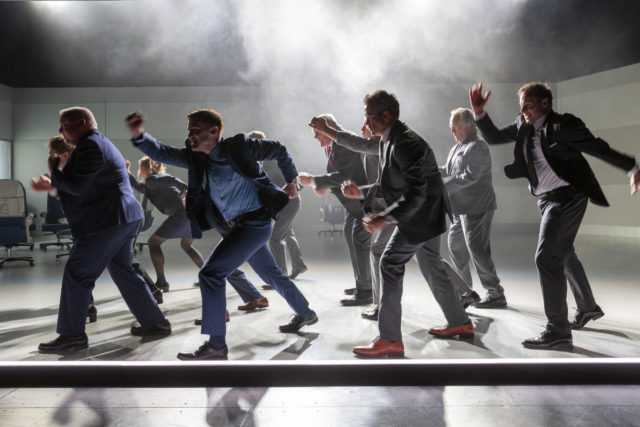
The Lehman Trilogy takes place on Es Devlin’s stunning stage (photo by Julieta Cervantes)

THE LEHMAN TRILOGY
Nederlander Theatre
208 West 41st St. between Seventh & Eighth Aves.
Tuesday – Sunday through January 2, $59-$209
877-250-2929
thelehmantrilogy.com

“The prospect of sitting through a nearly three-and-a-half-hour play about the history of Lehman Brothers performed by a mere three actors might not necessarily be your idea of fun,” I wrote about the American premiere of The Lehman Trilogy at Park Avenue Armory in the spring of 2019. But it turned out to be what I called “an epic masterpiece, must-see theater at its finest.”

Still, the prospect of watching it two and a half years later, at the Nederlander Theatre on Broadway with two of the same actors amid a continuing pandemic, was not necessarily my idea of fun. But it turned out to once again be must-see theater at its finest.

Adapted by writer Ben Power and director Sam Mendes from Stefano Massini’s five-hour Italian original, the dazzling play relates the history of the men behind the business, siblings Henry (Simon Russell Beale), Mayer (Adam Godley), and Emanuel Lehman (Adrian Lester), who were born and raised in the small town of Rimpar in Bavaria and arrived, individually, in the United States between 1844 and 1850, operating a fabric store in Montgomery, Alabama. Over the years, they change with the times and the needs of the market, selling raw cotton, coffee, and coal and, eventually, trading money, building a vast empire that came crashing down in the 2008 financial crisis. Henry is considered the head, with the most business sense; Emanuel the arm, able to forcibly get things done; and Mayer the potato, an unequal partner who serves as the mediator. As the firm develops, the evolving name of the company is written and rewritten on glass walls, a constant reminder of where they were and where they are going.

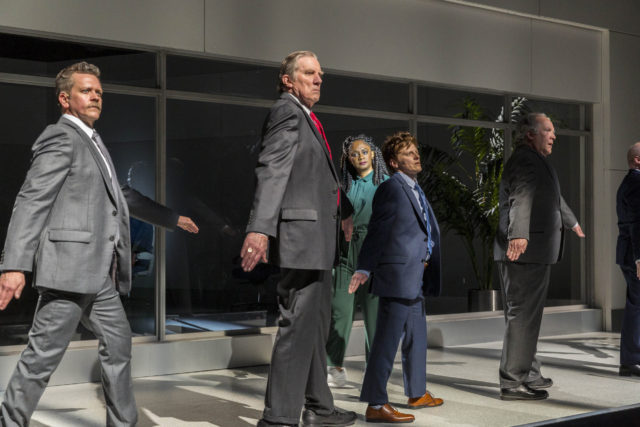
Adam Godley, Simon Russell Beale, and Adrian Lester play multiple roles in The Lehman Trilogy (photo by Julieta Cervantes)

The story is told primarily in the third person, an ingenious decision that adds an extra dimension to the characters, giving them each a unique perspective on themselves and their family.

Henry: Every morning, like this morning, they get up at five in their three-room home.
Mayer: They light the lamps with whale oil and wash with one pail of water between them.
Emanuel: This is worse than Germany! Emanuel said on his third day in America.
Mayer: After the slap that Henry laid on his face he never said it again.
Henry: Every morning, like this morning, while Montgomery sleeps, they pray together before leaving.
Emanuel: Just as they did in Bavaria. They put on their hats and go out.
Mayer: Another day.

The narrative is divided into three chapters, “Three Brothers,” “Fathers & Sons,” and “The Immortal,” as their fame and fortune rises through the next generations, which include Emanuel’s ruthless son, Philip (Beale); Mayer’s son, Herbert (Lester), who believes in fairness, stability, and security, not the Lehman tradition of risk taking; and Philip’s son, “Bobby” (Godley), who loves the limelight and becomes the very public face of the company. “No one outside this family can ever truly understand. What we’ve done. Why we did it. What we plan to do next,” Philip says. Bobby answers, “At Yale they teach us that nothing is more outdated as betting on industry. The times are changing, Father. The new century will wipe everything away.” He doesn’t know how right he is.

The play takes place on Es Devlin’s gorgeous set, a large, revolving transparent cube with several office-like rooms. Video designer Luke Halls projects geographic scenes onto the huge semicircle at the back of the stage and onto the floor around the cube, from the vast sea and plantation estates to cotton fields and the New York City skyline. As good as it all looks, the set lacks the magic and power it had in the armory’s massive Wade Thompson Drill Hall; it feels too cramped on the Nederlander stage, where, depending on where you’re sitting, you’re unlikely to get its full impact.

The history of the Lehman brothers is told by three actors in sensational production (photo by Julieta Cervantes)

Beale (Candide, Uncle Vanya), Godley (Rain Man, Anything Goes), and Olivier winner Lester (Red Velvet, Company), who replaces Ben Miles as Emanuel, are majestic, an absolute marvel. The three men have a commanding presence, balancing humor and gravitas as they move about the cube, using office packing boxes as furniture, arranging them into steps, furniture, and even a piano. (A real piano is played offstage by Candida Caldicot.)

Oscar, Tony, and Olivier winner Mendes (The Ferryman, American Beauty) and Power (Emperor and Galiean, Husbands and Sons) have made a few tweaks to the show in the wake of the Covid-19 crisis and the George Floyd protests. When Mayer discusses how the company benefits from plantations and slaves, Henry notes, “Doctor Beauchamp, who once treated the children of those slaves for chickenpox, now shakes his head the way he once did about yellow fever: ‘Surely you knew it could not last, Mr. Mayer? Everything that was built here was built on a crime. The roots run so deep you cannot see them but the ground beneath our feet is poisoned. It had to end this way.’” But “Mayer doesn’t want to hear. So day and night, he tries to convince himself that, although the war is lost, the South if you look hard enough still stands, is not dead.”

Later, in a Greek diner in Nebraska, Henry relates the story of its owner, Georgios Petropoulos: “He crossed the country in 1918 when the soldiers brought the influenza back from Europe and half a million Americans died. He saw the priests collecting the bodies off the street in Philadelphia, and the protests in San Francisco, against the wearing of masks.” At the Nederlander, employees walk up and down the aisles, making sure all audience members are wearing their masks correctly, over their mouth and nose.

Despite running more than three hours with two intermissions, The Lehman Trilogy flies by, moving faster than the Dow Jones stock ticker. It’s also a whole lot more satisfying, with Power, Mendes, and the outstanding cast taking all the risks and leaving all the rewards for the audience.

JENNIFER NETTLES: BROADWAY UNDER THE MISTLETOE

Who: Jennifer Nettles
What: Broadway Under the Mistletoe tour
Where: The Town Hall, 123 West Forty-Third St. between Fifth & Sixth Aves.
When: Wednesday, December 15, $69 – $129, 7:30
Why: Fresh off her turn in the lead role of Jenna in Waitress on Broadway, Georgia-born singer-songwriter and actress Jennifer Nettles returns to New York City with her holiday show “Broadway Under the Mistletoe,” which comes to the Town Hall on December 15. Nettles, a three-time Grammy winner who formed the country-pop group Sugarland in 2003 with Kristen Hall and Kristian Bush, has also starred on Broadway as Roxie Hart in Chicago, has appeared in the television series The Righteous Gemstones and the film Harriet, and has released such solo albums as That Girl, Always Like New, and To Celebrate Christmas, which includes seasonal favorites by Kenny Loggins, Dolly Parton, Irving Berlin, and others. The concert will feature Christmas songs and Broadway classics as well as tunes from Sugarland and Nettles’s solo career.

PROJECT SHAW: VILLAGE WOOING

Who: Maryann Plunkett, Jay O. Sanders
What: Project Shaw reading of Village Wooing
Where: Leonard Nimoy Thalia Theatre, Symphony Space, 2537 Broadway at Ninety-Fifth St.
When: Monday, December 13, $40, 7:00
Why: Gingold Theatrical Group’s long-running Project Shaw, which began in 2009 with the goal of eventually presenting every one of George Bernard Shaw’s sixty-two works, returns to live performances with a concert reading of 1933’s two-character comedy Village Wooing. Real-life husband and wife Jay O. Sanders (Girl from the North Country, Uncle Vanya) and Maryann Plunkett (Me and My Girl, Sweet and Sad) star as A and Z, respectively, who meet on board a cruise liner; he is a writer, while she is the daughter of a postman. They have three conversations, the first on the cruise, the latter two at a village shop where she works. Plunkett and Sanders work together often, most famously in Richard Nelson’s Rhinebeck Panorama, about three upstate families, the Apples, the Gabriels, and the Michaels. Shaw wrote the play after going on his first cruise.

“Though we kept these play readings going online during the last year and a half, and we’ll continue with an online presence, reconnecting with our in-person community is what we’ve most missed,” founding artistic director David A. Staller said in a statement. ”[We’ve just finished] the in-person off-Broadway production of Shaw’s Mrs. Warren’s Profession and decided to celebrate the end of this challenging year with a party, of sorts, with two of my favorite humans: Maryann and Jay. Just being with them is a party.” The party takes place December 13 at 7:00 at the Leonard Nimoy Thalia Theatre; tickets are $40.

PIONEERS GO EAST COLLECTIVE: CROSSROADS

The next edition of gorno’s Yonsei f*ck f*ck is part of Pioneers Go East Collective “Crossroads” series at Judson Memorial Church

Who: Pioneers Go East Collective
What: Performance series
Where: Judson Memorial Church, 55 Washington Square South between Thompson & Sullivan Sts.
When: Thursday, December 9 & 16, free – $50 (sliding scale), 8:00
Why: Pioneers Go East Collective was founded in 2010 as “an arts and cultural organization inspiring a lively exchange of queer art and culture by connecting people to ideas and experiences.” Focusing on social engagement, collaboration, accessibility, and relevance, the Manhattan-based group has put on such multimedia performances as My name’sound, Virgo Star, and American Mill No. 2 at such venues as La MaMa, Ars Nova, A.R.T/ New York Theatre, and Triskelion Arts. On December 9 and 16, PGEC returns to Judson Memorial Church for the performance and video series “Crossroads,” building a community of art, poetry, music, dance, film, and more around the work of multigenerational queer, BIPOC, and feminist artists.

On December 9 at 8:00, curator Hilary Brown-Istrefi brings together ALEXA GRÆ’s eve’s witness. 2 soliloquies to the night, created by GRÆ, Jon Wes, and Matthew Ozawa with text by Connie Edgemon; Arien Wilkerson’s climate change performance installation Equators, made in collaboration with David Borawski, Jon-Paul LaRocco, and Domenic Pellegrini; and gorno’s (Glenn Potter-Takata) Yonsei f*ck f*ck pt. 12, a collaboration with evan ray suzuki and Kimiko Tanabe. The program on December 16 consists of dancer Lydia Mokdessi and musician Jason Bartell’s Devotion Devotion IV, joined by vocalist Syd Island; Marija Krtolica’s Infinite Subjectivity, a dance-theater piece performed by Michael Mangieri and Krtolica, with live music and reading by Jason Ciaccio and text by Søren Kierkegaard; and Janessa Clark’s film Future Becomes Past, with dancer Courtney Drasner revisiting a 2003 solo, photographed by Kathleen Kelley with music by Ben Lukas Boysen and Sebastian Plano, along with an untitled work in progress by Clark.

AND WHAT HAPPENS IF I DON’T

The Cherry is back with the hybrid What Happens if I Don’t through December 12

AND WHAT HAPPENS IF I DON’T
Cherry Artspace and online
102 Cherry St., Ithaca
December 3-12, $25-$35 in person, $20 livestream
www.thecherry.org

The pandemic lockdown might have shuttered venues around the country, but it also offered theater lovers the opportunity to see innovative online productions from companies that are out of one’s geographic range. Since April 2020, I have enjoyed works from Baltimore Center Stage, San Francisco Playhouse, DC’s Studio Theatre and Woolly Mammoth, Steppenwolf in Chicago, Hartford Stage in Connecticut, Boston Court Pasadena and Barrington Stage in Massachusetts, and Chichester Festival Theatre and the Bristol Old Vic in England, among others, all while sitting at my computer.

One of the little gems has been Ithaca’s nonprofit Cherry Artists’ Collective, which has presented Felt Sad, Posted a Frog (and other streams of global quarantine), which interwove six stories dealing with isolation, A Day, a hybrid green-screened show that cleverly revealed its process between scenes, and the two-character onstage Hotel Good Luck, which looked at time, space, and loss in surprising ways.

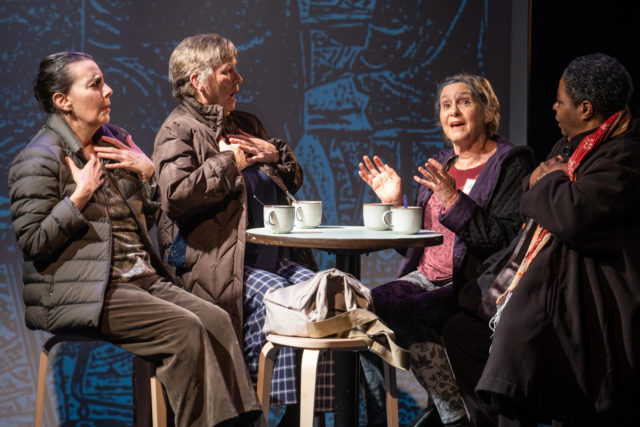
The company’s latest work is its first indoor show in front of an audience since the coronavirus crisis closed everything down. Berlin-based Serbian playwright and screenwriter Iva Brdar’s And What Happens if I Don’t is being performed in the theater and streaming live through December 12 from the Cherry Artspace. I saw one of the streams, filmed with multiple cameras (including one overhead); the play begins with the small audience entering the intimate space, sitting on chairs and risers on three sides of the room, and ends with the crowd leaving, adding to the overall live experience for those at home. The sixty-minute narrative features eight actresses — Adara Alston, Barbara Geary, Naandi Jamison, Elizah Knight, RJ Lavine, Elizabeth Mozer, Jen Schilansky, and Amoreena Wade — portraying thirteen girls and women who, as they grow older, from birth to seventy-eight, share stories about life lessons, both good and bad, they learned from their mothers; each scene also involves a threatening male figure, from a father and a traffic officer to a creepy man at a public pool and a Customs agent.

What Happens if I Don’t explores outdated gender roles in a series of monologues

In “On Ears, age 0,” the only thing a father can say to his newborn daughter (Jamison) is that she has nice ears, which warps her view of the rest of her body. In “On Concrete, age 18,” a teenager (Alston) is told by her mother to avoid sitting on concrete or else she will become a “sterile, hysterical, unfulfilled woman.” In “On Toilet Seats, age 29,” a woman’s (Wade) mother insists she not sit directly on toilet seats unless she wants to get a disease. Other words of advice relate to urinating` in pools, people with dimples, eating fruit, and plucking out gray hairs.

Each scene starts with the character, dressed in modern-day casual clothing, attempting to jump rope held by two of the other actors, a constant reminder of the joys and fun associated with childhood that go away as one ages and discovers more about the not-so-carefree world. Each character is also joined at one point by three angels who remind her that she is “polite, kind, and very well behaved,” understanding what is expected of her as a girl and a woman. Places to sit (a chair, a small bench, a large wooden farm spool) are moved around to sharp sound effects for every vignette, under eighteen lightbulbs in lampshades hanging from the ceiling at different heights. (The sound and music is by Lesley Greene, with lighting by Chris Brusberg, costumes by Iris Estelle and Sasha Oliveau, and livestream design by Greg Levins and Karen Rodriguez.)

Director Susannah Berryman (Holy Ghosts, Daisy Pulls It Off) gives the cast an ample amount of freedom, resulting in a loose, natural feel despite the serious turns; it’s a show by women, about women, but the male need for power and control hovers over all of it as Brdar (Geraniums Can Survive Anything, Rule of Thumb) explores sexism, misogyny, and old-fashioned gender roles. And What Happens if I Don’t also asks the question “Is mother always right?” (The answer is decidedly no.) The show consists of a series of monologues, but the eight cast members stand together throughout, supporting one another as they battle systemic stereotypes that are still all too real in 2021.

TINSEL: EVERETT BRADLEY’S HOLIDELIC

Who: Everett Bradley and special guests
What: Holidelic funk revue
Where: Lucille Lortel Theatre, 121 Christopher St.
When: December 9-31, $31-$101 (use code TINSEL50 for half-price tickets)
Why:Holidelic was born out of my obsession with Parliament Funkadelic. I grew up on that music and I love it, and I also like Christmas,” Everett Bradley says in a promotional video about his popular Christmas jam, returning this month to the Lucille Lortel Theatre. “I’m like a Christmas geek.” In his guise as Papadelic, the Father Christmas of Funk, the Grammy-nominated percussionist is joined by special guests, everyone in outrageous holiday finery as they blast through groovy Christmas songs, many from his 2002 album, Toy, which features such tunes as “Christmas Is Kickin’ In,” “Dirty Snow,” “Funky Santa,” “Say Cheese,” and “I’m Coming Home,” and 2017’s Holidelic: Rebooty, which includes “DysFunktional,” “Sugar Rump Fairies,” “Get on Down That Chimney,” “’Twas the Night Before the Funk,” and “Fro Ho Ho.”

Bradley began writing Christmas songs after 9/11 as a way to provide healing to a grieving nation. There will be twelve performances between December 9 and 31, and the Lortel has teamed up with local restaurants Cowgirl, Northfork, and Red Paper Clip for special preshow dinners and happy hours. Holidelic is part of the Lortel’s “Tinsel” global holiday festival, which kicks off December 6 and features such other shows as Jared Grimes’s Christmas in the Lab, Pastorela: A Very Merry Immigrant Christmas, Jaime Lozano & the Familia’s Canciones para Navidad, Ilene Reid’s the Sounds Around the House, Telly Leung’s Tossing Tinsel with Telly, and Latrice Royale’s Why It Gotta Be White Christmas?!

TWI-NY TALK: JAMAR ROBERTS OF ALVIN AILEY AMERICAN DANCE THEATER

Jamar Roberts will perform new solo on December 9 in final appearance as Ailey dancer (photo by Paul Kolnik)

ALVIN AILEY AMERICAN DANCE THEATER
New York City Center
130 West 56th St. between Sixth & Seventh Aves.
December 1-19, $29-$159
212-581-1212
www.alvinailey.org
www.nycitycenter.org

Jamar Roberts has spent nearly half his life with Alvin Ailey. First with Ailey II, then with Alvin Ailey American Dance Theater since 2002, the thirty-nine-year-old Miami-born Bessie Award winner was named the company’s first resident choreographer in 2019; has created such works as 2016’s Gêmeos, 2017’s Members Don’t Get Weary, 2019’s Ode, and 2020’s A Jam Session for Troubling Times, which was filmed on the roof of the troupe’s midtown studio at the Joan Weill Center for Dance.

During the pandemic, Roberts also created two short films for the Guggenheim’s Works & Process series, the fierce and unrelenting solo Cooped and A Chronicle of a Pivot at a Point in Time, a piece for five dancers in the corner of a studio, their shadows echoing hauntingly against one wall; both feature a tense electronic score by David Watson. In addition, Roberts debuted his fifteen-minute solo, Morani/Mungu (Black Warrior/Black God), at City Center’s 2021 digital Fall for Dance program.

On December 9, as part of AAADT’s annual winter season at City Center, Roberts will perform for the final time; he is retiring from dancing with the six-minute solo You Are the Golden Hour That Would Soon Evanesce, accompanied by pianist and visual artist Jason Moran playing his composition “Only the Shadow Knows (Honey).” On December 3, Ailey premiered Roberts’s mesmerizing Holding Space, which was first seen virtually. The twenty-four-minute piece for thirteen dancers, set to an electronic score by Canadian musician Tim Hecker and featuring scenic design and costumes by Roberts, explores healing and presence and is highlighted by a movable onstage open cube in which dancers perform brief solos. At the debut, I was sitting across the aisle from Roberts, whose eyes were zeroed in on the stage every second.

I spoke with the easily likable Roberts, who smiles and laughs often, over Zoom about his transition from dancer to choreographer, the future of virtual presentations, his newfound love of jazz, and more.

Jamar Roberts discusses the pandemic and his career during Zoom interview (screenshot by twi-ny/mdr)

twi-ny: When you started at Ailey, did you ever anticipate transitioning to choreography? Not all dancers want to become choreographers.

jamar roberts: No, not at all. When I got into the Ailey company, I wanted to be a fashion designer; that was the main thing on my list, and then there were three or four other things. Choreography was, like, number ten.

twi-ny: What were some of the others?

jr: Illustrator, animator, meteorologist, those kinds of things.

twi-ny: So what was your initial feeling when you were named the first resident choreographer in the company’s history?

jr: I was like, cool, only because they had hinted at it before, so I kind of felt it coming, but it didn’t really hit or register until I was well into my second piece.

twi-ny: What’s it like choreographing for your friends and colleagues?

jr: Oh, it’s great. I don’t really like the hierarchy, you know, where it’s like, I am the choreographer, I sit in the chair, you listen to me and you do what I say. I don’t really like that, so I get on the floor and I do the movements too, so for me it’s great because it feels like more of a collaborative effort, that we’re all in it trying to make the same thing. I always tell them I know everything and I know nothing at the same time. I can get the conversation started, but by the end of the day, you’re going to be the ones onstage dancing the work, so your input is essential.

twi-ny: During the pandemic you’ve been incredibly active and prolific. When did you first decide to forge ahead with virtual works?

jr: I didn’t make a decision; I would just get a commission and I would accept it. So I guess the answer to that would be when I got the first commission, which was the Guggenheim Works & Process virtual commission [Cooped.]

twi-ny: For that commission, you’re performer, choreographer, and film director. You really threw yourself right into the whole thing.

jr: Yeah, but if you make something, you’re going to have an opinion about how it should look, what environment it should be in, so the director part for me wasn’t anything more special or significant than the way that you would direct things in the studio, when you make a dance for the theater.

twi-ny: You could have put the iPhone somewhere else and not captured the same claustrophobic effect of confinement.

jr: It’s true. I think that artmaking is part, what, 20% skill, and the rest is taste; the majority of it is taste, and problem solving, and if you’re a person that’s making things and you’re relatively bright and you have a pretty good understanding of what works and what doesn’t — and some of us have that to varying degrees — you just trust your instincts and you go. I am no filmmaker, although I appreciate the sentiment; I’m not a director, but I’m an artist, I’m a person who likes creating, I’m a person who likes to see what I like to see, and if other people like to see what my eye is drawn to, then that’s great. But I’m not really here to put a title on anything. I’m just here to enjoy what it is I’m doing and feel good about it when it’s done.

twi-ny: The reaction to Cooped and so many of your other works has been phenomenal; people do want to see what you want to see. You followed Cooped with Morani/Mungu (Black Warrior/Black God), an intimate solo, and then the exhilarating Jam Session for Troubling Times, which you filmed with a team of dancers outside, although the dancers weren’t allowed to touch each other. What was it like to finally work with dancers, get out in the fresh air, yet still have this barrier, this space between each performer?

jr: When somebody tells you that you have to make a dance but they can’t touch each other, immediately it’s the end of discussion. You just have to deal with the cards you’ve been dealt. I guess at that point I just figured out, well, how am I going to do this. I didn’t really think too much about it because it was what it was.

twi-ny: It was so exciting to watch because just seeing people dance outside in this space was freeing for the viewer too. Your work during the pandemic was very much about space: Cooped is claustrophobic, Jam Session is on the Ailey rooftop, Chronicle has the dancers in a corner, and then with Holding Space you actually have a huge open cage that’s both threatening and liberating. Did these spatial elements progress naturally, or were you looking for confining imagery?

jr: The only one where I specifically looked for confining imagery was for the film Cooped. Everything else happened naturally. I think that because it happened naturally speaks to the kind of person I am. I know some people had a hard time during quarantine, stuck in their apartments, but I actually found it quite . . . great. There’s an aspect of my personality that feels very comfortable at home in confined spaces. I’m also six-four, so I’m always forced into confined spaces, like cars or airplanes. I don’t know, maybe subconsciously there’s a thing there.

twi-ny: Well, I’m much shorter than you and I don’t feel quite as confined, I think, as you do. What part of the city were you quarantining in?

jr: I was in Inwood. We were on tour in Texas in March 2020, and it got shut down. I was at home for about a week and then went to St. Louis to try to ride it out with some friends there. Cooped was made in the basement of their home. So the majority of it was in Missouri, and back and forth to New York.

twi-ny: A lot of your work, prepandemic, pre–George Floyd, and then after, is about the Black body, gun violence, racial injustice, and how Covid-19 disproportionately impacted communities of color while also celebrating, as you’ve said, “strength, beauty, and resilience.” How do you achieve this without expressing these elements explicitly?

jr: I think it’s because I’m a nice guy. [smiles] I mean, when the environment and the things that are going on around you are so heavy, you don’t have to say that much. For me, it really becomes about setting the tone for the moment and then on top of that just doing what dance does, which is inspire. Do you know what I mean? We inspire through images, beautiful images, beautiful movement. The rest is baked into the moment that we’re in.

twi-ny: On December ninth, you’ll be performing for what will be the final time, dancing You Are the Golden Hour That Would Soon Evanesce. Why did you decide now is the right time?

Jamar Roberts’s Holding Space is highlight of Ailey winter season at City Center (photo by Christopher Duggan)

jr: I decided now because my body is at the point where it can no longer keep up with the demands of a full-time professional dance career.

twi-ny: How do you think you’ll feel when it’s over? Are you going to be relieved, excited, sad, or do you have no idea?

jr: I don’t really think it’s the closing of a chapter; I think it’s the opening of a new one. This’ll probably be only the second time that I’ve ever been seen onstage doing my own work. I don’t know, I definitely won’t be crying, and I won’t feel sad at all.

twi-ny: As we come out of the lockdown and theaters are open and dancers can touch each other, do you anticipate making future virtual works or will you be sticking to in-person presentations?

jr: Why not both? I hope in the future they’re not called virtual pieces anymore, that they’ll just be called films. Because the word virtual makes it sound like it’s the B-plan. I think it’s all the same. You can have a virtual piece onstage — just throw a camera on the dancers as they’re dancing and have that be displayed. It’s all tools in the same bag; it doesn’t have to be one or the other. Yeah, I think dance has to think a little big bigger?

twi-ny: When you’re not involved with dance, and it seems like you’re always involved with dance, if you have any free time, what do you do?

jr: I try to connect with my friends and the people I love. I try to be a normal person and go to the clubs. I go to dinner and go and see shows. This past summer — summer in New York is always great because you can go and see so much music, jazz festivals in particular, jazz clubs, seeing live music and other performers. I try to keep my head in what’s going on.

twi-ny: You weren’t always a jazz fan, were you? [Roberts has set pieces to compositions by Moran, John Coltrane, Don Pullen, Nina Simone, Charlie Parker, and Dizzy Gillespie in addition to Fela Kuti and the Last Poets.]

jr: No, I grew up with Brandy, and Britney Spears, and Destiny’s Child, Beyoncé, Alanis Morissette, Björk, and all that music. My family never played jazz in the house; it was probably some gospel music, old sermons from the ’50s, and that’s it. But I had to learn it, I had to teach myself that stuff because I was dancing these works that Alvin Ailey choreographed, and they were all to jazz music. And if I wanted to be able to interpret that work authentically, I had to know what the hell it is I was listening to, where it came from, what was happening at the time in which it was made, just so that I could as a performer come across as authentic, with conviction. I went down the rabbit hole, I guess.