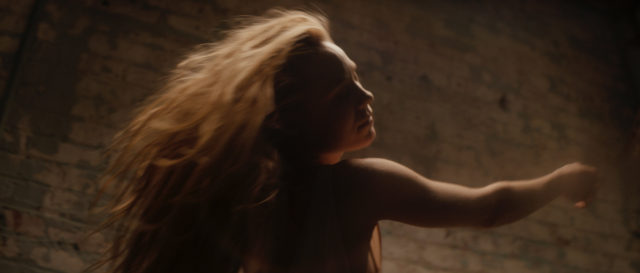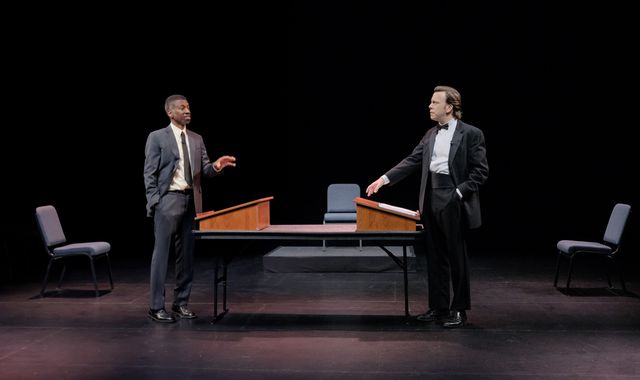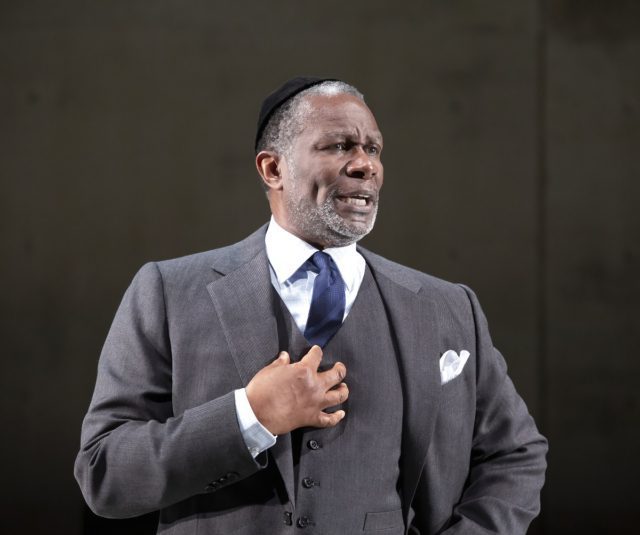
Faith Salie shares her quest for approval in one-woman show (photo by Daniel Rader)
APPROVAL JUNKIE
Audible Theatre’s Minetta Lane Theatre
18 Minetta Lane between Sixth Ave. and MacDougal St.
Tuesday – Sunday through December 12, $46-$56 www.audible.com
In her one-woman show, Approval Junkie, actress, author, and television and radio correspondent Faith Salie explains that when she would share a personal or professional success with her father, he would say, “I’m impressed, but not surprised.” I was impressed and surprised by how much I enjoyed the monologue, in which Salie details her lifelong quest for approval, from being an anorexic Georgia high school beauty and talent show contestant to auditioning for acting parts to getting married and wanting to have children. She also admits to being an applause junkie. “I’m half a century old, and I give a ton of fucks that you’re sitting at my feet,” she tells the audience. “Y’all came to the theater. And I’m pretty sure you’re wearing pants. And I hope you’re smiling behind those masks.”
Salie, an Emmy winner who appears regularly on NPR’s Wait Wait . . . Don’t Tell Me! and CBS Sunday Morning, is charming and likable — and brutally honest. She talks about some intensely private moments, but as much as she’s after our approval, she takes a humble, self-deprecating approach, telling a story that, in many ways, could be about any woman, although she acknowledges her significant privilege. She doesn’t brag about her accomplishments or look for sympathy for her failures; she just wants us to enjoy ourselves and, hopefully, learn about how we don’t need to search for approval ourselves around every corner.
Faith Salie accepts approval on opening night of Approval Junkie (photo by Daniel Rader)
The show is adapted from her book of the same name, which has two different subtitles: Adventures in Caring Too Much for the hardcover, My Heartfelt (and Occasionally Inappropriate) Quest to Please Just About Everyone, and Ultimately Myself for the paperback and ebook. For ninety minutes, Salie, in a lovely dark blue jumpsuit and beige heels (the costume is by Ivan Ingermann), walks across Jack Magaw’s spare set, which features a central platform, two small speakers where she sometimes sits, and a stained-glass-like backdrop of abstract geometric shapes on which video and animation are occasionally projected. Salie shares funny and moving stories about going to an Ayurvedic Healing Center in a Sarasota, Florida, strip mall to exorcise the darkness out of her in order to please her wasband (what she calls her ex-husband); being retweeted by Hillary Clinton and Mandy Patinkin; her desperation to look good at her divorce hearing; and attempting to be a hit on Bill O’Reilly’s Fox program. She remembers that early in her career, she took vocal lessons from acting coach Lesly Kahn, who asked her, “Why aren’t you as pretty as I want you to be?” She answers now, “I don’t know — I’m not as pretty as I want me to be.”
Directed by actor and producer Amanda Watkins, the play — which continues at Audible’s Minetta Lane Theatre through December 12, after which an Audible audio recording will be available — has a warm, welcoming atmosphere. Even when lines fall flat, and a bunch do, Salie proceeds, okay with that momentary lack of approval. Except for the animation at the beginning and end, the projections are random and inconsistent; you’ll find yourself time and again thinking something will be shown when nothing is. And that’s okay too.
It’s all bookended by tales about Shel Silverstein’s classic children’s book The Giving Tree (Salie calls the titular tree “the ultimate woodland approval junkie”) and Salie’s friendship with 104-year-old Ruth Rosner, a journey from childhood to old age. Describing Rosner’s sudden fame from Salie’s television profile of her, Salie says, “We all want to sit at the feet of someone with a century of wisdom and hear that once you get old enough, you stop striving, you figure it all out. You have, as the kids say, ‘zero fucks to give.’ But it doesn’t work that way. It feels too good to take a bow.” In this case, Salie has our approval, and she can take a well-deserved bow. (Salie will be taking part in an Audible Theater online 92Y conversation about Approval Junkie with writer and comic Josh Gondelman on November 30 at 7:00.)
Alley Mills, Lindsay Crouse, Patty McCormack, and Alma Cuervo play four sisters in Morning’s at Seven (photo by Maria Baranova)
Theatre at St. Clement’s
423 West Forty-Sixth St. between Ninth & Tenth Aves.
Through December 5, $44 www.morningsat7.com
It’s a shame that Dan Wackerman’s warm and cozy adaptation of Paul Osborn’s 1939 family comedy, Morning’s at Seven, is ending its run a month earlier than planned at the Theatre at St. Clement’s, closing on December 5 instead of January 9. It certainly can’t be because of the overall quality of the show, which is first-rate, with an outstanding cast and a terrific set. Perhaps it’s the space itself; over the last nine years, I’ve seen only one other play at the theater that I’ve heartily recommended (although I was in the minority); this is the second.
The three-act, 135-minute show (including one intermission) is set in an unnamed middle America small town in 1922, in a quaint backyard shared by an extended family. In one house, Cora (Lindsay Crouse) and her husband, Thor (Dan Lauria), live with one of Cora’s sisters, the single Arry (Alley Mills). Next door, another sister, Ida (Alma Cuervo), lives with her husband, Carl (John Rubinstein), and their forty-year-old nerdy son, Homer (Jonathan Spivey). The fourth and oldest sister, Esty (Patty McCormack), lives a few blocks away with her condescending professor husband, David (Tony Roberts), who thinks her relatives are a bunch of morons. Everyone (except David) is all atwitter that Homer is finally bringing home his girlfriend, Myrtle (Keri Safran), after dating her for twelve years. The general expectation is that Homer will finally marry Myrtle and move into the nearby house on Sycamore Drive that his father Carl built for them, off in the distance as if a beacon of hope. (The homey, comfortable set is by Harry Feiner, with modest, unembellished period costumes by Barbara A. Bell.)
But all is not a Thomas Kinkade / Norman Rockwell scene. Carl has what at the time would be called “a nervous condition,” suffering from vaguely existential spells in which he thinks he is a failure and asks himself, “Where am I?” When the supercilious David finds Esty visiting her family against his wishes, he declares her to be a “free agent” and banishes her to the second floor of their house while he plans to live on the first, barely interacting with her. It soon becomes evident that Arry is no mere old maid but has been in love with Thor for decades. And Cora dreams of at last being alone with her husband, a considerate, likable man who smokes a pipe and prefers to avoid controversy.
Dan Lauria and Alley Mills of The Wonder Years reunite in John Osborne revival (photo by Maria Baranova)
“Cora’s made a couple of awful funny remarks lately about me living by myself. She’s got some bee in her bonnet. She’s up to something,” Arry tells Thor. “Oh, she isn’t either,” Thor says. “Well, she hadn’t better be, that’s all I say,” Arry adds. “Now, your home’s right here with us, Arry. Just as long as you want it,” Thor promises. Arry replies, “Well, don’t you forget it either.” Of course, Cora is up to something, and this long-suffering sister is plotting to take home all the pie, as it were.
Over the course of less than twenty-four hours, long-held secrets, and new ones, emerge as a nine people take stock of their lives, asking themselves, “Where am I?” And they’re not always satisfied with the answer to a question that the audience itself can relate to. It’s probably one of the reasons why the play has been so successful on the rare occasions it has been mounted, earning a slew of Tony awards and nominations for its 1980 and 2002 Broadway revivals, for example.
David (Tony Roberts) has some pointed advice for Carl (John Rubinstein) in Morning’s at Seven (photo by Maria Baranova)
It’s also a treat to watch a play starring seven wonderful actors in their seventies and eighties, at the top of their game. Lauria (Lombardi,A Christmas Story The Musical) and Mills (The Bold and the Beautiful,Bad Habits with her late husband Orson Bean) rekindle the chemistry they had as the father and mother on The Wonder Years from the 1980s; Mills ably stepped in when Judith Ivey tore a tendon during previews. Obie winner and Emmy and Grammy nominee Crouse (The Homecoming,Places in the Heart) is touching as the woman caught between them.
Oscar nominee McCormack’s (The Bad Seed,Frost/Nixon) Esty is just the right foil for two-time Tony nominee Roberts’s (The Tale of the Allergist’s Wife,Play It Again, Sam) ornery and persnickety David, while Obie winner Cuervo (Uncommon Women and Others,On Your Feet!) is appropriately motherly to everyone, especially Tony winner Rubinstein’s (Pippin,Children of a Lesser God) Carl, who is a lost little boy except when he has his manly tools. Safran (Typhoid Mary) and Spivey (The Front Page) hold their own in such talented company as the naive, somewhat simpleminded young couple trying to figure out how to start their life together while the others are closer to reaching the end of theirs.
Obie winner Wackerman (Rocket to the Moon,Ten Chimneys), of the Peccadillo Theater Company, makes the audience feel like it’s a part of this small community, investing in the gossip and intimate drama of a family that unknowingly hides behind false modesty and a self-imposed politeness. They live in their own bubble; they don’t talk about politics, or the economy, or war, which is refreshing. Oscar and Tony winner Osborne, who wrote such hard-hitting plays as Look Back in Anger,The Entertainer, and Luther, took a lighter approach with Morning’s at Seven, and it works wonderfully in this version. Catch it while you can at this theater of doom.
John Sims speaks out in multimedia presentations at La MaMa
Who:John Sims What: Five-day multidisciplinary residency Where: The Ellen Stewart Theatre, La MaMa Experimental Theatre Club When: December 1-5, pay what you can $10-$60 Why: Conceptual artist and activist John Sims has been working on the multimedia project Recoloration Proclamation for two decades; it is now ready to be unveiled at La Mama, where the Detroit native is the 2021 artist-in-residence. From December 1 to 5, Sims will present six programs hitting on topical issues involving race, slavery, the Confederacy, police brutality, and inequalities that came to light during the Covid-19 pandemic.
The residency kicks off December 1 at 7:00 with an installation viewing and artist talk featuring the AfroDixieRemixes Listening Session — fourteen different Black versions of “Dixie” — and the world’s largest AfroConfederate flag, followed December 2 at 7:00 (and December 5 at 2:00) with a film screening of Recoloration Proclamation. On December 3, 4, and 5 at 7:00, Sims will take part in live performances of 2020: (Di)Visions of America. It all forms a unique self-portrait of the artist as well as a multidisciplinary look at the mind-set of contemporary America as Sims seeks redemption and rebirth through peace, liberty, and justice.
Robert Battle’s new For Four is part of his tenth anniversary celebration at Ailey (photo by Christopher Duggan)
ALVIN AILEY AMERICAN DANCE THEATER
New York City Center
130 West 56th St. between Sixth & Seventh Aves.
December 1-19, $29-$159
212-581-1212 www.alvinailey.org www.nycitycenter.org
If you weren’t following Alvin Ailey American Dance Theater during the pandemic lockdown, you missed out on some of the best virtual presentations of the last twenty months, from online conversations,“Dancer Diaries,” and “Ailey Up Close” talks to archival performances available on Ailey All Access and brand-new works created over Zoom and outdoors. Among the highlights were a celebration of the fiftieth anniversary of Alvin Ailey’s Cry, members of the Ailey company, Ailey II, and the Ailey School taking on artistic director Robert Battle’s The Hunt, a special filmed edition of Revelations Reimagined, and excerpts from Camille A. Brown’s City of Rain, Rennie Harris’s Lazarus, Judith Jamison’s Divining, and Jamar Roberts’s Ode in addition to Roberts’s exhilarating outdoor work A Jam Session for Troubling Times.
The Manhattan-based troupe, with new members Lloyd A. Boyd III, Caroline T. Dartey, Ashley Kaylynn Green, and Ashley Mayeux, is now back in person for its annual season at City Center, running December 1 to 19. In past years, AAADT has bid farewell to retiring dancers Linda Celeste Sims (now assistant to the rehearsal director) and Matthew Rushing (now associate artistic director) and longtime associate artistic director Masazumi Chaya; the winter run is centered around Bessie winner Roberts’s final performance, as he turns his attention to serving as AAADT’s resident choreographer. On December 9, Roberts will dance his last solo, You Are the Golden Hour That Would Soon Evanesce, with pianist Jason Moran playing his song “Only the Shadow Knows (Honey)” live; the evening also includes the world premiere of Roberts’s Holding Space, which was first seen virtually during the pandemic. Set to an electronic score by Canadian musician Tim Hecker, the piece features an onstage open cube that Roberts calls “a metaphor for many things: quarantine, being confined in a small space — if you were to, let’s say, look at an apartment building and you see the window and you see different people living in the apartment building, but the cube was sort of like taking a magnifying glass and going deeper into just one apartment unit and seeing what that experience is like, experiencing one person out of the whole.”
At City Center, AAADT will also present the in-person world premiere of Battle’s For Four, previously seen only online, with music by Wynton Marsalis. There will be new productions of Ailey’s 1976 Pas de Duke, restaged by Rushing and rehearsal director Ronni Favors, comprising five solos and duets set to songs by Duke Ellington; Reflections in D, Ailey’s 1963 solo restaged by Jamison; The River, Ailey’s thirty-four-minute 1970 opus with an original score by Ellington, restaged by Rushing, Favors, and Clifton Brown; and Battle’s Unfold, a 2007 duet set to Leontyne Price’s rendition of Gustave Charpentier’s “Depuis Le Jour,” restaged by Ailey dancer Kanji Segawa.
AAADT celebrates Battle’s tenth anniversary as artistic director with an evening consisting of Mass,Ella,In/Side,For Four,Unfold,Takademe, and the finale from Love Stories. Also on the schedule are Lazarus,Cry, Jawole Willa Jo Zollar’s Shelter, Aszure Barton’s BUSK, and Ailey’s Blues Suite and Memoria, divided into such programs as “New Works,” “All Ailey,” “50 Years of Cry,” and “Ailey & Ellington.” As always, the Saturday matinees will be followed by a Q&A with members of the company.
Seeing Ailey on its home stage at City Center is a rite of passage, something all New Yorkers must experience; just don’t be surprised when it becomes an annual December sojourn.
Who: David Broza, the Maccabeats, the Christian Cultural Center Choir, Eboni K. Williams, more What: Public menorah lighting Where: Times Square at Forty-Third St. When: Monday, November 29, free, 5:30 Why: On November 29, the second night of Chanukah, the UJA, JCRC, AJC, and ADL are coming together for Shine a Light, a holiday menorah lighting in Times Square, focusing on antisemitism in America and around the world. The event will be emceed by Eboni K. Williams and feature live performances by David Broza, the Maccabeats, the Christian Cultural Center Choir, and others along with messages from public officials. In order to “Dispel the Darkness,” everyone is encouraged to bring their own light to shine on hope and justice and fight against bigotry and hate. The initiative, which is taking place across the country during the Festival of Lights, was started “to raise awareness of antisemitism, share educational resources, empower individuals to stand against Jew hatred, and mitigate ignorance.”
In Indulge Your Senses: Scaling Intimacy in a Digital World, music entrepreneur and philanthropist Michael Dorf writes about opening night at his new club, City Winery: “By then, the smartphone and social-media revolution was underway, and I realized why music fans were showing up in droves. Like me, they had inadvertently let technology disrupt their connection to music — and now they were coming to City Winery to get away from their devices. They were eager to escape their hermetic digital bubble, excited to watch their favorite musicians pluck real guitar strings and slam actual drum skins while also nourishing their other senses — the dramatic sight of a legendary performer up close, the aroma of the winery, the taste of great food and wine, the touch of a nearby friend. . . . Man, it feels great to be back in the real world.”
The Wisconsin-born longtime New Yorker and married father of three wrote those words in 2019 about a 2008 New Year’s Eve concert by Joan Osborne, but he could just as easily have written them today, as the country emerges from a lengthy pandemic lockdown. The amiable and driven Dorf started the much-loved Knitting Factory in 1986 with Louise Spitzer, when he was a twenty-three-year-old Washington University psychology and business graduate. (“We had no idea what we were doing!” he has admitted.) In 2008 he opened City Winery on Varick St., an intimate venue where fans came for food, wine, and music. Among the many acts who played there were Richard Thompson, Kasey Chambers, Robyn Hitchcock, the Mountain Goats, Living Colour, Bob Mould, Nanci Griffith, Eric Burdon, Los Lonely Boys, Lucinda Williams, Todd Rundgren, Steve Earle, Ian Hunter, Ed Sheeran, and Prince. Dorf has also presented “The Music Of” concerts at Carnegie Hall, paying tribute to such musicians as Bruce Springsteen, R.E.M., Led Zeppelin, Aretha Franklin, David Bowie, Bob Dylan, the Who, and Joni Mitchell with all-star lineups, raising money for music education in schools.
In 2020, just before the coronavirus crisis stopped the world, City Winery moved to a thirty-two-thousand-square-foot space on Pier 57 in Hudson River Park. During the pandemic, Dorf and City Winery hosted special livestreamed holiday concerts for Mother’s Day, Valentine’s Day, and Father’s Day and virtual seders for Passover. Early on, Dorf, who also runs City Vineyard, became a vocal advocate for the reopening of bars, restaurants, and music venues, citing numerous inconsistencies and incongruities in government regulations. Following strict CDC guidelines, City Winery is back in business, with music, food, and wine flowing. The upcoming schedule includes Suzanne Vega, John Waters, Betty, Los Lobos, Aimee Mann, and David Broza.
On December 13, City Winery and the Town Hall are joining forces for the seventh annual John Henry’s Friends benefit to raise funds for the educational needs of autistic children; the concert features Steve Earle and the Dukes with special guests Bruce Springsteen, Rosanne Cash, Willie Nile, and the Mastersons.
Dorf recently shared his thoughts with twi-ny on coming out of the lockdown, charity concerts, the future of livestreamed shows, and how great it feels to be back in the real world.
twi-ny: You were one of the leading advocates for reopening New York City, especially entertainment venues. What were the major issues that you felt the government wasn’t getting?
michael dorf: We all agreed, we needed to do things safe. But in the bureaucratic fear in the beginning, there was no practical thinking around seating vs. standing, paid tickets vs. just free music, etc. We wanted to take the smart Dr. Fauci approach to the gatherings, whether it was rapid testing, social distancing, and provide real world producer input so that we could follow what was being advised but dovetailed for live performances.
twi-ny: A lot of people like to knock Sen. Schumer, but he really pushed Save Our Stages. What was his involvement like?
md: People like to bash everyone and that is unfortunate. Chuck Schumer and several others helped enormously to push for our industry. He understood live music, theater, dance, and the impact it was having, not just on our venues, but on all our people, the ecosystem of the live entertainment world. I have tremendous respect for him because of this.
twi-ny: Your virtual seders were a blast. Going forward, will you do some kind of hybrid Passover?
md: Breaking bread (in this case matzah) around the table with other human beings is the essence of the seder. Now, my Passover event, which I’ve been doing in New York City for over twenty-five years now, is certainly not your normal seder. So, I think a hybrid is our future, three hundred people live in on our room in NYC and another few thousand around the globe.
twi-ny: You also hosted several special holiday streaming shows with artists from around the country, and you have livestreams coming up with Jacob Whitesides, Sa-Roc, the Empty Pockets, and Woofstock. Will you be doing more of that in the future, or do you see that coming to an eventual end?
md: Again, our business is to create live, intimate gatherings of people and sell them food, wine, great service, and an experience they will remember. We can’t do that as well virtually (especially the selling of wine), but certainly when it is practical for us to add the livestream for shows and events so that people who can’t travel to any of our venues can partially experience the event.
twi-ny: When you first reopened, what was the reaction of artists and audiences? Was there any initial hesitancy on the part of either or both?
md: Audiences are still a bit hesitant, especially as we live in a world where breakthrough cases happen, even with all our strict protocols of vaccine-only admissions and masks for all unless eating and drinking. Nevertheless, people miss the magic of live entertainment and when you get to it, it is an emotional experience that one misses. Artists are so grateful to be working again and audiences grateful to be entertained. Together, we are seeing lovefests every night with very happy fans and artists.
twi-ny: Were those reactions different at your various locations? Or was the situation pretty much the same in Boston, Chicago, Nashville, Atlanta, Philly, the Hudson Valley, and DC?
md: It is similar. In Nashville, perhaps a little weirder given the local political insanity and freer laws. But for the most part, we have worked hard to push smart policies on admission and staff throughout the pandemic. It’s not over either.
twi-ny: No, it’s not. City Winery is renowned for its vintages. Has the pandemic, as well as climate change, affected your vineyards?
md: Well, thanks for the positive on the wine. The pandemic has only made working in the winery and harvest more difficult from a labor perspective. However, global warming, the fires and temperature out west and in Europe, has severely affected the crop, the yield. The lack of water has made some vineyards not be able to deliver their grapes. It is only going to get more difficult for a supply of grapes, and prices on wine will be going up.
twi-ny: Are you loving your new location on the Hudson? What do you think of your neighbor, Little Island?
md: Love our new location; the entire neighborhood is filled with the arts — architecture, visual arts, cool businesses, and, yes, Little Island is very cool. We are also near the Whitney Museum, the Meatpacking District, the High Line, and so many other cool buildings.
twi-ny: City Winery has always put on terrific benefit shows, raising money for music education in schools with your annual “The Music Of” concerts at Carnegie Hall. Next up is Carly Simon in March, with Darlene Love, Livingston Taylor, Bettye Lavette, Jimmy Webb, and more to be announced. Can you share who might be feted in the future?
md: I’m a kid in a candy shop, thinking about the future shows at Carnegie. The music of Stevie Wonder, CSN, Dolly Parton, U2, Sting, so many other great songwriters out there to do. There are so many artists that love them and want to pay homage to them. And there remains much-needed cash to the music programs that serve undersupported youth in schools around the country.
twi-ny: On December 13, you’re teaming up with the Town Hall for the seventh annual John Henry’s Friends Benefit, featuring Steve Earle & the Dukes and several of his amazing colleagues. What can you tell us about that show and the charity?
md: We have done this to support our friend Steve Earle, who is really the hero of this evening. His son is autistic and goes to the Keswell School, which this benefits. Steve makes the importance of this real by explaining to the audience the severity and challenges and why we need to support this program. It’s very powerful stuff, and this year’s show is going to blow people away. It feels great for all of us at City Winery to help raise these important funds.
twi-ny: You seem to have been going nonstop for decades; do you ever take a break? When you’re not at City Winery, what cultural things are you doing elsewhere?
md: I like to hike, need to hike. I like to golf, need to golf. I like wine, I like my kids, I like my friends. But I love what I do. I love creating spaces where people can gather, indulge their senses, and creating lasting memories. It keeps me going, and we have a lot more still to do and grow. Five new locations in 2022 and many more before I am done.
Sisters Ayamma (Sandra Okuboyejo) and Dede (Nana Mensah) are about to have a superstar travel into their lives in Nollywood Dreams (photo by Daniel J. Vasquez)
Newman Mills Theater, the Robert W. Wilson MCC Theater Space
511 West 52nd St. between Tenth & Eleventh Aves.
Tuesday – Sunday through November 28, $39-$88 (use code MCC) mcctheater.org
“When your spirit is sad and you’ve given up / and you don’t know where to go / Don’t get down, turn around / Pick up that remote and tune into your favorite show!” So goes the theme song to the popular Adenikeh! talk show in Jocelyn Bioh’s Nollywood Dreams. The same can be said for the play itself, an appealingly sweet comedy continuing at MCC through November 28.
Nollywood Dreams is set in Lagos, Nigeria, in the early 1990s, during the rise of the Nigerian film industry, what would come to be known as Nollywood, named after Hollywood and Bollywood. Gbenga Ezie (Charlie Hudson III), who studied in New York City before becoming Nigeria’s most popular filmmaker, is holding an open casting call for his new movie, The Comfort Zone, looking for an actress to play the love interest of superstar celebrity and all-around hottie Wale Owusu (Ade Otukoya), a blend of Tom Cruise, Denzel Washington, George Clooney, and Will Smith.
Ayamma Okafor (Sandra Okuboyejo), a young woman who works in her parents’ travel agency, is determined to get the part despite her lack of experience. “This is my calling,” she tells her gossipy older sister, Dede (Nana Mensah), who works with her and believes that Wale is destined to be her future husband. When Ayamma arrives at Gbenga’s Nollywood Dreams Studios, she faces off against her main competition, established star Fayola Ogunleye (Emana Rachelle), the “Nigerian Halle Berry with Tina Turner legs,” who is willing to go to extreme lengths in order to get the role. But Ayamma is not going to just sit back and let that happen.
Director Gbenga Ezie (Charlie Hudson III) gossips with popular talk show host Adenikeh (Abena) in Nollywood Dreams (photo by Daniel J. Vasquez)
“Ah, I am so silly! How could I not see — you are perfect for the role of Comfort’s mother!” Ayamma snarkily says. After they read together, Ayamma tells Fayola, “I will never forget this day for the rest of my life,” to which Fayola responds, “That is nice. At least one of us will remember it.” When Ayamma later meets Wale, sparks fly, complicating Gbenga’s ultimate decision, as the movie-within-the-play is a ridiculously soapy tale that just might be based on Gbenga’s real life, echoing the relationship between him, Fayola, Wale, and Ayamma, which serves as fodder for Adenikeh (Abena) and her show.
Arnulfo Maldonado’s set switches back and forth between the travel agency, which features two old floppy-disk computers and posters of vacations to African nations, and Gbenga’s studio, which shares some of the same furniture while the walls are plastered with silly movie posters. The stage morphs into Adenikeh’s program several times, the central couch and chair moving forward toward the audience, with a backdrop where Alex Basco Koch’s projections play. (The mystery of the quick set changes is eventually revealed.) Abena is a blast as the talk show host, part Oprah Winfrey, part Wendy Williams, pronouncing her words very carefully — especially “Nigeria” — while wearing ornate African finery by award-winning costumer Dede Ayite.
Director Saheem Ali, who also helmed Bioh’s Goddess at the Public and overrated Shakespeare in the Park presentation Merry Wives, in addition to Anna Deavere Smith’s Fires in the Mirror at the Signature, Chris Urch’s The Rolling Stone at Lincoln Center, and Donja R. Love’s Fireflies at the Atlantic, takes just the right approach with the clever material, mixing slapstick comedy with sweet romantic flourishes. Bioh, who has appeared in such plays as Suzan-Lori Parks’s In the Blood, Branden Jacobs-Jenkins’s Everybody and An Octoroon, and Jaclyn Backhaus’s Men on Boats, explores not only celebrity culture and Nigerian film but class differences and ethnocentrism in Nollywood Dreams. After explaining to a phone caller that the Serengeti is not in Nigeria, Ayamma says to Dede, “These white people.” Her sister adds, “Africa is a country to them, you know that.”
In a script note, Bioh, an MCC playwright in residence who was born in New York City to Ghanaian parents and grew up watching low-budget Nollywood movies as a child in Washington Heights, writes, “Many of the themes of these [Nollywood] films dealt with love or family issues but were layered in subtext about the political strife/temperature of the country . . . telling the story of the sad duality that existed in Nigeria at the time: live like the rich or suffer like the poor — there is no middle. One could say the same about America, but I digress.”
In her daily greeting, Adenikeh says, “Thank you for letting me bring love into your home.” With Nollywood Dreams, Bioh, Ali, and a cool cast have brought love into the theater, as we finally escape our homes and return to live shows, especially irresistible ones such as Nollywood Dreams.