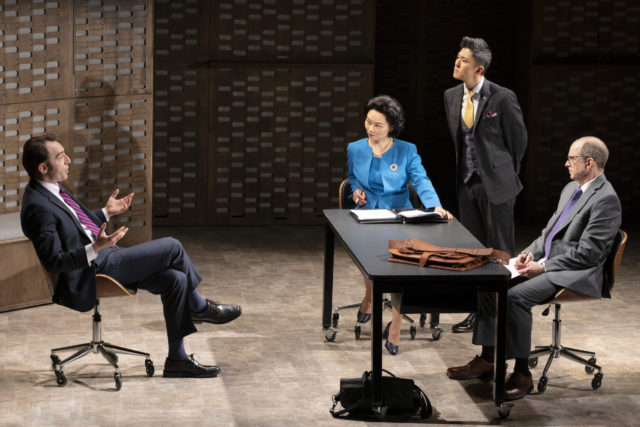
live performance

THE WETSUITMAN

Five actors portray more than two dozen characters in the Cherry’s hybrid production of The Wetsuitman

THE WETSUITMAN
The Cherry Artists’ Collective
The Cherry Artspace, Ithaca
March 31 – April 3, livestream $20, in-person $25-$35
www.thecherry.org

“It’s only a case,” a detective says in the Cherry’s English-language world premiere of Freek Mariën’s The Wetsuitman. Of course, in police procedurals, especially Scandiavian ones, it’s never only a case.

The Cherry continues its exemplary live and livestreamed productions with The Wetsuitman, running March 31 through April 3 from the Cherry Artspace in Ithaca, directed by Samuel Buggeln. Inspired by a magazine article by Norwegian journalist Anders Fjellberg and translated by David McKay, the hundred-minute crime thriller begins when a decaying body in a wetsuit is found by an old architect in a cove.

It’s 2015, and Inspector Westerman and criminology intern Magnussen are on the case, which has similarities to a previous unsolved murder. Again, evidence is scarce; the dour medical examiner states something many of us have learned by streaming Scandinavian crime dramas during the pandemic: “Norway is a country made for / accidents / we have cliffs / we have storms / we have big ships / we have big rocks / we have all those people / on drilling platforms / and god-knows-where in the Arctic / we freeze to death / we have train crashes / we have plane crashes / we have shipwrecks / terrorists / and remember half the time / this is in total darkness / so whatever can break down / will break down / and if no one else does it to us / we do it to ourselves / Norway / land of alcoholism and suicide / it’s not what the brochures say / but it’s true / we beat the world in drinking and depression / we beat each other to a pulp in the darkness / drunk and depressed / we fall off cliffs / that’s if we don’t get blown up / flattened / sucked into a propeller / which is all to say / we’re the best at identifying bodies / got it down to a science / give me a body / I’ll give you a name / I’m the medical examiner / I smell like formaldehyde / and have a hard time getting into relationships / because women seem to think / ‘those hands of his / were just inside a corpse.’”

The medical examiner (Marc Gomes) discusses death in Norway in The Wetsuitman

When Westerman asks him what the cause of death was, he essentially throws his hands up, admitting, “I couldn’t even tell you / if he’s been dead three days or three weeks.”

Westerman and Magnussen are joined by another detective, Hustvedt, as they interview anyone who might have information on the missing person, but red herrings keep being dangled in front of them. The investigation goes from Norway and France to Syria and the Netherlands as the cops and a journalist speak with Customs and tourism officials, salespeople, a scientist, a lifeguard, a corporate spokesperson, a beachcomber, refugees, and others, trying to figure out who the Wetsuitman is and how he died.

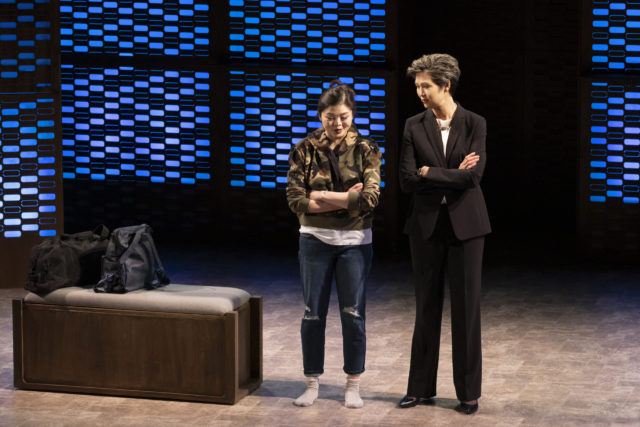
Eric Brooks, Marc Gomes, Karl Gregory, Amoreena Wade, and Sylvie Yntema do a terrific job portraying more than two dozen characters, with only minimal costume changes; sometimes they even argue over who is going to play whom at any moment, taking over a role in the middle of a scene. They often introduce themselves or each other so the audience knows who is who; for example, Hustvedt explains, “I’m on the case now / Hustvedt / head of missing persons / I’m taking over the investigation / bald spot / big mustache / clenching a cigarette / in my gold teeth.”

Sylvie Yntema makes a point in English-language premiere of Freek Mariën’s The Wetsuitman

The actors move folding tables and chairs on and off the set to indicate changes of time and space; still photos are projected onto a back screen to add detail to the story, including the geographic location. The livestream is designed by Karen Rodriguez, with multiple cameras offering closeups as well as views from the audience; several attempts at using split screens are not quite successful, but otherwise it definitely feels like a play and not a movie. And for the record, the comment about Renée Zellweger feels out of place, unnecessarily mean-spirited in an otherwise spirited production.

The narrative starts out as a murder mystery but turns into so much more as such issues as race, corruption, and immigration come into focus. During the lockdown, the Cherry presented such fine works as A Day, And What Happens if I Don’t, Hotel Good Luck, and Felt Sad, Posted a Frog (and other streams of global quarantine); I’m glad to see the company is continuing to stream its productions from its upstate home to give us city folk a chance to see it as well.

CONFEDERATES

Siblings Sara (Kristolyn Lloyd) and Abner (Elijah Jones) fight for freedom in Confederates (photo by Monique Carboni)

CONFEDERATES
The Pershing Square Signature Center
The Alice Griffin Jewel Box Theatre
480 West 42nd St. between Tenth & Eleventh Aves.
Tuesday – Sunday through April 24, $35-$80
212-244-7529
www.signaturetheatre.org

Playwright Dominique Morisseau and director Stori Ayers magnificently interweave two parallel threads, one that takes place on a plantation during the Civil War, the other at a modern-day university, in the world premiere of Confederates, which opened tonight at the Signature’s Alice Griffin Jewel Box Theatre for an extended run through April 24.

The play begins with tenured Black poly sci professor Sandra (Michelle Wilson) speaking to school leaders — and the audience — projecting a picture of the real-life postcard Type de Negresse d’ADANA, which famously depicts a Black woman breastfeeding a white baby, from more than a hundred years ago. “Before this becomes a complete misinterpretation of intent, I’d like to say that I am not averse to images of slavery,” she announces. “There is nothing slavery that is off limits for me. No shame in my own enslaved heritage. No shame. And yet. . . .” She then switches to a doctored version of the photo, with her head photoshopped onto the Black body, a printout of which had been taped to her office door, and asks for an immediate investigation.

As she departs, the action switches to a slave cabin in the 1860s, where Sara (Kristolynn Lloyd) is stitching a wound suffered by her brother, Abner (Elijah Jones), a runaway slave who is fighting for the Union army. On a raised platform sits a bench chest on one side and a writing desk on the other, surrounded by columns evoking the front of a southern estate. (Rachel Hauck’s set remains the same throughout the play, equating the two time periods.)

Sara wants to join the army too and be useful to the cause, but Abner is having none of it. He tells her, “You good n’ safe with what you do right now. Fast picker. Keep out of the eye of the storm. You like the nighttime nobody seem to notice. That’s good n’ safe. I ain’t got to worry as much.”

Sara insists that Abner train her on how to hold a musket. “So I know what it feels like to have the power of freedom in my hands. ’Case I never see you again,” she says. He shows her and replies, “Now you’re a real man.”

Candice (Kenzie Ross) and Sandra (Michelle Wilson) discuss bias in Dominique Morisseau world premiere (photo by Monique Carboni)

Jones does a quick change and becomes Malik, a Black student arguing a grade with Sandra, his teacher. He is defending his paper, which got a B-, claiming that his unconventional interpretation of Lincoln, the Emancipation Proclamation, and affirmative action is valid. Sandra responds, “I’m saying there are loopholes in your overall analysis of the so-called modern-day plantation in the workforce and its parallel to slavery during the time of the Civil War,” a capsule summary of what the play is about.

“Neither of these policies originally targeted the people it was designed to protect,” he declares. “They both came with multiple side clauses and loopholes. The result, slaves still weren’t freed even after the proclamation, and so-called minorities weren’t employed equally after affirmative action. Paperwork and lies and bullshit and plantation by another name.” She ultimately gives him a chance to rewrite the paper and hand it in the next morning.

Back at the plantation, the master’s daughter, Missy Sue (Kenzie Ross), has returned from her brief, failed marriage with new insight into the condition of slavery; having grown up with Sara, she considers them close friends — Sara most certainly does not feel the same way — and now she wants to work with Sara to spy on her father, the master, and ultimately live together safely in the North. Abner is not happy about this prospect, and Luann (Andrea Patterson), a slave who is sleeping in the master’s bed, starts getting suspicious that something is going on under her nose.

Meanwhile, at the university, Sandra is being accused by numerous people of having bias — Malik thinks she is biased against him; her ditzy, talkative white assistant, Candice (Ross), believes she favors Malik; and her fellow Black professor, Jade (Patterson), has heard that Sandra will not support her tenure vote and feels she treats her more like a threat than a colleague. In addition, everyone has a different opinion, not all of them good, about Sandra having worn a Black Lives Matter T-shirt the other day. Issues of gender, class, and race explode in shocking ways as the poignantly beautiful finale approaches.

Sara (Kristolyn Lloyd) and Missy Ann (Kenzie Ross) confront each other in play that bounces between past and present (photo by Monique Carboni)

Morisseau is one of the most successful and busiest writers of the last decade. In the last ten years, she has given us the Detroit Projects trilogy (Detroit ’67, Paradise Blue, Skeleton Crew), Pipeline, and Ain’t Too Proud — The Life and Times of the Temptations, addressing inequities in housing, business, employment, education, and entertainment.

Inspired by Ta-Nehisi Coates’s 2011 Atlantic article “Why Do So Few Blacks Study the Civil War,?” Confederates is another sparkling triumph from Morisseau, ninety minutes that will dig into your soul while also making you laugh. In a program note, the playwright offers, “Just like in the present, the enslaved are multifaceted. We all carry snark and sarcasm. We are all expert navigators of the systemic fuckeries. And sometimes, navigating that shit is painful. And sometimes, navigating that shit is funny.” Amid all of the controversy over critical race theory and the 1619 Project, Morisseau sharply portrays how America’s racial history has brought us directly to this moment in time, where we must learn from our past and face hard truths.

To further the comparison of then and now, Patterson, Jones, and Ross play characters existing in each era, with direct similarities, while Lloyd’s and Wilson’s characters are mirrors of each other. For example, Candice is aware of her white privilege just as Missy Sue wants to do something to help Sara after all the awful things her family has done to her, even though they each still don’t quite get it; both women are played with humor by Ross. The connections between the dual roles are further established in the costume changes, in which the actors tear off their clothes to reveal their other character as light and sound bombard us; the costumes are by Ari Fulton, with lighting by Amith Chandrashaker and Emma Deane, sound by Curtis Craig and Jimmy Keys, and projections by Katherine Freer.

The cast is superb, led by Wilson (The House That Will Not Stand, Sweat), who mixes vulnerability with determination as Sandra, and Lloyd (Dear Evan Hansen, Paradise Blue), who unearths a dark fierceness as Sara. The line conjoining them is evident from the start and passionately fuses them together by the end, making a grand statement of how much America has to learn about race.

Morisseau wrote Confederates after being challenged by Penumbra Theatre founder Lou Bellamy to craft a theatrical response to one of the main points Coates made in that 2011 Atlantic piece: “For my community, the message has long been clear: The Civil War is a story for white people — acted out by white people, on white people’s terms — in which blacks feature strictly as stock characters and props.” She was also inspired by Toni Morrison’s discussion of the white gaze; she once told Charlie Rose, “I have spent my entire writing life trying to make sure that the white gaze was not the dominant one in any of my books.”

In another program note, Morisseau explains, “I, too, have felt the lash of writing in a continuum that honors this gaze, even when I personally do not hold space for it in my own aesthetic. But there are other gazes as well. As a woman writer, I have also felt the male gaze. As a radical writer, I have felt the gaze of respectability politics. And as a Black writer, I have felt the gaze of Blackness that sometimes is only qualified as one myopic thing, rather than expansive and global as Blacknesss truly is. No matter the gaze, they all feel like one collective thing to me as an artist: oppression.” Confederates takes on all of those gazes in elegant and intensely clever ways. Morisseau’s Signature Residency 5 began with Paradise Blue and continues with Confederates; but no matter how much you enjoy it, don’t wait for the curtain call, because the play is about a whole lot more than just applauding a job well done.

FOOD FOR THOUGHT: AN AFTERNOON OF COMEDIC DELIGHTS

Blythe Danner and Bob Dishy team up again in one-act plays for Food for Thought

Who: Food for Thought Productions
What: In-person and livestreamed performance of three one-act plays
Where: Theatre 80 St. Marks, 80 St. Marks Pl. at First Ave., and online
When: Monday, March 28, free with RSVP for in-person (646-366-9340, info@foodforthoughtproductions.com), 2:00; available online March 28 and April 3
Why: Food for Thought Productions has presented more than a thousand one-act plays since 2000, featuring all-star casts in lesser-known works by major playwrights. Its twenty-second season kicks off March 28 at 2:00 with “An Afternoon of Comedic Delights,” three short plays featuring the incomparable Tony and two-time Emmy winner Blythe Danner and the inestimable Bob Dishy, directed by Antony Marselli, live in person at Theatre 80 St. Marks and online; you can also catch the stream on April 3. The Brooklyn-born eighty-eight-year-old Dishy (Lovers and Other Strangers, Sly Fox, Damn Yankees) and the Philadelphia-born seventy-nine-year-old Danner (Butterflies Are Free, Betrayal, Huff) will first team up for George S. Kaufman and Leueen MacGrath’s Amicable Parting, about a young couple, Bill and Alicia Reynolds, going through their possessions as they plan to separate; in the foreword, the authors explain, “This is meant to be high comedy. It should be played lightly, gayly. Never heavily. Never emotionally. Thank you.”

Early on, Alicia points out a specific painting. “I would like to have this one, if you don’t mind, Bill,” she says. “Suits me,” he replies. “Now, Bill, you’re sure? — I mean, that you don’t want it? Of course, I love it, but then you love it too,” she explains. Bill: “No, Sweetie — you saw it first — I remember very clearly. Paris, ’53. What was the name of the restaurant? Chez Something.” Alicia: “Nico.” Bill: “Chez Nico. Too much to eat, too much to drink, too much for this painting.” Ah, memories.

Bob Dishy and Blythe Danner deal with family issues in Brighton Beach Memoirs

Next up is Peter Stone’s Commercial Break, which has been previously performed by Lauren Bacall and Robert Preston and was initially written for Audrey Hepburn in Charade, then revised for Cary Grant in Father Goose, ending up on the cutting-room floor both times. In the play, Tony, Oscar, Emmy, and Edgar winner Stone (Kean, 1776, Woman of the Year) introduces us to Catherine and Harry Crocker; the couple finds itself in quite a predicament when she accuses him of being unfaithful. Dishy presented Stone’s My Doctor the Box with Judy Graubart at a 2007 FFT tribute to Stone, who passed away in 2003 at the age of seventy-three. The third relationship play is Tallulah Finds Her Kitchen, which Neil Simon, Danny Simon, and Joseph Stein wrote for the one and only Tallulah Bankhead, a monologue that takes place, well, in her kitchen. The festivities conclude with a Q&A with Danner and Dishy, who appeared together in Brighton Beach Memoirs in 1986 and in FFT’s December 2021 production of Arthur Miller’s I Can’t Remember.

UPLOAD

Soprano Julia Bullock and baritone Roderick Williams portray a daughter and father dealing with a digital afterlife in Upload (photo by Stephanie Berger)

UPLOAD
Park Ave. Armory, Wade Thompson Drill Hall
643 Park Ave. at Sixty-Seventh St.
March 22-30, $45-$150, 7:30 / 8:00
www.armoryonpark.org
www.vanderaa.net

Created specifically for Park Ave. Armory’s massive Wade Thompson Drill Hall, Dutch composer Michel van der Aa’s multimedia opera Upload is a haunting adventure into a near-future where people can choose to surrender their corporeal bodies and exist for eternity as digital beings. The process involves scanning the brain to make a map of the mind, implanting in the upload their family, social, and personal identities, pushing pain and trauma into the background.

The ninety-minute production begins in total darkness as a father (baritone Roderick Williams) and his daughter (soprano Julia Bullock) share many of the elements that make life unique; phrases such as “light – smile,” “struggle – grip,” “tingle – cheek,” “seek – calm,” and “carry – loss” emerge from speakers placed all around the drill hall. The darkness lifts to reveal lighting and set designer Theun Mosk’s stunning stage, which features three movable, translucent triptych screens in front of a larger movie screen. In the far right corner sits Ensemble Musikfabrik, an eleven-piece orchestra conducted by Otto Tausk; the powerful, immersive sound design, by Tom Gelissen and Paul Jeukendrup, lets van der Aa’s wonderful score, which often turns into scratchy electronic noise, echo gloriously in the cavernous space.

The daughter, in a red jumpsuit, converses with her father, who appears on the movable screens, wearing jeans and an unbuttoned shirt; his image is often blurry or pixelated, indicating the transmission is murky. Williams is actually performing from stage right, a camera projecting him onto the screens. The effective motion capture and graphics are by Darien Brito, with special effects by Julius Horsthuis.

A man is getting scanned to become a digital upload in Michel van der Aa’s multimedia opera at Park Ave. Armory (photo by Stephanie Berger)

The daughter is furious that her father has chosen to become an upload without consulting her; he assures her that he hasn’t left her. “Sweet smile of my child, / I still hear, / I see without knowing that I see. / It’s easier to feel than to explain. / My sense of touch is gone, / but no matter. / I can still think my own thoughts. I went on a journey to be what I must be. / I made this decision for us; / you can no longer lose me. . . . If you can’t live the way you want, there’s no point in living.” She angrily asserts, “Why didn’t you ask how I would feel about all this?”

The moments between father and daughter, which include footage of their home and garden projected onto the back screen, alternate with prerecorded scenes from the clinic that invented the procedure, from a sterile waiting room and laboratory to a fantastical Lego-like structure in shocking blue. The dialogue at the clinic is spoken, not sung. A psychiatrist (Katja Herbers) explains, “I think that what we do here can be regarded as a form of rebirth, analogous to the afterlife. I mean, haven’t we always tried to cheat death?” The smarmy CEO (Ashley Zuckerman) posits, “In the past, when a generation died, we would lose their collective wisdom. And that’s a great loss. . . . By digitizing the mind, removing it from the body, we’re removing it from these risks. Take one last trip in your biological body, and then you’ll live forever. . . . You just have to die first.”

The key to the transfer is a “memory anchor,” something the person being uploaded can think about to make the procedure go smoothly. The CEO notes that “memories are faulty,” but he believes that, technologically, the anchor “will always be reliable.” But as the daughter later tells her father, “No world they created for you can compete with the real one.”

Previously presented at the Dutch National Opera and the Bregenz Festival in Austria, Upload is like a live production of the popular anthology series Black Mirror directed by Ivo van Hove, along with a dash of the Amazon Prime show similarly titled Upload, which also involves a digital afterlife. Van der Aa previously explored what happens following death in his 2006 piece After Life, adapted from the film of the same name by Hirokazu Kore-eda; the opera featured Williams in a way station between heaven and hell.

Upload features dramatic staging at the armory (photo by Stephanie Berger)

The interplay between the live and prerecorded flashbacks, shot by cinematographer Joost Rietdijk, builds off the tension being experienced by father and daughter onstage; as the characters, sometimes assisted by others, push the vertical triptychs back and forth, the films depict nonstatic scenes outdoor, indoors, and underwater, the movement in multiple directions resulting in an uneasy 3D-like effect that matches the emotional mood of the narrative.

Bullock (Girls of the Golden West, Doctor Atomic, Zauberland) and Williams (Eugene Onegin, Billy Budd, Madam Butterfly) sound glorious together; I would have loved to have heard more from them. While there are English subtitles, you won’t need them for his vocals, which are sharp and pristine.

Written, composed, and directed by van der Aa — who was last at the armory with 2017’s Blank Out, in which Williams appeared onscreen in a story loosely based on the life and career of bilingual South African poet Ingrid Jonker — Upload can be confusing at times, but the overall production, complete with a breathtaking surprise near the end, is a genuine treat, a thrilling peek at the potential future of humanity while testing the boundaries of what opera can be.

HELP

April Matthis is fabulous as the only person of color in Claudia Rankine’s Help (photo by Kate Glicksberg for the Shed)

HELP
The Griffin Theater at the Shed
The Bloomberg Building at Hudson Yards
545 West 30th St. at Eleventh Ave.
Tuesday – Sunday through April 10, $29-$77
646-455-3494
theshed.org

Poet, playwright, and professor Claudia Rankine wanted to know what white people were thinking, so she asked them. The results can be seen in the blistering new show Help, which opened last night at the Shed’s Griffin Theater.

Several recent plays by Black playwrights, including David Harris’s Tambo & Bones, Jordan E. Cooper’s Ain’t No Mo’, and Jackie Sibblies Drury’s Fairview, have used fictional narratives to address systemic racism, breaking the fourth wall and directly confronting the predominantly white audience.

But Rankine goes right to the facts in Help, which consists of verbatim dialogue from interviews with white men and white women conducted separately by Rankine, who is Black, filmmaker Whitney Dow, who is white, and civil rights activist and theologian Ruby Nell Sales, who is Black; responses to Rankine’s 2019 New York Times article “I Wanted to Know What White Men Thought About Their Privilege. So I Asked”; and quotes from such politicians, writers, and other public figures as James Baldwin, Elon Musk, Marjorie Taylor Greene, Audre Lord, Donald Trump, Eddie Murphy, Bill Gates, Dr. Martin Luther King Jr., Dr. Richard Sackler, Mitch McConnell, Toshi Reagon, and Fred Moten.

Obie winner April Matthis hosts the evening as the Narrator, portraying a version of Rankine, speaking straight to the audience. “I am here — not as I — but as we — a representative of my category,” she says at the start. “The approximately eight percent of the U.S. population known as Black women.” After listing a few real names and epithets of Black women, she declares, “Ultimately, whatever name you use, all of them, begin with the letter N.”

She walks back and forth across the front of the long, horizontal stage, either holding a microphone or stopping at the stand near the middle, like a comedian performing a semiautobiographical one-person show. Although the ninety-minute play has plenty of laughs, it is also deadly serious when it comes to racism, white supremacy, reverse racism, and white privilege. And she’s not about to let the mostly white theatergoers off the hook because they have bought a ticket to see such a progressive show and clap at all the politically correct moments.

White men and women display their privilege through dance in Help (photo by Kate Glicksberg for the Shed)

Behind the Narrator is a glassed-in airport waiting room populated by nine white men and two white women in business attire, a stark contrast to the Narrator’s green jumpsuit. They often interact with her, either joining her at the front or welcoming her into their space. Actually, “welcoming” might not be the best word, because they usually don’t like what she has to say, even though she attempts to be neutral, not responding the way she wants to as they refuse to acknowledge the advantages their whiteness automatically brings them and turning it back on her.

In an early vignette, people are lining up to board a plane, in number order according to their ticket. The Narrator wants to make sure she is in the right spot but is not thrilled when one man (Jeremy Webb) says to another (Tom O’Keefe), “You never know who they’re letting into first class these days.” In a sidebar, her therapist (Tina Benko) tells her, “You didn’t matter to him. That’s why he could step in front of you in the first place. His embarrassment, if it was embarrassment, had everything to do with how he was seen by the person who did matter: his male companion. He made a mistake in front of his companion. You are allowing yourself to have too much presence in his imagination.”

The Narrator responds, “I want a new narrative, one that doesn’t demand, or require, or want . . . one that doesn’t accept my invisibility. I need a narrative that includes your whiteness as part of the diagnosis. . . . The limits of his world are the limits of your world too.” She’s not speaking to just the therapist but to everyone in the theater.

A few moments later, the Narrator assumes the man (Nick Wyman) in front of her voted for Trump, and he snidely replies, “You can stand in this line with me, but you’ll never be in line with me. That’s why I’ll vote for him again. And again.” And another (Rory Scholl) doesn’t hesitate to admit to her, “If the cost of my way of life is your life — that’s not my concern.”

It’s a war of words, interpretations, meanings, and intent that makes for an uneasy flight as she leads us through barrages of racist statements made by familiar names (identified specifically in the play’s online resources page) as well as a few brief chats in which the other person wants to be an ally but doesn’t know how to deal with their inherent privilege. She won’t even give her husband (O’Keefe), who is white, a break. “I’m not demonizing, I’m historicizing,” she tells us. “To stay alive, forget thriving, I need to negotiate whiteness.”

The white cast, which also includes Jess Barbagallo, David Beach, Charlotte Bydwell, Zach McNally, Joseph Medeiros, John Selya, and Charlette Speigner, occasionally breaks into group social dances, choreographed by Shamel Pitts, that sometimes involve the rolling waiting room chairs as the men and women put their whiteness on further display. The original music is by JJJJJerome Ellis and James Harrison Monaco, with sound by Lee Kinney, lighting by John Torres and costumes by Dede Ayite; Nicole Brewer is the antiracist coordinator.

The Narrator (April Matthis) navigates through a white world in Claudia Rankine play (photo by Kate Glicksberg for the Shed)

Over the last two years, Rankine (Just Us: An American Conversation, Citizen: An American Lyric) and Obie-winning director Taibi Magar (Twilight: Los Angeles, 1992, Is God Is) reshaped and updated the play, which had to shut down during previews in March 2020 because of the pandemic, working in the January 6 insurrection, the murder of George Floyd, the Covid-19 crisis, and other recent events, although there is, unfortunately, a timeless quality to everything, as racism doesn’t look like it’s going away soon. They’re not teaching or preaching, but they steadily navigate so the audience doesn’t feel backed into a corner.

At the center of it all is Matthis (Toni Stone, Fairview), who is brilliant as the Narrator, guiding the interactions while making sure the audience remains uncomfortable even when laughing, since Rankine pulls no punches. “Imagine if my fellow travelers were to wrestle with their own privilege, instead of with my presence. For once,” she says. Once again, she’s not just referring to the characters in the play; we’re all in the waiting room together.

Tony winner Mimi Lien’s fab set matches the Narrator’s description of it as a “liminal space, a space neither here nor there, a space we move through on our way to other places, a space full of imaginative possibilities.” Clearly, it’s white people who are doing most of the moving as minorities face more of a stasis. “There’s no outrunning the kingdom, the power, and the glory,” the Narrator reminds us. Meanwhile, another white man (Beach) insists, “The dominant culture is colorless,” later adding that classic phrase, “I don’t see color.”

The program features several excellent essays, by Rankine, Dow, Simone White, and Sales, who, in “Can We Just Get Down to the Conversation About Whiteness?,” writes, “We must ask, is it a privilege to inherit a death driven system that predicates itself on the decimation of the potential and possibility of white men to reach the fullness of their humanities? Contrary to calling out the worst in them as the system does, we must see the good in them that they do not see in themselves. Our work must enable them to find new meaning in their lives and provide relief from their brokenness and fragmentation.” Help is no mere attack on whiteness but a declaration that things can and must change, with help from everyone.

The Narrator sums it up best when she says, “There is, after all, no racism without racists.” At its heart, the show is about the fear that pervades white people who are desperately trying to hold on to the past, and their power, as the world changes right before their eyes. They’re afraid they and their kids won’t get into the right schools, won’t get the good jobs, won’t have the same opportunities they’ve had for more than two hundred years since the birth of the nation.

At the end of her writer’s note, Rankine points out, “As Ruby Sales has said, ‘There’s nothing wrong with being European American; that’s not the problem. It’s how you actualize that history and how you actualize that reality.’” And that’s what Help is about.

TOMÁS SARACENO: PARTICULAR MATTER(S) / SILENT AUTUMN

Spiders and their webs are at the center of Tomás Saraceno’s immersive, multimedia exhibitions at the Shed and Tanya Bonakdar Gallery (photo by twi-ny/mdr)

TOMÁS SARACENO: PARTICULAR MATTER(S)
The Shed
545 West 30th St. at Eleventh Ave.
Tuesday – Sunday through April 17
Upper level + gallery: $42; lower level + gallery: $35; gallery exhibition only: $12
646-455-3494
theshed.org
studiotomassaraceno.org

The integration of art, technology, nature, and the environment is central to Argentina-born artist Tomás Saraceno’s discipline, currently on display in a pair of complex immersive exhibitions in the city. In “Silent Autumn” at Tanya Bonakdar in Chelsea and “Particular Matter(s)” at the Shed in Hudson Yards, Saraceno investigates toxic air and water, the reuse of plastic bags, rampant consumerism, and, most of all, spiders though collaborations with MIT and NASA, among others, attempting to find ways to fix a broken planet in this out-of-control Capitalocene era.

In a 2014 lecture he gave at MIT, Saraceno discussed the “sociability” of spiders. “It’s very similar to humans,” he said. “Spiders are social because they have enough space and food. But if you put a lot of social spiders in a very tiny space, they are not social. They eat each other. They’re pretty much like humans. There are forty-three thousand species of spider and only twenty are social. Knowing that sociability is a big trend for the survival of the planet, no one really understands this. What we do is try to make [the spiders] operate and work, one with the other, the solitary and the social.” It sounds all too close as humanity emerges from a global pandemic.

Continuing through April 17, “Particular Matter(s)” leads visitors on an audiovisual journey through the kingdom of the spiders. Webs of At-tent(s)ion consists of seven encased hybrid spider webs, hanging in midair and lit so it appears that they’re glowing in the dark. Each case is like its own universe, with different species of spider building on what others started, resulting in magical architectural structures made of spider silk and carbon fibers.

Radio Galena turns a crystal into a wireless radio receptor. Printed Matter(s) reproduces cosmic dust from 1982 in a series of ten photos printed using black carbon PM2.5 pollution extracted from the air in Mumbai; they are arranged loosely on a wall, as if they might blow away and break up into shreds, like the atmosphere being destroyed by pollution. Particular Matter(s) is a light beam that reveals how much dust is in the air that we breathe, poisoned by the burning of fossil fuels.

Arachnomancy features a deck of thirty-three tarot-like meteorological “oracle” cards, printed on carbon-footprint-neutral paper, spread out across a table, based on the beliefs of the spider diviners of Somié, Cameroon, who make cards out of leaves, forecasting weather events. The cards include images of maps, plants, human figures, and webs, with such titles as “Bad News,” “Planetary Drift,” “Invertebrate Rights,” “Entanglement,” and “Fortunate Webbing.” Dangling above the table is a web built by two Cyrtophora citricola spiders that looks like you could rip it apart with a soft breath.

Inspired by the writings of science journalist Harriet A. Washington, We Do Not All Breathe the Same Air uses black carbon, soot, and PM2.5 and PM10 to reveal how pollution impacts air quality in different parts of the country, adversely affecting BIPOC and poorer areas. A red sliding sheet laser brings spider webs to life in a long horizontal window in How to entangle the universe in a spider/web,? which resembles a trip through the human circulatory system or into a far-off galaxy. The concept of spider ballooning and visitors’ movement combine to create music in Sounding the Air, an installation in which five threads of spider silk form an aeolian instrument that emits sonic frequencies when it encounters heat, wind, body movement, and other elements.

A Thermodynamic Imaginary is a room filled with many wonders of Saraceno’s oeuvre, a fantasy world comprising sculpture, projected video (Tata Inti and Living at the bottom of the ocean of air), shadows, reflections, large bubbles, and more, like its own galaxy in what the artist calls the Aerocene: “a stateless state, both tethered and free floating; a community, an open source initiative; a name for change, and an era to live and breathe in.”

On the fourth floor, you have to remove your shoes to walk into Museo Aero Solar, devised by Saraceno and Alberto Pesavento in 2007, an ecological balloon composed of plastic bags sewn together, their brands and trademarks visible, seeking to eventually eliminate the use of fossil fuels by providing sustainable, free-floating options. The gallery also includes documentation of the project and such items as an Aerocene Backpack and flight starter kits.

The centerpiece of “Particular Matter(s)” is Free the Air: How to hear the universe in a spider/web, a live eight-minute concert held in an almost blindingly white two-level, ninety-five-foot diameter floating sculpture, commissioned by the Shed for this exhibition. The limited audience gets misted as they enter the foggy space, which contains 450,000 cubic feet of air and features a large-scale net made of steel and thick wire that evokes a giant spider web on which people lie down; it’s a rather tenuous trampoline with gaps in it, so if you jump, it will affect not only your balance but others’ as well, so don’t play around too much. If you’re on the lower level, you can look up to see the people above you, almost walking on air.

Darkness ensues and the concert in four movements begins, prerecorded sound waves and vibrations of spiders interacting with their webs that are impacted by the audience’s presence, incorporating Sounding the Air, Webs of At-tent(s)ion, and other items in “Particular Matter(s).” It’s a welcoming atmosphere of interspecies communion and coexistence that plots a course for ways to save our increasingly fragile planet using our innate spider-sense and expanding our idea of what home is.

Advance tickets are necessary for the special experience and sell out quickly, so act fast. As part of the Shed program “Matter(s) for Conversation and Action,” on March 30 at 6:00 there will be a free Zoom panel discussion, “Invention, Experimentation, and Radical Imagination,” with MIT professor Caroline A. Jones, climate scientist Dr. Kate Marvel, and Vassar professor Molly Nesbit, moderated by designer, teacher, and entrepreneur Sandra Goldmark, followed on April 13 at noon by “Rights of Nature, Activism, and Change” with lawyer Alicia Chalabe, Dartmouth professor N. Bruce Duthu, and sociologist and writer Maristella Svampa, moderated by Columbia Law School professor Michael B. Gerrard.

Tomás Saraceno gallery show at Tanya Bonakdar complements Shed exhibition (photo courtesy Tanya Bonakdar Gallery)

TOMÁS SARACENO: SILENT AUTUMN
Tanya Bonakdar Gallery
521 West 21st St. between Tenth & Eleventh Aves.
Tuesday – Saturday through March 26, free, 10:00 am – 6:00 pm
www.tanyabonakdargallery.com

In conjunction with the Shed show, Tanya Bonakdar is presenting “Silent Autumn” through March 26. The title plays off Rachel Carson’s seminal 1962 book, Silent Spring, a “fable for tomorrow” that called for the elimination of such chemicals as DDT in order to maintain a living, breathing Earth. The exhibit begins with An Open Letter for Invertebrate Rights, in which Spider/Webs explain, “Do not be afraid. Let us move from arachnophobia to arachnophilia by sensing new threads of connectivity, or else face the eternal silence of extinction.”

Visitors must put booties over their shoes in order to enter Algo-r(h)i(y)thms, a musical instrument comprising a vast network of webs, the strings of which make warming sounds when plucked. You can either create your own solo or work in tandem with others for a more ornate score. Surrounding the instrument are Arachne’s handwoven Spider/Web Map of Andrómeda, with a duet of Nephila inaurata — four weeks and ensemble of Cyrtophora citricola — three weeks and Cosmic Filaments, intricate black-and-white architectural drawings of web universes.

The title diptychs (and one triptych) pair framed leaves glued to inkjet paper next to framed photographs of the leaves; the two works initially look identical, but over time the real leaves will fade and disintegrate while the picture endures. Silent Spring comprises four panels of pressed poppy flowers from contaminated soil near Saraceno’s Berlin-Rummelsburg studio, with shutters that protect them from the sun, although they too will fade; the dirt was polluted by a photographic film and dye manufacturer, so the piece is very much part of Saraceno’s personalized mission of recycling and sustainability.

In the same room, three stainless-steel and wood sculptures hang from the ceiling at different heights, evoking the much larger structures Saraceno installed on the Met roof for “Cloud City” in 2012 as well as the Silent Autumn framed leaves. In a smaller room, the blown glass pieces Pneuma, Aeolus, Aeroscale, and Aerosolar Serpens probe breathing, physical presence, and the brittleness of existence. Other works continue Saraceno’s exploration of overconsumption, pollution, climate change, and the future of life on the planet — and throughout the universe.

Saraceno is a genius at bringing us into his world by creating fascinating objects that are ravishing to look at, then hitting us with the heavily researched science behind it all as he attempts to save the world. But he can only do it with our help.

COAL COUNTRY

The characters of Coal Country listen to Steve Earle sing about a horrific mining disaster (photo by Joan Marcus)

COAL COUNTRY
Cherry Lane Mainstage Theatre
38 Commerce St.
Tuesday – Sunday through April 17, $39-$77
212-989-2020
www.cherrylanetheatre.org
coalcountrymusical.com

Coal Country is a damning portrait of much that’s wrong in America today, a tale of corporate greed, corruption, union busting, an unequal justice system, and a lack of compassion for one’s fellow human beings. And it’s all true.

On April 5, 2010, more than two dozen men died in the Upper Big Branch Mine disaster in Raleigh County, West Virginia. Jessica Blank and Erik Jensen’s documentary play is set at the end of the trial of Massey Energy CEO Don Blankenship, who ran the mine. The action begins as Judge Berger (Kym Gomes) has opened the floor for relatives and colleagues to share their stories of what happened before, during, and after the horrific event, the worst mining disaster in the United States in forty years. The audience serves as a kind of jury as the characters speak verbatim dialogue, word for word what the real men and women of Raleigh County said.

Patti Stover (Mary Bacon) talks about her chance at second love with Gregory Steven Brock, who went to the mine that day even though he wasn’t feeling well because he couldn’t afford to take time off. Tommy Davis (Michael Laurence) worked in the mines with his brother Timmy and nephews Cory and Josh; like many people who lived in the company town, mining went back generations.

Roosevelt Lynch Jr. (Ezra Knight) would pass by his father every morning, one having just finished a shift, the other about to start one. Dr. Judy Petersen’s (Deirdre Madigan) brother Dean did everything with his twin brother, Gene, but shortly after they both began in the mine, Gene quit while Dean stayed on.

Gary Quarles (Thomas Kopache) shares the story of his son in Coal Country (photo by Joan Marcus)

Gary Quarles’s (Thomas Kopache) son was tired of working off the dangerous longwall. “I’d say Massey ran outlaw from the day Blankenship brought ’em in,” Gary says about the hiring of nonunion employees. “We always said that Massey Energy was his third world country, and Don was the dictator.”

The de-facto leader of the group is Stanley Stewart, known as Goose (Carl Palmer), a third-generation miner whose grandfather was killed on the job. Goose told his wife, Mindi (Amelia Campbell), about how he could see trouble was brewing because of how the new ownership was dealing with basic health and safety issues. “My first twenty years was union. This was the strongest union place in the world before Massey came in,” Goose says. Gary adds, “And I’ll tell you what, you didn’t worry ’bout gettin’ fired by speakin’ up.”

Throughout the play, Grammy-winning folk-country-rock troubadour and activist Steve Earle plays related songs from his chair in the front right corner of the stage, switching between acoustic guitar and banjo. He sometimes gets up and joins the cast, who occasionally sing lines and choruses with him. Earle’s score ranges from the traditional folk song “John Henry,” about an African American “steel drivin’ man” battling a steam drill in the Big Bend Tunnel in West Virginia in the nineteenth century, to “Heaven Ain’t Goin Nowhere,” “The Devil Put the Coal in the Ground,” and “It’s About Blood.”

In “Union, God, and Country,” Earle asks the audience to sing along to these key lines: “Union, god, and country / West Virginia gold and blue / Union, god, and country / was all we ever knew.” Earle also performs his 2013 bluegrass song “The Mountain,” in which he explains, “I was born on this mountain / This mountain’s my home / And she holds me and keeps me from worry and woe / Well, they took everything that she gave / Now they’re gone / But I’ll die on this mountain / This mountain’s my home.” I’ve seen Earle numerous times over the years, from the Ritz and the Bottom Line to the Blue Note, the Lone Star Roadhouse, and Judson Church, and he is an inspired choice for Coal Country; he also served as composer and onstage narrator in Richard Maxwell’s existential Western Samara for Soho Rep. in 2017. On April 5, 2020, Earle played the songs of Coal Country in a free Facebook Live concert and has recorded them for the album Ghosts of West Virginia. (Wednesday night shows will be followed by a discussion with Earle on March 16 and 30 and Blank and members of the cast on March 23 and April 6.)

Dr. Judy Petersen (Deirdre Madigan) and Mindi Stewart (Amelia Campbell) wait for word of their relatives in Coal Country (photo by Joan Marcus)

An Audible production that had to cut short its premiere run at the Public in March 2020 because of the pandemic lockdown, the ninety-minute Coal Country has made a successful transition to the Cherry Lane. Richard Hoover’s wood-based set at times places the audience inside the mine, with David Lander’s lighting signaling trouble behind the slats of broken wood in the back. Movement director Adesola Osakalumi guides the actors on- and offstage as they rearrange various benches, providing much-needed breaks between emotional moments.

Married partners Blank and Jensen previously collaborated on such projects as The Exonerated, in which an ensemble reads the words of innocent men and women on death row, and The Line, a virtual Public Theater presentation from July 2020 in which an all-star cast told the verbatim stories of health-care workers and first responders in the early days of the Covid-19 crisis.

In Coal Country, Blank and Jensen do a magnificent job of integrating the individual stories, weaving them together to form a compelling narrative that will have you at the edge of your seat, even if you know exactly what happened. The scenes in which the characters are waiting on news of the fate of their loved ones are unforgettable, especially seen now, after two years of a global health crisis that has killed nearly a million Americans, many of whom died alone, their relatives forbidden to be with them. It’s a uniquely American tale, one that comes amid extreme partisanship, polarization, and divisiveness, but it doesn’t matter where you fall on the political spectrum to be deeply moved and infuriated by its overarching message.

As Earle sings, “It’s about fathers / It’s about sons / It’s about lovers / Wakin’ up in the middle of the night alone / It’s about muscle / It’s about bone / It’s about a river running thicker than water ’cause / It’s about blood.”