live performance

THE MUSIC MAN

Hugh Jackman and Sutton Foster turn up the glitz in Music Man revival (photo by Joan Marcus)

THE MUSIC MAN
Winter Garden Theatre
1634 Broadway between 50th & 51st Sts.
Tuesday – Sunday through January 15, $99-$599
musicmanonbroadway.com

In my decidedly unfavorable review of the 2017 revival of Hello, Dolly! starring Bette Midler, I wrote, “The new production of Hello, Dolly!, which is breaking house records at the Shubert Theatre, is everything that is wrong with Broadway. . . . Through it all, there’s Bette, who never really inhabits the role but plays herself playing the character while basking in the unending attention, the love bursting forth from the audience at her every knowing smirk; the Shubert practically explodes when she emerges in her glittering red dress for the title song, but it’s Bette who’s being celebrated, not Dolly.”

Unfortunately, the same can be said about the third Broadway revival of Meredith Willson’s 1957 smash The Music Man, continuing through November 6 at the Winter Garden. The star attraction is the beloved Hugh Jackman, but he is trapped as Hugh Jackman playing Professor Harold Hill, a con artist who has arrived in River City, Iowa, to sell the townspeople costumes and instruments for a band that will never be. The Grammy-, Emmy-, and Tony-winning Jackman, who follows such previous Hills as Robert Preston, Eddie Albert, Forrest Tucker, Bert Parks, Van Johnson, Dick Van Dyke, Craig Bierko, and Matthew Broderick, is as charming as ever, but he never fully embodies the character, and the fault lies in part with the audience, who won’t allow him to, and four-time Tony-winning director Jerry Zaks and Tony-winning choreographer Warren Carlyle, the duo who performed the same tasks on Midler’s Hello, Dolly! As with that production, which won four Tonys, many of the scenes don’t move the narrative along but instead are excuses to meander off track with showy, too long set pieces that are only fun for a while before we need to get back to the story.

The cast of The Music Man jumps for joy in Broadway revival at the Winter Garden (photo by Joan Marcus)

Tony winner Sutton Foster fares better as Marian Paroo, whose previous portrayers range from Barbara Cook and Shirley Jones to Rebecca Luker and Meg Bussert, but since we all know what is going to happen between Hill the snake oil salesman and Marian the adorable librarian, Zaks and Carlyle don’t focus properly on the chemistry between them that is necessary to propel the plot, even as basic as it is. Meanwhile, the cast features a slew of Tony winners in small roles, including Shuler Hensley as Marcellus Washburn, Jefferson Mays as Mayor Shinn, Jayne Houdyshell as Mrs. Shinn, and Marie Mullen as Mrs. Paroo, but it’s yet more window dressing; for example, Mays, one of New York City’s most consistently entertaining actors, can’t rise above the more dated material, as nearly all of the mayor’s jokes fall flatter than an out-of-tune trombone.

All the songs are here — “Rock Island,” “(Ya Got) Trouble,” “Seventy-Six Trombones,” “Pickalittle (Talk-a-Little),” “Marian the Librarian,” “Shipoopi,” “Till There Was You” — but the only one you’re likely to be humming on your way out is “Seventy-Six Trombones,” and only because it seems that it never ends. Santo Loquasto’s ever-changing set and colorful costumes get lost in the razzle-dazzle.

Born and raised in Iowa, Willson also wrote the musicals The Unsinkable Molly Brown, Here’s Love, and 1491, the holiday classic “It’s Beginning to Look a Lot Like Christmas,” several symphonies, and three memoirs. If he were alive to write a fourth book, maybe even he would agree that there’s big-time trouble in River City.

ASHWINI RAMASWAMY: LET THE CROWS COME

Ashwini Ramaswamy’s Let the Crows Come soars into BAC April 13-15 (photo by Jake Armour)

LET THE CROWS COME
Baryshnikov Arts Center, Jerome Robbins Theater
450 West 37th St. between Ninth & Tenth Aves.
April 13-15, $25, 7:30
646-731-3200
bacnyc.org
www.ashwiniramaswamy.com

While Baryshnikov Arts Center continues presenting outstanding filmed works on its website, including some of the best pieces made during the pandemic, it has also returned to live, in-person performances. Next up is Ashwini Ramaswamy’s Let the Crows Come, taking place April 13-15 in the Jerome Robbins Theater. A founding member of Ragamala Dance Company, Minneapolis-based dancer and choreographer Ramaswamy experiments with the South Indian Bharatanatyam technique in the sixty-minute dance, which explores ritual and tradition, memory and homeland, and features Brooklyn-born Alanna Morris, whose work focuses on her Afro-Caribbean diasporic identity; Minneapolis native Berit Ahlgren, a Gaga dancer and teacher; and Ramaswamy.

“I have been immersed in the South Indian dance form of Bharatanatyam for over thirty years,” Ramaswamy notes on her website. “The vitality of my choreography stems from extensive training guided by the technical rigor and expressive authenticity that are the hallmarks of my cultural and artistic lineage. The body of a Bharatanatyam dancer moves like an interlocking puzzle, its pieces a display of otherworldly grace.” The original score, inspired by Carnatic (South Indian classical) music, by Jace Clayton (DJ/rupture), Brent Arnold, and Prema Ramamurthy, will be performed live by Arnold on cello, Clayton on electronics, Rohan Krishnamurthy on mridangam, Roopa Mahadevan on vocals, and Arun Ramamurthy on violin. The sound is by Maury Jensen, with lighting by Mat Terwilliger.

“My upbringing in both India and the US has encouraged a hybrid aesthetic perspective, and my work is aimed at immigrants longing to make connections between the ancestral and the current,” Ramaswamy explained in a statement about Let the Crows Come. “I create environments for the stage where past, present, and future intermingle; these worlds capture the disorientation and reorientation of the immigrant settling into a new land and explore how to preserve individuality while creating new spaces of convergence.”

PLAZA SUITE

The Nashes (Sarah Jessica Parker and Matthew Broderick) try to celebrate their anniversary in Neil Simon’s Plaza Suite (photo by Joan Marcus)

PLAZA SUITE
Hudson Theatre
141 West Forty-Fourth St. between Sixth & Seventh Aves.
Tuesday – Sunday through June 26, $99-$559
plazasuitebroadway.com

Some playwrights age better than others. It’s been more than ten years since the last Neil Simon revival on Broadway, and if the current production of Plaza Suite at the Hudson Theatre is any indication, at least part of the reason why is evident.

The three-act play, which opened on Broadway on Valentine’s Day, 1968, is a slapstick love letter to marriage written with a poison pen. In each act, a couple, portrayed by the same actors, flirt and argue as they evaluate their relationships and their lot in life as they flit about in room 719 at the Plaza Hotel in midtown Manhattan. The original featured George C. Scott and Tony nominee Maureen Stapleton and was directed by Tony winner Mike Nichols; the current revival stars Matthew Broderick and Sarah Jessica Parker, who are married in real life, with John Benjamin Hickey directing the fusty festivities. The play might be set in 1968–69, but it feels a whole lot older than that, especially in its Neanderthal portrayal of women.

“Visitor from Mamaroneck” takes place on a late winter afternoon at the Plaza, where Karen Nash (Parker) has planned a romantic getaway with her workaholic husband, Sam (Broderick), to celebrate their anniversary in the same room where they spent their wedding night more than twenty years earlier. Karen orders Champagne and hors d’oeuvres, but when Sam arrives, he is overwhelmed with business issues.

While he is a wiz with figures, she has trouble with any kind of number, which slides right into gender stereotypes. After she claims that it’s their twenty-fourth anniversary, Sam responds, “Tomorrow is our anniversary and we’re married twenty-three years.” She asks, “Are you sure?” Sam: “I go through this with you every year. When it comes to money or dates or ages, you are absolutely unbelievable. We were married December fifteenth, nineteen forty-five.” Karen: “Then I’m right. Twenty-four years.” Sam: “Forty-five from sixty-eight is twenty-three!” Karen: “Then I’m wrong. Math isn’t one of my best subjects.”

When Sam’s devoted, and devilishly sexy, secretary, Jean McCormack (Molly Ranson), shows up, things take a turn for the worse, although not at all unexpectedly. In fact, we can see what’s coming from the proverbial mile away as occasionally funny banter transforms into a terrible, unfair weight on Karen (and Sarah).

A New Jersey housewife (Sarah Jessica Parker) and a Hollywood producer (Matthew Broderick) have a clandestine meeting in Neil Simon revival (photo by Joan Marcus)

“Visitor from Hollywood” is set the following spring, with hotshot Hollywood producer Jesse Kiplinger (Broderick) meeting his high school flame, Muriel Tate (Parker), in room 719. She’s an uptight New Jersey suburban housewife and mother obsessed with his success; she dreams of the glamorous life he’s leading, but he just wants to get into her pants. As he plies her with vodka stingers, she grows friendlier and friendlier even as she protests that she has to get home and take care of her family, although she’s pretty shifty about the details. It’s evident her “I never do things like this!” housewife shtick is . . . just shtick. She knows what she wants: proximity to fame. He wants proximity to her. Close proximity.

The play reveals its age in this act with its outdated references, from Bonwit and Lee Marvin to Elke Sommer and Marge and Gower Champion, which will leave younger audiences scratching their heads (or desperately wanting to Google the names right there and then). “Will you stop with the celebrity routine. Aside from a couple of extra pounds, I’m still the same boy who ran anchor on the Tenafly track team,” Jesse says. Muriel replies, “And is living in the old Humphrey Bogart house in Beverly Hills.” In 2022 — if not in 1968 — it’s tremendously uncomfortable watching a single male Hollywood producer trying to take advantage of a woman in a hotel room, regardless of how happy or not she is.

The play concludes in June 1969 with “Visitor from Forest Hills,” in which Roy and Norma Hubley (Broderick and Parker) are in room 719 at the Plaza, preparing for the wedding of their daughter, Mimsey (Ranson); the only problem is that Mimsey has locked herself in the bathroom and refuses to come out and marry Borden Eisler (Eric Wiegand). Roy and Norma try just about everything to get Mimsey to open the door, as Roy trots out jokes so old they have cobwebs about fathers and wedding costs.

Norma (Sarah Jessica Parker) and Roy (Matthew Broderick) are facing a wedding crisis in Plaza Suite at the Hudson (photo by Joan Marcus)

“All right, what did you say to her?” Roy demands to know. Muriel answers, “I knew it! I knew you’d blame me. You took an oath. God’ll punish you.” Roy explains, “I’m not blaming you. I just want to know what stupid thing you said to her that made her do this.” As they attempt to lure their daughter out of the bathroom, Roy ratchets up the blaming of the women while Norma keeps the truth from the ever-more-worried Eislers downstairs.

The best parts of this Plaza Suite, which runs slightly more than two and a half hours with an intermission and a brief pause, are John Lee Beatty’s gorgeous set, which gets its own well-deserved round of applause; Jane Greenwood’s costumes, especially the glorious outfits worn by Parker; and the stars’ undeniable chemistry and gift for physical comedy. There is some potent slapstick from Broderick (Evening at the Talk House, Shining City), who has appeared in three previous Simon plays, and Parker (The Commons of Pensacola, The Substance of Fire), who last worked with Broderick onstage in the 1995 Broadway revival of How to Succeed in Business without Really Trying; at one point in the second act, after Parker pulled off a hilarious move, both actors tried unsuccessfully to suppress their own laughter. The third act is highlighted by an outrageously funny stunt by a nearly unrecognizable Broderick, in gray wig and mustache and elegant tux. [Note: Both Broderick and Parker have contracted Covid-19 so the show has been temporarily shut down as of April 7.]

But standout moments here and there do not make up for the misogyny that is on view in all three acts, filling the theater with a dense cloud of midcentury woman hating. It’s also hard to get too excited about watching the foibles of wealthy white people in a fancy schmancy hotel room. The first of a trilogy that was followed by California Suite in 1976 and London Suite in 1995, Plaza Suite feels old, crusty, and unnecessary today, unless they’re going to redefine some of the characters or experiment more with the staging. Playing it straight in 2022 is just not viable, and it has nothing to do with political correctness.

Simon — who was nominated for four Oscars and four Emmys, won four Tonys and a Pulitzer Prize (for 1991’s Lost in Yonkers), and had a Broadway theater named after him in 1983 — was ultimately married five times to four women (three actresses and a dancer); this is the first revival of one of his plays since his death in 2018 at the age of ninety-one. Hopefully the next one will do more to burnish his legacy.

SEVEN SINS: RETURN ENGAGEMENT

(photo by Mark Shelby Perry)

Seven Sins is another hot and sexy night with Company XIV (photo by Mark Shelby Perry)

SEVEN SINS
Théâtre XIV
383 Troutman St., Bushwick
Thursday – Sunday through June 26, $95 – $640
companyxiv.com/sevensins

[Ed. note: Following a two-year pandemic break, Company XIV’s Seven Sins has returned to Bushwick; the below review is from March 2020.]

Company XIV founder and artistic director Austin McCormick outdoes himself with his latest baroque burlesque sensation, the decadently delightful Seven Sins. It’s so tailor-made for the extremely talented troupe that the only question is, what took them so long?

The company has previously staged outré cabaret adaptations of such fairy tales as Pinocchio, Cinderella, Snow White, and Queen of Hearts in addition to Paris! and the seasonal favorite Nutcracker Rouge. They now turn their attention to the original fairy tale itself, the story of Adam and Eve in the Garden of Eden. Serving as host for the evening is the Devil (a fab Amy Jo Jackson), all glammed out in horns, sequins, and heels. Shortly after Adam (portrayed alternately by Scott Schneider or Cemiyon Barber; I saw the former) arrives on Earth, he is joined by Eve (Danielle Gordon or Emily Stockwell; I saw Gordon) through a bit of magic, leading to a lovely duet that incorporates contemporary dance and classical ballet to Dean Martin’s rendition of “If You Were the Only Girl in the World.” Temptation threatens in the form of a long snake carried aloft by several performers; Adam and Eve are offered a glittering red apple, feel shame in their (near-)nakedness, and cover their naughty bits with fig leaves to Paul Anka singing “Adam and Eve.”

(photo by Mark Shelby Perry)

Pretty Lamé delivers an aria in latest bawdy baroque burlesque cabaret from Austin McCormick (photo by Mark Shelby Perry)

In the next two acts, they encounter Vanity, Wrath, Lust, Jealousy, Sloth, Greed, and ultimately Gluttony, each sin getting its own scene involving dance, acrobatics, and/or song, all bursting with an intense sexuality and a wicked sense of humor. The music includes original songs by Lexxe along with classical instrumentals, opera, and tunes by Cherry Poppin’ Daddies, Nancy Sinatra, Cab Calloway, Florence and the Machine, Cardi B, the Beatles, and others. Pretty Lamé lets loose with a pair of gorgeous arias, while the awe-inspiring Marcy Richardson struts her stuff in an aerial cage and on a swinging pole and Troy Lingelbach and Nolan McKew dangle over the audience on a double lyra.

There are multiple ways to see the show, which is staged in Théâtre XIV in Bushwick, where the sexy baroque motif extends to the two bars and every nook and cranny. There are bar chairs, petite chairs, couches, small tables, and deluxe tables where patrons are served food and drink by the performers within the narrative. The set and costumes are by the awesomely inventive Zane Pihlström, with sensual lighting by Jeanette Yew and mischievous makeup by Sarah Cimino. Conceived, choreographed, and directed by McCormick, who also curated the special cocktail menu, Seven Sins encompasses all the best parts of Company XIV, immersing the audience in a lush and lascivious fantasy world where anything can happen. It does lose a bit of its momentum with two intermissions — the total running time is about two hours and fifteen minutes — and there are no bawdy vaudeville-like acts during the breaks, as there have been at previous shows of theirs. But let him/her/them who is without sin cast the first stone. And don’t be surprised if you experience all seven sins yourself during this fantabulous evening.

TWI-NY TALK: ERIC EINHORN / ON SITE OPERA: GIANNI SCHICCHI

On Site Opera returns to site-specific productions with Gianni Schicchi at the Prince George Ballroom (photo courtesy On Site Opera)

GIANNI SCHICCHI
The Prince George Ballroom
15 East Twenty-Seventh St. between Fifth & Madison Aves.
April 7-10, $50
osopera.org

Since 2012, On Site Opera has been presenting immersive works in unique locations around New York City, including Benjamin Britten’s The Turn of the Screw at Wave Hill, Gian Carlo Menotti’s Amahl and the Night Visitors at the Holy Apostles Soup Kitchen, Gregg Kallor’s Sketches from “Frankenstein” in the Green-Wood Cemetery catacombs, and Michi Wiancko and Deborah Brevoort’s Marasaki’s Moon at the Astor Chinese Garden Court at the Met.

But when the coronavirus crisis led to a pandemic lockdown and people quarantining at home, barely venturing outside (or leaving the city entirely), the NYC-based company had to reevaluate its immediate future. Cofounding artistic director Eric Einhorn decided to continue making opera, but instead of fans coming to them, OSO would deliver the works straight to the audience, wherever they were sheltering in place.

The result was a series of innovative productions conveyed live over the phone for one person at a time (To My Distant Love); a mailed diary box featuring music by Dominick Argento, Juliana Hall, and Leoš Janáček and text by Anne Frank, Osef Kalda, and Virginia Woolf (The Beauty That Still Remains); and a live Zoom opera based on Georg Philipp Telemann’s Der Schulmeister (Lesson Plan).

Then, just as the troupe was preparing for its first site-specific indoor work in more than two years, Giacomo Puccini’s 1917–18 Gianni Schicchi at the Prince George Ballroom, Einhorn contracted Covid, forcing him to direct rehearsals over Zoom. The first of Puccini’s Il trittico (“The Triptych”), the fifty-minute comic opera tells the story of a family fighting over a will; the original was set in 1299 Florence, but Einhorn has reimagined it for the Roaring Twenties. OSO plans on staging the next two works, Il tabarro and Suor Angelica, in the coming years.

As opening night approached — Gianni Schicchi runs April 7-10 — Einhorn discussed the past, present, and future of OSO in this new age.

twi-ny: Okay, let’s start with the pandemic. What are the immediate thoughts of the head of a site-specific opera company when a health crisis suddenly shuts down indoor and outdoor venues everywhere and people lock themselves inside?

eric einhorn: I had two immediate thoughts when the pandemic hit: First, what does it now mean to be a company built on the idea of gathering in a specific space? And second, how can we as a company serve our community in these troubling times? The first question led us down a road of fascinating exploration about what constituted a site. The safest choice seemed to be to create projects that allowed each audience member’s own location to serve as the “performance site.” So many arts companies were defaulting to digital media as a way to maintain production, which made a lot of sense for most proscenium-based companies, but it did not for us. Looking at audience sites that did not involve patrons sitting on their computers (a must-have thanks to pretty immediate Zoom and YouTube fatigue) led us to create projects over the phone, through the mail, and via mobile app.

The second question of serving our community was answered through the fantastic collaborative efforts of our staff, board, advisory councils, and past artists. We offered free live watch parties of some previous productions, hosted industry panels, and offered free virtual performance coaching. All of this was rolled out in an effort to help our community remain together and offer experiences that could allow us all to focus on the things that brought us joy in the midst of the terrifying first months of the pandemic.

Eric Einhhorn directs via Zoom for latest OSO site-specific production (photo courtesy On Site Opera)

twi-ny: The phone project was To My Distant Love, a Beethoven song cycle performed for one listener at a time over the phone. How did that come about?

ee: Early in the pandemic, I was sitting in my home office going through my score collection, hoping to find some thread of inspiration in these newly troubling times. I pulled out my copy of Beethoven’s An die ferne Geliebte, which I had once performed when I was pursuing my vocal performance degree many years ago. I had always loved the song cycle for its compact pathos. Rereading the text in 2020, though, resonated in a totally new way. The poetry was about two lovers at a forced distance and the burning desire to be together again. If I didn’t know it was nineteenth-century poetry, I easily could have thought it was brand new and of the moment. Around the same time, I had been made aware of theater companies that created interactive telephone plays for an audience of one. After experiencing one for myself, I became convinced that opera (or a song cycle) could be delivered the same way. We commissioned playwright Monet Hurst-Mendoza to create an interactive script around the song cycle to allow performer and audience member to connect even more, as well as preshow love letters that elicited some fantastic, in-character replies from audiences.

twi-ny: You continued this idea of delivering the company to the audience instead of the audience coming to OSO with the diary box The Beauty That Still Remains, which was mailed out. How did people respond?

ee: After our “low tech” success with the Beethoven phone project, we continued to explore the various ways that we could connect with audiences that were not truly computer-based. Inspiration for The Beauty That Still Remains came from the phenomenon of subscription boxes that now permeate every market and taste. We didn’t know how audiences would respond to a project that was mailed in installments and featured both a tactile element (the box contents) and a digital one (the prerecorded musical performances). It turns out audiences loved it! As with all of our productions, every experiential element was tied into the story, which made it all that much more immersive. Patrons from all over the world engaged with this project, and it gave us yet another opportunity to explore the boundaries of site-specific performance during a time when gathering at a site was not possible.

twi-ny: Last summer you were finally able to gather at a site with The Perfect Pig and Tapestry of New York, at the Glade at Little Island. What did you think about the performance space and Little Island itself?

ee: Performing on Little Island as part of the NYC FREE festival was an incredibly special opportunity. Little Island is such a special place, and the Glade is a magical corner of the park that is perfect for performing. While we were in rehearsals for a full, outdoor production at the same time, the performances on Little Island were actually our first in-person performances since the pandemic began. It was really quite emotional to bring this particular repertoire to Little Island for our first in-person performances in two years. The Perfect Pig is a lovely short opera for families about the self-acceptance, and Tapestry of New York was a concert of selections highlighting many of the incredible communities that make up our city. Seeing audience members of all ages gather again and to be able to perform opera for them was truly a gift. For as much as audiences needed live music again, performers and creators needed to produce again.

twi-ny: If I’m not mistaken, your first Zoom show was Lesson Plan this past January. Had you previously been using Zoom for rehearsals or other reasons?

ee: Lesson Plan was, indeed, our first Zoom-based production. We had been using Zoom since the start of the pandemic for meetings and some select rehearsals but never for a full production. When most opera companies went fully digital in 2020, we did a significant amount of self-reflection to consider what it meant to be site-specific in these times of forced distance. In exploring the idea of the audience’s own location as the “site,” as you mentioned, we created productions for the phone and through the mail. We also created a self-guided walking tour program [The Road We Came] that explored Black music history in New York City through a mobile app with prerecorded performances. When planning our 2022 season, specifically the January slot, I took the general consensus of the scientific community to heart when they said that there could very well be another Covid surge during the winter of 2021. It seemed prudent to plan another remote project rather than face the possibility of having to cancel an in-person production.

For a while, I had wanted to create something around Telemann’s cantata Der Schulmeister — a charming comedy about a curmudgeonly music teacher attempting to teach children to sing. There were some jokes in the piece with the kids singing out of sync with the music teacher that immediately made me think of Zoom delays. This seemed like the perfect project for Zoom to become the site. We wanted to expand the piece a bit and create an English translation. For that, we commissioned Rachel J. Peters, who created something incredibly special with Lesson Plan. Our cast and team of engineering wizards brought it to life in such an amazing way — and it was fully remote and live over Zoom. This production choice proved prescient, as Omicron was in full force during the production period.

twi-ny: OSO is getting down to the site-specific business again with Gianni Schicchi at the Prince George Ballroom. Why that opera in that space?

ee: The Prince George Ballroom has been on my list of potential production venues for several years, but we couldn’t quite decide on the perfect piece to perform there. In planning the 2022 season, some of our programming goals were to keep our repertoire on the shorter side and skew towards comedy. We wanted to allow our audiences to ease back into the experience of being back “on site” and, given what the last two years have been like, we wanted to make sure laughter played a significant role in that. [OSO music director] Geoff McDonald and I arrived at Gianni Schicchi for several reasons: It’s funny, under an hour, and filled with some of the best music in opera. In matching the piece to a space, the Prince George Ballroom immediately came to mind as an opulent room perfect to serve as the home of Buoso Donati, the wealthy patriarch of the opera. The large ballroom also accommodates the audience, orchestra, and performers with plenty of room to spare, making sure that no one feels cramped — another important consideration given Covid.

twi-ny: What were the rehearsals like?

ee: Rehearsals were fantastic! To be in a rehearsal studio with so many wonderful artists working on such a masterpiece was really a joy that almost made one forget about the pandemic. That said, we adhered to strict health and safety protocols that included multiple tests every week for everyone involved in the production and fully masked rehearsals — all under the supervision of a Covid compliance manager hired specifically for the production.

twi-ny: The company is currently celebrating its tenth anniversary. What were your expectations when the company started in 2012? What are your plans for the next ten years?

ee: Back in 2012, On Site Opera was a side project for me. It was an experiment in producing and directing in the crazy format of site-specific production. I never could have imagined it would turn into my full-time job, nor be able to grow to support a staff and as many productions as we now do. There are still moments when I have to pinch myself. The next few years will bring several new commissions, the completion of the Puccini Trittico cycle, and further exploration of the most exciting sites in NYC and beyond. One of the great aspects of the company is its nimbleness. This allows us to remain incredibly flexible in our programming and create productions and initiatives that can serve our community most immediately. In our second decade we will remain committed to our values of equity, diversity, inclusion, and accessibility as well as rich collaborations with our community of patrons, volunteers, artists, and audiences.

twi-ny: You’ve been a leader in the digital opera movement, incorporating apps, Google Glass, and other cutting-edge technology. How is this impacting your audiences?

ee: Adoption of our various technological initiatives has been quite high across all demographics. I think that it is, in part, due to the way our tech is always integrated into our productions. Whenever we decide to include new technology, we evaluate how the tech will interact with the show, what the adoption process might be, and if it could potentially be distracting. We also are mindful that it does not create a barrier for entry for any audience members. By approaching technology from this people-first angle, our initiatives have been quite successful.

Google Glass was an incredibly exciting experiment that brought together the tech and opera communities. I was disappointed when Google changed Glass’s focus to enterprise versus retail, as it essentially closed the door to further operatic applications. Our mobile app, though, and specifically the supertitle translation module, has had an extremely positive impact on our audiences. Before the app, many of our productions did not feature projected English translations (an industry staple these days) due to our immersive seating arrangements or simply a lack of surfaces onto which we could project in our various venues. The app now allows us to always offer English translations for patrons, as well as other languages — we are now consistently offering Spanish translations and have offered Japanese on a previous show. Plans are in the works for multiple language offerings for all of our productions. Since the app is very intuitive and smartphone-based, most audiences find the use of it in performances quite easy and fun.

twi-ny: When you have time to go out, are you seeing opera, or do you have other guilty pleasures?

ee: The pandemic has made me even more of homebody than I was before. However, when I do go out, it is typically to go on some crazy adventure with my kids or see a musical with my partner.

DIANA OH: THE GIFT PROJECT

Who: Diana Oh
What: Live special event presented by All for One Theater
Where: Symphony Space, Leonard Nimoy Thalia Theatre, 2537 Broadway at Ninety-Fifth St.
When: Saturday, April 9, 8:00, and Sunday, April 10, 3:00, $25-$35
Why: Truth Teller, Truth Seeker, Punk Goddex, Wizard Phoenix, Dance Floor, and LGBTQ Korean American Artist Diana Oh nearly tore the roof of the Flea in their recent show-stealing performance in the communal healing ritual Arden — But, Not Without You. Oh and their band now just might tear the roof off Symphony Space in The Gift Project, presented by All for One Theater at the Leonard Nimoy Thalia Theatre on April 9 and 10. The show, created by Oh ({my lingerie play} Clairvoyance) and directed by Oh and AFO founding artistic director Nicholas A. Cotz, was inspired by Oh’s meetings with “Elders of Marginalized Experience or Identity.” Oh wrote the music and lyrics after filming interviews, in collaboration with jb, with immigrant Elders born in 1956 or earlier who had overcome obstacles. Oh wrote a song for each Elder and presented it to them; the Symphony Space show will be “a rock & soul & shamanic & boomlala concert” with documentary footage of the Elders, honoring June Oh, Salomon Rettig, Xuyen Hinh, Gordon Rogoff, Shigeko Sara Suga, Kazi Khatoon, and Dr. MaryLouise Patterson.

“I feel the pang of losing the very special generation of people who moved to America and gave birth here,” Oh said in a statement. “The Americans of Immigrant and Marginalized Experience who’ve given birth to my generation: They are our Elders now and I’m scared of losing their stories and life seen through their eyes. Thanks to the pandemic, I felt the panic of the world ending and how anyone who lives beyond sixty-five years old is a miracle, and I wanted to let them know. That’s why I decided to do The Gift Project. I’d meet an Elder living in America who identifies with a Marginalized Experience or Identity, talk with them about anything, let the conversation flow: and then write them a song as a Gift: not a song about them but a song for them and then come back to see them and give the song to them as a Gift: so The Gift Project.” The band features Oh on synth and looper, music director Jack Fuller on keyboards, Matt Park and Viva Deconcini on electric guitar, Michael Maloney on guitars and bass, Serena Ebony Miller on bass, glockenspiel, and cello, and Timothy Angulo on drums, with guests Sarah Shin and Tim Hall.

CANDOCO DANCE COMPANY AT BAM

Candoco Dance Company reimagines Trisha Brown’s Set and Reset in BAM debut (photo by Chantal Guevara)

Who: Candoco Dance Company
What: BAM debut of London-based dance troupe
Where: BAM Howard Gilman Opera House, Peter Jay Sharp Building, 230 Lafayette Ave.
When: April 8-9, $20-$55, 7:30
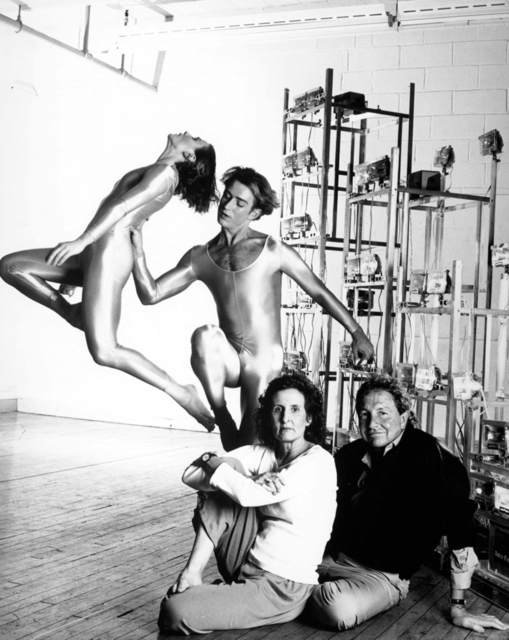
Why: Candoco Dance Company was founded in 1991 in London by Celeste Dandeker-Arnold and Adam Benjamin, following a series of workshops at the Aspire Centre for Spinal Injury. The troupe, which pushes the boundaries of what dance can be for both disabled and nondisabled performers, will be making its BAM debut on April 8 and 9, presenting two works, one of which is a reinterpretation of a classic. Commissioned by BAM in 1983, Trisha Brown Dance Company’s Set and Reset is a postmodern masterpiece that is currently being reconceived as an art installation at the Tate. Candoco, which is included in the Tate show, will perform its reimagining as part of the Set and Reset/Reset Restaging Project, with direction by former TBDC member Abigail Yager and music by Laurie Anderson. The costumes are by Dandeker-Arnold and visuals by David Locke, both based on Robert Rasuchenberg’s originals, with lighting by Chahine Yavroyan, based on the 1983 design by Rauschenberg and Beverly Emmons.

Also on the BAM bill is Face In, a 2017 collaboration between Candoco and Israeli-American choreographer and director Yasmeen Godder. The work, featuring set design by Gareth Green, lighting by Seth Rook Williams, costumes by Adam Kalderon, and music by the Brandt Brauer Frick Ensemble ft. Emika and others, swirls in multiple colors and unique movement. “I think our identity can be extended to more places sometimes than we think — it can, or that we’re willing to expose,” Godder said in a behind-the-scenes video about the work.