live performance

THE KITE RUNNER

Amir (Amir Arison) reads a story to Hassan (Eric Sirakian) in The Kite Runner (photo by Joan Marcus)

THE KITE RUNNER
Hayes Theater
240 West 44th St.
Tuesday – Sunday through October 30, $69-$199
thekiterunnerbroadway.com

The third time is not a charm for The Kite Runner.

Khaled Hosseini’s bestselling 2003 debut novel sold more than seven million copies in the United States. Director Marc Foster and screenwriter David Benioff’s 2007 film version was nominated for two Golden Globes, including Best Foreign Language Film, and for a Best Original Score Oscar. But Matthew Spangler’s 2009 theatrical adaptation, which opened July 21 at the Hayes Theater on Broadway, fails to live up to the promise of its forebears, rarely taking flight.

The play begins in San Francisco in 2001, with Amir (Amir Arison) explaining to the audience, “I became what I am today at the age of twelve. I remember the precise moment, crouching behind a mud wall on a frigid winter day in 1975 . . . peeking into a deserted alley. It’s wrong what they say about the past, about how you can bury it, because the past claws its way out.” For more than two and a half hours (plus intermission), Amir serves as both narrator and character, portraying himself from an Afghan child in 1973 to an adult in California. The story is told in scenes that are treated like individual set pieces that often merely depict what Amir has already described instead of offering more; when he is not in the scene itself, he is an observer, not taking action, which becomes the core of the plot.

The young Amir lives in Kabul with his father, Baba (Faran Tahir), a proud, moralistic, successful merchant; Amir’s mother died in childbirth, and he hasn’t remarried. Baba’s longtime devoted servant, Ali (Evan Zes), stays in a shack on the estate with his young son, Hassan (Eric Sirakian), who spends most of his time playing with Amir; Ali’s wife ran off with a troupe of actors and musicians years before. Amir and Hassan can’t necessarily be called friends because as Sunni Muslims and members of the Pashtun ethnic group, Amir and Baba are of higher status than Ali and Hassan, who are ethnic Hazaras and Shi’a.

Hassan loves listening to Amir reading stories to him, primarily from Ferdowsi’s tenth-century Persian epic poem Shahnamah; Amir wants to become a poet himself, which angers his father, who wants a tough, athletic son who can defend himself against bullies. “Real men don’t read poetry, and they certainly don’t write it! Real men play soccer, just like I did when I was your age!” Baba bellows. Baba tells his business partner, Ramir Khan (Dariush Kashani), “A boy who won’t stand up for himself becomes a man who can’t stand up to anything.”

Amir is determined to win the annual winter kite-fighting tournament, in which contestants try to cut the lines of everyone else’s kites, then have their runner track down the final fallen kite. Amir is one of the best kite cutters, but Hassan, who is devoted to Amir, is considered the greatest kite runner around. At the end of the competition, Hassan, in possession of the last kite, is confronted by neighborhood bully Assef (Amir Malaklou) and his cohorts, Wali (Danish Farooqui) and Kamal (Beejan Land). Ali demands that Hassan hand over the kite, but the young boy refuses, determined to bring it to Amir no matter the cost. As Assef commits a horrific act against Hassan, Amir watches, doing nothing, then runs away. “I ran as fast as I could. I ran all the way home,” the older Amir remembers sadly.

Baba (Faran Tahir) offers advice to his son (Amir Arison) in Broadway debut of The Kite Runner (photo by Joan Marcus)

The event, which the two boys never talk about, leads Amir to manufacture an estrangement; Ali and Hassan leave the estate, much to Baba’s displeasure. In 1978, Baba and Amir sacrifice everything following the Soviet invasion, first escaping to a refugee camp in Pakistan, then starting all over in San Francisco. In 1984, Amir and Baba are selling junk at a flea market in San Jose when Amir meets Soraya (Azita Ghanizada), the daughter of General Taheri (Houshang Touzie), who has also been reduced to selling random wares at the market. Amir and Soraya fall in love, but he is still haunted by how he treated Hassan. When Ramir discloses what has become of Ali and Hassan, Amir is determined to right the wrongs of his past, even if it means risking his life.

The Kite Runner is laden with the shame Amir is burdened with, and its heaviness weighs down the show. Too many of the scenes are extraneous or go on for too long; for example, a wedding might introduce us to certain aspects of Afghan culture, but it adds little to the narrative. The first act does a decent job of setting up what is to come, but the second act is an avalanche of incredulity and melodramatic coincidence that quickly grow tedious.

Spangler (Albatross, Operation Ajax), who has also adapted T. C. Boyle’s The Tortilla Curtain, Mary Manning and Sinead O’Brien’s Striking Back: The Untold Story of an Anti-Apartheid Striker, and Hanan al-Shaykh’s The Story of Zahra, among other books, tries to include too much of the novel, so the plot meanders, getting stuck in the trees till it finally comes crashing to the ground. Director Giles Croft (Tony’s Last Tape, The Understudy) is unable to untangle the tale, which takes place on Barney George’s spare stage, anchored by an uneven wooden picket fence in the back on which William Simpson projects images.

Throughout most of the show, Salar Nader plays the tabla, sitting at the sides of the stage, adding to the Central Asian mood. Arison (The Blacklist, Aftermath) has difficulty navigating the time jumps as the unreliable narrator, delivering important facts at too slow a pace. Tahir, who recently played Othello and Richard III, brings a Shakespearean majesty to Baba, while Touzie (The Tibetan Book of the Dead, From Satellite with Love) is strong as the once-powerful general and Sirakian (The Jungle, Pericles) is more effective than Arison in portraying a child.

Spangler and Croft touch on key issues, from bigotry and immigration to bullying and the Taliban, but they feel less central to the plot than they did in the book, even in the wake of the controversial US pullout from Afghanistan in 2001; the name of the play refers to Hassan, but it is all about Amir, an unsympathetic character who is difficult to stick with in this disappointing adaptation.

ART TALK: CYNTHIA DAIGNAULT ON CRISTINA IGLESIAS

Cristina Iglesias’s Landscape and Memory consists of five bronze pools flowing along the Oval Lawn in Madison Square Park (photo by twi-ny/mdr)

Who: Cynthia Daignault
What: Free art talk in conjunction with Cristina Iglesias’s Landscape and Memory
Where: Oval Lawn, Madison Square Park
When: Wednesday, August 3, free, 6:00
Why: Mad. Sq. Art concludes its free summer talk series with American painter Cynthia Daignault discussing monuments, memory, and the natural world as it relates to her work and Spanish artist Cristina Iglesias’s Landscape and Memory, which is on view in the park through December 4. Daignault’s canvases feature lush mountain valleys, black-and-white trees, words barely visible on black backgrounds, objects such as skulls and food, and figures such as JFK, Marilyn Monroe, Barack Obama, Malcolm X, and Divine. Iglesias’s public interventions include water-based works in England, Spain, Mexico, Brazil, Belgium, and Norway in addition to gates and passages, entwined murals, rooms and mazes, screens, suspended pavilions, and other conceptual and architectural projects. On August 3 at 6:00, Daignault will be on the oval lawn in Madison Square Park to share her thoughts on Iglesias’s captivating piece, a stream that winds through the grass in five bronze sculptural pools, referencing Cedar Creek and Minetta Brook, which once upon a time flowed across the park, heading for the East or Hudson River.

Each pool offers its own calming respite, with water gently babbling against rocks. “I started being interested in the use of water as an element of movement and change in this culture and also in the city, a way to show how nothing if we look carefully is always the same,” Iglesias explained in a 2021 virtual discussion for Whitechapel Gallery. “And I think water somehow makes that more visible.” It’s as if Iglesias, the daughter of a scientist, has uncovered a slice of the geographic history of Madison Square Park, now bubbling to the surface. (The park has also been home to a potter’s field, a parade ground / arsenal, and a reform school.) The title pays tribute to Simon Schama’s 1995 treatise Landscape and Memory, which explores the Western world’s interaction with nature. “Landscapes are culture before they are nature; constructs of the imagination projected onto wood and water and rock,” Schama writes. “Once a certain idea of landscape, a myth, a vision, establishes itself in an actual place, it has a peculiar way of muddling categories, of making metaphors more real than their referents; of becoming, in fact, part of the scenery.” Following the informal talk, the public is invited to continue the dialogue directly with Daignault.

THE BUTCHER BOY

Nicholas Barasch sparkles as Francie Brady in world premiere musical at the Irish Rep (photo by Carol Rosegg)

THE BUTCHER BOY
Irish Repertory Theatre, Francis J. Greenburger Mainstage
132 West 22nd St. between Sixth & Seventh Aves.
Wednesday – Sunday through September 11, $50-$70
212-727-2737
irishrep.org

Five years ago, high school senior Asher Muldoon came to the Irish Rep with a musical adaptation of Patrick McCabe’s award-winning 1992 novel, The Butcher Boy, about thirteen-year-old Francie Brady (Nicholas Barasch), a red-haired lad on a destructive path to do some very bad things in the village of Clones in County Monaghan in the mid-1960s. Shortlisted for the Booker Prize, the novel was turned into a well-received 1997 dark comedy by Neil Jordan starring Stephen Rea, Fiona Shaw, Brendan Gleeson, Milo O’Shea, and Sinéad O’Connor. Muldoon’s show opened last night at the Irish Rep, the first new musical developed by the company in eight years. Unfortunately, it could use some slicing and dicing; while the narrative parts work well, the musical numbers don’t bring home the bacon.

Nicholas Barasch is terrific as Francie Brady, a neighborhood bully from a dysfunctional family; he narrates the story in a series of flashbacks, disconcertingly oblivious to the full weight of his actions. “When I was a young lad twenty or thirty or forty years ago I lived in a small town where they were all after me on account of what I done on Missus Nugent,” he says at the beginning. “Now, it started with Joe and me out at the hide we had built. ‘Death to all dogs who enter here!’ we said. Except us of course.”

Francie’s mother, Annie (Andrea Lynn Green), suffers from severe depression, and his father, Ben (Scott Stangland), is a nasty alcoholic and failed trumpet player. Francie’s uncle, Alo (Joe Cassidy), his father’s brother, left his girlfriend, Mary (Kerry Conte), without saying goodbye, to try his luck in London. He comes to a party as a conquering hero until the two siblings have a bit of a contentious row.

Francie hangs around with his best friend, Joe Purcell (Christian Strange), fishing; seeking to create mayhem; doing whatever he can to obtain his favorite candy, Flash Bars; and bullying Phillip (Daniel Marconi), Mrs. Nugent’s (Michele Ragusa) nerdy son, stealing his treasured comic books. “Oh, if we lived like this forever we’d be fine / So why can’t we live like this forever?” Francie and Joe sing.

Upset at Francie’s treatment of Phillip, Mrs. Nugent visits Mrs. Brady and complains, “I’ll tell you something, Annie, it’s no wonder your boy is such a mean little runt. His father lying round in bars morning to midnight, a disgrace to the family, to the whole town, he’s no better than a pig. A PIG.” Francie, as narrator, tells the audience, “She didn’t know what she was doing then, Mrs. Nugent.” Mrs. Nugent then adds, “Pigs! Sure the whole town knows it. PIGS!!!”

Four pigs spur Francie Brady (Nicholas Barasch) to do bad things in The Butcher Boy (photo by Carol Rosegg)

The “pigs” comments get to Francie, who does not want to be seen as inferior to anyone. He soon finds himself accompanied by four imaginary pigs (Teddy Trice, Carey Rebecca Brown, Polly McKie, and David Baida), a quartet of adults wearing pig masks and goading him on. “Well, I’ll be damned if I let all those piggies take what’s mine / This town ain’t big enough for both of us, you filthy swine / Let’s open up an abattoir and / Drain their blood for boudin noir / Save room for sausage,” one of the pigs sings. The four then chime in together, “Cause those big fat piggies have too much to say / Show em we’re not afraid to go to war / Unless those pigs grow piggy wings and fly away / Within a day or two you won’t know who is you and who is piggy.”

Francie runs away to Dublin (using the elegant pseudonym Algernon Carruthers), believing, “We can all just stay together / And I know that we’ll be fine / And the world will be back where the world is supposed to be,” but he winds up back in Clones with his family, gets a job working for Mr. Leddy (Baida) the butcher (“I’m used to seeing pigs,” Francie says), and has to redefine his place in a community where everyone seems to have grown up around him but he has stayed the same. It doesn’t go well.

Directed by Irish Rep cofounder Ciarán O’Reilly (Autumn Royal, The Emperor Jones), The Butcher Boy is an intense look into the mind of a troubled teen whose dark fantasies lure him away from reality. The show begins on Charlie Corcoran’s superb set, a kind of confined hideout with wooden slats at the right and left side covered in colorful comic-book regalia and a large, old-fashioned black-and-white television screen in the back, where Francie watches The Lone Ranger, Captain Z-Ro, and The Twilight Zone, including clips from the famous TZ episode “It’s a Good Life,” in which Bill Mumy portrays a young boy with special powers that allow him to control every part of life — and death — in a small town (“You’re a bad man! You’re a very bad man!”). During intermission, the classic “Eye of the Beholder” episode is shown, in which Rod Serling asks, “What kind of world where ugliness is the norm and beauty the deviation from that norm?” The pig masks are reminiscent of two TZ episodes, but the musical overdoes the comparisons by having Phillip morph into Serling during an otherwise harrowing scene.

There are also references to John F. Kennedy, America’s first Irish-Catholic president, who was almost brought down by the Bay of Pigs invasion, and three iterations of women named Mary, all played by Conte, a clever melding of the Virgin Mary and Mary Magdalene, a trio of characters who intrigue Francie.

Francie’s descent into mental illness is both heartbreaking and frightening, particularly as the United States is involved in a wide-ranging discussion about mental health, especially as it relates to disturbed young white males who are prone to mass shootings. Barasch (Hadestown, She Loves Me) walks the fine line of Francie’s sanity with an infectious charm even though we know that things are going to get bloody at any moment; his smile, and bright red hair, lights up the room.

However, the musical numbers (“Big Fat Piggies!,” “My Lovelies,” “Francie Gets Mad,” “Don’t Forget About Me”), featuring limited, tongue-in-cheek choreography by Barry McNabb, actually detract from the story; they feel tacked on, like garnish, merely extending the show to a too-long two hours and twenty minutes (with intermission). I found myself rooting for them to end, like television commercials, so I could get back to the regularly scheduled program, which I was otherwise immersed in, enjoying thoroughly.

Muldoon, who is currently an undergrad at Princeton, wrote the book, music, and lyrics; the score is performed by the Slaughterhouse Five, consisting of conductor and musical director David Hancock Turner on keyboards, Danielle Giulini on violin, Joseph Wallace on bass, Martha Hyde on reeds, and Mike Rosengarten on guitar and banjo, playing behind the television screen, only occasionally visible.

The Butcher Boy could have used some more tenderizing and trimming before being served, as it has the promise of being one delicious meal where audiences wouldn’t mind making pigs of themselves.

CAT ON A HOT TIN ROOF

Maggie (Sonoya Mizuno) and Brick (Matt de Rogatis) have different plans for the future in Tennessee Williams classic (photo by Miles Skalli)

CAT ON A HOT TIN ROOF
Theatre at St. Clement’s
423 West Forty-Sixth St. between Ninth & Tenth Aves.
Wednesday – Monday through August 14, $39-$125
www.ruthstage.org

When I was on the high school tennis team, the coach, Mr. Spector, taught me to avoid getting caught in “no man’s land,” the midcourt area in between the service box and the baseline where it is most difficult to return volleys because the ball can come right at your feet or at your head, which forces you to awkwardly play the ball. Mr. Spector was also my tenth-grade English teacher. Although I don’t recall any classes on Mississippi-born playwright Tennessee Williams that year, I thought of Mr. Spector after watching Ruth Stage’s adaptation of Cat on a Hot Tin Roof, continuing at Theatre at St. Clement’s through August 14.

In October 2019, the troupe presented an alternate take on The Glass Menagerie at the Wild Project, directed by Austin Pendleton and Peter Bloch and starring Ginger Grace as Amanda Wingfield, company creative director Matt de Rogatis as Tom, Alexandra Rose as Laura, and Spencer Scott as the Gentleman Caller. Ruth Stage, with much of that same team, is now following that up with a unique version of Cat, the first-ever off-Broadway production approved by the Williams estate of the three-act 1955 Pulitzer Prize winner. Unfortunately, it spends too much of its 165 minutes (with an intermission and a pause) caught in a theatrical no man’s land.

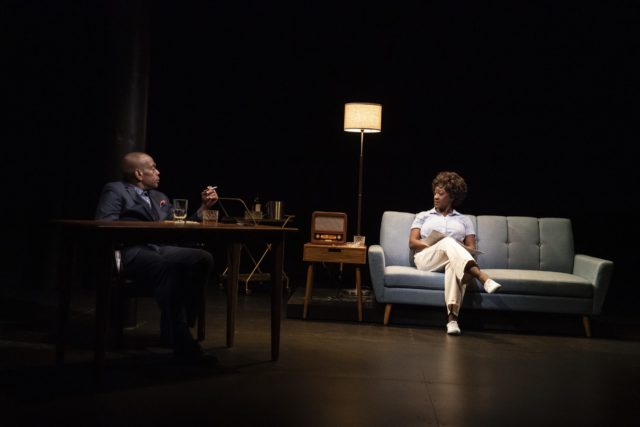
Director Joe Rosario (Flowers for Algernon, The Exhibition) moves the time to the present, on a summer day when a family on a twenty-eight-thousand-acre cotton plantation is getting ready to celebrate patriarch Big Daddy Pollitt’s (Christian Jules Le Blanc) sixty-fifth birthday. The action takes place in the bedroom of Big Daddy’s ne’er-do-well son, Brick (de Rogatis), and his wife, Margaret (Sonoya Mizuno), aka Maggie the Cat. Following the death of his very close friend Skipper, Brick has become a drunk, refusing to sleep with Maggie, who wants to have a baby. The night before, trying to relive his high school glory days, Brick, heavily intoxicated, busted his ankle jumping hurdles and so he’s moving around in pain using a metal crutch and wearing a boot.

In the next room are Brick’s brother, Gooper (Scott), a lawyer who has been helping manage the estate, and his catty wife, Mae (Tiffan Borelli), who is pregnant with their sixth child. Two of their kids, Trixie and Dixie (Rose and Carly Gold), wander around the mansion in their own world; Maggie refers to them as the no-neck monsters. A report from Doc Baugh (Pendleton) reveals that Big Daddy is dying of cancer, setting in motion a battle for his money and control of the plantation. They have all chosen not to tell Big Daddy or Big Mama (Alison Fraser) about the terminal illness; instead, they are told that he has a spastic colon. As the evening goes on, the family dysfunction ratchets up with pointed hostilities emanating from just about everyone except Rev. Tooker (Milton Elliott), who is in over his head with the Pollitts.

Big Daddy’s (Christian Jules Le Blanc) birthday party goes awry in Cat on a Hot Tin Roof (photo by Miles Skalli)

Despite admirable qualities, this Cat is stuck in no man’s land from the very start. The play opens with the heavily tattooed Brick taking a shower behind the bar while Maggie applies makeup at her vanity. They are both superhot, eye candy no matter your orientation, but they lack the fiery chemistry demanded for their failing relationship. While de Rogatis does a lot of grunting — alcohol does not seem to lessen Brick’s constant pain, at least part of which is psychological — Mizuno speaks softly, sometimes in a whisper that is hard to hear. When Maggie says about Gooper and Mae, “Of course it’s comical but it’s also disgusting since it’s so obvious what they’re up to!” Brick responds, “What are they up to, Maggie?,” which is the audience’s response as well, because not everything Mizuno just said was clear.

In fact, all of the actors speak at different levels throughout; combined with their seemingly random costumes and shifting accents, it’s like they’re all in separate versions of the play, each in their own no man’s land. Even the set itself is hard to figure out; while there is a door to the bedroom that Big Mama never wants to be locked, there are also two empty white doorframes that lead to a back veranda that anyone can use to enter the room whenever they want.

The nods to the present day are confusing and seemingly random as well. There’s a loud cordless phone in the room that rings a few times, which at first sounds like an audience member’s phone going off. During the party, Gooper pulls out a cell phone to take a family photo, but that’s the only appearance of such a device.

One of the no-neck monsters wears bulky headphones instead of earbuds, listening to contemporary pop tunes. Brick might believe he is deserving of his hurting ankle, but there is no talk of any kind of painkillers that could help him. Even though Big Daddy is worth more than one hundred million dollars, there is no discussion of second opinions or getting the best doctors in the world to treat him. Along similar lines, no one mentions to Brick and Maggie that they could try alternative methods of getting pregnant, including IVF.

One of the toughest problems facing many twenty-first-century productions of Williams is how to make the homophobia that drives so much of the action and so many of his characters understandable to a modern audience. The fear and shame that hover over the Pollitts because of what occurred between Brick and Skipper feels out of date, especially because the family does not seem to be bigoted. While homosexuality was certainly a controversial issue in the 1950s (and remains so today, though not nearly as hidden), it would not be handled with the same language or emphasis in 2022. And for a bonus contemporizing effect, there are a bunch of F-bombs dropped like the fireworks that later explode in the night sky over a projection beyond the veranda.

Le Blanc, who has won three Daytime Emmys for his portrayal of Michael Baldwin on The Young and the Restless, a role he has played for more than thirty years, stands out among the cast as a trimmed-down, bushy-haired Big Daddy. He speaks with bold authority, his accent consistent, his words artistically enunciated; when he’s onstage, you can’t take your eyes off him. He’s the only one Mr. Spector wouldn’t have to shout at to get out of that treacherous no man’s land.

HIT THE WALL

Adam Files and Alexandra Guerrero star in Jake Shore’s Hit the Wall (photo by Neil Ryan)

HIT THE WALL
The Kraine Theater
85 East Fourth Street between Second Ave. & Bowery
Thursday – Saturday through August 11, $25
www.frigid.nyc

During the pandemic lockdown, Rhode Island native Jake Shore wrote and directed (Adjust the Procedure, one of the best Zoom plays built around Zoom itself, consisting of a series of online meetings at a university attempting to deal with — or not deal with — a terrible tragedy. Presented by Spin Cycle and Shore’s JCS Theater Company, the prerecorded play enjoyed several extensions and was picked up by various festivals.

Shore’s first in-person play since theaters have reopened is Hit the Wall, a didactic seventy-minute, two-character drama about art and the audience continuing at the Kraine through August 11.

The show begins with famous forty-four-year-old graffiti artist Amir (Adam Files) and his protégé, twenty-five-year-old Rae (Alexandra “Allie” Guerrero), in his high-rise New York City apartment in 2010. For several minutes, they stand behind an empty picture frame hanging from the ceiling; it serves as a window to the outside world, an invisible canvas, and a reference to the Zoom boxes that were so prevalent during the height of the coronavirus crisis.

Rae tells Amir about a current project she’s failed to complete, a Madonna and Child on a wall in Crown Heights. She wants to go back and finish it, but Amir, who she compares to such graffiti legends as Banksy, Shepard Fairey, Lee Quiñones, and Claw Money, asserts that it would be a mistake, that she could be caught and sent to prison. “You’re succumbing to the rush and thrill of the chase, not the connection to your art,” he insists.

After some back and forth, Rae convinces Amir that she must finalize the work. He offers to help, but she refuses his support. The next morning she is excited, having executed the full piece in Brooklyn, and is now entertaining thoughts of hitting a wall in Times Square, despite the obvious danger. She tells him, “When I mention a wall, one of the first things you ask about is the visibility. The intention behind this being how many people can see it. How many sets of eyes. High visibility means a large audience, and then, in turn, more of a shot at influencing culture.” It’s as if Shore is comparing an off-off-Broadway play in Brooklyn — or a Zoom show — to a big-time production on the Great White Way.

While Rae desires the attention and wants to be a social media phenomenon, Amir is all about the art itself and its natural visibility to the right kind of people. He rails against capitalism and corporate greed, repeatedly claiming that sell-outs are rapists, thieves, and prostitutes. “Do you think that I would waste myself on the fuckers who visit and frequent Times Square?” he says. “That’s the point. Visibility is not just about the number of people you can reach, it’s about the quality of your audience.” A few moments later, Rae explains, “An empty theater has no audience,” another reference to the lockdown, when all theaters were empty and actors performing virtually had no idea who was out there watching them.

When Rae’s Madonna and Child suddenly and unexpectedly goes viral — perhaps not unlike what happened, to a lesser degree, with Adjust the Procedure — her relationship with Amir, and with her art, undergoes a rapid change.

Rae (Alexandra Guerrero) and Amir (Adam Files) discuss art and audiences in world premiere play at the Kraine (photo by Neil Ryan)

Directed by Timothy Haskell (Road House the Stage Play, Fatal Attraction: A Greek Tragedy, The Rise and Fall, Then Brief and Modest Rise Followed by a Relative Fall of . . . Jean Claude Van Damme . . .), Hit the Wall feels like an unfinished work in need of significant touch-ups. Even at only seventy minutes, it is repetitive as the two characters argue incessantly about the value of art and the need for it to be seen. Guerrero (At Least He Didn’t Die with Antlers on His Head) has the better, more well-rounded part, and she does a good job with it, capturing our attention and gaining our sympathies, while Files (Adjust the Procedure, Fragments) is held back by dialogue that sometimes sounds like he’s defending a dissertation — but only when you can hear the two actors, who have to compete with an aggressively loud air-conditioning unit.

Shore (The Devil Is on the Loose with an Axe in Marshalltown, Down the Mountain and Across the Stream) makes some interesting comparisons about mentors and protégés, parents and children — Rae has a strained relationship with her mother and ill father, so it’s not surprising that her signature piece is the idealized Madonna and Child, but the subplot grows overbearing.

The most compelling theme in the play is the exploration of the exchange between artist and audience as it relates specifically to live theater. At certain points Amir and Rae wonder if they themselves are performing for people sitting in seats, watching them.

“There is an eternal audience, Rae,” Amir says. “Imaginary?” Rae asks. Amir: “An eternal audience more real and present than any single person or group. . . . An audience on another plane. Like we’re in a play.” Rae: “Some otherworldly judgment? You speak clearly of God.” Amir: “Not God or gods.” Rae: “Then what?” Amir: “A group of viewers beyond our comprehension. . . .” Rae: “They are down there in the city, or up here so many stories high, but not seated in a dark theater in the caverns of your subconscious.”

No, we are seated in a dark theater, physical presences who have returned from two years of experiencing plays online, if at all, ready to be entertained, and challenged, no longer beyond comprehension. In a program note, Shore explains, “One reason I wanted to write a play like this is because graffiti artists want walls so badly. That’s sort of where it started.” Unfortunately, in his attempt to hit this wall, he misses.

ELEVATOR REPAIR SERVICE: SEAGULL

Elevator Repair Service puts its unique spin on Anton Chekhov’s The Seagull (photo by Ian Douglas)

SEAGULL
NYU Skirball Center for the Performing Arts
566 La Guardia Pl. between Third & Fourth Sts.
Through July 31, $50-$60 (use code FB25 for $25 tickets)
212-945-2600
nyuskirball.org
www.elevator.org

I’m beginning to think I might never see another traditional production of Anton Chekhov’s 1895–96 classic, The Seagull. Perhaps more than any other playwright, Chekhov’s works almost demand reinvention for the stage in the twenty-first century. His tragicomic take on human relationships and society’s ills invite modern, often extensive reinterpretation and experimentation.

As often as Shakespeare’s plays are reimagined, they almost always still contain the Bard’s original dialogue; it’s the staging that changes. The same is not necessarily true about Chekhov, as evidenced by such recent successes as Arlekin Players Theatre’s hybrid The Orchard (The Cherry Orchard), Aaron Posner’s Life Sucks. (Uncle Vanya), and Halley Feiffer’s Moscow Moscow Moscow Moscow Moscow Moscow (Three Sisters).

As far as The Seagull goes, over the last ten years I’ve seen Posner’s Stupid Fucking Bird at the Pearl in 2016, a deliriously chaotic yet controlled rave-up sticking to the main plot but told with an intoxicating irreverence; Jeffrey Hatcher’s Ten Chimneys, at St. Clement’s in 2012, which goes behind the scenes of an upcoming Broadway revival of The Seagull starring Alfred Lunt and Lynne Fontanne; and Christopher Durang’s Vanya and Sonia and Masha and Spike, a delightful all-star mashup of The Seagull, Three Sisters, and Uncle Vanya that ran on and off Broadway in 2013.

Elevator Repair Service, the downtown company whose literary adaptations include William Faulkner’s The Sound and the Fury, Shakespeare’s Measure for Measure, James Joyce’s Ulysses, and F. Scott Fitzgerald’s The Great Gatsby — the much-admired eight-hour Gatz — now turns its unusual techniques on Chekhov with Seagull, continuing at NYU Skirball through July 31. Nearly three hours with one intermission, the play self-referentially refers to itself regularly, with actors occasionally speaking to the audience as themselves, not as their characters. It begins with a long monologue by company member Pete Simpson, who talks about the Skirball space itself. “One of these two corkscrew, fluted, gold leaf columns is structural and holds up the building above us. The other is hollow, insubstantial, and does nothing but sit there and look pretty in an attempt to make things look symmetrical.”

When he said that under each chair are three flags, a red one that “will tell us you feel physically threatened or uncomfortable,” a checkered one to use if you just “wanna talk,” and a third to order food, I saw the woman sitting across the aisle from me reach below her seat to see if the flags were really there. (They’re not.) But it signals that this production is going to veer wildly between the real and the imagined, although all of it turns out to be Chekhovian in one way or another, even if, as Simpson, who also plays the teacher Semyon, explains, “95% of tonight’s text both original and adapted has been written by our company’s own Gavin Price,” who portrays wannabe playwright Konstantin.

Director John Collins leaves the central plot intact: The twentysomething Konstantin has invited friends and family over to a lovely lake house to watch his latest play, to be performed by Nina (Maggie Hoffman), a nervous actress he is desperately in love with. Konstantin is hoping to prove to his mother, famous actress Irina (Kate Benson), that he has talent and a purpose in life; Irina, who chastises him regularly in front of everyone, has arrived with her new beau, well-respected and successful writer Boris Trigorin (Robert M. Johanson), who takes a liking to Nina.

Also at the presentation are Patricia (Laurena Allan), Irina’s ailing sister; farmer Ilya (Julian Fleisher), who is a big fan of Irina’s, and his wife, Paulina (Lindsay Hockaday); Masha (Susie Sokol), the farmers’ daughter who is in love with Konstantin but might be married off to Semyon; Yakov (John Gasper), who works at the lake house; and Gene (Vin Knight), a doctor who has an innate charm that lures the ladies, including Paulina.

In the middle of the play-within-a-play, Irina asks, “Is this supposed to be symbolic?” A moment later, she says, “Something smells. Is that part of the effect?” A disgusted Konstantin eventually has to stop the show because of his mother’s interruptions.

Shortly after Patricia has an asthma attack, Benson, Hoffman, and Susie have a discussion as themselves, commenting on how much they enjoyed the previous scene and what Chekhov’s play is about. The play resumes as Konstantin presents Nina with a seagull he just shot.

Masha (Susie Sokol) leads the characters in a strange game in Seagull (photo by Ian Douglas)

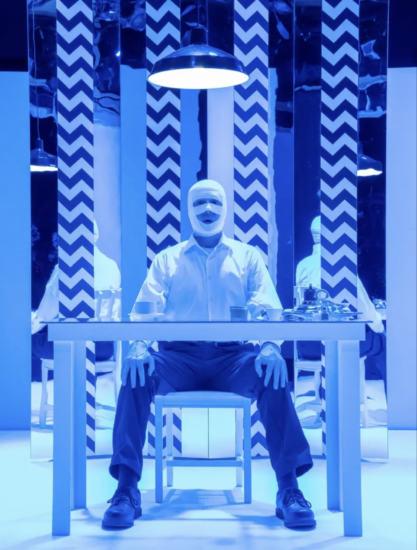
Following intermission, Sokol points out how long she has been with ERS, explains the set design, and expresses her disappointment that one of Masha’s key lines has been cut: “I’m in mourning for my life.” Soon various characters consider leaving the lake house, Irina insists she has no money to help anyone, and Konstantin sports a bloody bandage wrapped around his head. “You . . . Symbolist!” Irina again accuses her son. “Miser!” he replies. “You amateur!” she declares. It all goes downhill from there.

The set by dots, so ably described by Sokol, features a row of folding chairs in the front that the characters move about depending on the action. Downstage right is a table with electronic equipment, while upstage left is a cozy dinner table with pictures on the wall. The lighting is by Marika Kent, with sound by Price and Gasper and purposely mismatched costumes by Kaye Voyce, ranging from Nina’s elegant red dress to Irina’s short skirt, heels, and tights.

Collins’s direction may appear disordered as the fictional plot battles it out with the actors’ thoughts and some events happen either offstage or in the background — as when several characters sit down to eat but we can’t make out exactly what they are saying to one another, although it does turn into a terrific bingo-style dance number. But there is a method to his madness, even if it’s not necessarily always clear what he’s up to; numerous pieces of dialogue reflect back on the play we’re watching, as if ironically commenting on what is happening in Seagull at Skirball.

“It’s not easy, you know, acting in your play. There aren’t any ordinary people in it,” Nina tells Konstantin, who responds, “Ordinary people! We have to show life not the way it is, or the way it should be, but the way it is in dreams!” Nina retorts, “But nothing happens in your play! It’s all one long speech. And I think a play ought to have a love story.” Meanwhile, Collins emphasizes Chekhov’s Hamlet references, with Konstantin echoing the young prince, Irina a different kind of Gertrude, Boris representing Claudius, and Nina an embellished Ophelia.

“It was a strange play, wasn’t it?” Nina asks Boris about Konstantin’s show. Boris replies, “I’m afraid I didn’t understand a thing. But it was interesting to watch. You were wonderful. And of course, the set was magnificent!” Most people in the audience seemed to agree with that analysis of ERS’s production, although a handful walked out during the first act and others did not return after intermission; however, those who stayed, the vast majority of the crowd, gave the performers a standing ovation at the end.

Seagull is not for everyone’s taste. It is long — 173 minutes, as Simpson tells us — it is confusing, it is pedantic, and it can be self-referential to a fault, particularly as the cast passes around a microphone and cord, going in and out of character. And don’t get me started on the awful noise made when Patricia is pushed around in a chair. But it all continues founding artistic director Collins’s thirty-plus-year mission of experimenting with new theatrical forms, in original works and unique adaptations.

Hamlet asked himself, “To be or not to be.” In Seagull, Patricia answers, “Just go on living, whether you feel like it or not.” The same can be said for theater itself.

MR. SATURDAY NIGHT

Buddy Young Jr. (Billy Crystal) needs to prove to everyone he’s still got it in Mr. Saturday Night (photo by Matthew Murphy)

MR. SATURDAY NIGHT
Nederlander Theatre
208 West 41st St. between Seventh & Eighth Aves.
Tuesday – Sunday through September 4, $69-$179
877-250-2929
mrsaturdaynightonbroadway.com

Don’t get me started. So I’m sitting in a theater a few weeks ago, waiting for a play to begin, when I overhear the three people next to me, who are from Toronto, discussing what else they want to see while they’re in New York. “What about Mr. Saturday Night?” the oldest one asks. “Oh, I love Billy Crystal, but I’d rather see a musical,” his grown daughter says. “Who’s Billy Crystal?” her twentysomething son says, as if he could not care any less. What are they, meshugeneh?

In 1984, burgeoning superstar William Edward Crystal got his own HBO special, A Comic’s Line, in which he created Buddy Young Jr., an aging, antiquated comedian with a gruff voice and an even gruffer manner. Crystal, who played the barrier-shattering gay character Jodie Dallas on Soap from 1977 to 1981, further developed Buddy on Saturday Night Live (1985-85) and then in the 1992 film Mr. Saturday Night, which he also cowrote (with Lowell Ganz and Babaloo Mandel) and directed. By then Buddy was a fully fledged, long-out-of-date Borscht Belt has-been whose outsize ego continually results in lack of success.

Crystal, who won a Tony for his 2004 one-man autobiographical show, 700 Sundays, has now turned Mr. Saturday Night into an utterly charming and fun Broadway musical — yes, Toronto friends, a musical, with plenty of shtick — reteaming with Ganz and Mandel (Splash, Parenthood, A League of Their Own), who also worked with Crystal on the two hit City Slickers flicks and the forgettable Forget Paris. In addition, David Paymer, who won an Oscar as Buddy’s long-suffering brother and agent, Stan Yankleman, in the movie, is back in the same role onstage. For the film, Crystal, who was in his early forties at the time, had to go through nearly six hours of makeup every day to play the seventy-three-year-old comedian; for the Broadway show, which runs through September 4 at the Nederlander, Crystal, now seventy-four, requires very little makeup to play the younger Young.

A onetime television star in the 1950s, Buddy has been reduced to telling lame jokes at retirement homes to less-than-enthusiastic audiences. “So, the other day, my wife says, ‘Buddy, come upstairs and make love to me.’ So I said, ‘Make up your mind — I can’t do both.’” Met with crickets, he adds, “Hey, come on. I know you’re out there — I can hear you decomposing.”

Watching the Emmy Awards in his New York City apartment, Buddy is shocked when he sees himself highlighted at the end of the in-memoriam segment that lists all the famous people who died in the previous year. “Look! They killed me!” he tells his wife, Elaine (Randy Graff). “I’m not dead, you bastards!”

But instead of wallowing in self-pity, Buddy decides he can turn the mistake into his last chance to prove to the world what he’s got before he really dies. He sings, “No more playing brises and bar mitzvahs, / Sundays at the Szechuan buffet, / All that starts changing tomorrow when I’m on Today!” After going on the morning show, Buddy is a hot commodity again, taking meetings at the Friars Club and getting a movie offer but, as flashbacks reveal, the hardheaded comedian can’t stop getting in his own way on the road to fame and fortune.

Meanwhile, he tries to reestablish a connection with his forty-year-old daughter, Susan (Shoshana Bean), who has a history of drugs and arrests and is excited that she is up for a PR job. Buddy: “What’s it pay?” Susan: “Okay, you see?! I’m leaving.” Buddy: “That’s a normal question about a job. What does it pay?” Susan: “It pays ten cents a year, okay?! That’s what it pays. Ten cents a year!” Buddy: “Okay, that’s something. That’s ten cents more than last year.”

Buddy Young Jr. (Billy Crystal) keeps Jordan Gelber, Brian Gonzales, and everyone else laughing in hit Broadway musical (photo by Matthew Murphy)

Scott Pask’s set smoothly moves from the Youngs’ home to the Friars Club to a talk show to Young’s good old days, with costumes by Paul Tazewell and Sky Switser and video and projections by Jeff Sugg, taking us back and forth between past and present. Generously directed by Tony winner John Rando (Urinetown, On the Town), Mr. Saturday Night is great fun. Ganz, Mandel, and the endlessly irresistible Crystal — the most delightfully appealing comedian of the last fifty nears — never miss an opportunity to go for the quick laugh but without sacrificing the narrative. The show is all about Crystal; it’s unlikely to be remembered for its cast album, although three-time Tony winner Jason Robert Brown’s (Parade, The Last Five Years) music and orchestrations and Tony nominee Amanda Green’s (Hands on a Hardbody, Bring It On) lyrics are a fine match for the players.

Crystal and Paymer are not there for the singing or dancing; the more intensive numbers are left for Tony winner Graff (City of Angels, A Class Act) and Bean (Hairspray, Wicked), who are both superb. Choreographer Ellenore Scott keeps it mostly simple, not trying to give Crystal and Paymer too much tsuris. Jordan Gelber, Brian Gonzales, and Mylinda Hill excel as multiple characters, serving up, of all things, comic relief. Chasten Harmon (Hair, Les Misérables) is agent Annie Wells, who at first has no idea who Buddy Young Jr. is but is doomed to find out. I hope the same happened to the guy from Toronto. To use one of Young’s catchphrases, did you see what I did there?

Early on, Young declares, “Sure, I’m old but look, my mic hand is steady, / Still upright and I’m ready, / Do I pack away the tux and tie / and lie here growing fungus? / That’s what they want me to do!” And Crystal’s singing as much about himself as Young when he adds, “I got to hear them saying: / He’s still got it! / He’s still got it! / Balls you can’t lift with a crane.”