Welcome to imagi*Nation asks the audience to participate in deciding what happens next (photo by Julia Discenza)
WELCOME TO IMAGI*NATION: THE TRILOGY
Sanctuary Space at the Center at West Park
165 West Eighty-Sixth St.
October 27-29, $25, 7:30 www.eventbrite.com www.carmencaceres.com
Audiences get to choose their own adventure in the world premiere of New York-based Argentinian choreographer Carmen Caceres and DanceAction’s Welcome to imagi*Nation, taking place October 27-29 at the Sanctuary Space at the Center at West Park. The three-part work focuses on the the battle over natural resources, labor shortages, and immigration policy, inspired by Caceres’s own story as well as Eduardo Galeano’s 1971 tome Open Veins of Latin America: Five Centuries of the Pillage of a Continent. “The book flows with the grace of a tale,” Isabel Allende writes in the introduction. “His arguments, his rage, and his passion would be overwhelming if they were not expressed with such superb style, with such masterful timing and suspense. Galeano denounces exploitation with uncompromising ferocity, yet this book is almost poetic in its description of solidarity and human capacity for survival in the midst of the worst kind of despoliation.”
Welcome to imagi*Nation is performed by Caceres (who also designed the costumes), Israel Harris, Jenna Purcell, Lydia Perakis, Mallory Markham-Miller, Mar Orozco Arango, and Sofia Baeta, playing multiple characters, with video by Daniel Hess and music by Emilio Teubal and others. “From the very beginning of the process, this has been an extremely personal project,” Caceres said in a statement. “Having moved to the US as an immigrant over a decade ago, I’ve been thrown right into a whirlpool of issues that are rarely considered in the policymaking arena but dramatically affect everyone who needs to adapt to a new reality, language, and identity. I learned that for every choice you make, you leave something behind. This work — drawing from my own life and those of my collaborators/performers and inspired by Galeano’s seminal study of the struggle over power, resources, and access between the US and the South American countries — is an invitation for the audience to experience this firsthand, by engaging with potentially life-changing decisions on behalf of my characters.”
A young woman reexamines critical decisions she made about her future and grief over her mother’s death in Melis Aker’s Hound Dog, an entertaining if scattershot mishmash that opened tonight at Ars Nova @ Greenwich House for a limited run through November 5.
Anneh, aka Hound Dog (Ellena Eshraghi), is a Harvard grad and guitarist-singer who returns to her home in Turkey while considering whether she should attend the Royal Academy, which has accepted her after her successful audition. Her father, the rock-and-roll-loving Baba (Laith Nakli), has been suffering since the loss of his wife, lost in a fog of alcohol and television as he dreams of going to Graceland.
Anneh’s best friend, Ayse (Olivia AbiAssi), is thrilled that she’s back, but Anneh seems distracted. She is more interested in talking with Yusuf (Jonathan Raviv), the neighborhood garbage man and flute player, than she is in creating music with Ayse. Anneh also is attracted to Charlie Callahan (Matt Magnusson), an American who was her former piano teacher.
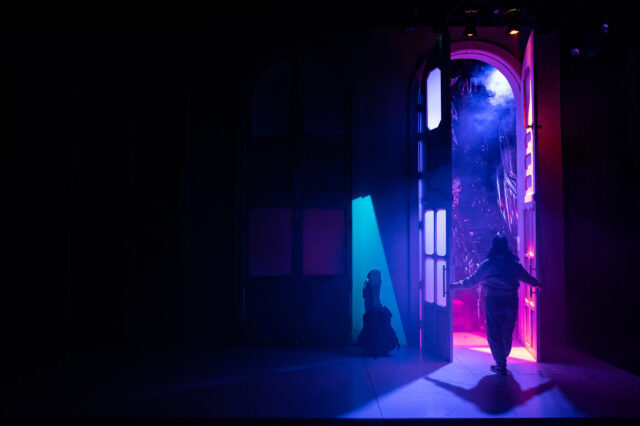
Frank J. Oliva’s set offers a surreal fantasy in Ars Nova / PlayCo world premiere (photo by Ben Arons)
Anneh travels between reality and what appears to be some kind of fantasy world that exists inside her house, the interior of which turns into an aluminum-foil-covered concert and dance hall as music and life merge in a surreal way that seems normal to everyone but her. Amid the phantasmagorical scenes, her confusion mounts when Professor Feliz, her musicology professor at Harvard, tells her that Elvis Presley was “born in the majestically boring city of Ankara, Turkey, in the year 1961” and “was often seen strutting around Seymenler Park, accompanied by his friend, the local garbage collector and traditional Turkish instrument maestro, Yusuf.”
Through it all, a singer-songwriter and her band keep entering scenes, playing such songs as “There She Goes,” “Where It’s All Gone,” “The Groove Is on the Loose,” and “An Emptying Thing,” serving as outside observer and muse. (The songs were written by Aker and brothers Daniel and Patrick Lazour.) Channeling Joni Mitchell, Liz Phair, and others, the singer shares such thoughts as “Time is lost / In my room / While you break free / From the gloom / Waking hours / You stay up late / What is life / But the breaking of the days” and “So if we choose to let you go / How will you know / That I remember / How to feel alive / Only in time / Only in time.”
As decision time approaches, Anneh’s mind is flooded with confusion, trying to figure out what to do next and where she belongs in a world where she thinks she doesn’t fit.
Directed by Machel Ross, the ninety-five-minute Hound Dog, a coproduction of Ars Nova and PlayCo, wanders all over the place, the nonlinear narrative often hard to follow. It takes a while to warm up to the characters, although eventually they become familiar and their struggles legitimate. Frank J. Oliva’s set is the star, a facade of a home with three sets of double doors on the ground floor and three sets of windows above, lit in different colors by Tuçe Yasak. Sound designer Avi Amon also serves as music director, with costumes by Qween Jean.
The crack band features Maya Sharpe on guitar, Mel Hsu on bass, Ashley Baier on drums, and Sahar Milani on lead vocals. The cast, several of whom are making their off-Broadway debuts (Eshraghi and Magnusson) and another an Emmy winner (Raviv), is fresh and engaging as they navigate a few too many awkward plot devices.
The story is a deeply personal one to Aker; in the script, she refers to Hound Dog as “me,” the setting as “a version of my hometown . . . through time and space,” and several characters as “alternate versions” of her father, childhood best friend, and teachers. Aker might be a little too close to the material; although she tackles universal issues, they don’t always gel cohesively.
In celebration of its twentieth anniversary season, Ars Nova is introducing “What’s Ars Is Yours: Name Your Price,” with tickets for Hound Dog running $5 to $100, depending on what you can afford.
Who: Al Pacino What: Benefit screening and Q&A for the Actors Studio Where:United Palace Theatre, 4140 Broadway at 175th St. When: Thursday, October 27, $35-$1000, 7:00 Why: The Actors Studio is celebrating its seventy-fifth anniversary with a special event at United Palace Theatre on October 27 at 7:00, a screening of Sidney Lumet’s classic Brooklyn-set drama Dog Day Afternoon, followed by a conversation with the star of the film and current Actors Studio copresident, Al Pacino. “This incredible institution, founded by Elia Kazan, Cheryl Crawford, and Robert Lewis, followed by Lee Strasberg, has left an indelible mark on the world of film and theater,” the East Harlem-born Pacino said in a statement. “It’s where actors are given the freedom to take chances and explore their work and craft. Anyone can audition for the Actors Studio. I’m surprised more people don’t know that. Once an actor becomes a member of the Actors Studio, it doesn’t cost anything, it’s totally free, and membership is for life. It’s going to be a great night at the United Palace. I look forward to watching Dog Day Afternoon and engaging, live, with an audience of New Yorkers, some who will be seeing it for the first time and others who will be seeing it for the first time in years.”
The 1975 film, based on a true story, earned six Oscar nominations, including Pacino for Best Actor, and won one statuette, for Frank Pierson’s original screenplay. Pacino stars as Sonny Wortzik, who leads a bank robbery with his friends Sal (John Cazale) and Stevie (Gary Springer) for a very special reason; the cast also features Chris Sarandon, Carol Kane, Lance Henriksen, Judith Malina, Dominic Chianese, James Broderick, Penelope Allen, and Charles Durning. Tickets for the event range from $35 to $1000; the other copresidents of the Actors Studio, the home of Method acting, are Alec Baldwin and Ellen Burstyn. “There are actors all over the world [who] regardless of their circumstances, professional or personal, regardless of whatever difficulties they are facing, whatever problems or changes — there is one thing they can rely on and that is that eleven o’clock on Tuesday and Friday mornings come rain, shine, snow, or what have you there is a session in the Actors Studio. And the fact that actors can count on that, that they know that that exists, can help them get through,” longtime studio artistic director Strasberg, who played Hyman Roth in The Godfather II opposite Pacino’s Michael Corleone, explained once upon a time.
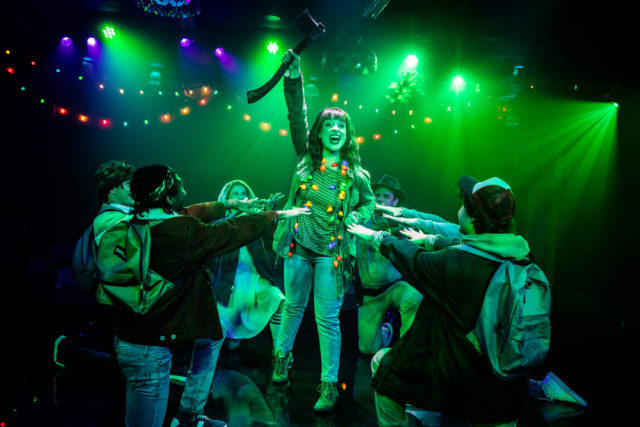
Dustin (Jeremiah Garcia), Mike (Jeffrey Laughrun), and Lucas (Jamir Brown) prepare for battle in Stranger Sings! The Parody Musical (photo by Evan Zimmerman_MurphyMade)
STRANGER SINGS! THE PARODY MUSICAL
Playhouse 46 at St. Luke’s
308 West Forty-Sixth St. between Eighth & Ninth Aves.
Thursday – Tuesday through August 13, $39-$111 www.strangersingsthemusical.com playhouse46.org
Fans of Stranger Things — and I am proudly one of them — can’t get enough of the Netflix series, an engrossing horror story that premiered in 2015 and will present its fifth and final season in 2024. In addition to books, comics, video games, and podcasts, there is also Stranger Things: The Experience, an immersive presentation that has traveled to New York, San Francisco, Atlanta, Los Angeles, and London, and Stranger Sings! The Parody Musical, which has returned to Manhattan, continuing at Playhouse 46 at St. Luke’s through August 13.
Stranger Things takes place in the mid-1980s in the small, close-knit all-American town of Hawkins, Indiana. “We wanna welcome you to Hawkins / Where everything is a total cliché! / We’re just like folks from classic films and TV shows / It’s nostalgic and you love us that way! / We live a safe, simple life here in Hawkins / Our government says there’s nothing to fear! / Expect nothing but the everyday normal / Cuz stranger things have never happened here,” the cast announces at the beginning.
Nerdy twelve-year-olds Lucas Sinclair (Jamir Brown), Dustin Henderson (Jeremiah Garcia), and Mike Wheeler (Jeffrey Laughrun) stop their Dungeons & Dragons game to help find the missing Will Byers, a shy young boy who has disappeared. Will’s mother, Joyce (usually played by Caroline Huerta but I saw the vibrant Hannah Clarke Levine; the actor portraying Joyce also operates Will, a small puppet), is distraught and determined to locate her son, with or without the support of the local sheriff, Jim Hopper (Shawn W. Smith), who has his own scars when it comes to family. Also involved are Will’s older brother, Jonathan (Garrett Poladian), an oddball aspiring photographer; the oh-so-cool and handsome Steve Harrington (Poladian), who has the hots for Nancy Wheeler (Harley Seger), Mike’s adorable older sister; and Barb Holland (SLee), Nancy’s best friend and perpetual third wheel.
Joyce Byers (Caroline Huerta) is determined to find her son in playful parody (photo by Evan Zimmerman_MurphyMade)
Strange things start occurring following the mysterious appearance of Eleven (Seger), a young girl with scary powers. “She looks like an escaped mental patient,” Dustin says. He’s not that far off; Eleven, whose real name is Jane, has run away from a government-run testing facility where she was under the care of Dr. Brenner (Poladian), known as Papa. “I always wanted a dad / Who never would make me cry / One who’d tell me, ‘Kid, I’m so proud of you,’ / Instead of ‘Stay in your cell til July,’” she sings. Throughout the show, Dr. Brenner and two men in white lab coats keep trying to track down Eleven and bring her back to the facility, supposedly for her own safety.
Oh, there’s also a murderous demogorgon hanging around, an evil creature in tight spandex that has emerged from the Upside Down, a creepy hell where Will and Barb have been taken.
You don’t have to be a big fan of Stranger Things to get a kick out of the parody musical, but it does help, as it is filled with inside jokes and aural and visual references to the show as well as the 1980s themselves. Audience members, a few of whom arrive dressed like some of the characters, sit on all four sides of the central staging area, which is surrounded by tree branches, as if the Upside Down is ever-present (the set is by Walt Spangler), and dozens of props (courtesy Brendan McCann) that are used in the show, from a 1980s telephone and bicycle handlebars to gynormous walkie-talkies and a boombox. There are also four beanbag chairs for audience members who want occasional interaction with the performers.
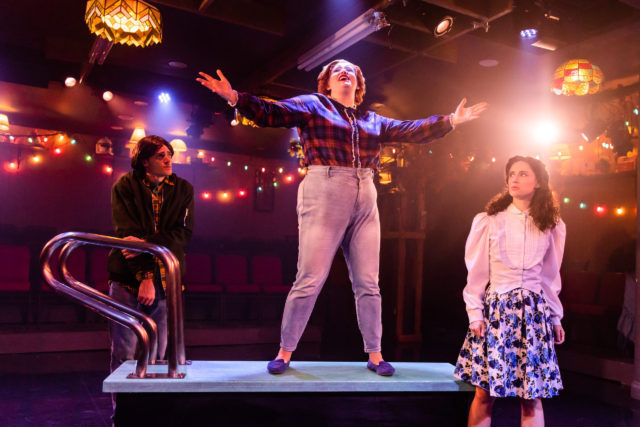
Barb Holland (SLee) stands up for herself and lets everyone know it in Stranger Sings! (photo by Evan Zimmerman_MurphyMade)
Jonathan Hogue wrote the book, music, and lyrics, which are lots of fun, with arrangements and orchestrations by Michael Kaish and playfully goofy choreography by Ashley Marinelli. The production, which features such musical numbers as “Hopper Triggered,” “Getting Closer,” and “Where There’s a Will,” is too long at 110 minutes with intermission, but director Nick Flatto keeps it all from descending into chaos; the creepy lighting and sound are by Jamie Roderick and Germán Martínez, respectively, and Matthew Solomon’s costumes immediately identify who is who. (You can come in your own costume October 21-31 and qualify for audience-voted prizes each night.)
The engaging cast captures the essence of the series, the feeling of constant impending doom along with the promise that comes with adolescence as the residents of Hawkins explore who they are and who they might be. Levine is terrific as Joyce, although a scene about Winona Ryder, who plays the mother on the show, although funny, jars you out of the narrative. Smith is fab as the brave, heroic sheriff, and Poladian is a hoot switching between the heartthrob Harrington and the weird Jonathan. Eleven is relegated to a relatively small role in the parody and, curiously, Dr. Brenner, played by a composed and careful Matthew Modine on Netflix, is portrayed here as a bumbling idiot.
Stranger Sings! does seek to right a terrible wrong from the streaming series in resurrecting Barb, who is mostly forgotten after a pool party; she doesn’t even make the cut in the nineteen-character cast list on Wikipedia. But the parody gives her several star turns, complete with well-deserved grudges. When Jonathan asks, “I’m confused . . . who is that?” Barb replies, “That’s right. Who IS that? Could that be poor Barb Holland, the throw-away plot device who not one person thought to look for??” SLee brings down the house a few times, but there ends up being too much of Barb; I wanted more Eleven. And for fans of Max, as I am, the show primarily stays within the first season, with some Easter eggs of what is to come.
Who:The Eli “Dr. E” Yamin Quartet What: Live Music Downstairs Where:Bond 45, 221 West Forty-Sixth St. between Seventh Ave. & Broadway, 212-689-4545 When: Sunday, October 23, no cover ($25 minimum), 7:30 Why: Broadway might be mostly dark on Sunday nights, but that doesn’t mean the Theater District isn’t hopping with some of the hottest shows at that time. In recent months, such bands as Vince Giordano and the Nighthawks, the Stan Harrison Quartet, and the Mark Kostabi Trio have performed Sunday nights Downstairs at Bond 45, the popular Italian restaurant that is now located on West Forty-Sixth St. On October 23 at 7:30, the Eli “Dr. E” Yamin Quartet will take the stage for its second weekend, consisting of Eli Yamin (aka “Dr. E”) on piano and vocals, Zaid Nasser on alto sax, Elias Bailey on bass, and David F. Gibson on drums. A native of East Patchogue, Long Island, Yamin recently earned his doctorate in musical arts, specializing in jazz piano, from Stony Brook; he also cofounded and serves as managing and artistic director of Jazz Power Initiative, a nonprofit organization whose mission is “to ignite the power of jazz music education and transform lives by fostering creative self-expression, community, teamwork, and diversity,” and was the founding director of Jazz at Lincoln Center’s Middle School Jazz Academy.
Yamin, who has a wide range of influences, from Pete Seeger and Arlo Guthrie to Bach and Mozart, from Sinatra and B. B. King to Jimi Hendrix and Taj Majal, has released such albums as Louie’s Dream,I Feel So Glad,You Can’t Buy Swing, and Pushin’ 30. The good doctor will kick off his Sunday at 2:00 cohosting the free Intergenerational Jazz Power Jam: Brass Extravaganza at the National Jazz Museum of Harlem before heading down to Bond 45. He’s also a bit of a philosopher, offering these words of wisdom on his website: “You can do it if you set your mind to it. Whatever your long term goal is, whether academic, artistic, spiritual. The main thing is just like Duke Ellington said and I’ll say it again. NEVER GIVE UP.”
COST OF LIVING
Samuel J. Friedman Theatre
261 West Forty-Seventh St. between Broadway & Eighth Ave.
Tuesday – Sunday through November 6, $74-$298 www.manhattantheatreclub.com
When I saw Manhattan Theatre Club’s production of Martyna Majok’s Cost of Living at New York City Center’s Stage I five and a half years ago, I did not anticipate that it would win the Pulitzer Prize for Drama. I also never imagined that the show, which I called “a tender, emotional play about four lonely people seeking connections,” would eventually transfer to Broadway. But Cost of Living has made a terrific transition to MTC’s Samuel J. Friedman Theatre, with all its tenderness, emotion — and sense of humor — fully intact. In fact, it is now even better.
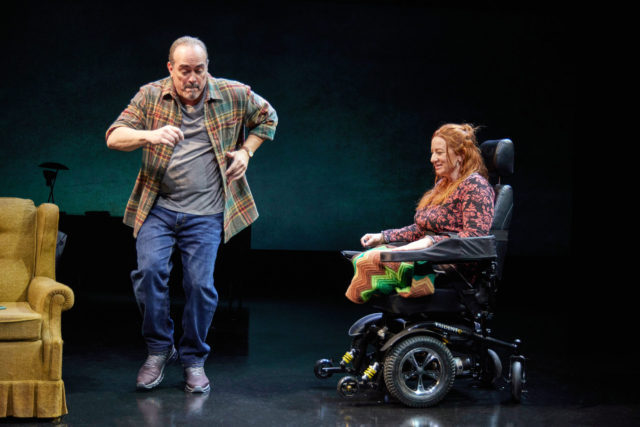
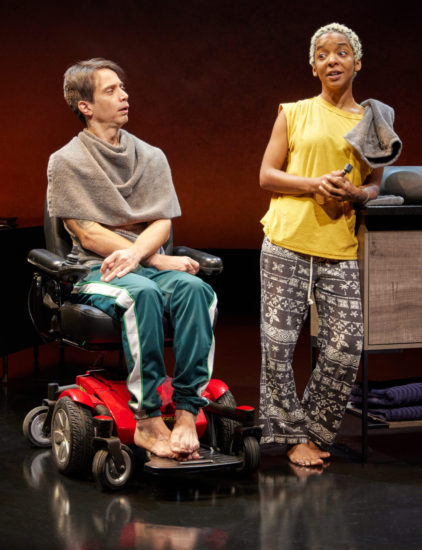
The play is once again directed by Obie winner Jo Bonney on Wilson Chin’s set, which rotates between the homes of John (Gregg Mozgala), a Harvard grad working on his PhD at Princeton and confined to a wheelchair with cerebral palsy, and Ani (Katy Sullivan), a quadriplegic also in a wheelchair.
While John is looking for a caregiver and interviews and hires Jess (Kara Young), a Princeton grad scrambling to make a living by working multiple jobs and who assures John that despite her slight build she can handle his needs, Ani initially refuses help from her ex-husband, Eddie (David Zayas), a former truck driver with a new girlfriend.
The play opens with Eddie sitting at a bar, talking to an unseen person in what is essentially a long, compelling monologue delivered directly to the audience. “The shit that happens is not to be understood. That’s from the Bible,” he says. “That life is good for people. I was thankful for every day they ain’t invented yet the trucker-robots. That life is good. The road. Sky. The scenery. Except the loneliness. Except in the case of all the, y’know, loneliness. This was what my wife was good for. Not that this was the only thing.”
The loneliness and vulnerability experienced by all four characters is palpable, expressed most effectively in scenes of back-to-back caretaking. In the first, Jess washes John in the shower, moving him out of his chair and then back into it, followed by Eddie giving Ani a bath.
Describing his sensations, John tells Jess that his body feels as if he’s constantly under attack. “That’s what it’s like. Under my skin. From underneath my skin. Like people hitting me from beneath my skin. And that’s what you’ll be working with. Every morning. Is touching, shaving, undressing, washing, and clothing — that. That’s what I’m like.”
Meanwhile, Eddie visits Ani on a day her nurse hasn’t shown up, so Eddie asks Ani to hire him instead. “What do you think’s gonna happen you come take care of me a few hours a day? Huh?” she spurts out. “You brush my teeth a couple mornings, dump my bedpan a few times, and BOOM, conscience — fuck-shit, clap yer hands when I say Boom. . . . Yer not doin’ penance on me.”
The separate storylines merge at the end in an uneasy finale that acknowledges that we all encounter tremendously painful issues in life, regardless of our physical or psychological situations, which is further established during the curtain call.
Both Mozgala (Teenage Dick,Diagnosis of a Faun), who has cerebral palsy, and Sullivan (The Long Red Road,Finish Line), who was born without lower legs, return from the original cast, and both give intense, superb performances again, neither one pulling any punches. Young (Clyde’s,Halfway Bitches Go to Heaven) displays a tenacious fragility as Jess, who might be getting in over her head, while Zayas (Dexter,Anna in the Tropics) proves once more that he is one of New York City’s finest actors, balancing toughness with a sweet gentleness that shines through. Jeff Croiter’s lighting and Rob Kaplowitz’s sound capture the pervasive loneliness playing out onstage.
“Self-pity has little currency in these characters’ worlds. Humor, however, has much,” Majok (Ironbound,Sanctuary City) explains in a script note. Her and Bonney’s (Father Comes Home from the Wars,Fucking A) approach feels honest and unambiguous, as summarized in this exchange between Jess and John:
Jess: Sorry, I never worked with the, differently-abled — John: Don’t do that. Jess: What? John: Don’t call it that. Jess: Why, I — John: Don’t call it differently-abled. Jess: Shit, is that not the right term? John: It’s fucking retarded. . . . Jess: So what do I, how do I, refer to you? John: Are you planning on talking about me? Jess: No. John: Why not? I’m very interesting.
The Broadway debut of Cost of Living, which was expanded from Majok’s 2015 short play John, Who’s Here from Cambridge, is a lot more than interesting, and you’ll be sure to be talking about it long after seeing it.
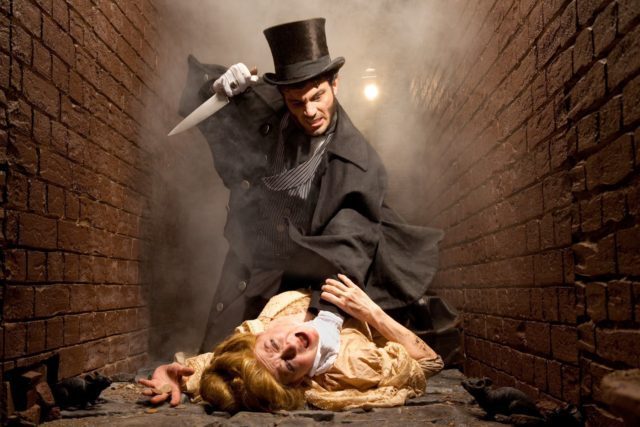
Nightmare: Gothic offers Victorian scares on the Lower East Side (photo by Joshua Hoffine)
NIGHTMARE: GOTHIC
Teatro SEA @ the Clemente
107 Suffolk St. between Rivington & Delancey Sts.
October 17-31, $30 GA, $45 VIP, 6:00 – 11:00 pm nightmarenyc.com
Nobody loves Halloween scares quite as much as the folks at Psycho Clan do. For twenty years, cofounders Timothy Haskell and Paul Smithyman have been presenting varieties of immersive haunted house experiences as well as other holiday-themed (mis)adventures, including Nightmare Haunted House,This Is Real,Full Bunny Contact, and SANTASTICAL. Their latest horror presentation is Nightmare: Gothic, a half-hour immersion set amid Victoriana macabre, running October 17-31 at Teatro SEA @ the Clemente on the Lower East Side. The hunt is on to locate a missing child, but there are frightening barriers every step of the way.
“People have a very specific idea when they think ‘Goth’ and it is mostly of the romantic goth genre,” Haskell said in a statement. “We are, however, inspired by the Victorian Goth era. Think mid to late nineteenth century. Think Mary Shelley, Bram Stoker, The Picture of Dorian Gray, Kafka, the contemporary work of Edward Gorey, corsets, dark purples and black, hoop skirts, parasols . . . you get the idea.”