live performance

UNDER THE RADAR 2023

A Thousand Ways (Part Three): Assembly brings strangers together at the New York Public Library (photo courtesy 600 Highwaymen)

UNDER THE RADAR FESTIVAL
Public Theater and other venues
January 4-22, free – $60
publictheater.org

The Public Theater’s Under the Radar Festival is back and in person for its eighteenth iteration, running January 4-22 at the Public as well as Chelsea Factory, NYU Skirball, La MaMa, BAM, and the New York Public Library’s Stavros Niarchos Foundation branch. As always, the works come from around the world, a mélange of disciplines that offers unique theatrical experiences. Among this year’s selections are Jasmine Lee-Jones’s seven methods of killing kylie jenner, Annie Saunders and Becca Wolff’s Our Country, Roger Guenveur Smith’s Otto Frank, Rachel Mars’s Your Sexts Are Shit: Older Better Letters, Kaneza Schaal’s KLII, and Timothy White Eagle and the Violet Triangle’s The Indigo Room.

In addition, “Incoming! — Works-in-Process” features early looks at pieces by Mia Rovegno, Miranda Haymon, Nile Harris, Mariana Valencia, Eric Lockley, Savon Bartley, Raelle Myrick-Hodges, and Justin Elizabeth Sayre, while Joe’s Pub will host performances by Eszter Balint, Negin Farsad, Julian Fleisher and his Rather Big Band, Salty Brine, and Migguel Anggelo.

Below is a look at four of the highlights.

600 HIGHWAYMEN: A THOUSAND WAYS (PART THREE): AN ASSEMBLY
The New York Public Library, Stavros Niarchos Foundation Library
455 Fifth Ave. at Fortieth St., seventh floor
January 4-22, free with advance RSVP
publictheater.org

At the January 2021 Under the Radar Festival, the Obie-winning 600 Highwaymen presented A Thousand Ways (Part One): A Phone Call, a free hourlong telephone conversation between you and another person, randomly put together and facilitated by an electronic voice that asks both general and intimate questions, from where you are sitting to what smells you are missing, structured around a dangerous and lonely fictional situation that is a metaphor for sheltering in place. The company followed that up with the second part, An Encounter, in which you and a stranger — not the same one — meet in person, sitting across a table, separated from one another by a clear glass panel, with no touching and no sharing of objects. In both sections, I bonded quickly with the other person, making for intimate and poignant moments when we were all keeping our distance from each other.

Now comes the grand finale, Assembly, where sixteen strangers at a time will come together to finish the story at the New York Public Library’s Stavros Niarchos Foundation branch in Midtown. Written and created by Abigail Browde and Michael Silverstone, A Thousand Ways innovatively tracks how the pandemic lockdown influenced the ways we interact with others as well as how critical connection and entertainment are.

Palindromic show makes US premiere at Under the Radar Festival (photo courtesy Ontroerend Goed)

ONTROEREND GOED: Are we not drawn onward to new erA
BAM Fishman Space
321 Ashland Pl.
January 4-8, $45
publictheater.org
www.bam.org

What do the following three statements have in common? “Dammit, I’m mad.” “Madam in Eden, I’m Adam.” “A man, a plan, a canal – Panama.” They are all palindromes, reading the same way backward and forward. They also, in their own way, relate to Ontroerend Goed’s Are we not drawn onward to new erA, running January 4-8 at BAM’s Fishman Space. Directed by Alexander Devriendt, the Belgian theater collective’s seventy-minute show features a title and a narrative that work both backward and forward as they explore climate change and the destruction wrought by humanity, which has set the Garden of Eden on the path toward armageddon. But maybe, just maybe, there is still time to save the planet if we come up with just the right plan.

PLEXUS POLAIRE: MOBY DICK
NYU Skirball
566 LaGuardia Pl.
January 12-14, $40
publictheater.org
nyuskirball.org

The world is obsessed with Moby-Dick much the way Captain Ahab is obsessed with the great white itself. Now it’s Norwegian theater company Plexus Polaire and artistic director Yngvild Aspeli’s turn to harpoon the story of one of the most grand quests in all of literature. Aspeli (Signaux, Opéra Opaque, Dracula) incorporates seven actors, fifty puppets, video projections, a drowned orchestra, and a giant whale to transform Herman Melville’s 1851 novel into a haunting ninety-minute multimedia production at NYU Skirball for four performances only, so get on board as soon as you can.

Brian Mendes and Jim Fletcher get ready for NYCP’s Field of Mars (photo courtesy New York City Players)

NEW YORK CITY PLAYERS: FIELD OF MARS
NYU Skirball
566 LaGuardia Pl.
January 19-22, 24-29, $60
publictheater.org
nyuskirball.org

I’ll follow Richard Maxwell and New York City Players anywhere, whether it’s on a boat past the Statue of Liberty (The Vessel), an existential journey inside relationships and theater itself (The Evening, Isolde) and outside time and space (Paradiso, Good Samaritans), or even to the Red Planet and beyond. Actually, his newest piece, Field of Mars, playing at NYU Skirball January 19-29, refers not to the fourth planet from the sun but to the ancient term for a large public space and military parade ground. Maxwell doesn’t like to share too much about upcoming shows, but we do know that this one features Lakpa Bhutia, Nicholas Elliott, Jim Fletcher, Eleanor Hutchins, Paige Martin, Brian Mendes, James Moore, Phil Moore, Steven Thompson, Tory Vazquez, and Gillian Walsh and that the limited audience will be seated on the stage.

Oh, and Maxwell noted in an email blast: “Field of Mars: A chain restaurant in Chapel Hill is used as a way to measure the progress of primates, from hunter/gatherer to fast casual dining experience. Topics covered: Music, Food, Nature, and Spirituality. . . . I also wanted to take this opportunity to tell parents regarding the content of Field of Mars: my kids (aged 11 and 15) will not be seeing this show.”

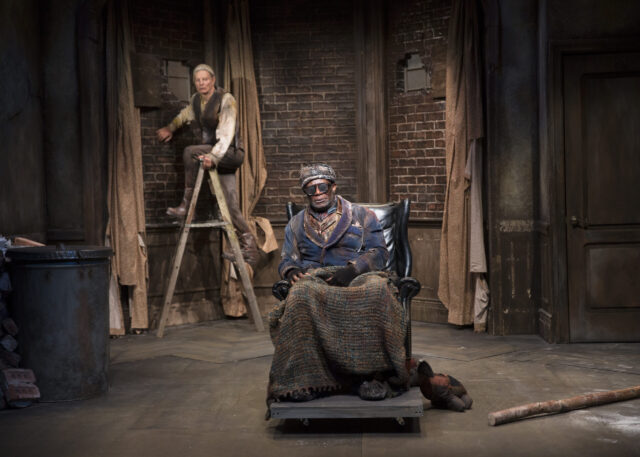
EDDIE IZZARD: CHARLES DICKENS’ GREAT EXPECTATIONS

Eddie Izzard works some magic in one-woman adaptation of Charles Dickens’s Great Expectations, (photo by Bruce Glikas)

GREAT EXPECTATIONS
The Greenwich House Theater
27 Barrow St. at Seventh Ave. South
Tuesday – Sunday through January 22, $60-$99
www.eddieizzardgreatexpectations.com

Eddie Izzard is absolutely delightful portraying approximately twenty characters in her one-woman retelling of Charles Dickens’s Great Expectations, continuing at the Greenwich House Theater through January 22. Adapted by Izzard’s brother, Mark, into a taut two hours (with intermission) from the five-hundred-plus-page 1861 novel, it’s a classic British coming-of-age story divided into three stages of the life of one Philip Pirrip. The Aden-born, two-time Emmy-winning, Tony-nominated actor, comedian, and activist — who is exactly 150 years younger than Dickens to the day — looks fabulous in spiky blond hair and a steampunk goth costume (by Tom Piper and Libby da Costa) consisting of a ruffled V-neck white blouse, form-fitting black coat, black skirt, black stockings, and knee-high lace-up black boots. Piper’s set features lush red drapery in the front and the dilapidated facade of a white house with graying, torn curtains in the back, emblematic of the faded royalty of Miss Havisham, one of the most memorable figures in all of literature.

Izzard is Pip, the book’s narrator, who sets the tone and scene in the opening monologue:

My father’s family name being Pirrip, and my Christian name Philip, my infant tongue could make of both names nothing longer or more explicit than Pip. So I called myself Pip. I never saw my father or my mother, never saw any likeness of either of them, for their days were long before the days of photographs, that wondrous new invention. Ours was the marsh country, south and east of London by the Thames river, within twenty miles of the sea. On a raw afternoon towards evening I found out that this bleak place overgrown with nettles was the churchyard; that Philip Pirrip, late of this parish, and also Georgiana, wife of the above, were dead and buried; and that five little stone lozenges, arranged in a neat row beside, were sacred to the memory of five little brothers of mine. I also discovered that the dark flat wilderness beyond the churchyard was the marshes, and that the distant savage lair from which the wind was rushing was the sea, and that Pip was the small bundle of shivers growing afraid of it all.

Pip is seven when the tale begins, living with his sole remaining sibling, his mean sister, who is married to the kind blacksmith Joe Gargery. Wallking through the marshes, Pip is accosted by a dangerous-looking man, Abel Magwitch, who declares, “Hold your noise, you little devil, or I’ll cut your throat!” He demands that Pip bring him food and an iron file, and Pip obliges, seeing no other choice, stealing the items, including a Christmas pork pie, that was meant for such family and friends as Mr. Wopsle, Uncle Pumblechook, and the Hubbles. “I was too cowardly to do what I knew to be right, just as I had been too cowardly to avoid doing what I knew to be wrong,” he admits, a theme that runs through his life, which takes its next turn when he is summoned by the mysterious spinster Miss Havisham, who wants the poor Pip to play with her adopted daughter, Estella.

Eddie Izzard is superb as Pip and everyone else in Great Expectations (photo by Bruce Glikas)

Pip, who learned how to read from the orphan Biddy, is desperate to become a gentleman, and the surprise opportunity arises when a London lawyer named Jaggers arrives, explaining to Joe that a benefactor wishing to remain anonymous is offering Pip the chance to study in the city and, indeed, become a gentleman. “I have come to relieve you of your apprentice,” Jaggers says to Joe. “The communication I have to make is that this young fellow has great expectations.”

Those “great expectations” lead Pip to meet London tutor Matthew Pocket, son of Herbert Pocket, Miss Havisham’s cousin; Jaggers’s clerk, Mr. Wemmick; rival scholar Bentley Drummle; Magwitch’s fellow convict, Compeyson; the merchant Clarriker; and Clara Barley, who takes a liking to Herbert. The adaptation has cut a few figures from the story, including Miss Havisham’s younger half-brother, Arthur; blacksmith Dolge Orlick; Wemmick’s friend Miss Skiffins; and another of Pip’s fellow students, Startop.

Izzard, who has appeared in such films as Ocean’s Twelve and Ocean’s Thirteen, The Lego Batman Movie, and Whiskey Galore!, such television series as The Riches, Hannibal, and Powers, and such plays as The Cryptogram, A Day in the Death of Joe Egg, and Race, is dyslexic; as a challenge, she recorded Great Expectations as an audiobook, the first major literary work she had ever read, and in doing so decided to make it into a solo show. She has a graceful, commanding stage presence onstage, smoothly transitioning between roles with just a twist of her body and a slight change of voice; the subtle movement direction is by Didi Hopkins. Izzard’s clear familiarity with the text and understanding of the material help her develop a quick rapport with the audience, who cannot help but root for Pip, a character previously played by such actors as John Mills, Roddy McDowall, Michael York, and Ethan Hawke.

The Izzards and director Selina Cadell (Love for Love, The Life I Lead) create a menacing Victorian atmosphere, especially when it comes to Miss Havisham; when she is in a scene, Tyler Elich/Lightswitch turns down the lights onstage and up on either side of the audience, an eerie glow building slowly to correspond with the ghostliness of Miss Havisham’s existence. You can practically see and smell the (nonexistent) decaying, rat-eaten bride-cake in the corner, the remnants of her being left at the altar many years before.

“As I had grown accustomed to my expectations, I had begun to notice their effect upon me and those around me and I knew very well that it was not all good,” Izzard says as Pip about halfway through the play. Izzard lives up to expectations, and it is all good.

MIKE BIRBIGLIA: THE OLD MAN & THE POOL

Mike Birbiglia discusses mortality with a smile in The Old Man & the Pool (photo by Emilio Madrid)

MIKE BIRBIGLIA: THE OLD MAN AND THE POOL
Vivian Beaumont Theater at Lincoln Center Theater
150 West 65th St. between Broadway & Amsterdam Ave.
Tuesday – Saturday through January 15, $104-$268
212-362-7600
www.lct.org

I remember being home sick one day in fourth grade, when I was ten, grabbing a relatively short book from my parents’ library, and reading it straight through in bed. It was the first real novel I ever picked up, called The Old Man and the Sea, by a man named Ernest Hemingway, about a fisherman facing his own mortality as he desperately tries to reel in a marlin in a life-or-death struggle, for both him and his catch. I can still feel myself turning the pages, the excitement building moment to moment.

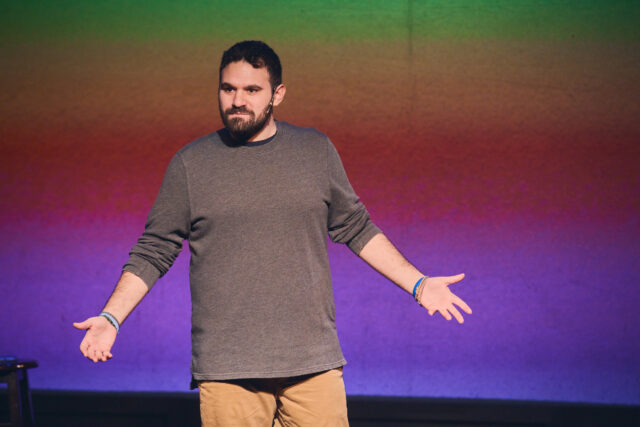
The title, and the theme of mortality, is the jumping-off point of Mike Birbiglia’s latest one-man show, the deeply personal and extremely funny The Old Man & the Pool, continuing at Lincoln Center’s Vivian Beaumont Theater through January 15. In such past solo works as The New One, Thank God for Jokes, and Sleepwalk with Me, the Massachusetts-born, Brooklyn-based comedian and This American Life contributor has documented his REM sleep behavior disorder, his sex life, trying to conceive, and the power of jokes themselves. “There are details in my life that are both setups and punchlines,” he explained in his Broadway debut, The New One, and the same is true once again in The Old Man & the Pool, in which mortality is front and center for seventy-five hysterical, moving minutes.

The show begins with Birbiglia describing his 2017 annual physical, “which I always dread because I have a lot of preexisting conditions, which I call ‘conditions’ because everything is existing if it does and everything is ‘pre’ unless it happened on the way to the appointment. When I see that checklist I circle the whole thing and cross out ‘pregnant.’” When he has trouble blowing into a tube for a pulmonary test, his doctor tells him that based on those results, he might be having a heart attack right then and there. “I call it ‘the birthday cake test,’” Birbiglia tells the audience, “because it sort of tells you how many birthday cakes . . . you have left.” Shortly after that, the doctor tells Birbiglia that he has type two diabetes.

At the time, Birbiglia was forty-four, married to Jenny (who he calls Chlo for no apparent reason), and raising their three-year-old daughter, Oona. Both his father and his paternal grandfather had heart attacks at fifty-six. “I’ve always thought I should just set aside that whole year when I turn fifty-six and get an airbnb by the hospital and keep a flexible schedule,” he says. I understand exactly where he’s coming from; my father died of a heart attack at forty-seven, his father at fifty-seven. Those kinds of facts tend to weigh heavily on your mind.

Mike Birbiglia surfs through a serious diagnosis in latest Broadway solo show (photo by Emilio Madrid)

It’s one of the many reasons why Birbiglia’s shows work so well. He’s a kind of everyman, sharing his foibles with a genuine self-deprecation and easygoing relatability. It pains him that he was raised in a family that would say “Take care” instead of “I love you.” He also tends to come down with extreme medical conditions that are fascinating to hear about. He has to sleep in a special sleeping bag and wear mittens so his sleepwalking doesn’t result in accidentally causing harm to himself, his wife, or his daughter. In The New One, he details undergoing a varicocele repair that makes every male in the audience wince and cringe. He survived bladder cancer. And now, he’s fighting off diabetes and a potential heart attack.

He’s told that he has to start doing cardio five days a week. “I don’t think anybody does cardio five days a week,” he tells his doctor, who replies, “A lot of people do cardio five days a week.” The doctor suggests he swims at the YMCA, which brings up a poignant and profound memory for Birbiglia in which, at the age of seven, he decided he would never again go to a YMCA pool. But the thought of leaving Oona fatherless overwhelms him, and the exercise regime begins as he strives to improve his health, even if it involves changing his diet and swimming laps five days a week. It evokes Santiago, the old man in Hemingway’s story, thinking to himself, “Now is no time to think of what you do not have. Think of what you can do with what there is.” Similarly, Birbiglia asks, “Why do we not do the thing we know we should be doing?”

Mike Birbiglia takes it easy while considering death in The Old Man & the Pool (photo by Emilio Madrid)

Birbiglia, who also wrote, directed, and starred in the films Don’t Think Twice and Sleepwalk with Me, is immensely personable and self-effacing, telling his tale in a laid-back, even-tempered manner. He picks up the sole prop, a stool, and walks around the stage with it, occasionally sitting on it. He relaxes on the floor, lays down, and works off the energy of the audience. The night I went, a handful of people came in late, including a woman in the front row. Birbiglia, who was laying on his side at the time, welcomed them and decided to get them up to speed by giving them a quick, unscripted summary of what they missed. It was a brilliant moment, and one that quickly sealed the bond between us and him.

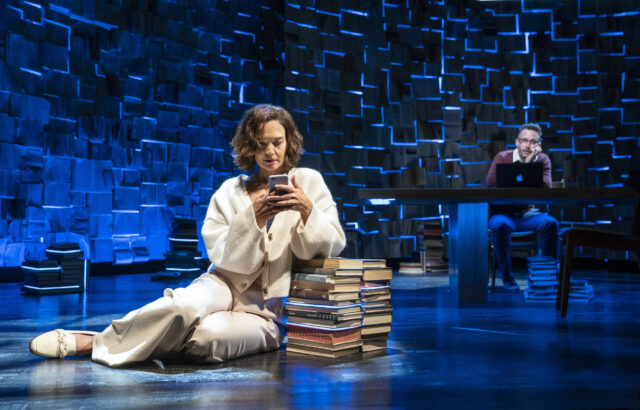
Beowulf Boritt’s set is sparse but effective: a concave board that mimics both a giant wave in its shape and a swimming pool in its gridlike design of blue squares. At times Birbiglia appears to surf under it, while at other times it looks like it is going to envelop him, drowning him. He wears jeans, comfy shoes, and an untucked blue-and-white button-down shirt that echoes the backdrop; the costume is by Toni-Leslie James, with lighting by Aaron Copp, projections by Hana S. Kim, and sound by Kai Harada, all helping develop a warm intimacy. Birbiglia’s longtime director, Seth Barrish, knows just how to keep it all moving forward as Birbiglia heads off on hilarious digressions about wrestling, mold, sugar fries, and signs such as “Slippery When Wet” and “No Breath Holding.”

The show begins and ends with the propulsive song “Red Hearse” by the LA band Red Hearse, in which Jack Antonoff, Sam Dew, and Sounwave promise, “I’ll be better than I was before / A natural, all of the past out the door / I never let you go, was all at our knees before / It’s gettin’ deeper, we’re caught up in the undertow / So come on / And if you can’t hold me / I’ll dive in it headfirst / I’ll die ridin’ in a red hearse.” In The Old Man & the Pool, master storyteller Birbiglia guides the audience through the undertow, emerging safely, and happily, from the abyss.

AN EVENING WITH ERIC BOGOSIAN: MONOLOGUES, DIGRESSIONS, AND AIR GUITAR

Eric Bogosian (between Chain artistic director Kirk Gostkowski and playwright G.D. Kimble) returns to the Chain for a solo benefit (photo courtesy Chain Theatre)

Who: Eric Bogosian
What: One-night-only benefit for Chain Theatre
Where: The Chain Theatre, 312 West Thirty-Sixth St. between Eighth & Ninth Aves., third floor
When: Saturday, January 21, $30-$50+, 8:00
Why: Founded in 2010 and based on West Thirty-Sixth St. since 2018, the Chain Theatre is a nonprofit whose mission is “to create artistic work that is accessible, relatable, and invokes a visceral response in the audience through the mediums of theater and film. . . . A deep respect for the narrative is the driving force behind the cultivation of original texts, the further investigation of recently produced work, and the reclaiming of existing classics for a modern audience. The material chosen focuses on the cyclical nature of history and complexity of the human spirit.” The Chain has presented works by such writers as Arthur Miller, David Rabe, Dale Wasserman, Neil LaBute, Sam Shepard, Martin McDonagh, and Edgar Allan Poe in addition to hosting the annual One Act Festival and Chain Film Festival. In 2014, the Chain staged Obie, Drama Desk, and Silver Bear—winning actor and writer Eric Bogosian’s 1988 Pulitzer finalist, Talk Radio, and this past summer featured the New York City premiere of Black Box PAC’s new production of Bogosian’s 2008 show 1+1 as part of its Play Festival.

On January 21, the Boston-born, New York City–based Bogosian will be at the Chain for the one-night-only benefit “An Evening with Eric Bogosian: Monologues, Digressions, and Air Guitar,” mixing recent work with older favorites. Tickets are $30 for general admission and $50 for priority seating to support the Chain. Bogosian has also written such other solo plays as Drinking in America, Pounding Nails in the Floor with My Forehead, and Notes from Underground as well as subUrbia and Sex, Drugs, Rock & Roll, which he adapted into films, and the novels Mall, Wasted Beauty, and Perforated Heart and the nonfiction Operation Nemesis: The Secret Plot that Avenged the Armenian Genocide. His acting career is highlighted by Interview with the Vampire, Billions, Law & Order: Criminal Intent, Uncut Gems, and Succession, so basically, you can expect just about anything from him at this ninety-minute charity event. Perhaps he’ll even include “Benefit” from 100 Monologues, in which a rock star discusses why his band is participating in a benefit for — well, you’ll have to discover that for yourself.

ALVIN AILEY AMERICAN DANCE THEATER: ALL NEW AT CITY CENTER

Ghrai DeVore-Stokes and Chalvar Monteiro explore love in Jamar Roberts’s In a Sentimental Mood (photo by Paul Kolnik)

ALVIN AILEY AMERICAN DANCE THEATER: ALL NEW
New York City Center
131 West 55th St. between Sixth & Seventh Aves.
Through December 24, $39-$169
www.alvinailey.org
www.nycitycenter.org

It was all about coupling, uncoupling, and never-coupling at Alvin Ailey American Dance Theater’s all-new program on December 15, part of the annual City Center season that continues through Christmas Eve. The evening began with the world premiere of Jamar Roberts’s poignant and emotional In a Sentimental Mood, in which Courtney Celeste Spears and Christopher R. Wilson follow the trajectory of a relationship in a dark and mysterious red-lit room. Spears appears first, dressed in a long white coat and white hat with red gloves, filled with hope as a scratchy recording of Duke Ellington’s “There’s Something About an Old Love” plays. She rips off her coat and hat to reveal a sexy black outfit underneath as she is joined by Christopher R. Wilson and the two get romantic to Rafiq Bhatia’s version of “The First Time Ever I Saw Your Face,” featuring vocalist Cécile McLorin Salvant, who sings, “The first time ever I kissed your mouth / I felt the earth move in my hand / Like the trembling heart of a captive bird,” holding the last word for a jarring, extended period. As Roberts’s sharp, angular choreography continues, the dancers experience an angry, then melancholic setback and try to reunite to Ornette Coleman’s “Lonely Woman” and Ellington’s “Single Petal of a Rose.” It’s a lovely piece from former longtime Ailey dancer Roberts, who also designed the costumes and set, enhanced with stark lighting by Brandon Stirling Baker.

Belén Indhira Pereyra and Patrick Coker merge as one in Paul Taylor’s DUET (photo by Paul Kolnik)

Following a pause, Jacquelin Harris and Renaldo Maurice become one in the company premiere of Paul Taylor’s 1964 DUET, a classic pas de deux set to Franz Josef Haydn’s “The Seven Last Words of Christ” Sonata VII in E-flat major – Largo. Dressed in George Tacet’s tight-fitting, colorful bodysuits, Harris and Maurice move elegantly with sinewy expertise, their beings merging amid their confident love.

Vernard Gilmore and Ghrai DeVore-Stokes reach for freedom in Alvin Ailey’s Survivors (photo by Paul Kolnik)

After intermission, a new production of Ailey and Mary Barnett’s 1986 Survivors, restaged by Masazumi Chaya, focuses on the love story between Nelson and Winnie Mandela after his arrest. As jazz drummer Max Roach’s “Survivors” and “Triptych” practically explode (balanced by Peter Phillips’s stings), Harris, in a flowing red skirt and African top, and Yannick Lebrun, in brown pants, a white shirt, and suspenders, are separated by incomplete bars, evoking both the injustice of Apartheid and the possibility of freedom. (The costumes are by Toni-Leslie James, with original décor by Douglas Grekin and lighting by Tim Hunter.) They are accompanied by Wilson, Solomon Dumas, Hannah Alissa Richardson, Caroline T. Dartey, and Yazzmeen Laidler, wearing traditional South African hats and serving as a kind of Greek chorus. It’s a powerful work about a determined couple, all the more affecting since we know that Mandela was freed in 1990 and he and Winnie divorced in 1996.

Chalvar Monteiro and Ashley Green come together and break apart in Kyle Abraham’s Are You in Your Feelings? (photo by Paul Kolnik)

The world premiere of Kyle Abraham’s Are You in Your Feelings? brought the house down, an exhilarating celebration of Black culture. Through spoken dialogue and such songs as the Flamingos’ “I Only Have Eyes for You,” Lauryn Hill’s “Forgive Them Father,” Drake’s “That’s How You Feel,” Erykah Badu’s “I’ll Call U Back,” and Kendrick Lamar’s “LOVE. ft. Zacari,” seven women (Dartey, Ghrai DeVoire-Stokes, Samantha Figgins, Ashley Kaylynn Green, Ashey Mayeux, Miranda Quinn, and Deidre Rogan) and five men (Dumas, Maurice, James Gilmer, Chalvar Monteiro, and Jermaine Terry), flirt, diss, come together, and grow apart in front of a backdrop of a fluorescent semicircle and larger, flatter circle, suggesting the sun and the moon. At the center of it all are Monteiro and Green, who swirl, embrace, push away, and keep an eye on each other as various other couples, including two men, form and dissolve. There’s a little bit of West Side Story here, some Night Creature there, leading to a thrilling finale.

Are You in Your Feelings? bursts with a masterful, infectious energy that is a fitting conclusion to a night of love and separation, joy and sadness, humor and romance, starting and ending with the choreographers who are leading AAADT into the future, Roberts and Abraham.

DOWNSTATE

Andy (Tim Hopper) and Em (Sally Murphy) have something to say to Fred (Francis Guinan, at left) in Downstate (photo by Joan Marcus)

DOWNSTATE
Playwrights Horizons, Mainstage Theater
416 West 42nd St. between Ninth & Tenth Aves.
Tuesday – Sunday through January 7, $61-$101
www.playwrightshorizons.org

“If you knew in advance exactly what was going to happen in your life, and how everything was going to turn out, and if you knew you couldn’t do anything to change it, would you still want to go on with your life?” Bee asks Jay in Bruce Norris’s A Parallelogram. “What if it turned out to be for the best if we’d never even existed?”

That question is central to Norris’s latest work, Downstate, extended through January 7 at Playwrights Horizons. One of the best plays of the millennium, Downstate takes an unusual angle on child molesters, making us see them as human rather than evil demons, eliciting compassion but not sympathy while delving into the concept of victimhood from all sides.

“I used to fantasize about how I would kill you,” Andy (Tim Hopper, now replaced by Brian Hutchison) tells his abuser, Fred (Francis Guinan), as Andy calmly reads from a reconciliation contract. “I would park outside your apartment and wait until you pulled in the driveway. And I would bring along my mother’s thirty-eight, the one she kept in her bedside table, and when you stepped out of your car I would hold it against your head and duct tape your mouth so I wouldn’t have to listen to any of your toxic bullshit . . . and I’d drive you to the edge of the forest preserve, and you’d kneel down in the dirt . . . and I’d rip the tape off your mouth and jam the barrel of the gun down your throat so that you —” Andy is cut off by several interruptions before accusing Fred of “exploiting my trust. By enlisting my sympathy. But you will never be deserving of sympathy.”

Em (Sally Murphy), Andy’s wife, says to Fred, “How can I ever explain to my child why Daddy is sometimes sad? Why he’d rather sit alone in the dark instead of using the PlayStation? Children need answers. And they need to know that some monsters are real.”

It’s a tough topic to navigate onstage; in recent years, David Harrower’s Blackbird, Paula Vogel’s How I Learned to Drive, and Jennifer Haley’s The Nether successfully tackled the issue from different angles, but Norris offers several new twists that test the standard dynamic that good and evil are black-and-white.

Four residents of a group home for convicted child molesters meet with parole officer Ivy Delgado (Susanna Guzmán) (photo by Joan Marcus)

Fred is an easygoing old man in a motorized wheelchair who speaks gently; in the script, Norris compares him to Mr. Rogers (whose first name is Fred). Fred was a piano teacher and still has a fondness for Frédéric Chopin, who he is quick to point out led a tragic life after the family of the woman he loved rejected their relationship. All four molesters in the home still believe what they did to their victims was done out of love and understanding, despite what the law and society dictate. Fred has a small keyboard in the living room, where he fake-plays to a CD of Chopin’s “Raindrop” Prelude, the drip-drip-drip of the music evoking the repetitive nature of the crimes by child abusers who think they are in love.

The home is run by Dee (K. Todd Freeman), an impassioned gay man who does the shopping and tries to keep everyone sane; he’s especially supportive of Fred, although he still angrily defends what he himself did to a teenage boy. Fast-talking, Bible-quoting Gio (Glenn Davis) is the youngest of the four and is facing the shortest sentence; convicted of statutory rape of a girl he thought was “old enough,” he considers himself to be better than the others, not an abuser, and has grand plans for starting his own business. Felix (Eddie Torres) is the quiet one who keeps to himself, although he has a problem with lying, especially to the group’s parole officer, Ivy Delgado (Susanna Guzmán), who lets them all know when they have broken the rules of their closely supervised release. The four men are tracked by ankle monitors and are not allowed to use the internet or a cellphone.

When Ivy announces that the local community has passed rulings further limiting their movement, they are furious, but she points out, “Well, ya know what? Nobody really wants y’all livin’ anywhere, much less in their neighborhood.” Dee says, “Why not put us on a desert island?” Gio suggests, “Y’all oughta be banished from human society.”

Gio works with the pert and cheeky Effie (Gabi Samels), who is not a fan of the police. When she shows up to drive Gio to their job, Ivy asks to see her ID. Effie repeatedly states, “Am I being detained?” Ivy then asks her name, to which Effie replies again and again, “I do not consent to the question.” It’s a comic scene, but it brings to the surface the critical ideas of detention and consent.

Things get even more heated in the second act when Andy returns, with more to say to Fred.

Downstate is brilliantly directed by Tony and Obie winner Pam MacKinnon, who previously helmed Norris’s Tony-, Olivier-, and Pulitzer Prize–winning Clybourne Park and The Qualms (as well as superb Broadway adaptations of Edward Albee’s A Delicate Balance and Who’s Afraid of Virginia Woolf?). MacKinnon accounts for every gesture, every interaction, every line of dialogue, making sure each aspect of the story is fully believable, from fighting over the bathroom to bickering over unripe bananas, the latter a reference to children too young for sex; it’s no coincidence that Dee sees no problem with them, telling Gio, who refuses to pay for his share of the bananas because they are too green, “Didn’t want bananas for next week, I wanted bananas for immediate consumption.” Norris and MacKinnon succeed in making the four abusers into a kind of family, with Ivy the de facto parent.

Fred (Francis Guinan) and Dee (K. Todd Freeman) share a rare tender moment in Downstate (photo by Joan Marcus)

Todd Rosenthal’s set is deceptively cozy, a cutaway living room above which is a roof with a satellite dish, emphasizing the limitations of the men’s lives. A flatscreen TV fills the fireplace, blocking the possibility of real warmth. Gio’s exercise equipment is in one corner, in front of Felix’s room, where Felix spends most of the show, behind an accordion door. The window next to the front door is broken, the result of a shotgun blast from an unhappy person in the neighborhood. (The lighting is by Adam Silverman, with sound by Carolyn Downing and costumes by Clint Ramos.)

The cast is exceptional; an ever-present tension hovers over the space as the characters interact as if on the edge of a knife. Guinan (Tribes, The Night Alive) is soft and gentle as Fred, who appears to be tender and harmless, especially in the wheelchair, but he has a dark past. Davis (Bengal Tiger at the Baghdad Zoo, The Christians) is a bundle of nonstop energy as Gio, while Torres, who is primarily a director (Familiar, Water by the Spoonful), makes the most of his few scenes. Two-time Tony nominee and Obie winner Freeman (Airline Highway, Song of Jacob Zulu) is a powder keg as Dee, ready to explode at any moment with the slightest provocation. Samels, in her off-Broadway debut, is electric as Effie, who speaks her mind, not afraid to hang out in a house of sexual predators. At one point she tells Gio, “A workplace is a safe space,” which also reveals a certain naivete.

Hopper (Go Back to Where You Are, More Stately Mansions) is a bundle of nerves as Andy, whose abuse at the hands of Fred has tortured him as he searches desperately for closure, while Murphy (The Minutes, August: Osage County) is forceful and tenacious as Em, who wants her husband to finally be free from pain.

Guzmán (La Luz de un cigarillo, Comida de Puta) is firm and unyielding as Ivy, especially when the concept of victimhood is raised. She tells Felix, “I got forty-seven clients, aright? Forty-seven of y’all I gotta deal with on a weekly basis all shapes and sizes but ya all got one thing in common, okay? Every one of you’s a victim. Everybody’s misunderstood, been done wrong, system’s broke, system ain’t fair blah blah, and that may or may not be the case — but I’ll tell ya something. If y’all feel so victimized? Maybe that gives ya a little idea how ya made other people feel, okay?”

Norris (The Low Road, Domesticated) was inspired to write Downstate by the sociopolitical disconnect between the right and the left in the United States, how the liberals and the conservatives are unable to talk to each other and resolve their differences in any constructive way, instead demonizing the supposed enemy.

The horror of child abuse is one thing that everyone agrees on; in 2019, New York State passed the Child Victims Act, which gave survivors a one-year window to file claims that had been barred by the statute of limitations, leading to approximately ten thousand lawsuits. The vote was 63-0 in the Senate and 130-3 in the Assembly. This past May, New York governor Kathy Hochul signed into law the Adult Survivors Act, which gives survivors who were abused when they were over eighteen a one-year lookback to pursue legal recourse.

In the must-see Downstate, Norris offers a compelling, thought-provoking, and exquisitely rendered exploration of our humanity as a people; it’s about child sexual abuse, justice, and victimhood, but it’s also about so much more.

JOHN ADAMS’ EL NIÑO: NATIVITY RECONSIDERED

John Adams’ El Niño: Nativity Reconsidered debuted at the Cloisters in 2018 (photo by Joshua Bright for the New York Times)

Who: American Modern Opera Company (AMOC)
What: John Adams’ El Niño: Nativity Reconsidered
Where: The Cathedral Church of St. John the Divine, 1047 Amsterdam Ave. at 112th St.
When: Wednesday, December 21, $5-$45 (choose-what-you-pay), 7:30
Why: Originally presented by American Modern Opera Company (AMOC) in 2018 at the San Martín at Fuentidueña chapel in the Cloisters, John Adams’ El Niño: Nativity Reconsidered will be performed one-time only at the Cathedral Church of St. John the Divine, in a slightly revised iteration. A retelling of the traditional Christmas story, El Niño premiered in Paris in 2000, with a libretto by Peter Sellars. At St. John the Divine, the nativity oratorio, conceived and curated by Julia Bullock, includes soprano Bullock, countertenor Anthony Roth Costanzo, bass-baritone Davóne Tines, violinists Miranda Cuckson and Keir GoGwilt, cellist Coleman Itzkoff, bassist Doug Balliett, flutist Emi Ferguson, percussionist Jonny Allen, pianist Conor Hanick, mezzo-soprano Rachael Wilson, and the Choir of Trinity Wall Street; the conductor is Christian Reif, who is responsible for the new chamber opera arrangement.

In a program note for the Met Museum digital premiere, Bullock wrote, “El Niño is one of my favorite pieces of music and I feel one of John and Peter’s greatest collaborations. . . . It is rarely programmed, either because of the resources needed or possibly because our North American holiday tradition insists upon multiple performances of Handel’s Messiah. The Messiah is, of course, a beloved work, but it doesn’t meditate solely on the nativity story; it also encompasses the life, death, and resurrection of Christ. El Niño, on the other hand, explores the central themes of the nativity — the immaculate conception, the unique relationship between mother and child, and gift giving — and also ruminates on the notion that with the promise of new life, there is the equal threat of inexplicable violence and sacrifice. In creating El Niño, John and Peter consciously decided that alongside European interpretations from the male-centric biblical canon, they would feature the contributions of women and Latin American poets.” Tickets for this special event are $5 to $45 based on what you are able to pay.