Documentary explores life and career of twentieth-century photographer Roman Vishniac
VISHNIAC (Laura Bialis)
Quad Cinema
34 West Thirteenth St. between Fifth & Sixth Aves.
Opens Friday, January 19 quadcinema.com vishniacfilm.com
After screening at the New York Jewish Film Festival at Lincoln Center, Laura Bialis’s Vishniac is opening January 19 at the Quad for a one-week run. The documentary tells the story of Russian-American photographer Roman Vishniac, who captured Jewish life in shtetls and ghettos in the 1930s while also pioneering photomicroscopy. Vishniac was born in St. Petersburg in 1897, moved to Berlin in his early twenties, and eventually settled with his family in 1940 in New York City.
“He had enormous chutzpah,” his daughter Mara Vishniac Kohn says in the film. “He regarded himself as a mixture of Moses and Superman.”
Bialis first met Kohn at an Elie Wiesel lecture more than two decades ago. “The encounter made a deep impact,” she noted while making the film. “It’s a story that feels more important to me now than ever, in the face of rising antisemitism and fading ties to the Holocaust. As more survivors pass away, we’re losing those who experienced it firsthand. However, one thing we’ll never lose are the faces portrayed in Vishniac’s photographs, faces that could be those of our grandparents, aunts, uncles, and cousins. They speak to us across time and space and compel us never to forget.”
Vishniac was written and coproduced by Sophie Sartain and edited by Chris Callister; it combines archival footage and new interviews with many of Vishniac’s sixteen thousand photos and reenactments of scenes from his life.
“Despite Vishniac’s monumental contributions to Jewish history and culture, a full-length, retrospective film about his life and work has never been produced. Our film will be the first,” Bialis said.
Bialis (Rock in the Red Zone,Refusenik) will be at the Quad for Q&As at the 7:15 show on January 19 and, joined by executive producer Nancy Spielberg, the 7:15 screening on January 20 and the 2:45 show on January 21.
[Mark Rifkin is a Brooklyn-born, Manhattan-based writer and editor; you can follow him on Substack here.]
Isabelle Cottenceau immerses viewers into the life and career of designer Gaby Aghion in Looking for Chloé
LOOKING FOR CHLOÉ (GABY, THE WOMAN BEHIND MAISON CHLOÉ) (Isabelle Cottenceau, 2023)
Walter Reade Theater, Film at Lincoln Center
165 West 65th St. between Broadway & Amsterdam Aves.
Saturday, January 20, 7:00 www.filmlinc.org thejewishmuseum.org
“Gaby was not a typical fashion designer who simply made clothes. She was someone who really wanted, in a way, to revolutionize society,” Chloé archive director Géraldine-Julie Sommier says about Jewish Egyptian designer Gaby Aghion in Isabelle Cottenceau’s Looking for Chloé. “There’s a quote I love: ‘She wanted to create an attitude through her clothes.’”
Screening January 20 at 7:00 at the Walter Reade Theater as part of the thirty-third annual New York Jewish Film Festival — copresented by Film at Lincoln Center and the Jewish Museum — the documentary tells the little-known story of the underrecognized Chloé founder, born Gabrielle Hanoka in Alexandria, Egypt, in 1921. In 1940 she married communist intellectual Raymond Aghion, they moved to Paris five years later, then she started Chloé in 1952, unhappy with the state of women’s clothing.
Aghion was not really a hands-on designer, not making any sketches or drawings, but she knew what she liked; she surrounded herself with talented individuals as she developed the brand, changing the industry with luxury prêt-à-porter. Among the designers she hired were Gérard Pipart, Phoebe Philo, Stella McCartney, and, most famously and successfully, Karl Lagerfeld, who helped put the fashion house on the map. “They understood each other. And it was Karl Lagerfeld who crystallized Chloé’s identity,” researcher Camille Kovalevsky says. However, Aghion points out, “We created Karl. It is not Karl that created Chloé.”
Cottenceau combines archival footage, family photographs, and old news reports with new interviews in the film, which features spoken text by Israeli-Dutch singer-songwriter and composer Keren Ann taken from a rare interview Aghion did in 2012.
“People have never understood how a fashion house called Chloé, a house that had no past, no name, could become so inventive,” Keren Ann narrates as Aghion. “We just opened the door to inventors. I love invention; I love people who stand up and take action.”
Longtime Chloé model Pat Cleveland explains, “Chloé is the essence of freedom, an air of elegance, but freedom at the same time . . . like a vacation for your body.”
Cottenceau (Sous les pavés, la jupe; Éloge de la laideur) paints a wide-ranging portrait by talking with Aghion’s economist son, Philippe, who shares touching remembrances with stark honesty; former creative director Clare Waight Keller; painter and photographer Peter Knapp; fashion exhibition curator Judith Clark; machinist Bayram Kaya; seamstresses Anita Briey and Virginia Da Silva Santos; celebrities atelier assistant manager Nicolas Imberty; personal friend Anita Saada; and FIT Museum curator Dr. Valerie Steele, who will participate in a postscreening discussion with producer Sophie Jeaneau.
Together they emphasize Aghion’s dedication to the freedom of movement, offering women literal and figurative liberation, helping them break out of boredom and social convention. She didn’t take herself too seriously, preferring to have fun and joke around as she remained in the background, her company making clothing that was adventurous, imbued with a spirit of fluidity, simplicity, and optimism for a new open-minded generation.
“She got into fashion with a determination to democratize it,” Aghion’s granddaughter, brand sustainability and development consultant Mikhaela Aghion, says. But Philippe admits her clothing was not inexpensive.
The film is being screened in conjunction with the excellent Jewish Museum exhibition “Mood of the moment: Gaby Aghion and the house of Chloé,” which continues through February 18 and consists of photographs, sketches, personal and professional documents, nearly 150 garments, and other paraphernalia celebrating the life and career of an extraordinary woman, who passed away in 2014 at the age of ninety-three but whose legacy lives on.
[Mark Rifkin is a Brooklyn-born, Manhattan-based writer and editor; you can follow him on Substack here.]
Liev Schreiber will speak about Ukraine at Shabbat services at Temple Emanu-El
Who:Liev Schreiber, Michael Goldfarb What: Shabbat services with special discussion Where:Temple Emanu-El Streicker Center, One East 65th St. at Fifth Ave., and online When: Friday, January 19, free with advance RSVP (in-person and virtual), 6:00 Why: In the 2005 film Everything Is Illuminated, which marked the directorial and screenwriting debut of actor and activist Liev Schreiber, Elijah Wood stars as Jonathan Safran Foer (the author of the novel the film is based on), who travels to Ukraine to find the woman who saved his grandfather’s life during the Holocaust. In March 2022, a month after Russia invaded Ukraine, Schreiber, whose maternal grandfather was a Jewish Ukrainian immigrant, cofounded BlueCheck Ukraine, “a collective of humanitarian crisis response experts, entrepreneurs, and filmmakers with decades of experience addressing the needs of conflict-affected populations and documenting solidarity movements countering oppression.” Schreiber has traveled to Ukraine several times and has been outspoken in his support of the nation.
On January 19, the three-time Emmy nominee and Tony winner will attend Shabbat services at the Temple Emanu-El Streicker Center, joined by fellow BlueCheck cofounder and board member Michael Goldfarb, who previously worked with Doctors without Borders/Médecins Sans Frontières in such countries as Afghanistan, Cameroon, Democratic Republic of Congo, Haiti, Iraq, Jordan, Kenya, Lebanon, Niger, South Sudan, Uganda, and Yemen. Schreiber and Goldfarb will discuss American and Jewish values, particularly as they relate to the war in Ukraine. Admission is free both in-person and virtually online with advance RSVP.
[Mark Rifkin is a Brooklyn-born, Manhattan-based writer and editor; you can follow him on Substack here.]
Leslie Odom Jr. stars as the title character in the prescient and uproarious Purlie Victorious: A Non-Confederate Romp Through the Cotton Patch (photo by Marc J. Franklin)
PURLIE VICTORIOUS: A NON-CONFEDERATE ROMP THROUGH THE COTTON PATCH
Music Box Theatre
239 West 45th St. between Broadway & Eighth Aves.
Wednesday – Sunday through February 4, $58 – $298 purlievictorious.com
Kenny Leon’s revival of Ossie Davis’s Purlie Victorious: A Non-Confederate Romp Through the Cotton Patch was already a special experience; they’re now upping the ante with a series of talkbacks as the show heads into its final weeks at the Music Box Theatre.
The original premiered on Broadway in 1961, with a cast that included Davis as fast-talking preacher-dreamer Purlie Victorious Judson, Ruby Dee as Lutiebell Gussie Mae Jenkins, Sorrell Booke as cotton plantation owner Ol’ Cap’n (Stonewall Jackson) Cotchipee, Alan Alda as his ne’-er-do-well son, Charley, Tony-nominated Godfrey Cambridge as obedient servant Gitlow Judson, Helen Martin as his wife, Aunt Missy, who runs the house, and Beah Richards as Idella Landy, who watches out for Charley.
Leon has assembled another ace cast for his sparkling adaptation, a prescient play so funny and on point that you’ll be wondering why you haven’t heard about it before — although some will recall the 1970 musical version, Purlie, which featured Cleavon Little as Purlie and Melba Moore as Lutiebell. Leslie Odom Jr. is phenomenal as the title character, who wants to pretend that Lutiebell (a scene-stealing Kara Young) is his cousin Bee so she can collect her late mother’s $500 inheritance from Ol’ Cap’n (Jay O. Sanders) and Purlie can reclaim Big Bethel as his church. Missy (Heather Alicia Simms) is highly suspicious of the plan, while Gitlow (Billy Eugene Jones) doesn’t want to get involved in anything that might upset Ol’ Cap’n. When Charley (Noah Robbins) goes missing, Idella (Vanessa Bell Calloway) is beside herself, but Purlie isn’t about to let anything get in the way of his acquisition of Big Bethel. Meanwhile, Derek McLane’s evolving sets are so fabulous that the last one draws gasps of approval and applause from the audience.
“There’s a whole lotta things about the Negro question you ain’t thought of!” Purlie proclaims to Lutiebell. “The South is split like a fat man’s underwear; and somebody beside the Supreme Court has got to make a stand for the everlasting glory of our people!”
Purlie Victorious must close on February 4; they’ve added a series of “Victorious Talkbacks” that began January 11 with Adrienne Warren and continues January 18 with Moore and January 25 with Lin-Manuel Miranda.
Andrew Rannells and Josh Gad team up again in Gutenberg! The Musical! (photo by Matthew Murphy)
GUTENBERG! THE MUSICAL!
James Earl Jones Theatre
138 West Forty-Eighth St. between Sixth & Seventh Aves.
Tuesday – Sunday through January 28, $74-$498 gutenbergbway.com
Lightning doesn’t strike twice for Josh Gad and Andrew Rannells, who first teamed up for the nonstop juggernaut The Book of Mormon in 2011, both earning Tony nominations. The dynamic duo is back in the double-exclamation-pointed Gutenberg! The Musical!, which are two bangs too many. It’s scheduled to close January 28.
Written by Scott Brown and Anthony King, the two-act version premiered off Broadway in 2006 with three-time Tony nominee Christopher Fitzgerald and Obie winner and Tony nominee Jeremy Shamos. In this new iteration of the meta-musical, Bud Davenport (Gad) and Doug Simon (Rannells), both from Nutley, New Jersey, have rented the James Earl Jones Theatre for one night to present their show, a musical about fifteenth-century German printer Johann Gutenberg, to a group of producers. They play all the characters, identifying them by putting on different hats, which say “Drunk #1,” “Helvetica,” “Bootblack,” “Trimmer,” and “Gutenberg,” among others.
Directed by Tony winner Alex Timbers, it starts out very funny, particularly as they discuss how they are including a serious issue in order to make sure the show is important — antisemitism — but as the story continues, it gets repetitive, going around in circles (literally and figuratively) as Bud and Doug keep interrupting the musical-within-a-musical to explain what they are doing, and why. The 2006 production was one act and forty-five minutes, and that feels about right; at two acts and two hours, it drags like a Saturday Night Live sketch that doesn’t know when to end.
The night I went, the best moment came when a woman from the audience shouted out to Bud, “You’re hot,” which Gad and Rannells ran with, cracking up themselves and the crowd with some fun improvisation.
There are plenty of good scripted lines — “In an actual production this song would include a gospel choir and lasers,” Doug notes; “I wish I was gay! But I’m just . . . not,” Bud opines — but the laughs dry up like, well, an underused, out-of-date printing press.
SPAMALOT
St. James Theatre
246 West Forty-Fourth St. between Broadway & Eighth Aves.
Tuesday – Sunday through July 28, $49-$225 spamalotthemusical.com
Monty Python’s Spamalot is back on Broadway and as hilarious as ever in this updated version gleefully directed and choreographed by Josh Rhodes.
With a book and lyrics by Python Eric Idle and music by John Du Prez and Idle, the endlessly punny show debuted on Broadway in 2005, with Tim Curry as King Arthur, Sara Ramirez as the Lady of the Lake, Hank Azaria as Sir Lancelot, David Hyde Pierce as Sir Robin, Michael McGrath as Patsy, Christopher Sieber as Sir Galahad, and Christian Borle as Prince Herbert, garnering fourteen Tony nominations and winning for Best Musical, Best Director (Mike Nichols), and Best Featured Actress (Ramirez). Based on the 1975 comedy Monty Python and the Holy Grail, one of the funniest movies ever made, Spamalot still holds up, skewering everything in its path.
This time around Tony winner James Monroe Iglehart is King Arthur, three-time Tony nominee Christopher Fitzgerald is Patsy, Leslie Rodriguez Kritzer is the Lady of the Lake, Tony nominee Ethan Slater is the Historian and Prince Herbert, two-time Tony nominee Alex Brightman has replaced the scene-stealing Taran Killam as Sir Lancelot, and Michael Urie is Sir Robin through January 21, after which he will be replaced by Jonathan Bennett.
While Sir Lancelot doesn’t get to save Sir Galahad from almost certain temptation and no one is asked to answer these questions three to cross the Bridge of Death, you will find just about everything else here, from a killer rabbit, the French taunter, and the Knights Who Say Ni to Dennis’s treatise on the exploitation of the workers, the Plague Village, and Sir Robin’s not-quite-bravery.
There are also tons of self-referential jokes: “We won’t succeed on Broadway / if we don’t have any Jews,” Sir Robin sings. “One in ev’ry show / there comes a song like this / It starts off soft and low / and ends up with a kiss,” the Lady of the Lake explains. “How are we going to put on a Broadway show? Broadway’s a thousand years in the future in a country that hasn’t yet been discovered,” Arthur worries. Also on the menu are “Find Your Grail,” “Whatever Happened to My Part?,” and “Always Look on the Bright Side of Life.”
Annaleigh Ashford and Josh Groban go into devilish business together in Sweeney Todd (photo by Matthew Murphy and Evan Zimmerman)
SWEENEY TODD: THE DEMON BARBER OF FLEET STREET
Lunt-Fontanne Theatre
205 West Forty-Sixth St. between Broadway & Eighth Ave.
Wednesday – Sunday through May 5, $89-$435 sweeneytoddbroadway.com
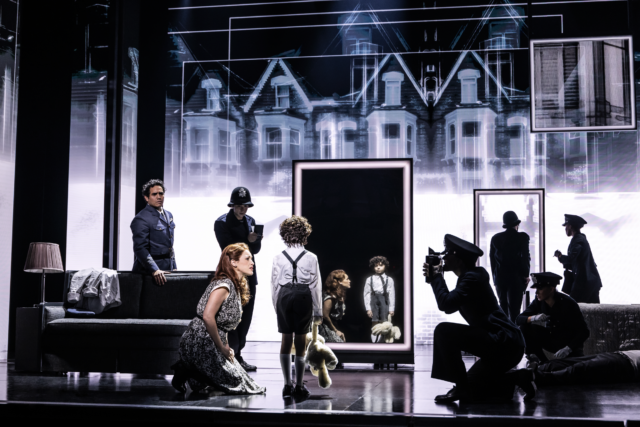
Thomas Kail’s revival of Sweeney Todd: The Demon Barber of Fleet Street is devilishly delicious. The dark tale of a mysterious master barber who teams up with a macabre pie maker features memorable music and lyrics by Stephen Sondheim and a delightful book by Hugh Wheeler, based on a 1970 play by Christopher Bond.
The 1979 original Broadway production starred Len Cariou as the title character and Angela Lansbury as Mrs. Lovett and won eight Tonys, including Best Musical, Best Score, Best Leading Actor, and Best Leading Actress. The current third Broadway revival opened last March with Josh Groban as Sweeney Todd and Annaleigh Ashford as Mrs. Lovett, earning eight Tony nods and winning for Best Lighting and Best Sound.
On February 9, Tony winner Aaron Tveit picks up the shaving blade as Sweeney, with two-time Tony winner Sutton Foster taking over baking the pies; an unrecognizable Ruthie Ann Miles continues her Tony-nominated performance as the beggar woman.
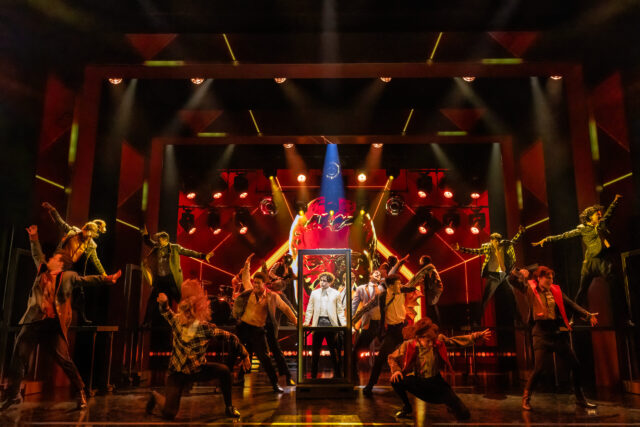
The exhilarating Buena Vista Social Club continues at the Atlantic through January 28 (photo by Ahron R. Foster)
BUENA VISTA SOCIAL CLUB
Atlantic Theater Company
Linda Gross Theater
336 West 20th St. between Eighth & Ninth Aves.
Tuesday – Sunday through January 28 atlantictheater.org
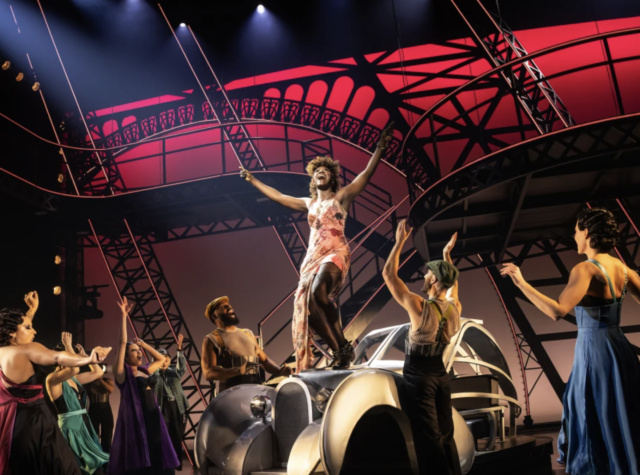
It would not be surprising if the Atlantic Theater’s world premiere of Buena Vista Social Club soon finds itself on Broadway; in the meantime, the sold-out run continues at the Linda Gross through January 28.
The two-hour musical was inspired by Wim Wenders’s 1999 Oscar-nominated documentary about Ry Cooder and his son, Joachim, traveling to Cuba to record an album with an ensemble known as the Buena Vista Social Club. Book writer Marco Ramirez has created a narrative, based on actual events, that goes back and forth between the 1950s, as the Cuban Revolution is simmering, and the economically depressed Special Period of the mid-1990s. Juan De Marcos (Luis Vega), who serves as narrator, explains early on, “Some of what follows is true / Some of it only feels true.” The real Juan De Marcos is a consultant on the show.
In 1996, Juan is trying to convince legendary singer Omara Portuondo (a sensational Natalie Venetia Belcon, in a gorgeous costume by Dede Ayite) to record an album in a Cuban studio with a band he has put together, including singer Eliades Ochoa (Renesito Avich). The possibility of singing some of her old songs takes her back to her youth, when she (Kenya Browne) and her sister, Haydee (Danaya Esperanza), were singing to tourists at the Tropicana until Haydee is enticed by guitarist Compay Segundo (Jared Machado) and pianist Rubén Gonzalez (Leonardo Reyna as a young man, Jainardo Batista Sterling as the older Rubén) to join them instead at the Buena Vista Social Club, a seedy nightspot in a dangerous part of town run by vocalist Ibrahim Ferrer (Olly Sholotan, although I saw understudy Justin Showell). Decades later, Compay (Julio Monge) seeks out Ibrahim (Mel Semé) to join in the recording, but he has no desire to revisit the past.
Although it does get sidetracked by bits of treacly melodrama, Buena Vista Social Club is splendidly directed by Tony nominee Saheem Ali, with energetic choreography by Patricia Delgado and Justin Peck on Arnulfo Maldonado’s inviting two-level set. The band is fantastic, performing such songs as “Silencio,” “Dos Gardenias,” “Veinte Años,” “El Carretero,” and “Y Tu Que Has Hecho?” Each member is worthy of mention: David Oquendo, Avich, and Monge on guitars, Javier Díaz, Mauricio Herrera, and Román Díaz on percussion, Guido Gonzalez on trumpet and flugelhorn, Hery Paz on woodwinds, Gustavo Schartz on bass, and Eddie Venegas on trombone. The performance of “Candela” alone is worth the price of admission, one of the best musical scenes of the year.
[Mark Rifkin is a Brooklyn-born, Manhattan-based writer and editor; you can follow him on Substack here.]
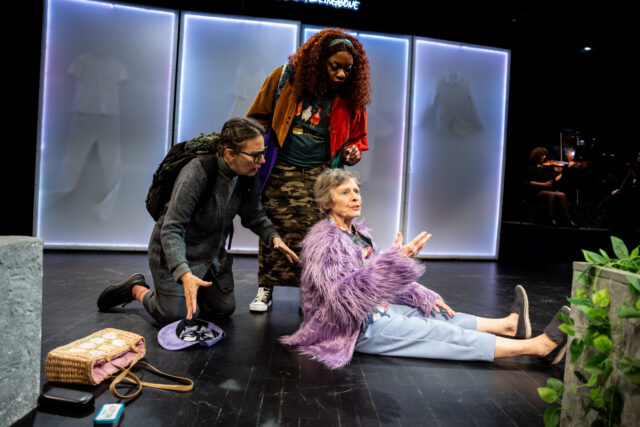
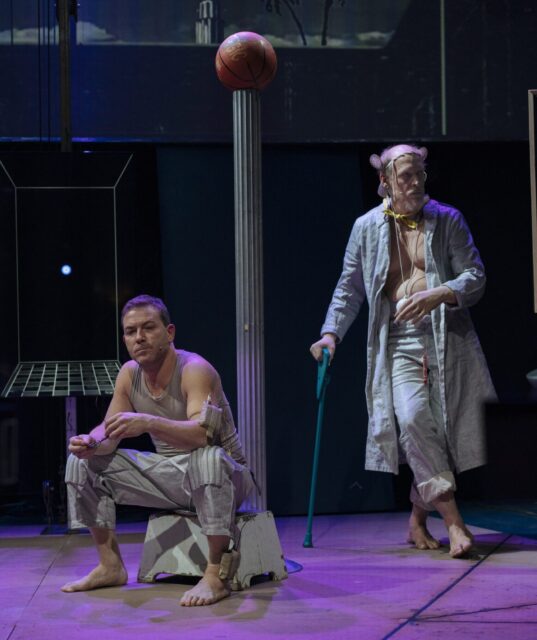
The Whole of Time offers a new look at Tennessee Williams’s The Glass Menagerie (photo by Maria Baranova)
THE WHOLE OF TIME
Torn Page
435 West Twenty-Second St. between Eighth & Ninth Aves.
Thursday – Monday through January 27, suggested donation $44 www.tornpage.org
About halfway through the US premiere of Argentinian playwright Romina Paula’s The Whole of Time, there’s a powerful, poignant scene between Antonia (Josefina Scaro), a young woman who prefers to spend her life inside her family’s house, and Maximiliano (Ben Becher), a leather-jacketed macho friend of her brother’s.
When Maximiliano asks her what she does with her life, she replies, “Oh, nothing.” Startled, he says, “What do you mean nothing?” She answers, “Yeah, nothing. At least according to the terms you’re asking me, nothing.” She tells him confidently that she doesn’t work or go to school. “You must do something,” he presses. She responds, “No, I don’t believe in doing.” Her younger brother, Lorenzo (Lucas Salvagno), who is reading Moby-Dick, calmly explains, “Antonia doesn’t go out.”
Lorenzo exits, and Maximiliano continues to ask her about her lifestyle choice, which he cannot understand. “This is who I am, I’m this way,” she declares. He asks, “But don’t you think it’s sad?” They disagree over what’s considered free or wasted time and what happiness is. As they move in closer to each other, she puts on Rata Blanca’s “La leyenda del hada y el mago,” a song about magic, love, and loneliness in a fairy-tale world.
Lorenzo and then their mother, Ursula (Ana B. Gabriel), enter, cutting off whatever might have been happening between Maximiliano and Antonia. “Oh, thank God you’re alive!” Ursula proclaims. Lorenzo interjects, “Awake, Mom. Thank God we’re awake.”
Unfortunately, that’s the only scene with any life to it; the rest of the play is a befuddling snooze.
Ben Becher and Josefina Scaro bring the heat to The Whole of Time (photo by Maria Baranova)
Translated from the original Spanish by Jean Graham-Jones, The Whole of Time is a contemporary reimagining of Tennessee Williams’s memory play The Glass Menagerie, but it goes way off track. It takes place in a small rectangular room at Torn Page, the Chelsea home where actors Rip Torn and Geraldine Page lived. Torn and Page starred onstage and onscreen in Williams’s Sweet Bird of Youth and were friends with the two-time Pulitzer Prize winner (for A Streetcar Named Desire and Cat on a Hot Tin Roof). An audience of no more than twenty-two people sit in two rows of folding chairs on one side of the room, across from the set that features a table where Antonia spends time on her laptop, an old armchair where Lorenzo reads, a fireplace, a vanity table, and a chifforobe; the back wall is a swriling blue, evoking Frida Kahlo’s Casa Azul in Mexico City. The set and video design is by Tony Torn, Rip and Geraldine’s son, who also directs the play; Donald Gallagher painted the backdrop.
It begins with a discussion about Mexican artist Marco Antonio Solís’s song “Si no te hubieras ido” (“There’s Nothing More Difficult Than Living without You”) that leads them to Kahlo’s Self-Portrait with Cropped Hair and talk of murderers. Projections on the back wall above the fireplace include a video of Solís performing his song and images of works by Kahlo, including the self-portrait and Portrait of My Father. The family lives in Argentina but Antonia and Lorenzo were born in Mexico; Ursula is from Hungary, which Antonia notes is like Kahlo’s father, photographer and painter Guillermo, who was born in Germany, died in Mexico, and might or might not have had Hungarian-Jewish roots. (Frida claimed he did, whereas a 2005 book debunked that using genealogy studies.)
Scaro, who strongly resembles Sarah Silverman and is the cocurator of events at Torn Page, is terrific as Antonia, a young woman not realizing that she has trapped herself; instead of having a limp like Laura in The Glass Menagerie, her physical affliction is represented by her obsession with Kahlo, who suffered severe injuries in a bus crash when she was eighteen and lived in terrible pain the rest of her life. Becher, who also serves as the preshow bartender, is seductive and charming as Maximiliano — the gentleman caller — a tough guy with a tender heart who just wants to enjoy life. Salvagno and Gabriel do what they can with their indistinct characters, he playing a calm, unassuming son and she a mother who still wants to dance and party, trying to find quick happiness that remains elusive. There’s a pall over the family, but it’s not the abandonment of the patriarch that hovers over Menagerie.
Jay Ryan’s lighting design is sparse, usually the standard lighting in the room, with occasional turns into darkness. Torn was sitting in one corner, often checking his cell phone, next to stage manager Berit Johnson, who works tech, which can be distracting if you’re sitting nearby. At one point, two characters were on either side of the space, engaged in a conversation that made audience members swivel their heads back and forth like they were watching a lackadaisical tennis match. There are a couple of avant-garde touches, but they feel out of place. Even at a mere seventy minutes, the production lags, meandering in and out of the story in confusing ways.
In The Glass Menagerie, Tom tells the audience, “Yes, I have tricks in my pocket, I have things up my sleeve. But I am the opposite of a stage magician. He gives you illusion that has the appearance of truth. I give you truth in the pleasant disguise of illusion.” That’s precisely what’s missing from The Whole of Time.
[Mark Rifkin is a Brooklyn-born, Manhattan-based writer and editor; you can follow him on Substack here.]
Ronald K. Brown/EVIDENCE return to the Joyce with Walking Out the Dark (photo by Ernesto Mancebo)
Ronald K. Brown/EVIDENCE, a Dance Company
The Joyce Theater
175 Eighth Ave. at 19th St.
January 16–21, $52-$72
212-691-9740 www.joyce.org www.evidencedance.com
One of the highlights of Alvin Ailey American Dance Theater’s sixty-fifth anniversary season at New York City Center last month was a new production of Ronald K. Brown’s 2009 Dancing Spirit, a celebration of longtime Ailey dancer and artistic director Judith Jamison. Before and after the December 23 presentation, Brown, who suffered a stroke in April 2021 that almost cost him his life, stood in the back of the orchestra with his life partner, dancer and associate artistic director Arcell Cabuag, hugging, kissing, and shaking hands with friends, colleagues, and well-wishers. Brown still has a lot of work to do, but his progress has been awe-inspiring.
Brown, a Bed-Stuy native, now brings his Evidence company — named after the 1948 Thelonius Monk composition — to the Joyce for its annual winter season. Running January 16–21, the show features two of Brown’s masterworks, 2001’s Walking Out the Dark and 2012’s Torch.
The former, a fifty-five-minute choreographed conversation among mother, brother, sister, lover, and friend dealing with self-examination, ritual, and healing, has an original score by Philip Hamilton (“Freedom”), with text from letters by Brown in addition to songs by Sweet Honey in the Rock (“Oh Death”), Ballet Folklorico Cutumba de Santiago de Cuba, and Toumani Diabate and live drumming by Abou Camara. The cast alternates between Demetrius Burns, Joyce Edwards, Gregory Hamilton, Isaiah K. Harvey, and Cabuag, who is celebrating his twenty-fifth year with the troupe and will take on the “Gratitude” solo four times, and Stephanie Chronopoulos, Austin Warren Coats, Valériane Louisy, Shaylin D. Watson, and Burns (“Gratitude”); the movement is inspired by dance from Benin, Cuba, and Côte d’lvoire.
The latter is a touching tribute to the life and memory of former Brown student and dance enthusiast Beth Young, who passed away in January 2012. The half-hour piece, which focuses on perseverance and self-determination, will be performed by Burns, Chronopoulos, Coats, Edwards, Hamilton, Harvey, Louisy, and Watson, with music by Teddy Douglas and DJ Zinhle featuring Busiswa Gqulu, remixed by Brown.
There will be a Curtain Chat on January 17 and a family matinee on January 20 at 2:00.
In addition, in conjunction with APAP, Brown and Cabuag are presenting an excerpt from Percussion Bitter Sweet, which they are creating for “Max Roach 100”; the sneak peek takes place at the Joyce on January 13 at 4:00 and at Alvin Ailey Studios on January 14 at 5:30.
No company has the kind of dancing spirit Brown and Evidence display, and it should be on full view in this winter program at the Joyce.
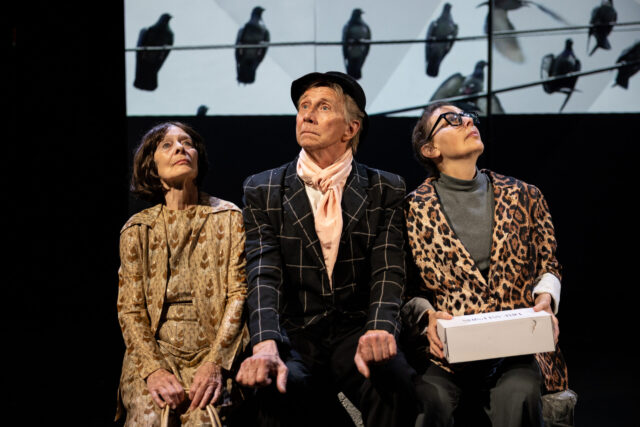
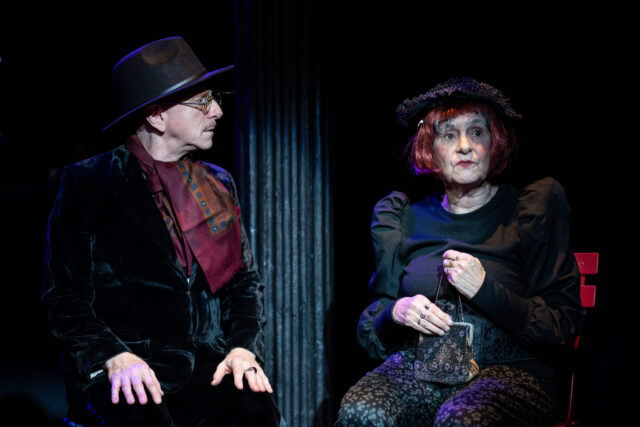
No need to worry if you missed your chance to get tickets to the site-specific play The Voices in Your Head, running this month at St. Lydia’s storefront dinner church in Brooklyn.
Created by Grier Mathiot and Billy McEntee, the sixty-minute dark comedy about a support group with eight members who share an unusual bond has just added another performance and a pair of seats for each show, which is now limited to eighteen guests at a time.
The impressive cast features Christian Caro, Marcia DeBonis, Patrick Foley, Vanessa Kai, Tom Mezger, Daphne Overbeck, Erin Treadway, and Jehan O. Young. Ryan Dobrin directs for the collective Those Guilty Creatures, which he cofounded with movement director Carina Goebelbecker. The company’s previous productions include Courtship,The Homiesexuals: A Social Media Tragedy,Dutchman, and She’s a Witch!