featured

COMPAGNIE HERVÉ KOUBI: SOL INVICTUS

Compagnie Hervé KOUBI worships the sun in Sol Invictus (photo by Nathalie Sternalski)

DANCE REFLECTIONS: SOL INVICTUS
Joyce Theater
175 Eighth Ave. at 19th St.
January 23-28, $10-$71
212-645-2904
www.joyce.org

French choreographer Hervé Koubi studied dance and biology at the University of Aix-en-Provence, and he combines the two elements gorgeously in Sol Invictus as his company of eighteen performers pushes the limits of what the human body can do.

In a program note, Koubi calls the seventy-five-minute piece “a manifesto for life,” and he fills it with sections that explore ritual, worship, faith in a higher power — in this case, the sun — and life, death, and rebirth.

Continuing at the Joyce through January 28, Sol Invictus, which means “invincible sun,” is named for the Roman Sun God, a deity that inspired cult followings. It begins in silence with Allan Sobral Dos Santos running around in a circle, faster and faster, moving lower and lower until his hand touches the reflective floor. The other dancers watch him from either side.

Soon the soundtrack starts — the score features music and soundscapes by Mikael Karlsson, Maxime Bodson, Beethoven (the funeral procession from the Seventh Symphony), and Steve Reich — and a friendly street dance battle breaks out. Koubi’s movement language melds hip-hop, capoeira, ballet, and contemporary dance, heavily influenced by his discovery in 2009 of his Algerian heritage; his troupe comes primarily from North Africa.

They twirl, jump, slide, shake, lift, toss, and dash around the stage, doing flips, cartwheels, head- and handstands, and dazzling twists and spins in musical arranger Guilaume Gabriel’s muted-palette culottes, loose-fitting skirts or shorts, several of the men going bare-chested, revealing impressive, heavily tattooed bodies. For the first time, Compagnie Hervé KOUBI includes women (Francesca Bazzucchi, Joy Isabella Brown, Hsuan-Hung Hsu), toning down a bit of the beefy masculinity on display.

Lionel Buzonie’s lighting ranges from heavenly glows to ominous fog; the eight spots at the top back bounce off the floor, casting ululating shadows on the Joyce’s ceiling. At one point a handful of dancers, each with a light behind them, approaches the stage slowly, like zombies. The narrative shifts from dance-off to postapocalyptic survival to West Side Story jubilance.

A long stretch of fabric in the back becomes a glittering gold translucent parachute enveloping first Bazzucchi, then later the one-legged Samuel Da Silveira Lima.

The dancers spend most of the show closely observing one another, but occasionally a single performer comes to the front and looks out at the audience, both warning us and beckoning us to join in the group worship of the sun as a way to rise out of the hazy darkness.

Koubi, who previously presented The Barbarian Nights, or The First Dawns of the World in 2020 and What the Day Owes to the Night in 2018 at the Joyce, can get a bit lost in all the razzle-dazzle, as impressive as it is, but he finds hope and love in the gathering itself, and it’s hard not to find the joy on his journey.

[Mark Rifkin is a Brooklyn-born, Manhattan-based writer and editor; you can follow him on Substack here.]
HENRY TAYLOR: B SIDE

Henry Taylor, THE TIMES THAY AINT A CHANGING, FAST ENOUGH!, acrylic on canvas, 2017 (Whitney Museum of American Art, New York; purchase, with funds from Jonathan Sobel & Marcia Dunn / © Henry Taylor)

HENRY TAYLOR: B SIDE
Whitney Museum of American Art
99 Gansevoort St.
Through January 28, $24-$30
212-570-3600
whitney.org

Among the many joys of the Whitney exhibit “Henry Taylor: B Side,” one of the best exhibitions of 2023 — catch it before it closes January 28 — is the audio guide. The work itself is extraordinary: stunning portraits, installations, assembled sculptures, early drawings, painted objects. Taylor, who was born in 1958 in Oxnard, California, and lives in Los Angeles, shares intimate details of his process on the guide, as do several subjects of his, artists themselves.

Regarding the above painting, a depiction of the murder of Philando Castile based on video taken by his girlfriend, Diamond Reynolds, Taylor says, “It was definitely emotional. . . . I do have a habit. I was a journalism major. Articles and things permeate. And then you say, no,I don’t want to do it. So, you have this ambivalence. But it’s not like I’m grabbing certain headlines. Sometimes we become, sort of, nonchalant is not the word, but when something happens over and over, we become sort of immune to it. But I think I just really reacted, you know what I mean?”

Below are six more works, with highlights from the audio.

Henry Taylor, i’m yours, acrylic on canvas, 2015 (courtesy the artist and Hauser & Wirth / photo by Sam Kahn)

Henry Taylor: I don’t always work from photographs, but this was a photograph taken by Andrea Bowers, and I liked it. . . . In the original photograph was just my son and I. And I added my daughter. Sometimes I might have material in the studio that I just grab or gravitate to. Sometimes it’s just there for a long time. So, you just put it to use, so to speak.

Henry Taylor, Cora (cornbread), acrylic on canvas, 2008 (courtesy the artist and Hauser & Wirth / © Henry Taylor; photo by Jeff McLane

Andrea Bowers: It’s a beautiful old stove. And when Henry was living in downtown Los Angeles, near Chinatown, he had this beautiful old stove, very similar to this, and he cooked constantly. And his meals were fantastic. And he always said that his mother taught him how to cook. And so, I love that he found her name, “Cora,” in the word “cornbread.” And I think this was always a painting that Henry always had hanging wherever he lived. Seemed to be really meaningful to him, like a really special painting. . . . I think that Henry has painted almost every day of his life. . . . When you start working with materials, there’s things that are going to come up, that’s a whole different kind of knowledge or communication. And I think that’s where Henry’s brilliance lies, just the day-to-day working. He loves to do it. And he paints all the time, and that’s beautiful.

Henry Taylor, Andrea Bowers, acrylic on canvas, 2010 (courtesy the artist and Hauser & Wirth / photo by Robert Bean)

Andrea Bowers: Henry and I are friends, so I was over there all the time. So it was like, “Okay, I’m going to sit here.” I don’t know, it was probably, like, probably five sessions or something, but for kind of long periods, he kept working on it. I’m sure everyone has told you that he makes really funny faces when he draws? Oh, okay. So, Henry’s really famous for that, the intensity that he gets on the face and the speed at which he’s looking and recording, looking, recording, looking and recording, with this kind of squint, and real intensity with one eye. And the other he’s squinting with. So that’s really fun, because he’s so in it, and he’s so focused. And you can see it. You’re just constantly aware of being recorded, This is real work he’s doing. It’s really interesting and fun.

Installation view of “Henry Taylor: B Side,“ including Y’ALL STARTED THIS SHIT ANYWAY, mixed media, 2021 (photo by Ron Amstutz)

Henry Taylor: You hear writers who talk about, oh, I wrote that song in twenty minutes, and it was a hit. This one just came together. And it seemed to have a nice compact little story — for me anyway. There’s a head, a decapitated . . . or just a mannequin’s head. And maybe I was thinking of just putting everything together or some of the materials like, oh, I had a bull. I have the head. I’m thinking about Native Americans. I’m thinking about green pastures and I’m thinking about golf, and I’m thinking about land and you know the white golf thing. I just thought that the buffalo and everything just kind of worked for me. And the cowboy boots, you know, that kind of goes. The buffalo, the boots. Buffalo Bill. Hey!

Henry Taylor: My brother was about five years older than me, four grades, when I was in the ninth he was in twelfth. So, he made me aware of things like Bobby Seale, Eldridge Cleaver, George Jackson. And so, I was thinking about a leather jacket. I had an idea to make only one jacket. But huge, because I didn’t know anything about this space [at LACMA]. But I was given another space. So, I was experimenting, say like closet-size. So, maybe I had eight jackets. So, it just took off from there. And I thought about the [January 6] insurrection. That is scary to me. But I don’t think — the Panthers weren’t trying to be intimidating. This was trying to save people.

Henry Taylor, Deana Lawson in the Lionel Hamptons, acrylic on canvas, 2013 (courtesy the artist and Hauser & Wirth / photo by Sam Kahn)

Henry Taylor: Deana [Lawson] is a photographer, a really good one, and a dear friend. And I was fortunate enough to go to Haiti with her and watch her in action. I guess this is something I did when I was visiting A. C. Hudgins, who was a collector out in the Hamptons. But, and that’s what we’d do out there, or I would do out there. I’d always have canvas there. I think I’m one of those people that just travels with material and likes to engage with nature and with people. And musicians often carry their guitar and play and collaborate and so, I look at it like that. It’s just something I enjoy doing. I love to paint.

[Mark Rifkin is a Brooklyn-born, Manhattan-based writer and editor; you can follow him on Substack here.]

THE VOICES IN YOUR HEAD

Gwen (Vanessa Kai) is the facilitator for an unusual group therapy meeting in The Voices in Your Head (photo by HanJie Chow)

THE VOICES IN YOUR HEAD
St. Lydia’s Dinner Church
304 Bond St., Brooklyn
January 8-29, $31.72
stlydias.org/events
www.thoseguiltycreatures.com

Lately I’ve been thinking more than ever about grief and death. I’m not a support group kinda guy, but when I heard about The Voices in Your Head, I knew I had to go.

I found solace — and nearly nonstop laughter — in Those Guilty Creatures’ immersive, site-specific group therapy black comedy, which continues at St. Lydia’s storefront dinner church in Brooklyn through January 29.

The space has been renamed St. Lidwina’s, after the Dutch patron saint of chronic pain and ice skating. The church has a large front window and door, looking more like a cozy shop than a place of worship. When you arrive, you are asked to check off your name on a sign-in sheet; to protect your anonymity, there are no last names, although people passing by outside can peek in and see you.

In the center of the room are more than two dozen unmatched chairs arranged in a large oval. In the back is a working kitchen where the facilitator, Gwen (Vanessa Kai), greets everyone while making tea and cookies. Several attendees engage in friendly conversation and chitchat. Shortly after Gwen calls the meeting to order, it becomes apparent that a handful of the participants are in the cast.

“It’s funny, when I was at my lowest, I was going to all these different meetings; it felt like dating, trying to find the right match, and they were all so . . . maudlin? I thought, there has to be another way. So, I started this group,” Gwen says. “Evidently, there was a need. So, we’re all here, we’ve met the criteria, but, broadly, I like to think of this as a place to share a sensibility. Laughter comes easier for me in here than out there. Everyone has their own relationship to grief; I’ve been considering mine, but what about anti-grief? We seek that through shared stories, activities, and discussions. . . . We aim to hear three stories each week, which, hopefully, helps us exchange some weird-ass joy.”

The audience becomes immersed in the grief of others in The Voices in Your Head (photo by HanJie Chow)

Sharing their sensibilities are the vivacious and outgoing Regina (Daphne Overbeck); Vivian (Marcia DeBonis), who believes in “Death, Embarrassment, Trauma”; Caleb (Christian Caro), who doesn’t want to be sad in college and can’t stop texting; the ultraserious Sandra (Erin Treadway); and the practical Hadiya (Jehan O. Young), who loves “the morbid stuff.”

They are eventually joined by first-timer Blake (Patrick Foley), who is determined to turn his story of loss into a Netflix special, and Ted (Tom Mezger), who actually attends the church and saw a flier.

Over the course of sixty fun, lively minutes, the group discusses Kelly Clarkson, hot cater waiters, self-care, vacuuming, exfoliating, sand, and other items and issues as they explore their personal misfortunes. A role-playing session that puts some of the group members in specific social situations doesn’t go quite as expected. During a break, the characters gossip, revealing more about who they are.

At the center of it all is the arbitrariness of death and Gwen’s assertion that we should “just approach the nature of the loss with a sense of humor. It helps us hold a certain space.”

The Voices in Your Head takes place in the storefront of a Brooklyn dinner church (photo by HanJie Chow)

The cast is uniformly excellent, led by Kai (The Pain of My Belligerence, KPOP) as the not-necessarily-so-stable Gwen, the always terrific DeBonis (Mary Page Marlowe, Small Mouth Sounds) as the chatty but caring Vivian, Treadway (Spaceman, War Dreamer) as the dour Sandra, Young (Speech, The Johnsons) as the purposeful Hadiya, Overbeck (Typed Out: A Princess Cabaret, Nightgowns) as the wonderfully over-the-top Regina, and Caro making his off-Broadway debut as the inattentive Caleb, but Foley (Circle Jerk, The Seagull/Woodstock, NY) nearly steals the show with his unforgettable Christmas story.

Created by Grier Mathiot and Billy McEntee and gleefully directed by Ryan Dobrin, The Voices in Your Head is as smart as it is hilarious. It’s not so much about how we deal with death than how we deal with life. Everyone reacts differently to tragedy and loss, but, as Gwen points out, “We need to hear each other’s laughter.”

The Voices in Your Head is not interactive — the audience should leave the talking to the actors — but feel free to mingle afterward and share your own thoughts about this engaging and involving experience.

[Mark Rifkin is a Brooklyn-born, Manhattan-based writer and editor; you can follow him on Substack here.]
THE FRIEL PROJECT: ARISTOCRATS

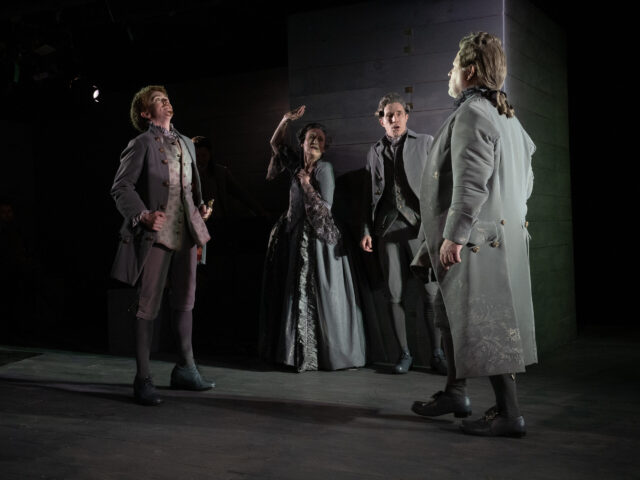
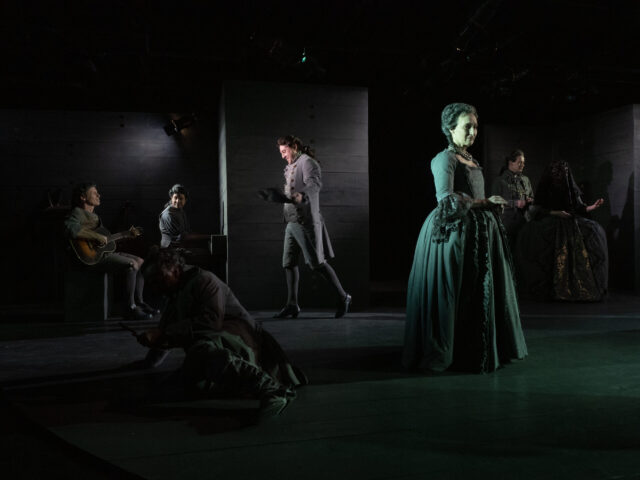
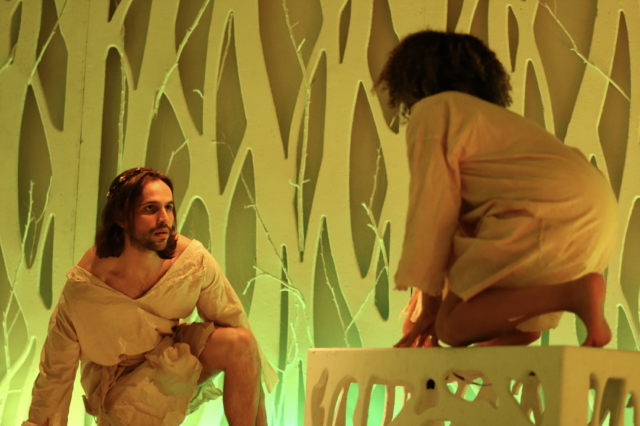
Uncle George (Colin Lane) goes for a stroll in Irish Rep revival of Brian Friel’s Aristocrats (photo by Jeremy Daniel)

ARISTOCRATS
Irish Repertory Theatre, Francis J. Greenburger Mainstage
132 West Twenty-Second St. between Sixth & Seventh Aves.
Wednesday – Sunday through March 3, $60-$125
212-727-2737
irishrep.org

The Irish Rep continues its 2023–24 Friel Project with what it does best, an exquisite revival of a superb Irish drama, in this case Brian Friel’s 1979 Aristocrats.

In 2005, when the company was in danger of losing the lease on its home on West Twenty-Second St., Friel, a native of Northern Ireland, praised the Irish Rep’s excellence, writing about cofounders Charlotte Moore and Ciarán O’Reilly, “The ground they occupy has now been made sacred by them. They have made their space hallowed. It would be unthinkable if 132 West Twenty-Second St. were to slip from them and become secularized. It must remain under their wonderful guardianship.”

Friel passed away in 2015 at the age of eighty-six, coincidentally during a major renovation of the Irish Rep’s hallowed space.

Since its beginnings in 1988, the Irish Rep has staged ten of Friel’s works, including Making History, Molly Sweeney, Dancing at Lughnasa, The Freedom of the City, Afterplay, and The Home Place. The Friel Project kicked off with Translations last fall and continues in March with Philadelphia, Here I Come!, which the troupe previously presented in 1990 and 2005, before concluding with Molly Sweeney, seen at the Irish Rep in 2011 and online in 2020.

Moore first directed Aristocrats in 2009; fifteen years later, she is helming another exemplary production. The story, partially inspired by such classic Chekhov family tales as The Cherry Orchard, Three Sisters, Uncle Vanya, and The Seagull, takes place in Ballybeg Hall in County Donegal in the mid-1970s, as the fortunes of a Catholic family have turned. (Friel wrote adaptations of Three Sisters and Uncle Vanya and set several other plays in the fictional Ballybeg, which means “small town.”)

Alice (Sarah Street) is suspicious as Casimir (Tom Holcomb) shares more information with Tom (Roger Dominic Casey) in Aristocrats (photo by Jeremy Daniel)

Charlie Corcoran, one of New York City’s finest scenic designers, has created a lovely indoor-outdoor set that features a flowered trellis and (fake) grass by an unseen tennis court, a porch swing, a desk in an old, dusty study raised a few steps, and a rear hallway with no front wall, so the audience can see people coming and going. The open set hints at the many secrets that will soon be revealed.

The decaying estate is run by Judith (Danielle Ryan), who lives there with her youngest sister, Claire (Meg Hennessy), who is getting married to a middle-aged widower with four young children; their father, former District Justice O’Donnell (Colin Lane), who has dementia; and their uncle George (Lane), a dapper old gent who rarely speaks. Their brother, Casimir (Tom Holcomb), has traveled from Hamburg for the wedding festivities, arriving without his wife, Helga, and their two children. The fourth sibling, the cynical Alice (Sarah Street), and her husband, the brash bully Eamon (Tim Ruddy), have also come, but it seems that they would prefer to be anywhere else.

As the play opens, family friend and handyman Willie Diver (Shane McNaughton) is installing a baby alarm on the top of a bookcase so the family can hear any noises coming from their father’s room, alerting them if there are any problems. An American scholar, Tom Hoffnung (Roger Dominic Casey), is at the estate researching a book he’s writing on “the life and the life-style of the Roman Catholic big house — by no means as thick on the ground but still there; what we might call a Roman Catholic aristocracy — for want of a better term. . . . And the task I’ve set myself is to explore its political, cultural, and economic influence both on the ascendancy ruling class and on the native peasant tradition.”

Casimir is only too happy to share the estate’s history with Tom, telling stories about such regular literary visitors as Sean O’Casey, G. K. Chesterton, Gerard Manley Hopkins, and W. B. Yeats. But Eamon has a different perspective, advising Tom that the book should be “a great big blockbuster of a gothic novel called Ballybeg Hall — From Supreme Court to Sausage Factory.

Casimir, who can’t get through on the phone to his wife in Germany, continually plays a game with Claire, a trained classical pianist who suffers from anxiety, guessing the pieces she is playing from an offstage room; they also challenge each other to an invisible game of croquet, representing their vanishing lifestyle. Alice, who has a suspiciously bruised face, drinks too much. Judith, who participated in the Battle of the Bogside, smokes too much. The O’Donnells are a family on the decline, existing in their own world, refusing, or unable, to confront the reality that’s staring down at them.

Judith (Danielle Ryan) and Eamon (Tim Ruddy) can’t forget the past in Friel revival at Irish Rep (photo by Jeremy Daniel)

Moore has a firm grasp on the proceedings, having previously directed five other Friel plays at the Irish Rep; the narrative flows smoothly, then hits hard when revelations come. The sound and original music by Ryan Rumery and M. Florian Staab immerse the audience in the elegiac world the O’Donnells are trying to hold on to, representative of an evolving Ireland as the Troubles pit the Catholics against the Protestants. Birds chirp and Claire’s piano emits beautiful melodies, but that is just background noise that can’t hide the truth. David Toser’s costumes range from casual to elegant to old-fashioned, further evoking the family’s loose relationship with time and change.

The expert cast is highlighted by Holcomb, who portrayed Chekhovian dreamer Conrad Arkadina in Woolly Mammoth’s adaptation of Aaron Posner’s reimagining of The Seagull, the fabulous Stupid Fucking Bird. The tall, thin Holcomb glides through the play, an unreliable narrator who is lost in a snow-globe fantasy.

Street, Hennessy, and Ryan are lovely as the three very different sisters; one of the most tender moments is when Alice and Claire are entwined on the swing, the former more mother than sibling to the latter. McNaughton is warm and friendly as Willie, Casey is stalwart as the observant Tom, and Lane makes the most of his short appearances as Uncle George and the father. Ruddy is strong as Eamon, a tough man who sees through much of the charade. “Between ourselves, it’s a very dangerous house, professor,” he tells Tom. He also refers to the lack of discussion of his mother-in-law as “the great silence.”

In addition to the four plays, the Irish Rep will also be paying tribute to Friel with several special events. On February 26, violinist Gregory Harrington, joined by pianist Simon Mulligan, will perform “Melodies for Friel: Echoing through the Landscape of Ballyweg,” and the Friel Project Reading Series continues through May 2 with readings of eleven Friel plays, anchored around a March 26 benefit presentation of the Tony-winning Dancing at Lughnasa.

[Mark Rifkin is a Brooklyn-born, Manhattan-based writer and editor; you can follow him on Substack here.]
ENCORE: JOB

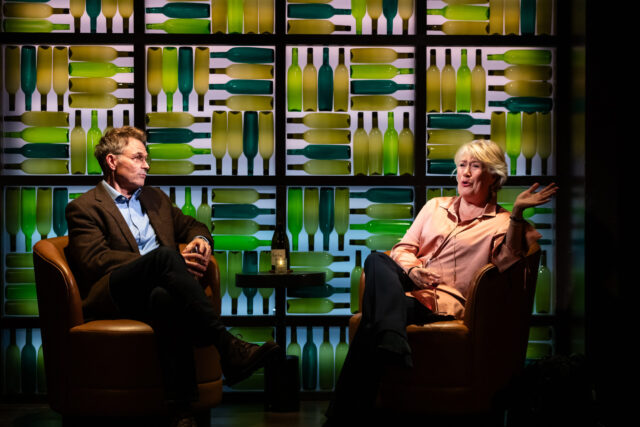
A therapist (Peter Friedman) and his new patient (Sydney Lemmon) fight for survival in Max Wolf Friedlich’s Job (photo by Danielle Perelman)

JOB
Connelly Theater
220 East Fourth St. between Aves. A & B
Wednesday – Monday through March 3, $32-$127
jobtheplay.com
connellytheater.org

Last fall, Max Wolf Friedlich’s Job became one of the hottest tickets in town, spurred not only by the quality of the production but by a TikTok rave from moschinodorito, aka actor Connor Boyd.

The show, with the same cast and crew, is now having an encore run through March 3, moving from SoHo Playhouse to the Connelly Theater on the Lower East Side.

Below is my original review from last October; tickets are likely to go fast, so get your resumes in now. . . .

——————————————————————————————————————-

The title of Max Wolf Friedlich’s intense generational thriller, Job, can be pronounced either with a soft o, meaning the type of work someone does, or with a hard o, referring to the biblical figure. Both characters in the world premiere at SoHo Playhouse will have to display patience and an innate understanding of their employment if they are going to survive this intense tale.

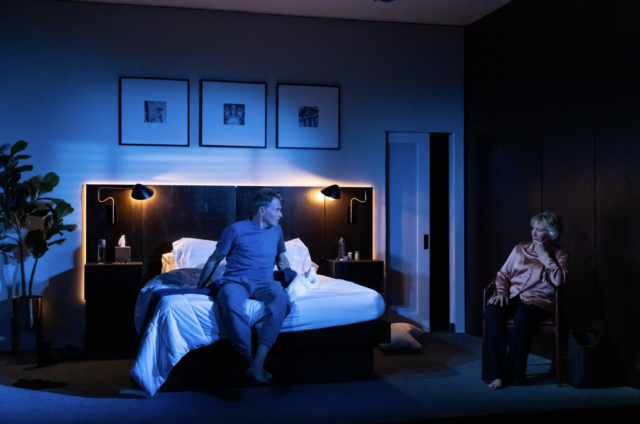
The show takes place in January 2020 in the San Francisco office of a therapist named Loyd (Peter Friedman), a sort of 1960s throwback who has to determine whether Jane (Sydney Lemmon) can return to her position in the tech world after having suffered a terrible psychological meltdown that went viral. As the play opens, Jane is holding a gun on Loyd.

“Thanks for squeezing me in,” she says plaintively, sitting down. “My pleasure. In general, do Wednesdays at this time work?” he asks, trying to ignore that his life appears to be in grave danger. For the next eighty minutes, Jane and Loyd play a kind of verbal cat-and-mouse game as facts slowly emerge explaining how it came to this.

Jane insists she is not a gun person but that her mental state is on the edge. She tells him, “I can’t imagine how scary that was for you — it was scary for me too — but I promise, I swear like . . . I will do whatever you need me to do just . . . I can’t be outside right now, I — I haven’t slept in a couple days, I haven’t — I can’t be outside, I just need to get back to work.”

Jane (Sydney Lemmon) believes she desperately needs to get back to work in Job (photo by Danielle Perelman)

Meanwhile, Loyd, responding to the shame Jane says she feels for having the gun, explains, “I’m not an especially spiritual person — at least not in the traditional sense — but I will contend that the people who wrote the Bible down were some very very clever people. We’re told that Adam and Eve eat the sort of magical wisdom apple, right? They eat the apple, realize they’re naked, and then . . . they feel shame. So shame is the very first feeling mentioned in the Bible — wisdom and shame are connected.”

Those two elements also arise in the Book of Job. “But where can wisdom be found? And where is the place of understanding? Man does not know its value, nor is it found in the land of the living,“ Job says to his friends. Shortly after, God says to Job, “Your enemies will be clothed in shame, and the tents of the wicked will be no more.”

As the two protagonists continue to battle it out, an underlying theme begins to emerge, one of the young fighting against the old. Jane is in her twenties, working in the tech profession in a role that didn’t exist a mere ten years before, while Loyd, in his sixties, is a laid-back Berkeley grad with outdated sensibilities.

“It’s the field that’s the problem,” Jane tells him. “Because people with your job come into work wanting to connect trauma A to trauma D, so they always do — it’s a self-fulfilling prophecy or whatever.” When Jane explains how a creepy guy on a train both hit on her and insulted her at the same time, Loyd defends it as “a misguided attempt at being friendly — generational miscommunication.” She also asks Loyd, “Like why are you so terrified of progress?”

Loyd delves into Jane’s upbringing, looking for clues regarding her meltdown, but keeps coming up empty. “It was a perfectly nice granola middle class existence — nothing to cry about,” she insists. Jane, however, often turns the tables on Loyd, asking him personal questions that he does answer, perhaps out of fear knowing that there’s still that gun in her bag. But once he’s said enough, a major twist leads to an intense finale.

Loyd (Peter Friedman) is the arbiter of Jane’s fate in world premiere at SoHo Playhouse (photo by Danielle Perelman)

No matter how you pronounce it, Job is a nail-biter about patience, wisdom, and, primarily, responsibility, about people being accountable for their actions and living up to their obligations. Both Jane, who works in “user care,” and Loyd have jobs in which they help people, though in different ways, through a kind of protection.

In his off-Broadway debut, director Michael Herwitz keeps the drama at high-boil, making good use of Scott Penner’s basic set, a few chairs facing each other atop a rectangular, carpeted platform, with two small tables, an ottoman, and a lamp. Mextly Couzin’s lighting features several eerie blackouts, accompanied by Jessie Char and Maxwell Neely-Cohen’s effective sound. The costumes by Michelle Li consist of casual pants and an unbuttoned shirt for Loyd and green pants and a belly-revealing striped shirt for Jane.

Ever-reliable Tony nominee Friedman (The Nether, Ragtime) is phenomenal as an easygoing therapist who suddenly find his life on the line, while Lemmon (Tár, Helstrom) — the daughter of Chris Lemmon and granddaughter of Jack Lemmon — is exceptional in her off-Broadway debut, stretching her long body, clasping her hands, and holding tight to her gun as she slowly reveals some hidden truths. (Friedman played series regular Frank on Succession, while Lemmon appeared in three episodes as Jennifer, who’s starring in Willa’s play.)

The twist is a biggie and will turn some people off, as will the open-ended finale. But everything up to those points is taut and nerve-racking. It’s not going to hurt any of the participants to have this Job on their resume.

[Mark Rifkin is a Brooklyn-born, Manhattan-based writer and editor; you can follow him on Substack here.]
UNDER THE RADAR: PUSHKIN “EUGENE ONEGIN” IN OUR OWN WORDS

Four actors portray multiple characters in Pushkin “Eugene Onegin” in our own words (photo by Bronwen Sharp)

PUSHKIN “EUGENE ONEGIN” IN OUR OWN WORDS
BRIC Arts Media House
647 Fulton St., Brooklyn
Tuesday – Sunday through January 28, $52.11-$67.93
bricartsmedia.org
krymovlabnyc.com

This past October, Moscow-born director, designer, and visual artist Dmitry Krymov made a smashing debut with his new company, Krymov Lab NYC, in Big Trip, two shows that ran in repertory at La MaMa. I saw Three Love Stories Near the Railroad, wild and woolly, wholly unpredictable retellings of Ernest Hemingway’s “Hills Like White Elephants” and “A Canary for One,” followed by a pair of scenes from Eugene O’Neill’s Desire under the Elms. The other presentation was the oddly titled Pushkin “Eugene Onegin” in our own words, another strange but clever and gratifying journey that is enjoying an encore run through January 28 at BRIC Arts Media House as part of the Under the Radar festival.

In the hallway, you are told that this is a children’s show and that, in order to gain entry to the BRIC Ballroom, you need to select a puppet from among the dozens and dozens scattered around what would have been the coat check room. The handmade puppets, created by Leah Ogawa and Luna Gomberg, are adorably grotesque, made of papier-mâché and assorted random items that serve as eyes, ears, or limbs. You are expected to hold on to your child-puppet throughout the wild and woolly, wholly unpredictable proceedings, a hilarious ninety minutes of meta-theatrics.

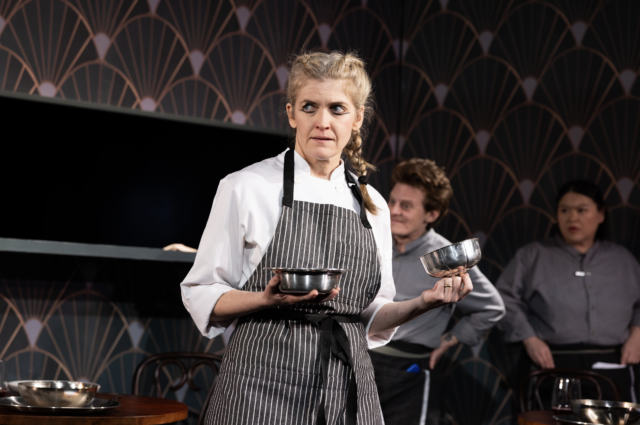
Four actors — Inna Natanovna (Anya Zicer), Pyotr Naomovich (Jeremy Radin), Oleg Lvovich (Jackson Scott), and Alla Borisovna (Elizabeth Stahlmann) — walk on Emona Stoykova’s sparse stage dragging bags of goofy props that they lay out on a table on one side and a row of chairs on the other. Addressing the audience directly, Pyotr says, “Hello. We come tonight to explain you about Evgeny Onegin, a very famous narrative poem. A novel, made of many little poems, written by Alexander Pushkin — the most great, most wonderful, amazing, fantastic poet in all history of Russia. Greatest poet of all time. Your parents ask us, four old Russian immigrants, to tell you story about Onegin and Pushkin.”

And so they do, but definitely not as you might expect.

Pyotr Naomovich (Jeremy Radin) and Inna Natanovna (Anya Zicer) move along the plot in unique ways at BRIC (photo by Bronwen Sharp)

Inna, Pyotr, Oleg, and Alla portray themselves and multiple characters from “Evgeny Onegin” and Pushkin’s personal life. Some require more significant costume changes than others, and many of the outfits look like they might have come from the performers’ own closets. (The costumes are by Gomberg, with lighting by Krista Smith, sound by Kate Marvin, and projections by Yana Biryukova, all of which are purposely low-tech.)

In the 1830s novel in verse, Pushkin introduces readers to the title character, a dandy who inherits a country estate. The landowner’s daughter, Tatyana Larina, falls in love with Onegin, who has become friendly with poet Vladimir Lensky, who is about to marry Olga Larina, Tatyana’s younger sister. When Onegin and Olga dance together at a celebration, Tatyana and Vladimir are none too happy, and things devolve from there as Pushkin explores class, gender, naïveté, and unrequited love.

The story is regularly interrupted by a heckler (Kwesiu Jones), logistical issues, literary arguments, and tangents about the art of theater itself, some of which involve “stage manager” Natalie Battistone. As Pyotr explains at one point, “From the traproom, you can rise and fall! This trick is often used in opera and ballet performances by devils! But we don’t talk about devils. Very superstitious people, theater people, ptew! No devils — we don’t want to give you nightmares, okay? We tell you, instead, about angels. . . .”

Several audience members in the first row are asked to participate. The actors keep a feather afloat by blowing on it for no apparent reason. Onegin’s spleen (depression) is examined. One of the men becomes the lower half of a ballerina’s body. A pair of oddball contraptions are employed to elucidate characters’ motivations. Onegin is compared to Pushkin. Clothes come off, revealing an unexpected surprise. A buxom nanny opens a window, then closes it, then opens it, then . . .

Writer-director Krymov was preparing a production of The Cherry Orchard in Philadelphia in February 2022 when Russia invaded Ukraine. Condemning Vladimir Putin’s actions, he became an exile, moving to New York City with his wife and starting Krymov Lab NYC. If these first two vastly inventive and entertaining shows are any indication of what is to come, Putin has cost Russia something very valuable indeed.

[Mark Rifkin is a Brooklyn-born, Manhattan-based writer and editor; you can follow him on Substack here.]
UNDER THE RADAR: VOLCANO

Volcano gushes forth over four episodes and nearly four hours at St. Ann’s Warehouse

VOLCANO
St. Ann’s Warehouse
45 Water St.
January 10-21, $54
stannswarehouse.org

Luke Murphy’s Volcano is an eruption of ingenuity, a multimedia, multidisciplinary melding of past, present, and future bathed in mystery.

Continuing at St. Ann’s Warehouse through January 21 as part of the Under the Radar festival, the nearly four-hour presentation takes place in a large transparent box, with the audience sitting on two sides in rising rafters. Alyson Cummins and Pai Rathaya’s set is a ramshackle room with drooping wallpaper, television monitors, a disco ball, a black trunk, toy figurines, and other odd, seemingly random items.

Every time an old-fashioned radio suddenly blurts on, two unidentified men, portrayed by Irish writer, director, and choreographer Murphy (X) and London-born dancer and actor Will Thompson (Y), they grab a camera on a tripod and try to film themselves dancing. Other times they glide into compelling duets in silence, interrupted by light and sound glitches that make it feel like they are under someone else’s control. Which, to some extent, they are.

The two men are participants in the Amber Project, a 1950s-like space mission. “We at the Amber Project are ready to take the next step in the exciting and illustrious heritage of exploration and technological advancement,” a spokesman tells them on the monitors. “This Alinia rocket with the mission designation Pod 00 will soon hurl a crewless spacecraft into orbit — the first of a series of interstellar vehicles, similar to the one which will soon carry two travellers past the reaches of our solar system for the first time.” But what’s really going on?

Volcano pours out over the course of four forty-five-minute episodes — “Frequency,” “Realia,” “Gift,” and “Pod 261” — with two five-minute pauses and one standard intermission in between. If you’re looking for easy answers to what’s happening, you’re not going to find them.

“I’m confused. And I’m scared. I don’t know anything. It’s like my mind’s a library and I just went to a section of shelves I don’t normally go to, and all the book are gone. . . . I don’t even know what books are supposed to be there. And that scares me. I . . . keep wondering . . . What are we doing?” Y says at one point. “I keep wondering whether the things I recognize, the things that make me feel comfortable . . . Do I trust them because I know them, or do I trust them because I don’t know anything else? . . . Now, I know something’s changed here, but I can’t tell if I’ve lost focus on something I used to see or if I’m only now noticing what I couldn’t see before. And mainly . . . I’m wondering who knows all the things I don’t. And that . . . that makes me scared.”

The abstract, surreal narrative breaks out into a game show, a weather report, Amber Project testimonials, magic tricks, a nod to virtual reality pioneer Morton Heilig, and songs by Hot Chip, the Beach Boys, Dirty Beaches, and Billie Holiday. Visual references are made to Superman, Marilyn Monroe, Michelangelo, and iconic 1960s sci-fi television.

The dialogue doesn’t make things much clearer, only adding to the conundrum:

Y: You know, I feel like we’ve got a real opportunity here, you know?
X: I’m not sure I understand what you mean.
Y: Well, you know, we can’t walk away from this; we should, you know, grab the bull by the horns.
X: You were saying you felt confused?
Y: This feels . . . this is important.
X: I believe you, I think.

And:

Y: Do you ever just wanna do something different?
X: What do you mean?
Y: Never mind.

Volcano is a technical marvel, mixing analog and digital in complex and humorous ways; the lighting is by Stephen Dodd, with sound by Rob Moloney. The prefilmed videos were directed by Pato Cassinoni, with a cast that includes Adam Burton, Amaya Gill, Ciaran Bermingham, Emily Terndrup, Ghaliah Conroy, Gina Moxley, John McCarthy, Lily Ockwell, Mufutau Yusuf, Pearse Donoghue, Rocio Dominguez, and Sile Maguire.

Does Volcano need to be as long as it is? Probably not. Should the audience have to wait about two and a half hours before a proper intermission? Not really. But if you give in to its conceits, it’s not unlike binging a limited sci-fi series that is as perplexing as it is riveting, with the added bonus of captivating choreography.

Murphy (Slow Tide, Pass the Blutwurst, Bitte) and Thompson are a dynamic duo, immersed in a cryptic world that reveals humanity losing its grip on reality — but always with a ray of hope somewhere out there on the horizon.

[Mark Rifkin is a Brooklyn-born, Manhattan-based writer and editor; you can follow him on Substack here.]