featured

PRAYER FOR THE FRENCH REPUBLIC

A Jewish family in Paris faces anti-Semitism in Joshua Harmon epic (photo by Matthew Murphy)

PRAYER FOR THE FRENCH REPUBLIC
Manhattan Theatre Club
MTC at New York City Center – Stage I
131 West 55th St. between Sixth & Seventh Aves.
Tuesday – Sunday through March 27, $99
212-581-1212
www.manhattantheatreclub.com

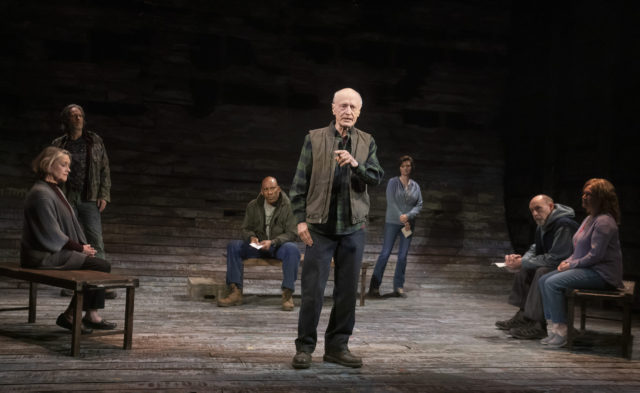
“Why do they hate us?” a Jewish character asks near the end of Joshua Harmon’s extraordinary Prayer for the French Republic, which opened tonight at MTC at New York City Center – Stage I for a limited run (now extended through March 27). The playwright’s characters answer the question without being preachy or, perhaps even more important, preaching to the choir. In this three-hour multigenerational time-traveling epic, Harmon explores the centuries-old scourge of anti-Semitism with exquisite skill through the experiences of one family.

The play goes back and forth between 1944–46 and 2016–17, narrated by Patrick Salomon (Richard Topol), part of a long line of Salomons who have been in France for more than a thousand years. In his fifties, Patrick is part stage manager from Thornton Wilder’s Our Town, part Woody Allen from Annie Hall, watching and interacting with characters from the past and present.

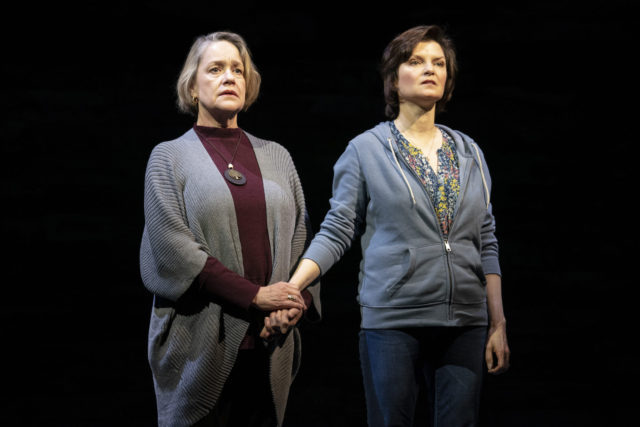
In 2016, Molly (Molly Ranson), a twenty-year-old college student from America, has come to visit her distant cousins in Paris while studying abroad in Nantes. She arrives on a day when Daniel Benhamou (Yair Ben-Dor), the twenty-six-year-old son, comes home beaten and bloodied after an anti-Semitic attack. His mother, Marcelle Salomon Benhamou (Betsy Aidem), wants to call the police and take Daniel to the hospital, but he refuses. His father, Charles Benhamou (Jeff Seymour) — both parents are successful doctors — is calmer, carefully checking his son’s injuries.

Elodie (Francis Benhamou), Daniel’s brilliant manic-depressive older sister, is incensed that Marcelle blames Daniel’s thrashing on his unwillingness to cover his yarmulke. Elodie doesn’t think Jews should have to hide who they are, while Marcelle is more fearful of the consequences. “You put a huge target on your back!” Marcelle shouts. “Oh, so Daniel’s asking for it now? Is that seriously your argument? He’s asking for it?” Elodie asserts.

The play uses that as a jumping-off point, with scenes marked by full-throated disagreements, quiet allusions, and an astonishing amount of smoothly integrated analysis of Israel, religious and secular Jews, and Judaism in France through the ages, encompassing such events as the People’s Crusade in 1096, the Valentine’s Day massacre of 1349 in Strasbourg, and the 1960s postcolonial exodus of Algerian Jews to France. Set pieces incorporate discussions of Israeli and American Jews and the mass shootings at Charlie Hebdo, the Bataclan theater, and a kosher supermarket in Paris. The characters are troubled by the rise of Marine Le Pen and the National Front in France while considering the fate of the family’s last piano store, a legacy that goes back to 1855.

Irma (Nancy Robinette) and Adolphe Salomon (Kenneth Tigar) wonder where their children and grandchildren are in 1944 Paris (photo by Matthew Murphy)

The play is deeply rooted in history, presented in both monologues and flashbacks, particularly to the mid-1940s, when Marcelle’s great-grandparents, the elderly Irma Salomon (Nancy Robinette) and her husband, Adolphe (Kenneth Tigar), are living in Paris despite the occupation, not about to evacuate their home or give up the life they’ve built together. They worry every minute about the fate of their children, Jacqueline, Robert, and Lucien (Ari Brand), and their grandchildren, including Lucien’s son, Pierre Salomon (Peyton Lusk); Jacqueline escaped to Cuba, but Robert and Lucien are missing.

As Irma and Adolphe, who runs the piano business, sit at the dinner table, Patrick wonders about his great-grandparents. “What were they like, as people?” he asks. “What did they talk about? I have to imagine it was hard not to talk about their children, their grandchildren. . . .” Irma responds as if Patrick is right there with them: “We don’t talk about our children that much.” Adolphe then regales his wife with a beautiful fairy tale in which every member of their family is happy, healthy, and safe, an unlikely fantasy.

Over the course of three hours (with two intermissions), Patrick, the son of a Catholic mother and nonreligious Jewish father, wanders between eras, sharing what details he knows, singing at the Salomon piano that his sister Marcelle inherited, and occasionally participating in the modern-day moments, highlighted by a Passover Seder that turns ugly fast.

Molly (Molly Ranson), Charles (Jeff Seymour), and Daniel (Yair Ben-Dor) make sufganiyot together in world premiere play from MTC (photo by Matthew Murphy)

Terrorism and fear are perpetually on their minds. In an early exchange, Molly, who represents the current battle over BDS and other Israel-related issues on American college campuses, and Marcelle, who represents, well, one of my mother’s best friends, get into it.

Molly: My parents didn’t want me to come to France at all, but . . .
Marcelle: Why not?
Molly: Just cause of all the, you know. The terrorism.
Marcelle: There’s terrorism everywhere.
Molly: That’s what I said, but they were scared.
Marcelle: Aren’t you from New York? What’s to be scared?
Molly: I agree.
Marcelle: The whole world has terrorism now. There’s nowhere to hide. Either you live in the world, or you live in a cave. Personally, I don’t want to be a caveman.

Charles, whose family escaped Algeria when it became too dangerous, admits, “I’m scared, Marcelle. You lay everything out, you lay it out so rationally, and I hear every word you’re saying, but, I’m scared. We are Jews. We are Jews. The only reason we’re still on this planet is because we learned to get out of dangerous situations before they got the better of us. Something is happening in the world, and it’s happening in our country too — I can feel it.” When he says “our country too,” it’s impossible not to think about how it’s happening in America today, with brutal assaults on Jews from Pittsburgh, Boise, and New York City to Colleyville, St. Petersburg, and Poway.

Francis Benhamou brings down the house in a dazzling monologue when Elodie, in a bar with Molly, rants and rages about American Judaism and misperceptions about Israel. “American Jews . . . feel pretty free,” she explains in a verbal barrage. “So when it comes to Israel, they either despise it, or they’re slavishly devoted to it because they have a deep-seated understanding in their bones that there has never been a country on Earth that hasn’t eventually at some point turned on its Jews, and even in America, that fate awaits them too. Then you have the American Jew who hates Israel or is highly critical of Israel and I would argue part of why they feel able to be so critical of Israel is because they feel so safe in America, because they’ve convinced themselves that they can stay in America forever and maybe that’s true now but if history is our guide and history must always be our guide then you have to ask, so you feel safe today but will that be the case a hundred years from now? Or ten?” It’s a discussion I know I’ve had many times with friends and relatives, and Harmon nails it.

Narrator Patrick Salomon (Richard Topol) goes back and forth in time in Prayer for the French Republic (photo by Matthew Murphy)

Takeshi Kata’s elegant set rotates between the Benhamous’ lovely home and the Salomons’ less-fashionable wartime apartment. Tony, Drama Desk, and Obie–winning director David Cromer, who mounted a groundbreaking adaptation of Our Town on Broadway in 2009 (as well as helming The Band’s Visit, The Sound Inside, Tribes, and many other well-regarded shows), seamlessly integrates the two eras, which are often onstage together, one in the background of the other like a ghost, with superb lighting by Amith Chandrashaker and sound by Lee Kinney and Daniel Kluger.

The cast is uniformly outstanding, with Topol’s (Anatomy of a Suicide, The Normal Heart) naturally calm, likable demeanor alleviating some of the palpable tension until there’s no stopping it; Topol previously starred as Lemml, the immigrant stage manager and narrator, in Paula Vogel’s Tony-nominated Indecent, about the making of Sholem Asch’s controversial 1907 Yiddish play, God of Vengeance. Ranson imbues Molly with an inner strength and confidence that has her going toe-to-toe with her cousins, who have a tendency to be loud and forceful; Ranson similarly portrayed Melody, Liam’s (Michael Zegen) shiksa goddess, in Harmon’s Bad Jews, which also dealt with the Holocaust and family legacy. Ranson and Ben-Dor have an immediate chemistry as they balance fighting and flirtation.

Even Daniel’s fondness for Bob Dylan is no mere affectation, as the Nobel- and Pulitzer-winning troubadour famously went from being Jewish to a born-again Christian and back to Jewish during his fabled career; his 1983 album, Infidels, features several songs about Israel.

But it’s Harmon’s (Significant Other, Admissions) impeccable dialogue and razor-sharp characterizations that take center stage. Every word, every action rings true and hits home; he gets the Jewish American experience just right, even if this is a Parisian family (that speaks English without the hint of a French accent). I’ve been involved in these arguments and know these people well; I’m planning on memorizing a bunch of lines in time for this year’s Seders.

SHHHH

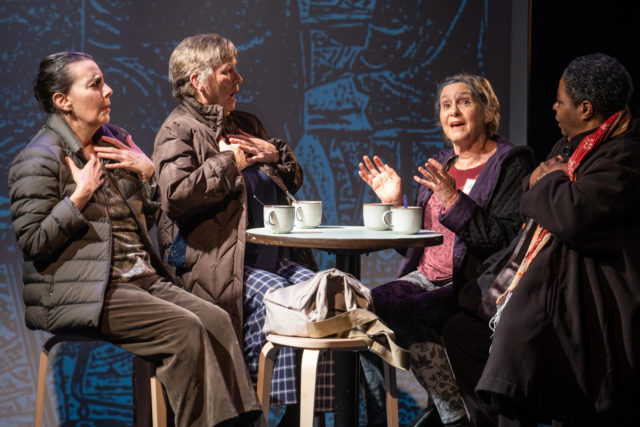
Shareen (Clare Barron) and Kyle (Greg Keller) have an unusual relationship in Shhhh (photo by Ahron R. Foster)

SHHHH
Atlantic Stage 2
330 West 16th St. between Eighth & Ninth Aves.
Tuesday – Sunday through February 13 (extended through February 20), $61.50-$81.50
atlantictheater.org

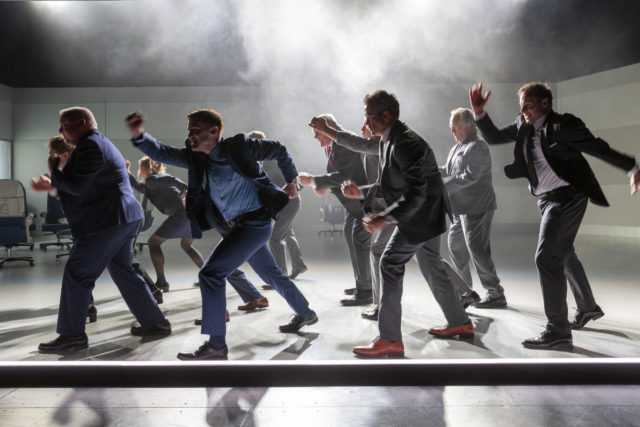
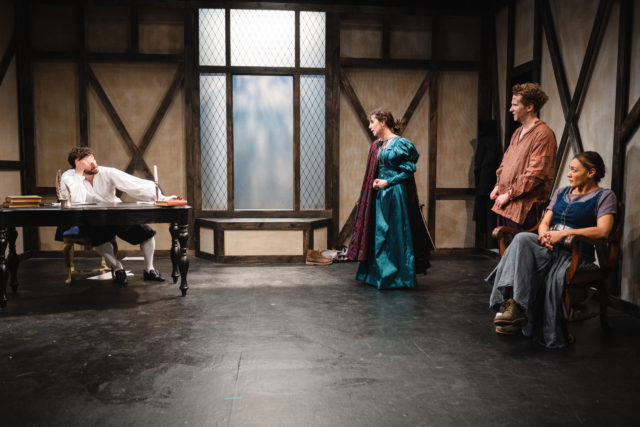
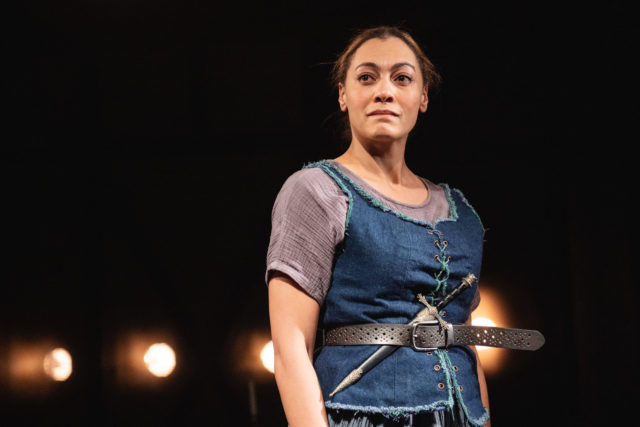
ASMR meets S&M in Clare Barron’s latest dark comedy, Shhhh, which opened tonight at Atlantic Stage 2 for a woefully limited run through February 13 (now extended to February 20). The semiautobiographical play touches on all five senses, beginning with a physical and metaphorical cleansing that concludes with ASMR podcaster Sally, aka Witchy Witch (Constance Shulman), whispering to her listeners, “Indulge yourself. . . . You deserve it.” And for the next ninety minutes, that’s exactly what the six characters do, indulging themselves amid sex, spit, sperm, snot, STDs, and shit as Barron, who wrote and directed the work and stars as Shareen, explores pain, power, penetration, and privilege along with consent, condoms, communication, and control. It’s a feminist reversal of stories by such authors as Charles Bukowski, Henry Miller, and Ernest Hemingway, putting women in charge of an unexpected narrative that goes places where primarily only men have gone before, diving headfirst (or, in one case, toe first) into sex, sadism, and blood and guts.

Shareen is a thirtysomething writer who is sick with an undiagnosed illness. “It’s like the inside of my mouth is one of those fast-forward flowers from the movie Planet Earth?” she tells Kyle (Greg Keller), a neighbor and former lover as she brushes her teeth and he sits on the toilet. “Except instead of flowers. I’m blossoming snot. And then I just swallow.” Kyle isn’t the only one in the theater who lets out an “ew.” It’s a terrific scene that lets the audience know that they are in store for something more than a little bit different.

All the characters speak frankly about bodily functions, about things entering and leaving their various orifices, incorporating pain and pleasure, often at the same time. Sally, a postal worker who is considering transferring to the forensics department — just the word “forensics” makes one think of cop shows in which the forensics unit is usually tasked with investigating the brutal murders of women — takes her date, a gender-fluid dog walker named Penny (Janice Amaya), to the Morbid Anatomy Museum, which includes an encased, full-size anatomical Venus, complete with death mask and innards sticking out. Sally offers Penny the chance to try out an electric device with her that can either “tickle or hurt.”

Francis (Nina Grollman) and Sandra (Annie Fang) talk about sex in graphic detail in Atlantic world premiere (photo by Ahron R. Foster)

Greg uses a graphic description of a horrific accident as foreplay to a perhaps unwanted intrusion. Shareen discusses the hairs on her chin and her inability to orgasm. Two young women in gloriously kinky glittering finery, Francis (Nina Grollman) and Sandra (Annie Fang), eat pizza while delving into their numerous sexual partners and the men’s insistence on not using protection.

Francis admits, “Sometimes I think if someone were to give me a button and say: If you push this button you could kill all the heterosexual men in the world, I would be ethically obligated to push that button. . . . But then here I am, a very privileged white woman. So maybe someone would be obligated to push the button for me as well.” Meanwhile, Sandra says about herself, “Wow. You are so happy You have never been so alone,” considering that she doesn’t necessarily need to be with a man to be satisfied.

Arnulfo Maldonado’s set is a kind of gothic museum, from mattresses strewn on the floor (one of which audience members can sit on) and glass jars of creepy items to a dingy bathroom and a barely visible kitchen in the entryway. The eerie lighting is by Jen Schriever, with sound by Sinan Zafar; Unkle Dave’s Fight House provides intimacy and fight direction.

Shhhh is extremely satisfying, alternating myriad laughs with an abundance of winces and cringes. Its inherent feminism comes equipped with a whip ready to do battle and draw blood, but it also has an innate charm that makes you welcome the thrashing. Every scene takes the complex narrative to another level where the audience better be ready for anything, because the play is wholly unpredictable from start to finish. Every time you think, no, it’s not gonna go there, it does, and then goes even further. Kudos to the brave actors who aren’t afraid of the journey.

Constance Shulman and playwright-director Clare Barron star as sisters in Shhhh (photo by Ahron R. Foster)

Shareen, wearing a tiny, shiny summer slip dress — the superb costumes are by Kaye Voyce — is tired of having to make decisions for herself. “I just want somebody to tell me when and where I can go to the bathroom,” she says. It’s a strong moment, especially when taken in the context of Barron’s personal and professional life. In “Not Writing,” a revealing piece she posted in August 2020 in the inaugural issue of Playwrights Horizons’ online “Almanac: Pasts, Nows, Futures,” she discussed her early success, mental breakdown, and struggle with bipolar disorder.

Alongside pictures of her cats and messy apartment, she explained, “The American Theater gets a real hard-on for a twenty-seven-year-old debut, and it’s impossible to separate the art from this world-premiere fanfare. I’ve played with this whole sexualized image of youth my whole career. It is authentically who I am, but I’m also using it because I know that as a young, white woman in America, this is one reliable way in which I can have power. My youth, my whiteness, my thinness, my Yale degree have all given me permission and protection to talk about whatever the fuck I want and still be taken seriously. These aspects of my identity have gotten me attention, gotten me jobs . . . They’ve made me palatable to people in power.”

More than merely palatable, Barron has been duly praised for her previous work, winning an Obie for 2015’s You Got Older and the prestigious Susan Smith Blackburn Prize for Dance Nation, which was also a Pulitzer finalist. Shhhh was written in 2016 but is only now having its world premiere at the Atlantic.

Barron indeed talks about whatever the fuck she wants in this world-premiere production. One of the most critical lines in the play is when Francis, talking about how men judge women’s bodies, says, “I don’t fucking dissect his body into fucking pieces like a fucking dead animal.” It’s made even more effective with the anatomical Venus hovering just behind her.

In “Not Writing,” Barron also opines, “I haven’t written a play in four years. I don’t know if I’ll write a play ever again. Who cares.” A whole lot of people do.

NYC’S MOVIE RENAISSANCE 1945 – 1955

New Yorkers should be flocking to see The Naked City and other Big Apple flicks at Film Forum

NYC’S MOVIE RENAISSANCE 1945 – 1955
Film Forum
209 West Houston St.
Through February 10
212-727-8110
filmforum.org

In his July 2021 book “Keep ’Em in the East”: Kazan, Kubrick, and the Postwar New York Renaissance (Columbia University Press, $40), film historian Richard Koszarski details how New York City came to be a haven for making movies. “Fiorello La Guardia was the first New York mayor to realize the full significance of the motion picture industry to the city’s economic well-being. The few hundred jobs directly at stake in the late 1930s were not unimportant, but ever since the turn of the century, the movies — along with broadcasting and publishing — had also been doing something else for New Yorkers. Where the twentieth century had begun with a range of great American cities competing for world and national attention, it was now clear that modern America was no longer so flat a landscape. Now there was New York — and all those other places. Pittsburgh, Chicago, and San Francisco were all great cities, but New York was the city.”

Tony Curtis and Richard Jaeckel are two of the toughies in Maxwell Shane’s City Across the River

New York City native Koszarski will be at Film Forum to talk about a few of the films in “NYC’s Movie Renaissance 1945 – 1955,” a two-week series consisting of two dozen flicks that take place in and around Gotham, released in the ten years beginning around the end of WWII. The diverse selection ranges from noir and romcoms to musicals and courtroom dramas, psychological studies and cop stories with car chases. Among the many stars you’ll encounter are Joseph Cotten, Jennifer Jones, Marlon Brando, Eva Marie Sainte, Richard Conte, Judy Holliday, Ray Milland, Jane Wyman, Jack Lemmon, Tony Curtis, Coleen Gray, Richard Widmark, Thelma Ritter, Dana Andrews, Jane Wyatt, Frank Sinatra, Ann Miller, Vittorio Gassman, Gloria Grahame, John Garfield, Moms Mabely, and Victor Mature.

Earl McEvoy’s The Killer That Stalked New York is among the many surprises in Film Forum series

Familiar classics such as Abraham Polonsky’s Force of Evil, Henry Hathaway’s The House on 92nd St. and Kiss of Death, Billy Wilder’s The Lost Weekend, Gene Kelly and Stanley Donen’s On the Town, and William Dieterle’s Portrait of Jennie are joined by such lesser-known works as George Cukor’s The Marrying Kind, Maxwell Shane’s City Across the River, Earl McEvoy’s The Killer That Stalked New York, Maxwell Shane’s City Across the River, Josh Binney’s Boardinghouse Blues, cinematographer extraordinaire Ted Tetzlaff’s The Window, and Bernard Vorhaus’s incarcerated women tale So Young, So Bad with Rita Moreno and Anne Francis.

Stanley Kubrick’s Killer’s Kiss is part of Film Forum series about the renaissance of NYC-set flicks

Koszarski writes about Fletcher Markle’s Jigsaw, “Interesting suggestions of widespread corruption involving the mafia, right wing vigilantes, and political power brokers who operate out of Manhattan penthouses. . . . Most of the cast consisted of unfamiliar New York faces, but Markle and [Franchot] Tone did convince quite a few of their friends to pop up in oddball cameos.” And he explains about Morris Engel, Ruth Orkin, and Ray Ashley’s absolute gem Little Fugitive, in which a young boy goes on a Coney Island adventure, its “simplicity was itself a great part of its appeal: no pointed moral, no dramatic character arc, no allegorical references to corruption, intolerance, World War II, or nuclear disarmament. Instead the audience is led on by the film’s uncanny sense of observation — not just in terms of photographic imagery but in the way ordinary New Yorkers relate to one another, solve their little problems, and go about the mundane details of their everyday lives.”

Moms Mabely stars in Josh Binney’s Boardinghouse Blues

Koszarski will introduce Joseph Lerner’s awesomely titled Guilty Bystander, featuring Zachary Scott as an ex-cop house detective, on February 2 at 6:40. Master Film Forum programmer Bruce Goldstein will introduce Jules Dassin’s genre-defining The Naked City on February 5 at 7:50, accompanied by his short personal documentary, Uncovering The Naked City, and Susan Delson, author of Soundies and the Changing Image of Black Americans on Screen: One Dime at a Time (Indiana University Press, December 2021, $35-$85), will present “Soundies: America for a Dime” on February 10 at 6:50, focusing on “movie jukebox” clips from Duke Ellington, Nat “King” Cole, Dorothy Dandridge, Fats Waller, Sister Rosetta Tharpe, and others.

JOACHIM TRIER — THE OSLO TRILOGY

Renate Reinsve is captivating as a free spirit unable to settle down in The Worst Person in the World

THE OSLO TRILOGY
Film at Lincoln Center, Walter Reade Theater
165 West 65th St. at Amsterdam Ave.
January 28 – February 3
The Worst Person in the World opens February 4
212-875-5601
www.filmlinc.org
neonrated.com

Norwegian director Joachim Trier concludes his Oslo Trilogy with the riveting The Worst Person in the World, which is having a preview screening at Lincoln Center on January 28 before opening there on February 4. Shortlisted for Best International Feature Film, it is part of a weeklong series that includes the first two parts of the trilogy, 2006’s Reprise and 2011’s Oslo, August 31st, along with works selected by Trier and cowriter Eskil Vogt that influenced them.

The Worst Person in the World is highlighted by an unforgettable, captivating performance by Renate Reinsve, who was named Best Actress at Cannes for her portrayal of a young woman who knows what she doesn’t want but isn’t sure about what she does desire. Divided into twelve chapters in addition to a prologue and epilogue, the film follows Julie as she goes from a medical student to a bookstore employee to a photographer, along the way falling in and out of love with a series of men she doesn’t always treat very well. We are often appalled by what Julie does and says, but it’s nearly impossible to turn our backs on her.

Kasper Tuxen’s camera utterly adores Reinsve, with alluring close-ups of her extraordinary eyes, which reveal both her need to be with someone and her craving for freedom. Shortly after meeting Aksel (Anders Danielsen Lie), an older comic book artist, Julie crashes a wedding party and is instantly drawn to Eivind (Herbert Nordrum); although both have significant others, they dive straight into a gorgeously filmed seduction that involves no touching, wondering whether that counts as cheating. It’s a marvelous scene that questions the very nature of relationships and fidelity and sets the stage for everything that comes next.

Despite Julie’s being the protagonist, the title does not refer only to her; at one point, Eivind thinks he might be the worst person in the world, and the film is likely to make you consider whether you have done anything in your life worthy of the designation. Trier and Vogt explore the dichotomy of intimacy and independence, resulting in a work of deep thought and intelligence. There will be a postscreening Q&A on January 28 at 6:00 with Trier, Reinsve, and Lie, who has major roles in all three part of the trilogy; Trier and Reinsve will be back at the Walter Reade Theater on February 4 for a Q&A following the 5:30 show.

The Oslo Trilogy began in 2006 with Trier’s feature debut, Reprise, in which Erik (Espen Klouman Høiner) and Phillip (Lie) are best friends who want to become literary sensations. Their lives spiral in and out of control as their dreams come within reach in a film swirling with a punk aesthetic. Reprise is screening January 29 and 31 and February 3, with Trier and Lie on hand for a Q&A at the January 29 show at 6:00.

Anders Danielsen Lie is brilliant as a young man trapped in a world of his own making in Oslo, August 31st

Lie is brilliant as a drug addict in Oslo, August 31st, the middle section of the trilogy. He stars as Anders, a junkie who, early on, attempts suicide by filling his pockets with heavy stones and walking into a lake, a la Virginia Woolf. At the last minute he changes his mind and returns to the rehab clinic where he’s trying to get clean. But when he gets a one-day leave in order to interview for a plum job, as an editorial assistant for a well-known literary journal, he challenges his sobriety by visiting old friends and an ex-lover he still pines for and seeking to see his sister, who is severely disappointed in him.

Lie is a powder keg of desperation as Anders, reminiscent of Jeremy Strong’s portrayal of Kendall Roy in Succession. He is lost in his own warped reality, refusing help when offered, sure that he is the only one who really understands what is going on inside him. It’s all the more painful to watch because he is wasting such promise, wandering from scene to scene in a fog of his own making. It’s a cautionary tale that begins with random people talking about their life in Oslo, as Trier and Vogt narrow down to the details of one man’s ills. Oslo, August 31st is screening January 30 and February 2 and 3, with Trier and Lie participating in a Q&A at the January 30 show 2:30.

Joachim Trier will introduce Arnaud Desplechin’s My Sex Life . . . or How I Got into an Argument at Lincoln Center on January 30

In conjunction with the theatrical opening of The Worst Person in the World on February 4, Trier and Cogt have chosen nine films that have impacted their work and/or they just plain love. The impressive list consists of Martin Scorsese’s The Age of Innocence (introduced by Trier on January 29), John Hughes’s The Breakfast Club, Agnès Varda’s Cléo from 5 to 7, Éric Rohmer’s The Green Ray (introduced by Trier on January 28), Alain Resnais’s Hiroshima mon amour, a digital restoration of Arnaud Desplechin’s My Sex Life . . . or How I Got into an Argument (introduced by Trier on January 30), George Cukor’s The Philadelphia Story, Erik Løchen’s Remonstrance, and Larisa Shepitko’s Wings.

HENRIK LUNDQVIST’S RETIREMENT NIGHT

Hulu Theater at Madison Square Garden
31st – 33rd Sts. between Seventh & Eighth Aves.
Friday, January 28, $30-$60, 6:30
www.nhl.com

Ed Giacomin (1), Brian Leetch (2), Harry Howell (3), Rod Gilbert (7), Adam Graves (9), Andy Bathgate (9), Mark Messier (11), Vic Hadfield (11), Jean Ratelle (19), Mike Richter (35). Since their inception in 1926, the New York Rangers, founded by Tex Rickard, have retired the jerseys of ten star players. They turn it up to eleven on Friday night when the number 30 worn by goaltender extraordinaire Henrik Lundqvist from 2005 to 2020 gets raised to the rafters.

Over the course of fifteen seasons, King Henrik amassed a regular season record of 459-310-96, with a 2.43 GA average and a save percentage of .918. The five-time all-star and five-time Vezina finalist — he won the coveted trophy in 2012 — took home a gold medal manning the pipes for Sweden at the 2006 Turin Olympics and led the Broadway Blueshirts to the Stanley Cup finals in 2014. The Rangers let Lundqvist go after the 2019-20 season, but before he could play a game with the Washington Capitals, who signed him to a one-year deal, he had to hang up the skates because of pericarditis that required open-heart surgery, forcing him to retire at the age of thirty-nine.

Henrik Lundqvist will be cheered yet again when his jersey is raised to the Garden rafters on January 28

Tickets are still available for the Rangers’ battle against the Minnesota Wild on January 28, but they currently start at a mere $350. So a better option might be spending thirty bucks and joining in the fun at a retirement watch party with Rangers alums at the Hulu Theater at Madison Square Garden. Tex’s Rangers are on a roll this year, with 60 points in 43 games, while the Wild is enjoying a hot first half as well, with 53 points in 38 games, so it should be quite a game. It all gets going around 6:30, when a parade of Rangers greats will pay homage to the King, a fashion plate who is likely to look hotter than ever on the Garden ice. In conjunction with the special event, you can post your own Lundqvist story here and check out a month of Henrik highlights here. Net proceeds from the watch party will be split between the Garden of Dreams Foundation and the Henrik Lundqvist Foundation.

LONG DAY’S JOURNEY INTO NIGHT

The Tyrone family faces the coronavirus in new streamlined Audible production (photo by Joan Marcus)

LONG DAY’S JOURNEY INTO NIGHT
Audible Theater’s Minetta Lane Theatre
18 Minetta Lane between Sixth Ave. and MacDougal St.
Through February 20 (no shows Monday and Friday), $57-$97
www.audible.com
longdaysoffbroadway.com

Jonathan Miller’s 1986 Broadway revival of Long Day’s Journey into Night created an uproar because the characters spoke over one another rather than treating Eugene O’Neill’s dialogue like gospel. Purists may also be unhappy with Robert O’Hara’s modern-day streamlined adaptation of the Pulitzer Prize-winning classic about a dysfunctional family, but audiences at Audible’s Minetta Lane Theatre, where O’Hara’s version opened tonight for a four-week run before being available on audio, may feel differently — or not.

As the crowd enters the theater, a large onstage monitor plays a loop of clips from CNN about the Covid-19 crisis and the 2020 presidential election. Clint Ramos’s multilevel set is strewn about with Fed Ex and Amazon boxes, a stack of masks, and a bar in the back. The coronavirus has come to the Tyrone family, who’ve been fast-forwarded into the twenty-first century.

O’Neill wrote the semiautobiographical play in 1941 and set it in 1912; O’Hara has moved it up more than a hundred years but hasn’t altered a single word. However, he has made significant cuts to the text, trimming the show down to a too-lean 110 intermissionless minutes; the play usually runs more than three hours and two breaks. Although much of the depth is lost, the production is still compelling, primarily because of excellent performances by real-life husband and wife Bill Camp as actor James Tyrone and Elizabeth Marvel as Mary Tyrone, a morphine addict who can’t face reality.

James Tyrone (Bill Camp) tries to take a break while his wife, Mary (Elizabeth Marvel), shoots up in off-Broadway O’Neill revival (photo by Joan Marcus)

The Tyrones’ older son, Jamie (Jason Bowen), was groomed to follow in his father’s footsteps but instead is a ne’er-do-well writer who spends all his money on booze and hookers. Younger son Edmund (Ato Blankson-Wood) is seriously ill, even if local Dr. Hardy says otherwise, thinking it might be a fever Edmund caught in the tropics. In O’Neill’s text, Jamie has tuberculosis — pretty much a death sentence in 1912 — but in this production it is clear that he has the coronavirus, and the family’s varying attitudes about his diagnosis are reminiscent of the start of the pandemic, before much was known about Covid-19.

O’Hara turns most of the focus on Mary; less time is spent on the others and their concerns inside and outside the house, from careers to alcoholism. Usually, James, Jamie, and Edmund only talk about Mary heading into the spare room, where she takes her morphine, but here we clearly see her sitting at a small table and shooting up, visible through a cutout in the back brick wall. It’s a disturbing image, causing a different kind of visceral reaction; it also made me wonder why one of the characters doesn’t just go upstairs and take the syringe and drugs away from her, a thought that never occurred to me in other productions I’ve seen. (Those include the aforementioned 1986 adaptation with Jack Lemmon, Bethel Leslie, Peter Gallagher, and Kevin Spacey, Jonathan Kent’s 2016 Broadway revival with Gabriel Byrne and Jessica Lange, and Sir Richard Eyre’s 2018 presentation at BAM with Jeremy Irons and Lesley Manville.)

Real-life husband-and-wife Bill Camp and Elizabeth Marvel get frisky in Long Day’s Journey into Night (photo by Joan Marcus)

The emotions between James and Mary are palpable, whether they’re flirting with each other or in a tense standoff; Camp (The Crucible, The Queen’s Gambit) and Marvel (Hedda Gabler, Homeland) display an instant chemistry that never lets up, enhanced by Yee Eun Nam’s abstract projections that reveal Mary’s inner turmoil. But the sons feel more distant and underdeveloped; there’s no longer the necessary back story to make us care about them, and neither Blankson-Wood (Slave Play, The Rolling Stone) nor Bowen (The Play That Goes Wrong, If Pretty Hurts Ugly Must Be a Muhfucka) is given enough to do.

In a production note, O’Hara explains, “The O’Neill Estate has allowed us to imagine this glorious play into the future that we are currently living through. . . . In both its concept and its brevity, this version is not meant to be anything other than an exploration of living in the time of a pandemic through the story and language of one of our greatest playwrights.” In updating the work, Tony nominee and two-time Obie winner O’Hara (Slave Play, Bootycandy) has left the skeletal structure but has removed a large chunk of the soul. And it’s one thing to perform this adaptation live onstage, with a full set, but I can’t imagine how it would work as an audio piece, without the props that place the Tyrones firmly in the Covid era.

CAMERA MAN: DANA STEVENS ON BUSTER KEATON

Bill Jr. (Buster Keaton) mimics his father, Bill Campbell (Ernest Torrence), in silent film classic

Who: Dana Stevens, Imogen Sara Smith
What: Screening and discussion about Buster Keaton
Where: Film at Lincoln Center, Elinor Bunin Munroe Film Center, Francesca Beale Theater, 144 West Sixty-Fifth St.
When: Thursday, January 27, $15, 7:00
Why:Steamboat Bill, Jr. may be [Buster] Keaton’s most mature film, a fitting if too-early farewell to his period of peak creative independence,” Slate film critic Dana Stevens writes. “Its relationship to the rest of its creator’s work has been compared to that of Shakespeare’s last play, The Tempest.” Stevens gets serious about the Great Stone Face, one of silent film’s best comics, in her brand-new book, Camera Man: Buster Keaton, the Dawn of Cinema, and the Invention of the Twentieth Century (Atria, $29.99).

In celebration of the launch of the tome, Stevens will be at Lincoln Center’s Francesca Beale Theater on January 27 at 7:00 to screen a 4K restoration of the 1928 classic, directed by Charles Reisner, about a riverboat battle and true love, preceded by a 2K restoration of Keaton and Edward F. Cline’s twenty-five-minute masterpiece, One Week, about a pair of newlyweds (Keaton and Sybil Seely) and their unusual new home. (Both films feature orchestral scores by American composer Carl Davis.) Stevens will put Keaton’s life and work in sociocultural context with Criterion contributor Imogen Sara Smith, author of Buster Keaton: The Persistence of Comedy. If you’ve never seen Keaton on the big screen, now is the time, as no one could turn tragedy into comedy quite like Keaton.