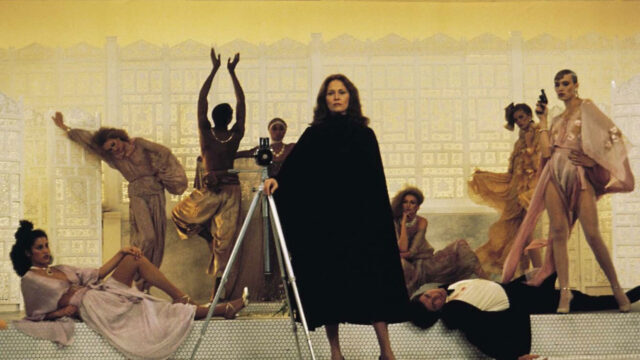
Lucy Harbin (Joan Crawford) doesn’t take kindly to marital infidelity in Strait-Jacket
STRAIT-JACKET (William Castle, 1964)
Village East Cinema by Angelika
181-189 Second Ave. at 12th St.
Friday, August 12, $20, 8:00 www.angelikafilmcenter.com
One of the posters for William Castle’s 1964 camp classic, Strait-Jacket, screams out, “Warning! Strait-Jacket vividly depicts ax murders!” accompanied by a lurid illustration of an ax swinging down and spraying blood. Indeed, when Lucy Harbin (Joan Crawford) comes home early one night and catches her younger husband (Lee Majors) in bed with another woman (Patricia Crest), she grabs an ax and gives them each a nasty whack. After twenty years in an asylum, she returns to her farm to find her daughter, Carol (Diane Baker), engaged to Michael Fields (John Anthony Hayes), whose parents (Howard St. John and Edith Atwater) don’t particularly approve of the union. Soon heads are rolling, and no one is safe.
The first of a handful of low-budget exploitation films made by Crawford at the end of her career — which also included Castle’s I Saw What You Did, Jim O’Connolly’s Berserk! and Freddie Francis’s Trog — Strait-Jacket has quite a pedigree, written by Robert Bloch, the screenwriter of Psycho; produced and directed by Castle, who had previously made House on Haunted Hill and The Tingler; photographed in black-and-white by two-time Oscar nominee Arthur E. Arling (The Yearling, I’ll Cry Tomorrow); a Theremin-heavy soundtrack by bandleader and composer Van Alexander; and costarring future Oscar winner George Kennedy, Six Million Dollar Man Majors, WWII navy hero Leif Erickson, and Pepsi vice president and nonactor Mitchell Cox. (Crawford was the widow of former Pepsi president Al Steele and was still on the board of directors of the company, resulting not only in Cox’s appearance but also in overt product placement in the movie.)
But most of all, Strait-Jacket has Crawford, who chews up the scenery with relish, living up to Faye Dunaway’s portrayal of her in Frank Perry’s 1981 cult favorite, Mommie Dearest. Just wait till you see her light a match using a record on a turntable and her reaction to a bust of her that her daughter has made — an actual bust of Crawford from her time at MGM in the 1930s. And be sure not to miss the Columbia Pictures logo at the end. Strait-Jacket is being shown August 12 at 8:00 in the long-running Village East series “Hedda Lettuce Presents the Classics,” hosted by the one and only drag icon Hedda Lettuce (Steven Polito); Hedda Lettuce will be back August 26 with the one and only Mommie Dearest.
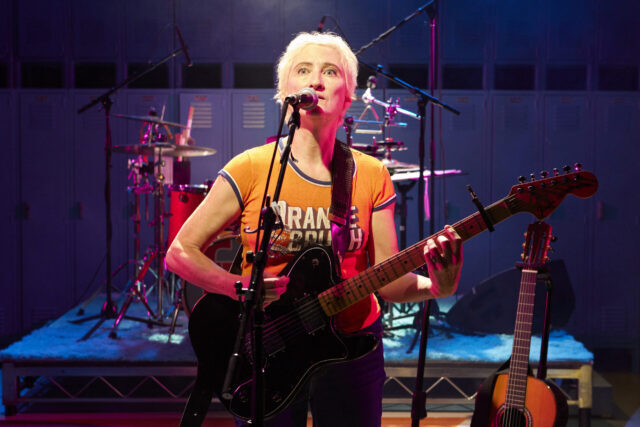
Jade Anouka shares her personal story in Heart (photo by Trévon James 2022)
HEART
Audible Theater’s Minetta Lane Theatre
18 Minetta Lane between Sixth Ave. and MacDougal St.
Wednesday – Sunday through August 14, $30-$67 www.audible.com/ep/minettalane hearttheplay.com
British poet and performer Jade Anouka establishes the parameters of her world premiere one-person show, Heart, from the very beginning, in an explanatory prologue. Standing front and center onstage, she tells the audience at Audible’s Minetta Lane Theatre, “This story was written by a black woman. / But this story has no mention of blackness. / This story is being performed by a black woman. / The fact that she is black / And a woman / Is political enough / And she already takes up much of her life talking about it. / About being black / And how it feels to be a woman. / So this is a just a story / Told by a black woman. / This is not a black story / Or a woman story / This is perhaps a story / For all the misfits, all those who have ever felt ‘other.’”
For the next seventy minutes, through six scenes plus an interlude and an epilogue, Anouka, a self-declared hopeless romantic who was born in London in 1990, shares her deeply intimate tale of her search for who she is, seeking personal and professional success. “I invite you to feel / Feel the rhythms / Of your own heartbeat / As I tell you a story / My story,” she says.
In spoken-word verse that ranges from furious rap to Shakespearean metre, Anouka — who, at the age of only thirty-one, has already appeared in nine works by the Bard, in addition to starring in such British series as Cleaning Up and Turn Up Charlie and portraying witch Ruta Skadi in His Dark Materials — leads us through a failed marriage; being misunderstood by her Bible-thumping Trinidadian mother and Jamaican father; a booze-and-drugs-fueled sexual rampage; using running to escape her issues; and jumping into a surprising new relationship.
Along the way, she offers no apologies for the choices she makes, concentrating on small instances that help define her emotional and psychological journey, like the tender interlocking of fingers. But ever-present is what she calls “the beast,” which she first saw in her husband but now believes is inside her. “I know he’s got a dark side / But sure haven’t we all,” she notes, later admitting, worried about her own mental health, “Precious moments of stillness / Of breath, of noticing / My beast / Realising / My beast.”
Anouka is haunted by thoughts of inadequacy, as a daughter, an actor, and a partner. “Unfortunately / I’m stuck with me / Trying to be / The best version / Of me I can be / But inadequacy / Pulls me inside of me / Can’t see the strengths / Only focus on the bad of me . . . It’s my beast you see / It’s taunting me,” she confesses in a way we can all relate to.
When she falls hard for someone, she attempts to break free of the beast and find joy in a new relationship, opining, “I so wish I was bolder / So wish I was braver / I so wish you could be proud of me / So wish you could love me / So wish you could trust me / So wish you knew just what I do / That I’d shout from the rooftops / And sing from the rafters / I love you I love you I love you! / But I can’t do that / I’m scared to do that.” But this time she’s determined to make things work.
Anouka is no stranger to solo performances. She turned her 2015 poem “Winning,” from her poetry collection Eggs on Toast, into a spirited video and won a Stage Award for Acting Excellence at the 2014 Edinburgh Fringe Festival for Sabrina Mahfouz’s one-person show, Chef. Although the narrative sometimes lapses into the mundane, the staging picks it up, occasionally literally. Heart is gorgeously directed by Ola Ince (The Convert,Poet in da Corner), with a wonderfully transcendent set by Obie winner Arnulfo Maldonado.
Jade Anouka rises high in world premiere one-person show (photo by Trévon James 2022)
Anouka, in a colorful costume by Emily Rebholz, interacts with several rows of fabric hanging from the ceiling alongside narrow, vertical neon bulbs, their hues changing with Anouka’s emotions courtesy of Obie winner Jen Schriever’s majestic lighting. Early on, a swing drops down from above like a gift from heaven, offering Anouka a brief respite of childhood innocence. Later, she climbs atop a tall chair that nearly reaches the rafters, evoking both a lifeguard station and a high chair for infants. The engaging movement choreography is by Annie-Lunnette Deakin-Foster. Tony winner Fitz Patton’s sound design (with original music by Renell Shaw and Patton) serves a key role from the outset, starting with a low drone that murmurs through the theater as the audience enters.
Audible specializes in presenting short runs of one-person shows (with some exceptions, as with the recent truncated, controversial adaptation of Eugene O’Neill’s Long Day’s Journey into Night) that are available as audiobooks. Previous productions include Faith Salie’s Approval Junkie, Lili Taylor in Wallace Shawn’s The Fever, Carey Mulligan in Dennis Kelly’s Girls & Boys, and Billy Crudup in David Cale’s Harry Clarke.
Heart is so dependent on the compelling staging and Anouka’s connection with the theatergoers — she tries to make eye contact with every audience member, never just looking into space — that I can’t imagine simply listening to it through earphones or in the car without those visuals. So get yourselves over to the Minetta Lane to see it in person as soon as you can; your heart will thank you.
[Note: The August 10 performance will be followed by a talkback with Anouka and playwright Dave Harris (Exception to the Rule,Tambo & Bones).]
With New York City sweltering in a muggy, sweat-drenching summer with temps that have stayed in the nineties, Metrograph offers two things to cool you off that usually don’t go together: air-conditioning and swimming. But that’s just what their new series, “Pool Party,” does, consisting of seven films in which characters go for a dip, for good and for bad.
The series kicks off with François Ozon’s beguiling mystery Swimming Pool, in which Charlotte Rampling shows Ludivine Sagnier that she still has it, followed by Jacques Deray’s 1969 erotic thriller La Piscine, in which Jane Birkin shakes things up between Alain Delon and Romy Schneider. Burt Lancaster swims home through suburban backyard pools in Frank Perry’s 1968 adaptation of John Cheever’s 1964 short story “The Swimmer.” Selena Gomez and friends take a wild road trip in Harmony Korine’s 2012 Spring Breakers, meeting up with a metallic-smiling James Franco. Elsie Fisher finds more trouble than she bargained for as a middle school vlogger in Bo Burnham’s bittersweet debut, Eighth Grade. British artist David Hockney makes a big splash in Jack Hazan’s 1974 hybrid docudrama, A Bigger Splash. And Lucretia Martel traces the fall of a bourgeois family in her 2001 debut, La Ciénaga. Below is a deeper dive into two of the films; get those bathing suits on and jump in to beat the heat!
Jealousy and envy are at the heart of François Ozon’s sexy thriller
Charlotte Rampling is divine in Swimming Pool, François Ozon’s playfully creepy mystery about a popular British crime novelist taking a break from the big city (London) to recapture her muse at her publisher’s French villa, only to be interrupted by the publisher’s hot-to-trot teenage daughter. Rampling stars as Sarah Morton, a fiftysomething novelist who is jealous of the attention being poured on young writer Terry Long (Sebastian Harcombe) by her longtime publisher, John Bosload (Game of Thrones’s Charles Dance). John sends Sarah off to his elegant country house, where she sets out to complete her next Inspector Dorwell novel in peace and quiet. But the prim and proper — and rather bitter and cynical — Sarah quickly has her working vacation intruded upon by Julie (Ludivine Sagnier), John’s teenage daughter, who likes walking around topless and living life to the fullest, clearly enjoying how Sarah looks at her and judges her. “You’re just a frustrated English writer who writes about dirty things but never does them,” Julie says, and soon Sarah is reevaluating the choices she’s made in her own life. Rampling, who mixes sexuality with a heart-wrenching vulnerability like no other actress (see The Night Porter,The Verdict, and Heading South), more than holds her own as the primpy old maid in the shadow of a young beauty, even tossing in some of nudity to show that she still has it. (Rampling also posed nude in her sixties in a series of photographs by Juergen Teller alongside twentysomething model Raquel Zimmerman, so such “competition” is nothing to her.)
Julie (Ludivine Sagnier) and Sarah (Charlotte Rampling) come to a kind of understanding in François Ozon’s Swimming Pool
Rampling has really found her groove working with Ozon, having appeared in five of his films, highlighted by a devastating performance in Under the Sand as a wife dealing with the sudden disappearance of her husband. Sagnier, who has also starred in Ozon’s Water Drops on Burning Rocks and 8 Women, is a delight to watch, especially as things turn dark. Swimming Pool is very much about duality; the film opens with a shot of the shimmering Thames river while the title comes onscreen and Philippe Rombi’s score of mystery and danger plays, and later Sarah says, “I absolutely loathe swimming pools,” to which Julie responds, “Pools are boring; there’s no excitement, no feeling of infinity. It’s just a big bathtub.” (“It’s more like a cesspool of living bacteria,” Sarah adds.) Ozon (Time to Leave, Criminal Lovers) explores most of the seven deadly sins as Sarah and Julie get to know each other all too well.
David Hockney works on his masterpiece in Jack Hazan’s A Bigger Splash
A BIGGER SPLASH (Jack Hazan, 1974)
Saturday, August 6, 2:30
Sunday, August 7, 5:00
Saturday, August 13, 7:15 metrograph.com
Coinciding with Pride celebrations throughout New York City in honor of the fiftieth anniversary of the Stonewall riots in June 2019, Metrograph premiered a 4K restoration of Jack Hazan’s pivotal 1974 A Bigger Splash, a fiction-nonfiction hybrid that was a breakthrough work for its depiction of gay culture as well as its inside look at the fashionable and chic Los Angeles art scene of the early 1970s. In November 2018, David Hockney’s Portrait of an Artist (Pool with Two Figures) sold at auction for $90.3 million, the most ever paid for a work by a living artist. A Bigger Splash, named after another of Hockney’s paintings — both are part of a series of canvases set around pools in ritzy Los Angeles — takes place over three years, as the British artist, based in California at the time, hangs out with friends, checks out a fashion show, prepares for a gallery exhibition, and works on Portrait of an Artist (Pool with Two Figures) in the wake of a painful breakup with his boyfriend, model, and muse, Peter Schlesinger, who is a key figure in the painting.
It’s often hard to know which scenes are pure documentary and which are staged for the camera as Hazan and his then-parter, David Mingay, who served as director of photography, tag along with Hockney, who rides around in his small, dirty BMW, meeting up with textile designer Celia Birtwell, fashion designer Ossie Clark, curator Henry Geldzahler, gallerist John Kasmin, artist Patrick Procktor, and others, who are identified only at the beginning, in black-and-white sketches during the opening credits. The film features copious amounts of male nudity, including a long sex scene between two men, a group of beautiful boys diving into a pool in a fantasy sequence, and Hockney disrobing and taking a shower. Hockney’s assistant, Mo McDermott, contributes occasional voice-overs; he also poses as the man standing on the deck in Portrait of an Artist (Pool with Two Figures), only to be replaced by Schlesinger later. There are several surreal moments involving Hockney’s work: He cuts up one painting; Geldzahler gazes long and hard at himself in the double portrait of him and Christopher Scott; and Hockney tries to light the cigarette Procktor is holding in a painting as Procktor watches, cigarette in hand, mimicking his pose on canvas. At one point Hockney is photographing Schlesinger in Kensington Gardens, reminiscent of Michelangelo Antonioni’s Blow-Up, which questions the very nature of capturing reality on film.
Hockney was so upset when he first saw A Bigger Splash, which Hazan made for about twenty thousand dollars, that he offered to buy it back from Hazan in order to destroy it; Hazan refused, and Hockney went into a deep depression. His friends ultimately convinced him that it was a worthwhile movie and he eventually accepted it. It’s a one-of-a-kind film, a wild journey that goes far beyond the creative process as an artist makes his masterpiece. Hockney, who turned eighty-five last month, has been on quite a roll of late. He was the subject of a 2016 documentary by Randall Wright, was widely hailed for his 2018 Met retrospective, and had a major drawing show at the Morgan Library in 2020-21. In addition, Catherine Cusset’s novel, Life of David Hockney, was published in English in 2019, a fictionalized tale that conceptually recalls A Bigger Splash.
Amir (Amir Arison) reads a story to Hassan (Eric Sirakian) in The Kite Runner (photo by Joan Marcus)
THE KITE RUNNER
Hayes Theater
240 West 44th St.
Tuesday – Sunday through October 30, $69-$199 thekiterunnerbroadway.com
The third time is not a charm for The Kite Runner.
Khaled Hosseini’s bestselling 2003 debut novel sold more than seven million copies in the United States. Director Marc Foster and screenwriter David Benioff’s 2007 film version was nominated for two Golden Globes, including Best Foreign Language Film, and for a Best Original Score Oscar. But Matthew Spangler’s 2009 theatrical adaptation, which opened July 21 at the Hayes Theater on Broadway, fails to live up to the promise of its forebears, rarely taking flight.
The play begins in San Francisco in 2001, with Amir (Amir Arison) explaining to the audience, “I became what I am today at the age of twelve. I remember the precise moment, crouching behind a mud wall on a frigid winter day in 1975 . . . peeking into a deserted alley. It’s wrong what they say about the past, about how you can bury it, because the past claws its way out.” For more than two and a half hours (plus intermission), Amir serves as both narrator and character, portraying himself from an Afghan child in 1973 to an adult in California. The story is told in scenes that are treated like individual set pieces that often merely depict what Amir has already described instead of offering more; when he is not in the scene itself, he is an observer, not taking action, which becomes the core of the plot.
The young Amir lives in Kabul with his father, Baba (Faran Tahir), a proud, moralistic, successful merchant; Amir’s mother died in childbirth, and he hasn’t remarried. Baba’s longtime devoted servant, Ali (Evan Zes), stays in a shack on the estate with his young son, Hassan (Eric Sirakian), who spends most of his time playing with Amir; Ali’s wife ran off with a troupe of actors and musicians years before. Amir and Hassan can’t necessarily be called friends because as Sunni Muslims and members of the Pashtun ethnic group, Amir and Baba are of higher status than Ali and Hassan, who are ethnic Hazaras and Shi’a.
Hassan loves listening to Amir reading stories to him, primarily from Ferdowsi’s tenth-century Persian epic poem Shahnamah; Amir wants to become a poet himself, which angers his father, who wants a tough, athletic son who can defend himself against bullies. “Real men don’t read poetry, and they certainly don’t write it! Real men play soccer, just like I did when I was your age!” Baba bellows. Baba tells his business partner, Ramir Khan (Dariush Kashani), “A boy who won’t stand up for himself becomes a man who can’t stand up to anything.”
Amir is determined to win the annual winter kite-fighting tournament, in which contestants try to cut the lines of everyone else’s kites, then have their runner track down the final fallen kite. Amir is one of the best kite cutters, but Hassan, who is devoted to Amir, is considered the greatest kite runner around. At the end of the competition, Hassan, in possession of the last kite, is confronted by neighborhood bully Assef (Amir Malaklou) and his cohorts, Wali (Danish Farooqui) and Kamal (Beejan Land). Ali demands that Hassan hand over the kite, but the young boy refuses, determined to bring it to Amir no matter the cost. As Assef commits a horrific act against Hassan, Amir watches, doing nothing, then runs away. “I ran as fast as I could. I ran all the way home,” the older Amir remembers sadly.
Baba (Faran Tahir) offers advice to his son (Amir Arison) in Broadway debut of The Kite Runner (photo by Joan Marcus)
The event, which the two boys never talk about, leads Amir to manufacture an estrangement; Ali and Hassan leave the estate, much to Baba’s displeasure. In 1978, Baba and Amir sacrifice everything following the Soviet invasion, first escaping to a refugee camp in Pakistan, then starting all over in San Francisco. In 1984, Amir and Baba are selling junk at a flea market in San Jose when Amir meets Soraya (Azita Ghanizada), the daughter of General Taheri (Houshang Touzie), who has also been reduced to selling random wares at the market. Amir and Soraya fall in love, but he is still haunted by how he treated Hassan. When Ramir discloses what has become of Ali and Hassan, Amir is determined to right the wrongs of his past, even if it means risking his life.
The Kite Runner is laden with the shame Amir is burdened with, and its heaviness weighs down the show. Too many of the scenes are extraneous or go on for too long; for example, a wedding might introduce us to certain aspects of Afghan culture, but it adds little to the narrative. The first act does a decent job of setting up what is to come, but the second act is an avalanche of incredulity and melodramatic coincidence that quickly grow tedious.
Spangler (Albatross,Operation Ajax), who has also adapted T. C. Boyle’s The Tortilla Curtain, Mary Manning and Sinead O’Brien’s Striking Back: The Untold Story of an Anti-Apartheid Striker, and Hanan al-Shaykh’s The Story of Zahra, among other books, tries to include too much of the novel, so the plot meanders, getting stuck in the trees till it finally comes crashing to the ground. Director Giles Croft (Tony’s Last Tape,The Understudy) is unable to untangle the tale, which takes place on Barney George’s spare stage, anchored by an uneven wooden picket fence in the back on which William Simpson projects images.
Throughout most of the show, Salar Nader plays the tabla, sitting at the sides of the stage, adding to the Central Asian mood. Arison (The Blacklist,Aftermath) has difficulty navigating the time jumps as the unreliable narrator, delivering important facts at too slow a pace. Tahir, who recently played Othello and Richard III, brings a Shakespearean majesty to Baba, while Touzie (The Tibetan Book of the Dead,From Satellite with Love) is strong as the once-powerful general and Sirakian (The Jungle,Pericles) is more effective than Arison in portraying a child.
Spangler and Croft touch on key issues, from bigotry and immigration to bullying and the Taliban, but they feel less central to the plot than they did in the book, even in the wake of the controversial US pullout from Afghanistan in 2001; the name of the play refers to Hassan, but it is all about Amir, an unsympathetic character who is difficult to stick with in this disappointing adaptation.
Cristina Iglesias’s Landscape and Memory consists of five bronze pools flowing along the Oval Lawn in Madison Square Park (photo by twi-ny/mdr)
Who:Cynthia Daignault What:Free art talk in conjunction with Cristina Iglesias’s Landscape and Memory Where: Oval Lawn, Madison Square Park When: Wednesday, August 3, free, 6:00 Why: Mad. Sq. Art concludes its free summer talk series with American painter Cynthia Daignault discussing monuments, memory, and the natural world as it relates to her work and Spanish artist Cristina Iglesias’s Landscape and Memory, which is on view in the park through December 4. Daignault’s canvases feature lush mountain valleys, black-and-white trees, words barely visible on black backgrounds, objects such as skulls and food, and figures such as JFK, Marilyn Monroe, Barack Obama, Malcolm X, and Divine. Iglesias’s public interventions include water-based works in England, Spain, Mexico, Brazil, Belgium, and Norway in addition to gates and passages, entwined murals, rooms and mazes, screens, suspended pavilions, and other conceptual and architectural projects. On August 3 at 6:00, Daignault will be on the oval lawn in Madison Square Park to share her thoughts on Iglesias’s captivating piece, a stream that winds through the grass in five bronze sculptural pools, referencing Cedar Creek and Minetta Brook, which once upon a time flowed across the park, heading for the East or Hudson River.
Each pool offers its own calming respite, with water gently babbling against rocks. “I started being interested in the use of water as an element of movement and change in this culture and also in the city, a way to show how nothing if we look carefully is always the same,” Iglesias explained in a 2021 virtual discussion for Whitechapel Gallery. “And I think water somehow makes that more visible.” It’s as if Iglesias, the daughter of a scientist, has uncovered a slice of the geographic history of Madison Square Park, now bubbling to the surface. (The park has also been home to a potter’s field, a parade ground / arsenal, and a reform school.) The title pays tribute to Simon Schama’s 1995 treatise Landscape and Memory, which explores the Western world’s interaction with nature. “Landscapes are culture before they are nature; constructs of the imagination projected onto wood and water and rock,” Schama writes. “Once a certain idea of landscape, a myth, a vision, establishes itself in an actual place, it has a peculiar way of muddling categories, of making metaphors more real than their referents; of becoming, in fact, part of the scenery.” Following the informal talk, the public is invited to continue the dialogue directly with Daignault.
Nicholas Barasch sparkles as Francie Brady in world premiere musical at the Irish Rep (photo by Carol Rosegg)
THE BUTCHER BOY
Irish Repertory Theatre, Francis J. Greenburger Mainstage
132 West 22nd St. between Sixth & Seventh Aves.
Wednesday – Sunday through September 11, $50-$70
212-727-2737 irishrep.org
Five years ago, high school senior Asher Muldoon came to the Irish Rep with a musical adaptation of Patrick McCabe’s award-winning 1992 novel, The Butcher Boy, about thirteen-year-old Francie Brady (Nicholas Barasch), a red-haired lad on a destructive path to do some very bad things in the village of Clones in County Monaghan in the mid-1960s. Shortlisted for the Booker Prize, the novel was turned into a well-received 1997 dark comedy by Neil Jordan starring Stephen Rea, Fiona Shaw, Brendan Gleeson, Milo O’Shea, and Sinéad O’Connor. Muldoon’s show opened last night at the Irish Rep, the first new musical developed by the company in eight years. Unfortunately, it could use some slicing and dicing; while the narrative parts work well, the musical numbers don’t bring home the bacon.
Nicholas Barasch is terrific as Francie Brady, a neighborhood bully from a dysfunctional family; he narrates the story in a series of flashbacks, disconcertingly oblivious to the full weight of his actions. “When I was a young lad twenty or thirty or forty years ago I lived in a small town where they were all after me on account of what I done on Missus Nugent,” he says at the beginning. “Now, it started with Joe and me out at the hide we had built. ‘Death to all dogs who enter here!’ we said. Except us of course.”
Francie’s mother, Annie (Andrea Lynn Green), suffers from severe depression, and his father, Ben (Scott Stangland), is a nasty alcoholic and failed trumpet player. Francie’s uncle, Alo (Joe Cassidy), his father’s brother, left his girlfriend, Mary (Kerry Conte), without saying goodbye, to try his luck in London. He comes to a party as a conquering hero until the two siblings have a bit of a contentious row.
Francie hangs around with his best friend, Joe Purcell (Christian Strange), fishing; seeking to create mayhem; doing whatever he can to obtain his favorite candy, Flash Bars; and bullying Phillip (Daniel Marconi), Mrs. Nugent’s (Michele Ragusa) nerdy son, stealing his treasured comic books. “Oh, if we lived like this forever we’d be fine / So why can’t we live like this forever?” Francie and Joe sing.
Upset at Francie’s treatment of Phillip, Mrs. Nugent visits Mrs. Brady and complains, “I’ll tell you something, Annie, it’s no wonder your boy is such a mean little runt. His father lying round in bars morning to midnight, a disgrace to the family, to the whole town, he’s no better than a pig. A PIG.” Francie, as narrator, tells the audience, “She didn’t know what she was doing then, Mrs. Nugent.” Mrs. Nugent then adds, “Pigs! Sure the whole town knows it. PIGS!!!”
Four pigs spur Francie Brady (Nicholas Barasch) to do bad things in The Butcher Boy (photo by Carol Rosegg)
The “pigs” comments get to Francie, who does not want to be seen as inferior to anyone. He soon finds himself accompanied by four imaginary pigs (Teddy Trice, Carey Rebecca Brown, Polly McKie, and David Baida), a quartet of adults wearing pig masks and goading him on. “Well, I’ll be damned if I let all those piggies take what’s mine / This town ain’t big enough for both of us, you filthy swine / Let’s open up an abattoir and / Drain their blood for boudin noir / Save room for sausage,” one of the pigs sings. The four then chime in together, “Cause those big fat piggies have too much to say / Show em we’re not afraid to go to war / Unless those pigs grow piggy wings and fly away / Within a day or two you won’t know who is you and who is piggy.”
Francie runs away to Dublin (using the elegant pseudonym Algernon Carruthers), believing, “We can all just stay together / And I know that we’ll be fine / And the world will be back where the world is supposed to be,” but he winds up back in Clones with his family, gets a job working for Mr. Leddy (Baida) the butcher (“I’m used to seeing pigs,” Francie says), and has to redefine his place in a community where everyone seems to have grown up around him but he has stayed the same. It doesn’t go well.
Directed by Irish Rep cofounder Ciarán O’Reilly (Autumn Royal,The Emperor Jones), The Butcher Boy is an intense look into the mind of a troubled teen whose dark fantasies lure him away from reality. The show begins on Charlie Corcoran’s superb set, a kind of confined hideout with wooden slats at the right and left side covered in colorful comic-book regalia and a large, old-fashioned black-and-white television screen in the back, where Francie watches The Lone Ranger,Captain Z-Ro, and The Twilight Zone, including clips from the famous TZ episode “It’s a Good Life,” in which Bill Mumy portrays a young boy with special powers that allow him to control every part of life — and death — in a small town (“You’re a bad man! You’re a very bad man!”). During intermission, the classic “Eye of the Beholder” episode is shown, in which Rod Serling asks, “What kind of world where ugliness is the norm and beauty the deviation from that norm?” The pig masks are reminiscent of two TZ episodes, but the musical overdoes the comparisons by having Phillip morph into Serling during an otherwise harrowing scene.
There are also references to John F. Kennedy, America’s first Irish-Catholic president, who was almost brought down by the Bay of Pigs invasion, and three iterations of women named Mary, all played by Conte, a clever melding of the Virgin Mary and Mary Magdalene, a trio of characters who intrigue Francie.
Francie’s descent into mental illness is both heartbreaking and frightening, particularly as the United States is involved in a wide-ranging discussion about mental health, especially as it relates to disturbed young white males who are prone to mass shootings. Barasch (Hadestown,She Loves Me) walks the fine line of Francie’s sanity with an infectious charm even though we know that things are going to get bloody at any moment; his smile, and bright red hair, lights up the room.
However, the musical numbers (“Big Fat Piggies!,” “My Lovelies,” “Francie Gets Mad,” “Don’t Forget About Me”), featuring limited, tongue-in-cheek choreography by Barry McNabb, actually detract from the story; they feel tacked on, like garnish, merely extending the show to a too-long two hours and twenty minutes (with intermission). I found myself rooting for them to end, like television commercials, so I could get back to the regularly scheduled program, which I was otherwise immersed in, enjoying thoroughly.
Muldoon, who is currently an undergrad at Princeton, wrote the book, music, and lyrics; the score is performed by the Slaughterhouse Five, consisting of conductor and musical director David Hancock Turner on keyboards, Danielle Giulini on violin, Joseph Wallace on bass, Martha Hyde on reeds, and Mike Rosengarten on guitar and banjo, playing behind the television screen, only occasionally visible.
The Butcher Boy could have used some more tenderizing and trimming before being served, as it has the promise of being one delicious meal where audiences wouldn’t mind making pigs of themselves.
Maggie (Sonoya Mizuno) and Brick (Matt de Rogatis) have different plans for the future in Tennessee Williams classic (photo by Miles Skalli)
CAT ON A HOT TIN ROOF
Theatre at St. Clement’s
423 West Forty-Sixth St. between Ninth & Tenth Aves.
Wednesday – Monday through August 14, $39-$125 www.ruthstage.org
When I was on the high school tennis team, the coach, Mr. Spector, taught me to avoid getting caught in “no man’s land,” the midcourt area in between the service box and the baseline where it is most difficult to return volleys because the ball can come right at your feet or at your head, which forces you to awkwardly play the ball. Mr. Spector was also my tenth-grade English teacher. Although I don’t recall any classes on Mississippi-born playwright Tennessee Williams that year, I thought of Mr. Spector after watching Ruth Stage’s adaptation of Cat on a Hot Tin Roof, continuing at Theatre at St. Clement’s through August 14.
In October 2019, the troupe presented an alternate take on The Glass Menagerie at the Wild Project, directed by Austin Pendleton and Peter Bloch and starring Ginger Grace as Amanda Wingfield, company creative director Matt de Rogatis as Tom, Alexandra Rose as Laura, and Spencer Scott as the Gentleman Caller. Ruth Stage, with much of that same team, is now following that up with a unique version of Cat, the first-ever off-Broadway production approved by the Williams estate of the three-act 1955 Pulitzer Prize winner. Unfortunately, it spends too much of its 165 minutes (with an intermission and a pause) caught in a theatrical no man’s land.
Director Joe Rosario (Flowers for Algernon,The Exhibition) moves the time to the present, on a summer day when a family on a twenty-eight-thousand-acre cotton plantation is getting ready to celebrate patriarch Big Daddy Pollitt’s (Christian Jules Le Blanc) sixty-fifth birthday. The action takes place in the bedroom of Big Daddy’s ne’er-do-well son, Brick (de Rogatis), and his wife, Margaret (Sonoya Mizuno), aka Maggie the Cat. Following the death of his very close friend Skipper, Brick has become a drunk, refusing to sleep with Maggie, who wants to have a baby. The night before, trying to relive his high school glory days, Brick, heavily intoxicated, busted his ankle jumping hurdles and so he’s moving around in pain using a metal crutch and wearing a boot.
In the next room are Brick’s brother, Gooper (Scott), a lawyer who has been helping manage the estate, and his catty wife, Mae (Tiffan Borelli), who is pregnant with their sixth child. Two of their kids, Trixie and Dixie (Rose and Carly Gold), wander around the mansion in their own world; Maggie refers to them as the no-neck monsters. A report from Doc Baugh (Pendleton) reveals that Big Daddy is dying of cancer, setting in motion a battle for his money and control of the plantation. They have all chosen not to tell Big Daddy or Big Mama (Alison Fraser) about the terminal illness; instead, they are told that he has a spastic colon. As the evening goes on, the family dysfunction ratchets up with pointed hostilities emanating from just about everyone except Rev. Tooker (Milton Elliott), who is in over his head with the Pollitts.
Big Daddy’s (Christian Jules Le Blanc) birthday party goes awry in Cat on a Hot Tin Roof (photo by Miles Skalli)
Despite admirable qualities, this Cat is stuck in no man’s land from the very start. The play opens with the heavily tattooed Brick taking a shower behind the bar while Maggie applies makeup at her vanity. They are both superhot, eye candy no matter your orientation, but they lack the fiery chemistry demanded for their failing relationship. While de Rogatis does a lot of grunting — alcohol does not seem to lessen Brick’s constant pain, at least part of which is psychological — Mizuno speaks softly, sometimes in a whisper that is hard to hear. When Maggie says about Gooper and Mae, “Of course it’s comical but it’s also disgusting since it’s so obvious what they’re up to!” Brick responds, “What are they up to, Maggie?,” which is the audience’s response as well, because not everything Mizuno just said was clear.
In fact, all of the actors speak at different levels throughout; combined with their seemingly random costumes and shifting accents, it’s like they’re all in separate versions of the play, each in their own no man’s land. Even the set itself is hard to figure out; while there is a door to the bedroom that Big Mama never wants to be locked, there are also two empty white doorframes that lead to a back veranda that anyone can use to enter the room whenever they want.
The nods to the present day are confusing and seemingly random as well. There’s a loud cordless phone in the room that rings a few times, which at first sounds like an audience member’s phone going off. During the party, Gooper pulls out a cell phone to take a family photo, but that’s the only appearance of such a device.
One of the no-neck monsters wears bulky headphones instead of earbuds, listening to contemporary pop tunes. Brick might believe he is deserving of his hurting ankle, but there is no talk of any kind of painkillers that could help him. Even though Big Daddy is worth more than one hundred million dollars, there is no discussion of second opinions or getting the best doctors in the world to treat him. Along similar lines, no one mentions to Brick and Maggie that they could try alternative methods of getting pregnant, including IVF.
One of the toughest problems facing many twenty-first-century productions of Williams is how to make the homophobia that drives so much of the action and so many of his characters understandable to a modern audience. The fear and shame that hover over the Pollitts because of what occurred between Brick and Skipper feels out of date, especially because the family does not seem to be bigoted. While homosexuality was certainly a controversial issue in the 1950s (and remains so today, though not nearly as hidden), it would not be handled with the same language or emphasis in 2022. And for a bonus contemporizing effect, there are a bunch of F-bombs dropped like the fireworks that later explode in the night sky over a projection beyond the veranda.
Le Blanc, who has won three Daytime Emmys for his portrayal of Michael Baldwin on The Young and the Restless, a role he has played for more than thirty years, stands out among the cast as a trimmed-down, bushy-haired Big Daddy. He speaks with bold authority, his accent consistent, his words artistically enunciated; when he’s onstage, you can’t take your eyes off him. He’s the only one Mr. Spector wouldn’t have to shout at to get out of that treacherous no man’s land.