featured

THE CHOSEN COMEDY FESTIVAL: A BENEFIT FOR THE UKRAINIAN EMERGENCY PERFORMING ARTS FUND

Who: Jeff Ross, Jessica Kirson, Alex Edelman, Jared Fried, Leah Forster, Gary Guz, T. J. Miller, Eric Tabach, Zarna Garg, Yohay Sponder, Ofer Shechter, Nissim Black, Kosha Dillz, Moshe Reuven, Laivy, Elon Gold, Modi
What: The Chosen Comedy Festival
Where: Coney Island Amphitheater, boardwalk at West Twenty-First St.
When: Tuesday, August 16, $36-$500, doors at 6:30 (festival begins August 12)
Why: So a bunch of Jews walk onto a beach . . . There are a lot of directions for that joke to take, but in fact it’s the setup for a special show at the Coney Island Amphitheater on August 16 as part of Stand Up NY’s inaugural Chosen Comedy Festival. The festival began August 12 at Stand Up NY on the Upper West Side and continues August 13 at 8:00 ($25) with Lauren Hope Krass, Raanan Hershberg, Tom Thakkar, Nicky Paris, Kosha Dillz, and Gianmarco Soresi, followed by a 10:00 showcase ($15) with Jonathan Randall, Nathan MacIntosh, Kosha Dillz, Pat Brown, Danny Polishchuk, and Dante Nero. On Monday night, August 15, at 8:00 ($25), Elon Gold and friends will celebrate with a “Kick Off Party” at Stand Up NY.

The main event, however, is in Coney Island on Tuesday night, a benefit for the Ukrainian Emergency Performing Arts Fund, an organization that “supports independent scene performing artists staying in Ukraine during the time of war.” Hosted by Gold and Modi, the show boasts comedy and music by an all-star lineup that includes Jeff Ross, Jessica Kirson, Alex Edelman, Jared Fried, Leah Forster, Gary Guz, T. J. Miller, Eric Tabach, Zarna Garg, Yohay Sponder, Ofer Shechter, Nissim Black, Kosha Dillz, Moshe Reuven, and Laivy. During the pandemic lockdown, Stand Up NY put on more than five hundred comedy shows in city parks; now they’re heading for the sun and sand to raise money for an important cause that is not very funny.

HARLEM WEEK: A GREAT DAY IN HARLEM AND MORE

Who: Uptown Dance Academy, Unveiled Unlocked, IMPACT Repertory Theatre, Mama Foundation’s Sing Harlem! Choir, the Isn’t Her Grace Amazing! Choir, Lord Nelson, Shemar Levy, Lorenzo Laroc, the Bengsons, Kenny Lattimore, Ray Chew & the Harlem Music Festival All-Star Band
What: Annual Harlem Week celebration
Where: U.S. Grant National Memorial Park, West 122nd St. at Riverside Dr.
When: Sunday, August 14, free, noon – 7:00 pm
Why: One of the centerpieces of Harlem Week is “A Great Day in Harlem,” which takes place Sunday, August 14, as part of the opening weekend of this ten-day summer festival. There will be an international village with booths selling food, clothing, jewelry, and more, as well as live music and dance divided into “Artz, Rootz & Rhythm,” “The Gospel Caravan,” and “the Concert Under the Stars.” Among the performers are the Uptown Dance Academy, Kenny Lattimore, Unveiled Unlocked, IMPACT Repertory Theatre, the Sing Harlem! Choir, the Isn’t Her Grace Amazing! Choir, and electric violinist and composer Lorenzo Laroc. In addition, the Bengsons will play songs from their show Where the Mountains Meet the Sea; there will be a tribute to Tobago-born calypsonian Lord Nelson, with Shemar Levy and Nelson himself; and Marvin Gaye’s What’s Going On album will be honored by Ray Chew & the Harlem Music Festival All-Star Band.

Harlem Week runs August 12-21 with such other events as the Percy Sutton 5K and 1.5-mile Harlem Health Walk (August 13, 8:00 am), Great Jazz on the Great Hill in Central Park with the Jimmy Heath Legacy Band, the Antonio Hart Quartet, and Tammy McCann (August 13, 4:00), the livestreamed Charles B Rangel Systemic Racism Summit (August 16, noon), the ImageNation Outdoor Film Festival (Marcus Garvey Park, August 17, 6:00; St. Nicholas Park, August 20, 6:00), the livestreamed talk “Ta-Nehisi Coates and Dr. Julius Garvey: A Harlem on My Mind Conversation” (August 17, 7:30), the livestreamed Arts & Culture/Broadway Summit (August 18, 3:00), Harlem SummerStage (August 18, 5:30), Summer in the City with the Jeff Foxx Band, Donnell Jones, EPMD, Freddie Jackson, and others (August 20, 1:00), and the grand Harlem Day with Dru Hill, Slick Rick, Doug E Fresh, Levell, Grandmaster Caz & Melle Mel, MJ the Musical, and more. All events are free.

BATTERY DANCE FESTIVAL 2022

Battery Dance Company hosts annual festival August 13-20 (photo by Steven Pisano)

BATTERY DANCE FESTIVAL
Robert F. Wagner Jr. Park, Battery Park City
20 Battery Pl.
August 13-19, free with advance RSVP, 7:00
August 20, Schimmel Center at Pace University, $10-$75, 6:00
batterydance.org

The forty-first annual Battery Dance Festival is back fully in person this summer, with live presentations from three dozen companies from around the globe, including several New York City and world premieres. Free performances take place August 13-19 at 7:00 at Robert F. Wagner Jr. Park in Battery Park City and will be livestreamed as well; the festival concludes August 20 at 6:00 with a ticketed indoor closing celebration and VIP reception at the Schimmel Center at Pace University ($10 for performance, $75 for VIP with priority seating and preshow Prosecco toast). Dance enthusiasts will be able to check out multiple disciplines, from tap and classical ballet to circus and Afro-Brazilian, from the US, Canada, Romania, Singapore, Denmark, Spain, and elsewhere, with some programs featuring live music.

“Lady Liberty might be tempted to shimmy and shake as dance companies from near and far take the stage at Wagner Park once again this summer. Audiences will have a tough time deciding which performance to attend,” Battery Dance founder Jonathan Hollander said in a statement.

Below is the full schedule.

Saturday, August 13, 7:00
Sydney Burtis, The Difference
Zachary Seto, Nostalgic Beings of Synesthesia
Camryn & Courtney Spero, Distance
Kate Louissant, For Love
Lerato Ragontse, In Between Change
Anya Susan, In Conversation
Myles King, The Last Foundry
Shannon Harkins, Dreams and Nightmares of a Mutant People

Sunday, August 14, 7:00
The Dancing Wheels Company, Unconquered Warriors
Ballet Nepantla, Let Down & Huasteca Suite
Linotip, Diagonal and Cain
Gaudanse, Nanibu
Peridance Contemporary Dance Company, Just Above the Surface
The Vanaver Caracan, Vanaver Caravan retrospective

Monday, August 15: India Independence Day, 7:00
Anjali Dance Company, Nagendra Haraya, Pranavakaram, and Tillana
Siddendra Kuchipudi Dance Company, Naumisatam, Sringaralahari, Chandra Sherkaram, and Keedaragoula

Tuesday, August 16, 7:00
Christina Carminucci, The Solidarity Series IV: Free Spirits Suite
Linotip, Diagonal and Cain
Fairul Zahid & LaSalle Dance Singapore, Allocentric
Buglisi Dance Theatre, The Threads Project #1: “Universal Dialogues”
Boca Tuya / Omar Roman de Jesus, Los Perros del Barrio Colosal

Wednesday, August 17, 7:00
Xing Dance Theater, Citizen
Julienne Doko, Lost Memories (Mémoires Perdues)
Tati Nuñez, Touch — Returned
Dos Proposiciones Dance Theatre, Pacto de Fuga
Ntrinsik Movement, Kindred Spirit
Ballet Inc., Touche
Alison Chase/Performance, Tsu-Ku-Tsu

Thursday, August 18, 7:00
Demi Remick & Dancers, That’s Entertainment!
Floyd McLean Jr., Cold
Battery Dance, A Certain Mood
TeaTime Company, Stick-Stok
Fairul Zahid & LaSalle Dance Singapore, Allocentric
Tina Croll + Company, Balkan Bacchanal

Friday, August 19, 7:00
Dallas Black Dance Theatre, Face What’s Facing You!
Lanecoarts, Swerve
Dos Proposiciones Dance Theatre, Pacto de Fuga
I Kada Contemporary Dance Company, Unfolding
Battery Dance, Wind in the Olive Grove
Compagnie Virginie Brunelle, Les Corps Avalés

Saturday, August 20, Schimmel Center at Pace University, 6:00
Boca Tuya / Omar Roman de Jesus, Los Perros del Barrio Colosal
Battery Dance, Above Deep Waters
Julienne Doko, Lost Memories (Mémoires Perdues)
TeaTime Company, Stick-Stok
Dallas Black Dance Theatre, Face What’s Facing You!
Compagnie Virginie Brunelle, Les Corps Avalés

CONEY ISLAND SAND SCULPTING CONTEST 2022

Twenty-fifth annual Sand Sculpting Contest takes place in Coney Island on Saturday (photo by twi-ny/mdr)

Thirtieth annual Coney Island Sand Sculpting Contest should feature some wild creations on Saturday (photo by twi-ny/mdr)

CONEY ISLAND SAND SCULPTING CONTEST
Coney Island
Boardwalk between West Tenth & Twelfth Sts.
Saturday, August 13, free, noon – 5:00 pm
www.coneyisland.com
www.allianceforconeyisland.org

The twice-Covid-postponed thirtieth annual Coney Island Sand Sculpting Contest finally comes to the People’s Playground on August 13, as amateurs, semiprofessionals, and professionals will create masterpieces in the Brooklyn sand, many with a nautical theme. It’s a blast watching the constructions rise from nothing into some extremely elaborate works of temporary art. The event, which features cash prizes, is hosted by the Alliance for Coney Island and features four categories: Adult Group, Family, Individual, and People’s Choice. There are always a few architectural ringers who design sophisticated castles, along with a handful of gentlemen building, well, sexy mermaids. You can register as late as eleven o’clock Saturday to participate. While visiting Coney Island on August 13, you should also check out the Coney Island Museum, the Coney Island Circus Sideshow, Puppets Come Home!’s Body Slam, and the fully restored New York Aquarium in addition to riding the Cyclone and the Wonder Wheel.

MONTHLY CLASSICS: AFTER LIFE

AFTER LIFE

Guides interview the deceased in Hirokazu Kore-eda’s After Life

AFTER LIFE (WANDÂFURU RAIFU) (Hirokazu Kore-eda, 1998)
Japan Society
333 East 47th St. at First Ave.
Friday, August 12, $15, 7:00
www.japansociety.org

Japan Society’s Monthly Classics series continues on August 12 with Hirokazu Kore-eda’s second narrative feature, After Life, an eminently thoughtful film about two of his recurring themes: death and memory. Every Monday, the deceased arrive at a way station where they have three days to decide on a single memory they can bring with them into heaven. Once chosen, the memory is re-created on film, and the person goes on to the next step of their journey, to be replaced by a new batch of souls. The way station is staffed by guides, including Takashi Mochizuki (Arata), Shiori Satonaka (Erika Oda), and Satoru Kawashima (Susumu Terajima), whose job it is to interview the new arrivals and help them select a memory and then bring it to life on-screen. Some want to take with them an idyllic moment from childhood, others a remembrance of a lost love, but a few are either unable to or refuse to come up with one, which challenges the staff. Twenty-one-year-old Yūsuke Iseya declares, “I have no intention of choosing. None,” while seventy-year-old Ichiro Watanabe (Taketoshi Naito) is having difficulty deciding on the exact moment, reevaluating and reflecting on the life he led. As the week continues, the guides look back on their lives as well, sharing intimate details, one of which leads to an emotional finale.

AFTER LIFE

After Life explores life, death, memory, heaven, and the art of filmmaking

Kore-eda, who previously examined memory loss in the documentary Without Memory and explored a family’s reaction to death in the brilliant Still Walking, interviewed some five hundred people about what memory they would take with them to heaven, and some of those nonprofessional actors are in the final cut of After Life, blurring the lines between fiction and reality. After Life is also very much about the art of filmmaking itself, as each memory is turned into a short movie created on a set and watched in a screening room. In fact, the film was inspired by Kore-eda’s memories of his grandfather’s battle with what would later be identified as Alzheimer’s disease; the director has also cited Ernst Lubitsch’s 1943 comedy, Heaven Can Wait, as an influence, and the Japanese title, Wandâfuru raifu, means “Wonderful Life,” evoking Frank Capra’s holiday classic. But Kore-eda never gets maudlin about life or death in the film, instead painting a memorable portrait of human existence and those simple moments that make it all worthwhile — and will have viewers contemplating which memory they would take with them when the time comes.

SUMMER FOR THE CITY: BAAND TOGETHER DANCE FESTIVAL

Who: Ballet Hispánico, Alvin Ailey American Dance Theater, American Ballet Theatre, New York City Ballet, Dance Theatre of Harlem
What: Free dance festival
Where: Lincoln Center for the Performing Arts
When: August 9-13, free, 5:00 & 7:30
Why: Last summer, Lincoln Center presented the inaugural BAAND Together Dance Festival, consisting of five different programs by five of New York’s finest companies: Ballet Hispánico, Alvin Ailey American Dance Theater, American Ballet Theatre, New York City Ballet, and Dance Theatre of Harlem. In a joint statement for the second annual event, the five artistic directors explain, “Last year’s festival was a resounding success, proof that New York audiences are excited for their beloved dance companies to return to the stage. This year we will go beyond performing side by side and do so together, as a unified dance family, through an exciting new work by Annabelle Lopez Ochoa. This new work is a testament to our commitment for building new avenues of cultural innovation, dialogue, and accessibility for our incredible city.”

Banding together August 9-13, each troupe will host one daily workshop at 5:00 for all ages. Below is the complete schedule, with wide-ranging works by Alvin Ailey, Michelle Manzanales, George Balanchine, Ulysses Dove, Helen Pickett, Jessica Lang, Robert Battle, Pedro Ruiz, and Robert Garland.

Tuesday, August 9, 5:00
New York City Ballet Children’s Workshop

Tuesday, August 9, 7:30
One for All, world premiere by Annabelle Lopez Ochoa, with dancers from each of the five companies, set to “Manteca” by Funky Lowlives/Dizzy Gillespie
Alvin Ailey American Dance Theater: Cry, by Alvin Ailey, with music by Alice Coltrane, Laura Nyro, and Voices of East Harlem
Ballet Hispánico: Con Brazos Abiertos, by Michelle Manzanales, with music by Julio Iglesias and others
Dance Theatre of Harlem: When Love, by Helen Pickett
American Ballet Theatre: Children’s Songs Dance, by Jessica Lang, with music by Chick Corea

Ballet Hispánico’s Club Havana is part of free Lincoln Center festival (photo by Paula Lobo)

Wednesday, August 10, 5:00
Ballet Hispánico’s Latin Social Dance Workshop

Wednesday, August 10, 7:30
One for All, world premiere by Annabelle Lopez Ochoa, with dancers from each of the five companies, set to “Manteca” by Funky Lowlives/Dizzy Gillespie
Ballet Hispánico: Con Brazos Abiertos, by Michelle Manzanales, with music by Julio Iglesias and others
New York City Ballet: Red Angels, by Ulysses Dove, set to Richard Einhorn’s “Maxwell’s Demon”
American Ballet Theatre: Children’s Songs Dance, by Jessica Lang, set to music by Chick Corea
Alvin Ailey American Dance Theater: Love Stories finale, by Robert Battle, with music by Stevie Wonder
Dance Theatre of Harlem: Return, by Robert Garland, with music by James Brown and Aretha Franklin

Thursday, August 11, 5:00
Dancing with Ailey on the Plaza!

Thursday, August 11, 7:30
One for All, world premiere by Annabelle Lopez Ochoa, with dancers from each of the five companies, set to “Manteca” by Funky Lowlives/Dizzy Gillespie
Ballet Hispánico: Club Havana, by Pedro Ruiz
Alvin Ailey American Dance Theater and American Ballet Theatre: Pas de Duke, by Alvin Ailey, performed by Jacquelin Harris and Herman Cornejo, with music by Duke Ellington
New York City Ballet: Red Angels, by Ulysses Dove, set to Richard Einhorn’s “Maxwell’s Demon”
Dance Theatre of Harlem: When Love, by Helen Pickett
Alvin Ailey American Dance Theater, Love Stories finale, by Robert Battle, with music by Stevie Wonder

Dance Theatre of Harlem will present Return at BAAND Together (photo by Rachel Neville)

Friday, August 12, 5:00
Dancing in the Street with Dance Theatre of Harlem

Friday, August 12, 7:30
One for All, world premiere by Annabelle Lopez Ochoa, with dancers from each of the five companies, set to “Manteca” by Funky Lowlives/Dizzy Gillespie
Dance Theatre of Harlem: Return, by Robert Garland, with music by James Brown and Aretha Franklin
Alvin Ailey American Dance Theater: Cry, by Alvin Ailey, with music by Alice Coltrane, Laura Nyro, and Voices of East Harlem
New York City Ballet: Allegro Brillante, by George Balanchine, set to Tschaikovsky’s Piano Concerto No. 3
Alvin Ailey American Dance Theater and American Ballet Theatre: Pas de Duke, by Alvin Ailey, performed by Jacquelin Harris and Herman Cornejo, with music by Duke Ellington
Ballet Hispánico: Club Havana, by Pedro Ruiz

Saturday, August 13, 5:00
American Ballet Theatre: ABTKids Story Ballet Workshop

Saturday, August 13, 7:30
American Ballet Theatre: Children’s Songs Dance, by Jessica Lang, set to music by Chick Corea
Ballet Hispánico: Club Havana, by Pedro Ruiz
Alvin Ailey American Dance Theater: Cry, by Alvin Ailey, with music by Alice Coltrane, Laura Nyro, and Voices of East Harlem
Dance Theatre of Harlem: When Love, by Helen Pickett
New York City Ballet: Allegro Brillante, by George Balanchine, set to Tschaikovsky’s Piano Concerto No. 3
One for All, world premiere by Annabelle Lopez Ochoa, with dancers from each of the five companies, set to “Manteca” by Funky Lowlives/Dizzy Gillespie

HAMLET / ORESTEIA

Alex Lawther is impressive as Hamlet in Robert Icke’s dazzling production at Park Ave. Armory (photo by Stephanie Berger)

HAMLET/ORESTEIA
Park Ave. Armory, Wade Thompson Drill Hall
643 Park Ave. at Sixty-Seventh St.
In repertory through August 13, $45-$199
www.armoryonpark.org/hamlet
www.armoryonpark.org/oresteia

An overwhelming sense of grief and severe family dysfunction link Robert Icke’s ingenious pairing of Hamlet and Oresteia, running in repertory at Park Ave. Armory through August 13. You might not immediately think of the two tragedies, one written in English by William Shakespeare around 1600 about an introspective Danish prince, the other a Greek trilogy penned by Aeschylus in the fifth century BCE focusing on the conflicted son of a powerful king, as theatrical brethren, but Icke masterfully weaves them together over the course of seven thrilling hours.

Following up his superb one-person reimagining of Henrik Ibsen’s Enemy of the People starring Ann Dowd in a pandemic-reconfigured Wade Thompson Drill Hall at the armory, Icke returns with this extremely satisfying duo, which tackle similar themes in these contemporary versions. Whereas Icke makes subtle tweaks to Hamlet, he institutes much heavier changes to Oresteia.

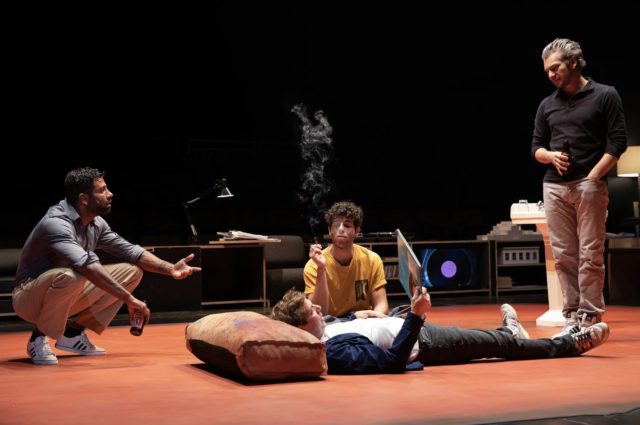
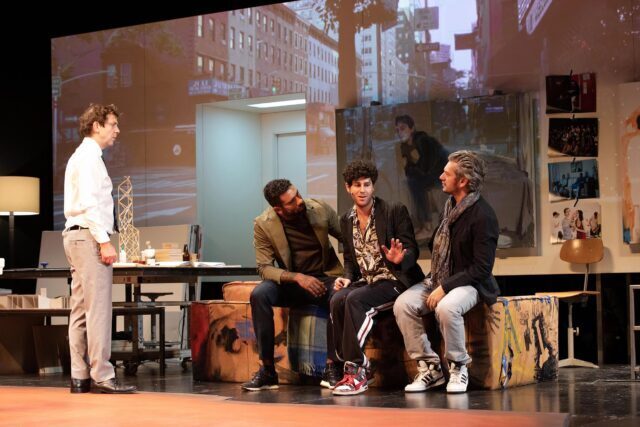
They both take place on Hildegard Bechtler’s expansive, relatively shallow horizontal set, with entrances at either side and a glassed-in back room with sliding doors that are alternately transparent, translucent, or opaque. For Hamlet, business chairs and a comfy L-shaped couch are brought on- and offstage in between rectangular marble stanchions, while for Oresteia, the furniture includes a long dinner table with benches, marble Greek pillars with exposed stone walls, and a large bathtub in the rear. Bechtler also designed the modern-day costumes, with intricate lighting by Natasha Chivers and sound by Tom Gibbons.

Hamlet, superbly played with a tender vulnerability by twenty-seven-year-old British actor Alex Lawther, is dismayed to find that his recently widowed mother, Gertrude (Jennifer Ehle), has married her late husband’s brother, Hamlet’s father, Claudius (Angus Wright), who is now the king of Denmark. The two seem very much in love, making out on the couch. But when Hamlet’s father’s ghost (David Rintoul), who appears on closed circuit security cameras wandering the empty, dungeonlike halls of Elsinore castle, tells his son that Claudius murdered him, Hamlet, who has been considering going back to school in Wittenberg, becomes obsessed with revenge, yet he lacks the resolve to take any kind of significant action in his life.

Klytemnestra (Anastasia Hille) and Agamemnon (Angus Wright) face each other across the family dinner table in Oresteia (photo by Joan Marcus)

Meanwhile, he seems destined to marry Ophelia (Kirsty Ryder), the daughter of Claudius’s chief adviser, Polonius (Peter Wight), and sister of the strong-willed Laertes (Luke Treadaway). Soon bodies are piling up, as Hamlet says, “with blood of fathers mothers daughters sons.”

In Oresteia, Agamemnon (Angus Wright), the king of Mycenae, is told by a seer, “By his hands alone. The child is the price. Fair winds.” Agamemnon and his brother, Menelaus (Peter Wight), need to sail their ships to Troy but are becalmed in Aulis, and Agamemnon interprets the prophecy to mean that he must kill his six-year-old daughter, Iphigenia (Elyana Faith Randolph or Alexis Rae Forlenza), in order to appease the gods and get the winds moving. The king is desperate to find another way, but both his brother and his herald, Talthybius (Josh Higgott), insist the deed must be done. When the queen, Klytemnestra (Anastasia Hille), deciphers the prophecy, she is of course furious, declaring, “You’re ill. You’re mad. To kill our child?” But she might not be able to stop him.

Ten years later, when Agamemnon returns from the war, bringing with him teenage captive Cassandra (Hara Yannas), he finds his family vastly changed. Bright young Orestes (Hudson Paul or Wesley Holloway) has grown into a conflicted teenager (Treadaway), daughter Electra (Tia Bannon) is jealous of Cassandra, and cousin Aegisthus (Angus Wright) has usurped Agamemnon’s place in the family. Soon bodies are piling up, and Klytemnestra warns Orestes, with more than a touch of wishful thinking, “You do not want blood on your hands.” Fathers, mothers, daughters, and sons are all in jeopardy.

Fear is central to both narratives. While Hamlet delivers his despair and anxiety directly to the audience in famous soliloquys, Oresteia unfolds in flashbacks as Orestes shares his memories with an unidentified woman (Ryder) who appears to be his therapist. Orestes tells her, “I watch it again, happening for the first time but — too late, too late to stop it. It pours out of me. But what if what’s next is — ? What if it’s better left sealed up, undisturbed?” The doctor responds, “We have to understand the truth.” Orestes: “What if it’s a dream? What if it’s a lie?” Doctor: “Then those lies reveal something about you. ‘Our self’ isn’t an absolute thing. It’s handfuls of memories and moments and people — and we form them into who we think we are. For most of us, it’s only partly true: one version of truth. A story.” Orestes: “A story. A story I’ve been through before. As a child. But I don’t know where it ends —”

Claudius (Angus Wright) and Gertrude (Jennifer Ehle) hold hands, much to Hamlet’s (Alex Lawther) consternation (photo by Stephanie Berger)

Looking backward and forward while fearing the end is also a leitmotif for each play. “I try and look forward rather than backward,” Agamemnon says. Hamlet explains, “I hold it not honesty to have it thus set down / for yourself sir should be old as I am / if like a crab you could go backward.” At dinner, Electra confesses, “I know. I was late. I have apologized. Let’s all just move forward.” When Orestes insists to the doctor that he can’t remember the past, she implores, “You will remember something. We just have to begin. Travel back along the road, all the way back to where it began.” Hamlet says to his mother, “Repent what’s past / Avoid what is to come.”

The words “end” or “ending” are repeated throughout all seven hours. “It’s ending. It is ending,” Agamemnon says. Hamlet explains to Claudius, “We fat all creatures else to fat us and we fat ourselves for maggots / that’s the end.” Talthybius tells Agamemnon and Menelaus, “No one thinks this thing is close to the end. It’s cut in deep, it’s gone too far for that. And our enemy is prepared, planning years beyond — so there’s no road to the end of this that’s swift.” Ophelia, losing control of her wits, babbles to Laertes, “I would give you some violets but they withered all when my father died / they say he made a good end / and will he not come again? / and will he not come again? / no no he is dead.”

Both works also explore the power of dreams. Hamlet famously says, “To die to sleep / to sleep perchance to dream / ay, there’s the rub / for in that sleep of death what dreams may come / when we have shuffled off this mortal coil / must give us pause.” Orestes asks the doctor, “What happens when I dream? What is knotting together with what — what is being made? Fear and wishes and — and if it’s me, if it’s just inside me with no meaning elsewhere, can’t I create something better than this, can’t I choose imagined hope rather than imagined fear?” Shortly after Klytemnestra awakes from a bad dream, Cilissa (Marty Cruikshank), Orestes’s nurse, recalls of him as a baby, “He screamed and screamed at night. Never a good sleeper.”

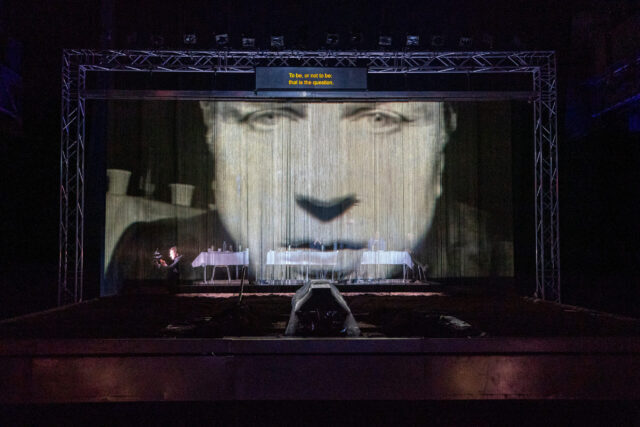
Icke, who is only thirty-five and was an associate director with the Almeida in London from 2013 to 2019, is now the Ibsen artist in residence at Ivo van Hove’s Internationaal Theater Amsterdam, and he has picked up van Hove’s obsession with using cameras to present live feeds on screens. (The projections are by Tal Yarden for Hamlet and Tim Reid for Oresteia.) In addition to the video surveillance that reveals Hamlet’s father’s ghost, there are news reports about young Fortinbras leading Norway’s military marching toward Denmark; press interviews with Agamemnon; and Claudius closely watching The Mousetrap, the play-within-a-play in which Hamlet discloses to Claudius that he knows he murdered his father. In addition, the screens are used for countdowns, ticking away the seconds during fifteen-, ten-, and five-minute intermissions in Oresteia like a doomsday clock. Meanwhile, articles of evidence and the exact times of characters’ deaths are detailed above the set like breaking news.

Klytemnestra (Anastasia Hille) can’t hold the pain inside any longer in Oresteia (photo by Joan Marcus)

Icke digs into 1960s music icons by featuring several Bob Dylan songs in Hamlet — one does not generally associate Dylan, and such tunes as Things Have Changed (“Standing on the gallows with my head in a noose / Any minute now I’m expecting all hell to break loose / People are crazy and times are strange / I’m locked in tight, I’m out of range”) and All Along the Watchtower (“There must be some kind of way outta here / Said the joker to the thief / There’s too much confusion / I can’t get no relief), as the soundtrack for a party with lots of dancing and balloons (of course, “Masters of War” would not exactly be the best choice either) — while Iphigenia sings verses from the Beach Boys’ “God Only Knows” in Oresteia (“God only knows what I’d be without you”).

The casting between the two plays is shrewdly resourceful. Wright is terrific as Claudius, Agamemnon, and Aegisthus, standing tall, speaking firmly, but not afraid to show the cracks in their armor. Peter Wright is stalwart as the loyal but ill-fated Polonius and Menelaus. Rintoul portrays the Player King and the ghost, haunting Claudius and Hamlet, respectively. Other key dualities that bring the works together include Bannon as Guildenstern and Electra, Treadaway as Laertes and Orestes, Abubakar as Marcellus and Calchas, Higgott as Horatio and Talthybius, Ryder as Ophelia and the doctor, Hara Yannas as Bernardo and Cassandra, and Athene Ross Waiton (in Hamlet only) as Francisco and the gravedigger, who makes a memorable appearance from under the stage, warbling Dylan’s “Sugar Baby.” Lia Williams was scheduled to play Gertrude and Klytemnestra but had to pull out after injuring her Achilles heel; Ehle and Hille are excellent as her respective replacements.

Both Hamlet and Orestes are onstage virtually the entire show, watching the proceedings when they’re not directly involved. They experience devastating loss that rips at their souls, and each has the opportunity to commit murder to avenge wrongdoing. Instead of wielding “a bare bodkin,” Hamlet puts a gun to Claudius’s head, while Orestes pulls a knife on one of his parents. But revenge will not necessarily relieve them of their deep trauma. “You must know your father lost a father / that father lost, lost his, and the survivor bound / in filial obligation for some term / to do obsequious sorrow / but to persever / in obstinate condolement is a course / of impious stubbornness / ’tis unmanly grief,” Claudius tells Hamlet. Referring to a murder in his family, the doctor tells Orestes, “You survived that trauma. We’re barely there in the moment it happens — we hardly feel it as it hollows us out — what hurts is the next second; awakening into what’s left — And I don’t think you’ve woken up. I’m not sure you want to wake up.” Orestes asks, “Why would I?” The doctor responds, “Fear. Of where you might be. Where you might really be.”

In a world turned upside down by a global pandemic that has killed nearly six and a half million people, Russia’s brutal invasion of Ukraine, climate change that is threatening the future of the planet, mass shootings in the United States committed with automatic assault weapons, and an insurrection that continues to jeopardize American democracy, many of us are afraid of where we might really be.

As Electra asks, “How do you mourn?” It’s a question we are all facing these days, in one way or another, a question brilliantly explored in Icke’s dueling plays.