featured

MEDUSA

A masked gang of religious zealots seek out sinners in Anita Rocha da Silveira’s Medusa

MEDUSA (Anita Rocha da Silveira, 2021)
Angelika Film Center
18 West Houston St.
Opens Friday, July 29
www.angelikafilmcenter.com
www.musicboxfilms.com/film/medusa

Brazilian writer-director Anita Rocha da Silveira follows up her 2015 success, Kill Me Please, about murder, sin, and misogyny among adolescents, with Medusa, which takes similar themes and more to another level.

According to ancient myth, Medusa was a beautiful mortal Gorgon virgin who was cursed after being seduced by Poseidon; she turned into an ugly snake-haired demon, and men who looked directly at her were turned into stone. In Medusa, a group of God-fearing young women prowl the streets at night, wearing white masks, hunting down sinful women and beating them until they agree to renounce their sins and worship Jesus; their confessions are recorded and posted on social media, where they go viral. The vicious group is inspired by an unknown woman who, years before, put on a mask and set on fire the face of an actress and dancer named Melissa (Bruna Linzmeyer) because of her lascivious promiscuity. Neither woman has been seen since.

By day, the mask-wearing gang is a bright and cheery religious singing troupe known as the Treasures of the Lord, dressed all in white, proudly chirping, “The Lord shall make my dream come true,” declaring themselves to be “witnesses of faith.” They are members of a cultlike church run by the charismatic Pastor Guilherme (Thiago Fragoso), who tells his flock, “My brothers, for a long time, the church has been estranged from the nation’s decisions. How much time have we wasted believing that the church shouldn’t decide the country’s future?”

The young men in the church are part of the Watchmen of Sion, self-appointed “guardians of the family, the morals, and the Lord,” a well-trained vigilante mob whose goal is to “crush the sinners.” The objective is that the Watchmen and the Treasures chastely fall in love and marry, creating a next generation of religious zealots to continue their mission to transform the world into faithful legions.

One night, the masked Treasures’ target fights back, scarring Mari’s (Mari Oliveria) face. The disfigurement is embarrassing to Mari, Treasures leader Michele (Lara Tremouroux), and the plastic surgery clinic where Mari works; she is soon fired because of her appearance.

While indoctrinating newbie Clarissa (Bruna G), Mari sets out to get a photo of the original victim, Melissa, and expose her sins on social media. She gets a job at a mysterious hospital that cares for people in long-term comas who are not expected to regain consciousness. There Mari is befriended by coworker Lucas (Felipe Frazão), who is attracted to her. It isn’t long before Mari begins questioning where her carefully regimented life is leading her.

Medusa is a creepy thriller, the eerie spawn of John Carpenter, David Lynch, Claire Denis, Dario Argento, and Brian De Palma as well as Georges Franju’s Eyes without a Face and Rachel Grady and Heidi Ewing’s Jesus Camp. Not afraid to let her influences show, Rocha da Silveira imbues the film with a 1970s giallo / 1980s horror aesthetic even though it is set in the present day. It’s a cleverly disguised condemnation of the far-right evangelical movement that seeks to control women’s bodies, legislate their restrictive morality, and convert their country — be it Brazil, the United States, or elsewhere — into a Christian nation.

Mari (Mari Oliveria) and Michele (Lara Tremouroux) attempt to hide their own scars while inflicting pain on others in Brazilian thriller

Cinematographer João Atala often zooms in for close-ups of characters’ faces, exploring ideas of beauty as well as physical and emotional scars; Mari isn’t the only one attempting to cover something up. The women occasionally stare directly into the camera, implicating the viewer for making judgments and hiding their own sins, symbolically threatening to turn them to stone.

Despite numerous plot holes, digressions left hanging, and bumpy transitions between scenes, Medusa is a dark, compelling chiller with a killer soundtrack by Bernardo Uzeda, including classic tunes (for example, “House of the Rising Sun”) with rewritten religious lyrics that provide a false sense of security to their performers. The film, now playing at the Angelika, is a dark cautionary tale about forcing one’s morals onto others in a world where we all debate who the real monsters are.

HIT THE WALL

Adam Files and Alexandra Guerrero star in Jake Shore’s Hit the Wall (photo by Neil Ryan)

HIT THE WALL
The Kraine Theater
85 East Fourth Street between Second Ave. & Bowery
Thursday – Saturday through August 11, $25
www.frigid.nyc

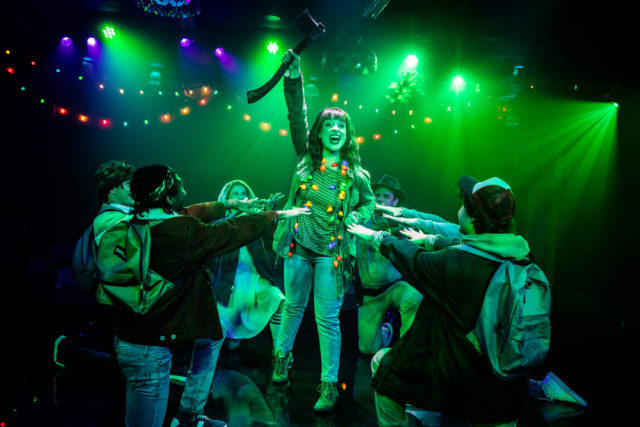
During the pandemic lockdown, Rhode Island native Jake Shore wrote and directed (Adjust the Procedure, one of the best Zoom plays built around Zoom itself, consisting of a series of online meetings at a university attempting to deal with — or not deal with — a terrible tragedy. Presented by Spin Cycle and Shore’s JCS Theater Company, the prerecorded play enjoyed several extensions and was picked up by various festivals.

Shore’s first in-person play since theaters have reopened is Hit the Wall, a didactic seventy-minute, two-character drama about art and the audience continuing at the Kraine through August 11.

The show begins with famous forty-four-year-old graffiti artist Amir (Adam Files) and his protégé, twenty-five-year-old Rae (Alexandra “Allie” Guerrero), in his high-rise New York City apartment in 2010. For several minutes, they stand behind an empty picture frame hanging from the ceiling; it serves as a window to the outside world, an invisible canvas, and a reference to the Zoom boxes that were so prevalent during the height of the coronavirus crisis.

Rae tells Amir about a current project she’s failed to complete, a Madonna and Child on a wall in Crown Heights. She wants to go back and finish it, but Amir, who she compares to such graffiti legends as Banksy, Shepard Fairey, Lee Quiñones, and Claw Money, asserts that it would be a mistake, that she could be caught and sent to prison. “You’re succumbing to the rush and thrill of the chase, not the connection to your art,” he insists.

After some back and forth, Rae convinces Amir that she must finalize the work. He offers to help, but she refuses his support. The next morning she is excited, having executed the full piece in Brooklyn, and is now entertaining thoughts of hitting a wall in Times Square, despite the obvious danger. She tells him, “When I mention a wall, one of the first things you ask about is the visibility. The intention behind this being how many people can see it. How many sets of eyes. High visibility means a large audience, and then, in turn, more of a shot at influencing culture.” It’s as if Shore is comparing an off-off-Broadway play in Brooklyn — or a Zoom show — to a big-time production on the Great White Way.

While Rae desires the attention and wants to be a social media phenomenon, Amir is all about the art itself and its natural visibility to the right kind of people. He rails against capitalism and corporate greed, repeatedly claiming that sell-outs are rapists, thieves, and prostitutes. “Do you think that I would waste myself on the fuckers who visit and frequent Times Square?” he says. “That’s the point. Visibility is not just about the number of people you can reach, it’s about the quality of your audience.” A few moments later, Rae explains, “An empty theater has no audience,” another reference to the lockdown, when all theaters were empty and actors performing virtually had no idea who was out there watching them.

When Rae’s Madonna and Child suddenly and unexpectedly goes viral — perhaps not unlike what happened, to a lesser degree, with Adjust the Procedure — her relationship with Amir, and with her art, undergoes a rapid change.

Rae (Alexandra Guerrero) and Amir (Adam Files) discuss art and audiences in world premiere play at the Kraine (photo by Neil Ryan)

Directed by Timothy Haskell (Road House the Stage Play, Fatal Attraction: A Greek Tragedy, The Rise and Fall, Then Brief and Modest Rise Followed by a Relative Fall of . . . Jean Claude Van Damme . . .), Hit the Wall feels like an unfinished work in need of significant touch-ups. Even at only seventy minutes, it is repetitive as the two characters argue incessantly about the value of art and the need for it to be seen. Guerrero (At Least He Didn’t Die with Antlers on His Head) has the better, more well-rounded part, and she does a good job with it, capturing our attention and gaining our sympathies, while Files (Adjust the Procedure, Fragments) is held back by dialogue that sometimes sounds like he’s defending a dissertation — but only when you can hear the two actors, who have to compete with an aggressively loud air-conditioning unit.

Shore (The Devil Is on the Loose with an Axe in Marshalltown, Down the Mountain and Across the Stream) makes some interesting comparisons about mentors and protégés, parents and children — Rae has a strained relationship with her mother and ill father, so it’s not surprising that her signature piece is the idealized Madonna and Child, but the subplot grows overbearing.

The most compelling theme in the play is the exploration of the exchange between artist and audience as it relates specifically to live theater. At certain points Amir and Rae wonder if they themselves are performing for people sitting in seats, watching them.

“There is an eternal audience, Rae,” Amir says. “Imaginary?” Rae asks. Amir: “An eternal audience more real and present than any single person or group. . . . An audience on another plane. Like we’re in a play.” Rae: “Some otherworldly judgment? You speak clearly of God.” Amir: “Not God or gods.” Rae: “Then what?” Amir: “A group of viewers beyond our comprehension. . . .” Rae: “They are down there in the city, or up here so many stories high, but not seated in a dark theater in the caverns of your subconscious.”

No, we are seated in a dark theater, physical presences who have returned from two years of experiencing plays online, if at all, ready to be entertained, and challenged, no longer beyond comprehension. In a program note, Shore explains, “One reason I wanted to write a play like this is because graffiti artists want walls so badly. That’s sort of where it started.” Unfortunately, in his attempt to hit this wall, he misses.

ELEVATOR REPAIR SERVICE: SEAGULL

Elevator Repair Service puts its unique spin on Anton Chekhov’s The Seagull (photo by Ian Douglas)

SEAGULL
NYU Skirball Center for the Performing Arts
566 La Guardia Pl. between Third & Fourth Sts.
Through July 31, $50-$60 (use code FB25 for $25 tickets)
212-945-2600
nyuskirball.org
www.elevator.org

I’m beginning to think I might never see another traditional production of Anton Chekhov’s 1895–96 classic, The Seagull. Perhaps more than any other playwright, Chekhov’s works almost demand reinvention for the stage in the twenty-first century. His tragicomic take on human relationships and society’s ills invite modern, often extensive reinterpretation and experimentation.

As often as Shakespeare’s plays are reimagined, they almost always still contain the Bard’s original dialogue; it’s the staging that changes. The same is not necessarily true about Chekhov, as evidenced by such recent successes as Arlekin Players Theatre’s hybrid The Orchard (The Cherry Orchard), Aaron Posner’s Life Sucks. (Uncle Vanya), and Halley Feiffer’s Moscow Moscow Moscow Moscow Moscow Moscow (Three Sisters).

As far as The Seagull goes, over the last ten years I’ve seen Posner’s Stupid Fucking Bird at the Pearl in 2016, a deliriously chaotic yet controlled rave-up sticking to the main plot but told with an intoxicating irreverence; Jeffrey Hatcher’s Ten Chimneys, at St. Clement’s in 2012, which goes behind the scenes of an upcoming Broadway revival of The Seagull starring Alfred Lunt and Lynne Fontanne; and Christopher Durang’s Vanya and Sonia and Masha and Spike, a delightful all-star mashup of The Seagull, Three Sisters, and Uncle Vanya that ran on and off Broadway in 2013.

Elevator Repair Service, the downtown company whose literary adaptations include William Faulkner’s The Sound and the Fury, Shakespeare’s Measure for Measure, James Joyce’s Ulysses, and F. Scott Fitzgerald’s The Great Gatsby — the much-admired eight-hour Gatz — now turns its unusual techniques on Chekhov with Seagull, continuing at NYU Skirball through July 31. Nearly three hours with one intermission, the play self-referentially refers to itself regularly, with actors occasionally speaking to the audience as themselves, not as their characters. It begins with a long monologue by company member Pete Simpson, who talks about the Skirball space itself. “One of these two corkscrew, fluted, gold leaf columns is structural and holds up the building above us. The other is hollow, insubstantial, and does nothing but sit there and look pretty in an attempt to make things look symmetrical.”

When he said that under each chair are three flags, a red one that “will tell us you feel physically threatened or uncomfortable,” a checkered one to use if you just “wanna talk,” and a third to order food, I saw the woman sitting across the aisle from me reach below her seat to see if the flags were really there. (They’re not.) But it signals that this production is going to veer wildly between the real and the imagined, although all of it turns out to be Chekhovian in one way or another, even if, as Simpson, who also plays the teacher Semyon, explains, “95% of tonight’s text both original and adapted has been written by our company’s own Gavin Price,” who portrays wannabe playwright Konstantin.

Director John Collins leaves the central plot intact: The twentysomething Konstantin has invited friends and family over to a lovely lake house to watch his latest play, to be performed by Nina (Maggie Hoffman), a nervous actress he is desperately in love with. Konstantin is hoping to prove to his mother, famous actress Irina (Kate Benson), that he has talent and a purpose in life; Irina, who chastises him regularly in front of everyone, has arrived with her new beau, well-respected and successful writer Boris Trigorin (Robert M. Johanson), who takes a liking to Nina.

Also at the presentation are Patricia (Laurena Allan), Irina’s ailing sister; farmer Ilya (Julian Fleisher), who is a big fan of Irina’s, and his wife, Paulina (Lindsay Hockaday); Masha (Susie Sokol), the farmers’ daughter who is in love with Konstantin but might be married off to Semyon; Yakov (John Gasper), who works at the lake house; and Gene (Vin Knight), a doctor who has an innate charm that lures the ladies, including Paulina.

In the middle of the play-within-a-play, Irina asks, “Is this supposed to be symbolic?” A moment later, she says, “Something smells. Is that part of the effect?” A disgusted Konstantin eventually has to stop the show because of his mother’s interruptions.

Shortly after Patricia has an asthma attack, Benson, Hoffman, and Susie have a discussion as themselves, commenting on how much they enjoyed the previous scene and what Chekhov’s play is about. The play resumes as Konstantin presents Nina with a seagull he just shot.

Masha (Susie Sokol) leads the characters in a strange game in Seagull (photo by Ian Douglas)

Following intermission, Sokol points out how long she has been with ERS, explains the set design, and expresses her disappointment that one of Masha’s key lines has been cut: “I’m in mourning for my life.” Soon various characters consider leaving the lake house, Irina insists she has no money to help anyone, and Konstantin sports a bloody bandage wrapped around his head. “You . . . Symbolist!” Irina again accuses her son. “Miser!” he replies. “You amateur!” she declares. It all goes downhill from there.

The set by dots, so ably described by Sokol, features a row of folding chairs in the front that the characters move about depending on the action. Downstage right is a table with electronic equipment, while upstage left is a cozy dinner table with pictures on the wall. The lighting is by Marika Kent, with sound by Price and Gasper and purposely mismatched costumes by Kaye Voyce, ranging from Nina’s elegant red dress to Irina’s short skirt, heels, and tights.

Collins’s direction may appear disordered as the fictional plot battles it out with the actors’ thoughts and some events happen either offstage or in the background — as when several characters sit down to eat but we can’t make out exactly what they are saying to one another, although it does turn into a terrific bingo-style dance number. But there is a method to his madness, even if it’s not necessarily always clear what he’s up to; numerous pieces of dialogue reflect back on the play we’re watching, as if ironically commenting on what is happening in Seagull at Skirball.

“It’s not easy, you know, acting in your play. There aren’t any ordinary people in it,” Nina tells Konstantin, who responds, “Ordinary people! We have to show life not the way it is, or the way it should be, but the way it is in dreams!” Nina retorts, “But nothing happens in your play! It’s all one long speech. And I think a play ought to have a love story.” Meanwhile, Collins emphasizes Chekhov’s Hamlet references, with Konstantin echoing the young prince, Irina a different kind of Gertrude, Boris representing Claudius, and Nina an embellished Ophelia.

“It was a strange play, wasn’t it?” Nina asks Boris about Konstantin’s show. Boris replies, “I’m afraid I didn’t understand a thing. But it was interesting to watch. You were wonderful. And of course, the set was magnificent!” Most people in the audience seemed to agree with that analysis of ERS’s production, although a handful walked out during the first act and others did not return after intermission; however, those who stayed, the vast majority of the crowd, gave the performers a standing ovation at the end.

Seagull is not for everyone’s taste. It is long — 173 minutes, as Simpson tells us — it is confusing, it is pedantic, and it can be self-referential to a fault, particularly as the cast passes around a microphone and cord, going in and out of character. And don’t get me started on the awful noise made when Patricia is pushed around in a chair. But it all continues founding artistic director Collins’s thirty-plus-year mission of experimenting with new theatrical forms, in original works and unique adaptations.

Hamlet asked himself, “To be or not to be.” In Seagull, Patricia answers, “Just go on living, whether you feel like it or not.” The same can be said for theater itself.

JEAN-MICHEL BASQUIAT: KING PLEASURE

Jean-Michel Basquiat, Untitled (Ernok), acrylic and oil stick on canvas mounted on tied wood supports, 1982 (photo by twi-ny/mdr)

JEAN-MICHEL BASQUIAT: KING PLEASURE
Starrett-Lehigh Building
601 West Twenty-Sixth St. between Tenth & Eleventh Aves.
Daily through January 1, $27-$65
Family Day: Saturday, August 27, $15 advance tickets for children thirteen and under
kingpleasure.basquiat.com

At this point, Jean-Michael Basquiat has been dead longer than he was alive; he died of a heroin overdose in 1988 at the untimely age of twenty-seven. Since then his life has become legend, and his legacy has ballooned to epic proportions, although he was justifiably famous even before he passed away. When one hears the Brooklyn native’s name, thoughts instantly emerge of his mentor, Andy Warhol; such films as Downtown 81 (in which he played himself) and Basquiat (in which he was portrayed by Jeffrey Wright, and David Bowie played Warhol) and the documentaries The Radiant Child and Rags to Riches; sex and drug abuse; his 1985 appearance on the cover of the New York Times magazine; blockbuster exhibitions at the Brooklyn Museum, the Whitney, and the Brant Foundation; and, of course, the enormous amounts his works sell for at auction, including an untitled 1982 painting that sold at Sotheby’s for $110.5 million in 2017 and another that went for $85 million at Phillips this past May.

His family recently decided to turn the focus on Basquiat the human being and his art, eschewing all the meta, resulting in the exhibition “King Pleasure,” curated by his sisters Lisane Basquiat and Jeanine Heriveaux and his stepmother, Nora Fitzpatrick, now extended at the Starrett-Lehigh Building in Chelsea through January 1. It’s an expensive ticket — $45 for adults, or $65 to skip the line, with pricy merch in the shop — but the show, consisting of works held by his estate and rarely displayed to the public, offers a fascinating look at who Basquiat was away from all the fame and (mis)fortune.

“The decision to curate an exhibition and write this catalogue devoted to Jean-Michel’s artwork from the family’s collection did not come easily,” Jeanine writes in the catalog. “The impetus to do this stemmed from conversations we had that his works needed to be seen and not hidden away in a warehouse. This is not meant to be a scholarly exhibition and book on Jean-Michel but a fresh perspective told from our family’s point of view. Creating the themes, choosing the works, and revisiting our childhood memories and family stories has been joyful and profoundly healing for my sister Lisane, our stepmother Nora, and me. Carefully going through what he left behind — books, hundreds of VHS movies, his collections of African sculpture, toys, and other objects, and his many sketchbooks and notes — has afforded us an even richer understanding of our brother now as adults.”

Lisane adds, “What you hold in your hands is a celebration of the life, legacy, and voice of Jean-Michel Basquiat, and I want to open it with a note of gratitude: thank you for seeing him.”

Designed by British architect Sir David Adjaye and named for a 1987 Basquiat painting inspired by jazz vocalist King Pleasure, the show features more than two hundred objects spread across twelve thousand square feet, divided into such sections as “Blue Ribbon,” “Ideal,” “Royalty,” “Those Who Dress Better Can Receive Christ,” and “Irony of Negro Policeman.” The path takes visitors through childhood and teen drawings, family photos and home movies, notebooks, a re-creation of the family dining room and living room (with video projections) and Basquiat’s Great Jones St. studio, his actual bicycle, his birth announcement, video reminiscences, and a generous amount of his paintings and drawings. Told chronologically, the story introduces us to Basquiat the person, beginning with drawings of Rocky and Bullwinkle, Gumby and Pokey, and Captain America and Dr. Radium. His combination of colorful images with hand-scribbled text was evident from an early age, transforming into more magisterial works as he started using acrylic and oil stick and incorporating what would become his trademark crown and striking faces, working on such materials as found wood, doors, canvas, and paper. Longtime Basquiat fans will not be disappointed by the breadth and quality of the art.

Untitled (Love) from 1984 features the word “LOVE” painted on an old refrigerator door covered in racing stickers. A series of 1984 paintings on wooden slotted fences and 1982 works on wood supports stand out for their bold freshness. An untitled 1982 painting centered by a red skull and a 1983–84 piece with a green-faced head surrounded by architecturally arranged writing and buildings seem to be alive. Such societal ills as incarceration, debt, corruption, inequity in housing, and police brutality occasionally show up in his work. Jailbirds depicts two policemen beating a young person with their batons.

Basquiat pays tribute to boxing legends Ezzard Charles and Sugar Ray Robinson, such art historical figures as Leonardo da Vinci, Peter Paul Rubens, and Gerard ter Borch, and, most dramatically, jazz great Charlie Parker, who gets his own room. The exhibit also includes silkscreens Warhol made of Jeanine and their parents, Gerard (who would often watch boxing with the kids on Saturday nights) and Matilde; a rare cityscape from 1981–82; and a 1977 drawing that contains only the phrase “the conveyor belt of life” in small letters, as if Basquiat already knew what he would be in for.

Personal exhibition immerses visitors into the world of Jean-Michel Basquiat (photo by twi-ny/mdr)

His re-created studio features dozens of original works, a record cover he designed, books and VHS tapes he owned, and tools he used. Items he collected (dolls, toys, masks, small sculptures from the Ivory Coast, cameras) are lined up in rows behind glass. Much of the music you hear throughout the exhibition has been compiled as a special Spotify playlist with songs by Parker, John Coltrane, George Michael, UB40, the Who, Elton John, Jimi Hendrix, and others; Basquiat himself was part of an experimental band called Gray. And yes, there are photos of Basquiat hanging out with the glitterati, but they are not as interesting as everything else. The show concludes with a pair of murals he made for the Michael Todd VIP Room at the Palladium, highlighted by the phenomenal forty-one-foot-long Nu Nile.

“Jean-Michel’s success was a double-edged sword. He felt quite a bit of pressure. He was so ahead of his time, and he was also very young,” Lisane writes in the catalog. “In spite of that success, though, he was still seen as ‘the other’ by the art world establishment; he didn’t fit in anywhere, really. Being put into a position of having to constantly correct how people saw him deeply annoyed Jean-Michel. . . . It frustrated him to defend himself against people’s prejudices, stereotypes, and assumptions. Jean-Michel was on a journey to figure out where he belonged and what he was going to do with his particular set of circumstances.” (To find out more, check out “Forum Basquiat,” a panel discussion with Lisane Basquiat, Jeanine Heriveaux, and Sir David Adjaye, moderated by Ileen Gallagher, that was held on July 10.)

His family has done him a great service with this deeply personal exhibition, which gives visitors a different kind of understanding of who Jean-Michel was and where he came from.

MR. SATURDAY NIGHT

Buddy Young Jr. (Billy Crystal) needs to prove to everyone he’s still got it in Mr. Saturday Night (photo by Matthew Murphy)

MR. SATURDAY NIGHT
Nederlander Theatre
208 West 41st St. between Seventh & Eighth Aves.
Tuesday – Sunday through September 4, $69-$179
877-250-2929
mrsaturdaynightonbroadway.com

Don’t get me started. So I’m sitting in a theater a few weeks ago, waiting for a play to begin, when I overhear the three people next to me, who are from Toronto, discussing what else they want to see while they’re in New York. “What about Mr. Saturday Night?” the oldest one asks. “Oh, I love Billy Crystal, but I’d rather see a musical,” his grown daughter says. “Who’s Billy Crystal?” her twentysomething son says, as if he could not care any less. What are they, meshugeneh?

In 1984, burgeoning superstar William Edward Crystal got his own HBO special, A Comic’s Line, in which he created Buddy Young Jr., an aging, antiquated comedian with a gruff voice and an even gruffer manner. Crystal, who played the barrier-shattering gay character Jodie Dallas on Soap from 1977 to 1981, further developed Buddy on Saturday Night Live (1985-85) and then in the 1992 film Mr. Saturday Night, which he also cowrote (with Lowell Ganz and Babaloo Mandel) and directed. By then Buddy was a fully fledged, long-out-of-date Borscht Belt has-been whose outsize ego continually results in lack of success.

Crystal, who won a Tony for his 2004 one-man autobiographical show, 700 Sundays, has now turned Mr. Saturday Night into an utterly charming and fun Broadway musical — yes, Toronto friends, a musical, with plenty of shtick — reteaming with Ganz and Mandel (Splash, Parenthood, A League of Their Own), who also worked with Crystal on the two hit City Slickers flicks and the forgettable Forget Paris. In addition, David Paymer, who won an Oscar as Buddy’s long-suffering brother and agent, Stan Yankleman, in the movie, is back in the same role onstage. For the film, Crystal, who was in his early forties at the time, had to go through nearly six hours of makeup every day to play the seventy-three-year-old comedian; for the Broadway show, which runs through September 4 at the Nederlander, Crystal, now seventy-four, requires very little makeup to play the younger Young.

A onetime television star in the 1950s, Buddy has been reduced to telling lame jokes at retirement homes to less-than-enthusiastic audiences. “So, the other day, my wife says, ‘Buddy, come upstairs and make love to me.’ So I said, ‘Make up your mind — I can’t do both.’” Met with crickets, he adds, “Hey, come on. I know you’re out there — I can hear you decomposing.”

Watching the Emmy Awards in his New York City apartment, Buddy is shocked when he sees himself highlighted at the end of the in-memoriam segment that lists all the famous people who died in the previous year. “Look! They killed me!” he tells his wife, Elaine (Randy Graff). “I’m not dead, you bastards!”

But instead of wallowing in self-pity, Buddy decides he can turn the mistake into his last chance to prove to the world what he’s got before he really dies. He sings, “No more playing brises and bar mitzvahs, / Sundays at the Szechuan buffet, / All that starts changing tomorrow when I’m on Today!” After going on the morning show, Buddy is a hot commodity again, taking meetings at the Friars Club and getting a movie offer but, as flashbacks reveal, the hardheaded comedian can’t stop getting in his own way on the road to fame and fortune.

Meanwhile, he tries to reestablish a connection with his forty-year-old daughter, Susan (Shoshana Bean), who has a history of drugs and arrests and is excited that she is up for a PR job. Buddy: “What’s it pay?” Susan: “Okay, you see?! I’m leaving.” Buddy: “That’s a normal question about a job. What does it pay?” Susan: “It pays ten cents a year, okay?! That’s what it pays. Ten cents a year!” Buddy: “Okay, that’s something. That’s ten cents more than last year.”

Buddy Young Jr. (Billy Crystal) keeps Jordan Gelber, Brian Gonzales, and everyone else laughing in hit Broadway musical (photo by Matthew Murphy)

Scott Pask’s set smoothly moves from the Youngs’ home to the Friars Club to a talk show to Young’s good old days, with costumes by Paul Tazewell and Sky Switser and video and projections by Jeff Sugg, taking us back and forth between past and present. Generously directed by Tony winner John Rando (Urinetown, On the Town), Mr. Saturday Night is great fun. Ganz, Mandel, and the endlessly irresistible Crystal — the most delightfully appealing comedian of the last fifty nears — never miss an opportunity to go for the quick laugh but without sacrificing the narrative. The show is all about Crystal; it’s unlikely to be remembered for its cast album, although three-time Tony winner Jason Robert Brown’s (Parade, The Last Five Years) music and orchestrations and Tony nominee Amanda Green’s (Hands on a Hardbody, Bring It On) lyrics are a fine match for the players.

Crystal and Paymer are not there for the singing or dancing; the more intensive numbers are left for Tony winner Graff (City of Angels, A Class Act) and Bean (Hairspray, Wicked), who are both superb. Choreographer Ellenore Scott keeps it mostly simple, not trying to give Crystal and Paymer too much tsuris. Jordan Gelber, Brian Gonzales, and Mylinda Hill excel as multiple characters, serving up, of all things, comic relief. Chasten Harmon (Hair, Les Misérables) is agent Annie Wells, who at first has no idea who Buddy Young Jr. is but is doomed to find out. I hope the same happened to the guy from Toronto. To use one of Young’s catchphrases, did you see what I did there?

Early on, Young declares, “Sure, I’m old but look, my mic hand is steady, / Still upright and I’m ready, / Do I pack away the tux and tie / and lie here growing fungus? / That’s what they want me to do!” And Crystal’s singing as much about himself as Young when he adds, “I got to hear them saying: / He’s still got it! / He’s still got it! / Balls you can’t lift with a crane.”

BETWEEN WORLDS — MOKUHANGA

“Between Worlds” explores the specialized ancient art of mokuhanga (photo courtesy Kentler International Drawing Space)

BETWEEN WORLDS — MOKUHANGA
Kentler International Drawing Space
353 Van Brunt St., Red Hook
Thursday – Sunday through July 31, free, from 12:00 – 5:00
Tour and flute performance July 24, free, 1:00
kentlergallery.org
mokuhangasisters.com

After meeting at the Mokuhanga Innovation Laboratory in Kawaguchi-ko, Japan, during shared residencies from 2017 to 2019, nine woman artists formed the Mokuhanga Sisters, a collective dedicated to the centuries-old ukiyo-e woodblock printing technique known as mokuhanga. The Mokuhanga Sisters — Katie Baldwin, Patty Hudak, Mariko Jesse, Kate MacDonagh, Yoonmi Nam, Natasha Norman, Mia O, Lucy May Schofield, and Melissa Schulenberg — are showing modern examples of the art form in the lovely exhibition “Between Worlds – Mokuhanga,” on view through July 31 at the Kentler International Drawing Space in Red Hook. In addition, each artist has invited either a teacher or a student of theirs or a community member (Matthew Willie Garcia, Hidehiko Gotou, Kyoko Hirai, Shoichi Kitamura, Terry McKenna, Brendan Reilly, Louise Rouse, Ayao Shiokawa, Chihiro Taki, Katsutoshi Yuasa) to show work as well, making it an intergenerational, multigender show.

In their curatorial statement, the Mokuhanga Sisters explain, “‘Between Worlds’ explores the technical innovations of mokuhanga and contemporary themes of identity, place, environment, and gender from artists working around the world. As a medium, mokuhanga is versatile and sustainable. Its subtle applications of color and the tactile surfaces create space for contemplation. Its connection to the past and its potential for innovation give it continued relevance for international art making in the twenty-first century.”

Katie Baldwin, Meeting Place (Garden), mokuhanga, 2021 (photo courtesy Kentler International Drawing Space)

The centerpiece of the exhibit is the more than twelve-foot-long scroll Borderless, comprising panels by eight of the Sisters. On the walls surrounding the scroll are more than four dozen individual works on paper in black-and-white and multiple colors, featuring various geometric shapes and patterns and landscapes. McKenna’s Water from Heaven and Linden Falls use the same blocks but are printed in very different hues; similarly, Yuasa’s VR Tokaido series boasts three versions of its scene of Mt. Fuji. Several artists incorporate gradations of an alluring blue, including Baldwin (Meeting Place [Garden]), Gotou (Blue Breath), Schofield (The Way You Look at Me), Norman (Woven Water), and MacDonagh (Diptych).

Circles play a prominent role in works by Hudak, Mia O, Ayao Shiokawa, and Norman. Baldwin’s Tornado Shelter (Practice Evacuation) evokes Edvard Munch’s In the Brain of Man and On the Waves of Love, a white face drawing attention in an otherwise dark outdoor scene. Yuasa’s Making your own paper, printing by hand, and seeing through the light recalls several oil paintings of woods by Paul Cezanne. Hudak’s stunning Two Trees hangs over the gallery’s inner entrance; it was inspired by W. B. Yeats’s poem “The Two Trees” (“Beloved, gaze in thine own heart, / The holy tree is growing there; / From joy the holy branches start, / And all the trembling flowers they bear”) and the forest canopy behind her home.

On July 24 at 1:00, Hudak will be leading a tour of the show, followed at 2:00 by a Japanese flute performance. Don’t miss the tour if you can help it: Hudak’s deep love for and knowledge of the form and its history, stretching back to the seventh century, were delivered with a light touch and engaging enthusiasm on the tour we went on a few weeks ago, and her information about the particular papers, inks, wood carving, and inking techniques of mokuhanga added immeasurably to our understanding and appreciation of the works. While there, be sure to check out “Focus on the Flatfiles: Between Worlds,” a cabinet of affordable prints by Annie Bissett, Takuji Hamanaka, Keiko Hara, Jennifer Mack-Watkins, Florence Neal, Yasu Shibata, and April Vollmer.

MY OLD SCHOOL

Alan Cumming stars as Scottish hoaxer Brandon Lee in My Old School

MY OLD SCHOOL (Jono McLeod, 2022)
Film Forum
209 West Houston St.
Opens Friday, July 22
212-727-8110
filmforum.org

“To rewind your life and be someone different — what would possess someone to do that?” Nicola asks at the beginning of Jono McLeod’s brilliantly eccentric hybrid documentary, My Old School.

Sam adds, “Anything’s possible here. I’m telling you, this guy is a charmer. He’s not what you think he is; he never was.”

In 1993, a new student named Brandon Lee entered prestigious Bearsden Academy in Scotland. Although he appeared to be significantly older than the rest of his classmates, some of whom initially assumed he was a teacher, he continued going to school and even starred as marine lieutenant Joseph Cable in Bearsden’s production of South Pacific. But it turned out that Brandon was not who he said he was, leading to a major scandal.

Jono McLeod uses animation flashbacks to tell strange tale in hybrid documentary

In 1995, it was announced that Scots actor Alan Cumming would portray Brandon in a movie, but it never got made. Instead, nearly thirty years later, Cumming is finally playing the man who eventually got caught pulling off a hoax of epic proportions. But Cumming doesn’t speak a word in the film; Brandon agreed to tell his story to McLeod, who was one of his Bearsden classmates, but he refused to appear on camera. So, sitting in a school desk, Cumming expertly lip syncs Brandon’s extremely strange tale of ambition, deception, and just plain weirdness.

It’s a bravura performance, reminiscent of Deirdre O’Connell’s Tony-winning role in Dana H., in which she portrayed playwright Lucas Hnath’s mother, sitting in a chair as she lip synced the story of an abduction from an interview Hnath conducted with the real Dana. Cumming, a Tony-winning stage actor himself (Cabaret, Macbeth), uses small gestures and movements and his alluring eyes to convey Brandon’s state of mind without ever getting out of his seat; George Geddes’s camera is as curious as we are, exploring his face and body in extreme close-ups as if looking for cracks in his armor.

In his debut feature film, McLeod, a former reporter and current television documentarian, uses multiple ways to share the bizarre chronicle: In addition to interviewing the main subject, McLeod speaks with more than a dozen of Brandon’s classmates, who also sit at school desks as they relate what happened from beginning to end. They do so with both humor and wonder, laughing and smiling as they describe the details of Brandon’s subterfuge; McLeod gets several teachers to go on the record as well.

McLeod presents their testimonials in playful animation (courtesy Rory Lowe), inspired by MTV’s Daria, interspersing real news reports and other archival footage, all seamlessly edited with quirky delight by Berny McGurk. Some of the cartoon characters are voiced by actors, including Clare Grogan as Mrs. Ogg, Joe McFadden as Mr. MacLeod, Juliet Cadzow as Brandon’s grandmother, Michele Gallagher as Mrs. Thomson, Camilla Kerslake as Brandon’s opera-diva mother, Gary Lamont as Mr. MacKinnon, Carly McKinnon as science teacher Miss MacKichan, Brian O’Sullivan as Mr. Gunn, Dawn Steele as Mrs. Nolan, Wam Siluka Jr. as Stefen (who lovingly admits how Brandon changed his life), and, most notably, the one and only Lulu (To Sir, with Love) as mean Mrs. Holmes. Lulu also sings the cover version of Steely Dan’s “My Old School” over the closing credits, during which McLeod pairs childhood photos of the students and teachers with their animated versions.

It’s a tour de force of storytelling, and what a story it tells. The less you know going in, the better, but regardless, it’s one hundred minutes of utter fun and amazement, particularly potent in 2022, when personal identity is at the forefront of so much discussion. My Old School opens July 22 at Film Forum; there will be Q&As with McLeod after the 7:50 screenings on Friday and Saturday night.