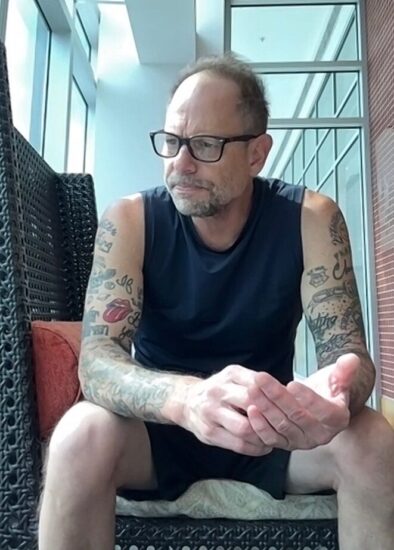
Robin Wilson is being inducted into the Long Island Music and Entertainment Hall of Fame on August 25 (Zoom screenshot by twi-ny/mdr)
ROBIN WILSON
The Long Island Music and Entertainment Hall of Fame
97 Main St., Stony Brook
Friday, August 25, $40, 7:00
www.limusichalloffame.org/museum
www.ginblossoms.net
Lou Reed, Run-D.M.C., Salt-N-Pepa, the Ramones, Count Basie, Beverly Sills, Pat Benatar, Louis Armstrong, Kurtis Blow, Blue Oyster Cult, Joan Jett, John Coltrane, Aaron Copland, Neil Diamond, George Gershwin, Stray Cats, Barbara Streisand, Billy Joel, Taylor Dane, Simon & Garfunkel.
Those are only some of the artists who have been inducted into the Long Island Music and Entertainment Hall of Fame (LIMEHOF). The next to join that prestigious roster is Robin Wilson, lead singer of the Gin Blossoms, who will be inducted on August 25. Wilson was born in Detroit and raised in Arizona, but he moved to Valley Stream on Long Island more than twenty years ago to spend more time with his son, Grey Wilson, and his ex-wife, Gena Rositano, a longtime stage manager at Saturday Night Live. On Valentine’s Day, 2021, Wilson had a serious fire in his home, forcing him to temporarily relocate to Hicksville, but he returned to Valley Stream, where he played a series of free house shows during the pandemic.
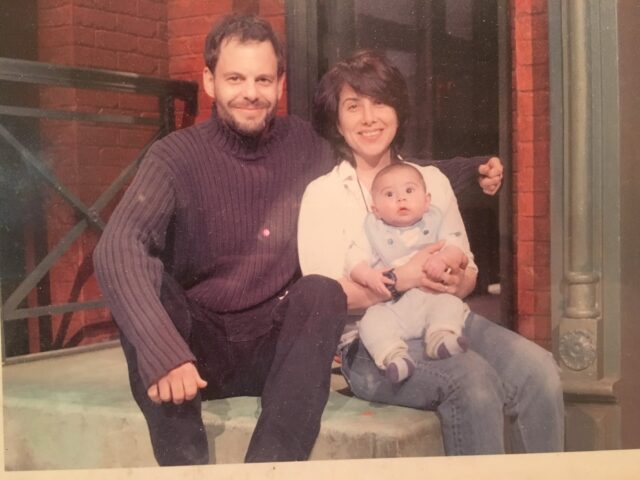
Robin Wilson and Gena Rositano with their son Grey at SNL (photo courtesy Gena Rositano)
I grew up in Malverne but went to high school in Valley Stream with Rositano and have closely followed Grey’s development as a musician in his own right; he is now part of several bands, including the Mercurys, the Afternoon Grifters, and Theo & the London Outfit.
Wilson, fifty-eight, became a Gin Blossom in 1988, one year after the group formed. The band’s major label debut, 1992’s New Miserable Experience, was packed with hits, including “Hey Jealousy,” “Until I Fall Away,” “Found Out About You,” and “Allison Road,” and has sold over five million copies. The follow-up, 1996’s Congratulations I’m Sorry, featured “Follow You Down” and “Til I Hear It from You,” the latter recorded for the 1995 film Empire Records. In addition to performing with the Gin Blossoms, Wilson joined the Smithereens after the 2017 death of Pat DiNizio; he writes songs with the band and alternates on lead vocals with Marshall Crenshaw.
Heavily tattooed and wearing black horn-rimmed glasses, a black T-shirt, and black shorts, Wilson zoomed in from a hotel gym in Indianapolis, where the Gin Blossoms were scheduled to play the penultimate show of their summer tour at the Indiana State Fair that night. After a short break, they’re going back out on the road, stopping at the Paramount in Huntington on September 12.
At the LIMEHOF induction ceremony on August 25 in Stony Brook, Wilson will play a set with a pair of fellow Smithereens, guitarist Jim Babjak and drummer Dennis Diken, along with Joe Jackson bassist Graham Maby and special guest Grey Wilson.
During our talk, Wilson was generous with his answers, giving them careful consideration while being open and direct. Below he discusses fathers and sons, the modern concert experience, cover songs, living in Valley Stream, and more.
twi-ny: We met briefly when your son Grey’s band the Mercurys played the Klub 45 Room in Times Square and you joined them onstage. You played the Gas Giants’ “Quitter,” which was a blast.
robin wilson: It was such a blast.
twi-ny: Grey has also played with the Gin Blossoms. What are those experiences like to have either you jump onstage with him or him jump onstage with you?
rw: Well, it’s a thrill for me because music is the predominant force in my life. And for it to become equally so in my son’s means a lot. It fills me with pride to see him take my lead and to try to follow in my footsteps.
My father was a stuffy Republican accounting professor who wanted nothing to do with me, and we had nothing in common. I never had a moment like that with my dad. There’s no parallel experience that I’ve had with my father. So it means a great deal to me to be able to perform with Grey from time to time.
twi-ny: You went to school where your father taught.
rw: We lived in Tempe. He was a professor at Mesa Community College. Which was nearby. He started teaching there in 1971 when we moved from Detroit to Arizona. And so I grew up on that campus and that was one of my first jobs, working in the cafeteria there. When I got out of high school, I was a student at Mesa. For a long time.
Since my dad was a professor, tuition was free. I went to school there for five years. I never quite got an associate’s degree. For the first few years, I changed my major a bunch of times and kind of floundered around. But by the time I finally found direction, I was studying physics and other of the physical sciences, like chemistry and calculus and geology. And then the band took off, and so I never got to finish my degree. I was very proud to walk into my physics professor’s office one day and say, I can’t finish this semester. Our band is going on tour.
twi-ny: That’s a great excuse.
rw: You know it; it was great. And I remember when I dropped out of college for that first tour, my dad told me, “Robin, you’re a fucking idiot.” [ed. note: After New Miserable Experience went gold, Wilson’s father conceded, admitting, “Robin, I feel like a fucking idiot.”] So I know what it means to my son to pursue music and what it means to dream of a life creating and performing music. I want him to succeed, and I want to give him the tools that he’ll need to accomplish his goal.
twi-ny: I’ve seen Grey play live and on YouTube and Instagram. He’s quite accomplished. He’s got a great stage presence, and he can play that guitar.
rw: Yeah, he can really play. And so I’m always really proud to have him join us onstage with the band. It’s gonna be great to have him performing at the Hall of Fame induction, too.
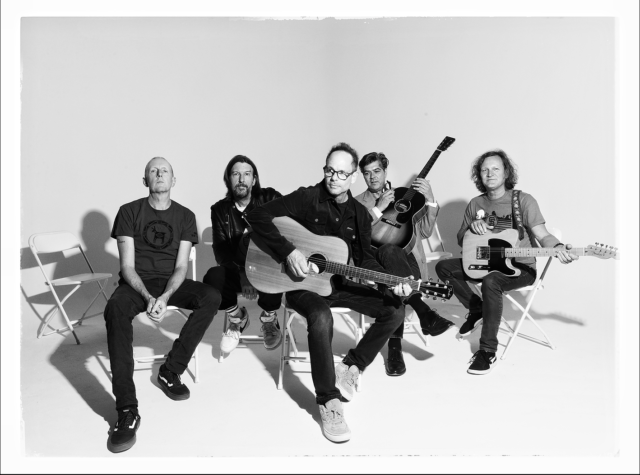
Bill Leen, Scott Hessel, Robin Wilson, Jesse Valenzuela, and Scott Johnson of the Gin Blossoms (photo courtesy the Gin Blossoms)
twi-ny: The Gin Blossoms have been together for about thirty-five years now, including four core members who have been together since 1992. What is the secret to the longevity of the group?
rw: Well, it’s a combination of factors, the most important of which is compromise. Knowing when to keep your mouth shut and just do your job. That goes a long, long way in the rock band environment. That combined with the fact that we have really good songs and we can go to any city in America and sell a thousand tickets and people can sing along with our music. It’s just such a gift to have been able to accomplish that sort of commercial success that it would be stupid just to turn your back on it. You’d have to be really, really unhappy and miserable to want to just blow the whole thing up just because you don’t want to go do rock shows.
It’s not easy. Most of what we do is the traveling. There’s at least ten or twelve hours of travel for every hour we spend onstage. But that ninety minutes a day onstage makes up for all the other bullshit. And my bandmates and I have been able to put our grievances behind us for the most part and accept that everyone in the band is allowed to have their own experience. So we just try to do our jobs and stay out of each other’s way, not create trouble. And we’re grateful that we could still do it at this level,
twi-ny: Touring has obviously changed since the band started. What are one or two things that stick out to you that are either better or worse than they were in the late eighties, early nineties? Fans are throwing objects at lead singers for TikTok. Have you encountered anything or like that?
rw: Well, that kind of thing has happened randomly throughout our career, but it’s just a random occurrence. It’s not a part of any sort of trend. The main force that makes it different now than what it used to be is this device that I’m talking to you on, the smartphone. When we first started touring, we didn’t have GPS. We had a road atlas that was about this thick.
twi-ny: I remember those.
rw: And that would go underneath the driver’s seat. When we would pull into a new town, we would have to pull that out and look through a map. You had to be able to read a map and find your way through a new city to get to the gig. There wasn’t a way to just pull up Yelp and find someplace to eat. You had to ask if there was a restaurant nearby or physically drive around looking for somewhere you could eat.
And then, of course, the worst thing about the phone, this new media, is social media. It’s just a fucking cancer. It makes everyone think that they’re the star of their own reality show and that everything is about them. I don’t mind people taking pictures of the band while we’re performing. I don’t mind video of the band while we’re performing. But what I cannot stand is when someone will stand right in front of me and take a selfie of themselves. That’s just so incredibly rude and so self-absorbed, and it takes you out of the moment, you know? Here’s a picture of me not listening to my favorite Gin Blossoms song.
I just don’t get it. And again, it’s just so rude. The way I think about it is, imagine if your child was onstage in the school play and someone stood up in front of your child while they were delivering their lines and started taking selfies of themselves and started distracting your child. How outraged would you be? Because this person is doing that. It would make you sick to see someone do that.
We didn’t enjoy concerts any less in the eighties and nineties before everybody had a camera with them. We enjoyed concerts just as much when we were forced to use our brains to remember them. And these people who say, Well, I’m entitled to capture the moment. Well, capture it with your brain, you lazy asshole. It’s so stupid. So that’s maybe the main thing. Like I said, I have no problem with people taking pictures or video of the band, but it absolutely disgusts me to see people taking pictures of themselves while standing in front of the band.
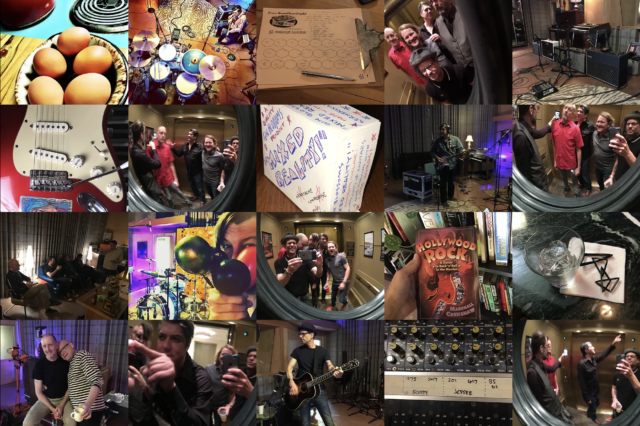
The Gin Blossoms’ most recent album is 2018’s Mixed Reality
twi-ny: As someone who goes to a lot of shows and often is up front, I can tell you it’s also distracting for the audience. If I’m standing behind someone and they suddenly turn around and their face is in my face so they can take a picture of you behind them onstage, it takes me out of the concert for that split second. And so it’s also annoying on that end.
rw: Yeah. But virtually everything else about the concertgoing experience is the same. I mean, how people react to the music and the performers, what the music means to them, the way it inspires genuine emotion. All of that is the same. The thrill of the light show and the sense of community and all of those things. None of that has changed. The only difference is that everybody’s got the phone, and the phone is a way to take you out of the moment.
twi-ny: Over the years, the Gin Blossoms have developed that real sense of community you just mentioned. Your songs really touch people. And I think that reaching them on an emotional level is really part of what’s kept you guys going so strong. I’ve also noticed on the current tour, you’re playing some great covers: Johnny Cash’s “Folsom Prison Blues,” Sam Cooke’s “Twistin’ the Night Away,” and then one of my favorite old songs, the Plimsouls’ “A Million Miles Away”; I saw them play that at the Whiskey a Go Go back in the early eighties.
rw: It’s just great music. I’m glad you’ve enjoyed those songs. And those are all certainly songs that I love to play. I like to play cover songs; I wish that we actually played more covers. I don’t necessarily want to do more covers per show, but I wish we had a larger repertoire of covers we could dip into. But not everybody in the band really loves playing cover songs. They prefer to play original music. And I can appreciate that.
And so, again, what I was saying earlier, the most important thing is to compromise and not make it so any one person in the band is absolutely miserable about the way the shows are done. Everybody’s entitled to have some fun during the show. So if one guy doesn’t want to play a lot of cover songs, well, his feelings are very important to me. So we try to keep it to a minimum. We find the place where we can compromise on these types of issues.
twi-ny: Which doesn’t always happen in a band.
rw: Yeah, it’s very, very difficult to find that. And it’s especially hard when you’re a young band and you’re just coming up and you’re on the charts for the first time. But part of keeping a band together for thirty-five years is learning how to communicate with each other and learning how to find those compromises and the middle ground.
twi-ny: Speaking of original songs, your last album came out in 2018. Anything you guys are working on?
rw: Yeah, at some point. We haven’t got a firm date set to record a new record. But I would suspect that we are going to be in the studio sometime in 2024, have something done by the end of the year. You know, we’re not super anxious, but some of us already have songs that we want to record, and we know we can’t really go much longer before we start to feel bad about it. We don’t owe anybody anything.
It’s not like we sell a lot of records anymore. But as musicians of a part of a certain generation, we feel like we owe it to ourselves to create new music from time to time to challenge ourselves, to create something that we feel holds up with the rest of our catalog. So we know we’ll do it for our own reasons on our own schedule. There’s no record company hounding us to get it done or anything. We’ll just do it when we feel like it. I suspect that it won’t be too long from now before we get another record done. [ed. note: The Gin Blossoms sold a majority stake in their music publishing rights and artist master royalties in 2021 to Primary Wave.]
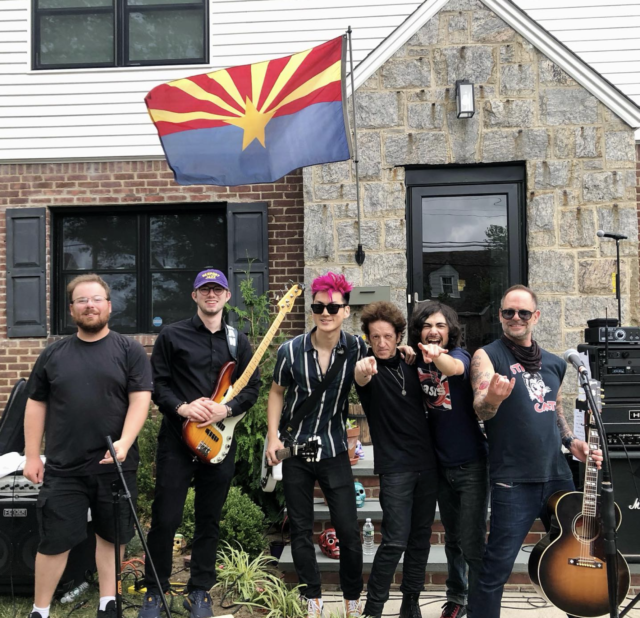
Robin Wilson and Willie Nile join Theo & the London Outfit for a Valley Stream house concert under the Arizona state flag (photo courtesy Theo & the London Outfit)
twi-ny: So getting back to August 25, you’re being inducted into the Long Island Music and Entertainment Hall of Fame. What was it like getting that notification?
rw: Well, it was really amusing. I mean, of course I’m filled with pride and it’s very gratifying. But I’ve had such a contentious relationship with Long Island; my being there, my living there is just such a strange, unlikely circumstance. And it took me so long to get used to it. If you knew what my bandmates have heard me say about Long Island over the years, we’d be laughing as hard as we were when we found out about this, because it was just very difficult for me to get used to being and living on Long Island.
But eventually, it did take, and I’m proud of my home there in Valley Stream, and I’m proud to be the only guy on Long Island who flies an Arizona flag on the front porch. I think it’s really funny when my neighbors come by while they’re walking their dogs and they say, “What is that flag?”
twi-ny: What country is that?
rw: What’s funny to me is, that’s Arizona, that’s the forty-eighth state, you know? So I’m there on Long Island representing my home state of Arizona, which I miss terribly. And now I’ve become a big part of this community.
The company that I’m in with this honor is incredible. It’s humbling and very gratifying. And I’m especially proud for my New York family, the Rositanos, all of my nieces and nephews, my ex-wife and my son, my sister-in-law, my brothers-in-law, and their families. I’m really proud for them, of all the Christmases and holidays we’ve spent together, and now they get to take pride in this, and their pride in this means more to me than anything else about this honor. So I’m very excited for my family, the Rositanos, and I hope they can all be there for for the ceremony.
twi-ny: Is that what brought you to Valley Stream in the first place, family?
rw: Yeah. My ex-wife, Gena, is from Valley Stream. She and I met at MTV. She used to work at MTV.
twi-ny: Yes, I remember.
rw: That’s right. You know Gena. And so she and I met doing The Jon Stewart Show on MTV. [ed. note: You can watch that full episode, also featuring Long Islander Howard Stern, here; Gena was one of the stage managers on the program.]
twi-ny: They just had a reunion, with Jon and everyone.
rw: Yes, that’s right, for the cast and crew. In 1996, Jenna and I had Jon Stewart ordained as a minister, and he performed our wedding ceremony in Valley Stream. It was my connection to Gena and specifically my son, Grey, that kept me there in in Long Island. I could have moved home to Arizona. I always thought I would, but when it came time to actually pull the trigger, I couldn’t leave and I wanted to be there for my son.
And so I’m a Long Island guy now, go figure. And my son, he is in a couple of bands that play around Long Island, Brooklyn, Queens, and whatnot. And then he’s also a DJ on the radio station at Nassau Community College, WHPC 90.3; his show is called “Alternative to What?” It’s Tuesday nights at 7:00, so everybody tune in and hear my son on the radio spinning the alternative hits. That’s 7:00 on Tuesdays, WHPC 90.3.
twi-ny: Excellent. I do want to ask you one other thing, and it has to do with Valley Stream. I was born in Brooklyn and went to school in Valley Stream. And so my wife has listened for decades to all the things I’ve said about Long Island, probably some of the same things that you would tell your bandmates about Valley Stream before you moved there. As a teenager, I couldn’t wait to get out of there to come to New York City. But a lot of my friends still live in Valley Stream and the surrounding area and love it. You’ve really settled in, huh?
rw: Yeah, I really have. You know, It’s a great little town. It’s got tons of great pizza; Ancona’s would be my favorite. There’s really great Pakistani food everywhere. It seems like we have a really large community of really good immigrant cooks everywhere. It’s a very diverse community.
twi-ny: That was not the case when I went to school there.
rw: On my block alone in Valley Stream, there are three families from Guam. You know, I went my entire life in Arizona without ever meeting anyone from Guam. And there on my street in Valley Stream, there are three families from Guam. So there’s something about it. My theory is that these families are moving to America, and they land at JFK with all their bags, and they get out to the curb and they look around and they go, Well, let’s buy a house. And they end up there in Valley Stream.
And I think that’s part of the strength of our community, the diversity and the variety of food and of viewpoints and such. I know that it wasn’t always like that; when I first moved to Valley Stream it was a very different place, in terms of the racial makeup. I very much enjoy how diverse and cool it is now, and how many different cultures are represented just on my block alone.
It’s great to be part of the community. I love my neighborhood. I love all my neighbors. I got to know everybody during the pandemic. I was doing shows for my neighbors during the pandemic; I would be out in my front yard and I would put on concerts. I am really happy. I’m really proud to live there. And so I hope that they can take pride in this honor too.
twi-ny: You recently played a show with Willie Nile and Grey at your house.
rw: Yes, indeed. That was the first one I had done in a while. And so if anyone’s interested in seeing the livestream performances that I’ve done from my home studio or in my front yard, you can go to the Gin Blossoms official YouTube page and see the shows I was doing for my neighbors during the pandemic.
It was the best part of the pandemic for me, performing for my neighbors; it really meant a lot to me that I was able to bring the neighborhood together in a time of isolation. I really enjoyed the pandemic. I mean, obviously it’s not something you would choose to happen, but I managed to make the most of it.
I enjoyed being home for the first time in my adult life. I enjoyed being home for more than a few weeks at a time. I really enjoyed getting to know my neighbors and performing for them, and spending time with my son. I made a lot of carnitas and I played a lot of video games, and I created a lot of content for the Gin Blossoms YouTube page. That’s really kind of when I truly became a citizen of Long Island, during the pandemic.
So, hi to Gena and Grey and all the Rositanos. I’m looking forward to seeing you guys soon. I’m gonna be home for a couple of weeks, for the first time since last winter. I actually have more than five days off starting next week. So I’m looking forward to spending some time in the studio with my son and riding my bike in Valley Stream State Park, just relaxing and enjoying my home.
twi-ny: Well deserved. And congratulations again on the Hall of Fame. I don’t know who’s going to have more fun, you or Grey, but it’s great for both of you.
rw: Definitely Grey; everything’s more fun for Grey than it is for me.
twi-ny: Thanks, man. This was great.
rw: No, thank you. Peace and love for everybody on Long Island. Rock away!
[Mark Rifkin is a Brooklyn-born, Manhattan-based writer and editor; you can follow him on Substack here.]