In late summer 2021, On Site Opera (OSO) presented What Lies Beneath, a collection of six vignettes on board the 1885 cargo ship the Wavertree at the South Street Seaport.
In April 2022, the Manhattan-based company brought its stirring version of Giacomo Puccini’s Gianni Schicchi, the first work in the Italian composer’s Il Trittico (“The Triptych”), to the Prince George Ballroom on East Twenty-Seventh St.
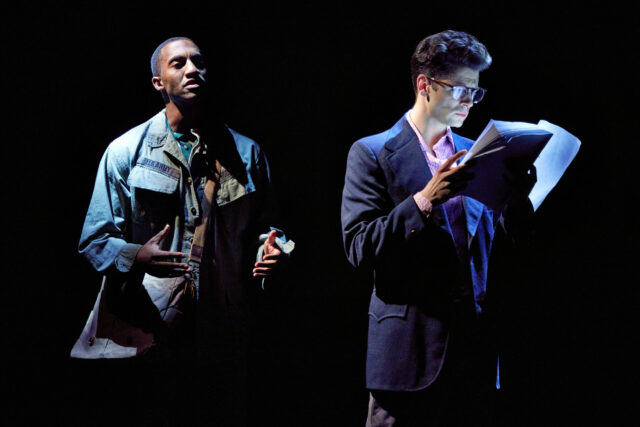
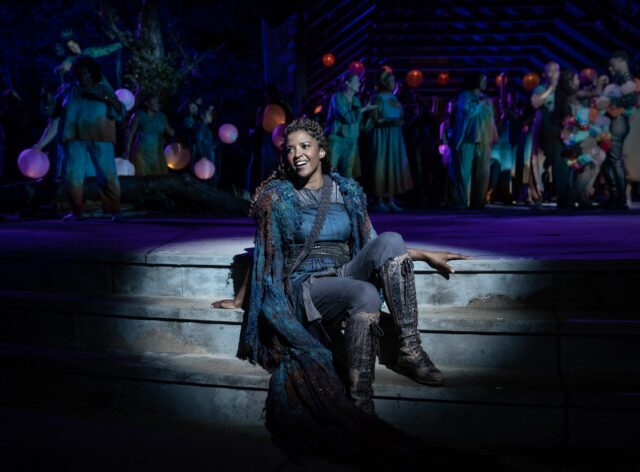
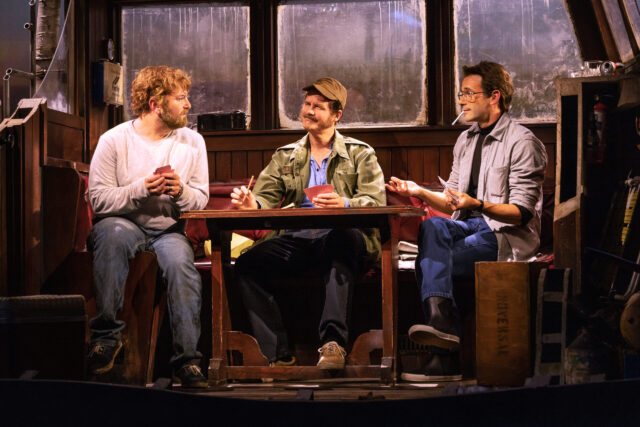
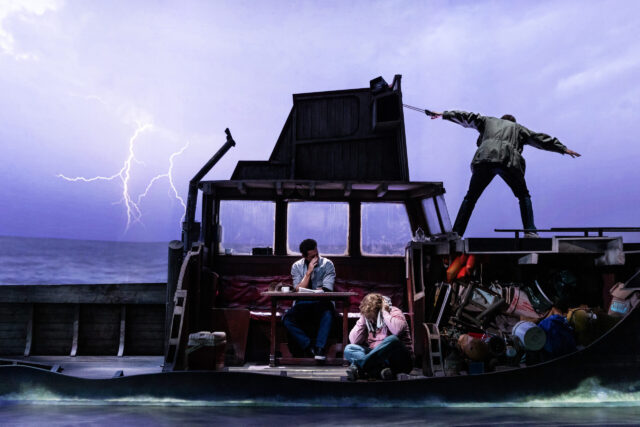
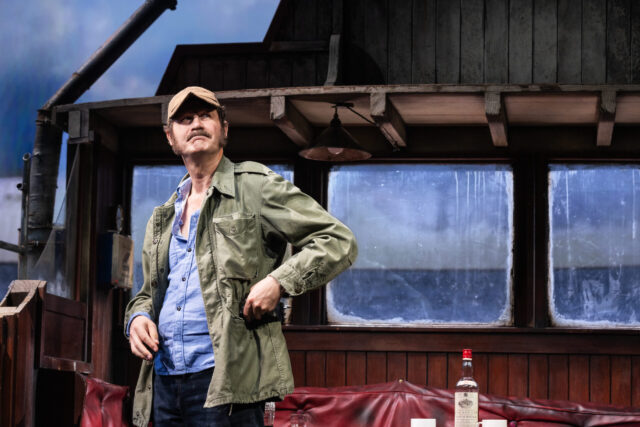
Now OSO is teaming up again with the South Street Seaport Museum for the second part of Puccini’s trilogy, Il tabarro (“The Cloak”), with a libretto by Giuseppi Adami, on board the 1908 lightship Ambrose; the audience will be seated on Pier 16, with minimal interaction with the cast. The approximately sixty-minute story of a love triangle gone bad — does it ever go well? — runs May 14-17 and stars baritone Eric McKeever as barge owner Michele, soprano Ashley Milanese as his wife, Giorgetta, and tenor Yi Li as dockhand Luigi. The ensemble features mezzos Claire Coven and JoAnna Vladyka, sopranos Yohji Daquio, Lindsey Kanaga, Theodora Siegel, and Kiena Williams, baritone Paul LaRosa, bass Brian McQueen, and tenor Daniel Rosenberg, with costumes by Howard Tsvi Kaplan, lighting by Shawn Kaufman, props by Rachel Kenner, and sound by Scott Stauffer. The orchestra will be conducted by Geoffrey McDonald, and the production will be helmed by Laine Rettmer, the first guest director of a full show in OSO’s eleven-year history; OSO co-founding director Eric Einhorn will be leaving the company at the end of the year.
On Site Opera rehearses Il tabarro at Sunlight Studios (photo by Bowie Dunwoody)
“What we have planned for this next installment of Puccini’s Il Trittico promises to be the perfect marriage of found site and libretto,” Rettmer said in a statement. “You will experience the overlay of 2023 merging into 1916 in this engrossing sixty-minute tale set against the setting sun on New York City’s Seaport.”
Ticket holders can also order in advance a $25 boxed dinner from Cobble Fish, which can be eaten before or during the show. The Ambrose, aka Lightship LV-87, is a National Historic Landmark and was the first lightship to have a radio beacon; it served in various capacities, including as an examination vessel during WWII, through 1963. The Seaport Museum offers free guided tours of the lightship Wednesday through Sunday. OSO will ultimately conclude Puccini’s Il tabarro with Suor Angelica at a date to be announced.
Two couples can’t reach a genuine understanding in God of Carnage (photo by Carol Rosegg)
GOD OF CARNAGE
Theatre Row
410 West 42nd St. between Ninth & Tenth Aves.
Tuesday – Sunday through May 20, $72.50 www.tbtb.org
“Why does everything always have to be so exhausting?” Veronica (Christiane Noll) asks in Theater Breaking Through Barriers’ (TBTB) splendid off-Broadway premiere of Yasmina Reza’s 2008 dark comedy, God of Carnage, running at Theatre Row through May 20. The prescient fifteen-year-old show feels even more relevant today as we deal with exhaustion of all kinds on a seemingly endless basis.
Before the actors take the stage, they identify themselves in voiceover: what they’re wearing and what the set looks like, the words projected onto the back wall, which Veronica explains “is composed of approximately twenty square and rectangular panels and is painted bright red. Because the panels are all different sizes and overlap each other, the wall presents as fractured with an illusion of depth to it. It is reminiscent of the cubism movement of the early twentieth century.” In this revival, “illusion of depth” and “cubism” would be two ways to describe what happens over the course of ninety minutes.
Founded in 1979, TBTB is “dedicated to advancing artists and developing audiences of people with disabilities and altering the misperceptions surrounding disability”; thus, some of the actors have disabilities (that are not necessarily noticeable and aren’t the point), and the dialogue is projected through the entire play for those who are hard of hearing (though often a distracting second or two behind the action). God of Carnage is an excellent choice for TBTB, as part of the plot involves a drug that might be causing side effects that mimic certain disabilities.
Michael Novak (Gabe Fazio), who runs a wholesale household goods company, and his wife, Veronica, a writer who works in an art history bookstore, have invited over Alan Raleigh (David Burtka), a hotshot corporate lawyer, and his wife, Annette (Carey Cox), who’s in wealth management, to discuss an unfortunate situation: The Raleighs’ eleven-year-old son, Benjamin, struck the Novaks’ eleven-year-old, Henry, across the face with a stick in Cobble Hill Park, knocking out two of his teeth. For legal and insurance purposes, the parents are drafting a document explaining precisely what happened. The disagreements begin from the very start, when Veronica states that Benjamin was “armed with a stick” but Alan objects to that word and they decide on “furnished” instead.
The narrative plays out like a courtroom drama as the audience shifts its sympathies among the four characters, who eventually all show their true colors, some of them unexpected. Alan spends much of his time on his cell phone, handling a crisis for a pharmaceutical company in a bind because of serious issues with one of its drugs. He remains in the living room, speaking loudly to his colleagues and clients, oblivious to whether or not everyone hears what he’s saying because he’s sure that it’s far more important than arguing about a couple of boys being boys.
Gabe Fazio, David Burtka, Christiane Noll, and Carey Cox star in off-Broadway debut of Tony-winning play (photo by Carol Rosegg)
Annette is furious at her husband’s disrespect and neglect and is at first insistent that Benjamin must apologize in person to Henry. But as more facts come out, she starts pulling back and pointing fingers. Veronica is appalled at this change, although she at times seems more concerned about her collection of rare art volumes and the book she’s writing on Sudan. Meanwhile, Michael sees nothing wrong with how he disposed of his daughter’s beloved hamster, while his mother keeps calling on the landline, worrying about her own health situation.
Every time the Raleighs get up to go, something happens to keep them in the living room, reminiscent of Luis Buñuel’s The Exterminating Angel, in which people at a dinner party are unable to leave. And as the two couples’ discussions get more combative — there’s even a debate over the homemade clafouti Veronica serves — the parents get more and more cruel as things devolve into mayhem.
Translated from the original French by Christopher Hampton, who has translated five of Reza’s plays, including the Tony-winning ‘Art,’God of Carnage debuted on Broadway in February 2009 with an impressive cast: Jeff Daniels as Alan, Hope Davis as Annette, James Gandolfini as Michael, and Marcia Gay Harden as Veronica. All four actors were nominated for Tonys; Gay Harden won for Best Actress and Matthew Warchus for Best Director, and the show took home the Best Play prize. Roman Polanski’s 2011 film starred Christoph Waltz as Alan, Jodie Foster as Annette, John C. Reilly as Michael, and Kate Winslet as Veronica.
TBTB’s adaptation might not boast huge names, but it is a small gem that celebrates the sharp writing, which is filled with hilarious absurdities while turning modern-day Brooklyn parenting inside out. The show takes place on the cusp of the social media revolution, when bullying was still mostly limited to physical rather than online interaction. The Novaks and the Raleighs are practically the opposite of helicopter parents; at one point, when Annette criticizes her guests’ parenting skills, Alan gives her permission to say anything she wants to Benjamin, something that is unlikely to happen today, especially in the Cobble Hill area.
Bert Scott’s set is centered by an off-white sofa and matching armchair, with a glass coffee table, beige rug, utility table with bottles of alcohol, Parson chair, and end table with a vase of yellow tulips; the soft lighting and projections are by Samuel J. Biondolillo, with sound by Eric Nightengale and appropriate bourgeois Brooklyn costumes by Olivia V. Hern.
Burtka (Gypsy,It Shoulda Been You) is strong and unflappable as Alan, a selfish man who cares more about his job than his wife and son. “I really wish you would just turn off your cell phone and focus on your family for a change,” Annette yells at him during TBTB’s added introduction. “There is nothing worse than someone who is so addicted to their cell phone that they can’t shut it off for a time and focus on what is right in front of them.” Cell-phone rudeness has only gotten worse since 2008, so Reza was right on target with Alan. When Annette says under her breath to the audience, “Blah blah blah, it’s the same nonsense all the time,” Alan asks, “Who are you talking to?,” as he is unable to see anyone else but himself, including the audience. (Echoing Alan and Annette, when Michael describes himself to the audience in the guise of testing out a new voice recorder, Veronica grumbles, “Michael, what are you doing?”)
Cox (The Glass Menagerie,The Handmaid’s Tale) kicks it into high gear as Annette, who is getting sick and tired of being pushed around by everyone because of her generally mousey demeanor; she is like the hamster, ready to break free from Alan, who calls her “Woof-woof” as if she is his pet. Meanwhile, Fazio (The Last Days of Judas Iscariot,The Good Nurse) captures Michael’s unpredictability, the character drifting in his own world, reaching for the fancy rum when things get rough. And Tony nominee Noll (Ragtime,Chaplin) holds nothing back as Veronica, whose carefully orchestrated existence is coming unhinged despite her best efforts to remain in control, even regarding her clafouti recipe.
TBTB artistic director Nicholas Viselli, who just received a Legend of Off-Broadway Award from the Off Broadway Alliance, builds the narrative at an ever-increasing pace as the Novaks and the Raleighs discover that they might be more alike than they ever imagined. No one is left unscathed in this spirited tale that begins as a taut psychological drama and slowly evolves into all-out physical chaos. These scenes of carnage may have been penned fifteen years ago, but in this stinging production it feels like they could have been written yesterday.
Gego installing Reticulárea 1981, 1980, permanent collection display, Sala Gego (Gego Room), Galería de Arte Nacional, Caracas (photo by Christian Belpaire, courtesy Archivo Fundación Gego)
Who: Mónica Amor, Vered Engelhard, Geaninne Gutiérrez-Guimarães, Pablo León de la Barra, Sean Nesselrode Moncada, Luis Pérez-Oramas, Mari Carmen Ramírez, Álvaro Sotillo What: Symposium on “Gego: Measuring Infinity” Where:Solomon R. Guggenheim Museum, 1071 Fifth Ave. at Eighty-Ninth St. When: Friday, May 12, $15-$25, noon – 5:00 Why: German-Venezuelan artist Gertrud Goldschmidt, better known as Gego, is the subject of the outstanding new Guggenheim exhibition “Gego: Measuring Infinity,” consisting of nearly two hundred drawings, etchings, watercolors, letters, and, primarily, mesmerizing, fragile, architectural sculptures that Gego called drawings without paper. On May 12, the Guggenheim is hosting the five-hour seminar “Gego: Weaving Lines of Thought,” examining the life and career of Gego, who was born in Hamburg in 1912 and died in Caracas in 1994. Organized by exhibition cocurators Pablo León de la Barra and Geaninne Gutiérrez-Guimarães, the symposium, part of the Guggenheim’s Latin American Circle Presents series, will feature presentations by León de la Barra, Gutiérrez-Guimarães, Mónica Amor, Vered Engelhard, Sean Nesselrode Moncada, Luis Pérez-Oramas, and Mari Carmen Ramírez in addition to longtime Gego collaborator Álvaro Sotillo. The exhibition continues through September 10; make sure to save time for the remarkable “Sarah Sze: Timelapse” as well.
The Actors Studio continues its seventy-fifth anniversary celebration with several special free events this month (photo courtesy the Actors Studio)
THE ACTORS STUDIO IN PROCESS
The Actors Studio
432 West Forty-Fourth St. between Ninth & Tenth Aves.
May 12-13, free with RSVP, 7:00
Additional events May 14, 19-20, 25-26 theactorsstudio.org
If you haven’t been paying attention, the Actors Studio has been celebrating its seventy-fifth anniversary with some outstanding public events. Last month, “Directed by Estelle Parsons” featured the Oscar- and Obie-winning actress helming three works; in December, Carroll Baker was on hand for a talk following a screening of Elia Kazan’s Baby Doll; and in October, Al Pacino hosted a screening of Sidney Lumet’s Dog Day Afternoon at United Palace.
The party continues this weekend with Tony and Obie winner Lois Smith and others taking audiences behind the scenes in “The Actors Studio in Process.” On May 12 and 13 at 7:00, there will be open rehearsals of scenes from three plays: Elizabeth Stearns’s Hillbilly Women, directed by Marilyn Fried and starring Smith, Jacqueline Knapp, and Taylor Plas; writer-director Dennis Russo’s Midnight and Sky, with Russo and Marc Solomon; and Chris Stack and Scott McCord’s We Might Fall Apart, with McCord, Stack, and Plas. Admission is free with RSVP.
On May 14 at 3:00, an encore of “The Playwright: Tales from the Color Line” consists of scenes from plays exploring race, followed by Q&As, with Phillip Hayes Dean’s This Bird of Dawning Singeth All Night Long, directed by Paul Calderon and starring Martha Gehman and Richarda Abrams; James Baldwin’s Blues for Mister Charley, directed by Patricia Floyd and featuring McCord, Robert Mobley, Samuel Pygatt, Delissa Reynolds, and Lawrence Stallings; Lorraine Hansberry’s The Sign in Sidney Brustein’s Window, with Michael Billingsley, Aprella Godfrey-Barule, and Omar Ezat and directed by JoAnna Rhinehart; and Charles Gordone’s No Place to Be Somebody, with Mobley, Brittaney Chatman, Rony Clanton, Marcus Naylor and Steven Vause, directed by Naylor.
The festivities carry on later in the month with “On the Fly 2023: Then and Now” on May 19 and 20, a two-part presentation of short plays by BIPOC writers and directors, the first night a screening of Zoom plays streamed during the pandemic, the second live works, and May 25 and 26 with “Areyto: Latine Celebration,” an immersive theatrical ceremony rooted in equatorial tribal origins, followed by a reception.
D’Arcy Carden, Chris Sullivan, Katie Finneran, and Scott Foley star in The Thanksgiving Play on Broadway (photo by Joan Marcus)
THE THANKSGIVING PLAY
Hayes Theater
240 West 44th St. between Broadway & Eighth Ave.
Tuesday – Sunday through June 11, $109-$169 2st.com/shows www.playwrightshorizons.org
Call it The Thanksgiving Play That Goes Wrong.
In November 2018, I wrote that the world premiere of Larissa FastHorse’s The Thanksgiving Play at Playwrights Horizons was “a wild and woolly farce that takes on important indigenous issues — in real life and on the stage. [FastHorse] is attempting to level the playing field by increasing diversity and pushing an own-voices sensibility.”
Nearly five years later, the play is debuting on Broadway from Second Stage, with a different director, different cast, different set, and significantly tweaked script that make it all feel like so many dried-out leftovers.
The plot is the same. Logan (Katie Finneran) is a high school drama teacher directing a forty-five-minute Thanksgiving play for elementary school students. She has hired her overly politically correct boyfriend, local street performer Jaxton (Scott Foley), to star in the show, along with professional actress Alicia (D’Arcy Carden), whose experience has been primarily in Disney theme parks; elementary school history teacher and amateur writer and actor Caden (Chris Sullivan) is the research consultant. Logan has decided it will be a devised production, with everyone contributing in an improvised fashion, which delights Caden, who has come with plans for a major epic, but bores Alicia, who says, “I’m an actress. Could I come back when there’s a script? I just got to town and have a hundred things to do.”
Logan, who is proudly vegan and refers to Thanksgiving as “the holiday of death,” has received the Race and Gender Equity in History Grant, the Excellence in Educational Theater Fellowship, a municipal arts grant, the Go! Girls! Scholastic Leadership Mentorship, and the Native American Heritage Month Awareness Through Art Grant and is determined to please all her funders. She is distressed when she discovers that Alicia, who she believed was Native American because of one of her head shots, is not. “So we’re four white people making a culturally sensitive First Thanksgiving play for Native American Heritage Month? Oh my Goddess,” Logan proclaims as if it’s the end of the world.
Alicia (D’Arcy Carden) and Logan (Katie Finneran) face some PC issues in The Thanksgiving Play (photo by Joan Marcus)
Each scene that they discuss unravels either because of length, cost, or political sensitivity. When Caden suggests starting the play four thousand years ago with the agricultural revolution and using lots of fire, Logan says, “I am conscious of not allowing my personal issues to take up more space in the room than the justified anger of the Native people around this idea of Thanksgiving in our postcolonial society. I want to make that crystal clear.” Alicia asks, “Was America even invented yet?” To which Jaxton replies, “It was not. Better times. That makes me wonder if using the word of the conqueror, ‘American,’ could be a trigger for people? What word do you prefer for naming this physical space? I’ve heard ‘Turtle Island’ used a lot. Do you prefer that?” Alicia chimes in, “I like turtles.”
They argue about casting, food, historical accuracy, prayer, Columbus Day, the depiction of violence, and “white people speaking for white people” as they try to figure out what actions they can take in good conscience in today’s equality-conscious culture.
The word “woke” began to take on its current meaning in 2014 following the police killing of Michael Brown in Ferguson, Missouri. In the October 2020 Vox article “A History of ‘Wokeness,’” Aja Romano writes, “In the six years since Brown’s death, ‘woke’ has evolved into a single-word summation of leftist political ideology, centered on social justice politics and critical race theory. This framing of ‘woke’ is bipartisan: It’s used as a shorthand for political progressiveness by the left, and as a denigration of leftist culture by the right.” This evolution of wokeness lies at the heart of the problems with this new iteration of The Thanksgiving Play; in the five years since it debuted off Broadway, the play has become a victim of its own wokeness.
In 2018, MacArthur Genius FastHorse (Cherokee Family Reunion, Urban Rez,What Would Crazy Horse Do?) was right on target, skewering how difficult it was to use the proper language to describe people and events. The battle between Logan and Jaxton’s progressiveness and Caden’s insistence on historical accuracy was hilariously spoofed by Alicia’s utter disinterest in what either side had to say, representing Americans who were fed up with partisan fighting over everything and instead just wanted to get on with it all. At one point, Jaxton says about Alicia’s lack of Native American heritage, “I think we could get away with using her before 2020, but now we’re post the postracial society. We can’t be blind to differences.”
At Playwrights Horizons, Jaxton said “a few years ago” instead of “before 2020,” and therein lies the conundrum. What was a clever, prescient satire in 2018 now feels stale and mean, revealing that the show is already dated. The cast is fine, led by Carden as a sexier Alicia, but Riccardo Hernández’s classroom set is confining, although it’s telling that posters on the wall promote such previous school productions as Sarah Kane’s 4.48 Psychosis, Euripides’s Medea, Sophocles’s Oedipus, and Aleshea Harris’s Is God Is, works that many school districts today would consider too controversial to put on.
The supremely talented Rachel Chavkin (Hadestown,Natasha, Pierre & the Great Comet of 1812) is unable to get a firm grasp on the proceedings, teetering between farce and a cautionary tale. I wrote about the PH show, “One of the main reasons why The Thanksgiving Play works so well, despite the occasional bumpiness, is because we recognize parts of ourselves in the four characters; of course, off-Broadway audiences tend to be significantly liberal — and often privileged — terrified of uttering or doing the wrong thing when it comes to people of color yet rather clueless about their own giant blind spots. Thus, there are moments in the show when you are likely to hesitate before laughing, wondering whether you are being insensitive by enjoying yourself too much.” That dichotomy is missing here.
The original production began with Logan (Jennifer Bareilles), Alicia (Margo Seibert), and Jaxton (Greg Keller) coming out dressed as pilgrims and Caden (Jeffrey Bean) as a giant turkey, singing, “The Twelve Days of Thanksgiving,” announcing that this was going to be a good-natured social comedy. The Broadway edition opens with a video of children, dressed in homemade costumes, singing the same song, but it is announcing that the debates over the validity of how and why we celebrate Thanksgiving and the entire DEI movement are poisoning the next generations. Each version concludes with the statement: “Teacher’s note: This song can do more than teach counting. I divide my students into Indians and pilgrims so the Indians can practice sharing.” At Playwrights Horizons, the audience laughed at that line; at the Hayes, they gasped. The Thanksgiving Play’s time has come and gone.
“This is a challenge, but we are the future of theater and education. Are we all in agreement?” Logan asks.
Dancin’ “revival” gets too much backward in looking forward (photo by Julieta Cervantes)
BOB FOSSE’S DANCIN’
Music Box Theatre
239 West 45th St. between Broadway & Eighth Aves.
Tuesday – Sunday through May 14, $114 – $318 dancinbway.com
The original Broadway production of Dancin’ was a thrilling celebration of music and movement as only Bob Fosse could do it. The superb cast included Sandahl Bergman, René Ceballos, Christopher Chadman, Wayne Cilento, Vicki Frederick, and Ann Reinking, shaking things up to a wide range of genres, from pop and jazz to classical and patriotic, with little or no plot. It was nominated for seven Tonys, with Fosse winning for Best Choreography and Jules Fisher for Best Lighting.
For the current reimagining of the show at the Music Box — there are too many changes to properly call it a revival — they have added Fosse’s name to the title, but that ends up being a disservice to the late, magnificent choreographer (and sometimes director) of Sweet Charity,Damn Yankees,The Pajama Game,Pippin,Chicago, and the film version of Cabaret, who is unlikely to have been thrilled with this 2023 iteration, which opened March 19 and has just posted an early closing notice of May 14 after receiving no love from the Tonys, coming up empty-handed.
Cilento is back, this time as director and musical stager, with Christine Colby Jacques credited with “reproduction of Mr. Fosse’s choreography” and David Dabbon with “new music and dance arrangements.” Cilento had his work cut out for him, as there was no script and no recordings of the original presentation, so he and Jacques, who understudied for the 1978 Broadway show, used muscle memory and YouTube videos of other productions. The result is a hot mess from start to finish, but it won’t tarnish Fosse’s legacy, as he can’t take any of the blame for this one. (Notably, however, Nicole Fosse, his daughter with Gwen Verdon, is one of the producers.)
Dancin’ will be closing early after coming up with no Tony noms (photo by Julieta Cervantes)
The so-called Bob Fosse’s Dancin’ features a whole lotta hats, cigarette smoking, shoulder shimmying, sequins, and jazz hands as the cast prances and twirls in, on, and around tall metal scaffolding towers and in front of occasionally dizzying projections on a back screen. The imposing industrial set is by Robert Brill, with projections by Finn Ross, over-the-top sound by Peter Hylenski, excessive lighting by David Grill, and inconsistent costumes by Harriet Jung and Reid Bartelme.
“Recollections of an Old Dancer” kicks off with tone-deaf archival footage of Bill “Mr. Bojangles” Robinson. “Big City Mime,” which was understandably cut in 1978, returns, a sleazy depiction of New York as a town of hookers and pimps. “Big Deal” is a failed attempt at noir. “The Female Star Spot” goes woke on Dolly Parton’s “Here You Come Again.” The “America” segment, with such red, white, and blue tunes as “Yankee Doodle Dandy,” “When Johnny Comes Marching Home,” and “Gary Owen,” feels today like parody. (At least they cut “Dixie”; other numbers were left out because of rights issues.) “The Dream Barre” has been banished.
The second act opens with the still-stellar “Benny’s Number,” a rousing performance of the Benny Goodman Orchestra’s “Sing, Sing, Sing,” with drummer Gary Seligson soloing up high on a platform, although it goes on too long; uncoincidentally, the original company performed the first part of the piece at the Tonys, so it is in this piece that Fosse’s choreography is most closely replicated in 2023.
And speaking of singing, we are told at the beginning that there will be some singing, but it turns out that there is a significant amount, and most of the vocals are undistinguished, delivered more like the performers are on The Voice or American Idol than on a Broadway stage. The individual scenes are like flashy MTV videos that have little to do with one another; Dancin’ 1978 worked as individual set pieces, but Dancin’ 2023 doesn’t trust the dancing enough and instead bombards the audience with posturing glitz and glamour to grab our attention. That continues during the curtain call, in which each dancer takes a bow with their name projected hugely on the screen, as if we need to remember who is who when we vote.
The only name we’d prefer not to see is Bob Fosse’s on the marquee.
David Hammons works on a piece for Documenta IX (photo by Hessischer Rundfunk)
THE MELT GOES ON FOREVER: THE ART AND TIMES OF DAVID HAMMONS (Judd Tully & Harold Crooks, 2022)
Film Forum
209 West Houston St.
Opens Friday, May 5
212-727-8110 filmforum.org themeltfilm.com
“David believes that the less said about him, the better off he is,” the late poet and Gathering of the Tribes founder Steve Cannon says about his friend, artist David Hammons, in The Melt Goes on Forever: The Art and Times of David Hammons, opening May 5 at Film Forum.
In 2020, Hammons, who was born in Springfield, Illinois, in 1943 and has been based in New York City for nearly fifty years, installed Day’s End, an homage to Gordon Matta-Clark’s 1975 similarly named intervention in an abandoned industrial building on Pier 52, outside where the Whitney is today. The 325-foot-long brushed-steel outline of the warehouse has no interior, a ghostly memorial to those lost in the AIDS crisis.
With The Melt, directors Judd Tully and Harold Crooks have constructed a stirring documentary that is missing one key figure: Hammons, who doesn’t do interviews or talk about his personal life, preferring to have his work stand on its own. There’s a reason why the subtitle is “the Art and Times,” not the more common phrase “the Life and Times.”
More than two dozen art historians (Kellie Jones, Bridget R. Cooks, Richard Powell, Gylbert Coker, Robert Farris Thompson), dealers and gallerists (Jeanne Greenberg Rohatyn, Dominique Lévy, Jack Tilton, Adam Sheffer, Robert Mnuchin), artists (Suzanne Jackson, Fred Wilson, Tschabalala Self, Betye Saar, Joe Lewis, Lorna Simpson), collectors (Dimitris Daskalopoulos), and curators (Robert Storr, Ilene Susan Fort, Mary Jane Jacob) share stories about Hammons, forming a picture of a fabulously talented eclectic iconoclast who does what he wants, when he wants, the way he wants.
Among his revolutionary works discussed in the film are Bliz-aard Ball Sale, in which he sold snowballs, arranged in rows of descending size, on the streets of New York; African American Flag, a reimagining of the US flag but in the Pan-African colors of red, black, and green; How You Like Me Now?, a billboard of Jesse Jackson as a blond-haired, blue-eyed white man; Flight Fantasy, painted on the wall of Cannon’s apartment; Untitled (Night Train), two circular rows of clear and green bottles of Night Train and Thunderbird planted in a pile of coal; and Blues for Smoke, a blue model train rolling across tracks that wind around grand pianos on their side, inspired by John Coltrane’s song “Blue Train.”
“I just thought he was nuts,” artist Paul H-O says about watching Hammons go through garbage to find potential materials.
“It’s not the art object itself,” Hammons explains in a 1991 NPR radio interview. “It’s the daring of the act.”
Archival footage of Hammons includes a visit by filmmaker Michael Auder to a Rome studio in 1989 where Hammons pontificates on what success means to him while constructing an untitled sculpture using real Black hair; Hammons adding cotton to wooden sticks in his Harlem studio in Michael Blackwood’s 1992 After Modernism: The Dilemma of Influence; Hammons introducing students to his outdoor sculpture Rock Fan, consisting of electric fans on a large rock on the campus of Williams College in 1993; and clips by Alex Harsley of Hammons making “Basketball Drawings” by bouncing a basketball against paper on a wall and Hammons kicking a can in his 2004 Phat Free performance.
Delving into a 1990 group show at Museum Overholland, curator Jan Christiaan Braun notes, “‘Black USA’ was more than David Hammons. It was an effort to find a podium for Black American artists. He was one of them. The meaning of ‘Black USA’ was bigger than David Hammons, and he himself thought so too. He was very, very much supporting the idea of bringing out Black art. That’s why he immediately said to me, ‘I’m your man.’”
Extensive attention is given to the 2016 career retrospective “Five Decades” at Mnuchin Gallery, which lends insight to Hammons’s wide oeuvre and process when it comes to hanging his work. “Two weeks prior to the opening, David expressed an interest in coming in to see the show,” dealer Sukanya Rajarantnam recalls, not so fondly. “Um, his reaction was not exactly exuberant. He didn’t like what we’d done and, in fact, hated it. So he decided to change things. . . . The show itself became an installation and an artwork by David.” I remember being blown away by the final exhibition, which featured many of the pieces mentioned in the documentary.
David Hammons unveils Rock Fan to students at Williams College (photo courtesy Williams College Museum of Art)
Throughout the film, arts journalist Tully and documentarian Crooks (The Price We Pay,Surviving Progress) regularly cut to Umar bin Hassan of the Last Poets performing Cannon’s catalog essay-poem “Rousing the Rubble,” recorded during Covid and originally written for Hammons’s 1990 PS1 museum show of the same name, accompanied by a barrage of grainy videos of New York City in the twentieth century and animation by Tynesha Foreman that brings some of his works to life against a pulsating Afro-jazz score:
“On the Streets of Manhattan, East Side West Side All Around the Town the Sidewalks of New York — after the bars and the clubs empty out the sordid the homeless! The misbegotten under the cover of darkness Blue Moon No moon, under the cover of darkness in the wee small hours up in Harlem — Midtown — on the Lower Eastside — Performing Artist — this is when you see the empty bottles and empty people makin’ their rounds, into makin’ their own sounds — into smiles into frowns! Digging in garbage in search of more empties — bottles and cans! Those who do be hungry doing something about their condition — with David on the scene in those lonely wee small hours after hours state of New York! Raw Energy! Making his rounds, dreams turned into nightmares heavy into art — that New York art scene outdoor art — dreams turned into realities — all night diners — back in his studio on 125th Street — making art out of that which he has heard and seen on the scene out of funk! Out of central Illinois — out of Los Angeles out of his world travels! Creating a space for the spirits! That flash of the spirit!”
The spectacular original music features composer Ramachandra Borcar on percussion, piano, found objects, and other instruments; saxophonists Idris Ackamoor, Marshall Allen, Shabaka Hutchings, and Frank Lozani; Tommy Babin and Dave Watts on bass; Aaron Doyle on trumpet and flugelhorn; Jeff Johnston on piano; and Kullak Viger Rojas on surdo. It pays tribute to the jazz influences Hammons has cited over the years, such legends as Charles Mingus, Miles Davis, Thelonius Monk, Charlie Parker, Ornette Coleman, and Coltrane. Foreman’s animation unfolds to those same vibrant rhythms, echoed in the artworks. (Hammons’s art influences range from his mentor, Charles White, to Marcel Duchamp.)
Even without their subject’s participation, Tully and Crooks are able to fill in much of the mystery surrounding Hammons, with the help of members of the arts community who adore him and his work, like partially furnishing the emptiness inherent in Day’s End. (Hammons did sit down for an interview with Whitney director Adam D. Weinberg to celebrate the opening of the Pier 52 project in June 2021, which you can watch here.)
The Melt Goes on Forever reveals Hammons to be a true nonconformist, a genius who doesn’t need to be center stage, letting his art do the talking for him.
Tully and Crooks will be at Film Forum for Q&As on May 5 at 7:15 presented by A Gathering of the Tribes, on May 6 at 7:15 with Suzanne Jackson, and on May 7 at 4:40.