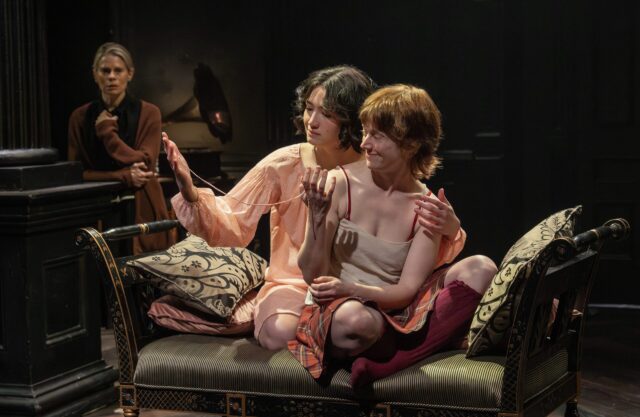
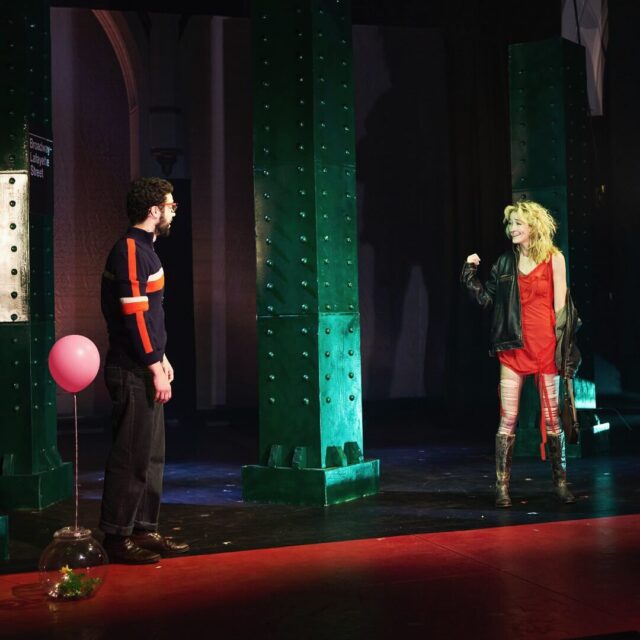
Chorus (Celia Keenan-Bolger) looks on as siblings Ismene (Haley Wong) and Antigone (Susannah Perkins) connect (photo by Joan Marcus)
ANTIGONE (THIS PLAY I READ IN HIGH SCHOOL)
Barbaralee Theater, the Public Theater
425 Lafayette St. at Astor Pl.
Tuesday through Sunday through April 12, $89-$109
publictheater.org
The Public has hit a grand slam with four current productions, continuing founder Joe Papp’s mission that has been embodied by longtime artistic director Oskar Eustis, who wrote in American Theatre in 2007, “The voices that need to be reflected on our stages are not the voices of the few, but the voices of the many.”
The quartet of works explore the state of America, and its position in the world, in wide-ranging plays that take things to the limit and beyond.
In the last dozen years, New York has seen no fewer than ten shows that featured some version of Sophocles’s Antigone character, the daughter of Oedipus and Jocasta who risks her life by insisting on an honorable burial for her brother Polynices after her uncle, King Creon, declares him a traitor. The dark tale has inspired such recent adaptations as Satoshi Miyagi’s lush Antigone at Park Ave. Armory; Alexander Zeldin’s contemporary transformation, The Other Place, at the Shed; and Shayok Misha Chowdhury’s rousing, impassioned version of Lee Breuer and Bob Telson’s The Gospel at Colonus at the Amph at Little Island.
At the Public’s Barbaralee Theater, Anna Ziegler’s Antigone (This Play I Read in High School) reimagines the Greek tragedy as a treatise on a woman’s right to choose what to do with her body. The narrative shifts between an alternate modern-day Thebes, where Antigone (a powerful and moving Susannah Perkins) is pregnant, and Pittsburgh, where the forty-year-old Dicey, serving as the chorus (a tender, superb Celia Keenan-Bolger), is contemplating her surprise pregnancy.
An early scene has them sitting across from each other on a plane, the teenage Antigone reading the Sophocles play. Dicey asks Antigone why she is reading it, and she responds, “Why shouldn’t I?” Dicey says, “It’s just that you don’t seem to like it very much.” Antigone explains, “It’s not that I don’t like it. I’m just like, is it even about her? It seems like it’s all about her brother’s body. A man’s body. . . . Is it even about her?”
With the death of Antigone’s parents, her uncle, Creon (a fine Tony Shalhoub), has taken the throne; one of his first edicts is to make abortion a capital crime, proclaiming, “A big part of the platform of this government is upholding the value of life, family, and kinship.”
Antigone seeks the support of her sister, the pristine, beautiful Ismene (a lovely Haley Wong), who is shocked when Antigone admits to her that she just had a drunken one-night stand with a waiter named Achilles (Ethan Dubin) despite being betrothed to Haemon (Calvin Leon Smith), Creon’s son. “Wouldn’t it have been okay to just let things be . . . quiet for a while. Not to make drama,” Ismene posits, to which Antigone replies, “Isn’t making drama, like, our inheritance?” Ismene is even more distressed when Antigone talks about getting a back-alley procedure from what turns out to be a sketchy proprietor (Katie Kreisler).
Desperately trying to retain control of his family and the kingdom, Creon enlists three guards (Dave Quay, Dubin, and Kreisler) to help, but they are more like the Keystone Cops than worthy protectors as Antigone refuses to back down from her beliefs.
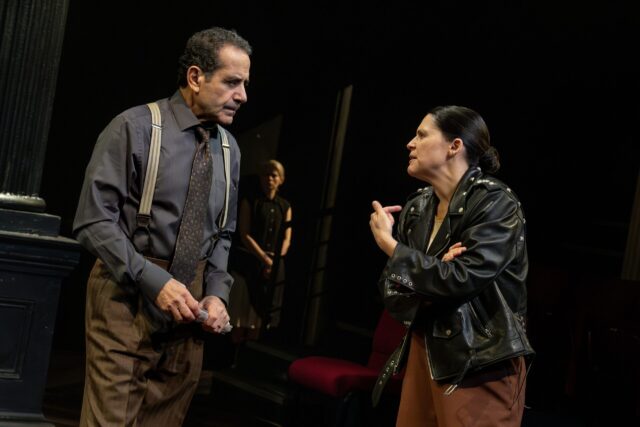
King Creon (Tony Shalhoub) has harsh words for an abortionist (Katie Kreisler) in unique take on Antigone (photo by Joan Marcus)
Beautifully designed by David Zinn with intriguing costumes by Enver Chakartash, Antigone (This Play I Read in High School) is a chilling feminist call to action, a treatise on motherhood, responsibility, and gender expectations; Ziegler (Boy, Actually) and director Tyne Rafaeli (Data, Becoming Eve) challenge the audience while celebrating theater itself, including sharp references to Arthur Miller’s Death of a Salesman. The 135-minute play (with intermission) veers into repetitive didacticism at the conclusion, telling us what they’ve already shown us, but it also reminds us that things we learned in high school do stay with us if we pay attention.
The cast is exemplary, led by a fierce performance by Perkins (Grief Hotel, The Wolves, The Good John Proctor), a rising star who commands the stage even with such Tony-winning veterans as Keenan-Bolger (To Kill a Mockingbird, The Glass Menagerie) and Shalhoub (Happy Days, Act One).
At the start of the second act, Dicey recalls seeing a college production of Death of a Salesman, remembering, “I stood in the back . . . spellbound. There was just something about it.”
The same can be said for this Antigone.

Four Korean American sisters reconnect in Jeena Yi’s playwriting debut (photo by Joan Marcus)
JESA
The Shiva Theater
425 Lafayette St.
Tuesday – Sunday through April 12, $80
publictheater.org
ma-yitheatre.org
The Public teams with resident troupe Ma-Yi Theater Company, whose mission is “to develop and produce new and innovative plays by Asian American writers . . . shaping local and national conversations about what it means to be Asian American today,” for Jesa, a passionate world premiere that marks the playwriting debut of actor Jeena Yi. Although the story is about four Korean American sisters, the script calls it An American Family Drama, an important statement.
In present-day Orange County, four siblings gather for Jesa, a ritual honoring their parents on the anniversary of their deaths. Grace (Shannon Tyo), a seemingly perfect suburbanite with a lovely home, a husband, and a daughter named Lily, is hosting the ceremony, determined to have everything go exactly as planned. The fashionable Elizabeth (Laura Sohn), who works in private equity, arrives first, bringing fruit and a reminder that she is setting up a trust for Lily, no matter what Grace thinks about it. The brash, opinionated Tina (Tina Chilip), a chef, is next, screaming as she enters, “Who’s ready for Jesa, bitches!!!???” The last to show up is Brenda (Christine Heesun Hwang), an independent theater director who has flown in from New York and apparently is not going to stay long.
Grace has decided that they will perform a double Jesa, for their Umma’s (mother’s) one-year anniversary and their Appa’s (father’s) fifth, which doesn’t make all of them happy, as each has their own beliefs about the ceremony. Over the course of ninety minutes, the siblings chastise and insult one another, share good and bad memories, and try to bond as they prepare for and perform the rituals and reevaluate their own and their siblings’ lives.

Elizabeth (Laura Sohn) looks on as Tina (Tina Chilip) and Brenda (Christine Heesun Hwang) have a moment in Jesa (photo by Joan Marcus)
The banter among the women often comes fast and furious, as in this exchange:
Grace: Who knows when you’ll be around again, and its Umma’s first Jesa. You should pour her a drink.
Brenda: If I do Umma’s, then we have to do another round of bows for Liz and this is gonna take forever.
Grace: We have to do another round anyway.
Brenda: How many rounds are there???
Grace: Does it matter?
Brenda: I have to leave in like an hour.
Grace: What? I thought you’re staying here.
Brenda: No, I’m staying at my friend’s place in NoHo.
Liz: NoHo! That’s so far! You’re gonna show up at your friend’s at like three in the morning? Rude!
Brenda: You know what —
Tina: Just pour the drink!
Tina: Show some respect, Brenda.
Brenda: Sorry.
Jesa takes place in You-Shin Chen’s pristinely designed kitchen and living room set; Mel Ng’s costumes firmly define the differences among the four sisters as they discuss shrimp, dress socks, Lily’s upcoming birthday, photos of their parents, and a Jesa app that’s in English. Tyo (Yellow Face, The Comeuppance) is affecting as the ever-dependable Grace, whose idyllic life is starting to reveal some cracks; Heesun Hwang (SUFFS, Miss Saigon) is wistful as Brenda, who is still searching for her purpose; Sohn (The Blacklist) makes a strong New York stage debut as Elizabeth, who has not found happiness through money; and Chilip (Knight of the Burning Pestle, A Delicate Balance) is uproarious as the aggressive, nasty, but honest Tina.
As important as the double Jesa itself is to the plot, it slows down the otherwise swift pace; Yi (Walden, Cymbeline) and director Mei Ann Teo (SKiNFoLK: An American Show, Where We Belong) can’t quite find the right balance there, but otherwise Jesa, boasting an all-female and gender-expansive–identifying AAPI cast and creative team, is a funny and potent world premiere with awesome action, biting dialogue, and a spiritual surprise.
Yes, it’s about a Korean American family, but it could just as well be about any American family, regardless of heritage.

Public Charge explores the career of Julissa Reynoso, who cowrote play (photo by Joan Marcus)
PUBLIC CHARGE
Newman Theater
425 Lafayette St. at Astor Pl.
Tuesday – Sunday through April 12, $99
publictheater.org
Fact-based plays such as Oslo and Kyoto have proved that international diplomacy can be a fascinating theatrical subject, the former about a 1993 peace meeting between Israel and the PLO in Norway, the latter detailing a series of 1989–97 climate change conferences. Foreign policy is similarly at the center of the engrossing Public Charge, continuing at the Public’s Newman Theater through April 12.
Written by former US ambassador Julissa Reynoso and Michael J. Chepiga, the world premiere production tells the true story of Reynoso’s rise from her first attempt to immigrate to the United States from the Dominican Republic when she was six in 1981 to working for the State Department under both Barack Obama and Joe Biden. Accompanied by her uncle Nelsido (Al Rodrigo) to the US Embassy in Santo Domingo, they are questioned by a consular officer (John J. Concado) who assumes the little girl, whose mother is working in a factory in the Bronx, will become a public charge, a noncitizen who will be dependent on the government for support. The officer makes such snide remarks as “Lots of welfare mothers in the Bronx.” and “It looks like her mother makes less than minimum wage. How is she going to feed this girl? We have enough people like you on food stamps.” He also chastises Julissa for not speaking English and rejects her application. “You are keeping this child away from her mother?” Nelsido says. “What kind of policy can that be?”
The story then jumps to Washington, DC, in 2009, when Reynoso is being interviewed by humorless State Department official Ricardo Zúñiga (Dan Domingues) for a position as a US representative overseas. “You work for the bureau that covers Latin America and the Caribbean?” Julissa asks. Ricardo responds, “Yes. I am in charge of Cuba.” To which Julissa says, “I thought Castro was?” She smiles, but he does not.
Soon she is working with Cheryl Mills (Marinda Anderson), chief of staff to Secretary of State Hillary Clinton, handling the Caribbean and Central America. Julissa is smart and savvy, willing to challenge the government’s written and unwritten policies, particularly when it comes to Cuba. When the 2010 earthquake devastates Haiti, Julissa has to obtain permission from Cuba to fly over its airspace in order to get medical supplies and other support to the Haitians as quickly as possible, but Ricardo says she cannot do that because America has cut off all contact with Cuba for decades.
Julissa proceeds anyway, opening long-closed channels. She enters into negotiations with Cuban officials Bruno Rodriguez (Armando Riesco), Jorge Bolaños (Rodrigo), and Josefina Vidal (Maggie Bofill), succeeding in Haiti but seemingly unable to free government contractor Alan Gross, who has been captured by the Cubans and imprisoned as a spy. His wife, Judy (usually Barbara Walsh, although I saw understudy Deirdre Madigan), is desperate to get him out and grows more and more upset with Julissa, who is haunted by her inability to secure his release.
Julissa also starts up a kind of friendship with Uruguayan president José Mujica (Rodrigo) after being named ambassador to the South American nation, although she is watched closely by his right-hand hatchet man, Chacha (Riesco), who distrusts everything American. As she continues her unique brand of diplomacy, pouring her heart and soul into the job, the story occasionally shifts back to a Bronx bodega where she talks politics and learns life lessons with her father, Julio (Riesco), and owner El Chino (Rodrigo).
In 1984, the three of them argue about Ronald Reagan and the Cuban embargo. “If Reagan lifted it, Cuba would be a rich country, and the Cubans would stay where they are. They would love Americans and American values, and hate the Soviets,” Julio claims. Julissa asks, “Show love and communism goes away? It’s that simple?” Her father answers, “Reagan should just pick up the phone and call Castro.”
A quarter century later, Julissa essentially takes that advice and runs with it.
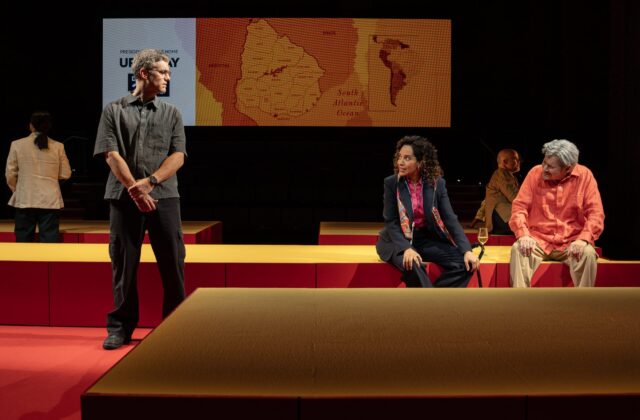
International diplomacy takes center stage in Public Charge (photo by Joan Marcus)
It would have been easy for Public Charge to have drowned in self-congratulatory moralizing, but instead Reynoso and Chepiga (Getting and Spending, Matter of Honor) aren’t afraid to depict Julissa’s failings along with her successes; they don’t build her into a hero making grandiose speeches but instead reveal a bright woman battling an aging bureaucracy set in its ways and often unwilling to change.
Arnulfo Maldonado’s scenic design consists of pastel-colored jigsaw-puzzle-like platform pieces that the characters walk across and sit on, evoking a three-dimensional map of countries that are separated from one another, difficult to bring together. Lucy Mackinnon’s projections set the time and place, from 1981 Santo Domingo to 2009 DC, 2010 Port-au-Prince, and 2014 Montevideo. Haydee Zelideth’s costumes range from business professional to Mujica’s easygoing casual.
Tony-winning director Doug Hughes (Doubt, Frozen) lets the proceedings flow with an austere simplicity, maintaining a steady pace even when situations grow dire. Guevara (My Broken Language, Water by the Spoonful) portrays Reynoso with just the right amount of veritas, with solid support from Anderson (Merry Me, Sandblasted), Domingues (The Tempest, Wild Goose Dreams), and, in multiple roles, Riesco (Deep Blue Sound, Water by the Spoonful) and Rodrigo (Blood Wedding, Open Admissions).
It’s impossible to watch Public Charge without thinking about the state of international diplomacy under the current administration; we could use a whole lot of Julissa Reynosos in today’s government. Reynoso, Chepiga, and Hughes don’t exploit that, but they do get in one specific dig when Julio, talking about Reagan in January 1984, posits, “Reagan’s an idiot and a hypocrite. He doesn’t know history. And he has no idea of how to deal with Cuba. Or Latin America. Or anything. We could never have a worse president.”
Point taken.
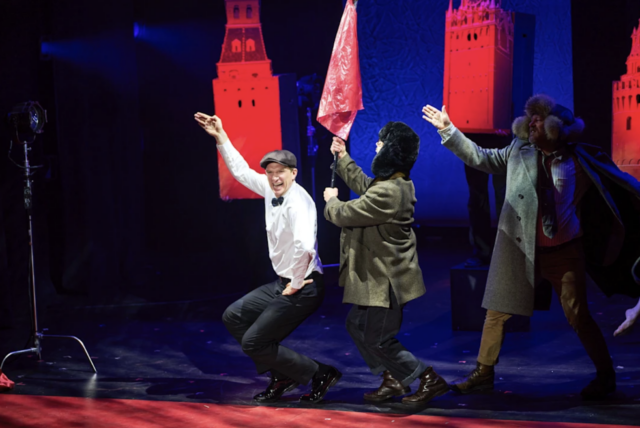
Andrey Burkovskiy serves as host and MC of Seagull: True Story remounting at the Public (photo by Kir Simakov)
SEAGULL: TRUE STORY
LuEsther Hall, the Public Theater
425 Lafayette St. at Astor Pl.
Tuesday – Sunday through May 3, $109
publictheater.org
Last May, I saw Alexander “Sasha” Molochnikov’s Seagull: True Story at La MaMa. As much as I enjoyed it then, it is even better in this revised version at the Public’s LuEsther Hall. I have adapted my initial review for this new production, which runs through May 3.
In Anton Chekhov’s 1896 tragicomedy The Seagull, wannabe playwright and director Konstantin Gavrilovich Treplev says, “It’s not about old or new forms, but about the fact that what a person writes, not thinking about forms at all, they write because it flies freely from their soul!” The line is at the center of Seagull: True Story.
In 2022, Molochnikov was a successful Russian director who had staged works at the Moscow Art Theater and won the prestigious Golden Mask award for his production of The Seagull at the Bolshoi. He was starting to make a film when Russia began bombing Ukraine; he soon spoke out against the attack. He then found himself a target of Vladimir Putin’s administration and departed for America with not much more than the clothes on his back.
“The pressure on artists, comedians, and especially directors has been ruthless in Russia. As a result, a dozen or so of the most celebrated theater directors working in Moscow before the war have left the country,” he wrote in Rolling Stone in November 2022. “Now any performance has to be careful so as not to offend the Kremlin’s feelings. Those who were not ready to cave in and play that game chose to give up their opportunities, resources, stages, and salaries and run. They escaped Russia to foreign countries, counting only on their own talents and starting over from scratch. My case was the latest in a chain of attacks on the arts and free speech in Russia. . . . There is only one reason so many artists have left: It’s unsafe and dangerous to express a negative opinion of what Russian authorities call ‘a special operation’ and what the world calls an invasion.”
In Seagull: True Story, Molochnikov and writer Eli Rarey adapt Sasha’s real tale into a kind of theatrical fantasy rooted in Chekhov’s play, complete with a play-within-a-play, a love triangle, a complicated mother-son relationship, a gun, and discussions of form and freedom. Andrey Burkovskiy serves as the emcee for the evening, addressing the crowd directly while also playing several other key roles.
It’s February 2022, and young director Kon (Eric Tabach) is leading the rehearsal for his wildly inventive adaptation of The Seagull at the prestigious Moscow Art Theater, which was founded by Konstantin Stanislavski and Vladimir Nemirovich-Danchenko in 1898. The MC succinctly sums up Chekhov’s plot: “Basically nothing happens. Treplev is a director in love with Nina, an actress. His mom is an actress too. Nina is in love with someone else. She leaves, Treplev is sad, she comes back, Treplev is even more sad. His mom is a bitch. He shoots himself. That’s it.”
Kon’s mother, Olga (Zuzanna Szadkowski), is a famous Russian actress who is playing Arkadina. Ivan (Quentin Lee Moore) is Treplev, her hapless son who is in love with Nina, portrayed by Masha (Gus Birney, replacing Stella Baker from the La MaMa cast). Poet and playwright Anton (Elan Zafir) is the dramaturg, while Yuri (Burkovskiy), the theater manager, keeps a careful watch on everything. Alexander Shishkin’s set features two dressing tables on either side of the stage in front of a red curtain and a deep open space behind it where the rehearsals are held; many of the props involve creative uses of plastic, from flags to ocean waves to bedspreads.
In a rare compliment, Olga tells Kon, “If Chekhov were here today, he would be happy to see that his play lives on in your hands. My little Stanislavsky!”
However, once Russia starts bombing Ukraine, the actors commence fighting — Ivan, defending the Kremlin, gets into it with Masha and Dmitri, who support Ukraine. But when Kon makes a private anti-Putin video that goes viral, he has to get out of the country immediately, leaving his mother and his good friend Anton behind.
In the second act, Kon arrives virtually penniless in New York, with nowhere to live. He meets aspiring actress Nico (Birney) on the subway and asks his mother’s old friend Barry (Burkovskiy), a producer, for help bringing his adaptation of The Seagull to the city, but first he must helm Barry’s bizarre immersive multimedia production of The Three Little Pigs.
“Wow! These are the kinds of shows I produce!” the MC declares.
Kon (Eric Tabach) and Nico (Gus Birney) meet cute in Seagull: True Story (photo by Kir Simakov)
A coproduction of Sofia Kapkov’s MART Foundation and Anne Hamburger’s En Garde Arts, Seagull: True Story is one of a number of recent shows from companies led by Russian or Ukrainian refugees, including Igor Golyak and Arlekin Players Theatre’s The Merchant of Venice and Our Class, Dmitry Krymov and Krimov Lab NYC’s Pushkin “Eugene Onegin” and Uncle Vanya, scenes from country life, and director Eduard Tolokonnikov and producer Polina Belkina’s encore engagement of Aleksandr Volodin’s Five Evenings.
The works bring an exhilarating aesthetic to independent New York City theater; Golyak and Krymov have brilliantly wild and unpredictable methods of storytelling where almost anything can happen, incorporating lunatic props and unique interactive elements. The exuberant cast of Seagull: True Story sing, dance, and march while switching between the play and the play-within-the-play. Certain lines of dialogue are accompanied by winks and nods as they relate just as much to what is happening in the United States under the current administration as to the events occurring in Russia and Ukraine. The first act is sensational, a fast and furious celebration of the power of theater even under the most stressful and dangerous situations. The second act has been significantly improved, streamlined to maintain a better focus.
At the beginning of the show, the MC says the word “fantastic” ten times, praising himself, the audience, and the play. He announces, “Don’t panic, you will be arrested only at the end of the show. No, no, I’m joking. Am I? Of course not. Everything is fantastic. Everyone is safe here.” Burkovskiy is fantastic in his multiple roles, his tongue firmly in his cheek as he offers his own spin on the MC from Cabaret. Zafir poignantly portrays the friendly and likable Anton, Birney adds a new dimension as the ambitious and sexy Nico, and Tabach ably stands in for Molochnikov as he faces a frightening reality and has to start all over again. (Molochnikov will assume the role himself at the April 12 gala performance.)
“The world loves Russian theater. It has survived under Josef Stalin, Nikita Khrushchev, and Leonid Brezhnev. It will outlive Putin, too,” Molochnikov concludes in his Rolling Stone essay. “But the life we had before the war is over. Russian theater is universal. The pain in the works of Chekhov, Nikolai Gogol, Fyodor Dostoevsky, and Leo Tolstoy are understood and appreciated all over the world. I will work on my dramas, operas, and ballets abroad. ‘We will work,’ as Sonya says in Uncle Vanya. We will ‘look for new forms,’ as Treplev says in The Seagull. The theater will live on.”
Russia’s loss is New York City’s gain.
In his American Theatre article, Oskar Eustis also writes, “So we know that the theatre is about democracy and that the theatre is about imagining what it looks like from somebody else’s point of view — which means that the theatre has to be, from its very nature, controversial. It doesn’t always have to be politically controversial. It doesn’t always have to be offensive. But the whole idea of the theatre is the idea of imagining things that you haven’t imagined before — of imagining perspectives that are not yours. The theatre is not there to validate our own experiences. The theatre is there to push our own experiences, to expand our notion of what we are.”
All four productions now at the Public do just that.
[Mark Rifkin is a Brooklyn-born, Manhattan-based writer and editor; you can follow him on Substack here.]