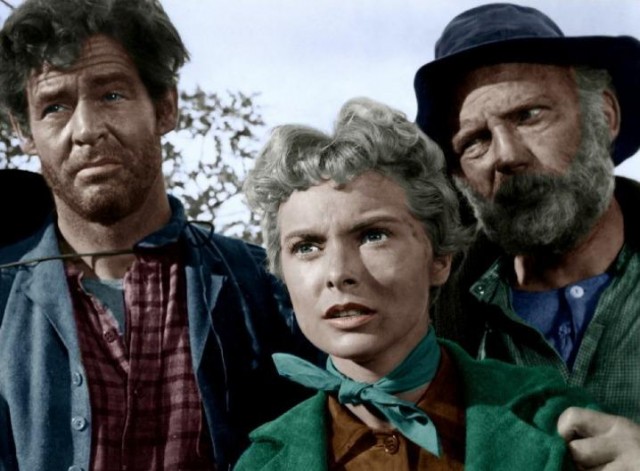
Robert Ryan, Janet Leigh, and Millard Mitchell have a lot of physical and psychological ground to cover in Anthony Mann’s THE NAKED SPUR
THE NAKED SPUR (Albert Mann, 1953)
Film Forum
209 West Houston St.
Sunday, August 14, 2:50, 6:10, 9:40
Series continues through August 25
212-727-8110
www.filmforum.org
 Shortly after the Civil War, bounty hunter Howard Kemp (James Stewart) is determined to bring in wanted murderer Ben Vandergroat (Robert Ryan) and claim the reward. Joined by grizzled old prospector Jesse Tate (Millard Mitchell) and dishonorably discharged Union lieutenant Roy Anderson (Ralph Meeker), Kemp gets his man, along with Ben’s companion, the young Lina Patch (Janet Leigh), the daughter of Ben’s dead best friend. They tie up Ben’s hands, put him on a burro, and head out on the long, arduous trail to turn him over to the federal marshals. But the smug, wisecracking outlaw has other plans, continually planting various seeds to try to set Howard, Roy, and Jesse against one another. Directed by Anthony Mann (Winchester ’73, The Man from Laramie) and shot in the Rocky Mountains, The Naked Spur is not just another Western; it is a multilayered exploration of lust and greed, love and sexuality, with Lina at the center of it all. When Ben needs his sore back rubbed, he asks her, “Can you do me?” Roy thinks he can do anything he wants with any woman. And Howard can’t get over a part of his past, suffering from nightmares that haunt him. Unfortunately, the complex story is dragged down by overly conventional music — “Beautiful Dreamer”? Really? — and some ridiculously staged, hard-to-believe action scenes, but it’s still worth saddling up your horse and going along for the ride. The Naked Spur is screening August 14 with John Sturges’s Bad Day at Black Rock (1955) as part of Film Forum’s “Robert Ryan” series, which continues with such pairings as Berlin Express (Jacques Tourneur, 1948) and Beware, My Lovely (Harry Horner, 1952); Odds Against Tomorrow (Robert Wise, 1959) and Lonelyhearts (Vincent J. Donehue, 1958); Caught (Max Ophüls, 1948) and Clash by Night (Fritz Lang, 1952); and such single presentations as The Wild Bunch (Sam Peckinpah, 1969), God’s Little Acre (Anthony Mann, 1958), and The Iceman Cometh (John Frankenheimer, 1973), which taken as a whole display Ryan’s Jimmy Stewart-like ability to shift between genres with grace and ease. A Dartmouth grad who was born in Chicago, Ryan was an outspoken civil rights activist who made more than fifty films during his thirty-plus-year career, which ended when he died of lung cancer in 1973 at the age of sixty-four.
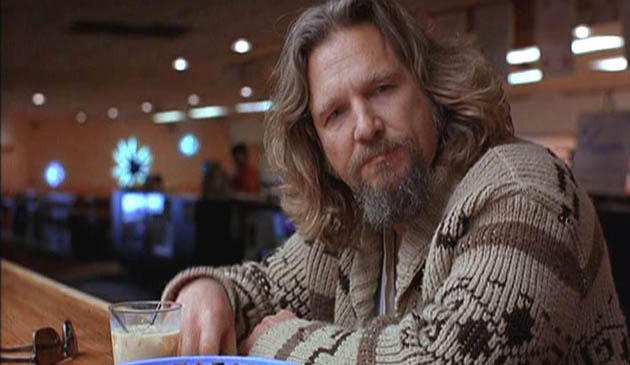
 One of the ultimate cult classics and the best bowling movie ever, the Coen brothers’ The Big Lebowski has built up such a following since its 1998 release that fans now gather every year for Lebowski Fest, where they honor all things Dude. This time around they’ll be partying even harder, celebrating the August 16 release of the limited-edition Blu-Ray at a pair of special events. On August 15, Achievers can go bowling at Chelsea Piers and take part in costume and trivia contests. The next night, the movie will be screened at the Hammerstein Ballroom, followed by a Q&A with stars Jeff Bridges, John Goodman, Steve Buscemi, and Julianne Moore and music impresario T Bone Burnett, as well as other festivities. As far as the film itself goes, if you’ve never seen it, well, this would be a fine time to finally catch this intricately weaved gem. Bridges is awesome as the Dude, a laid-back cool cat who gets sucked into a noirish plot of jealousy, murder, money, mistaken identity, and messy carpets. Moore is excellent as free spirit Maude, Tara Reid struts her stuff as Bunny, and Peter Stormare, Flea, and Torsten Voges are a riot as a trio of nihilists. Also on hand are Philip Seymour Hoffman, David Huddleston, Aimee Mann, Jimmie Dale Gilmore, David Thewlis, Sam Elliott, Ben Gazzara, Jon Polito, and other crazy characters, but the film really belongs to the Dude and his fellow bowlers Jesus Quintana (John Turturro, who is so dirty he is completely cut out of the television version), Donny (Buscemi), and Walter (Goodman), who refuses to roll on Shabbos. And through it all, one thing always holds true: The Dude abides. (August 16 also marks the release of Bridges’s latest CD, which he will be signing August 18 at 6:30 at the B&N at 555 Fifth and 46th St.; please note that he will not be signing anything else, including Blu-Ray copies of The Big Lebowski.)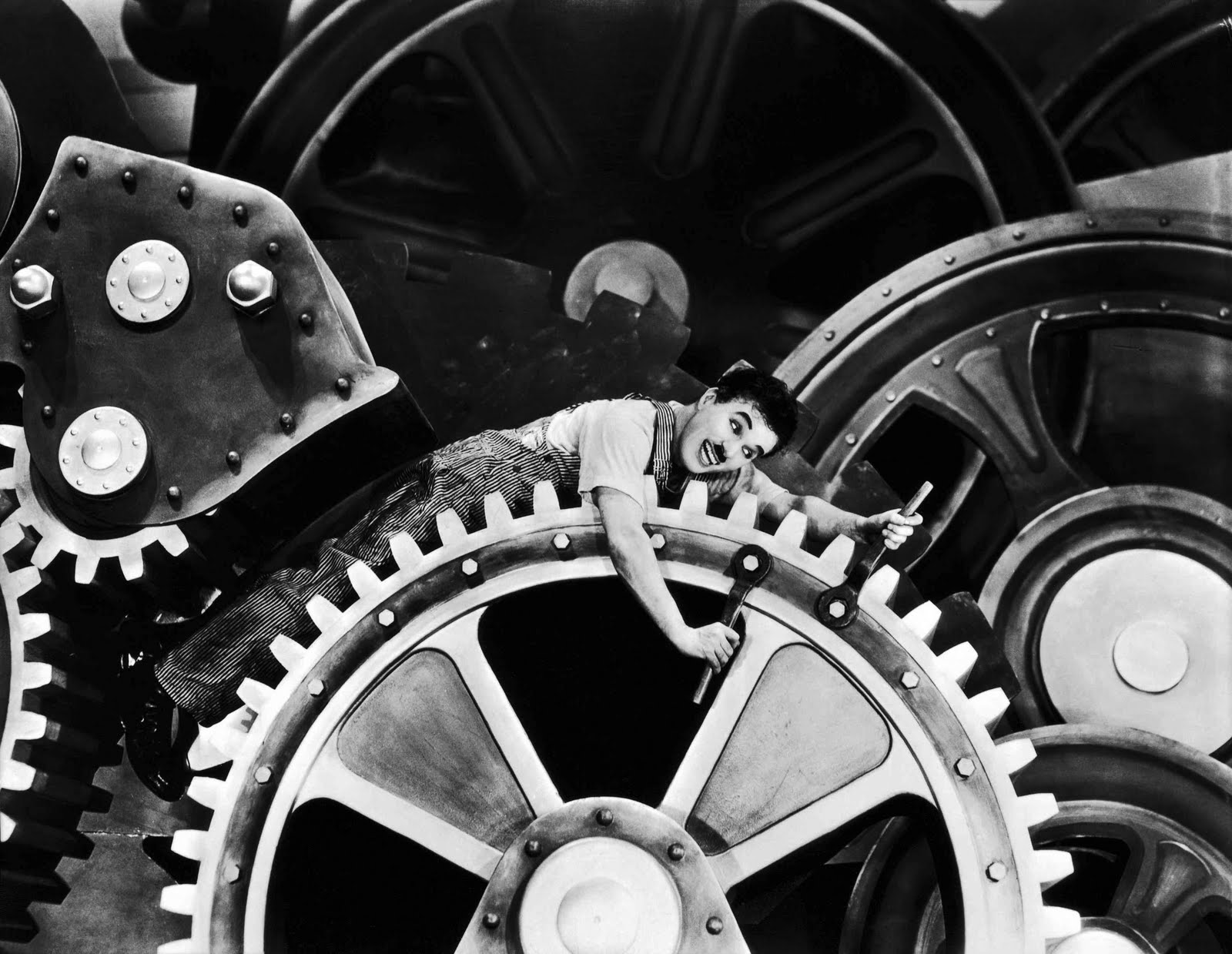
 As America slowly recovered from the Great Depression and headed toward the Second World War, Charlie Chaplin also found himself trapped between the past and the future. Talkies had started in 1927 with Al Jolson in The Jazz Singer, but the British-born actor, writer, director, producer, and composer had not crossed over yet, still favoring the silent cinema that had made him an international star. But his 1936 masterpiece, Modern Times, tackled the coming of the modern era in myriad ways, both public and personal, in the world at large as well as in cinema itself. Chaplin stars as an assembly line worker who literally gets caught up in the cogs of machinery, suffers a nervous breakdown, gets sent to prison for leading a Communist march he was not a part of, accidentally dabbles in a little nose candy, and falls in love with a homeless gamin who lives by her wits on the docks, played by his real-life lover, Paulette Goddard. He tries to fit in to the ever-changing society, without much luck; he even has trouble getting himself arrested again, thinking that jail is a better option than what’s out there. The unemployed former factory worker and the gamin move into a run-down shack and try to pretend that they are a happy, successful married couple, but the harsh reality of their poor existence continually thwarts them. Modern Times is a brutally funny, honest, and insightful examination of the socioeconomic conditions of America in the 1930s. As corporations began to grow, workers became nameless automatons; in fact, neither of the film’s protagonists is given a name. For the first time, Chaplin uses sound, but always in ingenious ways: the factory owner, who watches his workers like a hawk, using surveillance cameras that are remarkably prescient, talks only via a screen as he yells at his employees; music, which Chaplin previously utilized only on the backing soundtrack, now comes from bands seen on camera, as if they’re playing live; and the Little Tramp himself gets into the act as a singing waiter, although it’s not exactly like Garbo breaking her on-screen silence. Chaplin’s choice to include some sound while still avoiding even a single strand of actual dialogue between characters is a brash commentary on the technological revolution that was taking hold of the country and, of course, impacting the film industry. Chaplin’s previous movie, the 1931 classic City Lights, was a more traditional silent film, but with his next work, 1940’s The Great Dictator, he finally made the transition to a full talkie, albeit still finding himself trapped between two worlds, playing both a poor ghetto barber and the Fascist Hitler-like leader of Tomania. Modern Times is screening August 13 and 21 as part of Symphony Space’s “Chaplin” series, which is presenting many of his works on the big screen in HD for the first time ever, which is rather ironic, especially in the case of Modern Times; the series continues with such films as Monsieur Verdoux on August 14, The Great Dictator and City Lights on August 21, The Circus on August 27, and Limelight offering a fitting conclusion on August 28.