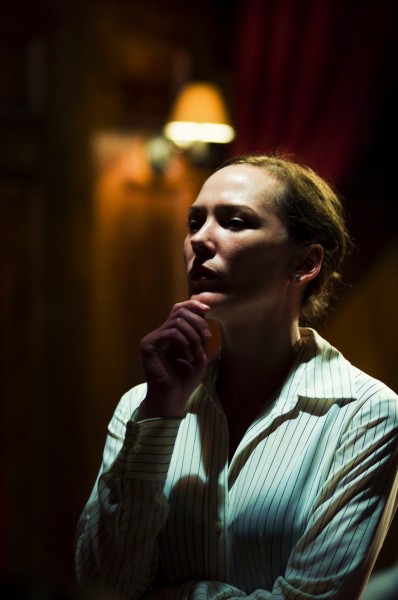
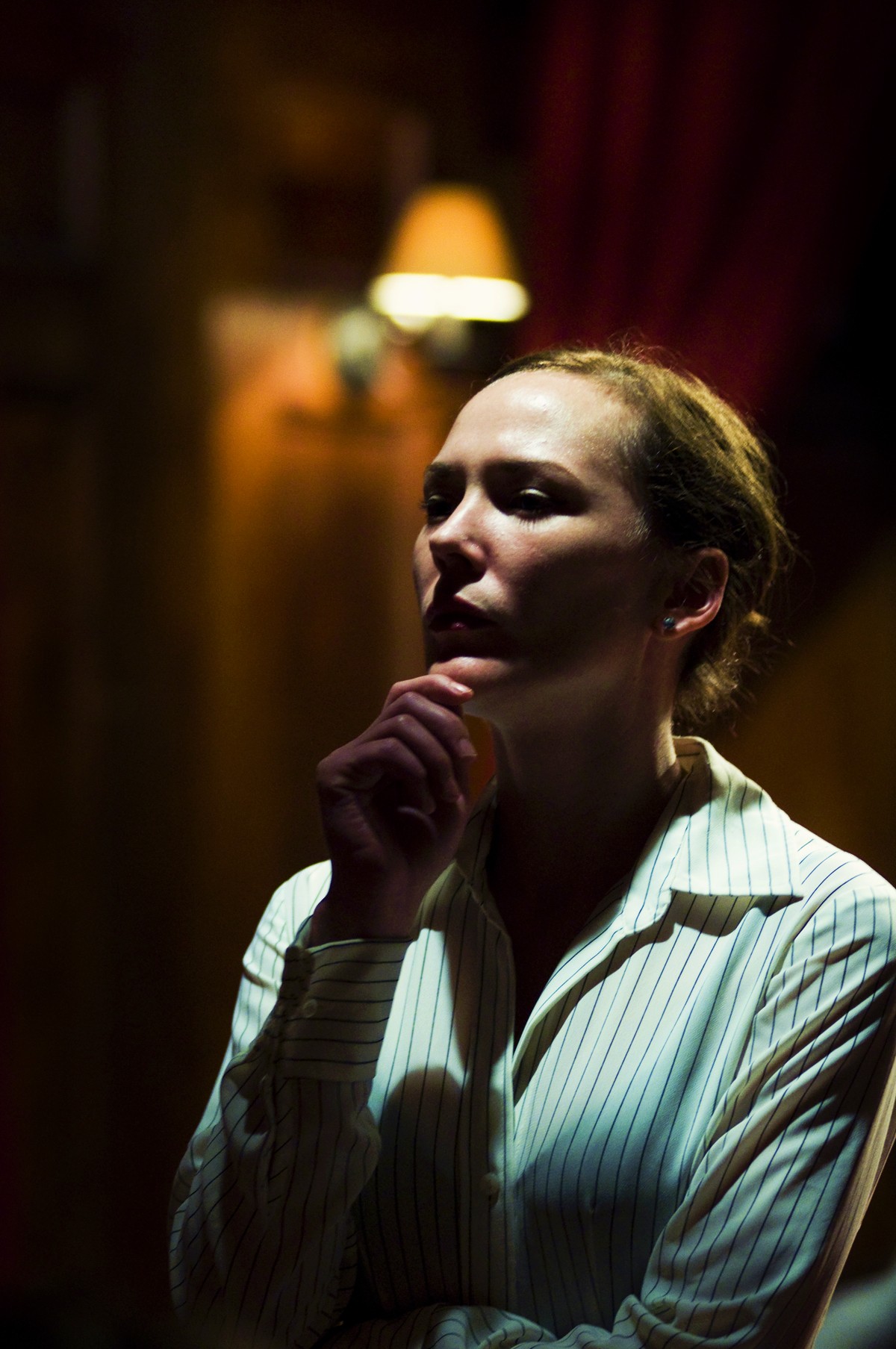
Sarah Lemp is cold and calculating as a dark sex therapist in Derek Ahonen’s PINK KNEES ON PALE SKIN (photo by Monica Simoes)
The Gershwin Hotel
7 East 27th St. between Madison & Fifth Aves.
Wednesday – Monday through September 19, $60 (extended through October 10, $35)
www.theamoralists.com
Over the last several years, hotels have become more than just a place for tourists to rest their weary bones in New York City. During Armory Week, the Dylan Hotel hosts the Verge Art Fair, while the PooL Art Fair fills rooms in the Gershwin Hotel with site-specific installations. Last fall, Swiss theater architect Dominic Huber set his adaptation of Joseph Roth’s Hotel Savoy in the Goethe-Institut, transforming the 1014 Fifth Ave. building into a ghostly hotel. And Punchdrunk’s dazzling Sleep No More, in the old McKittrick Hotel in Chelsea, has been extended yet again, this time through September 24. Joining the trend is the daring Brooklyn-based Amoralists theater company, which is currently putting on a double feature in a specially designed room in the back of the lobby of the Gershwin Hotel. Standing by its decree to be “fearless, courageous, dangerous, uncomfortable, and rattled . . . to get dirty . . . and to bleed, sweat, and cry,” the company is presenting HotelMotel, two full-length productions that provide lots of thrills and chills for adventurous theatergoers — twenty people at a time.
HotelMotel begins with the world premiere of Pink Knees on Pale Skin, written and directed by Derek Ahonen. After checking in and being given a key card, “guests” are escorted to their room, actually one of approximately twenty folding chairs lined up in one row around three sides of a bed draped in luscious red. A pianist plays in one corner of the room, which features a rose-wallpapered ceiling and four Gershwin Hotel bathrobes hanging on hooks. Soon Dr. Sarah Bauer (Sarah Lemp) and her boyfriend, Leroy (Jordan Tisdale) enter, preparing for the arrival of two married couples who have come to them because of sexual problems in their relationships. Heart surgeon Robert Wyatt (James Kautz) has cheated on his wife, lawyer Caroline (Vanessa Vache), while comedian Allison Williams (Anna Stromberg) is unable to achieve orgasm with her spouse, playwright Ted (Byron Anthony). The cold, manipulating, very direct Bauer has promised to cure them all — via a group-sex orgy (which could potentially involve Leroy as well). Bauer masterfully handles the two couples even as it slowly becomes apparent that she has some of her own deep-seated demons haunting her. The well-developed characters and believable story line build to a hot and heavy climax as spectators are turned into voyeurs who will be hard-pressed not to be titillated by the events unfolding right in front of them. Ahonen flawlessly navigates the emotional spectrum, resulting in a penetrating, insightful, and wickedly funny sex comedy that is not afraid to pull at the heartstrings.
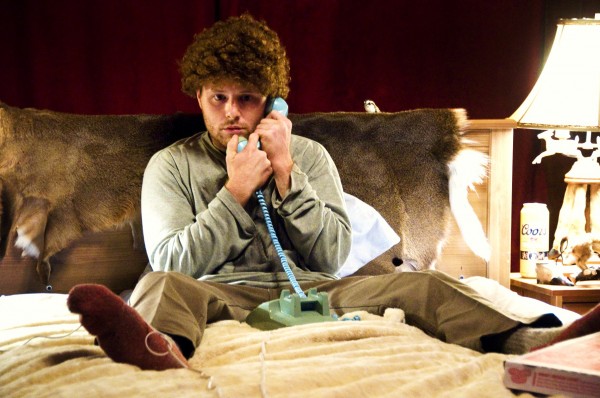
William Apps has a thing for putting odd things down his pants in Adam Rapp’s ANIMALS AND PLANTS (photo by Monica Simoes)
After a twenty-minute break, the audience is ushered back inside for the New York premiere of writer-director Adam Rapp’s Animals and Plants. Set designer Alfred Schatz has turned the space into a messy low-budget motel room in Boone, North Carolina, with pizza boxes, beer cans, and men’s toiletries strewn all over the place. This time people can sit wherever they want, either in the two rows on one side of the white-covered bed or in one of several chairs within the set; we strongly recommend the seat by the windowed door if you don’t mind being more in the middle of things. As the audience enters, the curly haired Dantly (William Apps) is sitting on the bed, staring at the television, which is showing nothing but static, while the pianist tinkles away right behind him (and remains there silently once the play kicks in). The room is filled with a multitude of stuffed birds and animals, evoking a Norman Bates–like atmosphere. Dantly’s partner in crime, Burris (Matthew Pilieci), soon emerges, a fast-talking muscle man who can’t stop exercising or using three-dollar words that both impress and confound the not-too-bright Dantly (who spends most of the first half of the play with one hand down his pants, where he likes to put such odd objects as an ice scraper, which turned out to be not such a great idea). The two men are in Boone to pull off a deal for an unseen boss in the midst of a blizzard, but mysterious phone calls and a singing man (Brian Mendes) in a grizzly bear outfit lighting matches lead to surreal situations that might or might not actually be happening, all coming together for a powerful, action-packed finale. Animals and Plants is more experimental than its predecessor, challenging the audience by subverting convention and delving into fantastical narrative. Near the beginning, Burris sits down on the toilet and goes to the bathroom (rather convincingly) in full view of many of the spectators, announcing that this will be something different, and indeed it is. And when Cassandra (Katie Broad) later shows up, the play takes off in yet another unanticipated direction. Animals and Plants is more theatrical in general than the more intimate Pink Knees on Pale Skin, but both create riveting situations that make inventive use of the limited space, which never feels claustrophobic. Both shows also include full-frontal male nudity, which can be both funny and disconcerting in such close quarters. Whereas Ahonen tempts the audience to consider their own personal relationships, Rapp invites them to consider the relationship between audience and performer; taken as a whole, HotelMotel is an exciting, well-rounded, unique theatrical experience that is well worth checking in to. [Ed. note: The production has been extended once more, through October 10, with all tickets now just $35; in addition, Michael Cerveris and Loose Cattle will perform on September 30 in the hotel lounge from 6:00 to 7:00.]

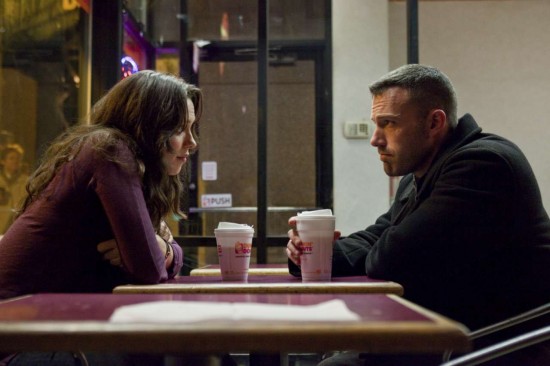
 Ben Affleck, who displayed great skill as a director in his debut feature, 2007’s Gone, Baby, Gone, has done it again with his follow-up, the romantic thriller The Town. Affleck, who also cowrote the script, stars as Doug MacRay, the leader of a small group of bank robbers in tough Charlestown, Massachusetts, the bank robbery capital of America. As the film opens, the thieves are just hitting a bank and are forced to take a hostage, manager Claire Keesey (Rebecca Hall). After later letting her go unharmed, they soon realize that she lives in their neighborhood and might be able to recognize one of them, so Doug starts hanging around her, pretending to be interested in her so he can tap her for information. Meanwhile, Boston cop Dino (Titus Welliver) and FBI Special Agent Frawley (Jon Hamm) are getting closer to the gang, who continue to pull off daring heists regardless of the heat on them. Although there are a handful of plot holes you could drive an armored truck through, The Town ends up being a compelling action film and love story, with car chases, massive shootouts, and a tender relationship as Doug begins to fall for Claire, and vice versa, even though the truth threatens to blow everything apart. Also threatening to blow everything apart is Doug’s right-hand man, Jem (Jeremy Renner, channeling James Cagney in White Heat), who likes hurting and killing way too much. Affleck, who as a director allows his actors a large amount of freedom, has gotten fine performances across the board; the cast also includes Pete Postlethwaite as an underworld florist, Chris Cooper as Doug’s long-incarcerated father, Blake Lively as a drug-dealing tramp, and Boston rapper Slaine, who contributed songs to the soundtrack as well. The film, based on the Chuck Hogan novel Prince of Thieves, also benefits from Affleck’s genuine affection for the place where he grew up, shooting on location and setting the finale in a world-famous landmark. The Town is screening August 17 in Hudson River Park as the last entry in the free Wednesday night RiverFlicks for Grown-ups series, with free popcorn. For a complete list of free outdoor summer films throughout the city, click
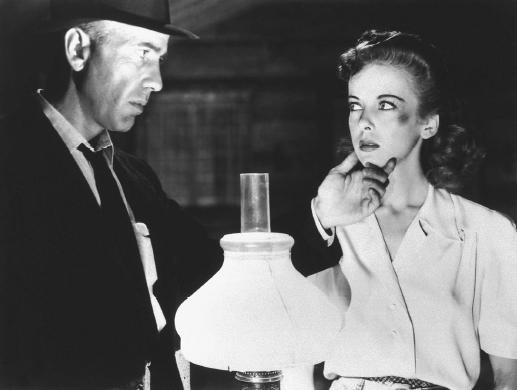
 Warner Bros. and First National brought out the big guns for their 1941 gangster picture High Sierra, with Raoul Walsh directing a script by W. R. Burnett (Little Caesar) and John Huston and starring Humphrey Bogart and Ida Lupino. Bogart (the part had been previously been offered to George Raft and Paul Muni) plays hardcore criminal Roy “Mad Dog” Earle, called in the trailer “the strangest of men in the strangest of stories,” recently released from prison and already caught up in a casino heist. He is joined by Louis (Cornel Wilde), Red (Arthur Kennedy) and Babe (Alan Curtis), with Babe having brought along femme fatale Marie (Lupino), who Roy knows is going to be trouble — with a capital T. Meanwhile, Roy has fallen for Velma (Joan Leslie), a pure and innocent young woman with a medical problem Roy is generously trying to help cure. He’s also taken a liking to a mutt, revealing that he might actually have a softer side in there somewhere. But when things don’t quite go as planned, Roy finds himself on the run, heading toward the Sierra Nevadas, willing to do whatever it takes to get away from the police, who are hot on his trail. Bogart gives one of his finest performances as the Dillinger-esque Earle, continually offering just the slightest twist on his character, adding depth not always found in murderous gangsters. Barring inclement weather, High Sierra is screening Monday night as part of the Bryant Park Summer Film Festival; the series concludes August 22 with the Clint Eastwood cop classic Dirty Harry.